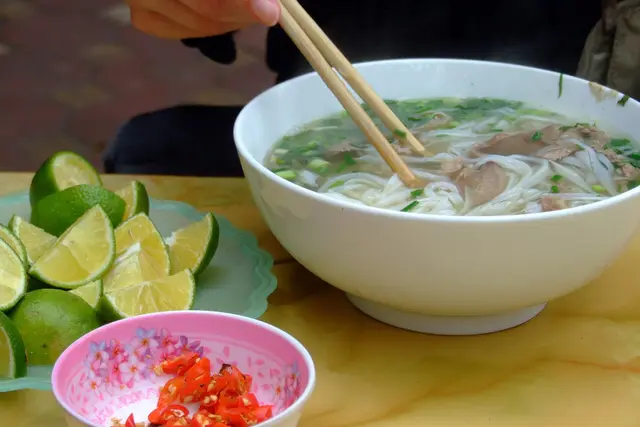
Making bun bo Hue (spicy Hue-style beef noodle soup) for a restaurant comes down to four parts done right: a clear, sweet broth from beef and pork bones; fermented shrimp paste (mam ruoc) diluted, settled and added as clear liquid only; bruised lemongrass in the pot plus an annatto, lemongrass and chilli oil for the red colour and aroma; and the meat (beef shank and pork hock) cooked in that same pot. Bun bo differs from pho in that its soul is shrimp paste and lemongrass, not cinnamon and star anise; get the shrimp paste wrong and the broth turns cloudy, funky or flat. This lesson is written for a restaurant kitchen: a 50-litre pot recipe for 80 bowls, a work schedule, portion sizes for each bowl and how to calculate food cost to set your prices.
By the end of this lesson, you will be able to:
- Draw up the ingredient list for a 50-litre bun bo broth yielding about 32 litres.
- Dilute and settle shrimp paste, add lemongrass, and make annatto chilli oil at the right time so the broth is clear and fragrant, not funky.
- Cook beef shank and pork hock until tender without falling apart, and know when to take them out.
- Portion a regular and a special bowl, calculate the food cost of each and the food cost percentage of the selling price.
- Store broth and meat safely and fix cloudy, funky or bland broth.
Learning Vietnamese cooking properly? Broths for pho, bun bo and hu tieu are step 3 of the roadmap, after food safety and knife and prep skills. See the 8-step Vietnamese cook roadmap to learn in the right order.
What goes into a bowl of bun bo Hue?
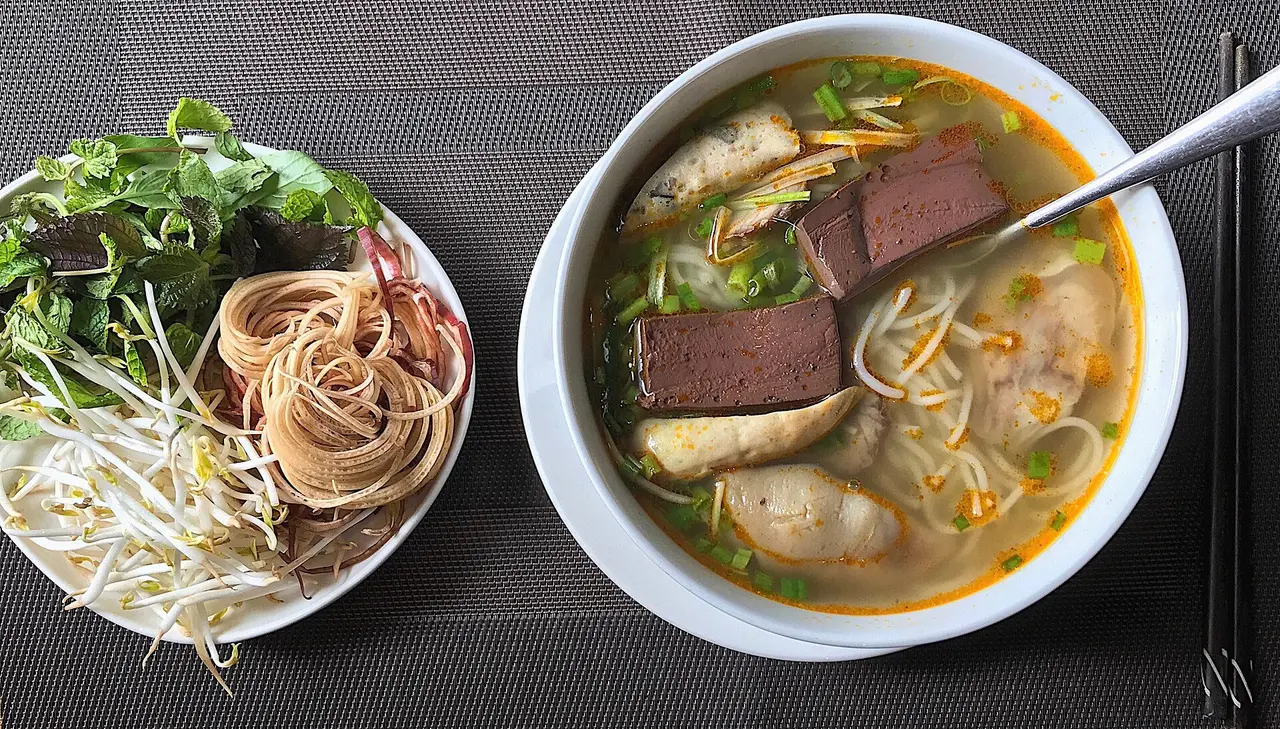
Before you cook, be clear about what your restaurant's bowl contains, because each part has its own preparation and its own cost (Figure 1).
The four main parts
- Broth: beef and pork bones simmered for hours, seasoned with shrimp paste, lemongrass, salt, rock sugar and fish sauce.
- Annatto lemongrass chilli oil: oil fried with minced lemongrass, shallots, garlic, annatto seeds and chilli powder; it gives the red-orange layer on the broth and doubles as the table chilli sauce (sa te).
- Meat and toppings: beef shank and pork hock cooked in the pot; Hue pork loaf (cha), crab cakes (cha cua) and pork blood cake.
- Noodles and herbs: thick round rice noodles, fresh herbs (lettuce, herbs, shredded banana blossom), bean sprouts, lime and chilli.
How bun bo differs from pho
Pho takes its aroma from cinnamon, star anise, black cardamom and charred ginger and onion; bun bo takes its aroma from lemongrass and shrimp paste, with heat and fragrance from annatto oil and chilli. Cleaning the bones and simmering a clear broth work the same way, and you can review them in How to make pho beef broth: a 50-litre recipe for restaurants. This lesson focuses only on what is specific to bun bo.
What is mam ruoc?
Mam ruoc (Hue shrimp paste) is made from tiny sea shrimp fermented with salt into a thick, pinkish-purple paste with a strong smell (Figure 2 shows shrimp paste being sun-dried in a similar way). Used in the right amount and settled properly, it gives the broth deep sweetness and its signature smell; use too much or pour in the sediment and the broth turns cloudy and funky.
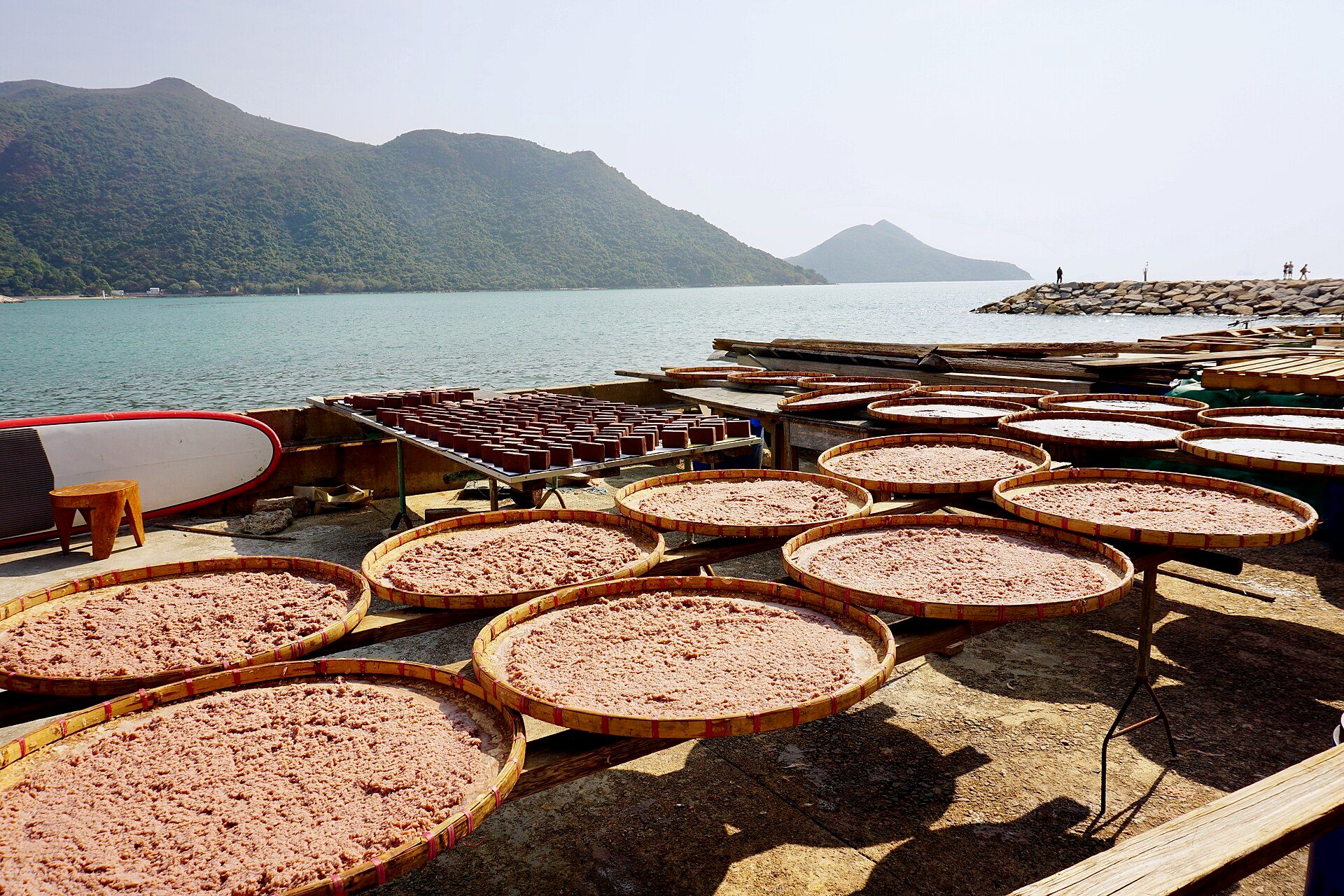
Photo: 方畢可 / Wikimedia Commons, CC0
A 50-litre recipe for a bun bo restaurant
This recipe uses a 50-litre stainless steel pot and gives about 32 litres of finished broth, enough for 80 bowls at 400 ml each. It is a starting point; every restaurant adjusts it to its customers and to the saltiness of each batch of shrimp paste.
| Ingredient | Quantity | Notes |
|---|---|---|
| Beef marrow bones | 6 kg | Cut into pieces, cracked to expose the marrow |
| Pork marrow bones | 5 kg | Round sweetness, softens the beefiness |
| Starting water | 40 litres | Top up with about 6 litres of boiling water while simmering |
| Beef shank | 4 kg | Cooked in the pot, taken out and sliced (counted as topping) |
| Pork hock | 2.4 kg | Cut into 30 slices, cooked in the pot (counted as topping) |
| Lemongrass | 2 kg | 1.6 kg bruised and tied in bundles for the pot; 0.4 kg minced for the chilli oil |
| Hue shrimp paste | 0.4 kg | Mixed with 2 litres of water, settled, clear liquid only |
| Shallots and garlic | 1 kg | Half charred for the pot, half minced and fried |
| Annatto seeds, chilli powder, cooking oil | 100 g, 150 g, 1 litre | For the annatto chilli oil |
| Fish sauce | 0.4 litres | Added last |
| Salt, rock sugar | about 200 g, 300 g | Season gradually |
Choosing beef shank and pork hock
Choose shank with tendon running through the grain, bright red and not slimy. Tie the shank with string so it holds its shape while cooking and slices neatly. Choose front pork hock with clean white skin, shaved of hair, cut into slices about 2 cm thick. In the table above, 2.4 kg of hock gives 30 slices of about 80 g each, used for the special bowl.
Annatto seeds and lemongrass chilli oil
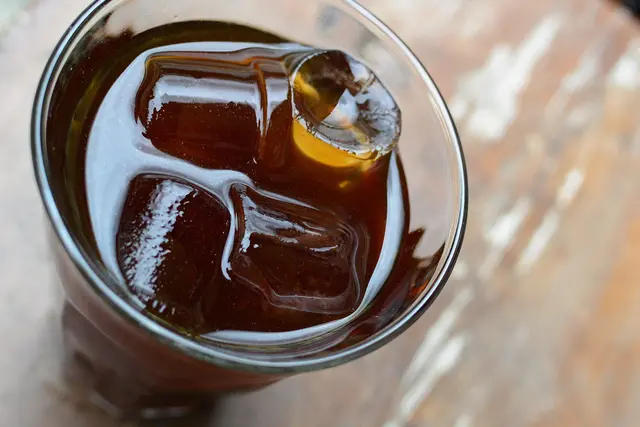
Annatto seeds give a red-orange colour when steeped in hot oil (Figure 3). Fry the seeds in oil over low heat for a few minutes until the oil turns red, then strain them out; fry the minced lemongrass, shallots and garlic until golden and fragrant, turn off the heat and only then add the chilli powder so it does not burn and turn bitter. Some of the oil goes on top of the pot; the rest goes into jars as table chilli sauce.
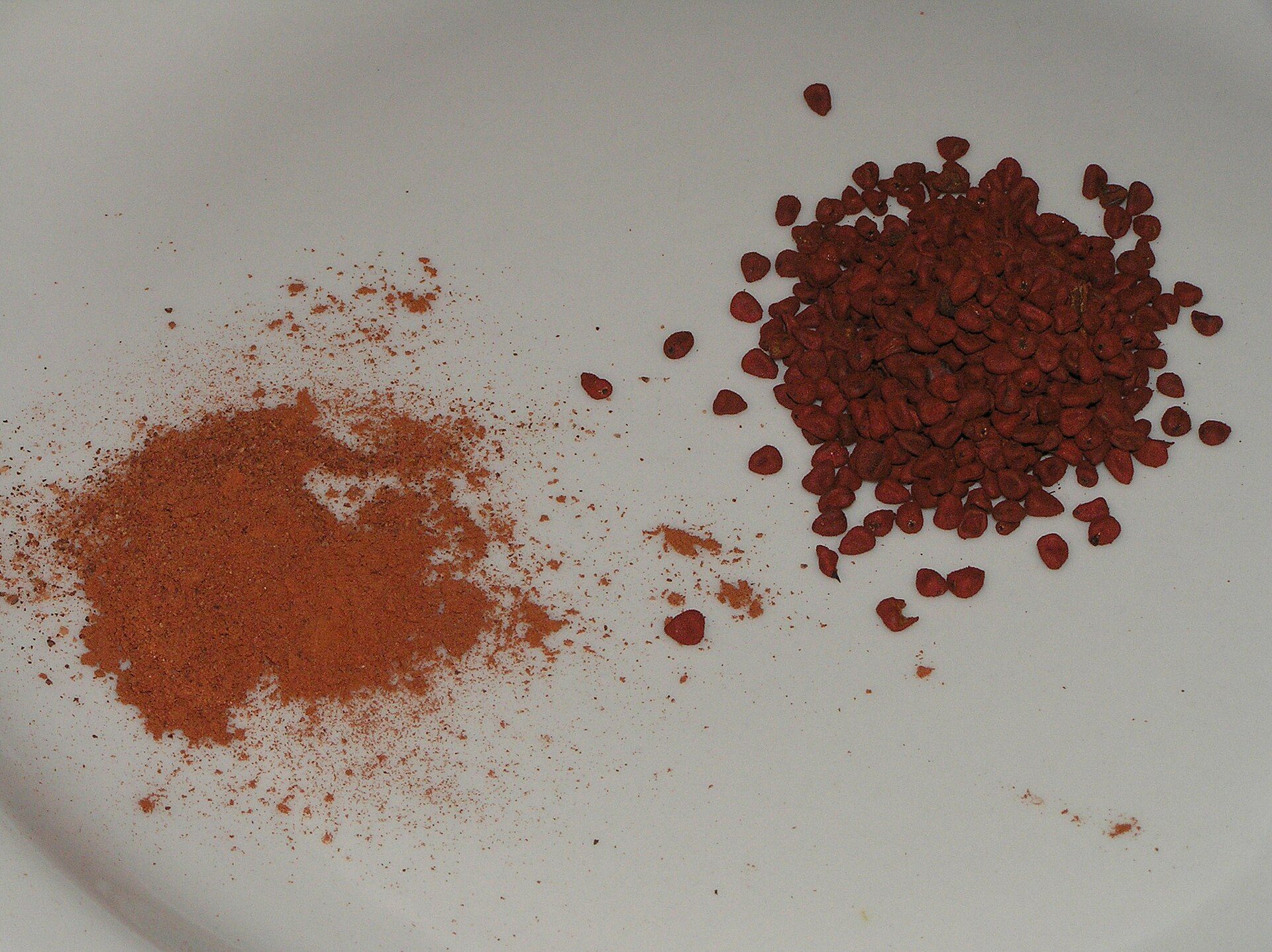
Photo: Ryan Snyder / Wikimedia Commons, CC BY 2.0
Thick rice noodles
Bun bo uses thick, round rice noodles. Arrange a daily delivery of fresh noodles and blanch them in boiling water before putting them in the bowl. A bowl takes about 200 g of noodles, so 80 bowls need about 16 kg.
Step by step: from blanching bones to seasoning with shrimp paste
The order below is for a pot sold at breakfast. Bones simmer for about 5–6 hours, shorter than pho, because the main aroma does not come from very long simmering.
- Soak and blanch the bones: soak in lightly salted water for 30–60 minutes, boil hard for 10 minutes, discard the water, and rinse the bones and the pot clean.
- Start the pot: put the bones in 40 litres of cold water, bring almost to the boil, then drop to a gentle simmer, skimming constantly for the first 30–45 minutes.
- Add the charred aromatics: char half the shallots and garlic until fragrant and add them to the pot.
- Cook the meat: blanch the shank and hock and add them about 3.5 hours before opening; shank takes about 1.5–2 hours and hock about 1.5–2 hours; when a chopstick goes in easily and the juices are no longer pink, take them out.
- Add the lemongrass: drop in the bruised lemongrass bundles and simmer for about 1–1.5 hours; once the aroma is strong enough, take them out so the broth does not turn bitter.
- Dilute and settle the shrimp paste: mix 0.4 kg of paste with 2 litres of water, stir until dissolved, let it settle for 20–30 minutes, pour off the clear liquid through a sieve and cloth, and discard the sediment.
- Season: add the shrimp paste liquid about 30 minutes before opening, season with salt and rock sugar first and fish sauce last; spoon the annatto chilli oil over the surface.
Chilling the meat after cooking
Plunge the shank and hock straight into a basin of boiled, cooled water with ice for 5–10 minutes so the meat firms up and the hock skin stays springy, then drain. Let the shank cool before slicing thinly across the grain; sliced hot it will crumble. Cooked meat waiting to be served must be covered and kept cool, or kept warm in a small pot of broth.
Season with shrimp paste a little at a time
Every batch of shrimp paste has a different saltiness, so do not pour in all 2 litres of paste liquid at once. Add about two-thirds, taste, then add more gradually. Taste by making a test bowl with noodles, meat and herbs before deciding, because the plain noodles "pull down" the flavour.
Sample schedule for a restaurant opening at 6 a.m.
| Time | Task |
|---|---|
| 22:30 | Soak and blanch the bones, wash the pot |
| 23:30 | Start the 40-litre pot, skim, add charred shallots and garlic |
| 02:30 | Add the blanched beef shank and pork hock |
| 03:30 | Add the lemongrass bundles; set the shrimp paste to settle; make the annatto chilli oil |
| 04:30 | Take out shank and hock into iced water; remove the lemongrass |
| 05:15 | Add the clear shrimp paste liquid, season, spoon on the annatto oil |
| 05:45 | Move the pot to the holding burner, set up the counter |
From 23:30 to 05:45 is 6 hours 15 minutes on the heat. Overnight simmering needs someone watching the stove; never leave a gas burner lit with nobody in the kitchen.
Portions and food cost (worked example)
Ms Hanh's restaurant serves breakfast from 6 to 10 a.m., about 80 bowls a day: 50 regular and 30 special. Prices below are 2026 references in Vietnam and vary by area and supplier; replace them with your own purchase prices.
Cost of the broth pot
| Item | Calculation | Cost |
|---|---|---|
| Beef marrow bones | 6 kg × 45,000 VND | 270,000 VND |
| Pork marrow bones | 5 kg × 35,000 VND | 175,000 VND |
| Lemongrass | 2 kg × 20,000 VND | 40,000 VND |
| Hue shrimp paste | 0.4 kg × 120,000 VND | 48,000 VND |
| Shallots, garlic | 1 kg × 60,000 VND | 60,000 VND |
| Annatto seeds, chilli powder, cooking oil | lump sum | 70,000 VND |
| Fish sauce | 0.4 litres × 120,000 VND | 48,000 VND |
| Salt, rock sugar | lump sum | 20,000 VND |
| Gas for about 6–7 hours | estimate | 69,000 VND |
| Total broth pot | 800,000 VND | |
Check: 270,000 + 175,000 + 40,000 + 48,000 + 60,000 + 70,000 + 48,000 + 20,000 + 69,000 = 800,000 VND (about US$31). The yield is 32 litres (40 litres to start + 6 litres topped up − about 14 litres evaporated and absorbed by bones and meat). 32 ÷ 0.4 = 80 bowls, so the broth costs 800,000 ÷ 80 = 10,000 VND per bowl.
Cost of a regular and a special bowl
Beef shank: 4 kg raw × 260,000 VND = 1,040,000 VND; after cooking about 2.4 kg remains (about 40% loss), split into 80 portions of 30 g, each costing 1,040,000 ÷ 80 = 13,000 VND. Pork hock: 2.4 kg × 100,000 VND = 240,000 VND for 30 slices, 8,000 VND each.
| Component | Portion | Regular bowl | Special bowl |
|---|---|---|---|
| Thick rice noodles | 200 g × 15,000 VND/kg | 3,000 VND | 3,000 VND |
| Cooked beef shank | 30 g | 13,000 VND | 13,000 VND |
| Hue pork loaf | 25 g × 200,000 VND/kg | 5,000 VND | 5,000 VND |
| Pork blood cake | 50 g × 30,000 VND/kg | 1,500 VND | 1,500 VND |
| Herbs, bean sprouts, lime, chilli | about 80 g | 2,000 VND | 2,000 VND |
| Spring onion, coriander, chilli oil | a little | 1,000 VND | 1,000 VND |
| Broth | 400 ml | 10,000 VND | 10,000 VND |
| Pork hock | 1 slice | none | 8,000 VND |
| Crab cakes | 2 pieces | none | 4,000 VND |
| Ingredient cost | 35,500 VND | 47,500 VND |
Check the regular bowl: 3,000 + 13,000 + 5,000 + 1,500 + 2,000 + 1,000 + 10,000 = 35,500 VND. Special bowl: 35,500 + 8,000 + 4,000 = 47,500 VND. The restaurant sells the regular bowl at 65,000 VND and the special at 85,000 VND (reference prices, varying by area): the ingredient cost percentage is 35,500 ÷ 65,000 ≈ 54.6% and 47,500 ÷ 85,000 ≈ 55.9%.
Totals for one trading day
- Ingredients: 50 × 35,500 = 1,775,000 VND; 30 × 47,500 = 1,425,000 VND; total 3,200,000 VND.
- Revenue: 50 × 65,000 = 3,250,000 VND; 30 × 85,000 = 2,550,000 VND; total 5,800,000 VND.
- Gross margin after ingredients: 5,800,000 − 3,200,000 = 2,600,000 VND, before rent, wages, utilities, equipment depreciation and waste.
A food cost of around 55% is high; to make a profit the restaurant must control meat waste, buy bones from a regular supplier at stable prices, and portion by weighing rather than by hand (see Figure 4). Planning start-up capital and fixed costs for the whole restaurant is covered in How much it costs to open a small restaurant in Vietnam: 30 m² budget.
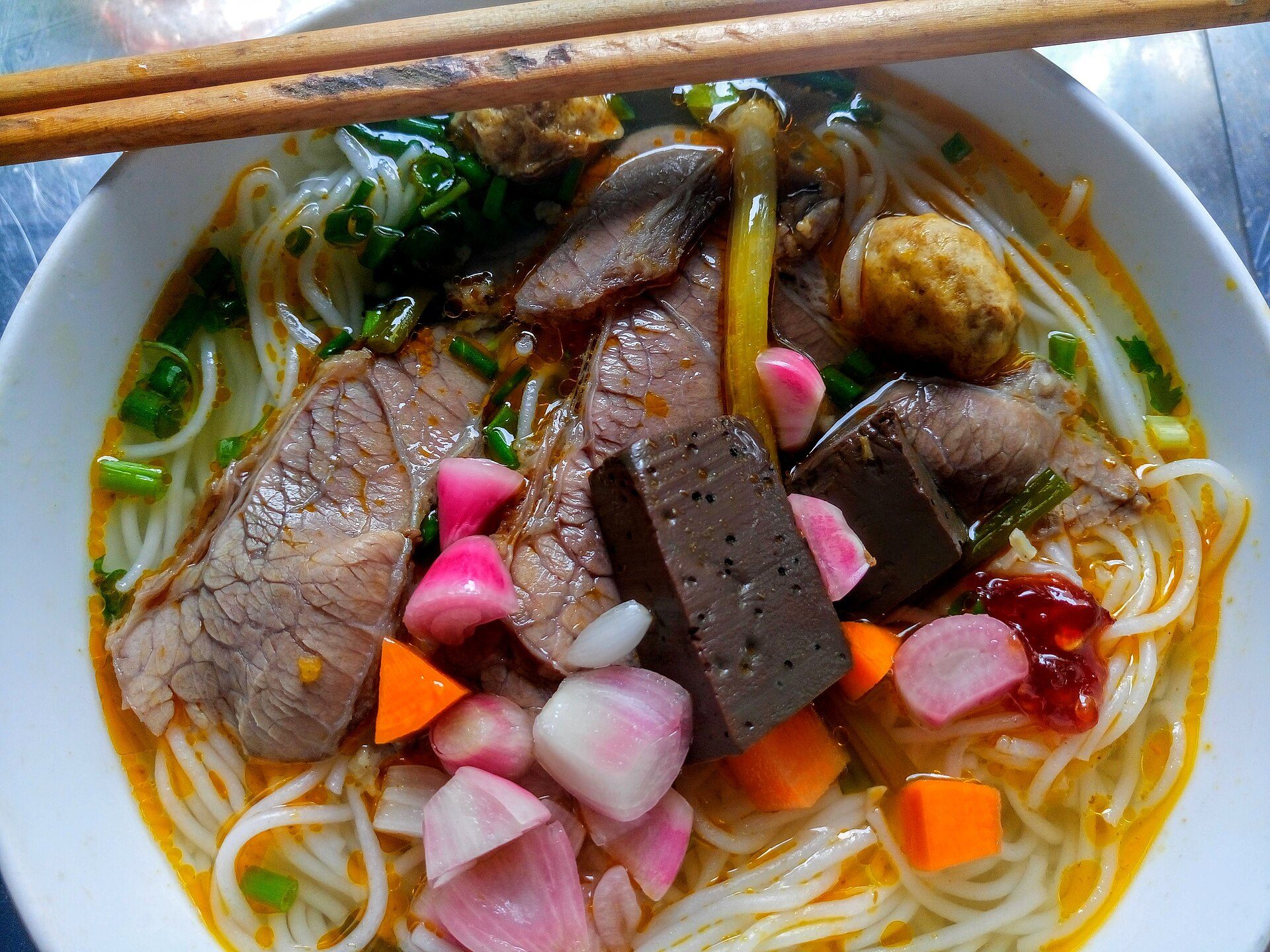
Photo: Beelerb / Wikimedia Commons, CC BY-SA 4.0
Common problems: cloudy, funky or bland broth
Cloudy broth with sediment
Sign: grey, murky broth. Cause: bones not blanched, a rolling boil, or shrimp paste sediment poured into the pot. Fix: next time blanch thoroughly, keep a gentle simmer, settle and strain the paste through cloth; for a pot that is already cloudy, lower the heat, skim carefully and strain through cloth before service.
Funky, harsh shrimp paste smell
Sign: a pungent smell that drowns out the lemongrass; customers complain it is "too strong". Cause: poor-quality paste, too much of it, or paste added too early and boiled for a long time. Fix: choose pinkish-purple, smooth paste with a strong but clean smell; add the clear liquid only in the last 30 minutes and season a little at a time.
Bland broth without the bun bo character
Sign: it tastes like an ordinary bone broth. Cause: too little lemongrass, old woody lemongrass, not enough shrimp paste, or no annatto oil. Fix: add more bruised lemongrass, make the chilli oil more fragrant, add shrimp paste a little at a time, and taste with a real bowl.
Tough shank, falling-apart hock
Sign: the shank will not bite through, the hock falls off the bone. Cause: wrong cooking time and no checking piece by piece. Fix: test with a chopstick from 75 minutes, remove each piece as it becomes tender, and plunge it into iced water straight away to keep the hock skin springy.
Food safety and kitchen safety with large pots
A 50-litre broth pot is heavy and hot, and sits on a gas burner for hours. The rules below protect both the cooks and the customers; the pot must sit firmly on the burner as in Figure 5.
Storing broth and meat
- During service, keep the broth at a gentle simmer or hot, above about 60°C.
- Cool leftover broth quickly: divide it into small pots, set them in an ice-water bath, stir, then refrigerate; never leave it to cool overnight in the kitchen.
- Buy blood cake from a traceable source and cook it thoroughly; keep pork loaf and cooked meat covered and use them the same day.
- Keep separate boards and knives for raw and cooked meat, and wash your hands after handling raw meat.
Food safety paperwork
In Vietnam, restaurants usually have to meet food safety requirements under current regulations (a certificate or a written commitment, health checks and food safety training for food handlers, depending on size). The rules change over time and differ by locality, so check directly with the food safety authority of the ward or district where you open.
Safety warning: A full 50-litre pot of broth weighs more than 50 kg: never lift a boiling pot alone; ladle some into smaller pots, or have two people carry it by sturdy handles along a dry path. Set the pot firmly on its stand with the handles turned inwards. Fry the annatto and chilli oil over low heat, never let water splash into hot oil, and keep a lid ready to smother a fat fire; never use water on burning oil. Commercial gas burners need their valves and hoses checked, a fire extinguisher and good ventilation; overnight simmering needs someone watching, and if you smell gas, close the valve, open the doors and do not switch electrical switches on or off.
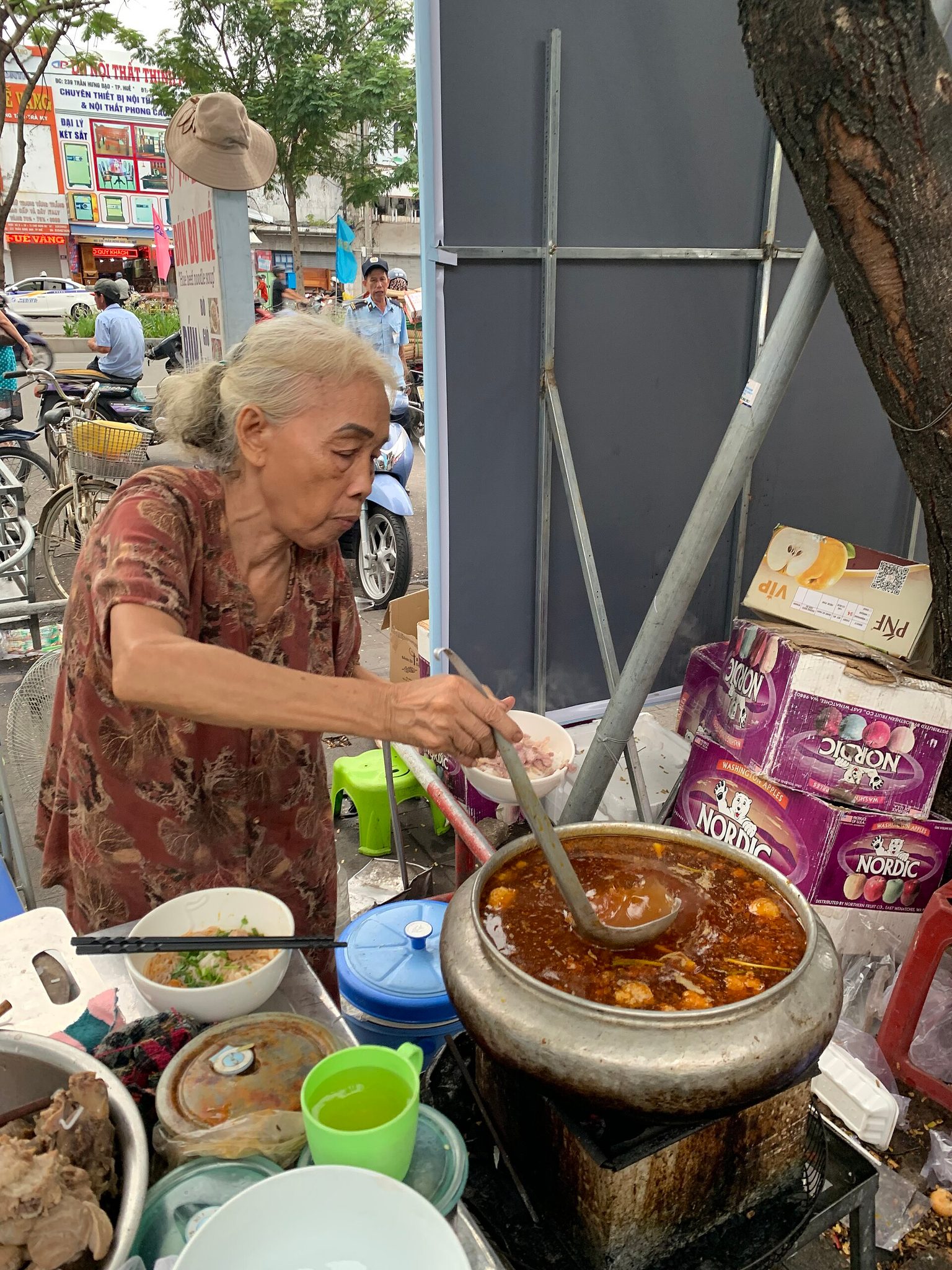
Photo: Chainwit. / Wikimedia Commons, CC BY 4.0
Frequently asked questions
How long should the bones simmer for restaurant bun bo Hue?
For a 50-litre pot, about 5–6 hours at a gentle simmer is enough for sweetness. The main aroma of bun bo comes from lemongrass, shrimp paste and annatto oil, so it does not need simmering as long as pho.
When should the shrimp paste go in so the broth stays clear?
Mix the paste with water, let it settle for 20–30 minutes, pour off only the clear liquid and strain it through cloth, then add it to the pot in the last 30 minutes or so. Throw the sediment away; never pour it into the pot.
How much meat should a bowl of bun bo have?
It depends on your selling price. The example above uses 30 g of cooked shank, 25 g of pork loaf and 50 g of blood cake for a regular bowl; the special adds 1 slice of pork hock and 2 crab cakes. What matters is weighing to a fixed portion so the food cost stays stable.
What is the food cost of one bowl of bun bo?
In the 2026 reference example, about 35,500 VND for a regular bowl and 47,500 VND for a special, counting ingredients only. Your real cost depends on local meat and bone prices and your portions.
Practice exercises and self-assessment
- Cook a 10-litre test pot at one-fifth of the recipe, recording the time of each step and how much shrimp paste you used.
- Prepare the shrimp paste two ways, settled and strained versus with the sediment, cook two small pots and compare colour and smell.
- Build a food cost table for a regular bowl at your own restaurant using real purchase prices, checking each line adds up.
Self-assessment criteria
- Pass: the broth is clear, red-orange from the annatto oil, fragrant with lemongrass, with a clear but not funky shrimp paste note.
- Pass: the shank slices without crumbling, the hock is tender but still on the bone with springy skin.
- Pass: the cost table adds up and the food cost percentage is calculated for each type of bowl.
- Not yet: pouring in the paste sediment, portioning meat by hand without weighing, or leaving broth to cool overnight in the kitchen.
Once your broth is right, the next step of the roadmap is Dipping sauces & regional flavours: mixing shrimp paste dips, fish sauce dressings and chilli lime salt, and understanding why customers in Hue, Saigon and Hanoi season the same dish differently.
Keep learning Vietnamese cooking: after broths come dipping sauces and regional flavours, braised, stir-fried, fried and steamed dishes, rice plates and handling the lunch rush. See the 8-step Vietnamese cook roadmap.