Opening a small restaurant of about 30 m² in Vietnam takes roughly 170–360 million VND in 2026 (about 6,700–14,200 USD): around 176 million in a provincial town and around 352 million in a big city, according to the budget in this lesson, depending on area and premises. That figure already covers the rental deposit, renovation, kitchen equipment, tables and chairs, paperwork, opening stock, three months of working capital and a contingency reserve. If you do not have that much yet, you can start with a street cart, an online kitchen run from home, or a very small shop for around 15–120 million VND. This lesson helps you build your own budget, work out how many meals you must sell each day to break even, and avoid the mistakes that burn through capital before a shop has time to build regular customers.
By the end of this lesson, you will be able to:
- Build an 8-line capital budget for your shop, with a total that adds up and a contingency reserve.
- Calculate your monthly fixed costs and the working capital to hold for the first 3 months.
- Calculate break-even: how many meals you must sell per day with a food cost of about 35–40%.
- Compare 3 low-capital models (street cart, online kitchen, very small shop) and choose one that fits your budget.
- List the paperwork to ask about before opening, and the 6 mistakes that most often drain capital.
Learning to open an eatery properly? Choosing a concept, a location and a capital budget is step 2 of the roadmap — right after the legal basics. See the 8-step roadmap for opening and running a small eatery to go in the right order.
What does the opening capital cover?
Many people budget only for rent, renovation and a stove, then open with empty pockets. In reality the capital for a shop has two parts: upfront investment (spent once before opening) and working capital (money to keep the shop alive in the first months while revenue does not yet cover costs).
Upfront investment
- Rental deposit: usually 1–3 months' rent, sometimes plus a few months paid in advance, depending on the landlord.
- Renovation: paint, tiling the kitchen area, wiring and plumbing, drainage, signage, lighting.
- Kitchen equipment: commercial gas burners, an extraction hood, a fridge or freezer, stainless steel tables, sinks, pots, utensils, fire extinguishers.
- Tables, chairs and tableware: for about 30–40 seats.
- Paperwork: household business registration, health checks and food safety training for kitchen staff.
- Opening stock: rice, seasonings, dry goods and the first batch of fresh ingredients.
Working capital and contingency
In the first three months most shops do not yet have enough regulars. Working capital is the money that pays fixed costs — rent, wages, basic electricity, water and gas — for 3 months in case revenue falls short. The contingency reserve is usually about 10% of everything above, for the unexpected: a burst pipe, an extra fridge, a landlord asking for more repairs.
Fixed costs versus variable costs
Fixed costs are what you pay whether you sell 0 or 100 meals: rent, fixed staff wages, internet, the minimum electricity and water. Variable costs go up and down with the number of meals: ingredients, takeaway boxes, gas for each batch. Separating the two is the key to the break-even calculation later.
Budget for a 30 m² eatery: provincial town vs big city
The table below is a budget for a rice or noodle shop of about 30 m², 8–10 tables, open for lunch and dinner. Provincial town: rent 7 million VND/month, 1 employee. Big city (Hanoi, Ho Chi Minh City): rent 18 million VND/month, 2 employees. All figures are 2026 references and vary by region, location and whether you buy new or used.
| Item | Provincial town | Big city | Notes |
|---|---|---|---|
| 1. Rental deposit | 14 million | 36 million | 2 months' rent |
| 2. Renovation, wiring, plumbing, signage | 30 million | 60 million | No structural work |
| 3. Kitchen equipment | 42 million | 68 million | Burners, hood, fridge, stainless steel, extinguishers |
| 4. Tables, chairs, tableware | 14 million | 24 million | About 30–40 seats |
| 5. Paperwork, health checks, food safety training | 3 million | 4 million | Ask locally |
| 6. Opening stock and seasonings | 6 million | 8 million | Dry goods and first batch |
| 7. Working capital for 3 months | 51 million | 120 million | 3 × monthly fixed costs |
| 8. Contingency (10% of items 1–7) | 16 million | 32 million | Do not touch unless needed |
| Total capital to prepare | 176 million | 352 million |
Checking the sums
Provincial town: 14 + 30 + 42 + 14 + 3 + 6 = 109 million VND upfront; plus 51 million working capital = 160 million; 10% contingency is 16 million; total 176 million. Monthly fixed costs in the provincial town: rent 7 + wages for 1 employee 7 + basic utilities and gas 3 = 17 million, times 3 months = 51 million.
Big city: 36 + 60 + 68 + 24 + 4 + 8 = 200 million upfront; plus 120 million working capital = 320 million; contingency 32 million; total 352 million. Monthly fixed costs: rent 18 + wages for 2 employees 18 + basic utilities and gas 4 = 40 million, times 3 = 120 million.
Which items can flex and which cannot?
Kitchen equipment and furniture can be cut by 30–50% if you buy good used items from restaurant clearance markets (Figure 1 shows a fully equipped restaurant kitchen — a small eatery does not need this much). Renovation drops if you pick premises that were already a food shop. Working capital and contingency, however, should not be cut: they keep the shop alive when the first month is slow.
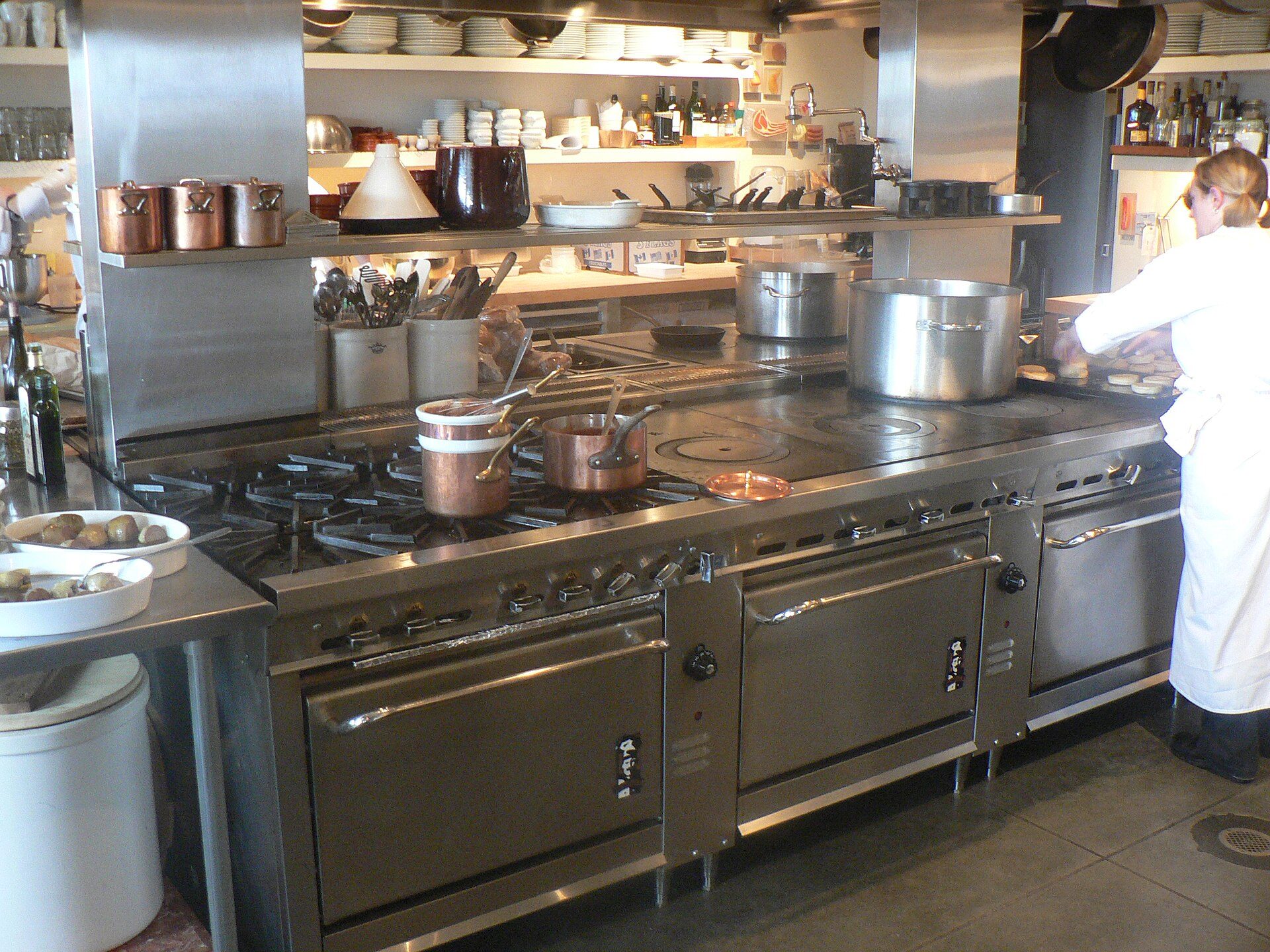
Photo: Stuart Spivack; https://www.flickr.com/photos/stuart_spivack/ / Wikimedia Commons, CC BY-SA 2.0
Break-even: how many meals per day?
Break-even is the number of meals at which the profit on each meal just covers all fixed costs for the month. Sell fewer and you lose money; sell more and you start making a profit.
The formula
- Gross profit per meal = selling price − food cost − other variable costs (boxes, gas per meal, extra herbs).
- Break-even meals per month = monthly fixed costs ÷ gross profit per meal.
- Break-even meals per day = monthly meals ÷ trading days (usually 26).
Food cost for a Vietnamese eatery should usually sit at about 35–40% of the selling price. Above 40% margins are thin and you can easily lose money when meat and vegetable prices rise; below 30% customers often complain about small portions.
The provincial town shop
Average price 40,000 VND per meal, food cost 38% = 15,200 VND, other variable costs 2,000 VND. Gross profit per meal: 40,000 − 15,200 − 2,000 = 22,800 VND. Fixed costs 17 million per month: 17,000,000 ÷ 22,800 ≈ 746 meals a month, divided by 26 days ≈ 29 meals a day to break even. The plate of broken rice in Figure 2 is a typical dish at this price level.
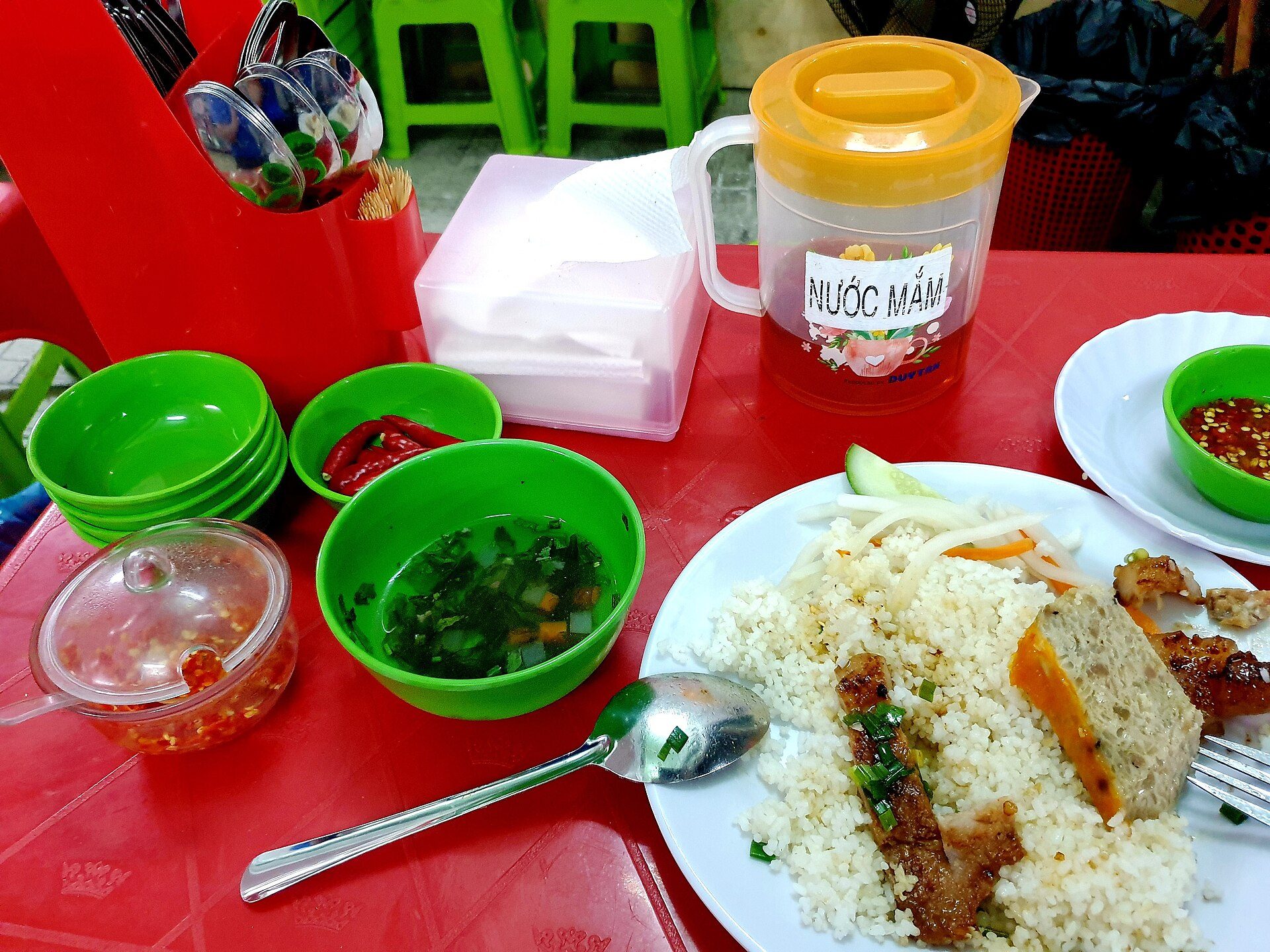
Photo: Phương Huy / Wikimedia Commons, CC0
Note: 29 meals does not include your own pay. If you want to pay yourself 10 million a month: (17,000,000 + 10,000,000) ÷ 22,800 ≈ 1,185 meals a month ≈ 46 meals a day.
The big-city shop
Average price 50,000 VND, food cost 36% = 18,000 VND, other variable costs 2,500 VND. Gross profit: 50,000 − 18,000 − 2,500 = 29,500 VND per meal. Fixed costs 40 million: 40,000,000 ÷ 29,500 ≈ 1,356 meals a month ≈ 53 meals a day. Check: 1,356 × 29,500 = 40,002,000 VND, just enough to cover 40 million.
| Measure | Provincial town | Big city |
|---|---|---|
| Average selling price | 40,000 VND | 50,000 VND |
| Food cost | 15,200 VND (38%) | 18,000 VND (36%) |
| Other variable costs | 2,000 VND | 2,500 VND |
| Gross profit per meal | 22,800 VND | 29,500 VND |
| Fixed costs per month | 17 million | 40 million |
| Break-even (before owner's pay) | ≈ 29 meals/day | ≈ 53 meals/day |
Delivery app orders
Orders through GrabFood, ShopeeFood and Be (the main delivery apps in Vietnam) carry a commission to the platform, usually a significant share of the dish price, depending on your contract and promotions. On app orders, gross profit per meal is much lower than for dine-in. Read the current commission terms in each platform's contract carefully, then calculate gross profit separately for app orders, or set app prices higher than in-store prices.
3 low-capital models if you cannot afford a shop yet
Not having 170 million does not mean you cannot sell food. These three models let you test dishes and build customers before renting large premises (2026 reference capital, varies by region).
| Model | Reference capital | Advantages | Risks to plan for |
|---|---|---|---|
| Street cart, small stall | 15–40 million | Low capital, quick dish testing, easy to move | Weather; local rules on pavement use |
| Online kitchen (cloud kitchen) | 20–60 million | No shopfront needed, sell via apps and Zalo | Platform commission; need dish photos and ads |
| Very small shop, 10–15 m² | 60–120 million | Seating, easy for regulars to remember | Few seats, easily overloaded at peak hours |
Street cart or small stall
A grilled rice paper stall, a banh mi cart or a morning sticky rice stand needs only a cart, a small stove, a gas cylinder, an insulated box and a few plastic stools (see Figure 3). Before building a cart, ask the ward or commune office where you plan to sell about the rules on pavement use, because each area manages it differently.
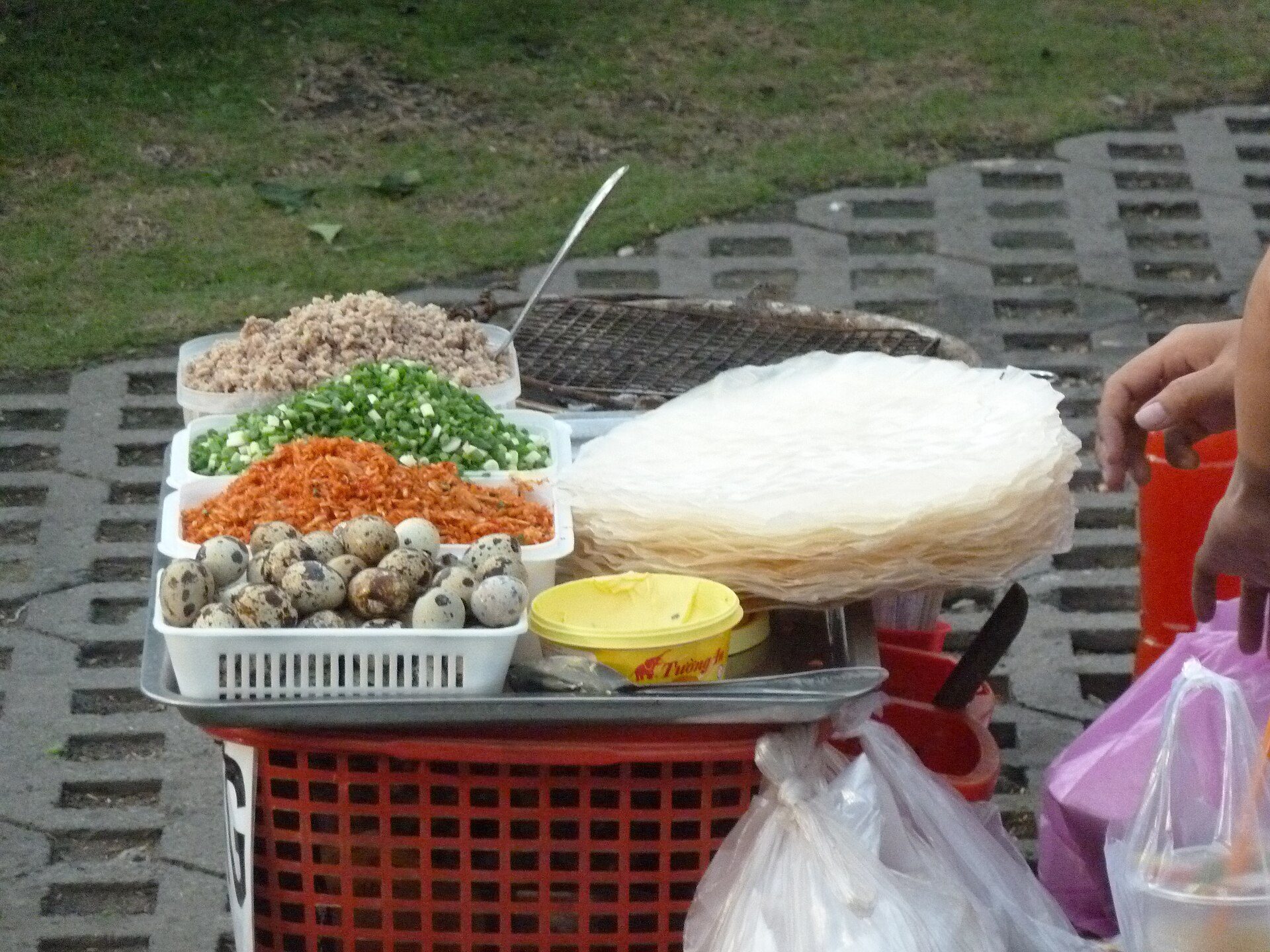
Photo: Light Write / Wikimedia Commons, CC BY-SA 2.0
Online kitchen from home
This model suits dishes that pack well, such as office lunch boxes, noodle salads and snacks. Capital goes mostly on kitchen equipment, packaging, dish photos and initial advertising. Remember that cooking for sale still has to meet food safety conditions and business registration requirements just like a shop with premises.
Very small shop
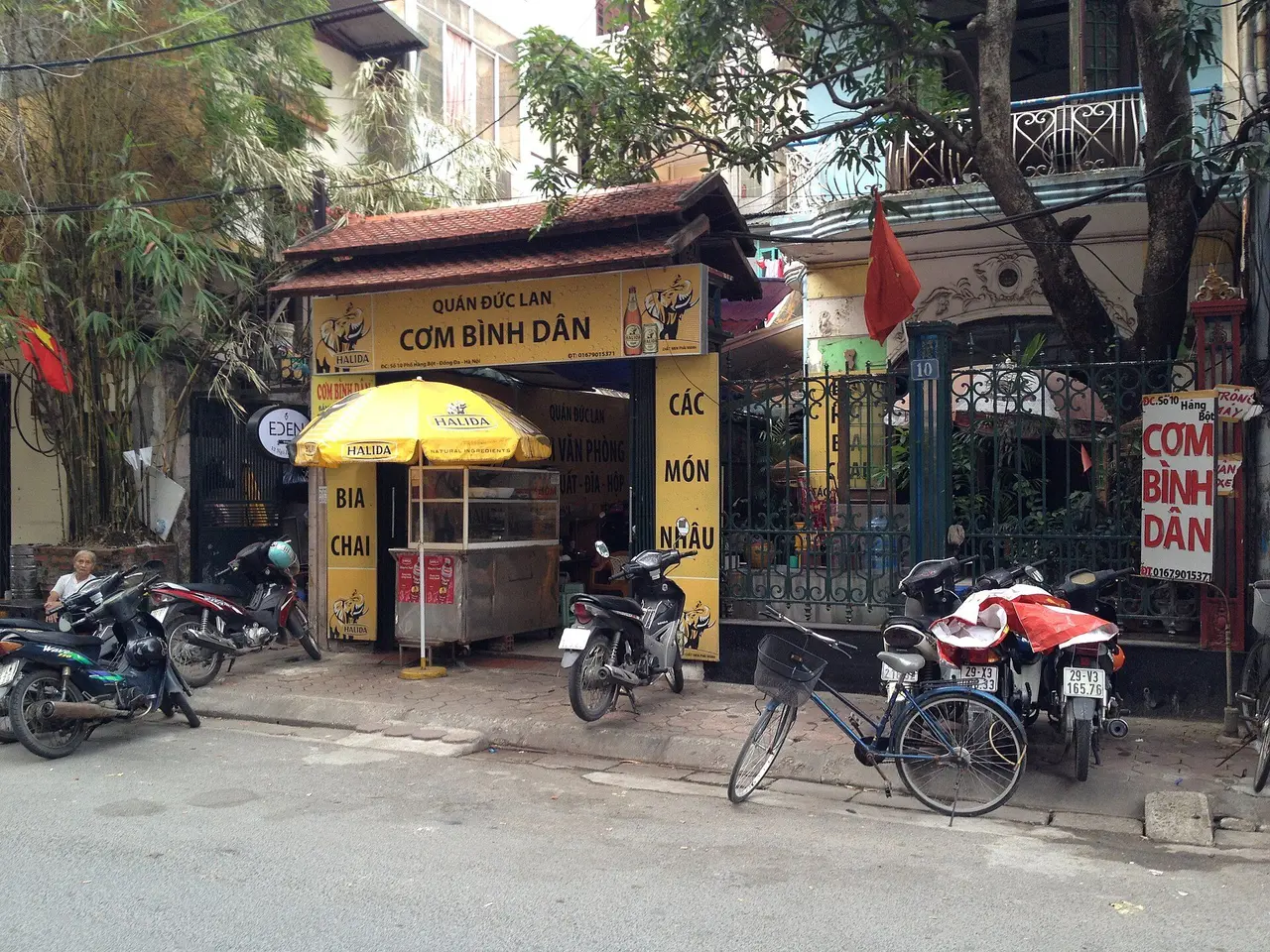
Premises of 10–15 m² with 3–4 tables and a menu of 1–3 signature dishes are a good stepping stone before a 30 m² shop. The com binh dan (everyday rice) eatery in Figure 4 is a common type of small shop in Hanoi: narrow premises, dishes cooked in advance, fast service.
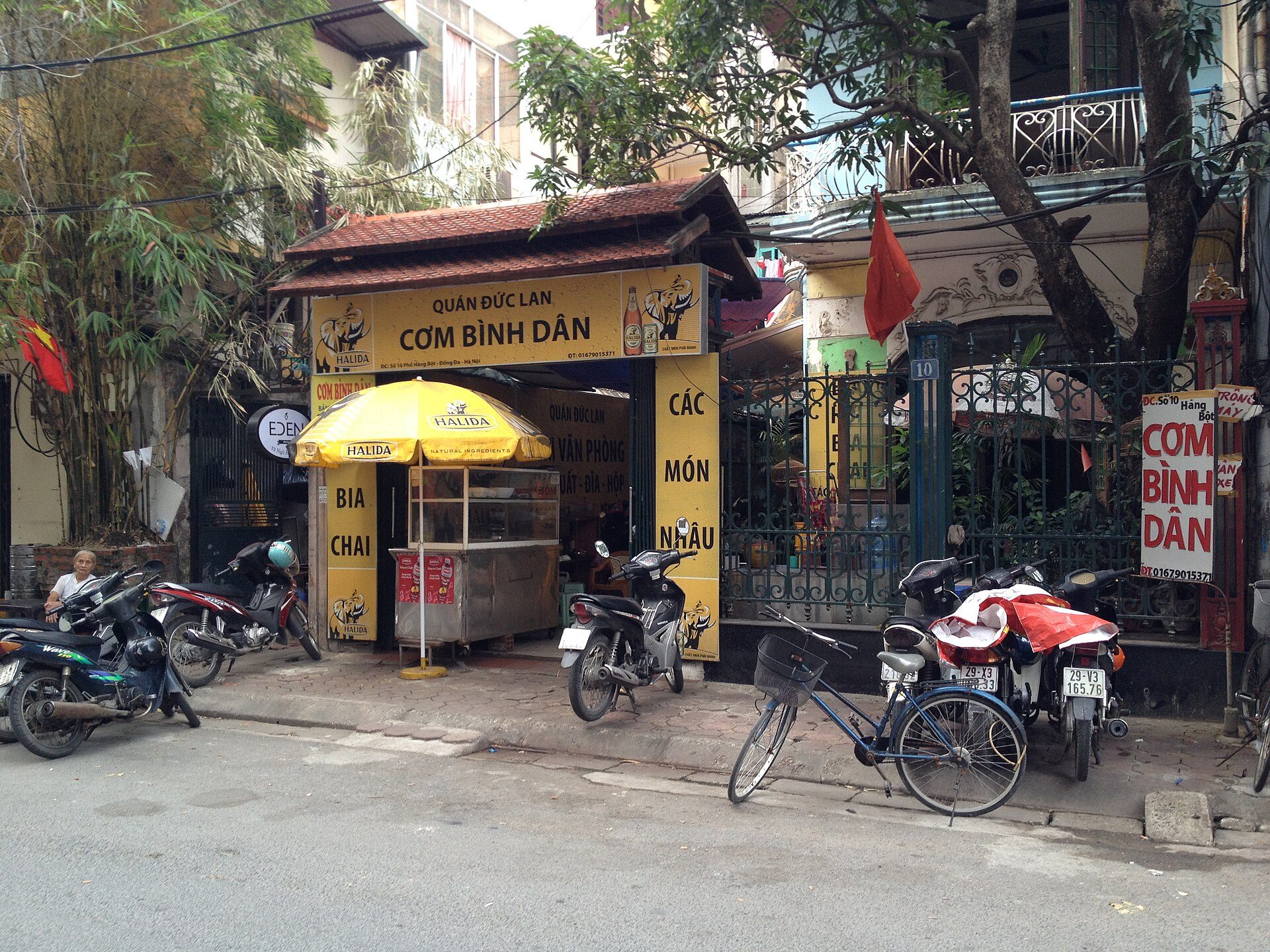
Photo: Phan Minh Tuấn / Wikimedia Commons, CC BY-SA 4.0
Paperwork: know the principles, ask the right office
Procedures for small eateries change over time and differ between localities, so this lesson only covers the principles, in the Vietnamese context. Before signing a lease, ask the ward or commune People's Committee, its one-stop service desk and the local tax office directly, and read the current regulations on official government portals.
Household business registration
Small eateries owned by an individual or a family are usually registered as a household business (ho kinh doanh) with the competent local business registration office. The file typically includes an application form, ID documents, the business address and the line of business. Ask how long processing takes and whether you need to submit premises documents such as the lease.
Food safety
Depending on size and type, a food business may need a food safety eligibility certificate, or may only need to sign a food safety commitment with the local authority. Either way, people who prepare food usually need health checks and basic food safety knowledge; the shop needs a one-way kitchen flow, clean water, separate storage for raw and cooked food, and invoices showing where ingredients come from.
Household business tax
Household businesses pay tax under the method set by the tax authority. In the past the usual form for small shops was a presumptive (fixed) tax; policy for household businesses is shifting toward declaring tax on actual revenue, with a revenue threshold below which no tax is due. Do not guess: ask the local tax office how tax is calculated, when it is due and whether you need e-invoices or a cash register system, then include tax in your monthly fixed costs.
Gas and fire safety warning: an eatery kitchen uses gas, hot oil and high-power electrical equipment — a serious fire and explosion risk in small premises. Keep gas cylinders in a ventilated place away from heat, use regulators and hoses within their service life, and check for leaks with soapy water (never with a flame). Install an extraction hood and clean the hood and ducting regularly, because grease build-up spreads fire. Keep suitable fire extinguishers near the exit and a fire blanket next to the stove, and never pour water on a burning pan of oil. Freezers and induction cookers need dedicated wiring and breakers installed by a qualified electrician. Ask the local fire police what applies to a shop of your size. In a fire or a strong gas leak: shut the valve, cut the power from a safe distance, evacuate and call 114 (Vietnam's fire emergency number).
Worked example: Thao opens a rice shop in a provincial town with 180 million VND
Thao has 180 million VND and plans to open a lunch-and-dinner rice shop in a provincial city, near offices and a market. She finds 30 m² premises at 7 million a month, with the landlord asking for a 2-month deposit. This is exactly the provincial scenario in the budget above: she needs 176 million and has 4 million to spare.
Checking rent against revenue
The rule at this step of the roadmap: rent should not exceed about 15–20% of expected revenue. Watching at lunchtime, she sees a nearby rice shop selling about 60 meals. She sets a cautious target of 46 meals a day: 46 × 40,000 × 26 = 47,840,000 VND a month. Rent of 7 million ÷ 47.84 million ≈ 14.6% — within the safe range.
Expected profit and payback time
At 46 meals a day: gross profit 46 × 26 × 22,800 = 27,268,800 VND; minus 17 million fixed costs leaves 10,268,800 VND — close to the 10 million she wants to pay herself. To recover the 109 million upfront investment she needs to sell more. At 60 meals a day: 60 × 26 × 22,800 = 35,568,000 VND; minus 17 million fixed costs and 10 million owner's pay leaves 8,568,000 VND a month; 109,000,000 ÷ 8,568,000 ≈ 12.7 months, or about 13 months to recover the upfront investment, if revenue holds.
Thao's decisions
She buys a used fridge and stainless tables, saving about 12 million on equipment, and moves that money into the contingency reserve instead of spending it. Her menu has only 4 signature dishes, each with a written recipe and portion sizes. She records income and expenses every evening so she knows early when to adjust.
6 mistakes that drain capital before a shop finds customers
Renting too expensive a spot for a "great location"
Symptom: rent is over 20–25% of actual revenue. Cause: believing a big shopfront will pull in customers on its own. Fix: count real customers at peak hours for 3–5 days, estimate revenue cautiously, and only then compare rent.
Spending everything on renovation and new equipment
Symptom: a beautiful opening, but by month two you owe wages and suppliers. Fix: lock in 3 months of working capital and the contingency first, then split what is left between renovation and equipment; buy used for anything that does not affect food safety.
Too long a menu
Every extra dish adds stock and waste. A new shop should have 1–3 signature dishes, cooked really well and consistently before expanding.
Mixing shop money and household money
Taking cash from the till for family spending means you never know whether the shop makes or loses money. Open a separate account for the shop and pay yourself a fixed amount.
A short or vague lease
You spend 30–60 million on renovation and the landlord raises the rent after a year. Sign for at least 2–3 years, and write down rent increases, who pays for major repairs and how the deposit is returned.
No bookkeeping, no break-even tracking
Without daily records you only discover a loss three months later. Log income and expenses every evening in Excel or an app, and compare actual meals sold with break-even every week.
Frequently asked questions
Can I open a small eatery with 50 million VND?
It is hard for a shop with 30 m² premises, but enough to start with a street cart, a small stall or an online kitchen from home. Use this stage to test dishes, build regular customers and collect real figures before renting larger premises.
How long does it take an eatery to break even?
Monthly break-even (covering costs) can come within a few months if the location and dishes are good; recovering the full upfront investment usually takes about 1–2 years or longer, depending on revenue. This is a rough reference, not a promise for every shop.
What food cost percentage is reasonable?
About 35–40% of the selling price is what many Vietnamese eateries aim for. Calculate food cost from the real portion of each dish and update it when ingredient prices change — the detailed method is in the next step of the roadmap.
Do I need to register if I only sell online from home?
Selling food regularly for income generally requires registration and food safety compliance, just like a shop with premises. Ask your ward or commune People's Committee and the local tax office about your specific case.
Practice exercises and self-assessment
- Build an 8-line budget for real premises you are considering, using prices quoted by the landlord and equipment shops.
- Calculate your monthly fixed costs and 3 months of working capital.
- Choose a signature dish, estimate its food cost and calculate break-even meals per day (with and without your own pay).
- Watch 2 similar shops near the premises at lunchtime and count customers to compare with your break-even number.
- Write a list of questions on household business registration, food safety, tax and fire safety to take to the ward office and tax office.
Self-assessment criteria
- Pass: the budget has all 8 lines, including 3 months of working capital and contingency, and the sum matches the total.
- Pass: break-even meals are calculated with the correct formula; rent is under about 20% of expected revenue.
- Pass: you have a list of paperwork questions and have written down the local offices' answers.
- Not yet: the total covers only rent, renovation and equipment; there is no working capital; or break-even is higher than the customer numbers you actually observed.
With a budget and a break-even number in hand, you are ready for the next step in the roadmap: Menu, standard recipes & food cost — choosing signature dishes, writing portion-controlled recipes and costing each dish to stay within 30–40%. See the 8-step roadmap for opening and running a small eatery.