Hotel room types are named on two levels: the room category (Standard, Superior, Deluxe, Suite and so on) tells you the size, view and amenities, while the bed type (Single, Double, Twin, Triple) tells you how many people the room sleeps. Room rates change with the season, the day of the week, the meal plan and the cancellation terms, and guests book through channels such as Booking.com, Agoda, Traveloka, the hotel website, the phone, or a travel company booking for a group. All channels sell from one shared room inventory through a channel manager; slow syncing, or a booking taken but never entered into the system, leads to overbooking (selling more rooms than you have). This lesson helps a new receptionist read a reservation correctly, quote prices without mistakes and understand why double-selling happens, using examples from hotels in Vietnam.
By the end of this lesson, you will be able to:
- Tell apart 5 common room categories and 5 bed types, and never confuse a Double room with a Twin room when taking a booking.
- Read the meal plan codes RO, BB, HB, FB and the cancellation terms on a reservation, and explain them to a guest in one minute.
- Build a 3-night quote with weekday rates, weekend rates and a child breakfast supplement where every line adds up.
- Know who collects the money for each booking channel and what to check when the guest arrives.
- Explain a channel manager in your own words and name 5 causes of overbooking and how to prevent them.
Learning hotel reception? Room types and booking channels are step 2 of the roadmap, right after etiquette and communication and before check-in on the property management system. See the 8-step hotel receptionist roadmap to learn in the right order.
Hotel room categories: Standard, Superior, Deluxe, Suite
A room category is a group of rooms sold at the same rate and nearly identical in size and amenities. Any room in the group can be assigned to a guest who booked that category.
How room categories differ
Categories differ in floor area, view, floor level and extras such as a bathtub, a balcony or a separate seating area. There is no universal standard: a Deluxe room in one hotel may be no better than a Superior room in another. So the first thing to learn in a new job is your own hotel's room category list.
Common room categories
The table shows a typical ladder in 3 to 4 star hotels in Vietnam. Floor areas are illustrative examples to show the order, not a required standard.
| Category | Example size | Typical features | Who usually books it |
|---|---|---|---|
| Standard | 18–22 m² | Basic room, sometimes no window or a window onto an alley | Short business trips, guests on a budget |
| Superior | 22–26 m² | Has a window, better furniture than Standard | Couples, independent travellers |
| Deluxe | 26–35 m² | Larger, city, sea or lake view, sometimes a balcony | Leisure guests staying 2–4 nights |
| Family / Triple | 30–45 m² | Sleeps 3–4: one large bed plus a single, or two large beds | Families with children, groups of friends |
| Suite | 45 m² and up | Living room separate from the bedroom, highest amenities | VIPs, honeymooners, long stays |
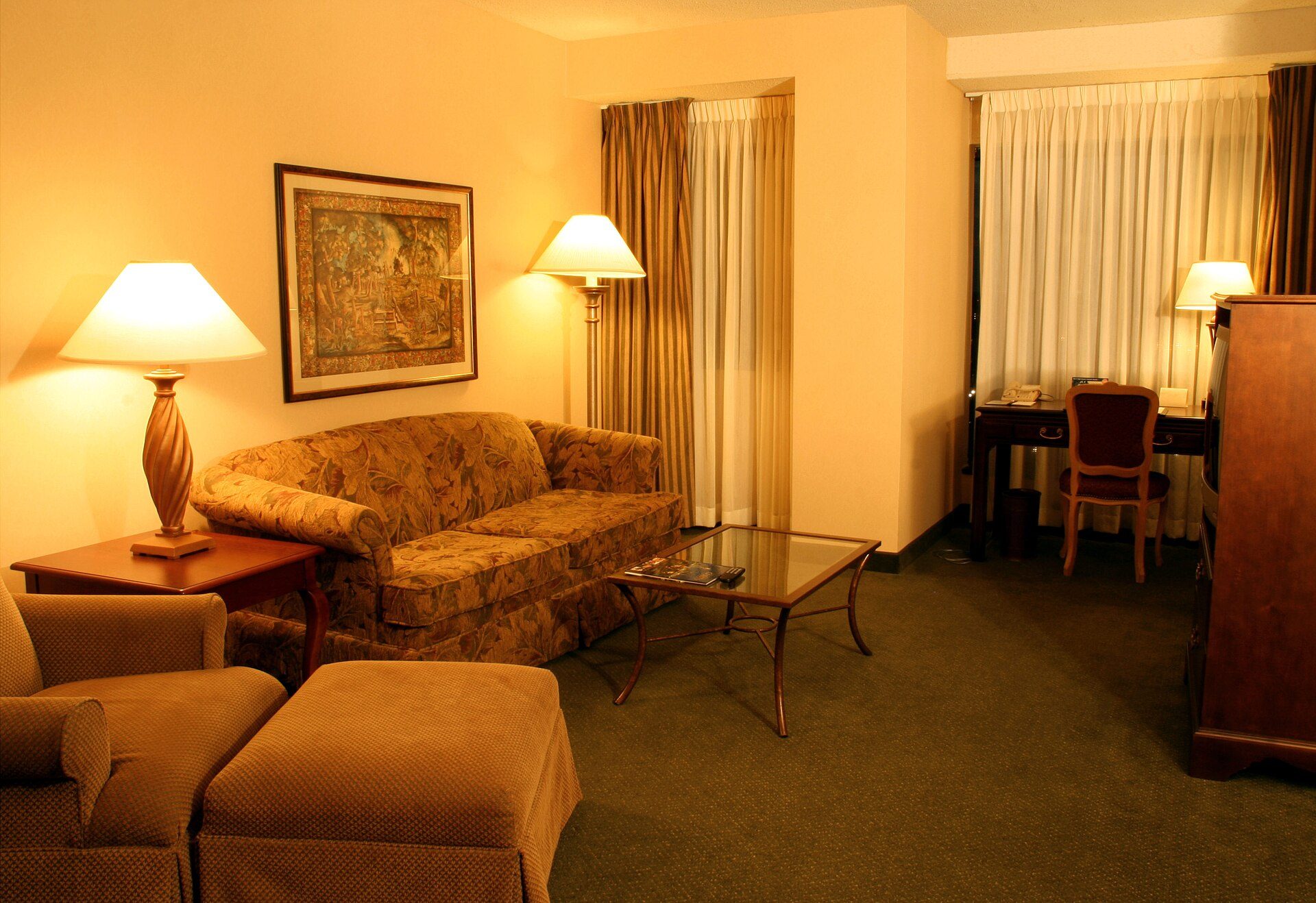
Photo: Derek Jensen ( Tysto ) / Wikimedia Commons, Public domain
Connecting rooms, family rooms and accessible rooms
Connecting rooms are two neighbouring rooms with an inner door between them, good for families with children. Adjoining rooms are simply next to each other with no inner door; guests often mix the two up. An accessible room has a wide door, a step-free bathroom and grab bars. Hotels have very few of these rooms, so only promise one once it is actually held in the system.
Bed types and room names: Single, Double, Twin, Triple
One Deluxe category may be sold in two bed types: Deluxe Double (one large bed) and Deluxe Twin (two smaller beds). Assign exactly the bed type the guest booked.
Double vs Twin: the most common mix-up
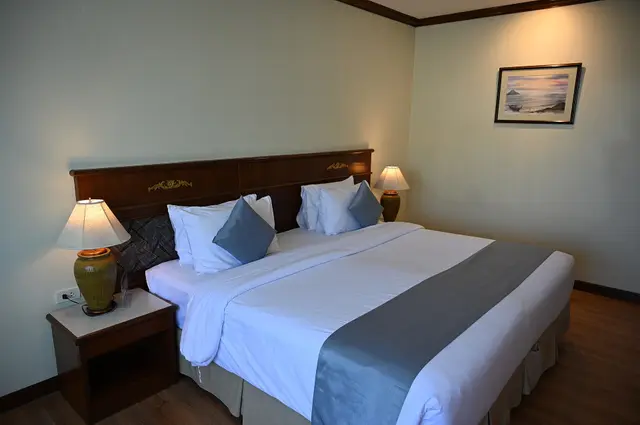
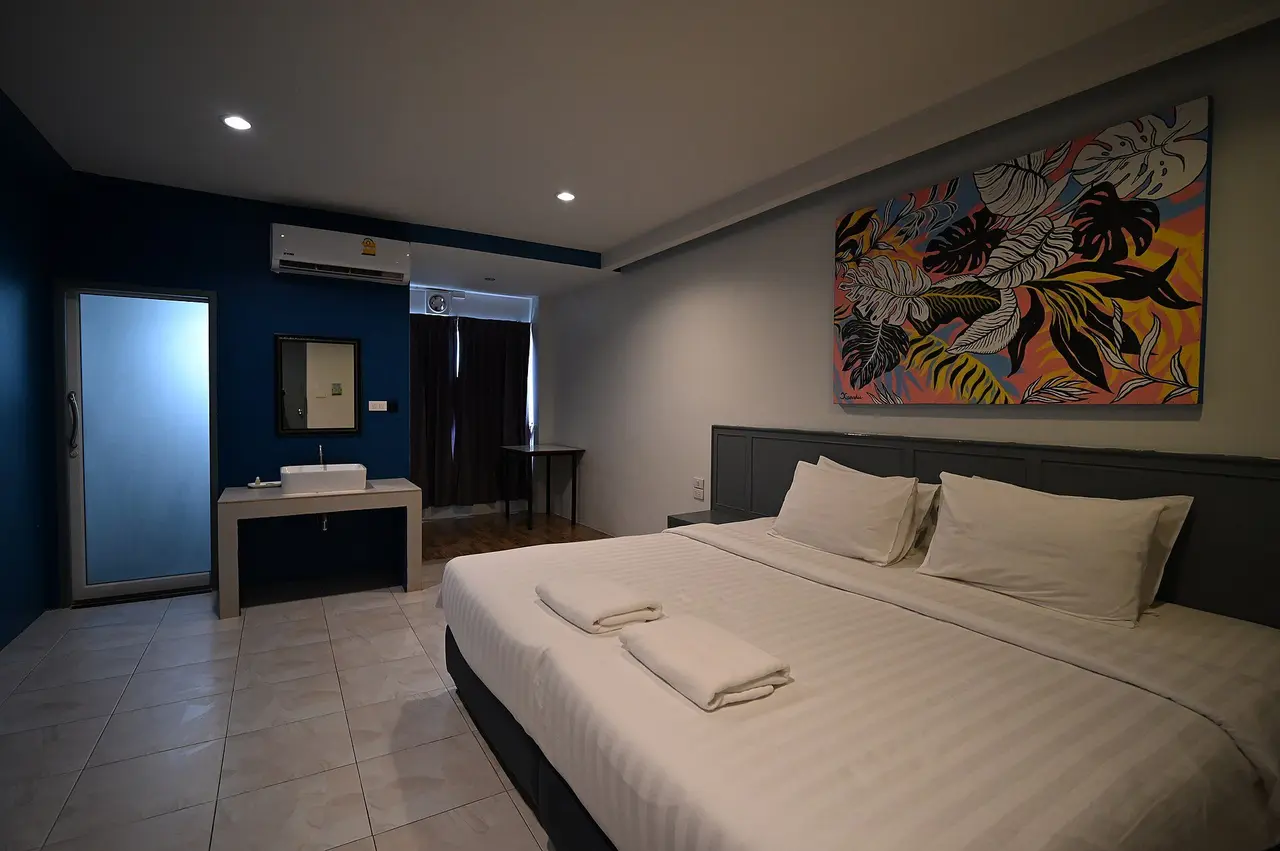
A Double has one large bed for two people sharing. A Twin has two separate single beds for two people (colleagues, friends, a parent and child). New staff often think "twin" means "for a couple" and assign the wrong room. Figure 2 shows a typical Twin room and Figure 3 a room with one King bed.
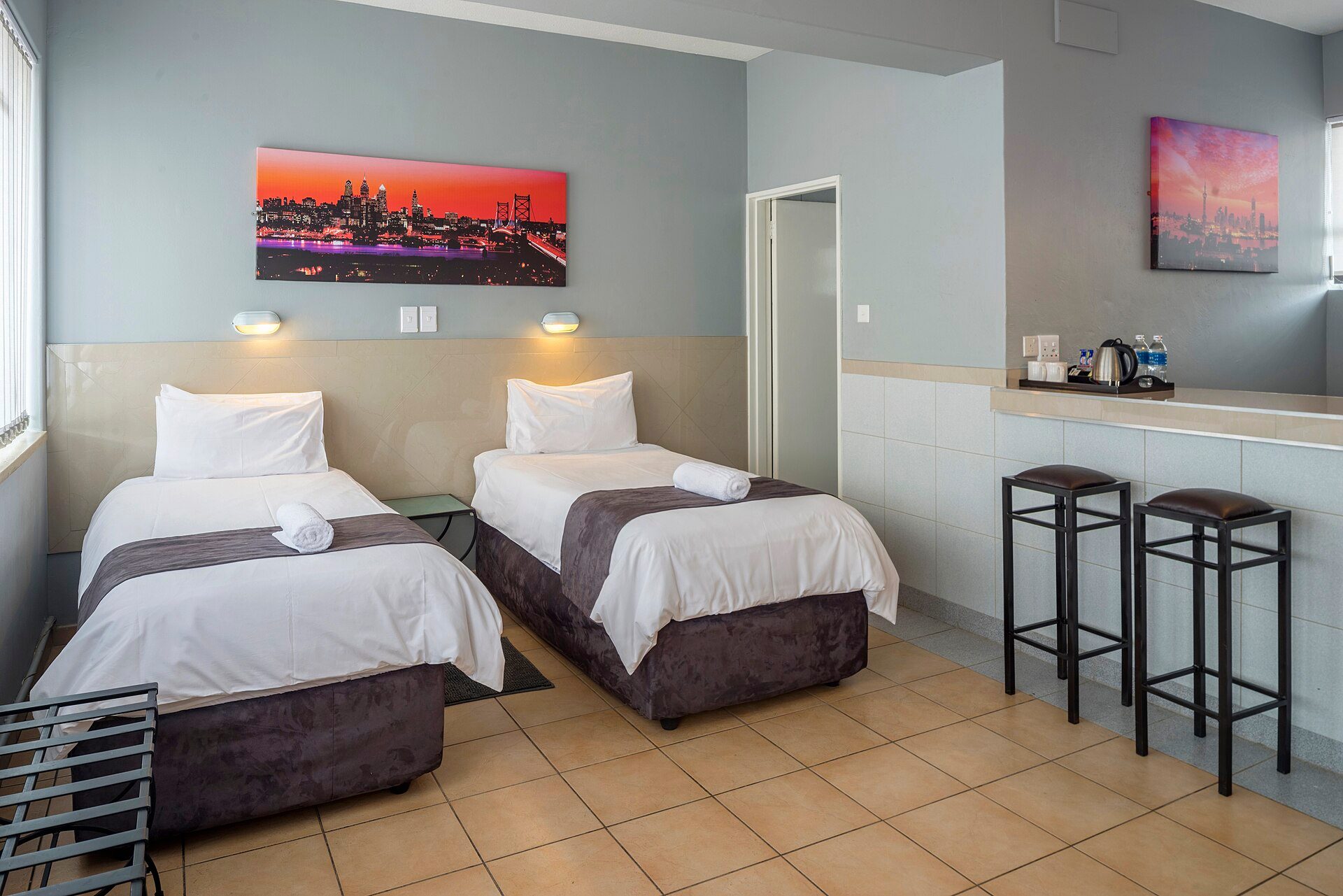
Photo: Rufouslark / Wikimedia Commons, CC BY-SA 4.0
Common bed sizes
The widths below are typical figures and vary between hotels; when a guest asks, check the room specifications rather than guessing.
| Bed type | Typical width | Sleeps | Notes |
|---|---|---|---|
| Single | 0.9–1.2 m | 1 | Single rooms are rare; a Double is often sold for one person |
| Double | 1.4–1.6 m | 2 | Standard double bed |
| Queen | about 1.6 m | 2 | Some hotels simply call it a Double |
| King | 1.8–2.0 m | 2 | Common in Deluxe rooms and Suites |
| Twin | 2 beds of 1.0–1.2 m | 2 | Some hotels push the beds together on request |
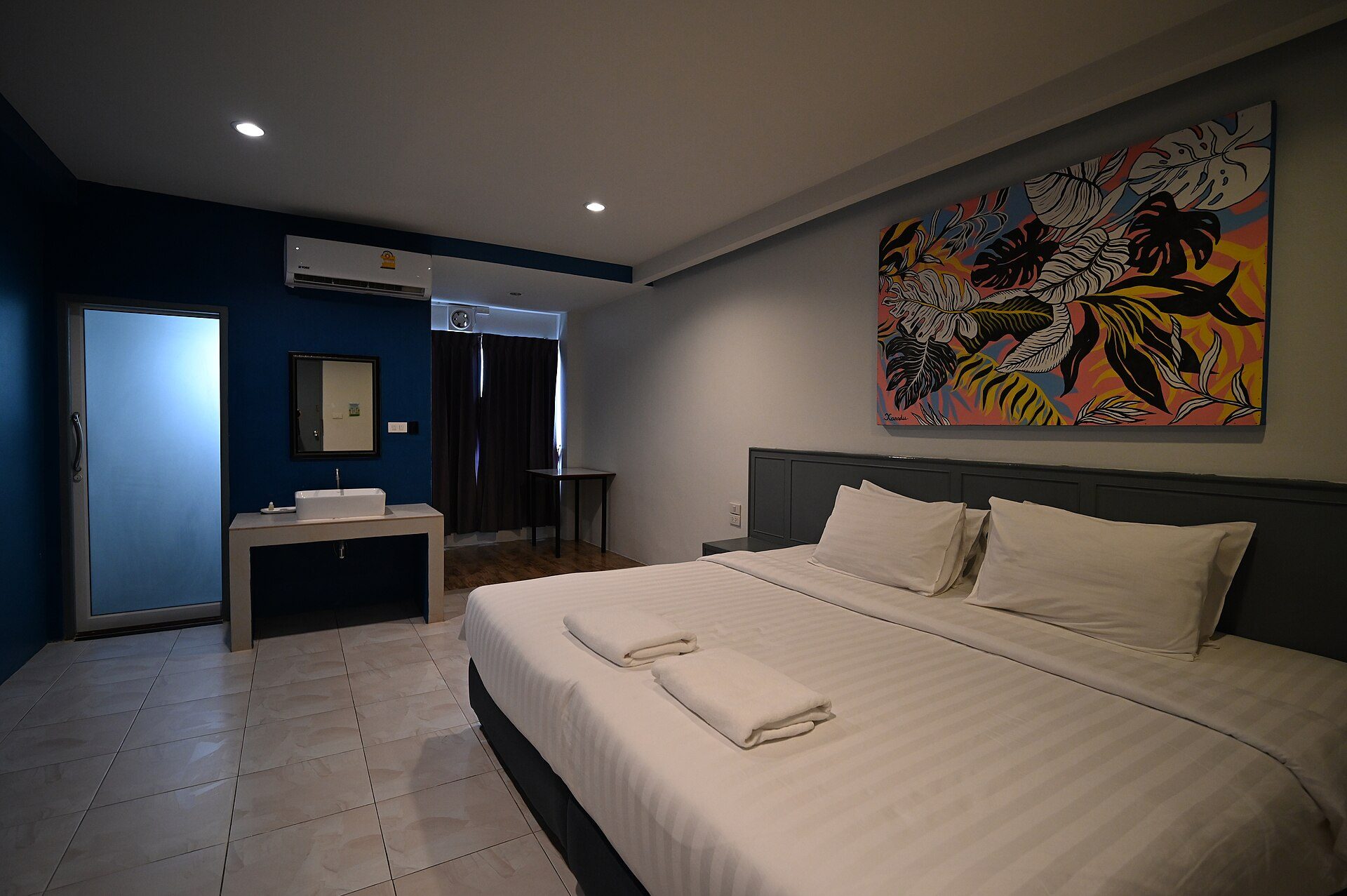
Photo: PattayaPatrol / Wikimedia Commons, CC BY-SA 4.0
Extra beds, baby cots and child policies
An extra bed for a third person usually carries a nightly supplement. Baby cots are limited, so they must be requested in advance. Every hotel has its own rules on the age at which children stay free and on child breakfast charges; this is the question families ask most often when booking.
How are hotel room rates set?
A room does not have one single price. A Tuesday night in low season and a Saturday night on a public holiday can differ a lot, and a guest booked through a travel company pays a different rate from one who booked directly.
Rack rate, public rates and contract rates
- Rack rate: the highest published price; guests rarely pay exactly this.
- BAR (Best Available Rate): the best public rate right now, changing day by day.
- Corporate rate: a fixed rate agreed with a company.
- Net rate for agents: a lower rate so travel agents can resell; never quote it to walk-in guests.
- Group rate: a special rate based on the number of rooms, with deposit terms and a deadline for the guest list.
Seasonal, weekday and holiday rates
Hotels split the year into low, shoulder and high season; beach hotels fill up in summer, city hotels during conference season. At resorts, weekend nights usually cost more than weekdays. Tet (Lunar New Year) and other national holidays usually have their own rates, often with a minimum stay. Receptionists do not set prices; you read the rates loaded in the system and approved by sales or management.
What the price includes: all-in rates and "++" rates
Some hotels quote rates that already include tax and service charge (all-in rates), while others quote "++" rates, meaning service charge and value added tax are added on top. Tax and service charge follow the regulations in force in Vietnam and each hotel's policy, so check the internal rate sheet before quoting. Always say clearly "this rate includes tax and service charge" or "it does not; the total is…", because guests are most upset when the bill is higher than the price they were quoted.
Cancellation and payment terms
Every rate comes with a condition: flexible (free cancellation before a certain date) or non-refundable (cheaper, paid in advance, money lost if cancelled). A no-show is charged according to the terms chosen. When a guest asks to change dates or cancel, open the reservation and read the terms; never answer from memory.
Breakfast packages and meal plan codes
A rate plan combines the room category, the meals included and the cancellation terms. Meals are usually shown as short codes, and misreading them is how the "I thought breakfast was included" problem starts.
Meal plan codes
| Code | Full name | What it includes |
|---|---|---|
| RO | Room Only | The room only, no meals |
| BB | Bed & Breakfast | Room plus breakfast (usually for the number of adults on the booking) |
| HB | Half Board | Breakfast plus one main meal (lunch or dinner) |
| FB | Full Board | Breakfast, lunch and dinner |
| AI | All Inclusive | Meals and drinks according to the resort's list |
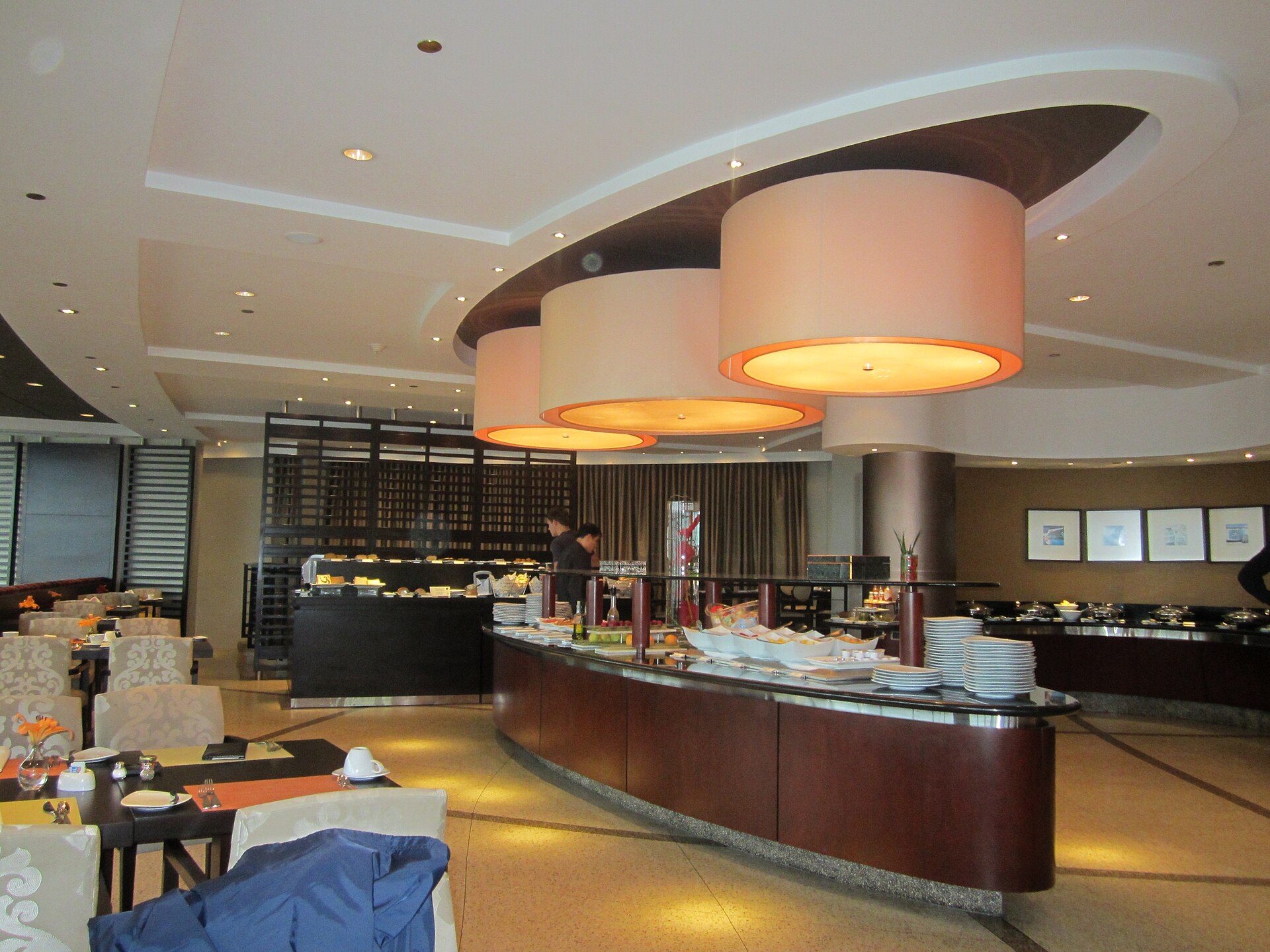
Photo: Kim / Wikimedia Commons, CC BY-SA 2.0
Breakfast for children and a third person
A BB plan normally covers breakfast only for the adults on the reservation; children or a third guest pay a supplement from the hotel's price list. Tell the guest about this in advance and add a note to the reservation, because the restaurant in Figure 4 only knows who may eat from the list the front desk sends.
Hotel booking channels and who collects the money
Each booking source handles payment differently; a receptionist must know this to avoid charging twice or forgetting to charge.

Photo: Shixart1985 / Wikimedia Commons, CC BY 2.0
Online travel agencies (OTAs): Booking.com, Agoda, Traveloka
OTAs are websites and apps that sell rooms for many hotels, such as Booking.com, Agoda, Traveloka and Expedia. The hotel pays the OTA a commission on each booking; the rate depends on each hotel's contract, and receptionists do not need to, and should not, discuss it with guests. There are two main payment models: the guest pays at the hotel, or the guest prepays the OTA, which then pays the hotel, sometimes with a virtual card attached to the booking. The reservation states which model applies; read it carefully before taking money from the guest.
Direct bookings: website, phone, email, social media
Bookings made on the hotel website (through a booking engine) flow into the system automatically. Bookings by phone, email or message must be created by staff, and this is where most errors happen: saying yes and forgetting to enter it. The rule: if it is not in the system and the guest has not received a confirmation, the booking does not exist.
Travel companies and groups
Travel companies often have a block of rooms held for them by contract (an allotment). They must send a rooming list, the guest names by room, before a deadline; if they do not confirm in time, the hotel can release the rooms for sale to others. Groups are usually paid by the travel company under the contract, so at the desk you only collect personal extras such as minibar and laundry, unless the contract says otherwise.
Channel comparison
| Channel | Who collects the room charge | What to check on arrival |
|---|---|---|
| OTA, pay at hotel | The hotel, at the desk | Rate on the booking, meal plan, cancellation terms |
| OTA, prepaid | The OTA, which then pays the hotel | Do not charge the room again; only take a deposit for extras |
| Hotel website | The hotel (prepaid or at the desk) | Whether it was paid online, any promo code |
| Phone, email, message | The hotel | Price in the confirmation email, whether a deposit was paid |
| Travel company, group | The travel company under contract | Rooming list, which items guests pay themselves |
How does a channel manager work?
A channel manager is software that connects the hotel's property management system (PMS) with the OTAs and the website: it pushes availability and rates out to every channel and pulls new bookings back into the hotel.
One shared inventory for all channels
Say the hotel has 10 Deluxe rooms. Instead of splitting them rigidly between channels, the channel manager lets every channel sell from one pool of 10; when any channel sells a room, the remaining count drops on all channels. This helps the hotel sell out, but it depends on the sync being fast enough.
Mapping room types and rate plans
Each room category and rate plan in the PMS must be mapped to the matching category and rate plan on each OTA. If "Deluxe Twin" on an OTA is mapped to "Deluxe Double" by mistake, a Twin booking shows up as a Double and you assign the wrong beds. Sales staff set up the mapping, but the front desk usually spots the error first, so report any odd-looking booking straight away.
Stop sell and minimum stay
Through the channel manager, the hotel can stop selling a room category on all channels, or set a minimum length of stay. New staff only do this when trained and authorised.
Why does overbooking happen?
Overbooking means a night has more bookings than rooms available to sell. Some hotels deliberately accept a few extra bookings because they expect cancellations; that is a management decision. Unintended overbooking usually comes from the 5 causes below.
5 common causes
- Slow sync: two channels sell the last room within seconds, before availability updates.
- Manual bookings not entered: a booking taken by phone or message is not created in the system, so channels keep selling that room.
- Broken rooms not blocked: a room under repair (out of order) is still counted as sellable.
- Wrong mapping or a disconnected channel: one channel still shows availability because it missed the update.
- Unplanned extensions: an in-house guest extends their stay when the room is already booked by someone else.
When overbooking has already happened
Tell the shift leader or duty manager immediately and do not make promises yourself. The hotel will look for cancellations or a guest who can be upgraded; if it is still short, it may move a guest to an equivalent nearby hotel (known in the trade as "walking" a guest). Compensation is decided by management. Your job is to contact the guest early, apologise clearly and record everything in the handover log.
Prevention during your shift
- At the start of each shift, compare availability in the PMS with the channel manager for the next 3 days.
- Every phone or message booking: enter it immediately, then tell the guest "confirmed".
- Broken rooms: report to maintenance and change the room status in the system as soon as you know.
- Guest asks to stay longer: check availability before saying yes.
Payment security note: OTA bookings may include card details or a virtual card. Do not copy card numbers onto paper, do not screenshot them and send them by phone or chat apps, and do not read card numbers aloud at the desk. Only authorised staff may open card details, and only following hotel procedure. If you suspect a fake booking (strange name, declined card, a request to refund to a different account), tell a manager and never issue the refund yourself.
Worked example: a family quote and an overbooking case
All prices below are hypothetical figures for illustration, including tax and service charge, not market prices; real rates are a 2026 reference and vary by region, star rating and season.
Case 1: a family of three booking 3 nights
Mr Nam phones to book for 2 adults and an 8-year-old child, arriving Friday evening and leaving Monday morning (3 nights: Friday, Saturday, Sunday). The example hotel has a Deluxe Double on a BB plan (breakfast for 2 adults) at a flexible rate of 1,100,000 VND (about 42 USD) per weekday night and 1,400,000 VND per Friday or Saturday night. Under the example policy the child shares the parents' bed at no room charge, but child breakfast costs 120,000 VND per day.
| Item | Calculation | Amount |
|---|---|---|
| Friday night | 1 × 1,400,000 VND | 1,400,000 VND |
| Saturday night | 1 × 1,400,000 VND | 1,400,000 VND |
| Sunday night | 1 × 1,100,000 VND | 1,100,000 VND |
| Breakfast for the 8-year-old | 3 × 120,000 VND | 360,000 VND |
| Total, flexible rate | 3,900,000 + 360,000 VND | 4,260,000 VND |
Mr Nam asks if there is anything cheaper. The example hotel has a non-refundable rate 10% below the room charge: 3,900,000 × 90% = 3,510,000 VND, plus 360,000 VND child breakfast makes 3,870,000 VND, which is 390,000 VND less. You quote both options with their conditions: "The flexible rate is 4,260,000 VND with free cancellation before the hotel's deadline; the non-refundable rate is 3,870,000 VND, paid in advance and not cancellable." Once he chooses, you enter the booking in the system, add the note "1 child aged 8, breakfast supplement", and send a confirmation email.
Case 2: the last Deluxe room on Saturday night
The hotel has 10 Deluxe rooms. Saturday night already has 8 bookings and 1 room is under repair. At 15:00 a receptionist accepts a Deluxe booking by message but plans to "enter it this evening".
| Time | Event | Rooms still sellable on channels | Rooms actually free |
|---|---|---|---|
| 14:00 | 10 rooms − 8 bookings − 1 broken room | 1 | 1 |
| 15:00 | Booking taken by message, not entered | 1 (wrong) | 0 |
| 15:40 | An OTA sells the last room | 0 | −1 |
Result: 8 + 1 (OTA) + 1 (message) = 10 bookings for 9 sellable rooms, one guest too many. Had the booking been entered at 15:00, the channel manager would have closed the last room on the OTA. Hence the rule: enter first, confirm second.
Common booking mistakes and how to avoid them
Giving a Twin to a guest who booked a Double
Sign: a couple comes back to the desk asking to change rooms. Cause: skimming the room name, or wrong mapping. Fix: repeat "Double = one bed, Twin = two beds" to yourself when assigning; if a booking says "honeymoon" but the room is a Twin, check with the guest before arrival.
Leaving supplements out of a quote
Sign: the guest is surprised by the bill. Cause: forgetting the extra bed, child breakfast, or tax and service charge. Fix: quote line by line as in the example above.
Not reading the notes and plan on OTA bookings
Sign: a prepaid guest is asked to pay again, or thinks breakfast is included. Cause: not checking the payment section and the meal code. Fix: read the next day's arrivals in advance and mark each one "prepaid" or "collect at desk".
Frequently asked questions
What types of hotel rooms are there?
Rooms are usually grouped by category (Standard, Superior, Deluxe, Family, Suite) and by bed type (Single, Double, Queen, King, Twin, Triple). Names are not consistent between hotels, so learn your own hotel's room list.
What is the difference between a Double room and a Twin room?
A Double has one large bed for two people sharing; a Twin has two separate single beds. Couples usually choose a Double, friends or colleagues a Twin.
Does the hotel room rate include breakfast?
It depends on the plan. BB includes breakfast, RO is room only. Breakfast in the plan usually covers only the adults on the booking; children and extra guests may pay a supplement.
What is a hotel channel manager?
Software that connects the hotel management system with sales channels such as Booking.com, Agoda, Traveloka and the website, so every channel sells from one room inventory and updates automatically when a new booking arrives.
What is overbooking?
It is when a night has more bookings than rooms available, usually due to slow syncing or manual bookings not entered. The receptionist reports it to a manager immediately; the solution and any compensation are decided by management.
Practice exercises and self-assessment
- Draw the room list of a hotel you know (or look one up on a hotel website): category, bed type, view and maximum occupancy.
- Explain out loud to a friend what "Deluxe Twin, BB, non-refundable, 2 nights" means, who pays and whether breakfast is included.
- Build a quote: 2 adults and a 10-year-old child, Saturday and Sunday nights; hypothetical rates 1,300,000 VND for Saturday, 1,000,000 VND for Sunday, extra bed 300,000 VND per night, child breakfast 120,000 VND per day. Answer: 2,300,000 + 600,000 + 240,000 = 3,140,000 VND.
Self-assessment criteria
- Pass: no Double/Twin mix-ups, all 5 meal codes read correctly, a quote where every line adds up, and at least 4 of the 5 causes of overbooking named.
- Not yet: a quote missing supplements, unable to say whether a rate includes tax and service charge, or confirming a booking to the guest before entering it in the system.
If you need to review how to greet guests and answer the phone when taking bookings, see the lesson on hotel receptionist etiquette. Once you know room types, rates and booking channels, move on to the next step of the roadmap: Check-in & check-out on a PMS, where you create and edit bookings, assign rooms, take deposits and split folios in the system; you can read ahead in the lesson on the 8-step hotel check-in procedure.
Keep learning hotel reception: after room types and booking channels come check-in on the PMS, guest registration, cashiering, complaint handling and real shifts. See the 8-step hotel receptionist roadmap.