Electrical safety in appliance repair comes down to one rule: touch the appliance only after it has been unplugged or its breaker switched off, after you have measured to confirm it is dead, and after large capacitors (microwaves, induction hobs, inverter boards) have had time to discharge. Alongside that you need the right tools: insulated screwdrivers, a voltage tester, a multimeter, a clamp meter, a soldering iron, a bearing puller and an extension lead with built-in residual current protection so you protect yourself in a customer's home. This is the first lesson in the roadmap for repairing washing machines, fridges and other household appliances, written for someone who has never opened an appliance before.
By the end of this lesson, you will be able to:
- Follow the correct sequence to isolate an appliance, prove your tester on a live source and confirm the appliance is dead before touching it.
- Explain why microwaves, induction hobs and inverter boards remain dangerous after unplugging, and know which jobs a beginner must not do alone.
- Check a customer's RCD with its test button and use an RCD-protected extension lead whenever you must power an appliance for testing.
- Choose and use the 12 basic tools, on a budget of about 3.85 million VND whose figures add up.
- Carry out a 15-minute safety routine at the start of every home visit, following a checklist.
Learning appliance repair properly? Electrical safety and tools are step 1 of the 8-step roadmap, before testing components and repairing washers, fridges, microwaves, induction hobs and water heaters. See the 8-step home appliance repair roadmap to learn in the right order.
Why electrical safety is the first step for an appliance technician
Household appliances in Vietnam run on 220 V, 50 Hz mains power and often sit in damp places such as bathrooms, balconies and kitchens. An appliance technician works in customers' homes, where you do not know how the wiring was installed. The three hazards below are why you learn safety before you learn repairs.
Current through the body
An electric shock is dangerous because current flows through the body, especially across the heart. Just a few tens of milliamps flowing from hand to hand or hand to foot can cause muscles to lock so you cannot let go, and disturb the heart rhythm. Wet skin and wet floors greatly reduce the body's resistance, so more current flows. Touching the same washing machine with dry hands while wearing sandals is very different from touching it with wet hands, barefoot, in a bathroom.
Water and electricity in the same place
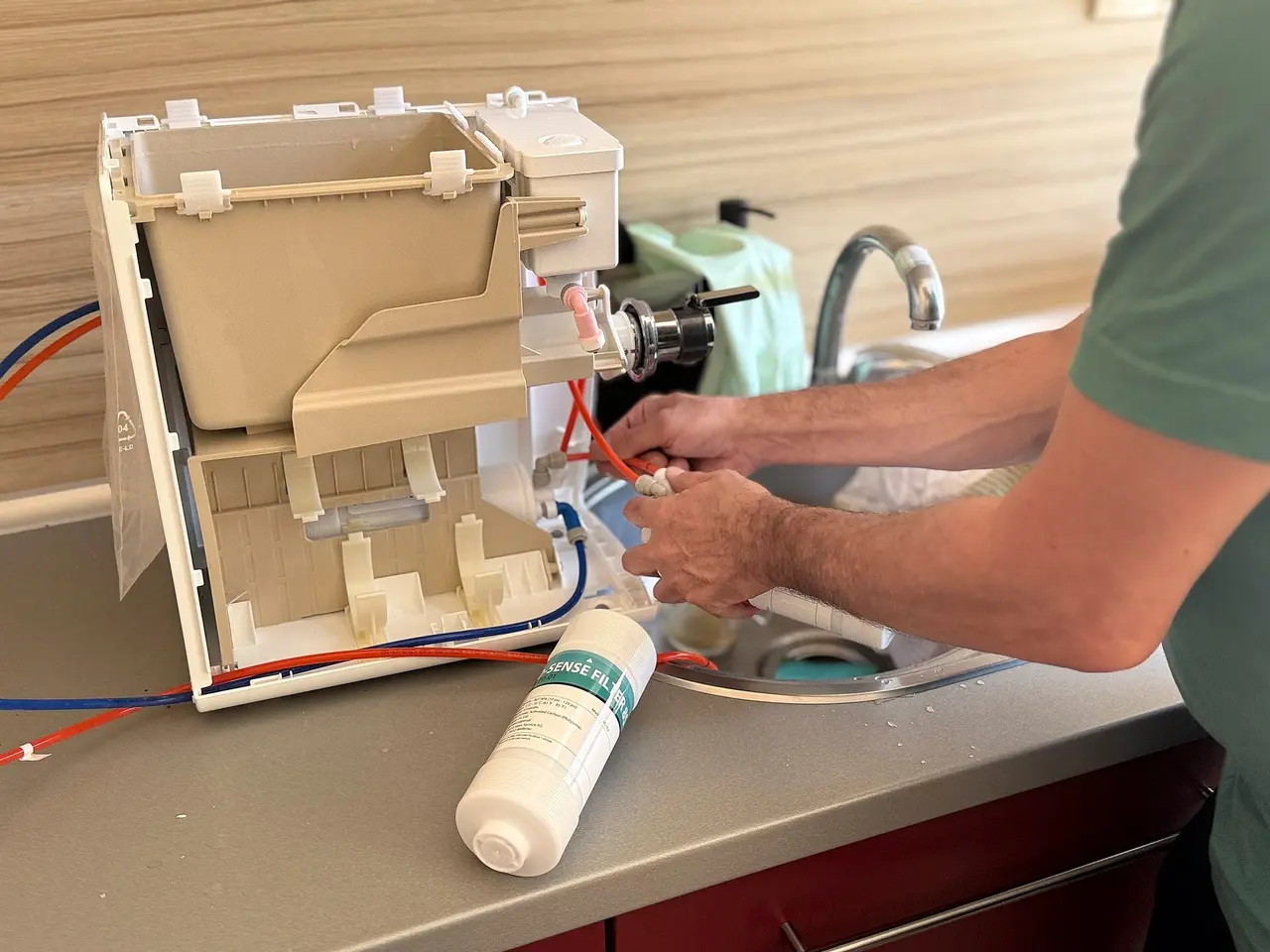
Washing machines, water heaters, water purifiers and fridges being defrosted all involve water. Opening a drain pump filter, removing a hose or defrosting a fridge sends water across the floor, sometimes towards a socket. The right habit is to lay down towels, place a tray and check where the water will flow before removing anything. When you must work on an appliance next to a sink, as in Figure 1, it must be fully unplugged and the electrical parts kept dry.
Energy still stored after unplugging
Unplugging does not always remove the danger. Large capacitors can hold a charge for minutes or longer, a washing machine drum or a fan blade keeps spinning, door springs and shock absorbers are under compression, and hot water pipes may still be at 50–70°C. A careful technician always asks, "Where is this machine still storing energy?" before reaching inside.
Isolate the supply and prove it dead
This is the routine for every appliance, even if you are "just taking a look". If you have studied electrical work, the lesson 5 mandatory safety rules before you touch any electrical wire is the shared foundation; below is how to apply it to household appliances.
Unplug; do not just press the power button
The power button on a washing machine or microwave often only tells the control board to switch off; behind it, the power supply board still has 220 V. Always pull the plug from the socket and keep it where you can see it, so nobody plugs it back in while you are working. In a customer's home, say clearly: "Please do not plug this in until I tell you."
Hard-wired appliances: switch off the breaker
Water heaters, built-in induction hobs and plumbed-in water purifiers may be wired directly with no plug. Switch off the breaker that feeds that appliance and tape over it or hang a "Under repair, do not switch on" tag. If you are not sure which breaker it is, switch off the main breaker and warn the customer first, because the whole house will lose power.
Test, measure, test again
- Check your voltage tester or multimeter on a known live source (another socket) to make sure it works.
- Measure at the point you are about to touch: both supply leads into the appliance, the water heater terminal block, and between live and the metal case.
- Check the tester on the live source again. If steps 1 and 3 show voltage and step 2 shows none, the point you are working on is dead.
A non-contact voltage pen is handy for quick checks, but it can give false readings with a weak battery or thick cable insulation; base your "it is dead" conclusion on a multimeter.
Capacitors in microwaves, induction hobs and inverter boards
A capacitor stores charge like a small tank. The power boards of induction hobs and inverter washing machines and fridges have filter capacitors that turn mains power into DC at a little over 300 V. A microwave has a high-voltage circuit that runs at thousands of volts. After unplugging, these capacitors need time to discharge through their bleed resistors; if a bleed resistor has failed, the capacitor can hold its charge much longer.
Safety warning: The high-voltage circuit in a microwave oven (transformer, high-voltage capacitor, high-voltage diode, magnetron) can deliver a fatal shock, even with the oven unplugged. Beginners must not remove a microwave's cover until they have been properly trained and an experienced technician is supervising them directly; never run a microwave with its cover off. For induction hobs and inverter boards in washers and fridges: unplug, wait a few minutes, and measure the voltage with a correctly rated multimeter at the test point shown in the manufacturer's documentation before touching; if voltage remains, do not touch it and ask a senior technician. Never short the capacitor terminals with a screwdriver "to discharge it quickly".
Why beginners get "bitten" by capacitors
The most dangerous habit is to unplug, open the case straight away and rest a hand on the board to steady it. Filter capacitors are usually the largest parts on the board, cylindrical and marked with a voltage such as 400 V; touching their legs or the heatsink of a power transistor can give you a shock. Always hold a board by its edges, and treat every power board as live until you have measured that it is not.
What belongs to later steps, and what not to do yourself
Testing and replacing capacitors and repairing inverter boards belong to the steps "Testing components & reading basic diagrams" and "Microwaves, rice cookers, induction hobs & water heaters". In step 1, your job is to recognise the hazard and stop at the right moment. Microwave high-voltage circuits, brazing fridge pipes and recharging refrigerant require separate training; until you have it, pass the job to a qualified technician.
RCD protection and earthing in a customer's home
A residual current device (in Vietnam usually called an "anti-shock breaker": RCD, RCBO or RCCB) compares the current going out on the live wire with the current returning on the neutral. When some current leaks to earth, for example through a person or through a live appliance case, and the difference exceeds the threshold (usually 30 mA for personal protection), the device cuts the power very quickly (Figure 2).
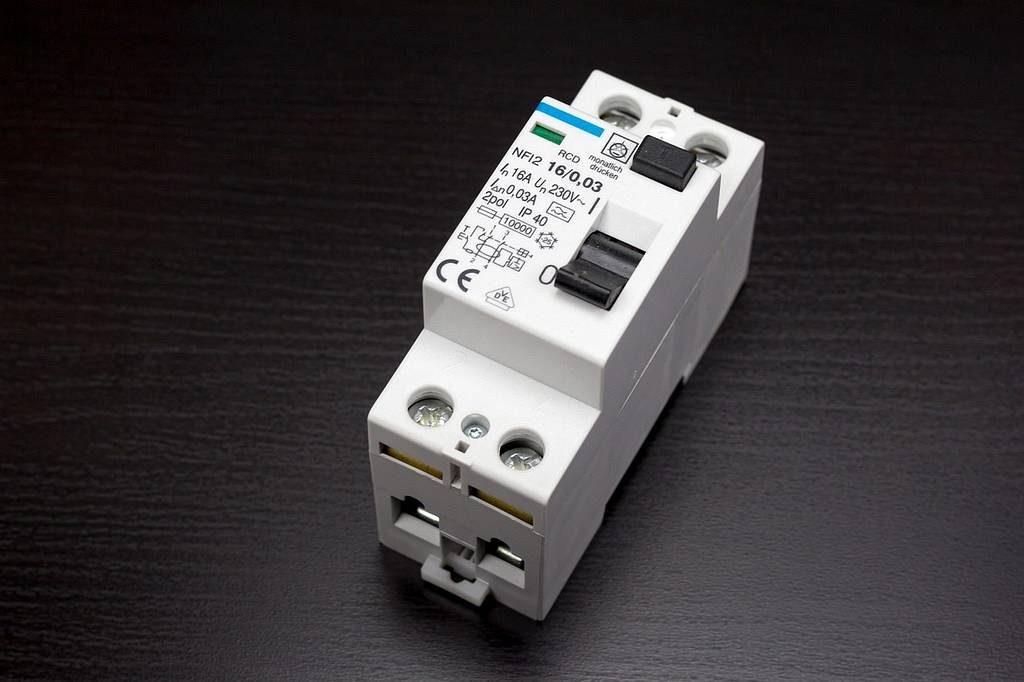
Photo: Diermaier / Wikimedia Commons, CC0
Quickly checking the customer's RCD
Before you need to power an appliance for testing, ask the customer whether that circuit has RCD protection. If it does, press the test button on the device: it should trip at once. If it does not trip, it is faulty or wired incorrectly; tell the customer and use your own RCD-protected extension lead. How to wire and choose an RCD is explained in detail in the lesson how to wire an RCD (RCBO/RCCB) at home.
The technician's own RCD extension lead
Carry an extension lead with a built-in 30 mA RCD (or a portable plug-in RCD). Every time you power an appliance that has its cover off, plug it in through this lead, even if the house already has RCD protection. It is a layer of protection you carry with you, independent of the customer's wiring.
When touching the case gives a tingle
A tingle when you touch a washing machine or fridge case means current is leaking to the case and the earth wire is not doing its job. Stop, do not touch it again, switch off the breaker and unplug. Note for the customer whether the socket is earthed. Finding the leak with an insulation test belongs to a later step; your job now is to make sure nobody touches the appliance until it has been repaired.
A basic appliance repair tool kit
An appliance technician's kit combines an electrician's tools with a mechanic's. Buying the right tools from the start costs much less than replacing cheap ones that break halfway through a job in someone's home.
Insulated screwdrivers and dismantling tools
A set of insulated screwdrivers (usually marked 1000 V, with insulation running almost to the tip, as in Figure 3) in flat and Phillips sizes. Add Torx, hex and tamper-proof bits, because many washing machines and microwaves use these screws. Electrician's pliers, long-nose pliers, side cutters, wire strippers and hose clamp pliers; a small socket and spanner set for motor and pulley bolts.
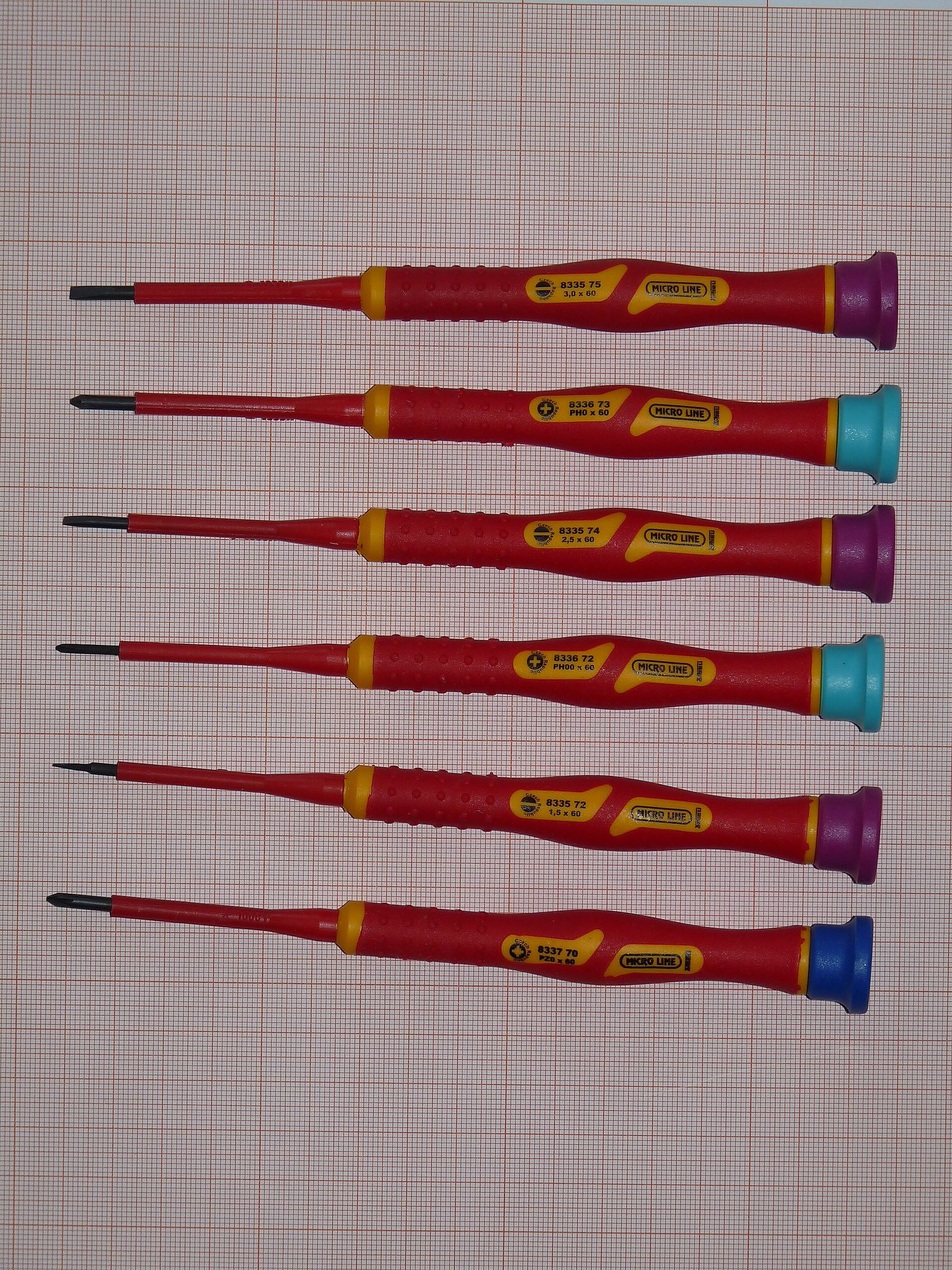
Photo: Dmitry G / Wikimedia Commons, CC BY-SA 3.0
Voltage tester, multimeter and clamp meter
- Voltage tester: quick check for voltage and finding the live terminal of a socket.
- Digital multimeter: AC and DC voltage, resistance, continuity, capacitance; choose one rated CAT III with shrouded test leads.
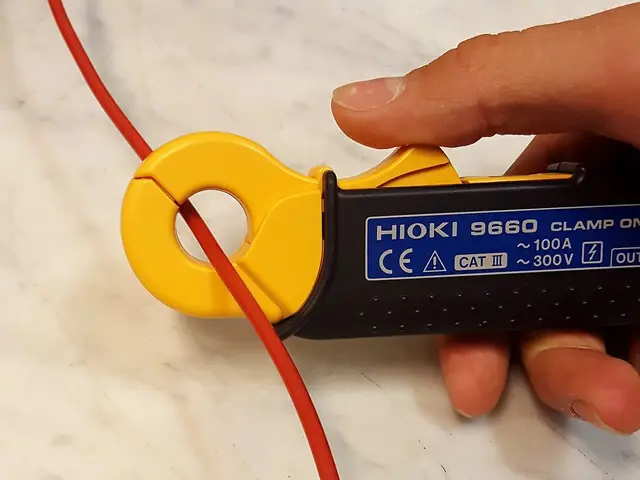
- Clamp meter: measures the current in a wire without cutting it. Clamp only one conductor (live or neutral), as in Figure 4; if you clamp the whole two-core cord, the outgoing and returning currents cancel and the meter reads close to zero.
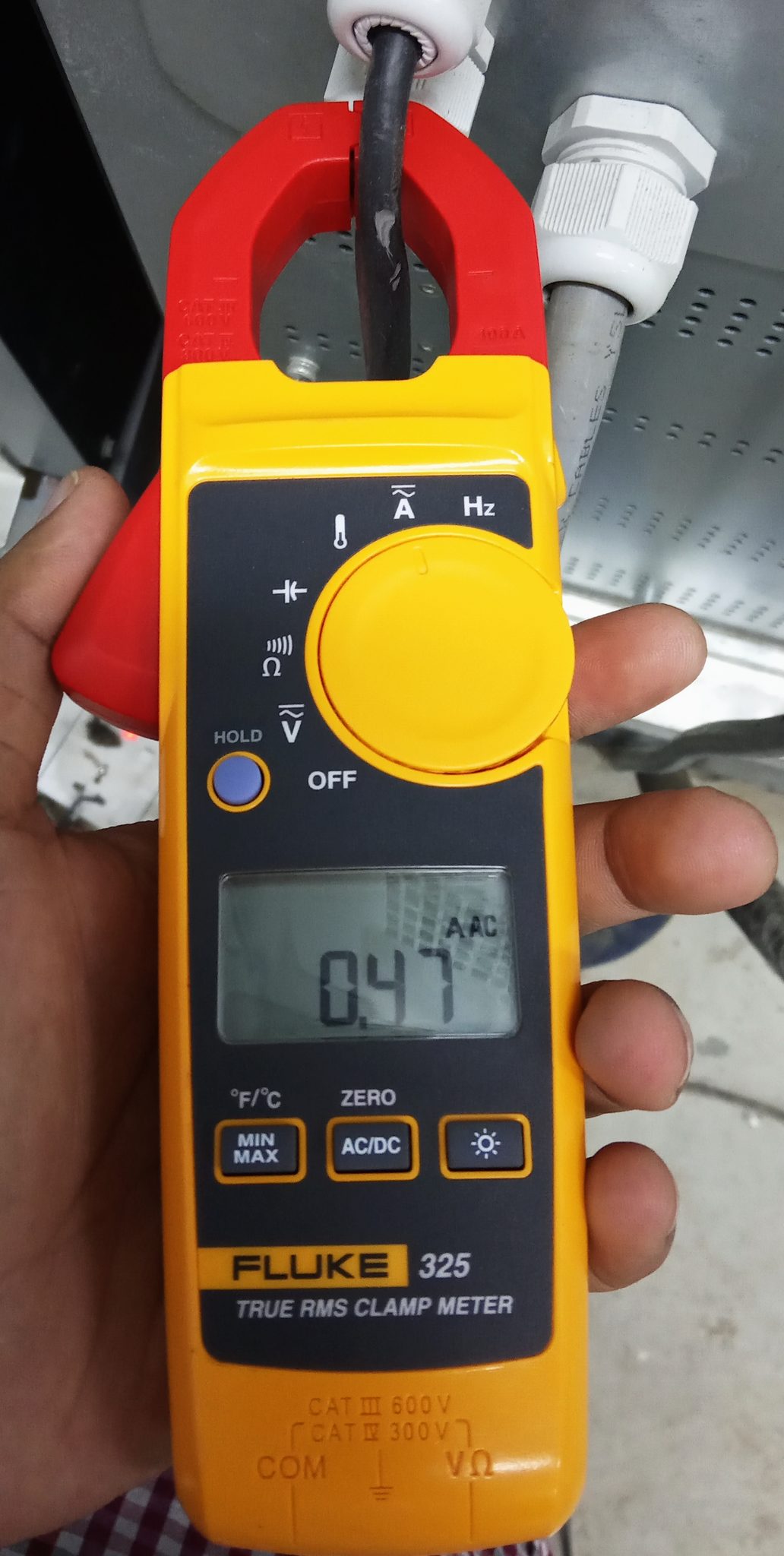
Photo: ZianMan / Wikimedia Commons, CC BY-SA 4.0
Soldering iron and bearing puller
A soldering iron of about 40–60 W, with solder, flux and a desoldering pump, is used for joining wires and replacing through-hole parts on power boards. Only solder on an unplugged appliance, and keep the iron on its stand. A bearing puller (Figure 5) pulls bearings, pulleys and gears off a motor shaft without hammering. Hook the jaws evenly behind the bearing edge, tighten the centre screw slowly, and wear safety glasses because a slipping jaw can fly off.
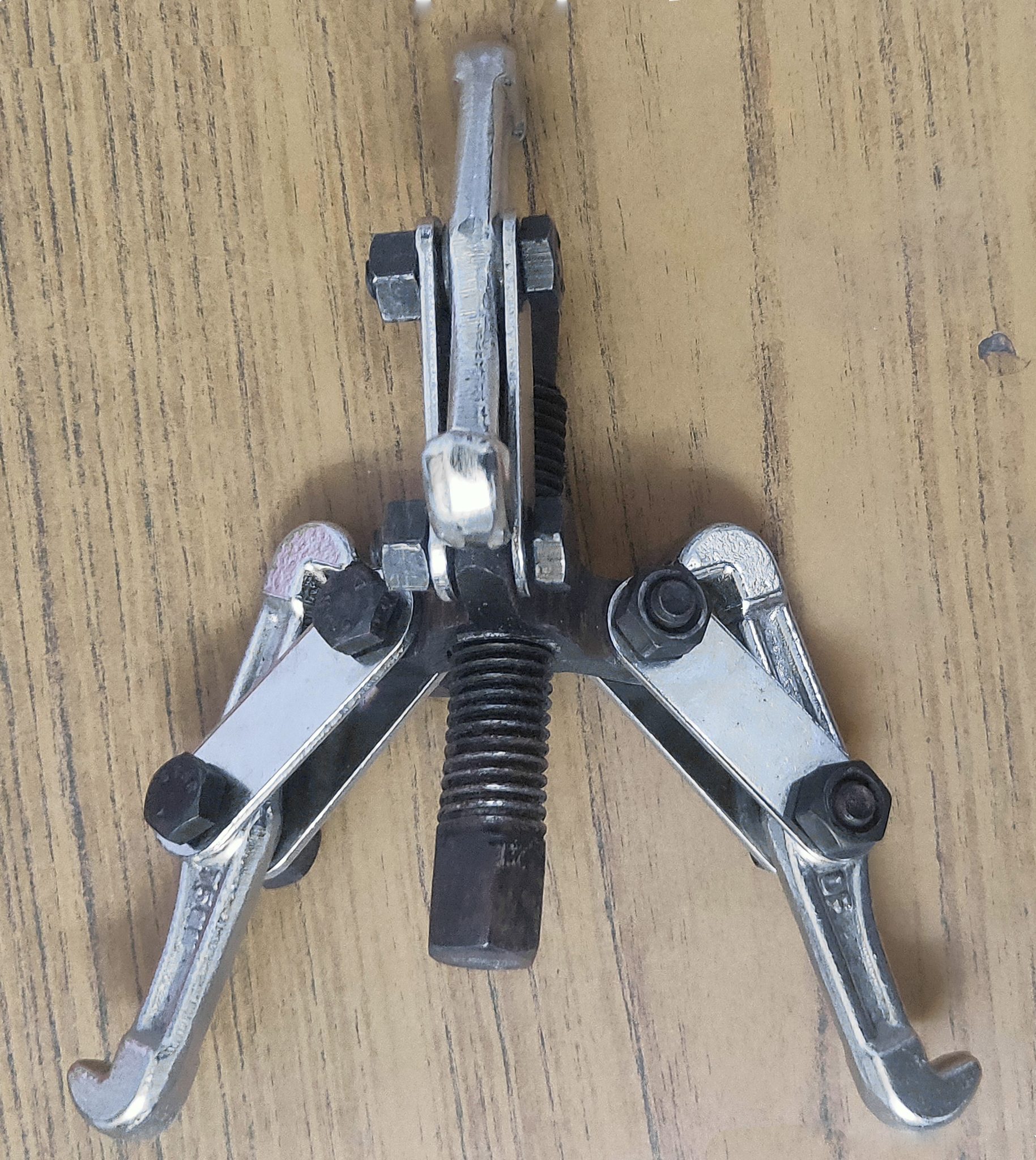
Photo: Nadinviki / Wikimedia Commons, CC BY-SA 4.0
Tool choice by task
| Tool | When to use it | Safety note |
|---|---|---|
| Insulated screwdrivers | Removing covers, terminal blocks, switches | Insulation intact; still isolate the supply first |
| Voltage tester | Quick checks, finding live | Prove it on a live source; do not use it to declare a circuit dead |
| Multimeter | Proving dead, resistance, capacitors | Select the range before the probes touch; shrouded leads |
| Clamp meter | Motor, compressor and heater current | Clamp one core; do not touch bare parts on a running appliance |
| Soldering iron | Wires, through-hole parts | Appliance unplugged; iron on its stand; ventilate flux fumes |
| Bearing puller | Removing bearings and pulleys from shafts | Jaws evenly placed; safety glasses; never hammer the shaft |
| RCD extension lead | Powering an opened appliance for tests | Press test before use |
Worked example: a 3.85 million VND tool kit and the first 15 minutes on site
Minh, 22, has just finished a basic domestic electrics course and wants to repair washing machines and fridges in customers' homes. He lists the minimum tools he needs to go out with a senior technician and handle simple jobs himself.
Tool budget (reference prices for 2026, depending on region and supplier)
| Item | Notes | Reference price |
|---|---|---|
| Insulated flat + Phillips screwdriver set | Several sizes, insulation marked | 250,000 VND |
| Torx, hex and tamper-proof bits + driver | For washer and microwave screws | 200,000 VND |
| Electrician's, long-nose, cutting and stripping pliers | Insulated handles | 350,000 VND |
| Voltage tester + non-contact pen | Quick checks | 120,000 VND |
| Digital multimeter | CAT III, capacitance range | 450,000 VND |
| Clamp meter | AC current | 700,000 VND |
| 60 W soldering iron + solder, flux, pump | With stand | 250,000 VND |
| 3-jaw bearing puller | Small size for motors and pulleys | 250,000 VND |
| Small socket and spanner set | Motor and drum bolts | 400,000 VND |
| 30 mA RCD extension lead | Protection you carry with you | 450,000 VND |
| Gloves, safety glasses, head torch | Personal protective equipment | 200,000 VND |
| Toolbox, towels, drip tray | For home visits | 230,000 VND |
| Total | 3,850,000 VND | |
Check the sum: 250,000 + 200,000 + 350,000 + 120,000 + 450,000 + 700,000 + 250,000 + 250,000 + 400,000 + 450,000 + 200,000 + 230,000 = 3,850,000 VND (about 150 USD). To save money, Minh can borrow the clamp meter (700,000 VND) and bearing puller (250,000 VND) from his senior in the first month, leaving 3,850,000 − 950,000 = 2,900,000 VND to buy. The RCD extension lead is never the item to cut.
A real job: a top-loading washer in a bathroom shows an error
A customer calls because a top-loading washing machine stopped mid-cycle. The machine stands in the bathroom and the floor is still wet. Before diagnosing anything, Minh runs this safety routine and times it:
- Ask about the fault and look at the machine, socket and cord for scorch marks: 3 minutes.
- Ask whether the bathroom circuit has an RCD, press its test button, confirm it trips, reset it: 3 minutes.
- Unplug, place the plug on top of the machine in plain sight, ask the customer not to plug it back in: 2 minutes.
- Prove the tester on another socket, measure both plug pins and the case, prove the tester again: 2 minutes.
- Dry the floor around the machine, lay towels, place a tray, photograph the wiring before removing the cover: 5 minutes.
Total time: 3 + 3 + 2 + 2 + 5 = 15 minutes. These 15 minutes are not charged separately, but they are a mandatory part of every job, and the customer sees your professionalism from the start. Diagnosing specific washer faults comes in the step "Repairing top- and front-load washers", for example the lesson washing machine not spinning: 5 causes and a step-by-step check.
Common beginner mistakes and how to avoid them
Pressing the power button and opening the machine
Symptom: a tingle when touching the power board or terminal block. Cause: believing the power button removes all voltage. Fix: always unplug or switch off the breaker, then measure to prove it dead.
Touching the board right after unplugging
Symptom: a shock from the filter capacitor or a power transistor heatsink on an induction hob or inverter board. Cause: the capacitor had not discharged. Fix: wait a few minutes, measure at the test point in the manufacturer's documentation, and hold boards by their edges.
Clamping the whole supply cord
Symptom: the appliance is running but the clamp meter reads close to 0 A, and you wrongly conclude the motor draws no current. Cause: clamping both cores, so outgoing and returning currents cancel. Fix: clamp a single core, or use a line splitter.
Powering an opened appliance without RCD protection
Symptom: nothing happens, until your hand touches a live part. Cause: complacency. Fix: always power test appliances through an RCD extension lead whose test button you have pressed, hold the probe in one hand and keep the other hand off the case.
Frequently asked questions
What tools do you need to repair household appliances?
At minimum: insulated screwdrivers, Torx and tamper-proof bits, assorted pliers, a voltage tester, a multimeter, a clamp meter, a soldering iron, a bearing puller, a small socket set, an RCD-protected extension lead and personal protective equipment. Around 3–4 million VND in total (reference prices for 2026 in Vietnam, depending on where you buy).
Is it completely safe to repair an appliance once it is unplugged?
Not yet. Unplugging cuts mains power, but capacitors in microwaves, induction hobs and inverter boards can still hold a charge; motors may still be spinning; water may still be hot. You must wait, measure and check for remaining energy sources.
Should I repair a microwave oven myself at home?
If you are not trained, do not remove a microwave's cover. The high-voltage circuit inside can kill, even when the oven is unplugged. Take it to an experienced technician or an authorised service centre.
Can an RCD replace isolating the supply during repairs?
No. An RCD only trips when current leaks to earth; if you touch live and neutral at the same time, current passes through you without leaking to earth and the RCD does not detect it. Isolation is still mandatory; the RCD is an extra layer of protection.
Practice exercises and self-assessment
- On an old appliance (a fan or rice cooker), follow the full sequence of unplugging and test, measure, test again, and write the readings in your notebook.
- Press the test button of the RCD at home and on your extension lead, and record whether each trips.
- Use a clamp meter with a line splitter to measure the current drawn by an iron or electric kettle, and compare it with the rated power on the label (current is roughly the power divided by 220 V).
- List your own tools using the budget template, make the total add up, and mark what you will borrow and what you must buy.
Self-assessment criteria
- Pass: you carry out all three steps of test, measure, test again without looking at notes.
- Pass: you can explain why clamping the whole supply cord reads close to zero, and why an RCD does not replace isolation.
- Pass: you can name at least 3 sources of energy left after unplugging (capacitors, momentum, hot water, springs).
- Not yet: you open a microwave without supervision, power an opened appliance without RCD protection, or declare a circuit dead using only a non-contact pen.
Once you have mastered the safety routine and your tool kit, move on to the next step of the roadmap: Testing components & reading basic diagrams, where you use a multimeter to test heating elements, fan capacitors and motor windings and read the wiring diagram stuck inside the appliance cover.
Keep learning appliance repair: after electrical safety come component testing, washers, fridges, microwaves, induction hobs, water heaters, pricing and launching a home repair service. See the 8-step home appliance repair roadmap.