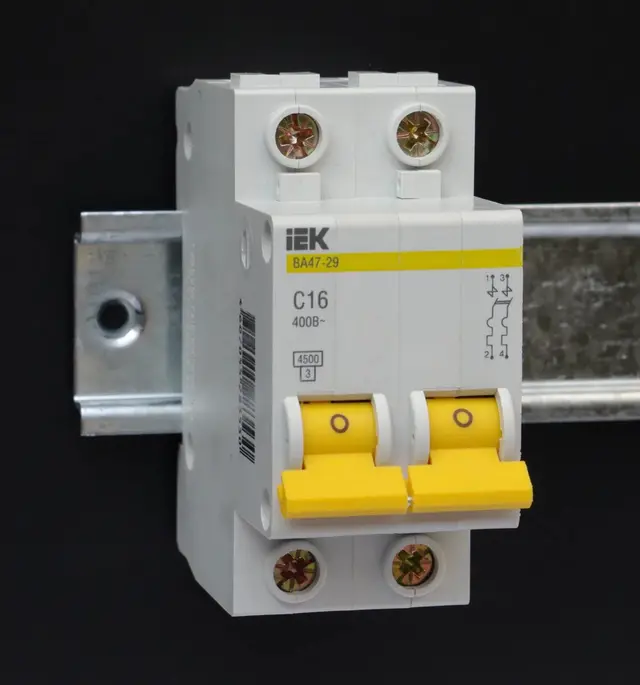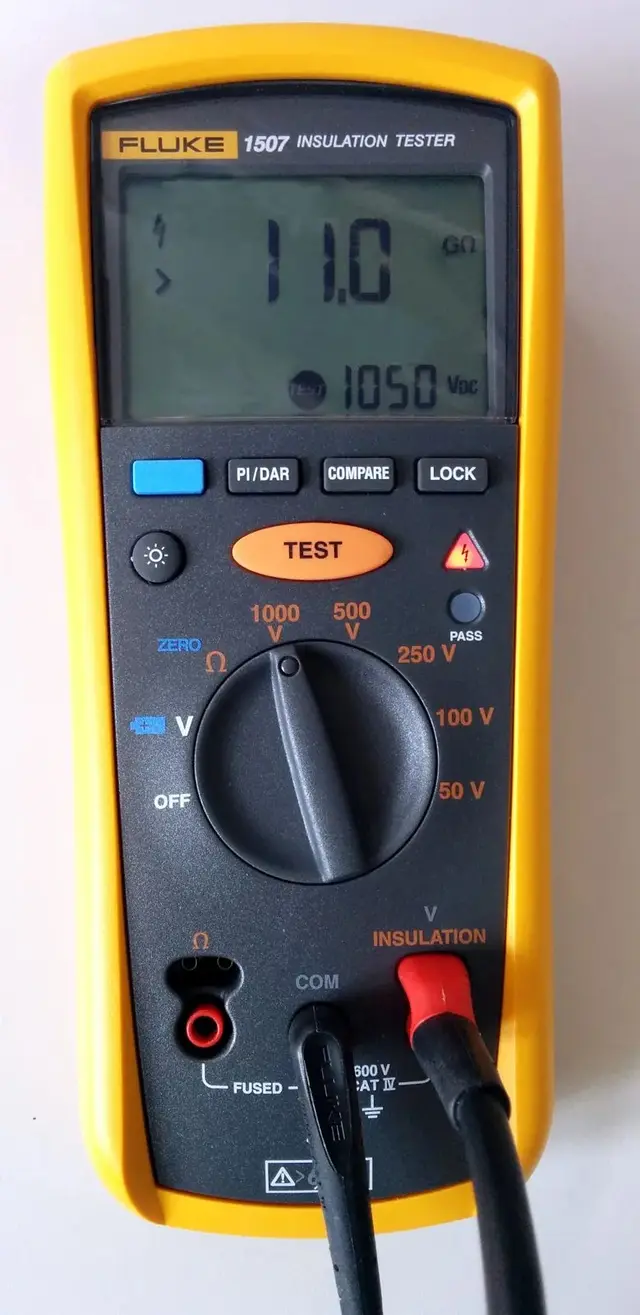
Most electrical accidents in homes do not happen because of a lack of skill, but because of one second of complacency: assuming the breaker is off, assuming the neutral wire is dead, assuming it is "just a quick connection". This is the first step of the Residential Electrician roadmap and a mandatory condition for every hands-on lesson that follows.
By the end of this lesson, you will be able to:
- Explain with numbers why household 220V/50Hz power (the standard supply in Vietnam) can kill.
- Prepare and check your minimum protective gear and tools before every shift.
- Carry out the full 5-step routine: identify the circuit – isolate – lock out and tag – test, measure, re-test – inspect before re-energizing.
- Respond in the right order during the first few minutes when someone gets an electric shock.
Why is 220V in the home still dangerous?
What harms the body is the current flowing through it, not the voltage on its own. Just a few tens of milliamps (mA) across the chest can disturb the heart rhythm. At 220V, when your hands are wet, you stand on a damp floor or go barefoot, your body resistance drops sharply and the current through you rises high enough to be dangerous.
Ohm's law applied to the human body
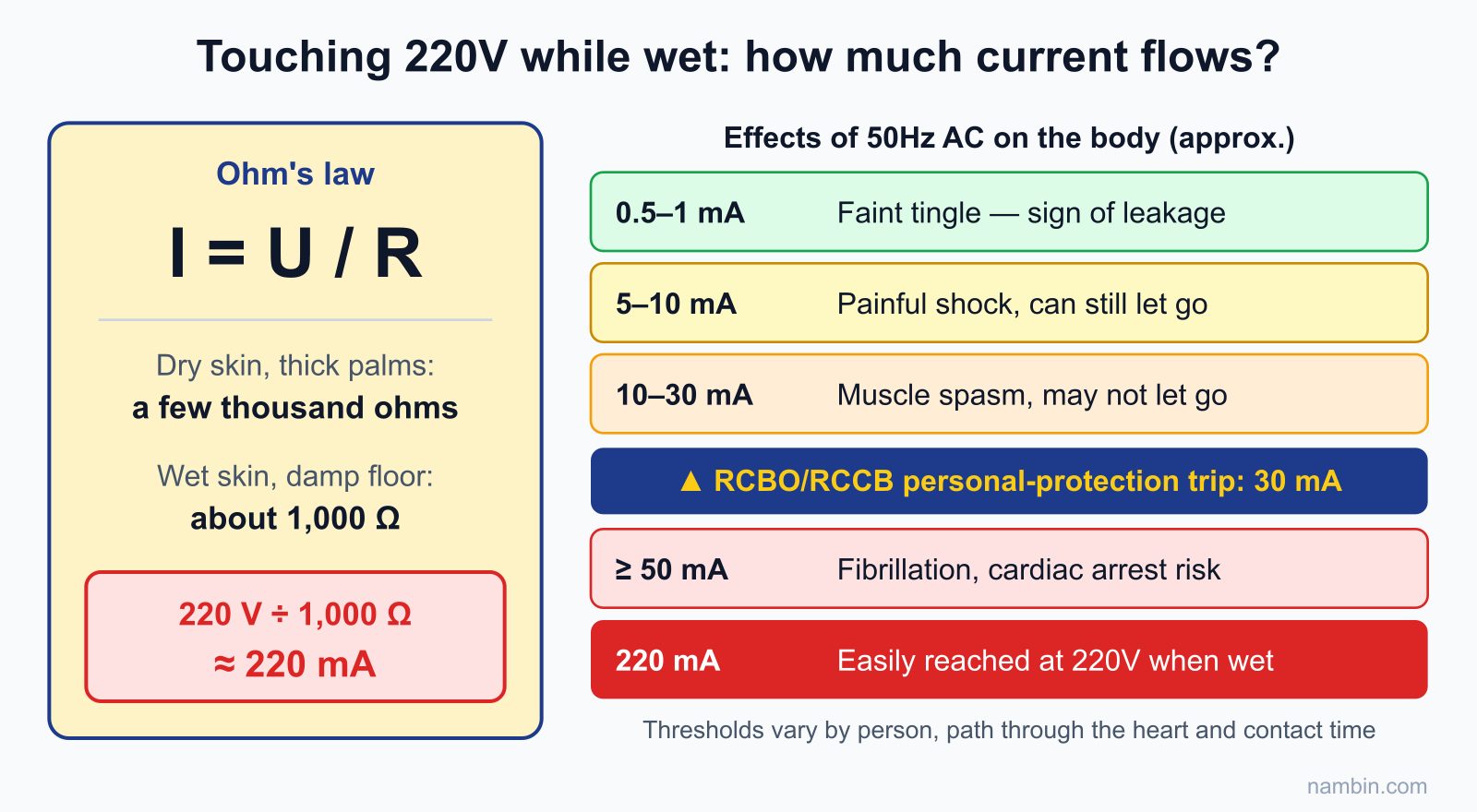
The current through a person is roughly I = U / R, where U is the voltage touched and R is the total resistance along the current path: skin, body, footwear and floor. Body resistance is not fixed. Dry, thick skin on the palm may give a few thousand ohms; skin wet with sweat, scratched, or in contact over a wide area can drop to about 1,000 ohms or less.
Do the simple math: 220V divided by 1,000 ohms is about 0.22A, or 220 mA — many times higher than the level that can cause ventricular fibrillation (the heart quivers chaotically and stops pumping blood). That is why an ordinary wall socket can be fatal, especially in bathrooms, kitchens and on rooftops after rain.
The current path matters as much as the amount
Current flowing hand to hand or hand to foot crosses the chest and passes through the heart — the most dangerous path. That is why experienced electricians get used to working with one hand near anything that might be live, never resting the other hand on a metal panel or water pipe. This habit does not replace isolating the power; it only reduces risk if something unexpected happens.
Contact time also decides how severe the injury is. From about 10–20 mA, the hand muscles clamp so the victim cannot let go by themselves. That is why residual-current devices for personal protection (RCBO, RCCB) use a 30 mA threshold and must trip very fast: no more than 0.3 seconds at exactly 30 mA, and only a few tens of milliseconds when the leakage is several times higher.
Reference table: effects of 50Hz alternating current
The thresholds below are approximate and vary by person, current path and contact time. The goal is to help you picture why "a few tens of mA" is already a frightening number.
| Current through the body (approx.) | Sensation / effect | What it means for an electrician |
|---|---|---|
| About 0.5–1 mA | A faint tingle begins | Sign of leakage — inspect right away |
| About 5–10 mA | Painful shock, can still let go | You may flinch and fall off a ladder — a secondary accident |
| About 10–30 mA | Muscle spasm, hard or impossible to let go, difficulty breathing | Why personal-protection RCBOs/RCCBs trip at 30 mA |
| About 50 mA and above | Risk of ventricular fibrillation, cardiac arrest if prolonged | Can be fatal in less than one second |
| Hundreds of mA to several A | Deep burns at entry and exit points, internal organ damage | Easily reached at 220V when the body is wet |
Three common accident paths
- Direct contact with the live (phase) wire when you think the power is off.
- Indirect contact with the metal casing of a leaking appliance (water heater, washing machine) when there is no earthing.
- Arc flash and fire when you short a circuit under load, burning your eyes and hands.
There are also secondary accidents: a mild shock on a ladder makes you jump and fall 2–3 meters — the fall is often worse than the current itself.
Warning: The neutral wire (N) is not always safe. With incorrect wiring, a lost neutral, or load current returning through it, the N wire can still carry a dangerous voltage. Treat every wire as live until you yourself have measured that it is not.
Minimum protective gear and tools
You do not need an expensive kit to start, but you must not go without the following:
| Item | What it is for | What to check when buying |
|---|---|---|
| Insulating gloves | Protect your hands when working near possibly live parts | Voltage class marked, no tears, no holes |
| Insulated-sole shoes | Reduce current flowing through your feet to ground | Solid rubber sole, kept dry |
| Safety glasses | Protect against arc flash and metal chips when drilling | Close fit around the face |
| Voltage tester pen | Quick check for presence of voltage | Prove it on a known live source before use |
| Multimeter | Accurate voltage measurement between wires | Probe leads fully insulated, suitable range |
| Insulated pliers and screwdrivers | Making connections | Handles not cracked, insulation marking present |
| Lock and warning tag | Stop others from switching the power back on | Tag clearly reads "Work in progress – do not switch on" |
Check your protective gear before every shift
Damaged protective gear is more dangerous than none, because it gives you a false sense of safety. Before you start, spend two minutes checking:
- Gloves: roll the cuff tightly to trap air inside, then squeeze gently; if the glove deflates or you hear a hiss, there is a hole and it must be thrown away. Do not use gloves soaked in oil or petrol, or made brittle and cracked by the sun.
- Shoes: soles not worn through, no nails or metal chips stuck in them. Wet shoes lose most of their insulating value.
- Insulated tools: the plastic is not cracked or melted out of shape, and no tape is hiding damage.
- Ladder: all rubber feet present, rungs solid, A-frame lock working. Prefer a dry wooden or fiberglass ladder for electrical work.
- Clothing: long sleeves, cotton fabric. Synthetic fabric can melt onto the skin in an arc flash and deepen the burn.
Why do you need both a tester pen and a multimeter?
A tester pen is fast but easily gives false results: it shows voltage because of induced voltage on a long wire, or shows nothing because of a weak battery or the wrong grip. The trade rule: the pen is for screening, the meter is for confirming.
The 5-step routine before touching a wire
This is the core sequence, simplified from the lockout/tagout procedure used in industrial electrical work. In homes, no step may be skipped.
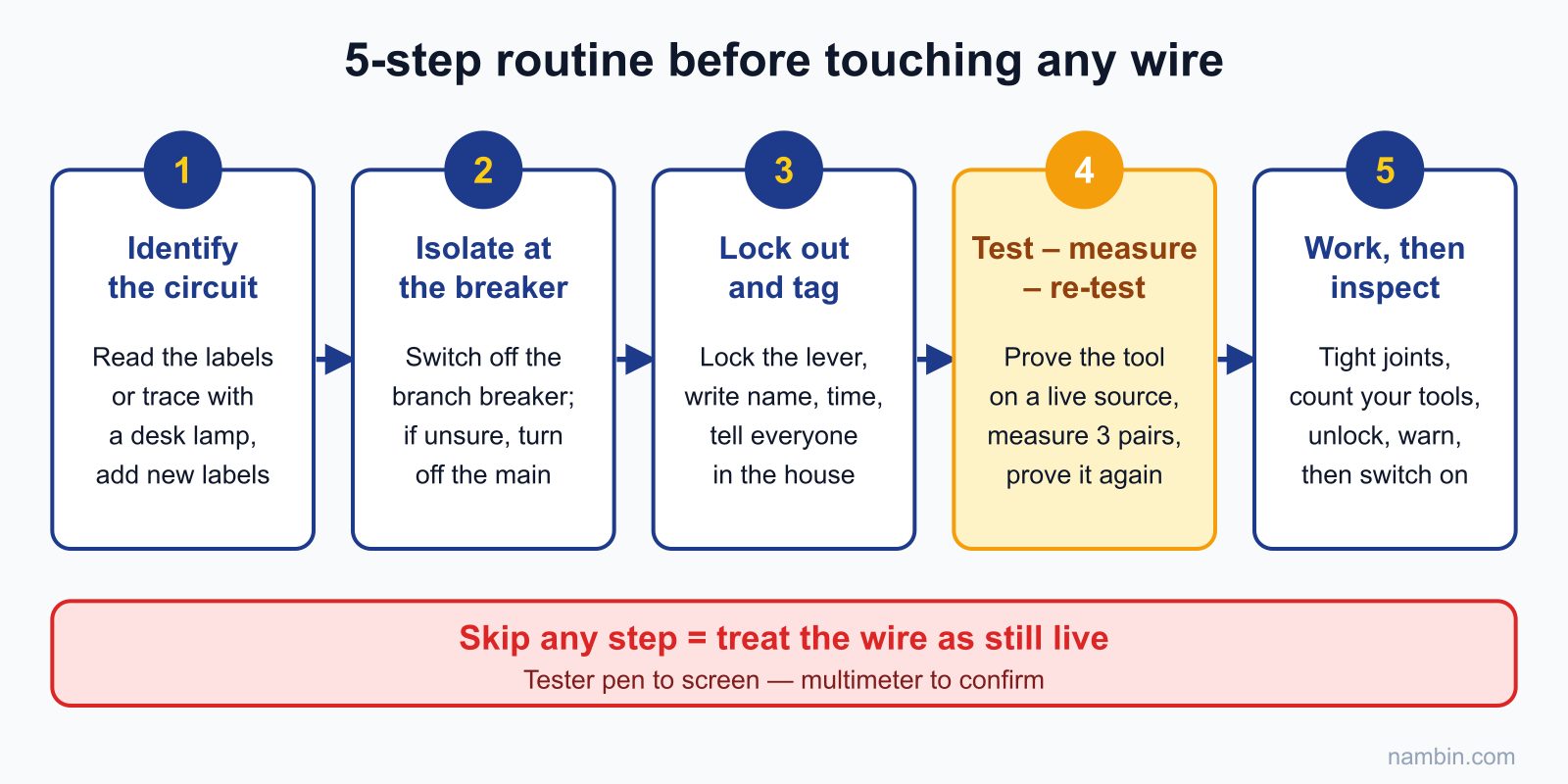
- Identify the right circuit. Look at the panel diagram or breaker labels. If the panel has no labels, switch off one breaker at a time and see which devices lose power, then label them for next time.
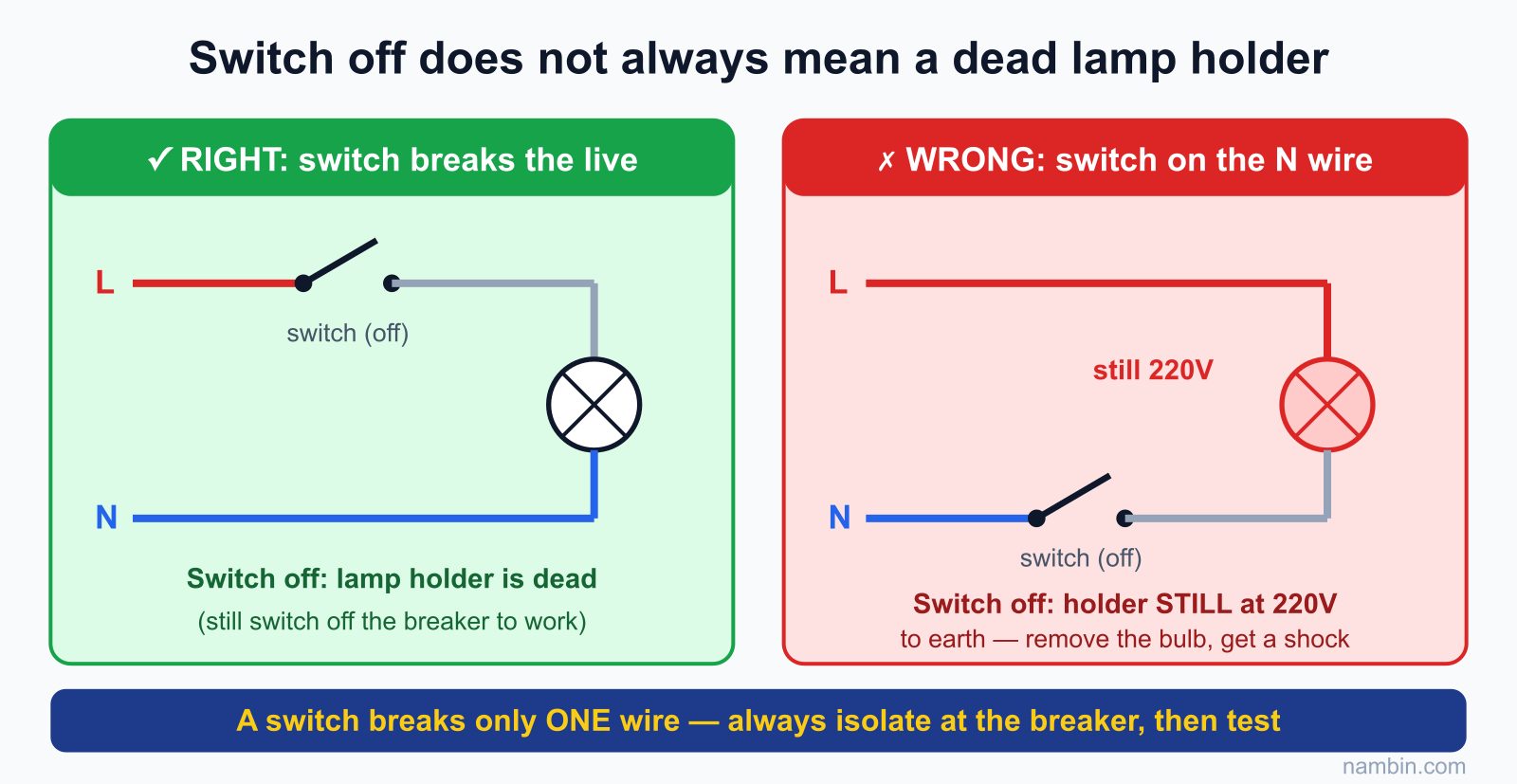
- Isolate the power. Switch off the breaker for that circuit. If you are not sure, switch off the main breaker. Never just turn off a light switch and start working — a switch usually breaks only one wire.
- Lock out and tag. Use a breaker lock, or tape over the lever with a warning tag. Tell everyone in the house that you are working and must not touch the panel.
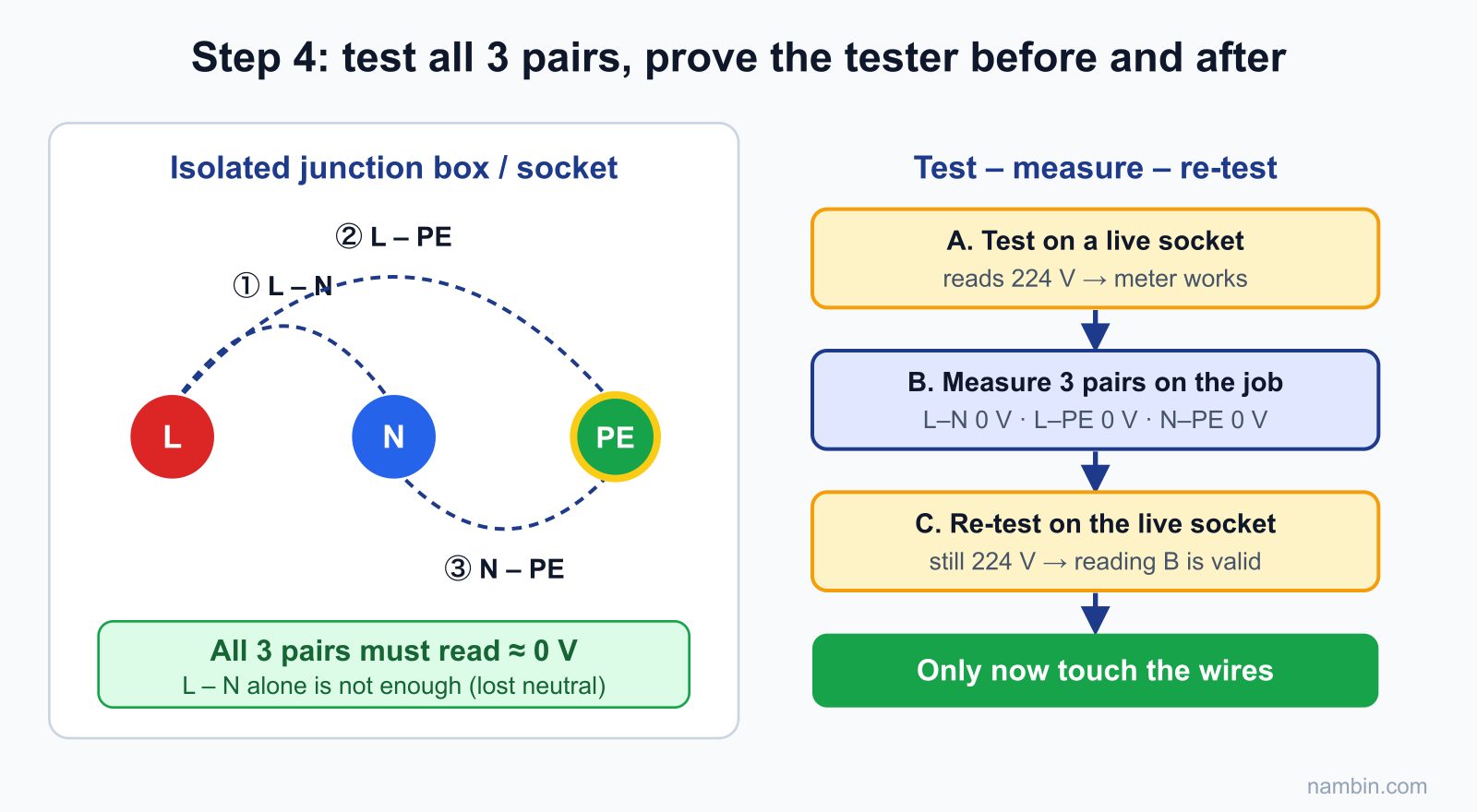
- Test – measure – re-test. Try your pen or meter on a socket that is live to confirm the tool works, measure the wires you will work on, then try the tool on the live source again. These three checks rule out a faulty tool giving a false "no voltage" result.
- Work, then inspect before re-energizing. After connecting, check that joints are tight, no bare copper is exposed and no tools are left in the box. Remove the lock, warn everyone, and only then switch the power back on.
Step 1 in detail: when the panel has no labels
Older houses often have unlabeled panels, or labels that became wrong after years of repairs. How to trace: plug a desk lamp into the socket you will work on, switch off the breakers one by one and watch, then write on masking tape under each breaker: "Bedroom sockets, 2nd floor", "Kitchen lights"… A socket can be fed by two circuits if a previous electrician took shortcuts — so step 4 is still mandatory even when the device is already off.
Step 2 in detail: why a switch is not isolation
A light switch breaks only one wire. If a previous electrician put the switch on the neutral instead of the live wire, the lamp holder still sits at 220V to earth when the switch is off. Remove the bulb, touch the holder, and you get a shock even though the light is "off". With two-way switch circuits (on stairs), the state is even harder to predict. Always isolate at the breaker.
Step 3 in detail: lockout and tagging, home style
If you do not have a dedicated breaker lock, put wide tape across the lever and write your name, the start time and "Under repair – do not switch on". If the panel door can be locked, lock it and keep the key in your pocket. In apartment buildings, the unit's panel is sometimes in the corridor — the tag matters even more, because passers-by do not know you are working.
Step 4 in detail: which wire pairs to measure?
Measure every pair: live – neutral, live – earth, neutral – earth. All must read close to 0V. If you only measure live – neutral, you may miss a disconnected neutral that is carrying voltage to earth. For double sockets or junction boxes with many wires, measure each wire against earth — some boxes hold wires from two different circuits.
Worked example: replacing a bedroom socket in a 3-story tube house
To see the routine in real life, follow a typical job. A customer in a 3-story tube house (the narrow, deep townhouse common in Vietnamese cities) reports that the bedside socket on the 2nd floor is loose, phone chargers cut in and out, and the faceplate has yellow stains. You arrive with an apprentice.
Survey and isolation
You ask what usually gets plugged in (a fan, a phone charger, sometimes a 1,200W hair dryer), then go down to the panel on the ground floor. It has 6 breakers, only 3 labeled. The apprentice plugs a desk lamp into the socket and reports by phone; you switch off the unlabeled breakers one at a time, and at the 5th breaker the lamp goes out. You label it "2nd floor sockets", then tape the lever and write "Under repair – do not switch on – 9:15".
Measuring before removing anything
Upstairs, you try the multimeter on a corridor socket that is still live: it reads 224V — the meter works. You remove the faulty socket's faceplate and measure live – neutral: 0V; live – earth: 0V; neutral – earth: 0V. Back at the corridor socket you measure again: 224V. Only when all three readings tell the same consistent story do you start disconnecting wires.
Replacing the socket and re-energizing
When you remove it, you find the live conductor blackened and its screw loose — the cause of the heat and yellow stains. You cut off about 1 cm of oxidized copper, strip the end again to the right length, and fasten it tightly to the new socket in the correct live – neutral – earth positions. You check that no copper strands stick out, fold the wires neatly into the back box and fit the faceplate. Before going downstairs, you count your tools: pliers, screwdrivers, meter — all there. You tell the customer the power is coming back, remove the tape and switch the breaker on. Measuring the new socket gives 223V between live and neutral, and a test charger works steadily. Finally, you advise the customer not to run a hair dryer and an electric kettle at the same time on one double socket.
The safety part took about 10 extra minutes and removed three risks: the wrong breaker, a faulty meter, and a family member switching the power back on.
Mistakes beginners often make
- Trusting wire colors. Older houses are often wired without following color codes. Measure, do not guess.
- Working live because they do not want to cut power to the whole house. A 10-minute outage is always cheaper than an accident.
- Wearing rings or a metal watch inside a panel — metal can cause a short and severe burns.
- Working alone in dangerous places. For main panels or large sites, always have a second person who knows how to cut the power and give first aid.
A closer look at the three most dangerous mistakes
Mistake 1 — Skipping the tool check. Sign: you read 0V and feel safe, but the meter is on the wrong range or a probe lead is broken inside. Cause: hurrying, thinking "the meter was fine yesterday". Fix: proving the tool on a live source before and after must become a reflex, like fastening your seatbelt when driving.
Mistake 2 — Switching off the wrong breaker. Sign: the device you watched is off, but wires from another circuit run through the same box. Fix: measure every wire in the box against earth; if one is still live and you cannot find its breaker, switch off the main breaker.
Mistake 3 — Re-energizing without inspection. Sign: a "bang" when you switch on, and a blackened faceplate. Cause: a copper strand touching the box, an unfastened screw, a screwdriver forgotten inside. Fix: look over the joints, count your tools, stand to the side of the panel when you flip the breaker and switch it firmly.
Working conditions
Do not do electrical work outdoors in rain or thunderstorms, and do not work when tired or after drinking alcohol. In poor light, wear a headlamp — do not rely on the lights of the circuit you just isolated. If a bathroom or kitchen floor is wet, dry it and stand on a rubber mat or dry wooden board.
Limits of your work: An apprentice works only on the household side after the electricity meter. Never interfere with wiring before the meter, utility poles, low-voltage street lines or a building's main distribution board — that is the job of the power company or building management, and requires people with the appropriate certificates and licenses.
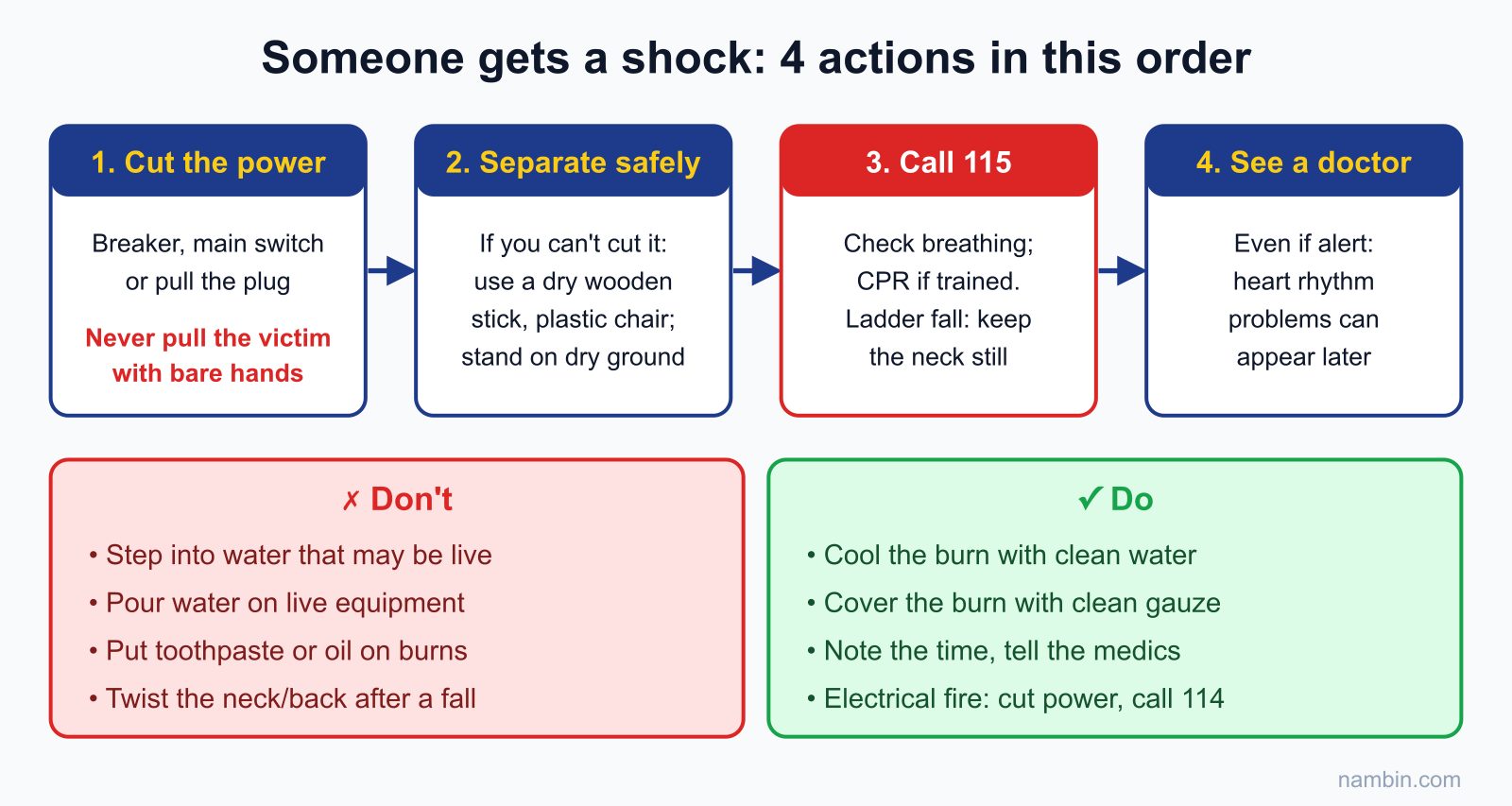
If someone gets an electric shock
The right reflexes in the first few seconds make a huge difference:
- Cut the power immediately (breaker, main switch, or pull the plug). Do not pull the victim with bare hands.
- If you cannot cut the power, use a dry non-conductive object (a dry wooden stick, a plastic chair) to separate the victim from the source.
- Call 115 (the emergency medical number in Vietnam). Check breathing; if you have been trained, perform CPR while waiting.
- Even if the victim is alert, they should still see a doctor, because a shock can cause internal injuries that are not visible right away.
More to know about first aid
Before approaching, look around: is the floor wet, is the victim touching a live metal object? Step into a live puddle and you become the second victim. Electrical burns are often small on the surface but the damage underneath can be deep, so only cool the burn and cover it with gauze as in Figure 5, then let medical staff assess it. For an electrical fire: cut the power first, use a suitable extinguisher, and call 114 (the fire service number in Vietnam).
At every job site, before starting, know where the main breaker is and the exact address to give the dispatcher. It is worth taking a first-aid course with hands-on CPR practice at an accredited training center.
Frequently asked questions
I already switched off the main breaker. Do I still need to measure?
Yes. A breaker can have welded contacts (the lever is down but the contacts inside are still closed), and the house may have a second source such as a generator, a UPS or a solar system, or a circuit tapped in before the main breaker. Only a measurement tells you the truth.
Is an RCBO/RCCB enough to let me work on live wires?
No. A residual-current device only trips when current leaks to earth. If you touch the live and neutral wires at the same time (current goes in one hand and out the other), the device "sees" no imbalance and does not trip. It is a backup layer of protection, not a license to work live.
With insulating gloves on, can I work while the power is on?
Not as a residential electrician. Gloves reduce risk when working near parts that might be live, but live work requires its own training, tools and procedures. In homes, always isolate the power.
I had a mild shock and feel fine. Do I need to see a doctor?
You should, especially if the current crossed your chest (hand to hand, hand to foot), or if you blacked out, have chest pain, palpitations or burns. Heart rhythm problems can appear later.
Are there Vietnamese regulations on electrical safety I can refer to?
Yes. There is a national technical regulation on electrical safety issued by the Ministry of Industry and Trade, and TCVN (Vietnamese national standards) on electrical installations in dwellings. Read the current original texts on official government portals rather than copied documents.
Practice exercises and self-check before the next step
- Can you explain why you must prove your measuring tool on a live source before and after measuring?
- Have you prepared gloves, shoes, a tester pen, a multimeter and a warning tag?
- Practice: label every breaker in your home's panel completely.
Exercise: rehearse the 5-step routine
After labeling the panel (with the homeowner present), sketch a hand-drawn diagram of the main breaker and its branches. Then pick a socket and go through all 5 steps as in the worked example, but without disconnecting any wires: isolate, lock, tag, measure 3 times and write the readings in a notebook. Repeat at three different locations until you can do it smoothly without looking at your notes.
Self-assessment criteria
- Pass: every breaker has a label that matches reality; you recorded all 3 measurements with actual readings; you never skipped the tool check.
- Pass: you can explain in your own words why a switch is not isolation and why the neutral wire can be live.
- Pass: you can immediately state where the main breaker is, plus the emergency numbers 115 (ambulance) and 114 (fire).
- Not yet, redo: you touched a wire before measuring; you forgot to tell people in the house; you did not check your gloves and shoes before starting.
Once this habit is in place, the next step in the roadmap is Multimeter & voltage tester pen: you will learn to read the numbers in step 4 correctly — measuring voltage, continuity and resistance, and finding the live wire — so that "test – measure – re-test" is not just a habit but a reliable measurement. What you learned here is also mandatory theory for the safety test in step 7.