You turn the hot tap on and wait. Thirty seconds, a full minute, and the water is still cold; then it turns lukewarm and finally hot. A short wait is normal in almost every house. A wait so long that people give up usually has a cause you can find and often fix.
This guide explains where the wait comes from, how to estimate it with simple arithmetic, how to tell a "long pipe" problem from a heater or mixer fault, and which fixes really shorten it.
Scope and safety. For trainee and working residential plumbers and interested homeowners, in typical Vietnamese homes: PPR pipework, a rooftop tank, sometimes a booster pump, and a storage heater (bình nóng lạnh), instant electric heater or rooftop solar heater, on a 230 V / 50 Hz supply. Measuring, observing and insulating pipes are safe for a careful homeowner. Work on a heater's wiring, thermostat or element, or a new circuit for a heater or pump, is for a competent electrician or the maker's service technician. Every electric water heater must be earthed and RCD-protected (residual current device), and switched off at its own breaker before any cover is removed. Numbers marked for reference are typical examples for estimating, not rules or limits from a standard.
Why you have to wait: the cold water already in the pipe
When nobody uses hot water for a while, the water in the hot pipe between the heater and the tap cools to room temperature. Plumbers call this stretch a dead leg. When you open the tap, that cold water has to come out before hot water from the heater arrives.
How long that takes depends on how much water is in the pipe (its length and inner diameter) and how fast the tap lets it out (the flow rate):
Wait time ≈ volume of water in the pipe ÷ flow rate at the tap
The real wait is usually a bit longer, because the first hot water loses heat to the cold pipe walls and mixes with the water in front of it. Treat the result as the minimum wait.
Step 1: Measure the flow rate at the tap
Open the hot tap the way the customer normally uses it and time how many seconds it takes to fill a 1 litre jug. Flow in litres per minute = 60 ÷ seconds. A jug filled in 15 seconds means 60 ÷ 15 = 4 litres per minute; 30 seconds means 2 litres per minute. Take care near the end: storage and solar heaters can deliver very hot water.
Step 2: Estimate the volume of water in the hot pipe
Trace the hot pipe from the heater outlet to the tap, estimate its length including vertical runs in walls, and multiply by the volume per metre.
PPR pipe is sold by outer diameter (20, 25, 32 mm), but the inner diameter is what counts, and it depends on the wall thickness, which varies with pressure class (PN10, PN16, PN20) and maker. Thick-walled pipe such as PN20 is commonly used for hot lines; the marking printed on the pipe usually shows outer diameter and wall thickness. The volume of 1 metre is:
Litres per metre = 0.000785 × (inner diameter in mm)²
For a pipe with an inner diameter of 16.6 mm: 0.000785 × 16.6 × 16.6 = 0.000785 × 275.6 ≈ 0.216 litres per metre.
Reference table: approximate water volume per metre of PPR pipe
For reference only: inner diameter varies by PN class and maker. Wall thicknesses below are typical examples; use the figures printed on the actual pipe where you can.
Outer diameter | Example wall (thin, e.g. PN10) | Inner diameter | Litres per metre | Example wall (thick, e.g. PN20) | Inner diameter | Litres per metre |
|---|---|---|---|---|---|---|
20 mm | 1.9 mm | 16.2 mm | about 0.21 | 3.4 mm | 13.2 mm | about 0.14 |
25 mm | 2.3 mm | 20.4 mm | about 0.33 | 4.2 mm | 16.6 mm | about 0.22 |
32 mm | 2.9 mm | 26.2 mm | about 0.54 | 5.4 mm | 21.2 mm | about 0.35 |
Volume grows with the square of the diameter, so a 32 mm pipe holds roughly two and a half times as much water per metre as a 20 mm pipe of the same class. A short braided hose under a basin has a small bore and adds little.
Step 3: Work out the expected wait
Worked example: kitchen sink far from the heater
A storage heater is mounted in the upstairs bathroom. The hot pipe to the kitchen sink downstairs is about 15 m of 25 mm PN20 PPR (inner diameter about 16.6 mm, so about 0.216 litres per metre).
Volume in the pipe: 15 m × 0.216 L/m ≈ 3.2 litres
Measured flow at the kitchen tap: 4 litres per minute
Minimum wait: 3.2 ÷ 4 = 0.8 minutes ≈ 48 seconds
Now change one thing at a time:
Same pipe, low-flow aerator giving 2 L/min: 3.2 ÷ 2 = 1.6 minutes ≈ 96 seconds. The pipe holds the same water; it just comes out at half the speed.
Same flow (4 L/min), but 20 mm PN20 pipe (about 0.137 L/m): 15 × 0.137 ≈ 2.1 litres, so about 31 seconds.
Same flow, but 32 mm PN20 pipe (about 0.353 L/m): 15 × 0.353 ≈ 5.3 litres, so about 80 seconds.
If the calculated wait is close to what the customer experiences, the cause is simply the layout and the flow. If the real wait is much longer, or the water never gets properly hot, look at heat loss, the heater and crossflow (Steps 4 to 6).
Worked example: solar heater on a town-house roof
In a narrow Vietnamese town house (nhà ống), the solar heater sits on the roof, five floors above the kitchen. The hot pipe runs about 18 m down and about 4 m across: 22 m of 25 mm PN20 pipe.
Volume: 22 × 0.216 ≈ 4.75 litres
At 5 L/min: 4.75 ÷ 5 ≈ 0.95 minutes ≈ 57 seconds
At 3 L/min: 4.75 ÷ 3 ≈ 1.58 minutes ≈ 95 seconds
Nearly 5 litres of cold water before every rinse explains why families say "the solar heater is weak" when the pipe is simply long.
Step 4: Check the common layout causes
The heater is far from the fixtures
The most common cause: a heater in one bathroom also serves a kitchen or a bathroom on another floor. Sketch the heater and every hot outlet with pipe lengths; the longest runs are your problem points.
The pipe is larger than it needs to be
Some installers keep a large pipe "for good pressure" all the way to a basin tap that needs only a small flow. A long 32 mm run to one washbasin can hold more than twice as much cold water as a properly sized branch, so oversizing makes the wait longer without making the tap work better.
Low-flow fixtures and aerators
Low-flow aerators and shower heads save water but lower the flow, so the pipe takes longer to clear. A partly blocked aerator does the same unnoticed. If the wait has grown over months, clean the aerator and measure again. Removing aerators permanently is not the fix; reducing the water in the pipe is.
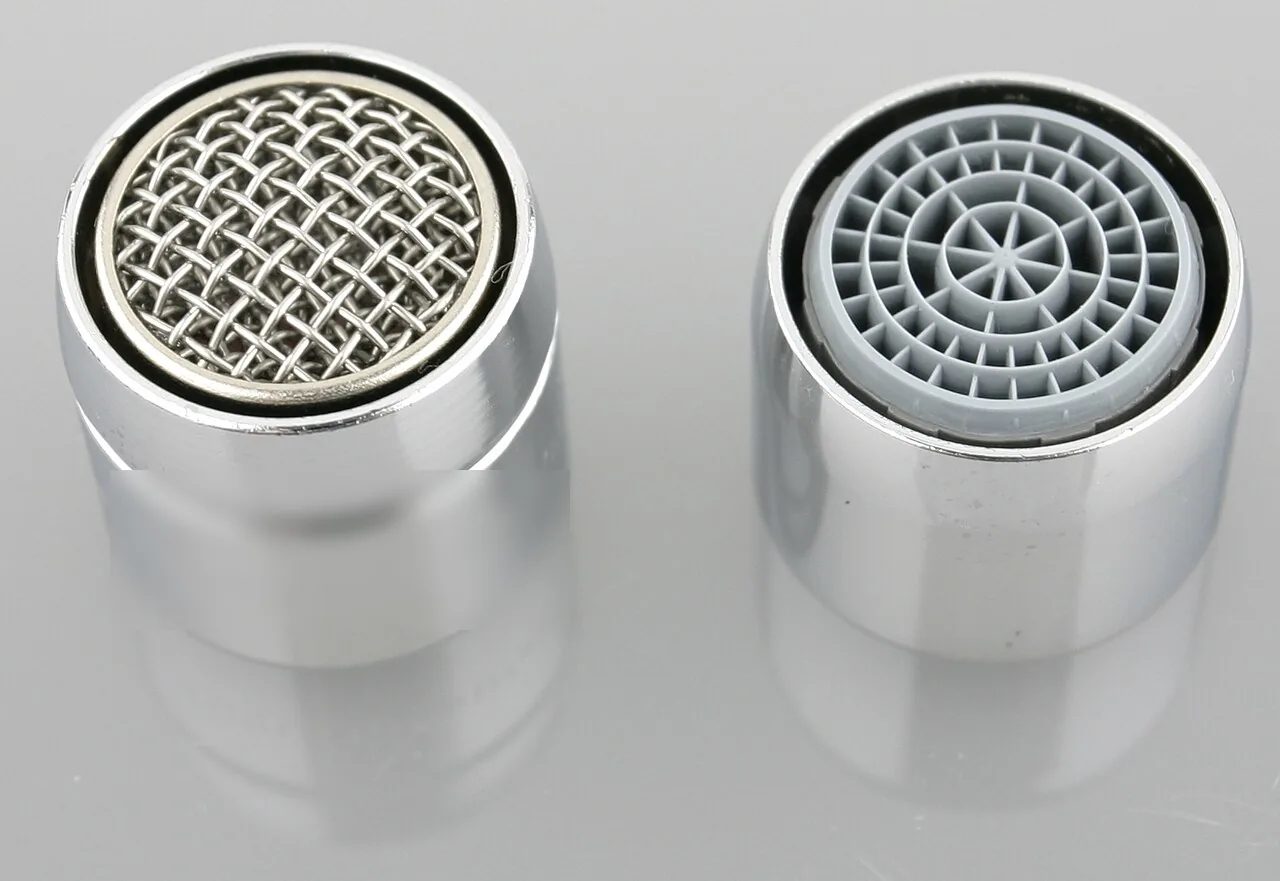
Figure 1. Two tap aerators side by side: one with a fine stainless steel mesh screen, the other with a grey plastic grid insert. Aerators shape the flow and many also limit it, so a hot tap with one can take longer to clear the cold water from the pipe; a blocked one is worth cleaning first. (Photo: SRuhnke, Wikimedia Commons, CC BY-SA 3.0)
Uninsulated pipe runs
A bare hot pipe loses heat while water waits in it and while hot water flows through it, faster on the roof, in outside walls or in contact with concrete. Signs:
The water arrives warm but not as hot as at a tap near the heater.
The wait is short if the tap was used a few minutes ago, but long after an hour.
Hot pipes on the roof or in a light well are bare, cracked or have lost their covering in the sun.
Step 5: Check the water heater
If the water never becomes properly hot, run the tap nearest the heater first. If even that tap stays lukewarm, the heater or its supply is the problem.
Storage heater (bình nóng lạnh)
No hot water at all, even at the nearest tap: the heater may be switched off, its breaker or RCD may have tripped, the thermostat may be set too low, or the element or thermostat may have failed. Check the switch and indicator lamp. Do not open the cover; a failed element or thermostat is a job for an electrician or service technician.
Hot at first, then cold after a few people have showered: the tank is empty of hot water and needs time to reheat. This is a capacity problem, not a pipe problem.
Slowly getting worse over the years: scale or sediment; service as the manufacturer instructs.
Instant electric heater
An instant heater heats only while water flows, and switches on only above a minimum activation flow given in its manual. With the tap barely open, or low gravity pressure on a top floor, it may not switch on at all, and the customer thinks "hot water takes forever". Open the tap fully and watch the indicator. If it only works at full flow, check the inlet filter, aerator or shower head, the supply pressure and the manual before blaming the pipe.
Solar heater on the roof
Rooftop evacuated-tube solar heaters are common on Vietnamese town houses. Typical issues:
Long downpipe. The tank is on the roof and the taps are several floors below, so the dead leg is long (see the worked example).
Weather and time of day. After cloudy days, or in the morning after the tank was used the evening before, the water may only be lukewarm.
Backup heating. Many systems have an electric backup element, often on a switch or timer indoors. If it is off, failed or mistimed, the water is cold on cloudy days. Its wiring and controller are for an electrician or the supplier's technician.
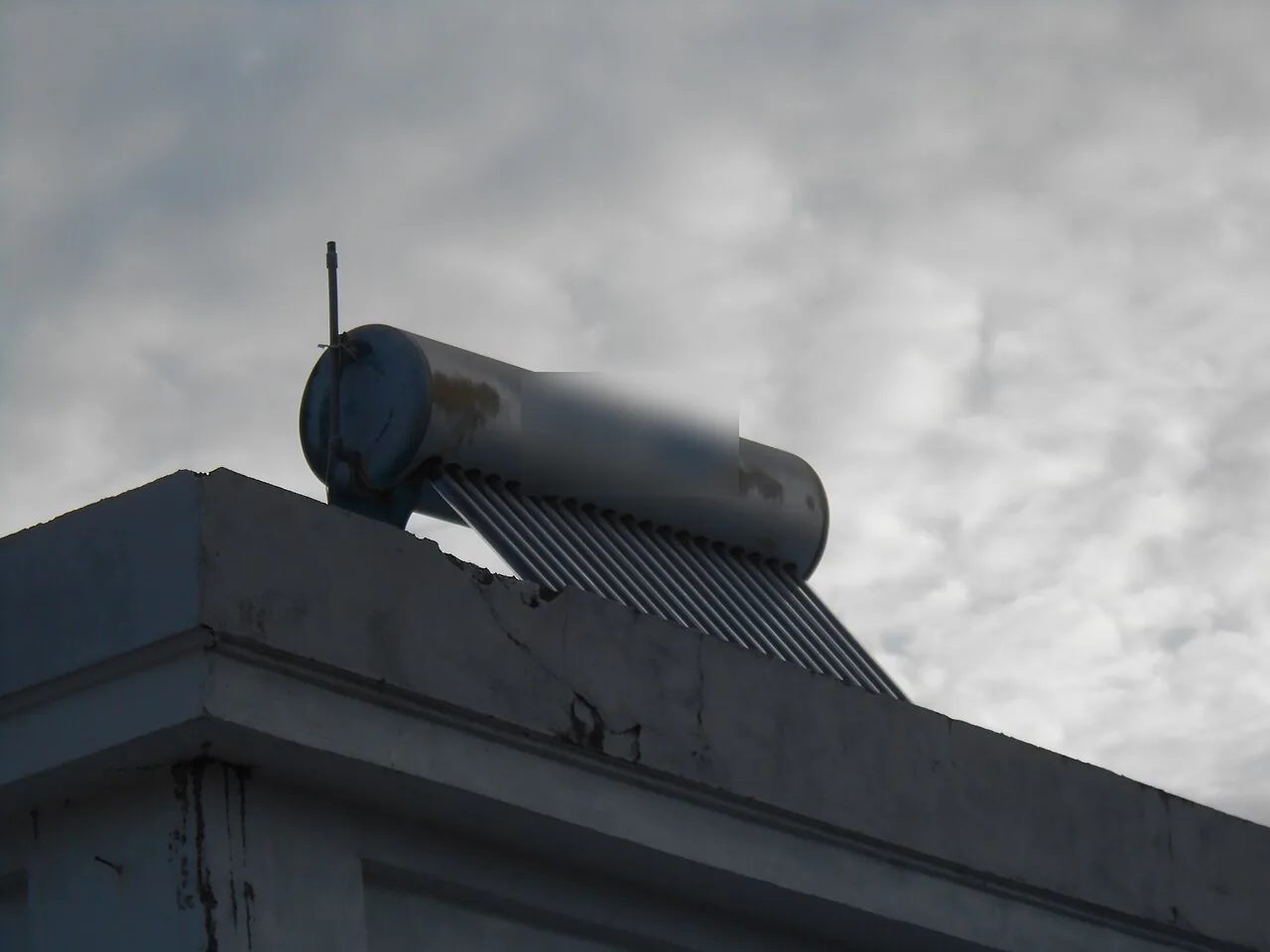
Figure 2. A rooftop solar water heater with a horizontal storage tank above a row of glass vacuum tubes, on the edge of a flat concrete roof under a cloudy sky. In town houses the tank is often several floors above the taps, so a long downpipe must clear first, and on cloudy days the water may only be lukewarm. Maker's label blurred. (Photo: Editor abcdef, Wikimedia Commons, CC0)
Step 6: Check for mixer crossflow
Crossflow happens when cold water pushes into the hot pipe (or hot into cold) through a faulty mixer elsewhere, such as a single-lever mixer with a worn cartridge or a thermostatic mixer with a failed non-return valve. The hot line is diluted, so taps take longer to get hot and may never get fully hot. Signs: warm water from cold taps, lukewarm hot taps even near the heater, or a problem that started when a new mixer was fitted.
A simple test with a storage heater:
Switch the heater off at its breaker.
Close the valve on the cold inlet to the heater.
Open a hot tap briefly. A little water will drain out, then the flow should almost stop.
If the hot tap keeps running steadily, cold water is getting into the hot pipes somewhere. Isolate the mixers one at a time (with their stop valves) until the flow stops; the last one isolated is the culprit.
Afterwards reopen all valves, open a hot tap until water flows steadily with no air, so the heater is full, and only then switch the heater back on.
Step 7: Put it together
What the customer notices | Most likely cause | First check |
|---|---|---|
Long wait, then properly hot; same every time | Long or oversized pipe run (dead leg) | Measure flow, estimate pipe volume, compare |
Wait got longer over months | Blocked aerator or shower head; scaled heater | Clean aerator, measure flow again |
Short wait if used recently, long after an hour | Heat loss from bare pipe | Look for uninsulated runs on the roof or in walls |
Lukewarm even at the tap next to the heater | Heater fault, thermostat setting, empty tank | Indicator lamp, breaker, time since last use |
Hot only when the tap is fully open (instant heater) | Flow below minimum activation flow | Open fully, check filter and pressure |
Long wait and lukewarm on cloudy days (solar) | Low solar gain; backup element off | Weather, backup switch or timer |
Warm water from cold taps; hot never fully hot | Crossflow through a faulty mixer | Heater inlet closed, hot tap open (Step 6) |
Fixes that actually shorten the wait
1. Insulate the hot pipe
Closed-cell foam sleeves sized for the pipe slow heat loss, so water stays warm longer between uses and arrives hotter. This helps most at taps used often and on roof runs; on the roof, use covering suitable for sunlight or protect it, because many foams break down in strong sun. Be honest with the customer: insulation does not remove the water in the pipe. After a long gap it still cools and still has to run out.
2. Re-route: a shorter, correctly sized branch
The most permanent fix is to reduce the volume of water between the heater and the tap:
Take a new branch from the nearest point on the hot main instead of from the far end.
Use a smaller branch to fixtures that need only a small flow, such as a washbasin, while keeping the size needed for showers. Sizing should be checked against the flow each fixture needs and the available pressure, especially on upper floors fed by gravity.
Avoid detours when chasing a new route. Re-routing means opening walls or floors, so it fits best with renovation.
3. A point-of-use heater near the fixture
If one tap is far from the main heater, a small under-sink storage heater or compact instant heater next to it removes most of the dead leg: the cold pipe feeds the heater and only a short hose runs to the tap.
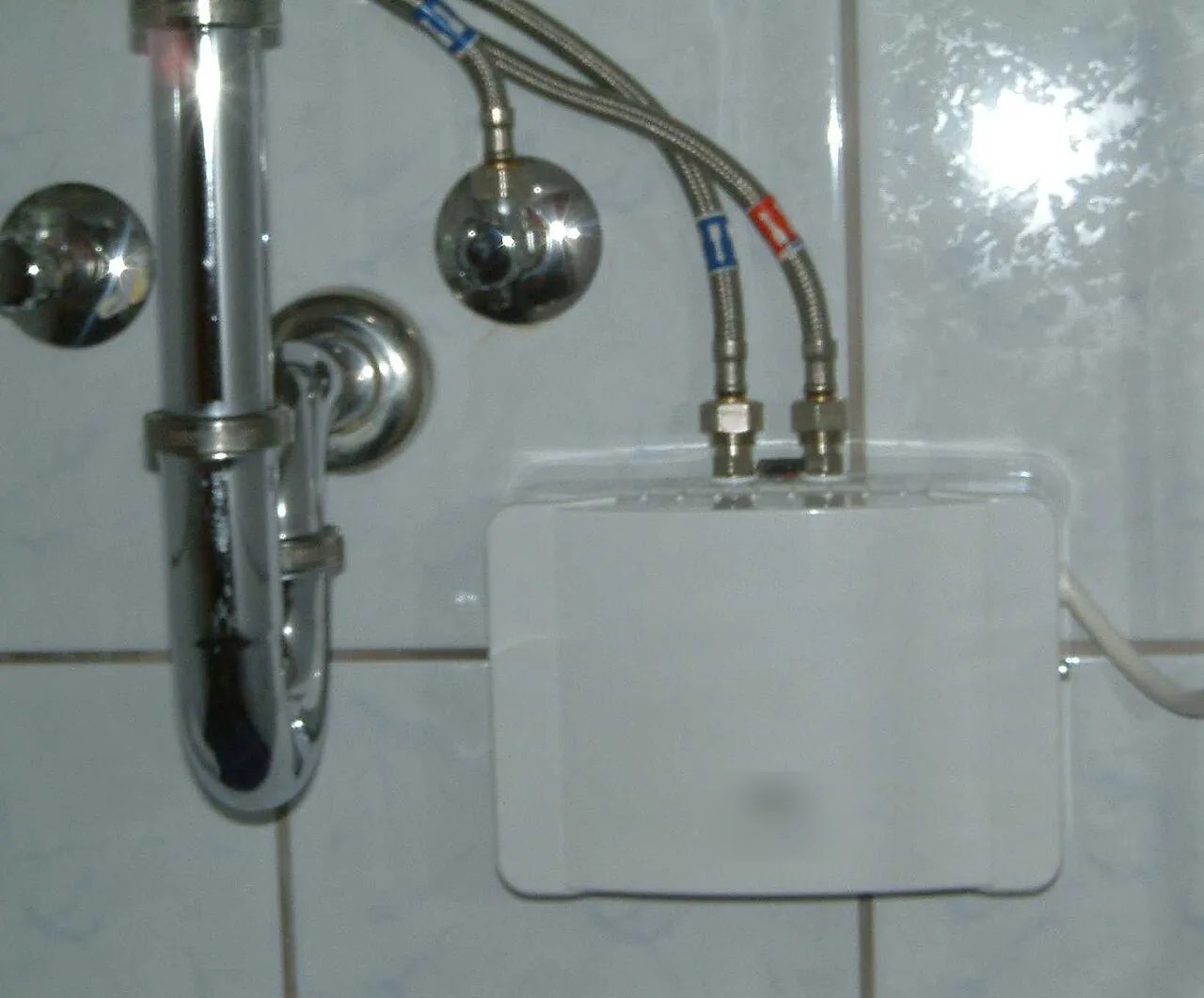
Figure 3. A small instant electric water heater mounted on a tiled wall under a washbasin, next to the chrome waste trap. The blue-marked hose brings cold water to the heater and the red-marked hose carries hot water a short way up to the tap, so there is very little cold water to clear. The power cable leaves on the right. Maker's logo blurred. (Photo: Faibel, Wikimedia Commons, public domain)
An instant unit must suit the tap's flow (Step 5). Any electric heater needs a suitable circuit, earthing and RCD protection; on a 230 V / 50 Hz supply that is an electrician's job, and the plumber connects only the water side.
4. Hot water recirculation
A recirculation system keeps hot water moving so the pipe near the taps is already hot. Two main types:
Pump with a dedicated return line. A second pipe runs from the far end of the hot pipe back to the heater and a small pump circulates the water, controlled by a timer (for example only at busy morning and evening hours), a thermostat on the return or an on-demand button. It is best planned at design stage or in a major renovation; the loop needs check valves and balancing as the pump and heater makers instruct.
Under-sink valve type (no new return pipe). A pump near the heater pushes water round, and a temperature-sensitive bypass valve under the farthest sink returns the cooled water through the cold pipe. No new pipe is needed, but that sink's cold tap may run warm for a while, and it suits only some layouts. Follow the kit's instructions exactly.
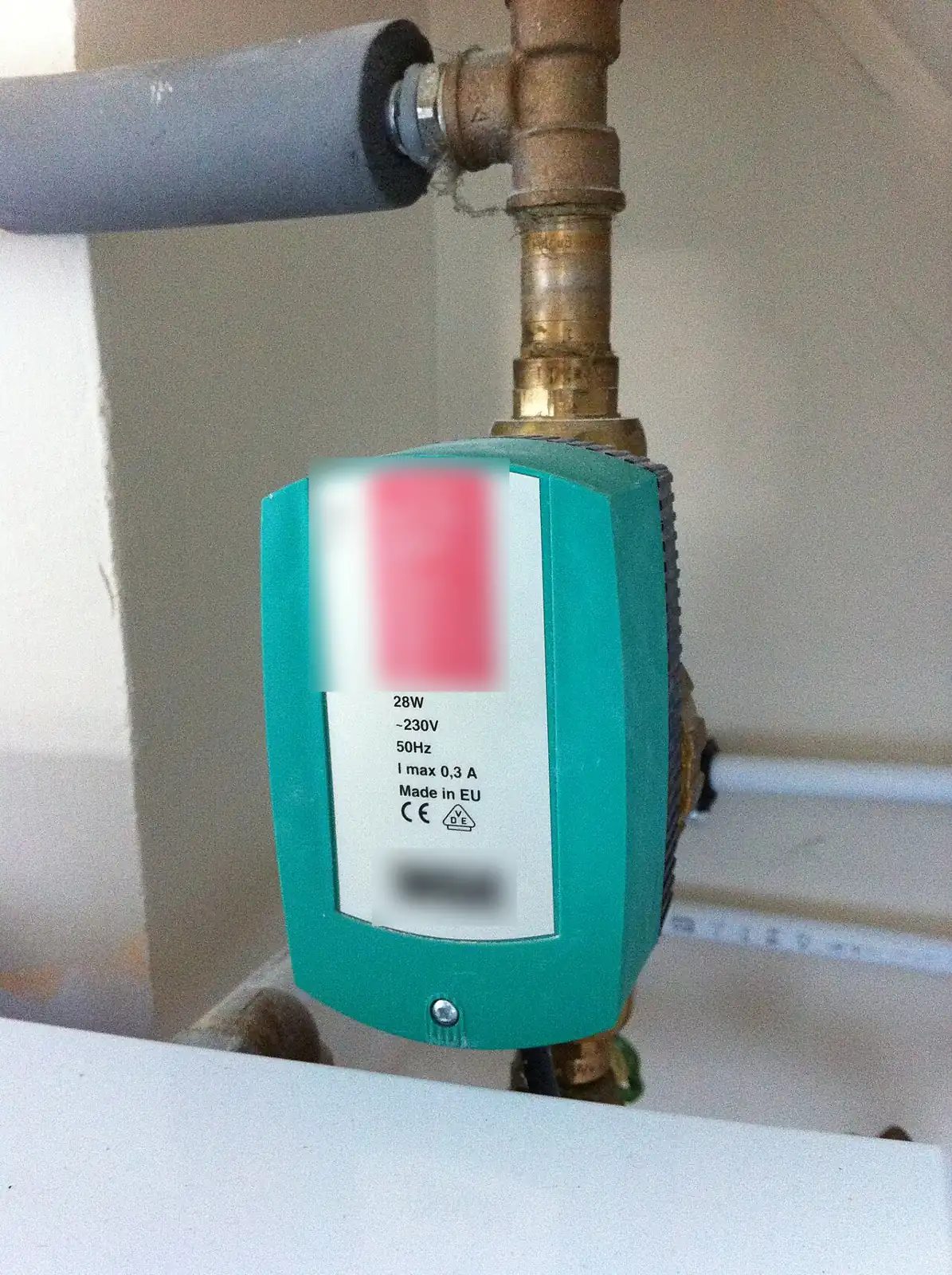
Figure 4. A small circulation pump fitted in a brass hot-water line, with a grey foam-insulated pipe running off to the left. The visible rating plate shows that it runs on 230 V, 50 Hz. Pumps like this keep hot water moving round a return loop; insulation reduces the heat lost from it. Brand and model details blurred. (Photo: User:wiDaki, Wikimedia Commons, CC BY-SA 3.0)
Points to discuss with the customer before installing any recirculation:
Energy. A loop running all the time loses heat continuously and the pump uses electricity. Timer or on-demand control and insulation on the whole loop keep losses down.
Water hygiene and Legionella. Bacteria such as Legionella grow best in lukewarm, stagnant water, which a badly designed or lukewarm loop, or a storage temperature set too low, can create. Keep stored water at the temperature the heater maker recommends, avoid dead ends off the loop, and follow the maker's and local health authority's guidance. Where hot storage could scald children or elderly people, fit a thermostatic mixing valve.
Electrical work. The pump needs an earthed, RCD-protected supply installed by an electrician; never an extension lead in a wet area.
When to call a plumber or an electrician
Call a plumber when the wait is much longer than your estimate and the aerator is clean, when you suspect crossflow but cannot find the mixer, or when a branch needs re-routing, a return line or a point-of-use heater needs plumbing in, or the solar heater's roof pipework needs work (with safe roof access).
Call an electrician or the maker's service technician when an electric heater shows no indicator light, its breaker or RCD trips, the water is suddenly much hotter than usual, or a new heater, backup element or pump needs a supply. If you feel any tingle from water, a tap, a heater or a metal rail, switch the heater off at its breaker and do not use the water until it has been checked.
Practical examples
Example 1: The kitchen that waited a minute
In a two-storey house the storage heater was upstairs and the kitchen tap took about a minute to run hot. The plumber measured 3.5 L/min and estimated 16 m of 25 mm PN20 pipe: 16 × 0.216 ≈ 3.5 litres, so about one minute. Nothing was faulty; the pipe was long. The customer chose a small under-sink heater, plumbed in by the plumber, with an electrician providing an earthed, RCD-protected supply.
Example 2: The "weak" solar heater
In a five-storey town house with a rooftop solar heater, the ground-floor tap took well over a minute on rainy days and then ran barely warm. The downpipe explained the wait and the weather the temperature; the backup element had also been switched off months earlier. A technician checked the backup and set it on an evening timer, and the bare roof pipe was insulated. The wait remained, but the water at the end of it was hot.
Safety checklist
Switch the water heater off at its own breaker before removing any cover, draining it or working on its hot-water joints.
Never open a heater's electrical cover or adjust a thermostat or element with the power on; leave electrical work to an electrician or service technician.
Check that every electric water heater and circulation pump is earthed and RCD-protected; press the RCD test button as its maker advises.
Refill and bleed a storage heater completely (hot tap open until water flows with no air) before switching it back on after draining or a crossflow test.
Take care with hot water at the end of a test; storage and solar heaters can deliver scalding water.
Use safe access and fall protection when working on the roof near a solar heater or tank.
Do not leave lukewarm, stagnant loops or dead ends when changing pipework; use a thermostatic mixing valve where hot storage could scald.
Frequently Asked Questions
How long should I have to wait for hot water?
There is no single correct figure. Estimate it: litres in the pipe ÷ litres per minute at the tap. If the real wait is close to the estimate, the layout is the cause; if much longer, look for a heater, aerator or crossflow problem.
Will a bigger pipe make the hot water arrive faster?
Usually not. A bigger pipe holds more water per metre, so there is more cold water to push out. Unless the existing pipe is so small that it restricts the flow badly, upsizing a branch tends to make the wait longer.
Does pipe insulation stop the wait completely?
No. Insulation keeps the water in the pipe warm for longer, so it helps when hot water is used often. After a long gap the water still cools, and it still has to run out before hot water arrives.
Is a recirculation pump worth it?
It can be, where taps are far from the heater and are used often at predictable times. Use a timer or on-demand control and insulate the loop, otherwise the energy lost from the loop can be significant. The loop must be designed so it does not leave lukewarm, stagnant water.
Practice Exercises
Flow measurement. At three hot taps in a house, time how long it takes to fill a 1 litre jug and calculate each flow in litres per minute.
Pipe volume. Calculate the volume of water in 12 m of 20 mm PN20 PPR pipe (inner diameter about 13.2 mm) and in 12 m of 32 mm PN20 pipe (inner diameter about 21.2 mm). (Answer for checking: about 1.6 litres and about 4.2 litres.)
Wait time. A shower is fed by 9 m of 25 mm PN20 pipe (about 0.216 L/m) and delivers 6 L/min. Estimate the minimum wait. (Answer for checking: about 1.9 litres ÷ 6 L/min ≈ 0.32 minutes ≈ 19 seconds.)
Diagnosis. For each case, name the most likely cause and your first check: (a) the wait became longer over six months at one basin only; (b) every hot tap is lukewarm and the kitchen cold tap runs warm; (c) hot water on the ground floor of a town house is lukewarm only after cloudy days.
Customer advice. In four or five sentences, explain to a customer the difference between insulating the pipe, fitting a point-of-use heater and installing recirculation, including what each one cannot do.