Drywall ceiling safety comes down to four things you must do before driving the first screw: set up a stable scaffold or ladder, wear goggles and a dust mask when drilling and cutting boards, switch off the power to the area, and find the electrical cables, water pipes and air-conditioning lines running through the ceiling so you never drill or screw into them. Drywall installers spend most of the day working at height with their faces turned up to the ceiling, with dust and debris falling straight into their eyes, so safe habits have to start on day one. This is the first lesson of the drywall and ceiling installer roadmap, written for complete beginners, with a checklist you can use straight away.
By the end of this lesson, you will be able to:
- Check a mobile scaffold tower and a stepladder before standing on them to work on a ceiling, using an 8-point checklist.
- Use a hammer drill, a drywall screw gun and a utility knife correctly, with the right goggles, mask and gloves.
- Carry and lift boards up to the ceiling without hurting your back or dropping them.
- Switch off the power, then locate and mark cables, water pipes and AC lines before fixing hangers and screws.
- Plan the safety preparation for a living room ceiling, with time and cost figures that add up.
Starting out in drywall? Scaffold, screw gun and hidden cable safety is step 1 of the roadmap, before boards and metal framing. See the 8-step drywall and ceiling installer roadmap to learn in the right order.
What accidents do drywall installers have?
A gypsum ceiling is much lighter than a concrete one, but the trade has its own risks because you spend most of your time at height, working face up.
Falls from scaffolds, ladders and plank "bridges"
On many small Vietnamese jobs, installers lay a plank across two stepladders as a working platform. If the plank is not fixed and one end slides, you fall. A 2 m fall onto a concrete floor can already cause head and spine injuries. Ceilings over 3 m in lobbies, showrooms and ground floors of townhouses are even more dangerous.
Dust, debris and drill bits falling into your eyes
When you drill concrete to fix ceiling hangers, the dust falls straight onto your face. When you drive screws overhead, board crumbs and metal swarf fall into unprotected eyes. This is the most common beginner injury.
Electric shock, punctured water pipes, leaking AC lines
Inside the ceiling run cables for lights, fans and sockets, supply and waste pipes from the bathroom upstairs, and copper refrigerant pipes and condensate lines for the air conditioning. A screw or drill bit that hits a live cable can cause a shock or a short circuit; one that hits a water pipe means a stained, sagging ceiling a few weeks later.
Cut hands, back and neck pain
Utility knives are sharp, and the cut edges of steel framing are as sharp as a blade. Carrying large boards badly and craning your neck all day lead to long-lasting back, shoulder and neck pain.
Working safely on mobile towers and ladders
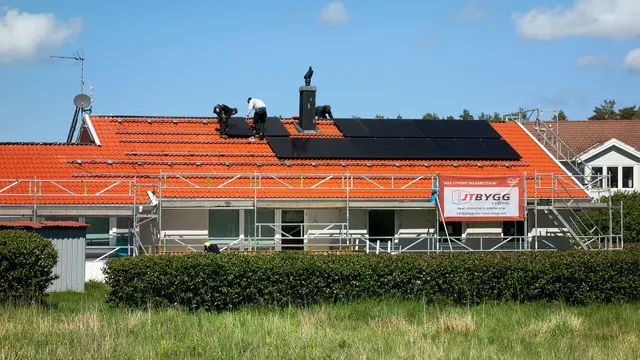
The mobile scaffold tower on wheels is the ceiling installer's main tool (Figure 1): stable footing, room for tools and quick to move. A stepladder is only for short jobs on low ceilings.
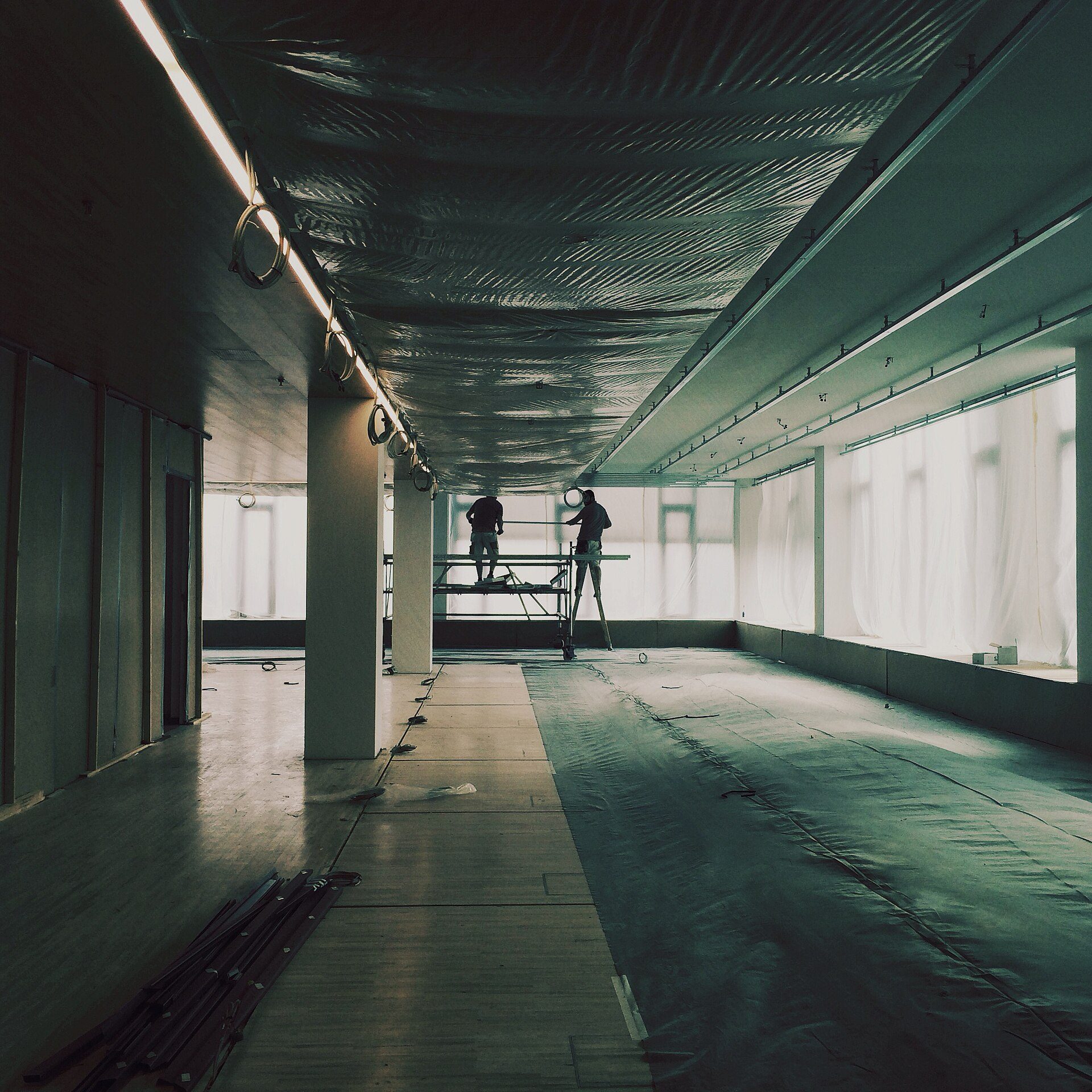
Photo: Casey Hugelfink / Wikimedia Commons, CC BY-SA 2.0
Check the mobile tower before each shift
- Frames and braces complete, all locking pins in place, no bent members or cracked welds.
- A fully boarded deck with platforms hooked into the frame; no loose planks.
- Guardrails round the deck when working high; never stand on the guardrail to reach.
- Wheels lock, the floor is level, and no wheel sits on the edge of a hole, a pipe or a cable.
Rules when you are on the tower
Lock the wheels before climbing. Climb the ladder inside the frame, not the outside. Never push the tower with people or heavy tools on the deck. Never stand a ladder, bucket or box on the deck to gain height; if you are too low, add a level to the tower properly. Set the deck height so you reach the ceiling with your elbows slightly bent, without standing on tiptoe, which also saves your neck.
Stepladders and planks between two ladders
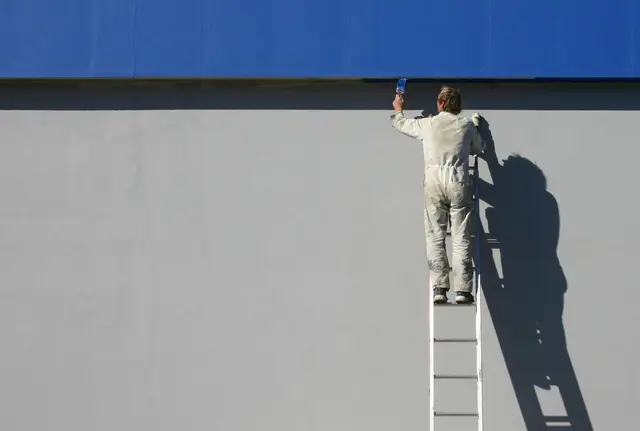
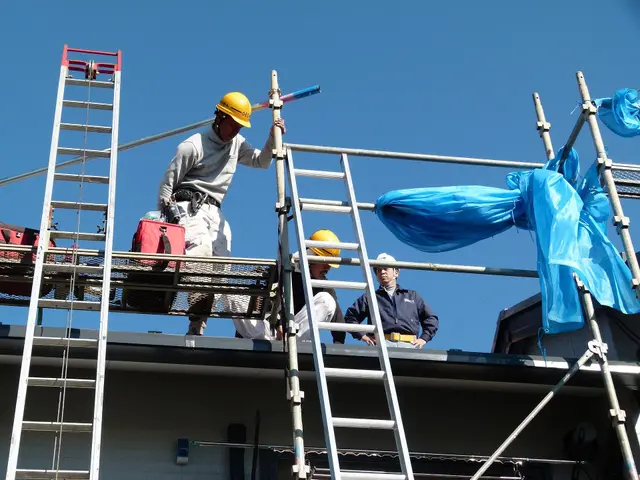
A stepladder must be fully open with both spreaders locked, and you must not stand on the top step (cover photo: an installer working high on a stepladder set on a level floor). If your crew still uses a plank between two ladders, use only a thick, sound plank clamped or tied to the ladders, with both ends overlapping the steps by a good length; this is a stopgap and should be replaced by a mobile tower. For high ceilings, light-well edges or balconies without guardrails, wear a full-body harness clipped to a solid anchor.
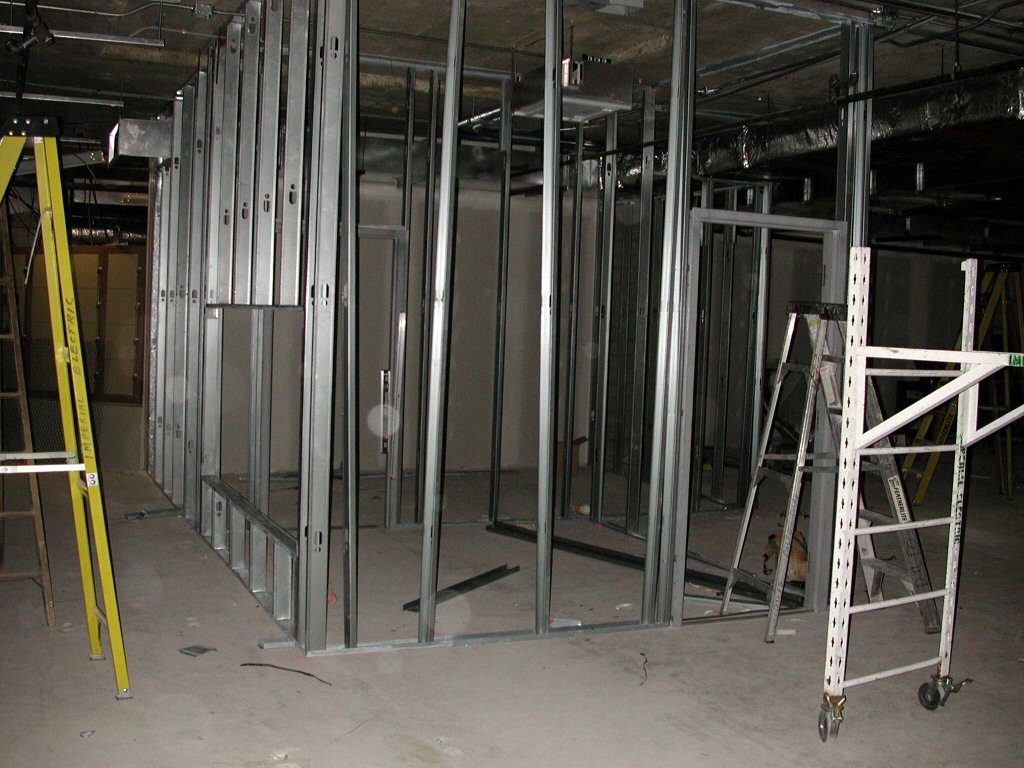
Photo: P199 / Wikimedia Commons, Public domain
Hammer drills, screw guns and board knives
These three tools are used most often during the day. Most injuries come from using them wrongly or carrying on with a damaged tool.
Drilling concrete for ceiling hangers
- Wear sealed goggles, a fine-dust mask and a hard hat: concrete dust contains silica and falls straight onto your face.
- Hold the drill with both hands using the side handle; stand firmly on the tower deck, not on a ladder, when drilling large holes.
- Use a straight, sharp bit of the right size for the anchor; if the bit jams, release the trigger immediately so the drill does not twist your wrist.
- Powder-actuated nail guns are only for trained, authorised operators; beginners must not use them.
Drywall screw guns
A drywall screw gun has a depth-setting nose: the screw head should sit just below the paper face without tearing it and without standing proud (Figure 3). Keep your fingers at least a hand's width from the screw; do not hold the board with your hand right next to where you are driving. Use the correct, unworn bit so screws do not cam out and fly off. Do not wear loose cloth gloves or loose sleeves with drills that have long spinning bits. Change batteries and bits only with the tool off; charge batteries with the matching charger, away from packaging and foam that can catch fire.
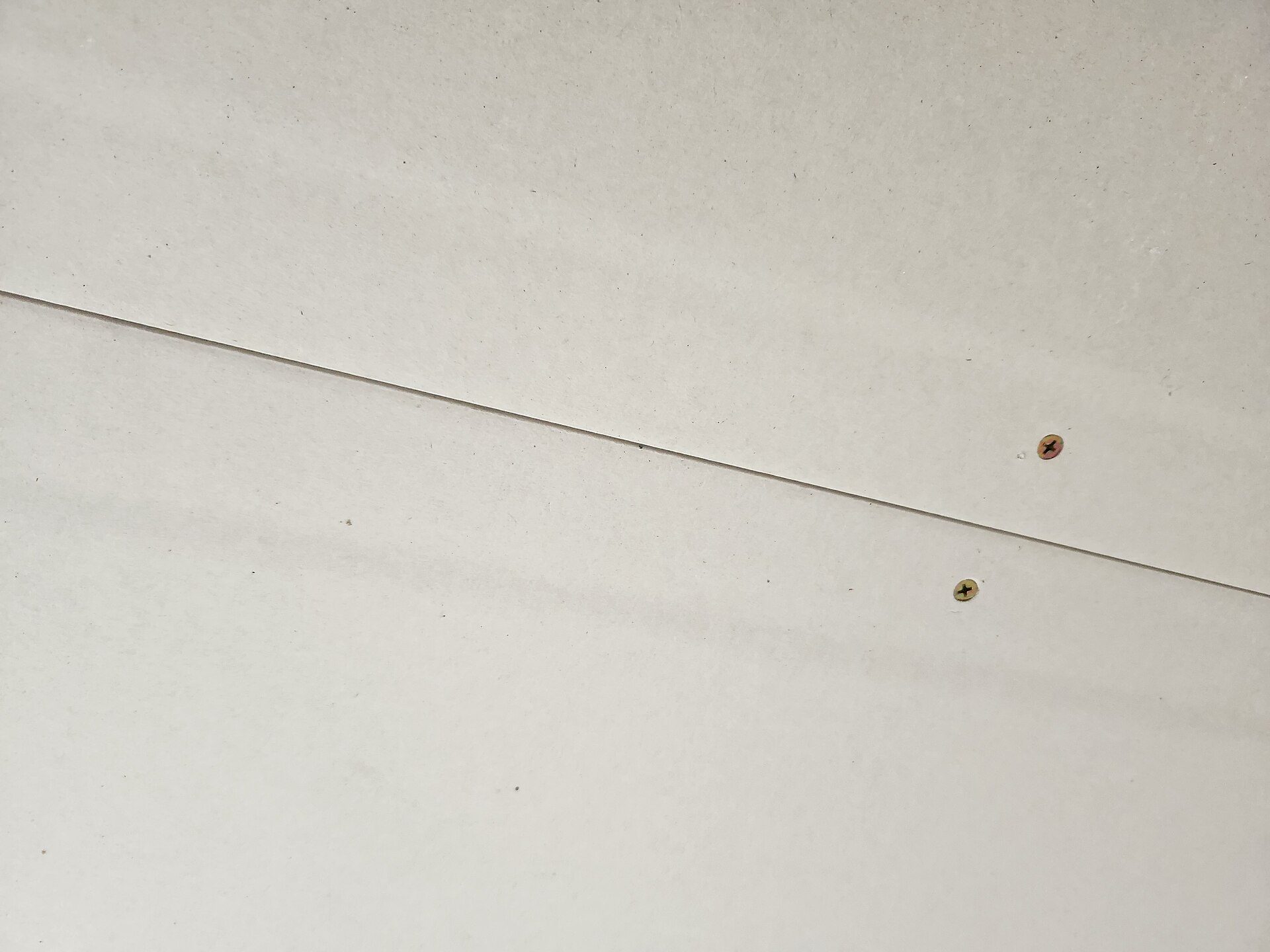
Photo: Panamitsu / Wikimedia Commons, CC BY-SA 4.0
Knives and cutting boards
Gypsum board is usually cut with a utility knife: score along a straightedge, snap the gypsum core, then cut the paper on the back. Keep the hand holding the straightedge on the side away from the blade, pull the knife away from your body and retract the blade after each cut. Snap off or replace a blunt blade at once, because a blunt blade makes you press harder and slip. Cut steel framing with tin snips and cut-resistant gloves; freshly cut steel edges are very sharp.
Gypsum dust and noise
Gypsum dust from cutting, making light holes and sanding joints irritates the eyes, nose and throat. Wear a fine-dust mask, vacuum with a filtered extractor instead of dry sweeping, and cover the floor. Hammer drills and cutters are very loud: wear earplugs for long spells.
Carrying and lifting boards correctly
The common board size in Vietnam is 1220 × 2440 mm; a 9 mm board weighs about 20 kg (depending on type and brand; moisture-resistant, fire-rated and thicker boards are heavier). Boards are heavy and wide and break easily when carried flat.
Carrying boards
- Two people per board, carried on its long edge, one person at each end.
- Bend your knees and keep your back straight when lifting from the stack; do not twist while carrying.
- Stack boards flat on a dry floor with even supports; do not lean them for days, which makes them bow.
Lifting boards to the ceiling
Never hold a board up with your head. Use a drywall panel lift, or two people on the tower lift the board while a third holds it against the frame with a T-brace while it is screwed. Drive a few screws in the middle and corners first before removing hands or the brace.
Taking breaks
Working overhead for long periods tires your neck and can make you dizzy when you step down. Every 45–60 minutes, stop for a few minutes, come down, stretch your neck and shoulders, then carry on.
Cables, water pipes and AC lines in the ceiling
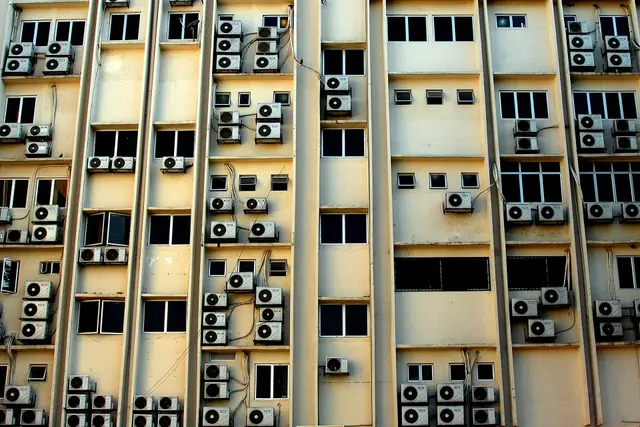
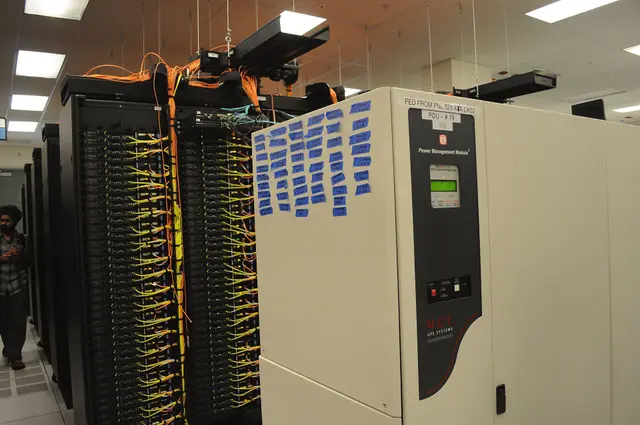
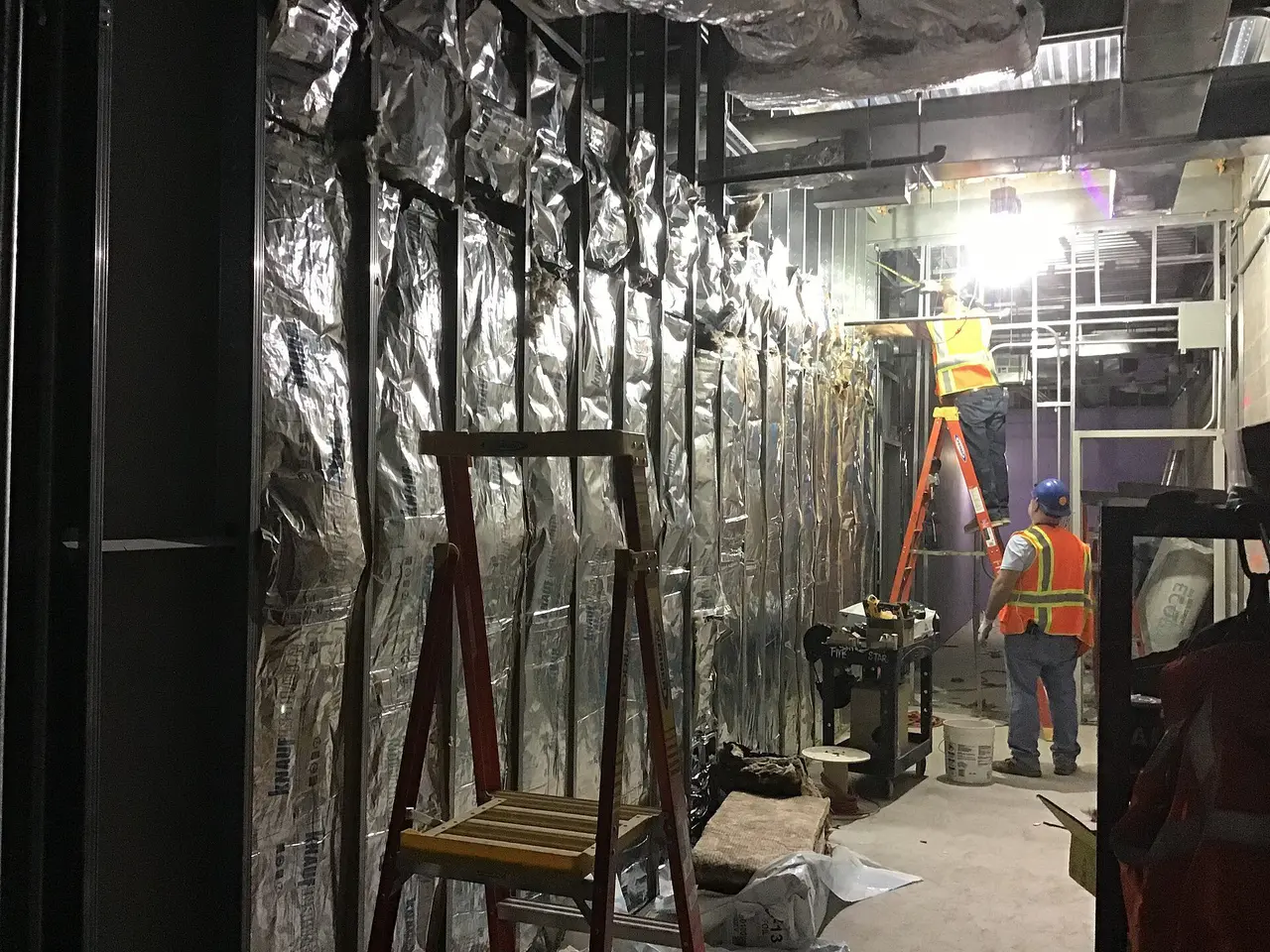
This is where new installers lose their reputation fastest: a screw through a cable trips the breaker, or one through a water pipe makes a brand-new ceiling leak. Above a ceiling, cables, pipes and ducts can be densely packed as in Figure 4; homes have fewer, but the principles are the same.
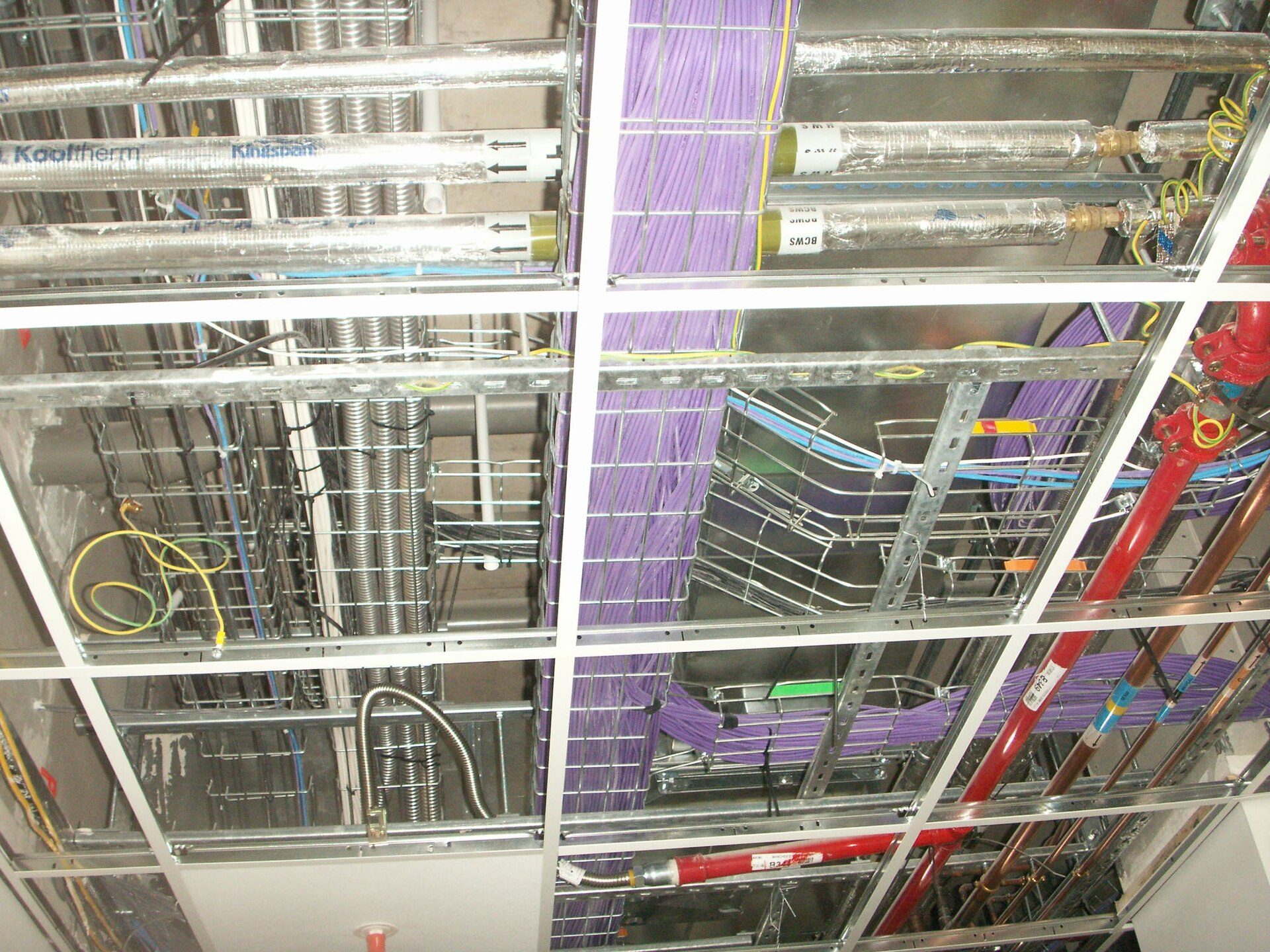
Photo: Rathfelder / Wikimedia Commons, CC0
Safety warning: Before drilling for hangers, fixing framing or cutting light holes near hidden cables, switch off the circuit breaker for the area, hang a "Work in progress, do not switch on" sign or keep the key to the distribution board, and ask the owner and electrician where the cables run. Do not connect or pull light wiring yourself unless you are qualified; that is the electrician's job. Do not drill or screw where a water pipe or copper AC line may be; if you do hit one, leave the screw in and tell the lead installer at once so the water can be shut off or an AC technician called. If someone is being electrocuted, cut the power first, never touch them with bare hands, and call 115 (Vietnam's emergency number). If dust or debris gets in your eye, do not rub it; rinse with clean water and see a doctor if it still feels gritty or hurts.
Ask first, look first
Ask for the electrical and plumbing drawings or photos taken before the slab was poured and cables were run (many owners keep them). Ask where the lights, ceiling fans, air conditioners and the bathroom upstairs are. Open an access panel or look through any unboarded section to see how the cables run.
Detect and mark
Use a wall scanner for cables and metal to check doubtful spots; a scanner only helps and never replaces switching off the power. Mark cable and pipe routes on the walls with a pen or chalk line so you still know where to avoid screwing once the boards are up.
Working with the electrician
Ceiling cables should run in conduit, fixed to the concrete slab or their own supports, not draped over the ceiling framing. The electrician leaves cable tails at each light position; the drywall installer only cuts the holes in the right places, after the power is off.
Safety checklist before ceiling work
| Item | How to check | Pass when |
|---|---|---|
| Mobile tower | Look at frames, pins, deck, guardrails; test wheel locks | All pins in, deck complete, locked wheels do not move |
| Stepladder | Fully open, spreaders locked, rubber feet present | Ladder stands firm without wobbling |
| Power to the area | Switch off breaker, test with an instrument or have the electrician confirm | No power on light and socket circuits in the work area |
| Cable and pipe routes | Ask for drawings, look, scan, mark on walls | Every route is marked |
| Drill and screw gun | Cord, plug, battery, bit, drill bit, depth setting | No damaged cord, bit not worn, screws sink correctly |
| PPE | Goggles, fine-dust mask, hard hat, gloves, earplugs | Everyone on the tower is equipped |
| Area below | Barrier or warn people not to stand under the tower | Nobody walks under where you are drilling |
| Boards and materials | Stacked flat and tidy, away from walkways | Clear walkways, nothing to trip on |
Worked example: safety preparation for a 5 × 6 m living room ceiling
A crew of 3 (lead installer, assistant and you as apprentice) is building a flush ceiling for a townhouse living room of 5.0 × 6.0 m, 3.6 m from floor to slab soffit, with the finished ceiling at 3.2 m. There are 8 downlights, and the bathroom on the floor above sits over one corner. You are asked to prepare.
Step 1: boards and carrying load
- Ceiling area: 5.0 × 6.0 = 30 m².
- One 1220 × 2440 mm board: 1.22 × 2.44 ≈ 2.98 m². 30 ÷ 2.98 ≈ 10.1, so 11 boards, plus 1 spare for cutting mistakes = 12 boards.
- Weight: 12 boards × about 20 kg = about 240 kg. Two people carrying one board per trip need 12 trips; allow extra rest if they go up stairs.
Step 2: safety preparation time before drilling
| Task | Who | Time |
|---|---|---|
| Erect and check the mobile tower | Assistant + apprentice | 15 minutes |
| Switch off power, confirm dead, trace cables | Lead installer | 20 minutes |
| Mark pipe routes from the upstairs bathroom and AC lines | Lead installer + apprentice | 15 minutes |
| Cover the floor, fence off the area under the tower | Apprentice | 10 minutes |
| Check drill and screw gun, hand out PPE | Assistant | 10 minutes |
| Total | 70 minutes | |
Check: 15 + 20 + 15 + 10 + 10 = 70 minutes. Some tasks run in parallel, so in practice the crew spends about 40–50 minutes, but no task should be skipped to "save time".
Step 3: your PPE and safety tools (2026 reference, varies by region and brand)
- Sealed safety goggles: 80,000 VND.
- Fine-dust masks, box of 20: 250,000 VND.
- Hard hat with chin strap: 120,000 VND.
- Cut-resistant gloves, 2 pairs × 60,000 VND = 120,000 VND.
- Earplugs, 1 box: 50,000 VND.
- Wall scanner for cables and metal (shared by the crew): 600,000 VND.
Total: 80,000 + 250,000 + 120,000 + 120,000 + 50,000 + 600,000 = 1,220,000 VND (about 48 USD). Wall scanners cost roughly 300,000–1,500,000 VND depending on type. When you work for a crew, PPE is normally supplied by the contractor; when you take jobs yourself, you have to equip yourself.
Common beginner mistakes and how to avoid them
Drilling and screwing without goggles
Sign: gritty, red eyes after a shift. Cause: thinking "it's only a few holes". Prevention: goggles on from the moment you climb the tower until you come down, even for a handful of screws.
Not switching off because "I'm drilling far from the lights"
Sign: the breaker trips, burnt smell while drilling. Cause: cables do not run in straight lines as you assume. Prevention: always switch off the area, trace and mark first.
Pushing the tower with someone on it
Sign: the tower sways, a wheel catches a cable or tile edge. Cause: not wanting to climb down. Prevention: everyone down, push, lock the wheels, recheck, then climb up.
Holding the board by hand next to the screw
Sign: the screw slips and goes into your hand. Cause: no T-brace, depth not set. Prevention: use a T-brace or panel lift, and keep your hand at least a hand's width from the screw.
Frequently asked questions
Do I need to cut the power to the whole house for ceiling work?
Usually only the breaker for the work area, if the distribution board is clearly labelled. If you are not sure which circuit feeds the area, switch off the main breaker while drilling and cutting holes, and ask an electrician to confirm.
Is gypsum dust harmful?
Gypsum dust irritates the eyes, nose and throat when you breathe a lot of it; concrete dust from drilling for hangers also contains silica, which harms the lungs over the long term. Wear a fine-dust mask and goggles and use a filtered vacuum. See a doctor if you have a lasting cough or shortness of breath.
How high can a mobile tower be before guardrails and a harness are needed?
The general principle is that the higher the deck, the more complete the guardrails must be; read the tower manufacturer's instructions and the site safety rules. At light-well edges, balconies and decks without guardrails, wear a full-body harness.
Can a drywall installer wire the downlights?
The drywall installer cuts the holes in the right places; connecting the lights should be done by an electrician. If you want to do it yourself, train properly in residential electrical work and follow electrical safety rules.
Practice tasks and first-day checklist
- Erect a mobile tower with the lead installer and check 4 points yourself: frame, pins, deck, wheels.
- Practise cutting 3 offcut boards with a utility knife along a straight line, with the right hand position and knife direction.
- Drive 20 screws into a test board, adjusting the depth until every screw sits just below the paper without tearing it.
- In a real room, ask about and sketch the cable and pipe routes in the ceiling, then mark them on the walls.
Self-assessment criteria
- Pass: the tower passes all 8 points of the checklist and locked wheels do not move.
- Pass: at least 18 of 20 screws at the right depth; straight cuts and no cut fingers.
- Pass: you can explain why power must be off before drilling, and what to do if you hit a water pipe.
- Not yet: drilling without goggles, not switching off the power, or standing on an unfixed plank between two ladders.
Once safety is second nature, move on to the next step of the roadmap: Boards, metal framing & fixings, where you learn standard, moisture-resistant and fire-rated boards and the framing for flush and suspended grid ceilings. To see how the trade earns money, you can read ahead: how much a gypsum ceiling costs and how to measure m².
Keep learning drywall: after safety come boards and framing, laser levelling, suspended grid ceilings, flush and stepped ceilings, partitions, joint finishing against cracks and quoting. See the 8-step drywall and ceiling installer roadmap.