House painting safety comes down to three big hazards: falling from a ladder or scaffold, breathing solvent vapour when using oil-based paint, and fire from white spirit or paint-soaked rags left in the wrong place. To work safely you need to set up stepladders and scaffolds correctly, wear a full-body harness when painting facades, wear a respirator with vapour cartridges for solvent paints, ventilate the room, and keep paint and solvents away from any source of ignition. This is the first lesson of the house painter roadmap, written for people who have never held a roller, with a checklist you can use on your first day as a helper.
By the end of this lesson, you will be able to:
- Set up stepladders and leaning ladders at the right angle and standing height, and check a ladder before climbing.
- Check frame scaffolds and mobile towers against a checklist before each shift, and know when a harness is mandatory.
- Choose the right mask, gloves and eye protection for water-based paint, oil-based paint and solvent-based waterproofing.
- Store paint and white spirit and deal with paint-soaked rags so they do not start a fire.
- Draw up an access-equipment and PPE list for a tube-house job, with costs that add up.
Starting out as a house painter? Scaffold, ladder and chemical safety is step 1 of the roadmap, before paint systems and skim coating. See the 8-step house painter roadmap to learn in the right order.
What accidents do house painters have?
Painting looks gentle, but painters work at height for most of the day and handle flammable chemicals. Most accidents come from the habit of "just getting it done quickly", not from a lack of skill.
Falls: the number one hazard
Falling from a stepladder while overreaching, a leaning ladder sliding out at the foot, a scaffold missing boards, or standing on a facade window ledge without a harness. A fall of just 2–3 m onto a tiled floor can break bones and injure the head. On the facade of a 3–5 storey Vietnamese tube house, a fall is very likely to be fatal.
Breathing solvent vapour and dust
Oil-based paint, anti-rust primer, epoxy, solvent-based waterproofing and white spirit all evaporate strongly. Solvent vapour in a closed room causes headaches, dizziness and nausea, and a dizzy painter on a ladder falls easily. Years of unprotected exposure can affect the nervous system, liver and kidneys. Water-based paint smells less but still needs ventilation.
Fire, electric shock and eye injuries
White spirit and many solvents ignite at room temperature. An aluminium ladder raised near overhead power lines in front of a house can cause electrocution. Paint and chemicals splashing into the eyes while painting ceilings is a very common beginner injury.
Using stepladders and leaning ladders correctly
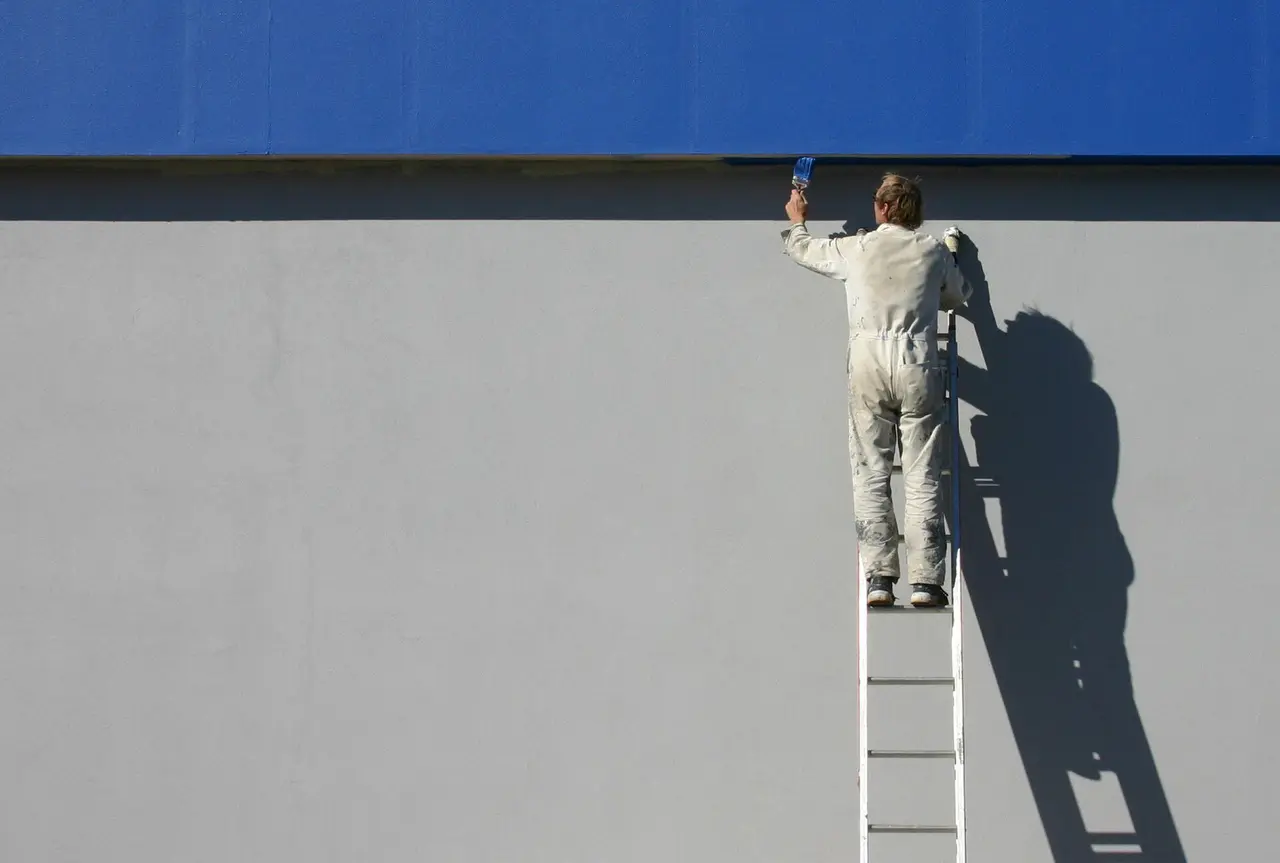
The ladder is a painter's everyday tool, which is exactly why it is so easily taken for granted. The cover photo shows a painter on a leaning ladder painting the top of a high wall: that is only safe when the ladder is at the right angle, its foot is held or blocked, and the painter does not lean out.
Check the ladder before you climb
- The feet still have their rubber anti-slip pads, with no bends or cracks.
- Rungs and steps are solid and free of wet paint, oil or mud.
- Stepladder: the spreader bars on both sides are fully open and locked; never use a folded stepladder as a leaning ladder.
- Stand it on firm, level ground; never prop the feet on bricks or timber to gain height.
Leaning ladder angle: the 4-to-1 rule
Set a leaning ladder so the foot is 1 m out from the wall for every 4 m of height to the top support (about 75 degrees). Too steep and it tips backwards; too shallow and the foot slides out. If you use a ladder to reach another level, it must extend about 1 m above the landing so you have something to hold.
Where to stand and how to work
- Always keep 3 points of contact: two feet and one hand, or two hands and one foot.
- Never stand on the top step or top cap of a stepladder; read the label for the highest standing step.
- Keep your belt buckle between the stiles; if you cannot reach, climb down and move the ladder.
- One person per ladder; hang the paint pot on a hook instead of carrying it in your hand while climbing.
Cut down work at height with an extension pole
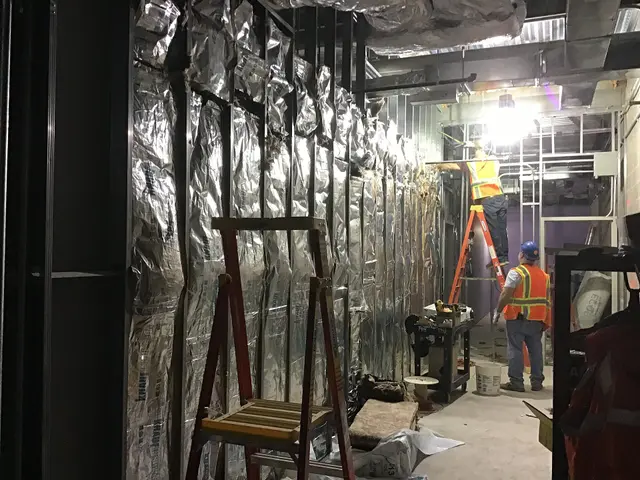
The safest climb is the one you do not need. For indoor walls and ceilings around 3–4 m high, a roller on an extension pole from the floor (Figure 1) is faster and saves climbing down every time you move. Use the ladder only for cutting in and edges.
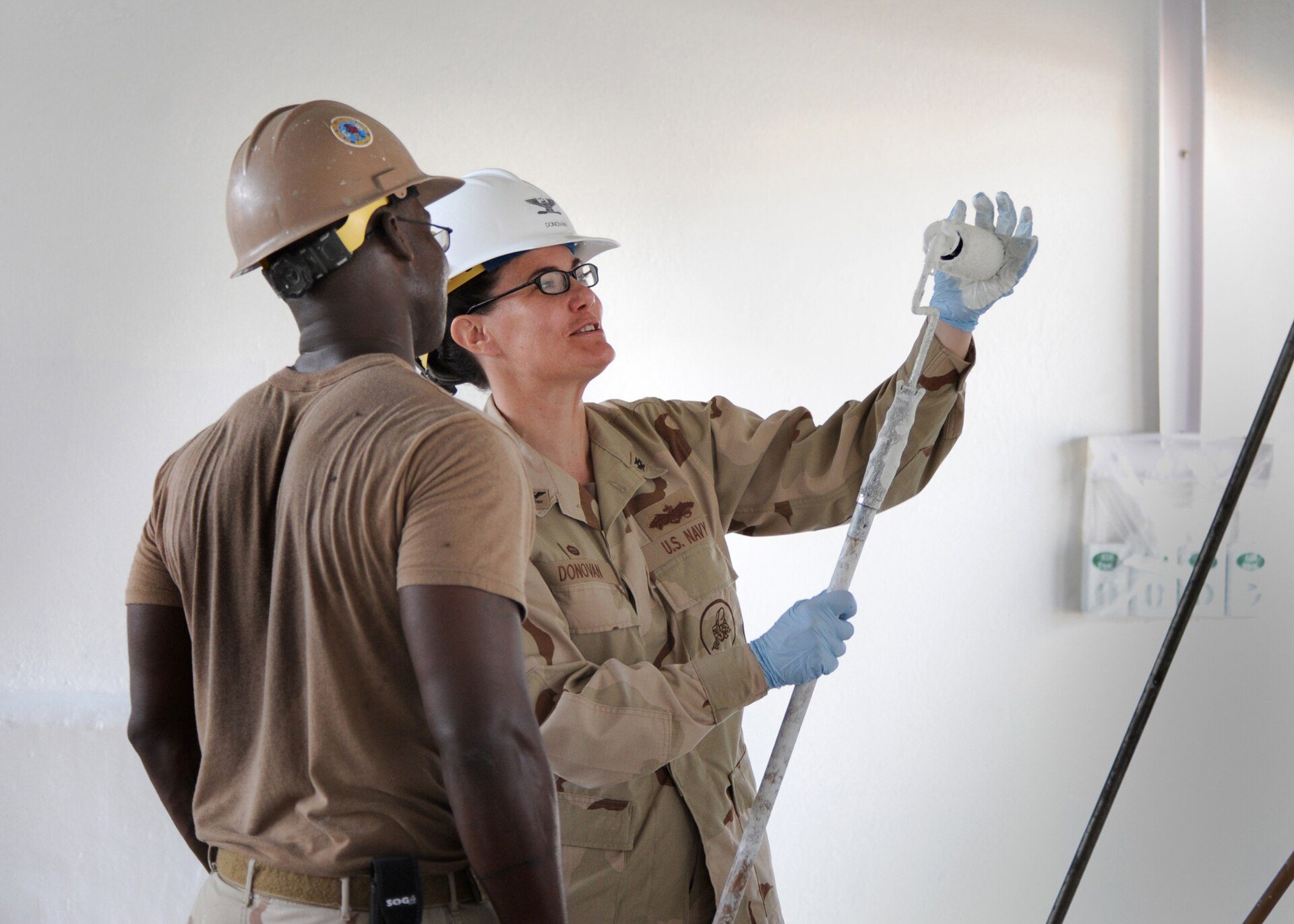
Photo: Petty Officer 2nd Class Michael Lindsey / Wikimedia Commons, Public domain
Scaffolds and harnesses for outdoor work
Facades, light wells and side walls of tube houses need a scaffold or a lift with a working platform. A beginner never erects a scaffold alone; you help the lead painter or the scaffold crew and learn how to check it before stepping on.
Frame scaffolds for facades
A steel frame scaffold has frames, cross braces, base jacks, working boards and guardrails. The feet stand on firm ground with wide sole plates; tall scaffolds must be tied to the wall or the building structure as the rental company instructs. Every working level needs a fully boarded deck, guardrails and toe boards.
Mobile scaffold towers
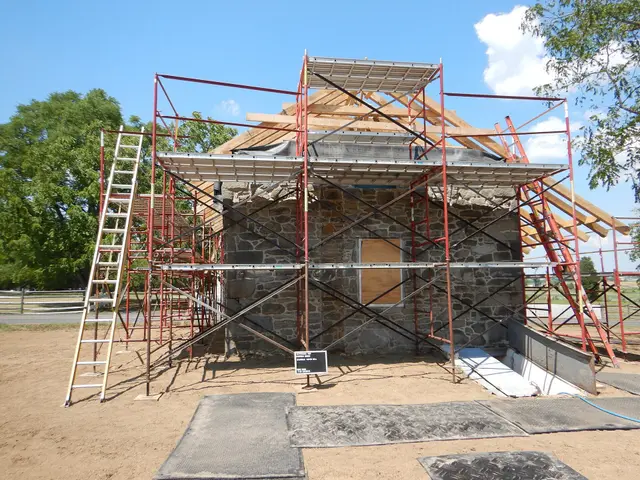
Indoors, in high-ceilinged halls and light wells, painting crews often use a mobile tower (Figure 2). Lock every wheel before climbing, never push the tower with people or paint pots on the deck, and climb the internal ladder, not the outside of the frame. Fit outriggers on taller towers as the manufacturer specifies.
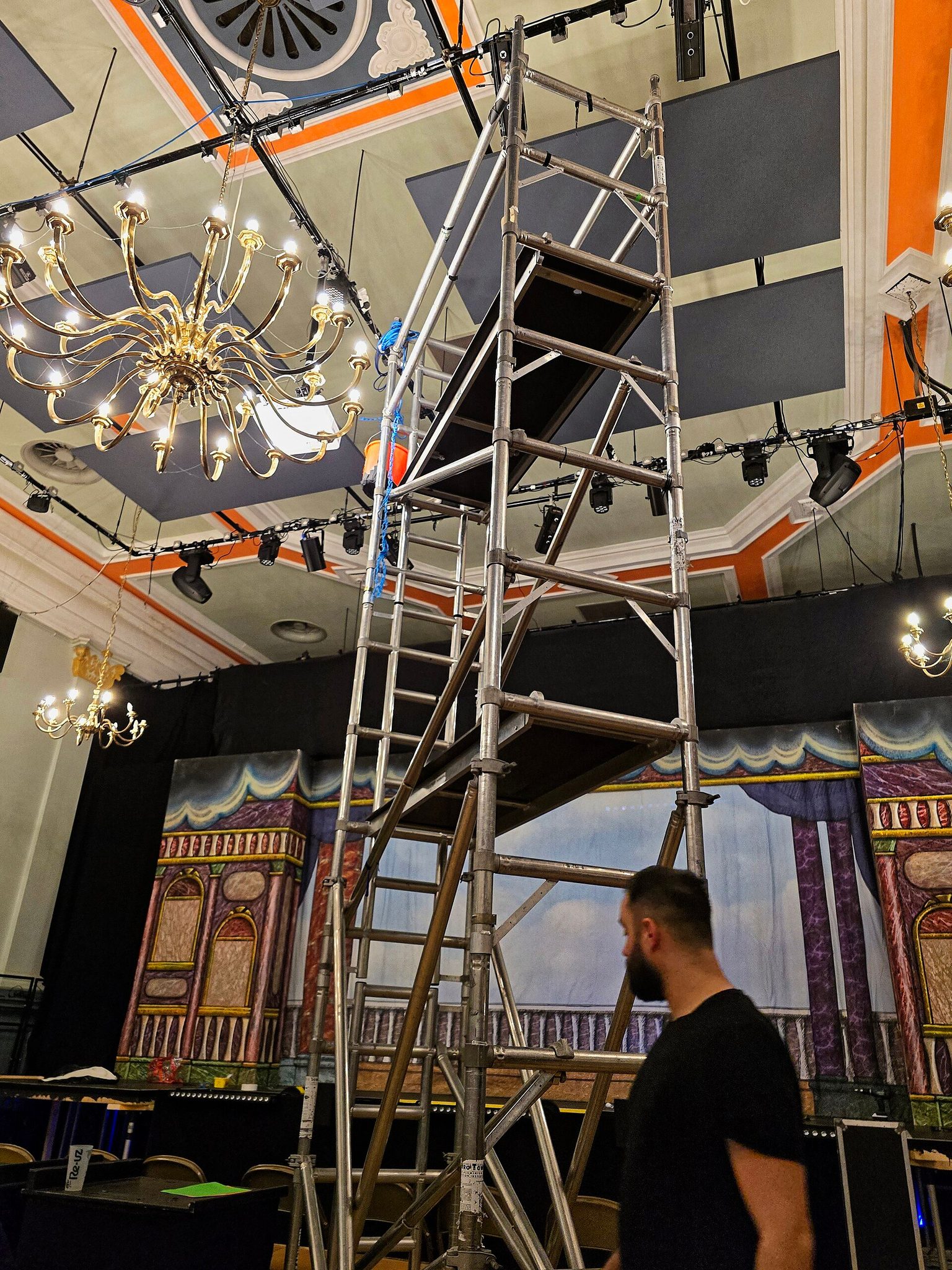
Photo: Acabashi / Wikimedia Commons, CC BY-SA 4.0
When a harness is mandatory
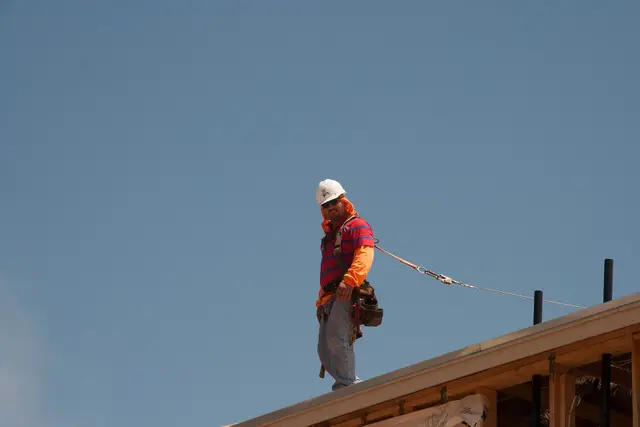
When you work at the edge of a floor, balcony, roof or facade without full guardrails, or whenever the crew or contractor requires it, you must wear a full-body harness (Figure 3) clipped to a solid anchor above shoulder height. A simple waist belt is not fall protection. Before each shift, check the straps, buckles, hooks and shock-absorbing lanyard; any harness that has arrested a fall must be taken out of service.
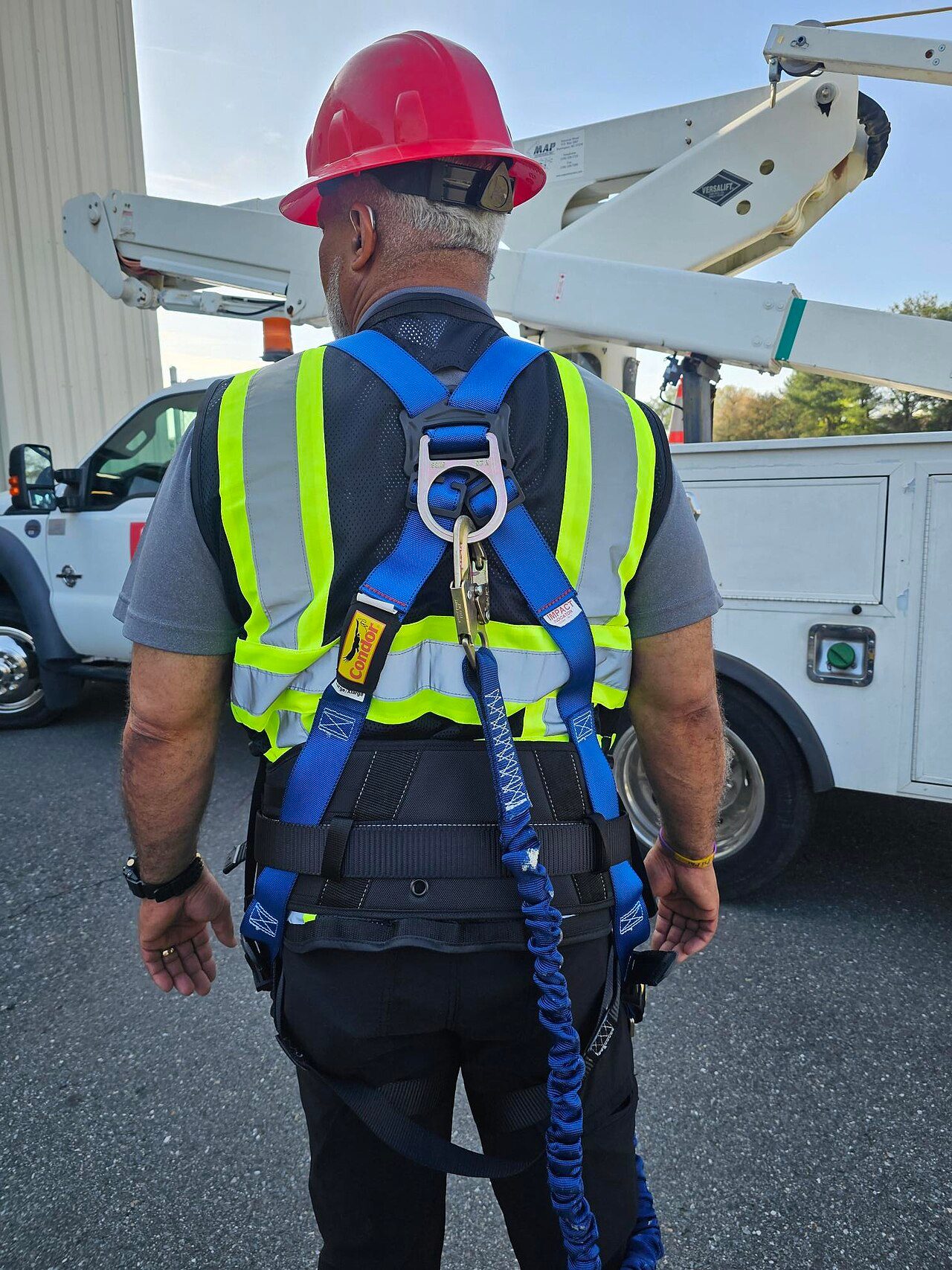
Photo: SafetyEdition / Wikimedia Commons, CC0
Suspended chairs and rope access: not for beginners
Painting high-rise facades from a bosun's chair or ropes requires specialist training, an independent backup line and a supervisor. Work at height in Vietnam generally requires occupational safety training under current regulations; ask your contractor and check the official rules. A beginner must never take on this work.
Paint chemicals: masks, gloves, goggles and ventilation
Each type of paint needs a different level of protection. The best habit is to read the tin label and the manufacturer's safety data sheet (SDS) before opening the lid.
| Paint or chemical | Main hazard | Minimum protection | Ventilation |
|---|---|---|---|
| Water-based interior or exterior paint | Mild odour, eye splashes, skin irritation | Goggles, gloves, a mask when rolling ceilings | Open doors for cross draught |
| Oil-based paint, anti-rust, wood paint | Solvent vapour, flammable | Organic vapour respirator, nitrile gloves, goggles | Essential; add an extractor fan blowing outwards |
| Solvent-based waterproofing, epoxy | Strong vapour, skin irritation | As for oil paint; read the SDS | Essential, especially in closed rooms and basements |
| White spirit, thinners, paint stripper | Highly flammable, toxic vapour | Vapour respirator, solvent-resistant gloves, goggles | Essential; keep away from flames |
Which mask for which job
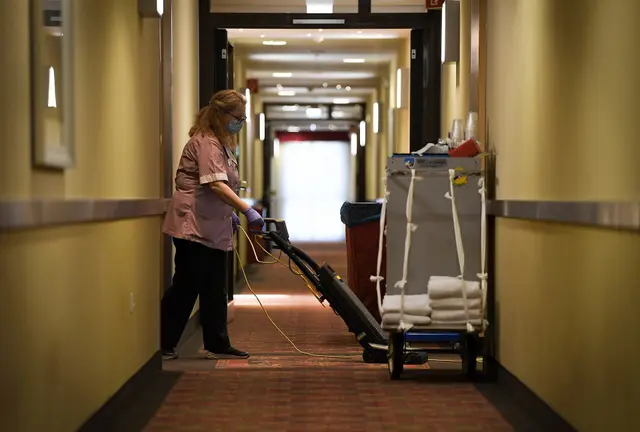
Surgical masks, cloth masks and dust masks only stop particles, not solvent vapour. When mixing, brushing or rolling oil-based paint or using white spirit indoors, wear a half-mask respirator with activated-carbon organic vapour cartridges (Figure 4), fitted tightly, and change the cartridges as the maker advises or as soon as you can smell the solvent. For sanding, use a fine-dust mask.
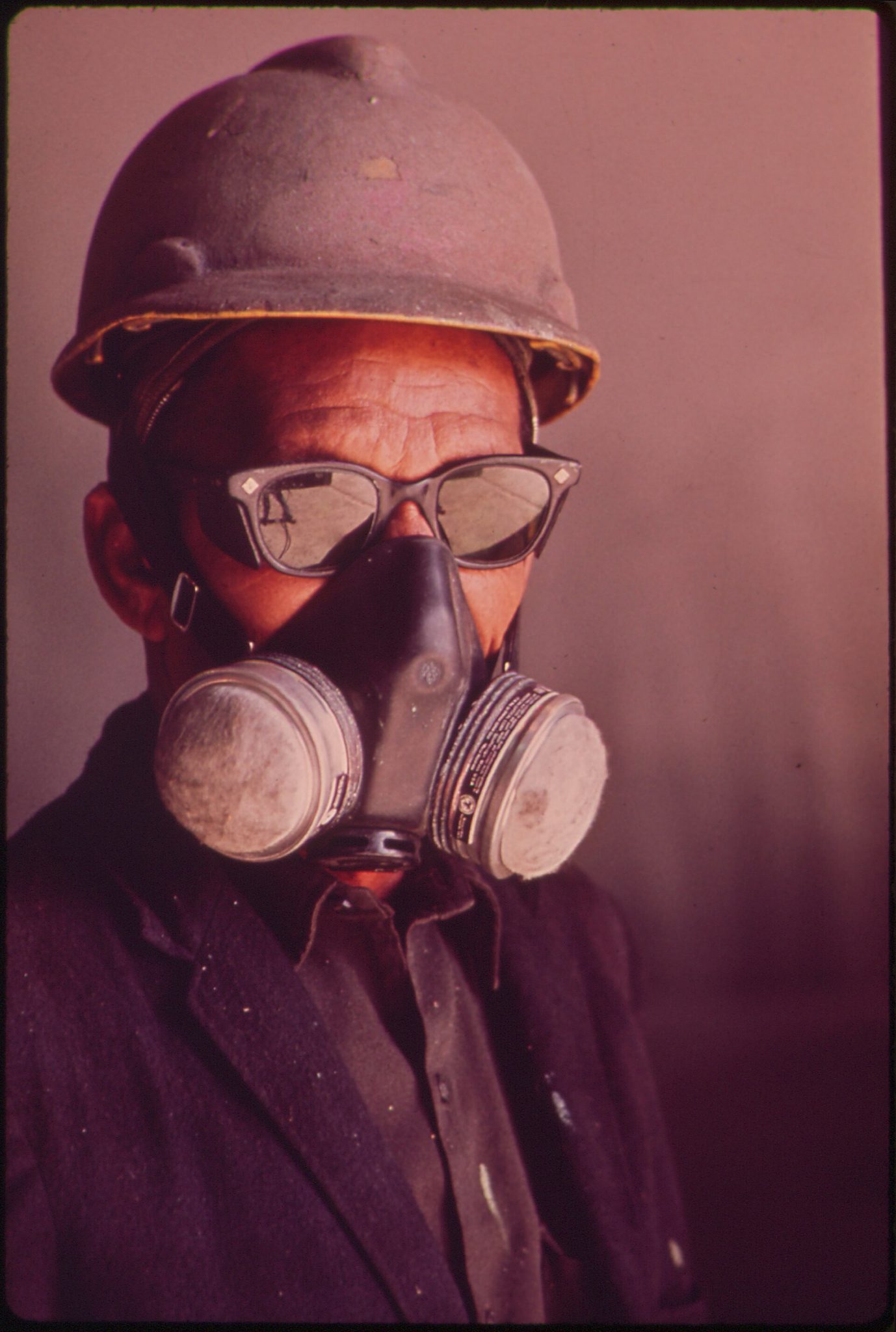
Photo: John Messina / Wikimedia Commons, Public domain
Ventilating properly
Open doors or windows on two sides so air flows through the room. Put an extractor fan in a window blowing the fumes outside, not into rooms where people are. In bathrooms, store rooms and closed basements, paint in short spells, step outside to rest and keep a second person nearby. If you feel dizzy or sick, stop, get to fresh air at once and do not climb a ladder while light-headed.
Protecting skin and eyes
Wear nitrile gloves when mixing oil-based paint and using solvents; never wash your hands in white spirit, use soap or a proper hand cleaner. Wear goggles when rolling ceilings, spraying and mixing chemicals.
Fire prevention: storing paint, white spirit and rags
Fires on painting jobs usually start very small: a cigarette, a spark from a cutter, or a pile of oil-soaked rags left in a hot corner.
Safety warning: White spirit and paint thinners are highly flammable; their vapour is heavier than air and creeps along the floor to gas stoves, sockets or welding in another room. No smoking, cooking, cutting or welding where oil-based paint is being used; switch off sockets and switches before painting around them. Never raise an aluminium ladder or metal roller pole near the power lines in front of a facade; keep a safe distance and tell the contractor and the power company if the lines are too close. Rags soaked in oil-based paint can heat up and catch fire on their own: soak them in water in a metal can with a lid, or lay them flat outdoors to dry before disposal. Always keep a fire extinguisher in the work area. If paint or solvent gets into your eyes, rinse with clean running water for at least 15 minutes and see a doctor; if someone falls from height, is unconscious or cannot breathe properly, call 115 (Vietnam's emergency number) and do not move a fall victim if a spinal injury is possible.
Storing paint and solvents
- Close lids tightly after every use; wipe the rim so the lid seals.
- Store in a dry, ventilated, cool place, out of direct sun, away from kitchens, sockets and children.
- Never decant white spirit into drinking bottles or unlabelled bottles.
- Bring only one day's supply to the work area; keep the rest in the store.
Paint waste
Do not pour solvents or oil-paint brush-cleaning liquid down the drain. Let dirty solvent settle in a closed container, pour off the clear part to reuse for brush cleaning, and dispose of the sludge and empty tins according to local collection rules.
Worked example: a safety plan for a 3-storey tube house
A 2-person crew is repainting a 3-storey tube house: water-based paint for indoor walls, oil-based paint for the iron balcony railings and solvent-based waterproofing for the roof terrace. The facade is about 11 m high, with power lines running across in front. You are the helper, asked to list the access equipment and PPE.
Step 1: choose equipment for each location
- Indoor walls and ceilings 3.2 m high: roller with extension pole, stepladder for cutting in.
- Two-storey light well: mobile tower with guardrails and locked wheels.
- 11 m facade: frame scaffold erected by the rental company, tied to the wall with guardrails; both painters wear full-body harnesses. Ask the owner to contact the power company about the stretch of line near the scaffold before it goes up.
- Iron railings and roof terrace: organic vapour respirators, nitrile gloves, and a fire extinguisher by the door to the terrace.
Step 2: work out the leaning ladder position
To paint the vent opening above the back door, the leaning ladder touches the wall 3.6 m up. By the 4-to-1 rule, the foot goes 3.6 ÷ 4 = 0.9 m from the wall. The lead painter holds the foot while you paint, and you only climb to the highest step allowed on the label.
Step 3: PPE cost for one painter (2026 reference, varies by region and brand)
| Item | Quantity × unit price | Amount |
|---|---|---|
| Full-body harness + shock-absorbing lanyard | 1 set × 900,000 VND | 900,000 VND |
| Half-mask + 1 pair of organic vapour cartridges | 1 set × 450,000 VND | 450,000 VND |
| Spare pair of cartridges | 1 pair × 200,000 VND | 200,000 VND |
| Safety goggles | 1 × 80,000 VND | 80,000 VND |
| Nitrile gloves, box of 100 | 1 box × 180,000 VND | 180,000 VND |
| Hard hat with chin strap | 1 × 120,000 VND | 120,000 VND |
| 4 kg dry powder extinguisher (shared) | 1 × 350,000 VND | 350,000 VND |
| Total | 2,280,000 VND | |
Check: 900,000 + 450,000 + 200,000 + 80,000 + 180,000 + 120,000 + 350,000 = 2,280,000 VND (about 90 USD). Real prices vary: a full-body harness costs roughly 600,000–1,500,000 VND and a cartridge respirator about 300,000–700,000 VND. When you work for a crew, PPE is normally supplied by the contractor; when you take jobs yourself, you buy it, and it should be treated as a fixed cost, not something to save on.
Common beginner mistakes and how to avoid them
Standing on the top of a stepladder to "reach"
Sign: the ladder wobbles and you are on tiptoe. Cause: the ladder is too short for the job. Prevention: get a taller ladder, use an extension pole or a mobile tower.
Wearing a dust mask for oil-based paint
Sign: you can still clearly smell solvent and have a headache by evening. Cause: the mask does not filter vapour. Prevention: use an organic vapour respirator, increase ventilation and take regular fresh-air breaks.
Pushing a mobile tower with someone on it
Sign: the tower sways and a wheel catches a tile edge. Cause: not wanting to climb down. Prevention: everyone down, clear the deck, move it, lock the wheels, then climb back up.
Throwing oil-paint rags in a heap
Sign: the pile feels warm and smells scorched. Cause: the oil in the paint oxidises and gives off heat. Prevention: soak rags in water in a lidded metal can, or lay them flat outdoors to dry.
Frequently asked questions
Is water-based paint toxic? Do I need a mask?
Water-based paint contains far less solvent than oil-based paint, but it still smells and can irritate the eyes and nose. Wear a mask and goggles when rolling ceilings, ventilate, and let the room air out before people move back in, especially young children and anyone with breathing problems.
Do I need a harness to paint the outside of the first floor?
Yes, if you are working at a balcony edge, a window ledge or on a scaffold without full guardrails. A fall from the first floor up is enough to cause serious injury. The safe setup is a fully boarded scaffold with guardrails plus a full-body harness clipped to a solid anchor.
Can white spirit be kept in the house?
Only a small amount in a sealed, labelled can, in a cool ventilated place away from the kitchen, sockets and children. Never in a bedroom, an enclosed space under the stairs or next to a gas cylinder.
Do house painters need a safety certificate?
People who work at height in Vietnam generally need occupational safety training under current regulations, and many contractors and sites ask for a card or certificate. The detailed rules can change, so ask your contractor and check the official documents and authorities.
Practice tasks and first-day checklist
- Set a leaning ladder against a wall touching 3 m up, measure the foot distance by the 4-to-1 rule and write it down.
- Open and lock a stepladder and read the label to find the highest step you may stand on.
- Put on a full-body harness, adjust the shoulder and leg straps to fit snugly, and ask the lead painter to check it.
- Read the label of an oil-based paint tin and a can of white spirit, and note the hazard symbols and storage instructions.
Self-assessment criteria
- Pass: the leaning ladder is at the right distance (touching 3 m up, the foot is 0.75 m from the wall) and the stepladder is locked on both sides.
- Pass: you choose the right mask for water-based paint, oil-based paint and sanding, and can explain why a dust mask does not stop vapour.
- Pass: you can explain how to handle oil-paint rags and where to store white spirit safely.
- Not yet: standing on the top of a ladder, climbing a scaffold without checking it, or using oil-based paint in a closed room without ventilation.
Once safety is second nature, move on to the next step of the roadmap: Paint systems: putty, primer, topcoat, where you learn what each layer does and how to pick the right product. You can also look ahead at technique lessons for this trade: how to skim coat walls with putty and repainting an old house.
Keep learning house painting: after safety come paint systems, surface preparation, skim coating, primer and topcoat, sprayers and per-m² quoting. See the 8-step house painter roadmap.