A wire that is too small for its load heats up, ages its insulation and is one of the most common causes of house fires. A circuit breaker that is too large for its wire will not trip in time when the circuit is overloaded. In the previous step you learned to measure voltage and read real current with a clamp meter; this step turns those measured numbers into design decisions for homes on single-phase 220V/50Hz power, the standard supply in Vietnam.
By the end of this lesson, you will be able to:
- Read a line on an electrical diagram and divide a house into sensible circuits by floor and by load.
- Calculate the current of each circuit and choose a breaker and wire size that satisfy the rule Ib ≤ In ≤ Iz.
- Check voltage drop on long cable runs and choose the correct B, C or D trip curve.
- Build an equipment schedule for the whole distribution board of a 3-storey tube house, including the main breaker and the main feeder cable.
The core principle: the breaker protects the wire
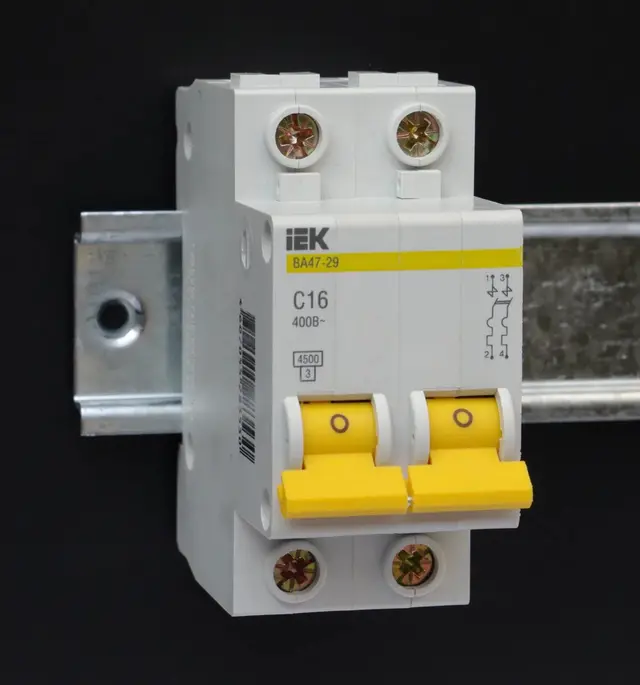
A miniature circuit breaker (MCB — in Vietnam usually called an "aptomat") exists to protect the conductor downstream of it. So the correct order is:
- Calculate the load current on the circuit.
- Choose a breaker whose rated current is greater than or equal to the load current.
- Choose a wire whose current-carrying capacity is greater than the breaker's rated current.
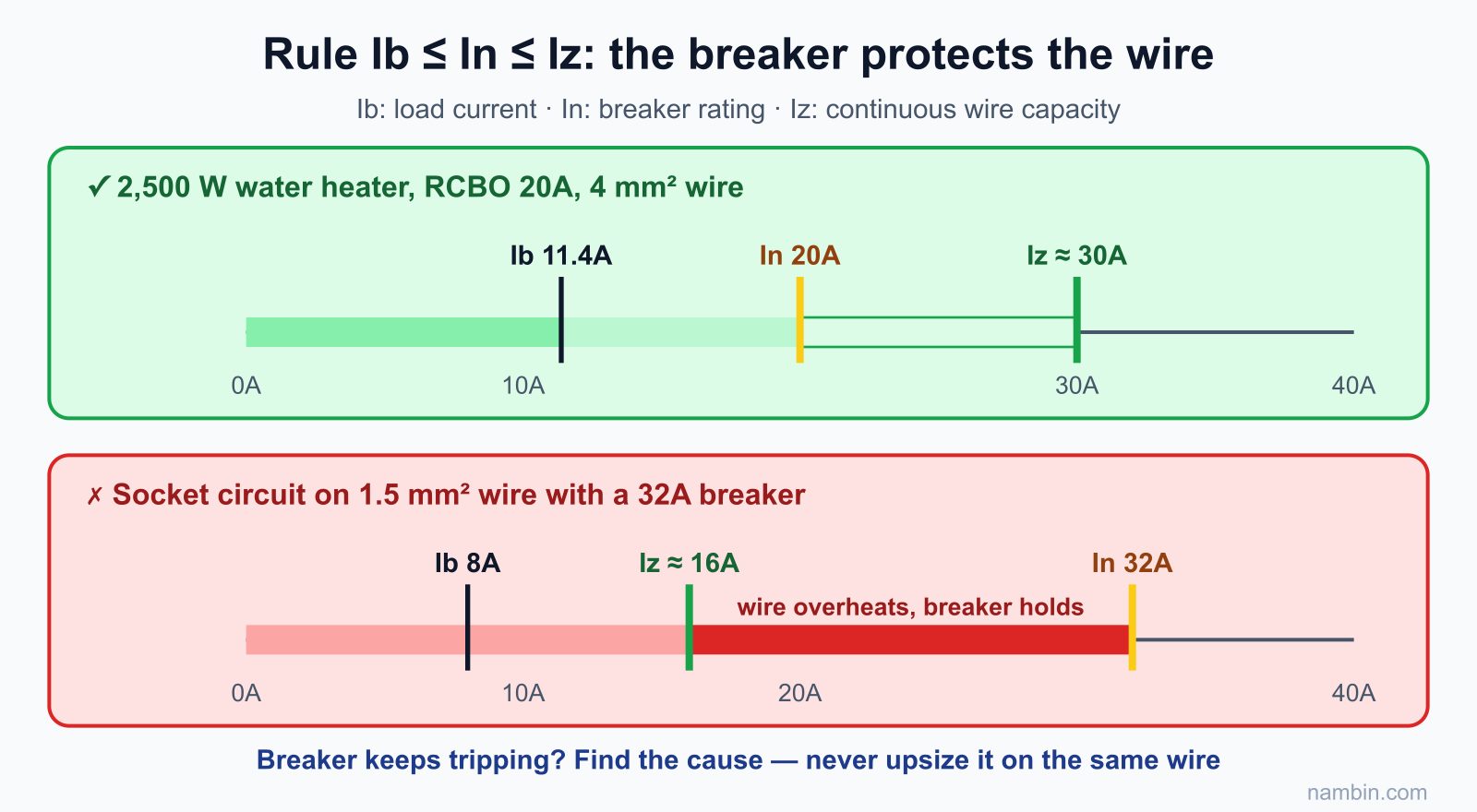
If you fit a 32A breaker on a 1.5 mm² wire, the wire's insulation can melt before the breaker trips.
Writing it as one inequality
Designers remember the rule as: load current ≤ breaker current ≤ current the wire can carry, written Ib ≤ In ≤ Iz. Ib is the operating current of the circuit, In is the rated current printed on the breaker, and Iz is the continuous current the wire can carry under its real installation conditions. If either side is wrong, the circuit is unsafe: if Ib is larger than In, the breaker trips constantly; if In is larger than Iz, the wire overheats while the breaker stays closed.
Why a hot wire is dangerous even before it shorts
Common PVC-insulated copper wire is designed for a conductor temperature of about 70°C in continuous use. Exceed that for hours every day and the PVC hardens, becomes brittle, cracks and loses its insulation; after a few years a wire inside the wall can short-circuit without any warning sign. A mild, long-lasting overload is dangerous precisely because it is silent.
Reading the electrical diagram and dividing circuits
A residential single-line diagram usually shows: main breaker → branch breakers → each circuit (ground-floor lighting, ground-floor sockets, bedroom air conditioner…). When reading the diagram, check:
- Whether each circuit shows its wire size and breaker rating.
- Whether high-power appliances have their own circuits.
- Whether wet areas have residual-current (earth-leakage) protection.
- Whether an earth wire runs to sockets and metal-cased appliances.
Common symbols on the diagram
Residential electrical drawings in Vietnam usually use symbols based on TCVN (Vietnamese national standards) and IEC, and every drawing should carry its own legend. A line on a branch diagram might look like: MCB 1P 20A 6kA – Cu/PVC 2x4 + E4 – Heater WC2. It reads: single-pole 20A breaker with 6kA breaking capacity; PVC-insulated copper cable with 2 cores of 4 mm² (phase and neutral) plus a 4 mm² earth wire; supplying the water heater in the second-floor bathroom (WC2). On Vietnamese drawings the load name is written in Vietnamese, so ask the designer whenever an abbreviation is unclear.
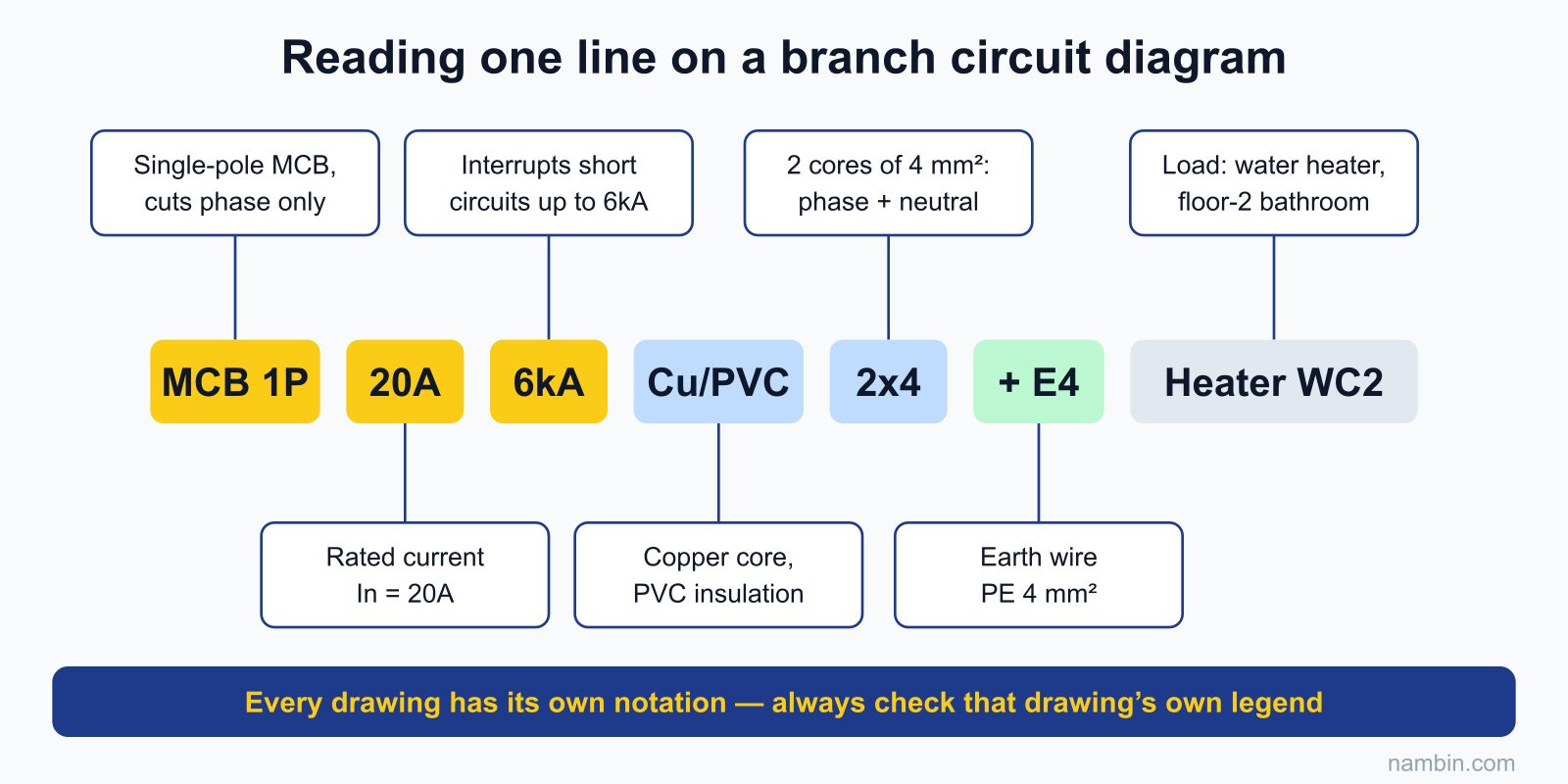
- 1P, 1P+N, 2P: number of breaker poles. 1P only disconnects the phase wire; 2P disconnects both phase and neutral.
- RCBO, RCCB (ELCB): devices with residual-current (earth-leakage) protection, usually marked with a 30mA threshold.
- E or PE: the protective earth wire.
- Symbols for lights, sockets and switches on the floor plan: always compare them with the legend of that specific drawing, because each design office may draw them slightly differently.
Rules for dividing circuits
- Separate lighting from sockets. If a socket breaker trips, the house still has lights so you can deal with the problem.
- Dedicated circuits for large loads: every air conditioner, every water heater, the induction hob and the water pump should have their own breaker.
- Divide by floor or area: at least one lighting circuit and one socket circuit per floor, which makes faults easier to isolate.
- Spare capacity: the board should keep 2–4 free breaker spaces so the owner can add equipment later.
Calculating load current
For single-phase power, the approximate formula is I = P / (U × cosφ), where P is the total power (W), U = 220V, and cosφ (power factor) is about 0.8–0.9 for mixed household loads. A quick mental rule: every 1,000 W is roughly 5 A.
Not every appliance runs at the same time, but for a dedicated circuit for a water heater, air conditioner or induction hob, always calculate at the appliance's maximum power.
Where to get the power rating
Take the power from the rating plate on the appliance or from its manual, not from hearsay. Air conditioners show cooling capacity in BTU, which is not electrical power. Look for "power input" (W) or "rated current" (A) on the outdoor unit's plate. The table below gives reference values for estimating when no plate is available.
| Appliance | Typical electrical power | Approximate current at 220V |
|---|---|---|
| LED lighting for a whole floor (10–15 lamps) | 100–250 W | 0.5–1.2 A |
| Household refrigerator | 100–250 W | 0.5–1.2 A (higher starting current) |
| Washing machine (no dryer) | 400–800 W | 2–4 A |
| 9,000 BTU air conditioner | about 700–900 W | 3.5–4.5 A |
| 12,000 BTU air conditioner | about 1,000–1,200 W | 5–6 A |
| 18,000 BTU air conditioner | about 1,600–1,900 W | 8–9 A |
| Storage water heater | 2,000–2,500 W | 9–11.5 A |
| Double induction hob | 3,500–4,000 W | 16–19 A |
| 1 HP water pump | about 750 W | 4–5 A (several times more when starting) |
Diversity factor for the main feeder and main breaker
For the main feeder and main breaker, simply adding up every load and sizing for the total gives an oversized, expensive cable. In reality nobody switches on the hob, two water heaters, three air conditioners, the washing machine and the pump all at once. Designers multiply the total connected load by a diversity (simultaneity) factor, usually about 0.6–0.8 for homes. Use a higher value for houses with few appliances that are used at the same hours; use a lower value for houses with a large connected load whose big loads run briefly and at different times (water heaters switch off when hot, the hob only cooks for 1–2 hours). Do not apply this factor to a branch circuit that feeds one appliance.
Quick reference table for copper wire in conduit
These values are for reference in ordinary homes, with PVC-insulated copper wire run in conduit inside the wall over moderate lengths. When a run is very long, several circuits share one conduit, or the location is hot, go up one size.
| Circuit | Wire size | Typical breaker |
|---|---|---|
| Lighting | 1.5 mm² | 10A |
| General sockets | 2.5 mm² | 16–20A |
| 9,000–12,000 BTU air conditioner | 2.5 mm² | 16–20A |
| 2,500 W water heater, 18,000 BTU air conditioner | 4 mm² | 20–25A |
| 3,500–4,000 W double induction hob | 4–6 mm² | 25–32A |
| Main feeder for a small apartment | 6–10 mm² | 32–50A (depending on total load) |
Important: Bathroom circuits, water heaters, washing machines and sockets in wet areas should be protected by a 30mA residual-current device (an RCBO, or an RCCB combined with MCBs). This protects people from electric shock, not just the wire.
Reference current-carrying capacity of copper wire
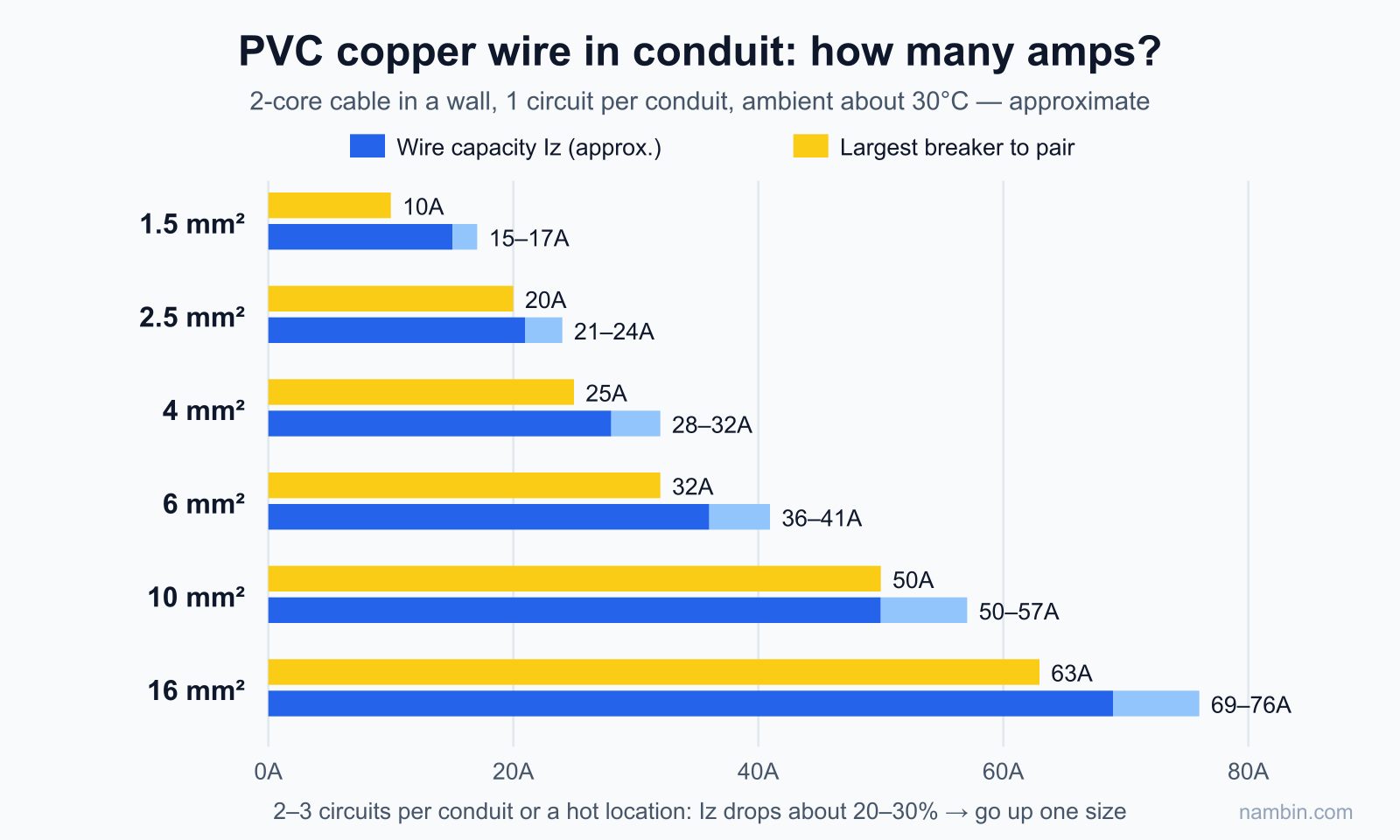
The table above already includes a safety margin. If you want to understand why, here is the approximate continuous current capacity of 2-core PVC-insulated copper cable in conduit inside a wall, at an ambient temperature of about 30°C, with one circuit per conduit (following the common method of IEC 60364, the standard referenced by Vietnam's TCVN rules for low-voltage installations). For real designs, use the cable manufacturer's own catalogue and the current standard.
| Cross-section | Approximate Iz (in conduit, 1 circuit) | Largest breaker to pair with it |
|---|---|---|
| 1.5 mm² | about 15–17A | 10A (16A at most on short, cool runs) |
| 2.5 mm² | about 21–24A | 20A |
| 4 mm² | about 28–32A | 25A |
| 6 mm² | about 36–41A | 32A |
| 10 mm² | about 50–57A | 50A |
| 16 mm² | about 69–76A | 63A |
Derating when circuits share a conduit or run somewhere hot
When 2–3 circuits run in the same conduit, the heat from one wire warms the others, and each circuit's capacity drops by about 20–30%. Wires running under a metal roof or in a hot ceiling space in summer are derated similarly. That is why the quick table says to go up one size. Example: a 2.5 mm² wire in its own conduit carries about 23A, but sharing a conduit with two other circuits it carries only about 16–17A — at that point a 20A breaker no longer protects the wire.
Checking voltage drop on long runs
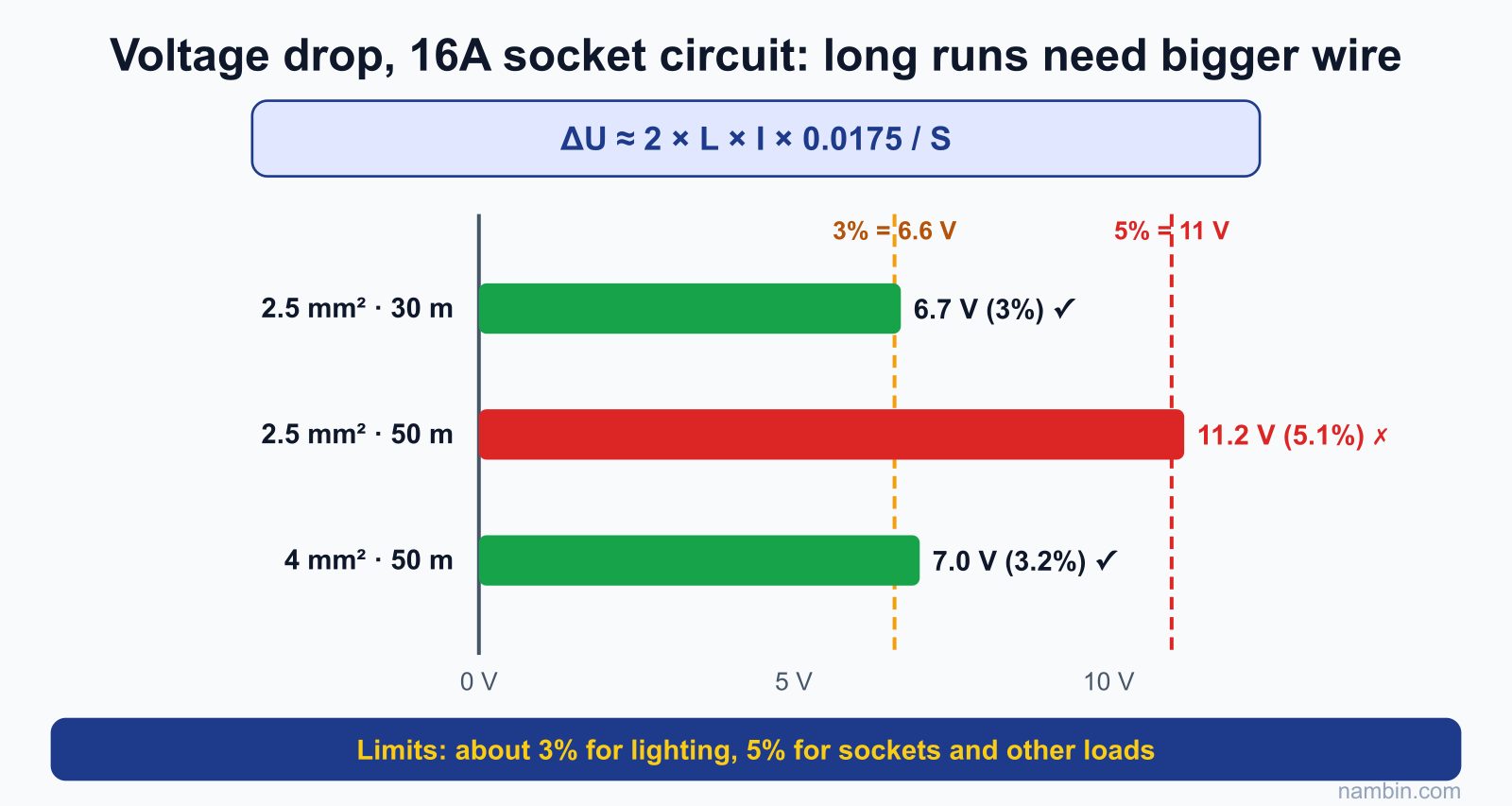
A wire that can carry the current is not necessarily good enough. A long run lowers the voltage at the far end, so air conditioners and pumps struggle to start and lights dim. Common design practice keeps the voltage drop from the board to the appliance below about 3% for lighting and about 5% for other loads, i.e. about 6.6V and 11V at 220V.
Single-phase voltage drop formula
ΔU ≈ 2 × L × I × ρ / S, where L is the one-way length of the run (m), the 2 is there because current flows out on the phase wire and back on the neutral, I is the current (A), S is the cross-section (mm²), and ρ is the resistivity of copper, about 0.0175 Ω·mm²/m at 20°C (it rises as the wire heats up, so keep a margin).
Voltage drop example
A 2.5 mm² socket circuit 30 m long carrying 16A: ΔU = 2 × 30 × 16 × 0.0175 / 2.5 ≈ 6.7V, about 3% — acceptable for sockets. If the run is 50 m: about 11.2V, more than 5% — go up to 4 mm² (about 7V, 3.2%). Deep tube houses with the board on the ground floor and the altar room or rooftop terrace on the fifth floor run into this all the time.
Choosing the right type of breaker, not just the right amps
Trip curves B, C and D
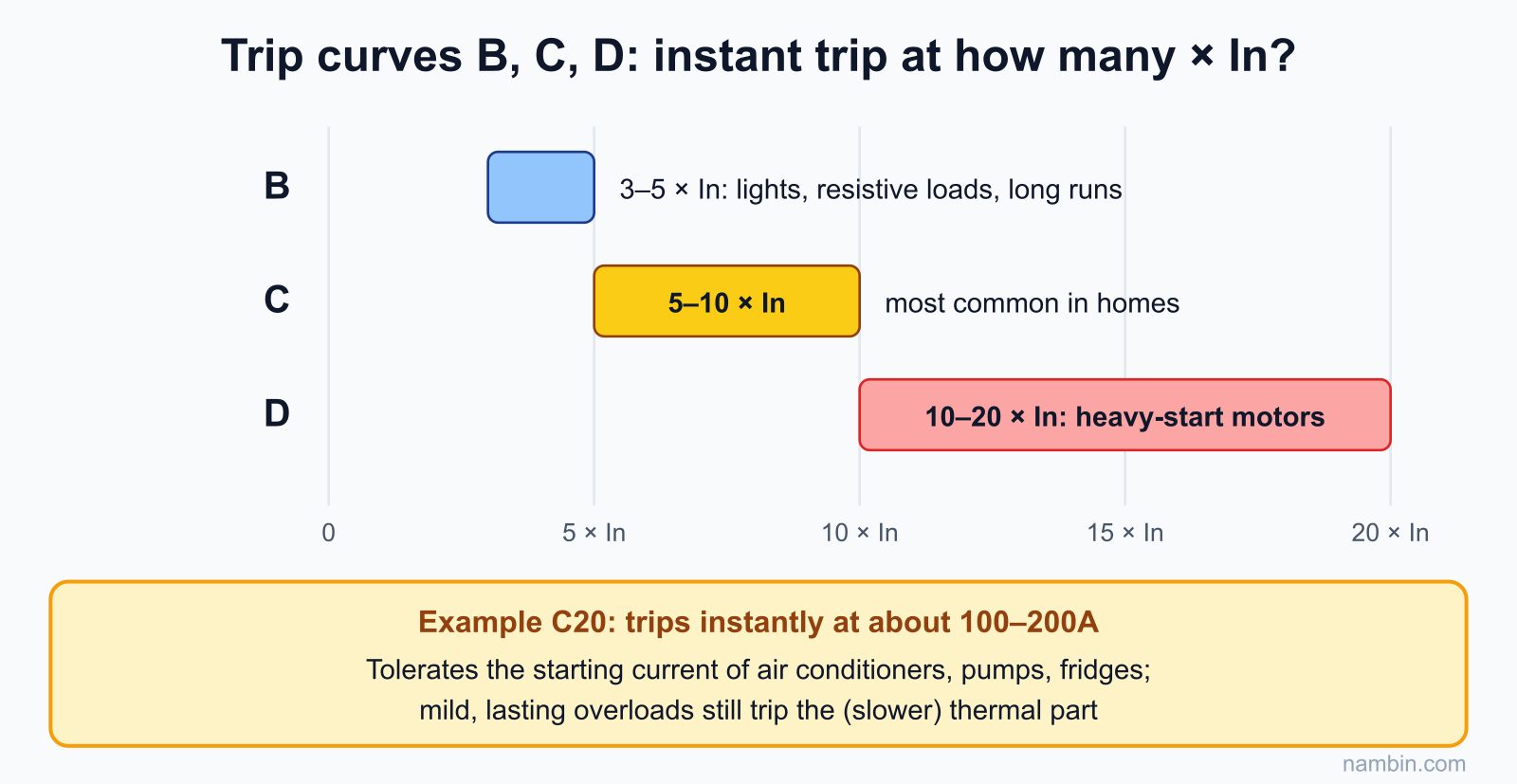
The letter before the amp rating, for example C20, tells you at what current the breaker trips instantly. Type B trips at about 3–5 times In, suitable for lighting circuits and resistive loads on long runs. Type C trips at about 5–10 times In, the most common in homes, and tolerates the starting current of air conditioners, pumps and refrigerators. Type D trips at about 10–20 times In, for motors with heavy starting, and is rare in homes. Besides this instant (magnetic) trip, every breaker also has a slower thermal trip that handles mild, long-lasting overloads.
Short-circuit breaking capacity (kA)
The figure 4.5kA, 6kA or 10kA on a breaker is the largest short-circuit current it can interrupt safely without being damaged. A house close to a transformer station sees a higher short-circuit current than a house at the end of the line. Household breakers are usually 4.5–6kA; the main breaker in a house near a substation or a large townhouse should be rated higher, following the designer's advice.
Single-pole or double-pole breakers
The main breaker should be double-pole (or 1P+N) so that both phase and neutral are isolated when it is switched off. Branch circuits in homes can use single-pole breakers, but for water heaters and bathrooms many electricians choose a 1P+N RCBO to disconnect both wires on earth leakage. The main breaker must match the power registered in the electricity supply contract and the utility's meter.
Practical calculation examples
Example 1: Living-room socket circuit
TV 150 W, fan 60 W, phone and laptop chargers 150 W, an electric hotpot used occasionally 1,200 W. Total about 1,560 W → about 8A. Choose a 16A breaker and 2.5 mm² wire — leaving room for appliances added later.
Example 2: 2,500 W water heater
A water heater is a resistive load, cosφ ≈ 1: 2,500 / 220 ≈ 11.4A. Choose a 20A 30mA RCBO and 4 mm² wire so the wire stays cool and lasts when the heater runs for long periods. 2.5 mm² can be used on a short run, but 4 mm² is the safer choice.
Example 3: 3,800 W double induction hob
3,800 W → about 19A. Choose a 25A breaker and 4 mm² wire, or 6 mm² if the run is long or shares a conduit with other wires. Run a dedicated circuit from the board; do not share a socket with the microwave or electric kettle. Check voltage drop on a 25 m run of 4 mm²: 2 × 25 × 19 × 0.0175 / 4 ≈ 4.2V, about 1.9% — acceptable.
Worked example from start to finish: the board of a 3-storey tube house
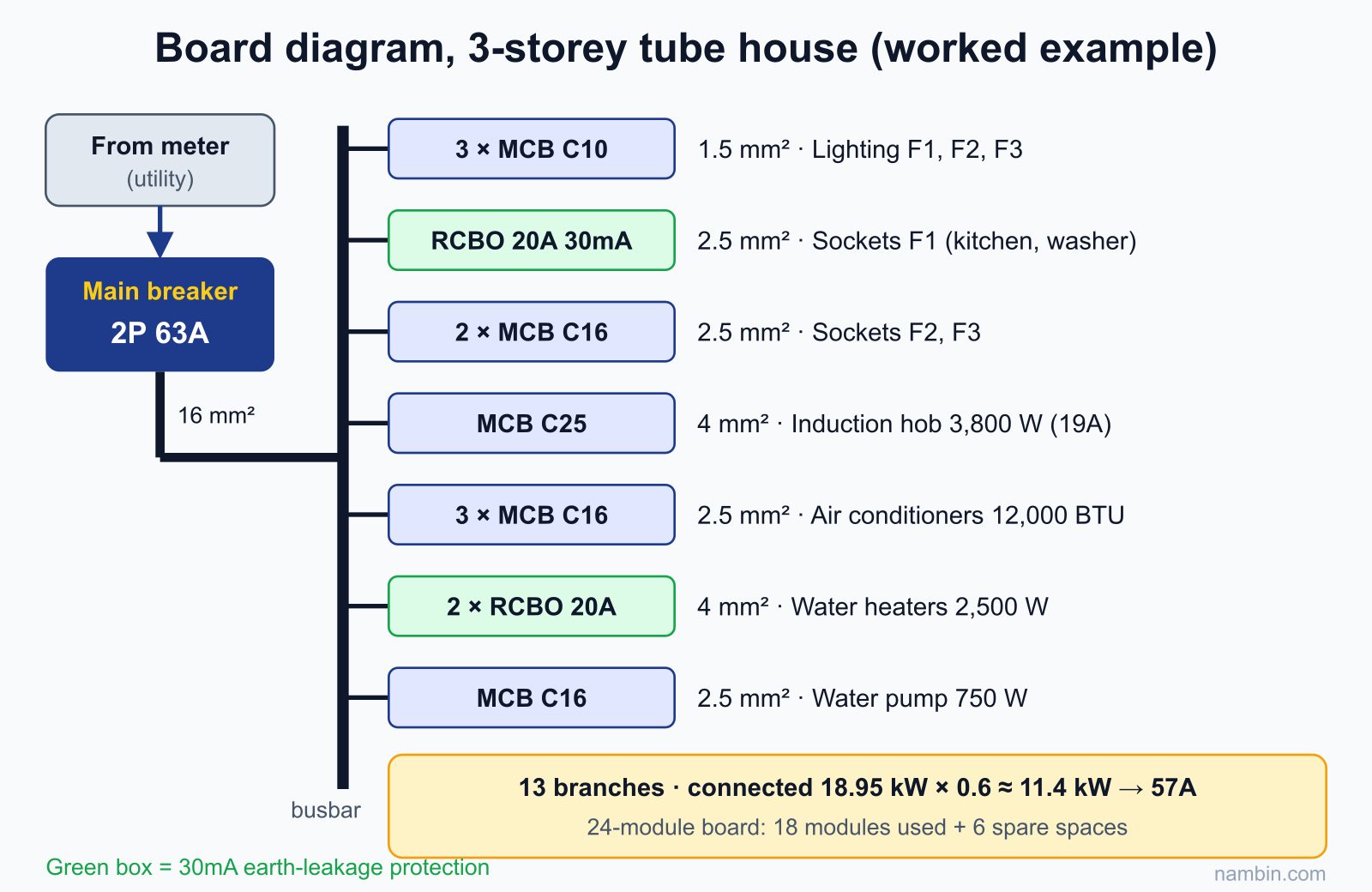
A family of 5 lives in a 4 × 15 m tube house (a narrow, deep townhouse typical of Vietnamese cities) with 3 floors; the main board is on the ground floor near the door. Appliances: the ground floor has a 3,800 W double induction hob, a refrigerator, a washing machine and a 750 W pump; floors 2 and 3 each have two bedrooms, three rooms have 12,000 BTU air conditioners (about 1,100 W each), and two bathrooms have 2,500 W water heaters.
Step 1: divide the circuits and size each branch
| Circuit | Design load | Current ≈ | Breaker | Wire |
|---|---|---|---|---|
| Lighting, floors 1, 2, 3 (3 circuits) | 150–250 W per floor | 1A | MCB C10 | 1.5 mm² |
| Sockets, floor 1 (fridge, washer, small kitchen appliances) | about 2,500 W | 12A | RCBO 20A 30mA | 2.5 mm² |
| Sockets, floors 2 and 3 (2 circuits) | about 1,500 W per floor | 7A | MCB C16 | 2.5 mm² |
| Induction hob | 3,800 W | 19A | MCB C25 | 4 mm² |
| Air conditioners (3 circuits) | 1,100 W each | 5–6A | MCB C16 | 2.5 mm² |
| Water heaters (2 circuits) | 2,500 W each | 11.4A | RCBO 20A 30mA | 4 mm² |
| Water pump | 750 W | 4A | MCB C16 | 2.5 mm² |
Step 2: size the main breaker and main feeder
Total connected load: lighting about 0.6 kW + sockets 2.5 + 1.5 + 1.5 = 5.5 kW + hob 3.8 kW + air conditioners 3.3 kW + water heaters 5 kW + pump 0.75 kW ≈ 18.95 kW. The connected load is large, but the big loads run at different times (water heaters switch off once hot, cooking mostly happens 17:00–19:00, air conditioners run at night), so take a diversity factor of 0.6: 18.95 × 0.6 ≈ 11.4 kW. Design current: 11,400 / (220 × 0.9) ≈ 57A.
With this result, a 63A double-pole main breaker and a 16 mm² copper main feeder (because 10 mm² only carries about 50–57A in conduit, which a 63A breaker cannot protect) is a sensible choice. Before finalizing, check the registered power with the electricity utility: if the current contract and meter cannot supply it, the owner must apply to increase the registered capacity or switch to three-phase power — this work is done by the utility.
Step 3: re-check and document the diagram
Check the longest run: the floor-3 water heater is about 22 m from the board, 11.4A on 4 mm²: ΔU ≈ 2 × 22 × 11.4 × 0.0175 / 4 ≈ 2.2V, about 1% — very good. In total the board has 13 branch breakers: 10 single-pole MCBs (1 module each), 3 RCBOs 1P+N (usually 2 modules each) and a double-pole main breaker (2 modules) — 18 modules in all. Choose a 24-module enclosure to leave 6 spare spaces. Write everything on the diagram, label every breaker and hand a copy to the owner.
Warning: The calculation is only correct if the installation is done correctly. Any connection inside the board must be made with the power off, locked out and tested dead following the procedure in the safety lesson. Connections before the meter, changing the registered power or converting to three-phase are the utility's job; residential electricians do not do them themselves.
Common mistakes
Besides the three mistakes analysed below, you will also often see: choosing a wire that is "just enough" and then the owner buys another large appliance; joining wires of different sizes by twisting them by hand and taping them inside the wall; and leaving no diagram or labels for the owner.
Mistake-by-mistake analysis
Upsizing the breaker because it keeps tripping. Sign: a 16A socket breaker trips every evening and the owner asks for a 32A one. Cause: the real load exceeds what the circuit can carry (for example a kettle, microwave and air fryer plugged in at the same time). Fix: measure the actual current with a clamp meter and move large loads to a dedicated circuit with suitable wire; never increase the breaker while the wire is still 2.5 mm².
Earth wire smaller than the phase wire. Sign: a 1.5 mm² PE wire pulled for a 4 mm² hob circuit. Cause: cost-cutting. Fix: for phase wires up to 16 mm², the earth wire should be the same size as the phase wire so it can carry fault current long enough for the protective device to trip.
Wrong wire colours. Sign: green-yellow wire used as a phase wire. Fix: the common convention is green with yellow stripes for earth, blue for neutral, and the remaining colours (brown, black, red, grey…) for phase. Keep it consistent across the whole job and note it on the diagram.
Frequently asked questions
Can 2.5 mm² wire be used for a 2,500 W water heater?
In terms of current, 11.4A is within the capacity of 2.5 mm² if it runs in its own conduit over a short distance with a breaker no larger than 16–20A. But water heaters run for a long time, the area is damp and the wire often shares a conduit — so 4 mm² is the more durable and safer choice, and the difference in material cost is small.
Should I use cosφ or the 1,000 W ≈ 5 A rule?
The 5 A per 1,000 W rule corresponds to a cosφ of about 0.9 — good enough for quoting and preliminary sizing. For motor loads such as air conditioners and pumps, use the current on the rating plate, because it is more accurate than any formula.
Can aluminium wire replace copper?
Homes today use copper almost exclusively. Aluminium wire of the same size carries less current, and its joints with copper devices oxidize, loosen and heat up unless special connectors are used. Apprentices should never decide on their own to use aluminium wire in a house.
Does every circuit need an RCBO?
Not necessarily every circuit, but at a minimum wet areas, water heaters, washing machines and outdoor sockets should have one. Many electricians use one 30mA RCCB for a group of socket circuits combined with an MCB per circuit. Detailed board layout is covered in the distribution board step.
The wire says 2.5 mm² but looks thinner — how can I tell?
Poor-quality wire may be undersized or have impure cores. Buy wire from sellers who issue invoices, read the information printed on the sheath (cross-section, voltage, standard), and if in doubt count the strands and measure the core diameter to compare with the manufacturer's published data.
Practice exercise
- List the appliances in your home, group them by room, calculate the current and propose wire and breaker sizes for each circuit.
- Draw a board diagram with a main breaker and at least 5 branch circuits.
- Pick the longest cable run in your home, measure or estimate its length and calculate the voltage drop.
- Use a clamp meter to measure the actual current of 2–3 circuits during the evening peak and compare it with your calculation.
Self-assessment criteria
- Pass: every circuit satisfies Ib ≤ In ≤ Iz, with all three numbers written clearly in your calculation sheet.
- Pass: large loads (hob, water heaters, air conditioners) all have dedicated circuits; wet areas have 30mA earth-leakage protection.
- Pass: voltage drop on the longest run is below about 3% (lighting) or 5% (other loads), with the calculation attached.
- Pass: the diagram shows the breaker type (poles, curve, kA), phase/neutral/earth wire sizes and circuit names.
- Not yet: any circuit has a breaker larger than the wire's capacity, or the main breaker was sized by adding up loads directly without explaining the diversity factor.
The next step in the roadmap is Installing lighting circuits, switches & sockets: you will run wire in conduit, make joints and install devices using exactly the wire sizes and breakers chosen here. The Ib – In – Iz calculation sheet from this lesson will also be reused when laying out the distribution board in step 5 and in the circuit installation exam in step 7.