"The water is so weak I can't rinse my hair." Low water pressure is one of the most common calls a residential plumber gets, and one of the easiest to get wrong. A new shower head will not help if a valve is half closed, and a bigger pump will not help a blocked aerator. Good diagnosis narrows the problem down from "the whole house" to "this floor", "this tap" or "only the hot side", and measures rather than guesses. This guide gives trainee plumbers in Vietnam a method for both mains-fed houses and the common townhouse system with a ground tank, pump and rooftop tank.
Scope and safety. This article covers diagnosing low pressure and low flow in the cold and hot water supply of a house or apartment: taps, showers, filters, valves, storage and instant water heaters, rooftop tanks and booster pumps. Pumps and water heaters run on 220–230 V: switch off and isolate them before opening anything electrical or water-filled, and do not open pump terminal boxes unless you are trained to. Working on a roof or a tank platform means a fall risk; never climb into a water tank. All figures in this guide are for reference only; equipment manufacturers' instructions and local rules come first.
Pressure or flow? Get the words right first
Clients say "pressure", but what they feel is usually flow. The two are linked but different.
Static pressure is the pressure in the pipe when no water is flowing. It depends on the source: the street main, the rooftop tank height or the pump.
Dynamic (running) pressure is the pressure at an outlet while water is flowing. It is always lower, because pipes, fittings, valves, filters and screens use up pressure as friction.
Flow rate is the volume delivered per minute, usually measured in litres per minute (L/min).
This is the key to the diagnosis. If the static pressure is low, the problem is the source: the tank is too low, the street supply is weak, or the pump is not delivering. If the static pressure is fine but the running pressure collapses as soon as a tap opens, something between the source and the outlet is restricting the water: a blockage, a partly closed valve, a clogged filter, or a corroded or undersized pipe.
Gravity head: the rule every Vietnamese plumber needs
In a house fed from a rooftop tank, the pressure at any outlet comes only from the height of the water above it. Water gives roughly 0.1 bar for every metre of height (about 9.8 kPa per metre). A shower head 1.5 m below the bottom of the tank therefore has, at best, about 0.15 bar of static pressure before any friction losses, which is why the top-floor shower in many townhouses is weak while the ground-floor taps are strong.
Height of water surface above the outlet | Approximate static pressure (for reference) |
|---|---|
1 m | 0.1 bar |
2 m | 0.2 bar |
3 m (about one storey) | 0.3 bar |
6 m (about two storeys) | 0.6 bar |
10 m (about three storeys) | 1.0 bar |
13 m (about four storeys) | 1.3 bar |
Storey heights vary, so measure the real height. As the tank empties, the head and the pressure fall.
Step 1: Ask the right questions
Spend five minutes with the client first; the answers often point straight to the cause.
Where is it weak? One tap, one bathroom, one floor, or the whole house?
Hot, cold or both? Weak hot water with good cold water points to the water heater or the hot pipe, not the supply.
Since when? Suddenly (after a repair, a renovation, a water cut, a new pump), or slowly getting worse over months (scale, rust, clogging filter)?
When? All day, or only in the morning and evening when the neighbours also use water? Only when another tap is open?
How is the house supplied? Direct from the street, from a ground tank (bể ngầm) with a pump to a rooftop tank, from a booster pump, or from a well?
Has anything changed? New fixtures, filters, heater or pipe work?
Write the answers down; they save time on a call-back.
Step 2: Map the problem
Now confirm it yourself. Open each outlet in turn, from the source outwards and upwards, cold then hot, and note the result.
Only one outlet is weak. The cause is almost always at that outlet: the aerator, shower head, hand-shower hose, cartridge, the angle stop valve or the flexible hose feeding it.
One bathroom or one floor is weak. Look at what that group of outlets shares: a branch valve, a branch pipe, a filter, or simply its height below the tank.
Only the hot side is weak, everywhere. Look at the water heater: its inlet, its valves and the hot pipe.
The whole house is weak. Look at the source: the street supply, the meter and main valve, the ground tank and pump, the rooftop tank, the booster pump and any whole-house filter.
Also open two outlets at once. If one tap is fine alone but drops to a trickle when the shower runs, the pipe or the source cannot supply the combined demand. That is a sizing or supply problem, not a blocked tap.
Step 3: Measure flow and pressure
Two simple measurements turn opinions into numbers.
The bucket test (flow)
Open the outlet fully and time how long it takes to fill a container of known volume, such as a 10-litre bucket.
Flow (L/min) = volume (L) ÷ time (s) × 60
For example, if a shower fills a 10-litre bucket in 75 seconds, the flow is 10 ÷ 75 × 60 = 8 L/min. If it takes 200 seconds, the flow is 3 L/min. Water-saving fixtures are designed to limit flow, so compare the result with the fixture's specification, with other outlets, and before and after each fix.
The pressure gauge (static and running pressure)
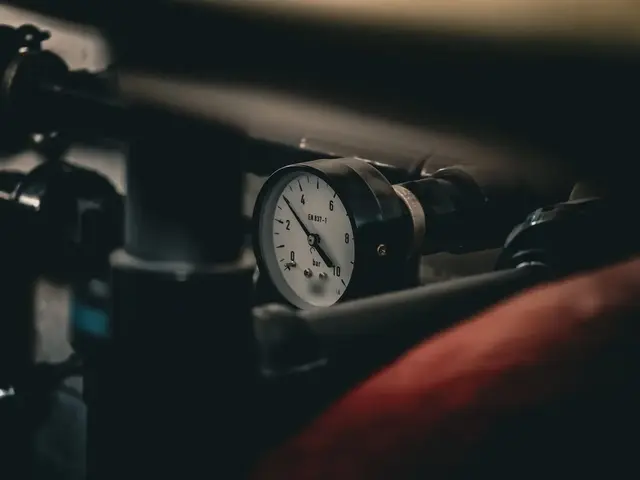
A gauge with a threaded adaptor fits onto a tap outlet, a washing machine valve or a test point. Choose a suitable scale: a 10 bar gauge is hard to read at 0.2 bar in a gravity-fed house.
Fit the gauge with every other outlet closed. The reading is the static pressure.
Open another outlet nearby fully and read again. This is a rough running pressure for that part of the system.
Compare. A small drop is normal. A large drop, or a needle that falls almost to zero, means a restriction or an undersized pipe between the source and the gauge.
In a gravity system, static readings at different outlets should differ by about 0.1 bar per metre of height. If the problem outlet reads much lower than its height suggests, look for a partly closed valve or a blockage upstream.
Step 4: Check the outlet itself
Aerators
The aerator at the end of a tap spout has one or more fine screens. Sand, rust, scale and pipe-work debris collect there, especially after a water cut or a renovation. Unscrew the aerator (protect the chrome with a cloth if you use pliers), and open the tap briefly without it. If the flow is strong without the aerator, clean or replace the aerator.
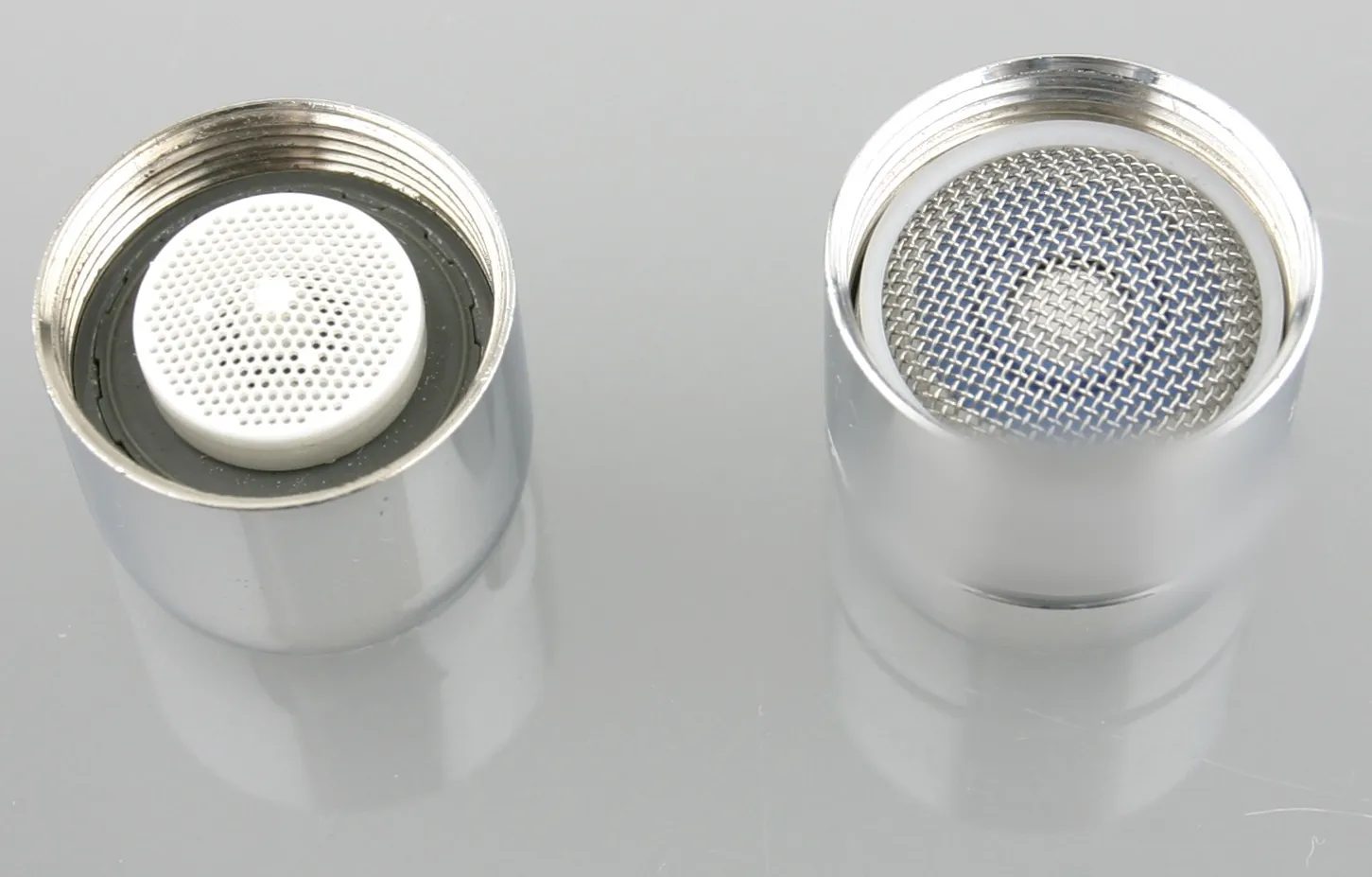
Figure 1. Two tap aerators seen from the outlet side. The left one has a white perforated insert in a dark rubber seat (the file describes it as an aerator with a flow regulator); the right one has a fine stainless mesh screen. Sand, rust and scale collect on these screens first. Embossed product text has been blurred. (Credit: SRuhnke, Wikimedia Commons, CC BY-SA 3.0)
Shower heads and hand showers
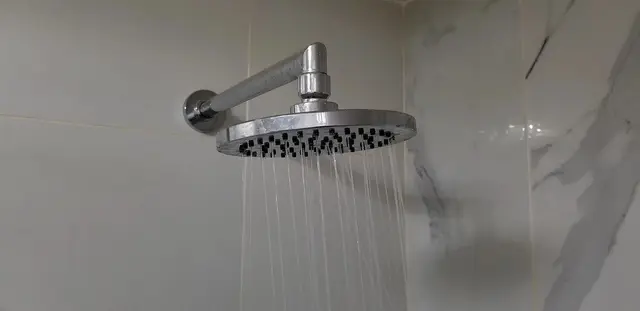
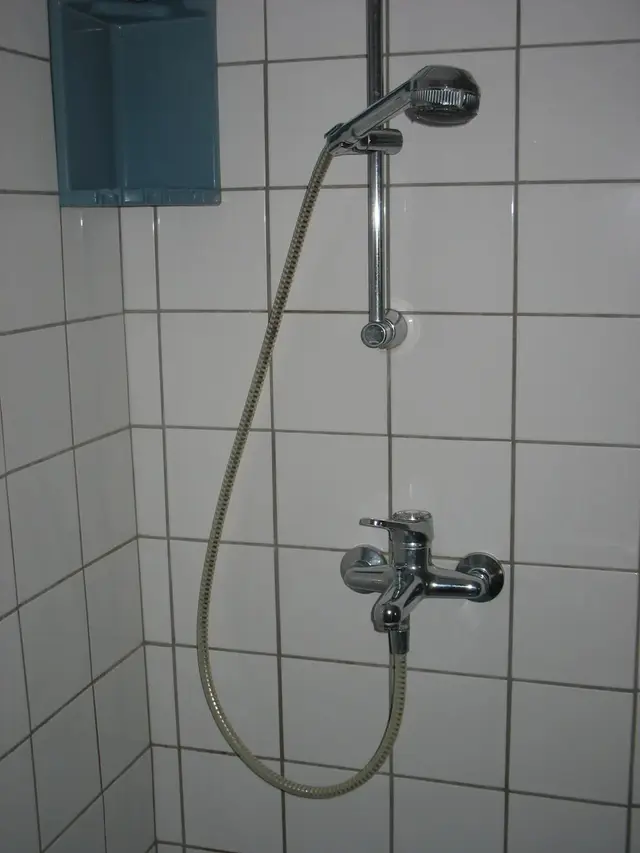
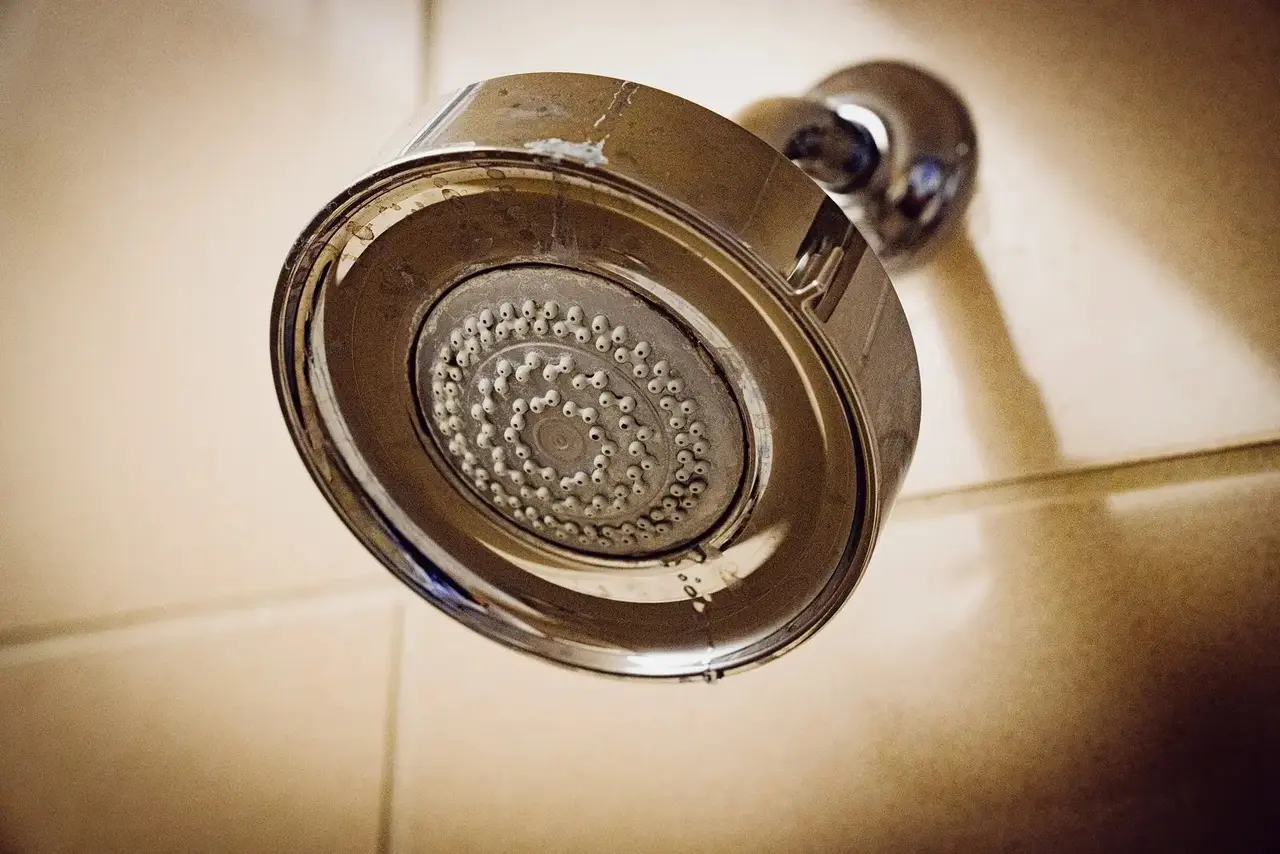
Scale blocks the small nozzles of a shower head, and the inlet often has a small screen as well. Many shower heads can be soaked in diluted white vinegar or a descaler recommended by the maker to dissolve scale; check the instructions first, because some finishes do not tolerate acids. Rubbing soft rubber nozzles with your thumb also breaks scale loose.
Some shower heads contain a flow restrictor. Removing it increases water use; never remove one on a shower fed by an instant electric heater without checking the heater's requirements. Also check the hand-shower hose: an internal liner can collapse or kink and cut the flow without any visible sign outside.
Cartridges and mixers
Many mixers have small inlet screens or check valves where the supplies enter the body. When these clog, the flow falls on one or both sides. Shut off the water, clean the screens following the maker's instructions, and replace a grit-damaged cartridge with a matching one.
Angle stop valves and flexible hoses
The angle stop valve under the basin or behind the toilet is sometimes left half closed after a repair. Open it fully (gently: old spindles can start to leak). Kinked or crushed flexible hoses also restrict flow. For replacing a faulty valve, see our English guide to replacing an angle stop valve.
Step 5: Check valves and filters on the line
Valves left partly closed
Find every valve between the source and the problem area: the main valve after the meter, the outlet valve of the rooftop tank, branch valves for each floor, and valves at the water heater. Check that each one is fully open. A quarter-turn ball valve is fully open when its lever is in line with the pipe.
Old multi-turn gate valves deserve special suspicion. In some of them, the gate can come loose from the spindle, so the handle turns but the gate stays partly or fully down inside the body. If the flow does not change at all when you turn a gate valve, this is a likely cause, and the valve needs to be replaced. Our Vietnamese article on main shut-off valves (van khóa tổng) covers this in detail.
Strainers and filters
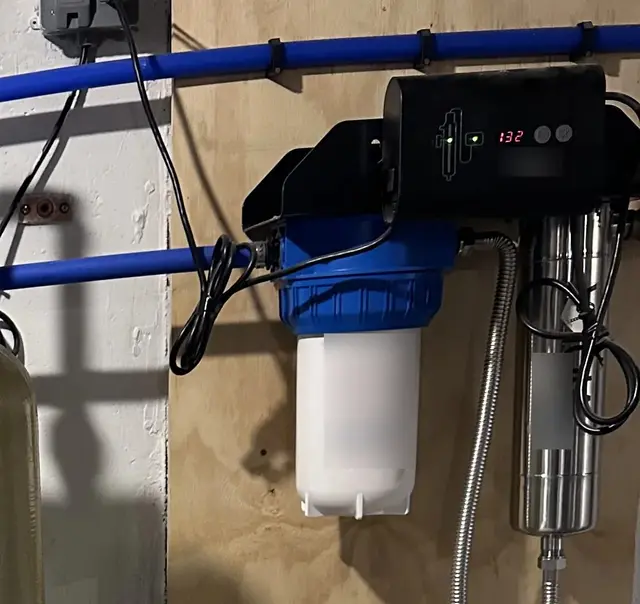
Many Vietnamese homes have a Y-strainer after the meter or before the pump, a whole-house sediment filter, or filters for the RO unit or heater. Every filter clogs sooner or later. A useful clue: the flow was good after the filter was installed and has slowly fallen since.
Shut off the water on both sides of the filter, relieve the pressure, and open it according to the maker's instructions. Clean or replace the screen or cartridge, check the O-rings, and refit it.
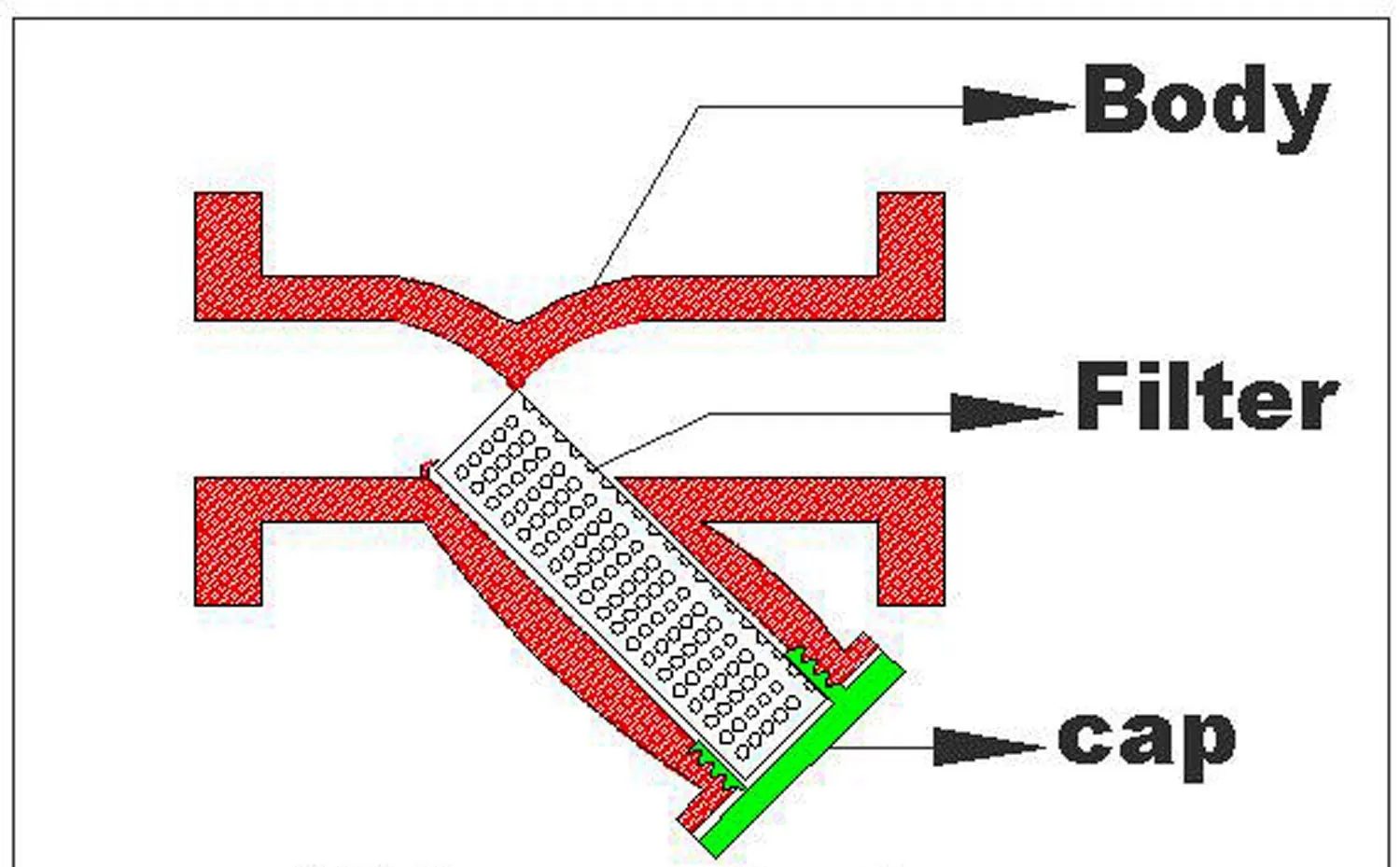
Figure 2. Cross-section diagram of a Y-strainer. Water passes through the perforated screen held in the angled branch of the body; the screen is taken out through the threaded cap for cleaning, after the water has been shut off and the pressure relieved. The original title and signature were cropped. (Credit: Palagiri, Wikimedia Commons, CC BY-SA 4.0)
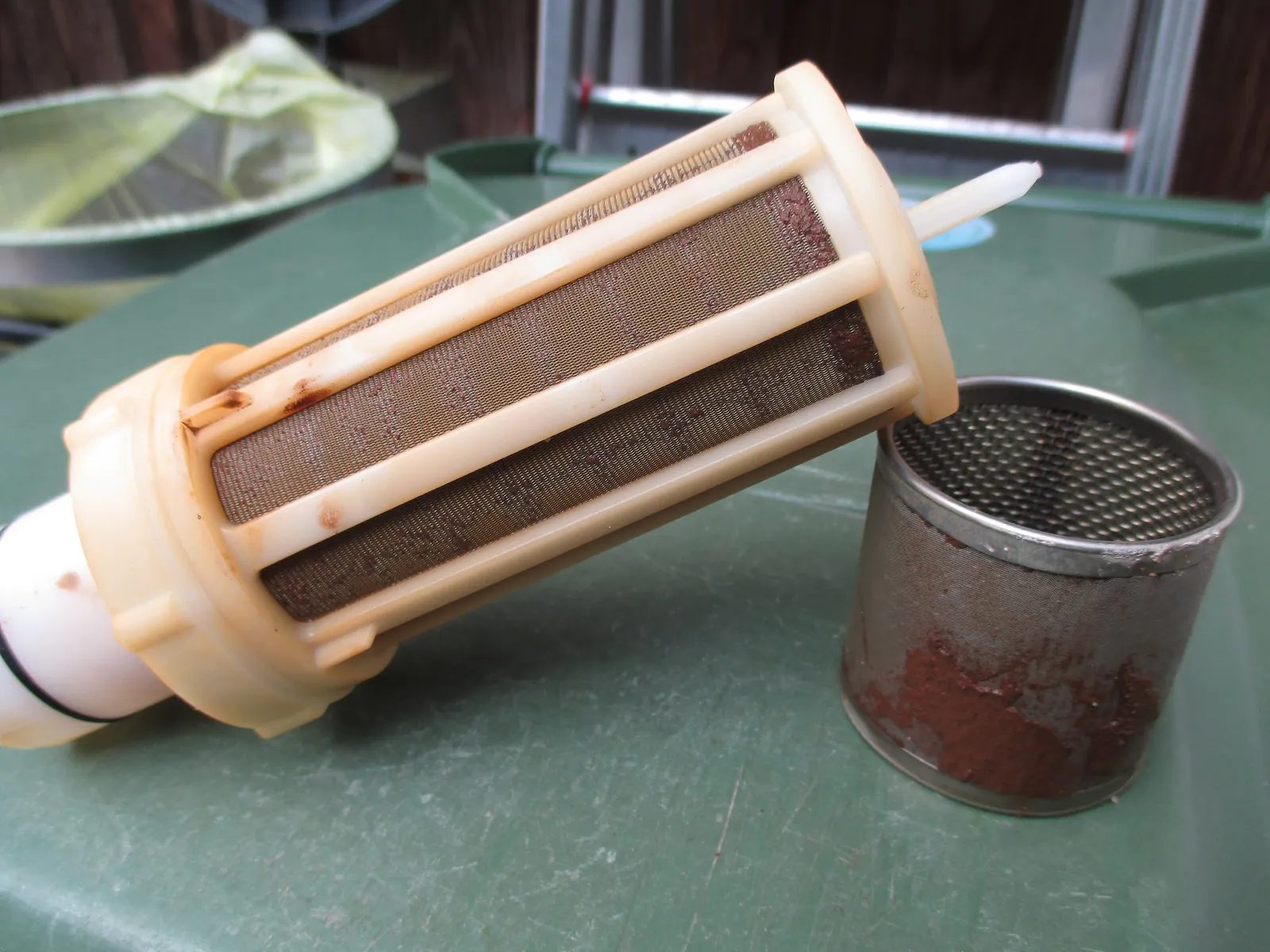
Figure 3. A water filter cartridge with its fine mesh panels coated brown with rust particles, next to a rust-stained stainless mesh cup. A filter in this state restricts the flow to everything downstream of it. (Credit: Hungchaka, Wikimedia Commons, CC BY-SA 4.0)
Comparing the running pressure just before and after a filter also shows whether it is the restriction.
Step 6: Hot side only? Check the water heater
When only the hot water is weak, look at the heater and the hot pipe.
Storage water heaters (bình nóng lạnh) usually have a combined safety valve with a non-return valve on the cold inlet. Scale here can restrict the inlet. Switch off the heater at its isolator and shut off the cold supply first; the water inside may be very hot. Never block or remove the safety valve.
Instant electric water heaters often have a small inlet filter that clogs easily, and many need a minimum flow to switch on, so a blocked shower head can make them cycle or not heat. Clean the outlet first, then the inlet filter, following the manual.
Scale inside the hot pipe builds up faster than in the cold pipe in hard-water areas, especially near the heater.
Always compare hot and cold at the same outlet: if both are weak, the heater is probably not the cause.
Step 7: Whole house weak? Check the source
Street supply
For mains-fed houses, ask whether neighbours have the same problem. Low pressure only at peak times, or along the whole street, is for the water company; note times and readings so the client can report it.
Do not connect a pump to suck directly from the street pipe; water companies in Vietnam commonly do not allow this. Advise the client to check their supply contract, and use a ground tank or a rooftop tank instead.
Rooftop tank
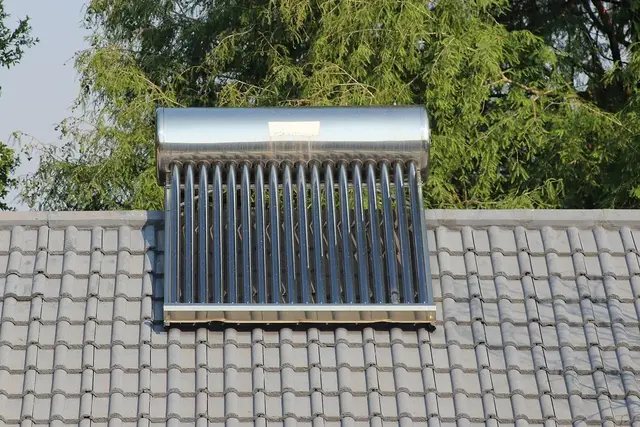
In a tank-fed house, go up and look (safely) at the tank:
Is it full? If not, check the filling pump, the float valve, or a leak.
How high is it above the highest outlet? Measure it and use the gravity rule. If the head is only 1–2 m, a weak top-floor shower is expected and cleaning will not fix it.
Is the outlet clear? Sediment in a tank that has not been cleaned for years can partly block the outlet, and it is a hygiene problem too.
Is the outlet valve fully open?
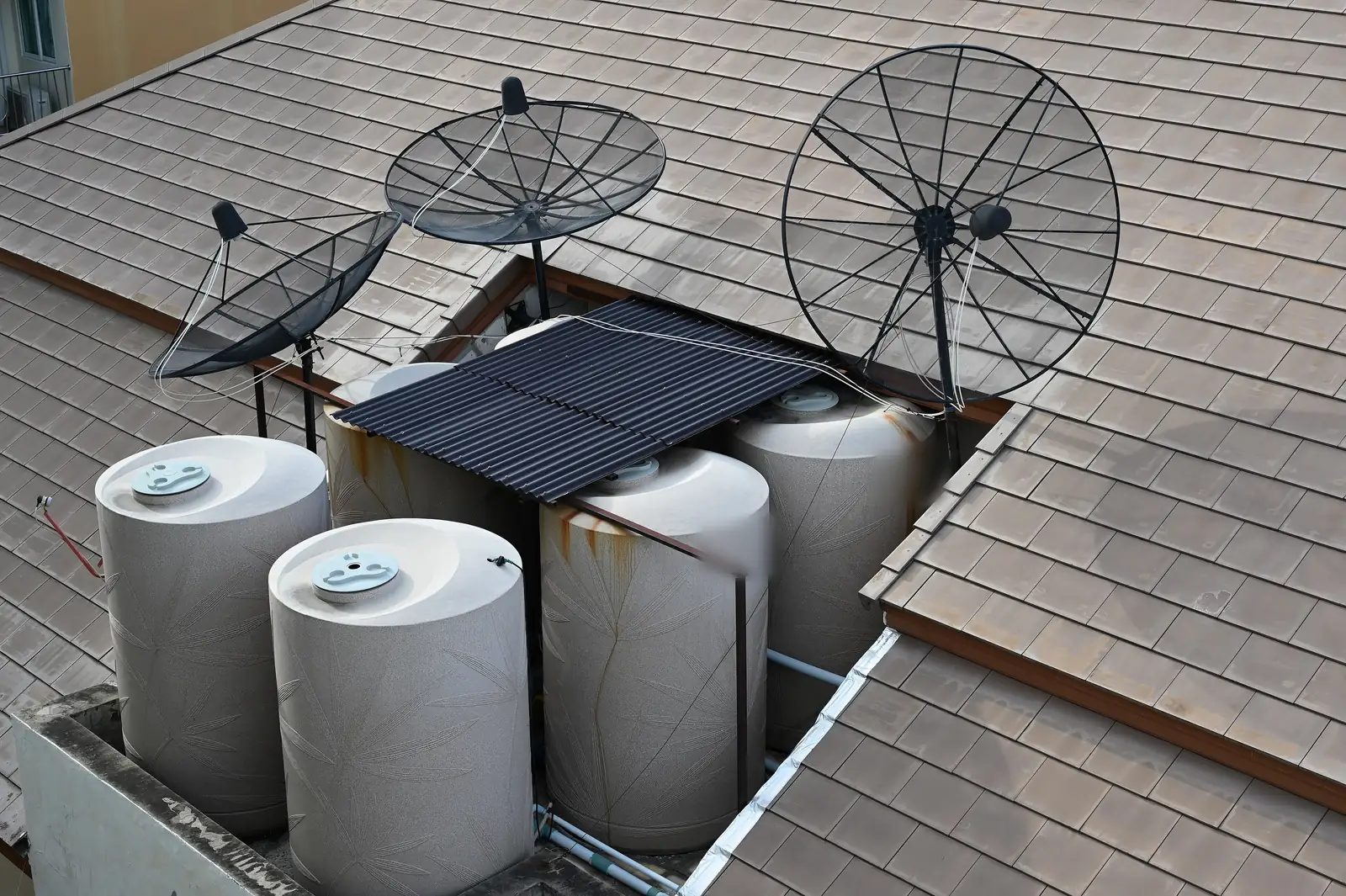
Figure 4. Plastic water storage tanks set into a cavity in a tiled roof (Pattaya, Thailand), a set-up similar to many homes in Vietnam. When tanks sit at or only just above the level of the top floor, those outlets get very little gravity head, so weak upstairs pressure is to be expected. Brand marks have been blurred. (Credit: PattayaPatrol, Wikimedia Commons, CC BY-SA 4.0)
Air locks in gravity pipes
Gravity systems run at low pressure, so a pocket of air trapped at a high point in the pipe can reduce or even stop the flow. Typical signs, often after the tank runs dry, are sputtering taps and flow that changes from day to day. Opening outlets one at a time from the highest to the lowest, with the tank full, usually purges the air. Our Vietnamese article on air in the supply pipes explains this in more detail.
Booster pumps
Many townhouses have a booster pump (máy bơm tăng áp) after the rooftop tank for the upper floors. If the pressure is still weak:
Check that the pump actually runs when a tap opens. Some booster pumps are triggered by a flow switch, which may not react if the flow is very small.
Check the pump's inlet: an empty tank, a closed valve, a clogged strainer or an air leak on the suction side starves the pump.
If it runs but does not build pressure, compare its pressure switch settings and pressure tank pre-charge (if fitted) with the maker's data.
Our Vietnamese articles on pumps that run but do not deliver water and on booster pumps that cycle constantly cover pump faults step by step. Switch the pump off at its isolator before opening any water connection, and leave electrical faults to someone trained.
Step 8: Look at the pipes themselves
If the outlet, valves, filters, heater and source are all fine and the pressure still collapses as soon as water flows, the pipe itself is the restriction.
Old galvanised steel pipes rust on the inside. Corrosion narrows the bore, and the water often runs brown at first use. The fix is to replace the section, for example with PPR.
Undersized pipes cannot carry enough water for several outlets at once. A long run of small pipe with many elbows to a top-floor bathroom is a typical example. The symptom is good flow with one outlet open and poor flow with two or more.
Crushed or partly blocked pipes can result from renovation work or poor installation.
Hidden leaks reduce pressure and waste water.
The meter test for hidden leaks
Close every outlet in the house and make sure no appliance (washing machine, RO unit, float valve) is taking water. Watch the meter's smallest dial for 10–15 minutes (for reference). If it moves, water is flowing somewhere. For a tank-fed house, a pump that starts again and again with no one using water, or a rooftop tank that drains overnight, tells you the same thing. Narrow it down by closing branch valves one at a time; our Vietnamese article on finding hidden leaks covers the method.
Reference table: symptoms, likely causes and first checks
Symptom | Likely cause | First check | Typical fix |
|---|---|---|---|
One tap weak, others fine | Blocked aerator | Open the tap with the aerator removed | Clean or replace the aerator |
One shower weak, spray uneven | Scale in shower head; kinked hose | Bucket test with and without the head | Descale or replace the head or hose |
Hot side weak everywhere, cold fine | Heater inlet valve or filter; scale | Compare hot and cold at one outlet | Clean the inlet filter or valve; descale per maker |
Top floor weak, lower floors fine (gravity) | Not enough height above outlets | Measure the head; gauge reading | Booster pump for upper floors; raise the tank if feasible |
Flow gradually worse over months | Clogging filter or strainer; scale; rusting pipe | Pressure before and after the filter | Clean or replace; plan pipe replacement |
Good with one tap, poor with two | Undersized pipe or weak source | Open two outlets and compare | Larger pipe or booster pump; staggered use |
Whole street weak at peak times | Public supply | Ask neighbours; note times | Client reports to the water company; consider a tank |
Pump runs, pressure stays low | Starved suction; air leak; worn pump | Check the tank level, inlet valve, strainer | Clear the inlet; repair or replace the pump |
Meter moves with all taps closed | Hidden leak | Meter test; close branches one by one | Find and repair the leak |
Worked examples
Example 1: Weak shower on the fourth floor
A four-storey townhouse has a rooftop tank on a 1 m stand. The ground-floor taps are strong, but the top-floor shower, about 2 m below the bottom of the tank, is weak and the instant heater keeps switching off.
You measure about 0.2 bar static at the shower, which matches the height: nothing is faulty, there is simply not enough head. The practical options are a suitable booster pump after the tank for the upper floors, sized and installed according to the maker's instructions with a proper electrical supply and earth, or raising the tank on a taller stand if the structure allows it and a qualified person confirms the roof can carry the weight.
Example 2: Kitchen tap weak after renovation
After a kitchen renovation, the new mixer tap gives only a thin stream on both sides. Everything else in the house is fine. You remove the aerator and find grit and small plastic chips trapped in the screen. With the aerator removed, the flow is strong. You clean the aerator, flush the line, and also check the mixer's inlet screens.
Example 3: Hot water weak in one bathroom
In one bathroom the hot water has become weak while the cold is fine. The bucket test gives 9 L/min on cold and only 3 L/min on hot at the same mixer. The storage heater is several years old and the area has hard water. With the heater isolated and the cold supply closed, you find scale in the inlet valve assembly. You clean it or fit the maker's correct replacement part, and the hot flow returns close to the cold flow.
Safety checklist
Ask questions and map the problem before opening anything.
Measure flow (bucket test) and pressure (gauge) before and after every fix.
Switch off and isolate pumps and water heaters at their isolators before opening any water connection on them.
Remember that water in a storage heater may be very hot; let it cool and relieve the pressure before opening.
Never block, plug or remove a water heater's safety valve.
Check that pump and heater circuits have earth and leakage (RCD/ELCB) protection; refer electrical faults to a qualified electrician.
Work safely on roofs and tank platforms: stable access, no work in rain or strong wind, and never climb into a tank.
Shut off the water and relieve the pressure before opening filters, strainers or valves.
Do not remove flow restrictors without the client's agreement and without checking the requirements of any instant water heater.
Frequently Asked Questions
Why is the water strong downstairs but weak upstairs?
In a house fed from a rooftop tank, the pressure at each outlet depends on the height of the water above it, about 0.1 bar per metre. The ground floor has several storeys of head; the top floor may have only one or two metres. That is physics, not a fault; the usual fix is a booster pump for the upper floors.
My pressure dropped suddenly after a water cut. Why?
Returning water carries sand, rust and air. Clean the screens and purge air from the highest outlets down.
Should I remove the flow restrictor from my shower head?
It may increase flow, but also water use, and with an instant heater it may affect heating. Check both sets of instructions and fix any real blockage first.
Practice Exercises
Exercise 1: Gravity head. A rooftop tank's bottom is 1.2 m above the roof slab. Calculate the approximate static pressure at (a) a shower head 2 m below the slab on the top floor, and (b) a tap 11 m below the slab on the ground floor. Explain why the top-floor shower is weak.
Exercise 2: Bucket test. Measure the flow at three outlets in your training area (a basin tap, a kitchen tap and a shower) with and without the aerator or shower head. Record the results in a table and calculate the flow in L/min.
Exercise 3: Read the symptoms. For each case, name the most likely cause and your first check: (a) only one basin tap is weak after a water cut; (b) all hot outlets are weak, cold is fine; (c) pressure is fine with one tap open but drops to a trickle when the washing machine fills; (d) the meter moves with every tap closed.
Exercise 4: Client explanation. Write a short note to a client whose top-floor shower is weak because the tank is too low, explaining the cause in plain language and the two practical options.