Scooter judder on take-off is mostly caused by the rear clutch: the clutch shoes and the clutch bell become glazed, dirty or unevenly worn, so they grab in jerks instead of engaging smoothly. After that come a worn drive belt, worn or flat-spotted variator rollers, weak springs, perished damper rubbers and worn engine mounts. The symptom is easy to recognise: as the rider opens the throttle from a standstill up to about 20 km/h, the handlebars and footboard shake hard, sometimes with a rattling noise, and everything smooths out above that speed. Most cases only need a proper clutch clean; some need new rollers, a new belt or new shoes. This lesson shows you how to diagnose in order, clean the clutch safely and give the customer a clear quote.
By the end of this lesson, you will be able to:
- Tell clutch judder apart from vibration caused by a rough-running engine or worn engine mounts, using 3 tests in 5 minutes.
- Name the 6 groups of causes and point out where each one sits along the CVT power path.
- Remove, clean and refit the CVT and clutch in the correct order without getting oil or grease on the shoes or the belt.
- Inspect the belt, rollers, clutch shoes and clutch bell and decide whether to clean or replace.
- Write an itemised quote with a correct total and explain to the customer why parts need replacing.
Want to become confident with scooters? Drive belts, clutches and engine overhauls are step 6 of the roadmap — after servicing, brakes and tyres, electrics and fuel injection. See the 8-step motorbike mechanic roadmap to learn in the right order.
What is scooter judder on take-off?
Vietnamese mechanics call it "rung dau" — literally "front-end shake". The rider pulls away from a red light and, instead of gliding off, the scooter shudders and jerks in pulses, then calms down once it passes about 15–20 km/h. It is worst when carrying a passenger up a slope. It affects almost every belt-driven scooter popular in Vietnam, such as the Honda Vision (Figure 1), Air Blade and Lead or Yamaha's scooter range, after a few tens of thousands of kilometres or after frequent rides through flooded streets.
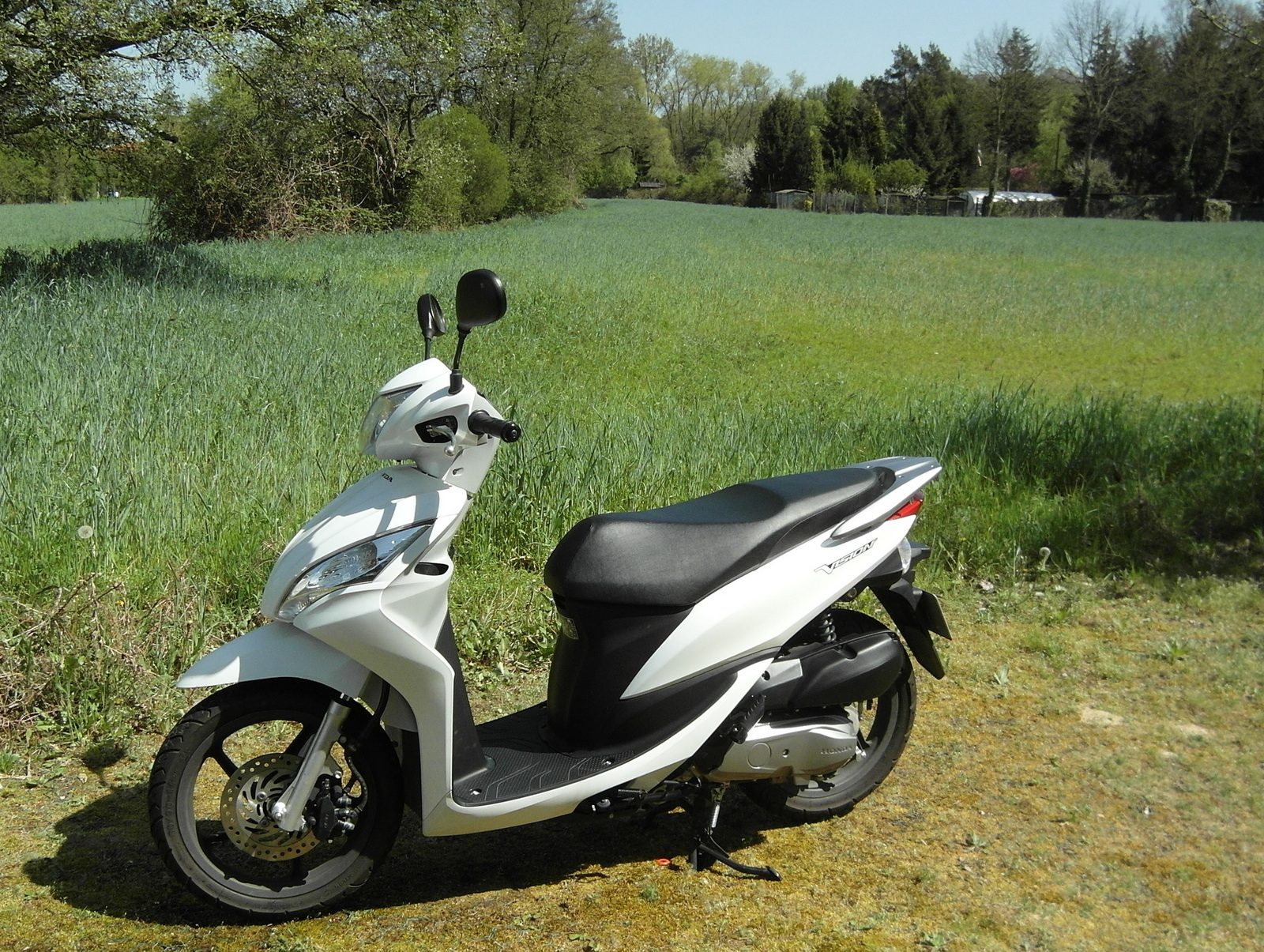
Photo: Millermaster / Wikimedia Commons, CC0
Why does it only shake when pulling away?
Scooters use a centrifugal clutch. At low revs the clutch shoes sit inside the clutch bell without touching it, so the scooter stays still. As you open the throttle, the shoes swing outwards and rub against the inside of the bell, and the scooter starts to move. This "half grip, half slip" phase lasts from the moment the wheel turns until about 20 km/h. If the friction surfaces are uneven — slippery in one place and rough in another, worn here and thick there — the drive force pulses, and that pulse is the judder. Once the shoes lock fully onto the bell there is no more slip, so the shaking stops.
Judder is not the same as sluggish pull or a rough engine
Sluggish pull (the scooter accelerates slowly and revs loudly without going anywhere) usually comes from a narrow worn belt, worn rollers or a weak torque spring — the drive slips but does not jerk. A rough-running engine shakes even when the scooter is standing still, the idle speed hunts up and down and the warning light may come on. True take-off judder only appears when the scooter starts rolling. Getting this right stops you from opening the CVT for no reason.
How does a scooter CVT work?
To fix judder you need a clear picture of how power travels from the crankshaft to the rear wheel: front pulley → drive belt → rear pulley → clutch shoes → clutch bell → reduction gearbox → rear wheel. Mechanics in Vietnam call the whole continuously variable transmission (CVT) assembly "bo noi" — "the pot set". The five usual sources of judder sit along that path: rollers, belt, clutch shoes, clutch bell and springs.
Front pulley (variator) and rollers
The front pulley, or variator, is mounted directly on the crankshaft and has a fixed half and a moving half. The moving half holds the rollers (weights, usually six). The more throttle you give, the further the rollers fly outwards, pushing the moving half closer and making the belt climb to a larger diameter — like shifting into a higher gear. Rollers that are worn oval or flat-spotted make the moving half travel in jerks, causing judder and sluggish pull.
Drive belt and rear pulley
The V-belt carries the power to the rear pulley. The rear pulley also has a moving half, pushed back by the torque spring, plus a helical cam slot and guide pins that tighten the belt when more pulling force is needed. A belt that is worn narrow, cracked between the cogs, hardened or running crooked because a pulley is worn unevenly will slip in pulses.
Clutch shoes, shoe springs and the clutch bell
The clutch assembly mounted on the rear pulley has a back plate and usually three shoes, each pulled inwards by a small spring. The clutch bell fits over the outside and is connected to the gearbox input shaft and the rear wheel. Figure 2 is a real photo of this type of centrifugal clutch: three shoes with friction lining and the springs linking them.
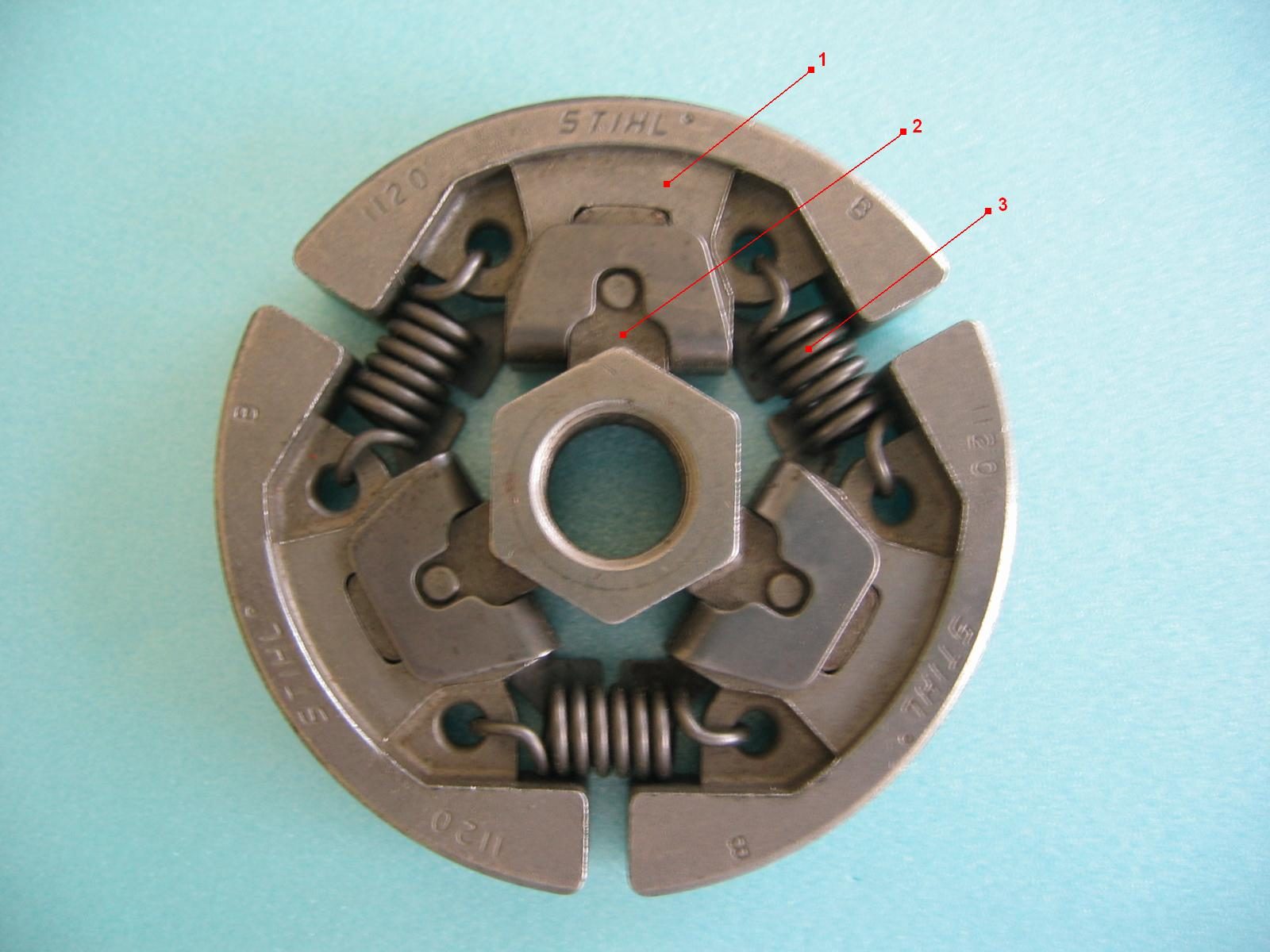
Photo: Không rõ tác giả / Wikimedia Commons, CC BY-SA 3.0
6 causes of scooter judder on take-off
Listed in the order they turn up most often in the workshop.
1. Dirty, glazed or unevenly worn clutch shoes and bell
This is the number one cause. Lining dust, belt dust and road mud build up on the shoes and the bell; over time the lining glazes like a mirror and the inside of the bell shows burn marks or a stepped ridge. If oil leaks from a shaft seal or grease flies off the pulley and soaks into the lining, the judder becomes severe. A bell that is worn unevenly or slightly oval also causes judder in a regular rhythm.
2. Weak or uneven clutch springs
There are two kinds of spring: the small shoe springs that pull the shoes in, and the large torque spring on the rear pulley. If the shoe springs are weak, or one has stretched, the three shoes do not swing out together — one touches the bell first and the grab is lopsided. A weak torque spring, combined with a dry or worn cam slot and guide pins, stops the rear pulley holding the belt steadily at low speed.
3. Worn or misaligned drive belt
A belt worn narrow sits deep in the pulley, and a belt with cracked cogs or peeling fabric slips unevenly. A belt runs crooked (out of line between the two pulleys) when one pulley is worn, a slider bush is loose or a part was fitted wrongly. The belt is a wear item — when to replace the drive belt depends on the service book for that exact model, plus a real inspection every time the CVT is opened.
4. Worn or flat-spotted variator rollers
After long use, rollers wear flat on one side or their outer shell cracks. A flat roller does not roll evenly, so the moving half sticks and releases, and the belt goes tight and slack. A dry or worn slider bush causes the same effect.
5. Perished damper rubbers in the rear pulley assembly
Depending on the design, some models have damper rubbers in the rear pulley assembly or the drive hub. When the rubbers harden or break up, play develops: you hear a "clunk" when pulling away, followed by judder. Whether the customer's scooter has these parts is shown on the parts diagram for that exact model — do not guess.
6. Worn engine mounts or a rough-running engine
When the rubber bushes of the engine mount are worn or cracked, engine vibration passes straight into the frame under load and is easily mistaken for clutch judder. An engine that runs unevenly — weak spark plug, dirty throttle body, wrong idle speed — also makes take-off jerky; that case belongs to the fuel injection step, not to the CVT.
Diagnosis table: symptom, cause, fix and 2026 cost
The table links symptoms to causes. Costs are 2026 reference prices in Vietnamese dong (VND), varying by region, model and genuine versus aftermarket parts, and do not include extra work found on inspection.
| Symptom | Usual cause | Fix | 2026 reference cost |
|---|---|---|---|
| Hard shaking at 0–20 km/h, worse with a load or uphill | Dirty, glazed clutch shoes and bell | Clean the CVT, lightly sand shoes and bell | Labour for a CVT clean 80,000–150,000 VND |
| Judder with a burning smell, oil-soaked lining | Leaking shaft seal, too much grease | Replace the shoes, fix the leak | Shoe set 200,000–500,000 VND |
| Rhythmic judder, ridge or burn marks in the bell | Unevenly worn or oval bell | Replace the clutch bell | 250,000–600,000 VND |
| Judder plus sluggish pull | Flat-spotted rollers, dry slider bush | Replace the roller set, clean the bush | Roller set 80,000–200,000 VND |
| Slipping, engine revs, belt cracks visible | Worn, cracked or misaligned belt | Replace the belt, check the pulleys | 250,000–600,000 VND |
| One shoe worn very differently from the other two | Stretched shoe spring | Replace the shoe springs (full set) | 50,000–150,000 VND |
| A "clunk" on take-off, then judder | Hardened or broken damper rubbers | Replace the rubbers per the parts diagram | 100,000–300,000 VND |
| Shaking even when idling at a standstill | Engine mounts, rough-running engine | Replace mount bushes; check spark plug, throttle body | 100,000–300,000 VND (mount bushes) |
3 tests before opening the CVT
- Start the engine with the scooter on its centre stand, no throttle: if the frame and bars already shake hard, suspect a rough-running engine or the engine mounts.
- Test-ride on a quiet stretch, pulling away gently and then hard: judder that gets clearly worse under load points to the clutch; judder that does not change points to the engine.
- Ask the customer about the history: has the scooter been through floods, at what mileage was the CVT last cleaned, when was the belt replaced, have they greased or sprayed rust-preventer into the CVT case themselves?
How to clean a scooter clutch step by step
Cleaning the scooter CVT and clutch is the job apprentices do most at this step. Following the correct order means no small parts go missing, nothing is refitted backwards and no oil reaches the friction surfaces.
Safety warning: only open the CVT when the engine and exhaust are completely cold (wait at least 30–45 minutes after riding) — the CVT cover sits close to the exhaust and can burn you. Put the scooter on its centre stand on firm, level ground; ideally add a support or use a lift with a locking pin. Switch off, remove the key or switch off the smart key and keep it away. Never start the engine with the CVT cover removed: the belt and pulleys spin very fast and can catch fingers, rags or hair, and scooters with an idling stop function can restart when the throttle is touched. Wear goggles when blowing out dust with compressed air and a mask, because lining and belt dust should not be breathed in. Cleaning solvent is flammable: no smoking and no open flames nearby.
Tools and materials
- Socket set and ratchet; a torque wrench to tighten to the figures in the service manual.
- A variator holding tool and a clutch bell holder — never jam a screwdriver into the cooling fins.
- An air gun or soft brush, clean rags and a parts tray; brake cleaner (evaporates and leaves no residue); sandpaper of about P120–P180.
- Vernier calipers to measure belt width and roller diameter; heat-resistant grease of the type the manufacturer specifies, used only where required.
Removal order
Figure 3 shows the CVT of a scooter with its cover off, so you can see where the pulleys, the belt and the rear clutch assembly sit.
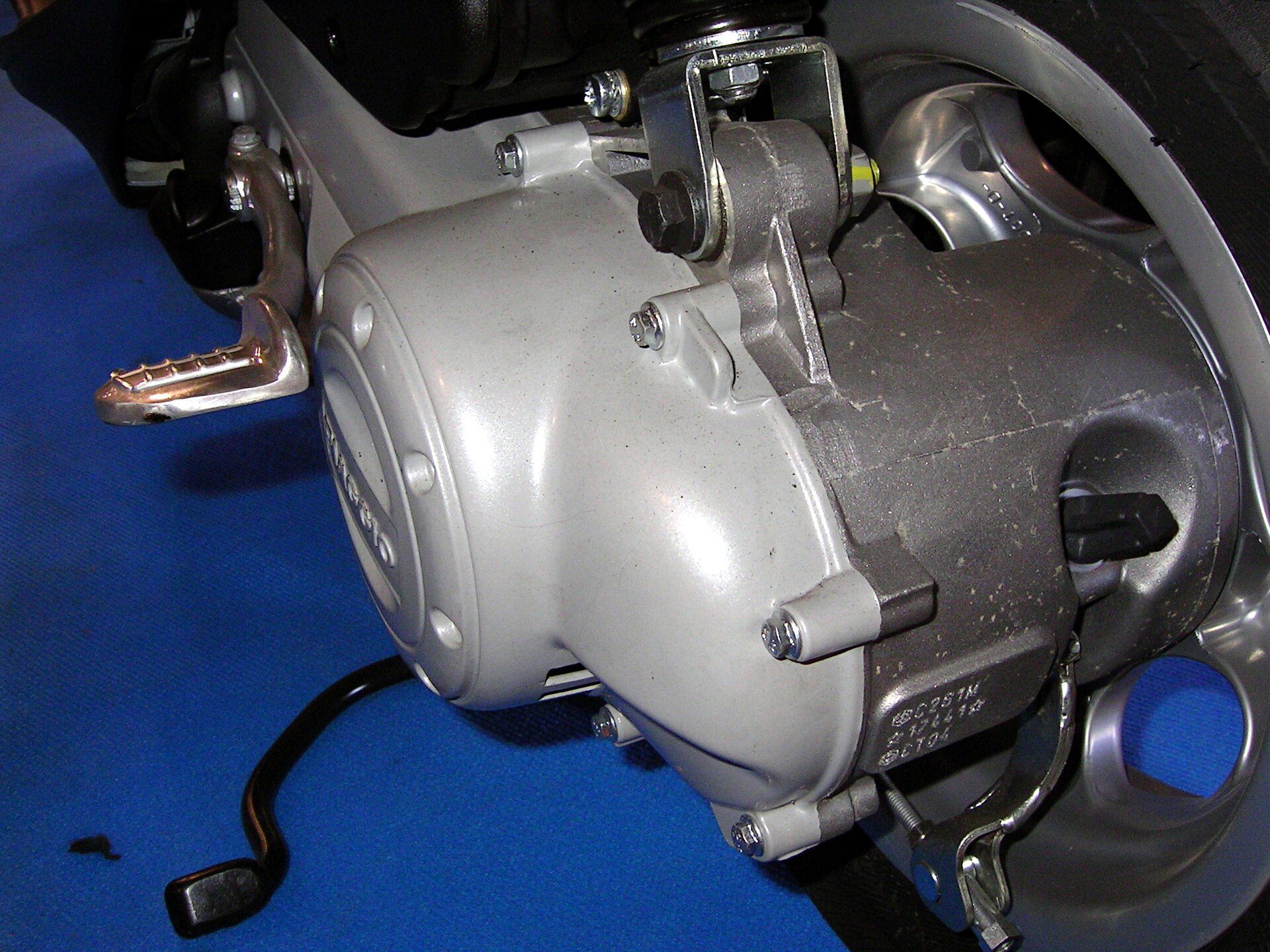
Photo: Khaosaming / Wikimedia Commons, CC BY-SA 3.0
- Remove the side panels, mudguard and the CVT cooling duct (many models such as the Air Blade and Lead have an air duct at the front of the CVT cover).
- Loosen the CVT cover bolts in a criss-cross pattern and note which bolts are long and short. Tap the cover gently with a plastic mallet and keep the dowel pins and gasket.
- Fit the variator holding tool (Figure 4), undo the front pulley nut, remove the fixed half (usually with the cooling fan) and ease the belt off the front pulley.
- Pull out the moving half with the rollers inside; keep it in the tray and do not turn it upside down or the rollers will fall out.
- Hold the bell with the bell holder, undo the clutch nut, take off the bell and withdraw the whole rear pulley with the clutch and belt.
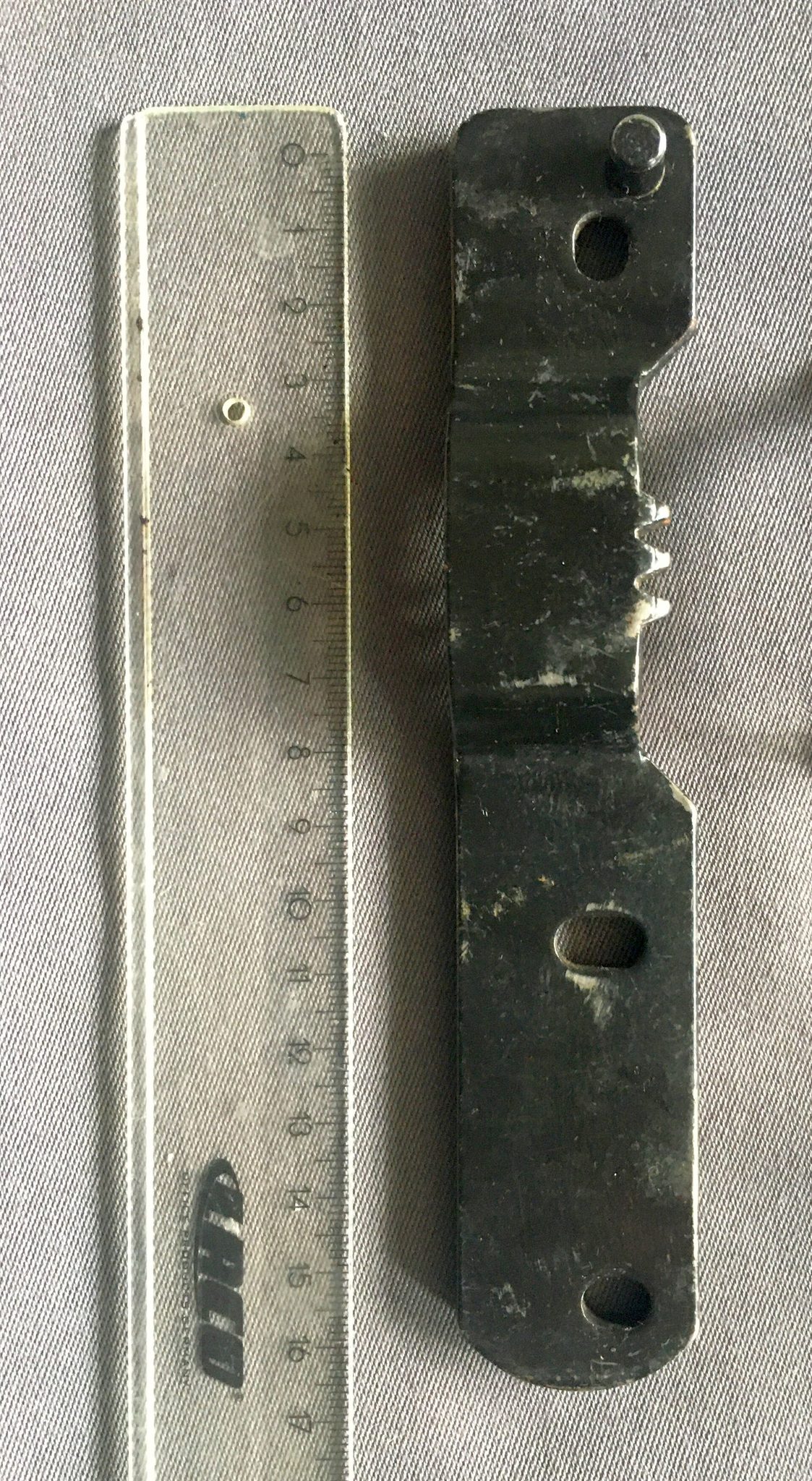
Photo: Pittigrilli / Wikimedia Commons, CC BY-SA 4.0
Cleaning, light sanding and inspection
- Dry cleaning: blow the dust out in a well-ventilated place, spray brake cleaner on the bell and pulleys and wipe them clean. Never use rust-preventer spray.
- Lightly sand the shoes: lay P120–P180 paper on a flat surface and rub each shoe gently along its curve until the glaze is gone and the lining has an even matt finish. Do not sand deeply or try to erase heavy uneven wear — that shoe needs replacing.
- Clutch bell: sand the inner surface lightly in a circular motion to remove the glaze; if there is a clear ridge, deep burn marks or the bell is oval, tell the customer it needs replacing.
- Drive belt: measure its width at several points and compare with the limit in the manual; look closely for cracks between the cogs, glazed sides or loose fibres.
- Rollers: roll each one on a flat surface; if any has a flat spot or a cracked shell, replace the whole set, never just one roller.
Refitting and test ride
Refit in the reverse order. Apply only a thin film of heat-resistant grease where the manual says (slider bush, rear pulley cam slot) and wipe off the excess — never put oil or grease on the clutch shoes, the bell or the belt. Fit the belt with the printed arrow pointing the right way and tighten the pulley nut and clutch nut with a torque wrench to the specified torque for that model. Only start the engine after the CVT cover and air duct are back on. Test-ride for 2–3 km with several take-offs, and carry a passenger if the customer complained of judder when loaded.
When to replace the belt, rollers and clutch shoes
Customers often ask: "Can't you just clean it?" The answer depends on measurements, not on feel.
Drive belt
Replace it when the width is below the limit, the cogs are cracked, the layers are peeling, or the mileage in the service book has been reached. A belt that is about to snap can leave the scooter without drive in the middle of the road.
Rollers and slider bush
Replace the full roller set if any roller is flat-spotted or cracked; check the slider bush too, because a worn bush quickly ruins new rollers.
Clutch shoes, bell and springs
Replace the shoes when the lining is down to the limit, oil-soaked or clearly worn unevenly; replace the shoe springs together with the shoes. Replace the bell if it has a ridge, is oval or its inner diameter is beyond the limit — new shoes running in a worn bell can still judder.
Worked example: an Air Blade at 32,000 km juddering with a passenger
Mr Tuan brings in his 2018 Air Blade 125 with 32,000 km on the clock. He says it shakes every morning when he pulls away from traffic lights, and it is worse when he takes his wife to work; the CVT has never been cleaned and the belt has never been changed. The mechanic proceeds as follows (2026 reference prices, varying by region).
Diagnosis
- Engine running, scooter on the centre stand: the engine runs evenly and the frame does not shake → engine and engine mounts ruled out.
- Test ride: gentle take-off gives slight judder, hard take-off gives clear judder at 5–15 km/h → clutch suspected.
- After letting the scooter cool for 40 minutes, the CVT is opened: lots of black dust, glazed shoe linings, a glazed bell but no ridge and not oval.
- Rollers: 2 of the 6 are flat on one side.
- Belt: measured width is close to the limit in the manual, with a few small cracks between the cogs; the scooter is also past the replacement mileage in the service book.
- Clutch shoes: plenty of lining left, even wear, no oil → light sanding only, no replacement yet.
The quote for the customer
| Item | Reference cost |
|---|---|
| Labour: clean the CVT, sand shoes and bell, fit parts | 120,000 VND |
| Roller set (6 rollers) | 150,000 VND |
| Drive belt | 450,000 VND |
| Cleaning solvent, heat-resistant grease | 30,000 VND |
| Total | 750,000 VND |
Check: 120,000 + 150,000 + 450,000 + 30,000 = 750,000 VND (about US$29). The mechanic also mentions a possible extra up front: if the shoes turn out to be oil-soaked, a new shoe set costs about 350,000 VND, bringing the total to 750,000 + 350,000 = 1,100,000 VND — and Mr Tuan will be phoned for approval before that work is done. Test ride with a passenger: no more judder.
Explaining it to the customer
Show the customer the old rollers and belt next to the new ones: the CVT clean cures the judder, while the rollers and belt are replaced because they have reached their wear limits. Suggest doing the next CVT clean together with the gear oil change — see the lesson on how many km between motorbike oil changes to plan the customer's schedule.
Common mistakes new mechanics make with take-off judder
Spraying rust-preventer or greasing the clutch shoes
Sign: judder gets worse a few days after a clean, with a burning smell. Cause: oil or grease has soaked into the lining and the friction is no longer even. Fix: use only an evaporating cleaner; oil-soaked shoes must be replaced, sanding cannot save them.
Replacing the belt without checking pulleys and rollers
Sign: new belt, still judder and sluggish pull. Cause: flat rollers or a worn pulley make the belt run crooked. Fix: every time the CVT is opened, check all 5 points: rollers, belt, clutch shoes, clutch bell and springs.
Holding the pulley with a screwdriver or running the engine to undo nuts
Sign: chipped pulley fins, sometimes an injury. Cause: no holding tools. Fix: use the variator holder and the bell holder; never start the engine with the CVT cover off.
Opening the CVT when the fault is really in the engine
Sign: the customer still complains of shaking after a CVT clean. Cause: skipping the standing idle test. Fix: always do the 3 tests before removing the CVT cover (see Figure 5).
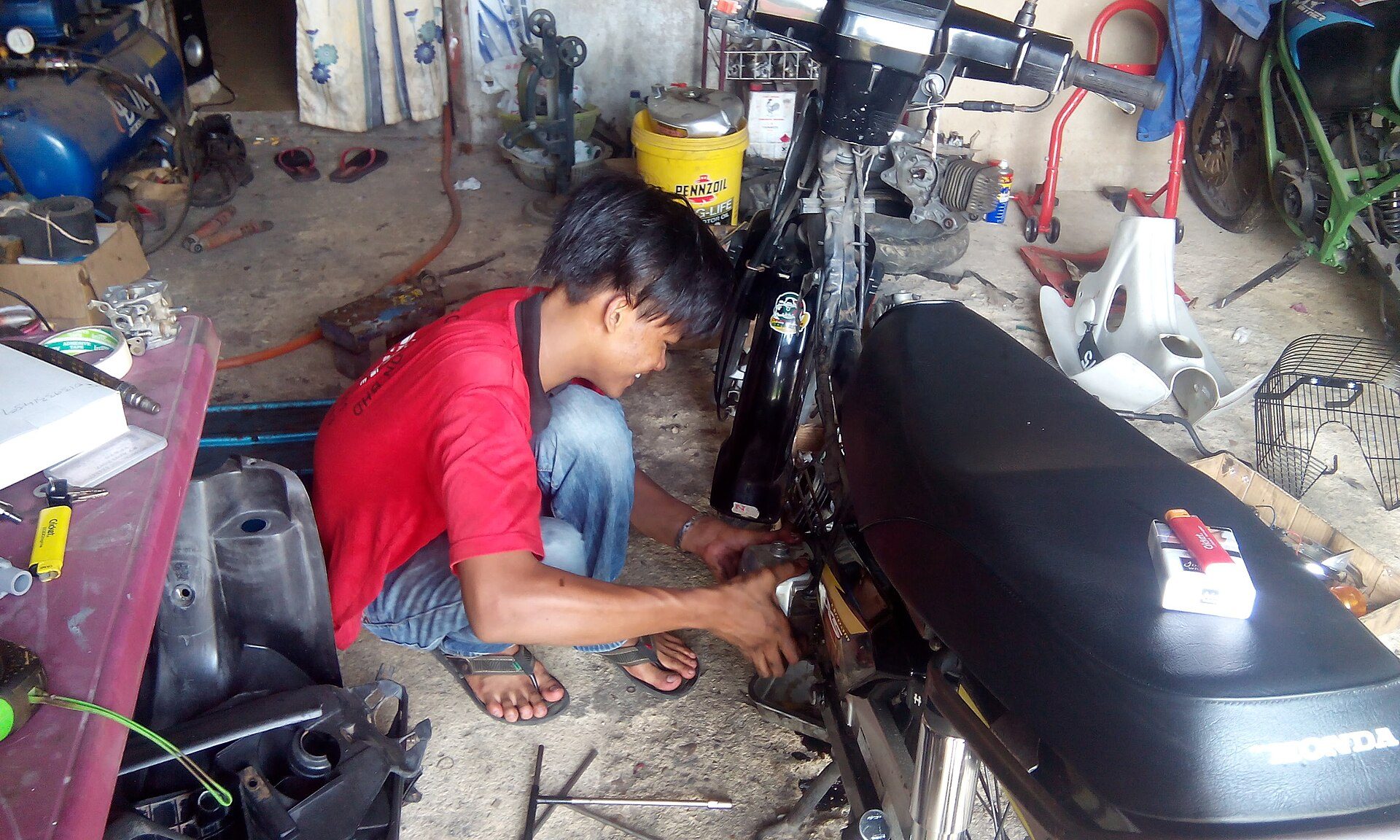
Photo: madmalaysia / Wikimedia Commons, CC BY-SA 4.0
Frequently asked questions
Why does my scooter jerk when pulling away?
Usually because of the rear clutch: dirty or glazed shoes and bell; next come worn rollers, a worn belt and weak springs. If the scooter also shakes while idling at a standstill, check the engine and engine mounts first.
How often should a scooter CVT be cleaned?
Follow the drive-system inspection schedule in the scooter's service book; scooters that often ride on dusty or flooded roads should be checked sooner. Labour for a CVT clean is around 80,000–150,000 VND (2026 reference).
When should a scooter drive belt be replaced?
At the replacement mileage in the service book for that exact model, or sooner if its width is below the limit or it shows cracks or peeling. A typical belt costs around 250,000–600,000 VND (2026 reference).
Is judder different on a Vision, Air Blade or Lead?
The principle is the same (belt CVT and centrifugal clutch); what differs is how the panels and air duct come off, the parts themselves and the torque figures — check the manual for each model.
Is judder dangerous, and can I keep riding?
Mild judder is not immediately dangerous, but it wears the shoes, bell and belt faster; if a cracked belt is the cause, it may snap and leave you without drive mid-journey. Have it checked soon.
Practical exercise and self-assessment
- On 2 different scooters, perform the 3 tests before opening the CVT and write down your conclusion: "suspect clutch" or "suspect engine".
- Under a senior mechanic's supervision, remove, clean and refit a complete CVT and clutch, tightening the nuts with a torque wrench to the manual's figures.
- Measure the belt width at 3 points, roll-test all 6 rollers and record the condition of the shoes and bell on a job card.
Self-assessment criteria
- Pass: the CVT is only opened when the engine is cold and the scooter is stable; the engine is never started with the cover off; the correct holding tools are used.
- Pass: no oil or grease on the shoes, bell or belt; the test ride is judder-free; the quote is itemised and the total is correct.
- Not yet: replacing parts without measuring, replacing single rollers, grease spreading onto friction surfaces, or forgetting to refit the CVT cooling duct.
Once you have mastered the CVT and clutch, you have completed the first half of the step Scooter CVT, clutch & engine overhaul; next comes the engine overhaul, followed by the step One-month apprenticeship & a full rebuild. If the judder comes with hard starting, revise the lesson on a motorbike that won't start; to find out how long training takes and what you can earn, read how long it takes to learn motorbike repair.
Want a clear path to learning scooter repair? From servicing, brakes and tyres, electrics and starting, and fuel injection through to CVT clutches and engine overhauls. See the 8-step motorbike mechanic roadmap.