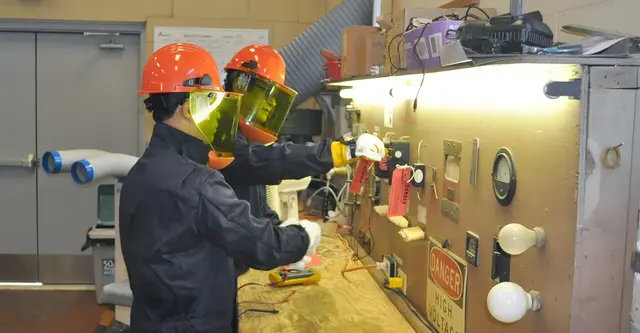
Welding safety means protecting four things at once: your eyes and skin from the arc, your lungs from welding fumes, the workshop from sparks that start fires, and yourself from electric shock and gas cylinders. Beginners usually think only about the helmet, but serious accidents tend to come from elsewhere: welding galvanised steel without fume extraction and running a fever all night, sparks dropping through a gap in the floor and setting fire to a storeroom below, an unchained cylinder falling over and snapping its valve. This is the first lesson of the welder path, covering protective gear, fume control, fire prevention, hot work permits and cylinder safety, with a checklist to run before every arc you strike.
By the end of this lesson, you will be able to:
- Set an auto-darkening welding helmet to the right shade, sensitivity and delay for each process.
- Choose leather gloves, flame-resistant clothing and safety boots, and know which clothing is banned for welding.
- Set up fume extraction and recognise materials that give off toxic fumes, such as stainless steel, galvanised steel and painted steel.
- Clear combustibles, prepare a hot work permit and keep a fire watch after welding.
- Stand, chain, open and close gas cylinders safely and check the welding machine's electrics before each shift.
Just starting to learn welding? Arc, fume and fire safety is step 1 of the roadmap, before materials, drawings and stick welding. See the 8-step welder roadmap to learn in the right order.
Five main hazards in welding
A welding arc is an extremely intense source of heat and light. Every time you strike an arc you create radiation, metal fumes, flying sparks and an open electrical circuit running through the workpiece.
Arc radiation
The arc gives off very strong ultraviolet and infrared radiation. Looking at it unprotected for a few seconds can cause "arc eye" (photokeratitis): a few hours later your eyes feel gritty, water and cannot stand light. Exposed skin gets burned red like sunburn. People standing nearby who are not welding are affected too if there is no screen.
Fumes and toxic gases
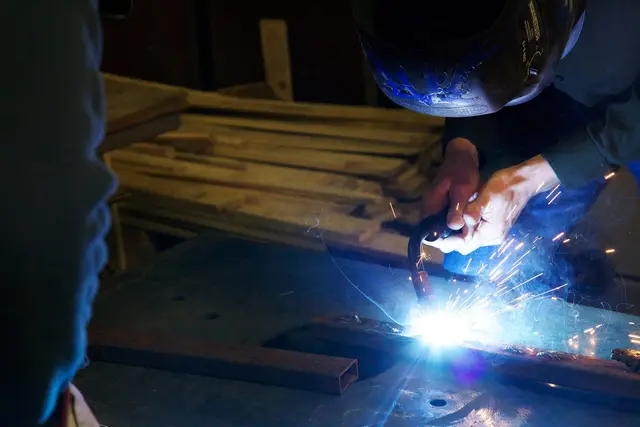
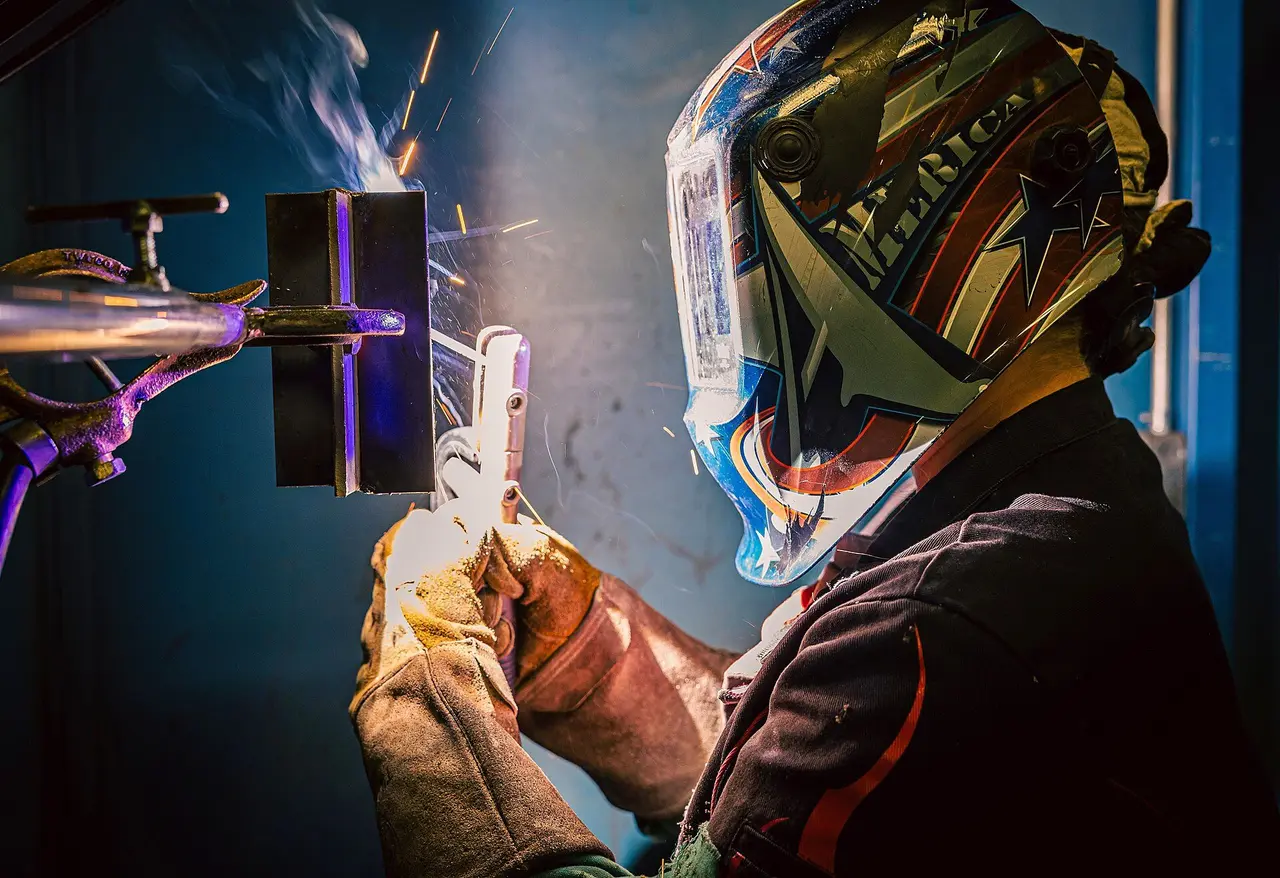
Welding fume is ultra-fine metal particles rising from the weld pool and the electrode or wire coating (Figure 1). Depending on the material, it contains iron, manganese, chromium, nickel or zinc; the arc also produces ozone and nitrogen oxides. Long-term exposure causes lung disease; a heavy dose of zinc fume at once causes fever.
Fire, explosion, shock and cylinders
- Fire: sparks and hot slag fly several metres, drop through gaps in floors and walls, smoulder in rags, wood or cardboard, then flare up after the welder has gone home.
- Explosion: welding or cutting drums and tanks that once held fuel or chemicals; leaking fuel gas; oxygen meeting oil or grease.
- Electric shock: the open-circuit voltage of a welder is enough to shock you in damp conditions; the 220 V or 380 V supply to the machine is even more dangerous.
- Gas cylinders: a cylinder that falls and breaks its valve can take off like a rocket; CO2 and argon leaking in a confined space can suffocate.
Auto-darkening helmets and eye protection
An auto-darkening helmet has an electronic filter: normally light (around shade 3–4) so you can see the work, and when its sensors detect an arc it darkens within a fraction of a millisecond. A compliant filter in good condition blocks ultraviolet and infrared at all times, even in its light state.
Setting shade, sensitivity and delay
- Shade: the higher the current, the darker the shade. Choose the darkest shade at which you can still see the weld pool clearly.
- Sensitivity: raise it for low-current TIG where the arc is weak, so the lens darkens in time; lower it when welding next to other welders so their arcs do not trigger yours.
- Delay: how long the lens stays dark after the arc stops. Use a longer delay at high currents when the metal is still glowing.
| Process | Current | Reference shade |
|---|---|---|
| Stick welding | About 60–160 A | 10–11 |
| Stick welding | About 160–250 A | 11–12 |
| MIG/MAG | About 100–250 A | 11–12 |
| MIG/MAG | Above 250 A | 12–13 |
| TIG | Below 150 A | 9–11 |
The table is for reference only; always follow the helmet maker's instructions and your workplace rules. Tired eyes or glare after welding mean you should go one shade darker.
Checking the helmet before each shift
Wipe the outer cover lens and replace it when it is pitted or clouded by spatter. Check the battery or solar cell and press the test button if there is one. Do not use a cracked lens or one that flickers between light and dark. Always wear safety glasses under the helmet, because when you flip the helmet up to chip slag or grind, your eyes still need protection.
Protecting people around you
Put up welding curtains or screens around the work, especially in busy workshops or on sites with walkways. Make sure a helper holding parts nearby wears a suitable filter lens.
Leather gloves, flame-resistant clothing and safety boots
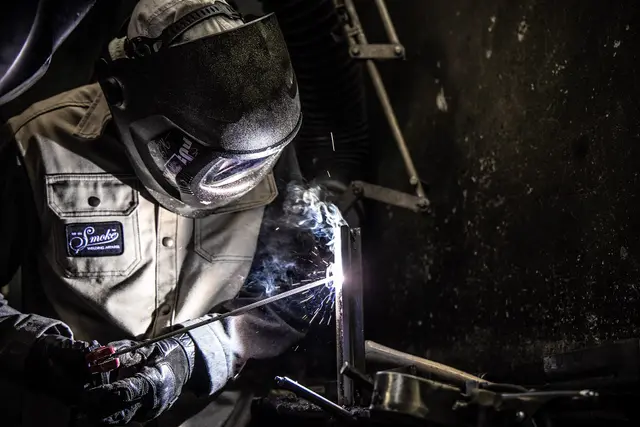
A welder's clothing has to withstand sparks, hot slag and arc radiation (Figure 2). The wrong material can catch fire or melt onto your skin.
Gloves
For stick and MIG welding, use thick leather gloves with long cuffs that cover your sleeves. For TIG, use thinner leather gloves so you can feel the filler rod. Replace gloves that are holed, stiff or wet: sweat-soaked gloves raise the risk of shock when changing electrodes.
Clothing and head
- Long sleeves, buttoned collar, flame-resistant fabric or heavy cotton. No synthetic fibres such as polyester or nylon: sparks make them melt and stick to the skin.
- No open front pockets and no rolled sleeves or trouser cuffs: sparks land in them and smoulder.
- For overhead or vertical welding, add a leather apron, leather sleeves and a flame-resistant hood.
- Never carry a gas lighter or matches in your pockets while welding.
Boots, ears and hands
Wear high-top steel-toe boots with trousers over the boots so slag cannot fall inside. Use earplugs when grinding and cutting, and when welding overhead (sparks can fall into the ear). Remove metal rings: they heat up very quickly and conduct electricity.
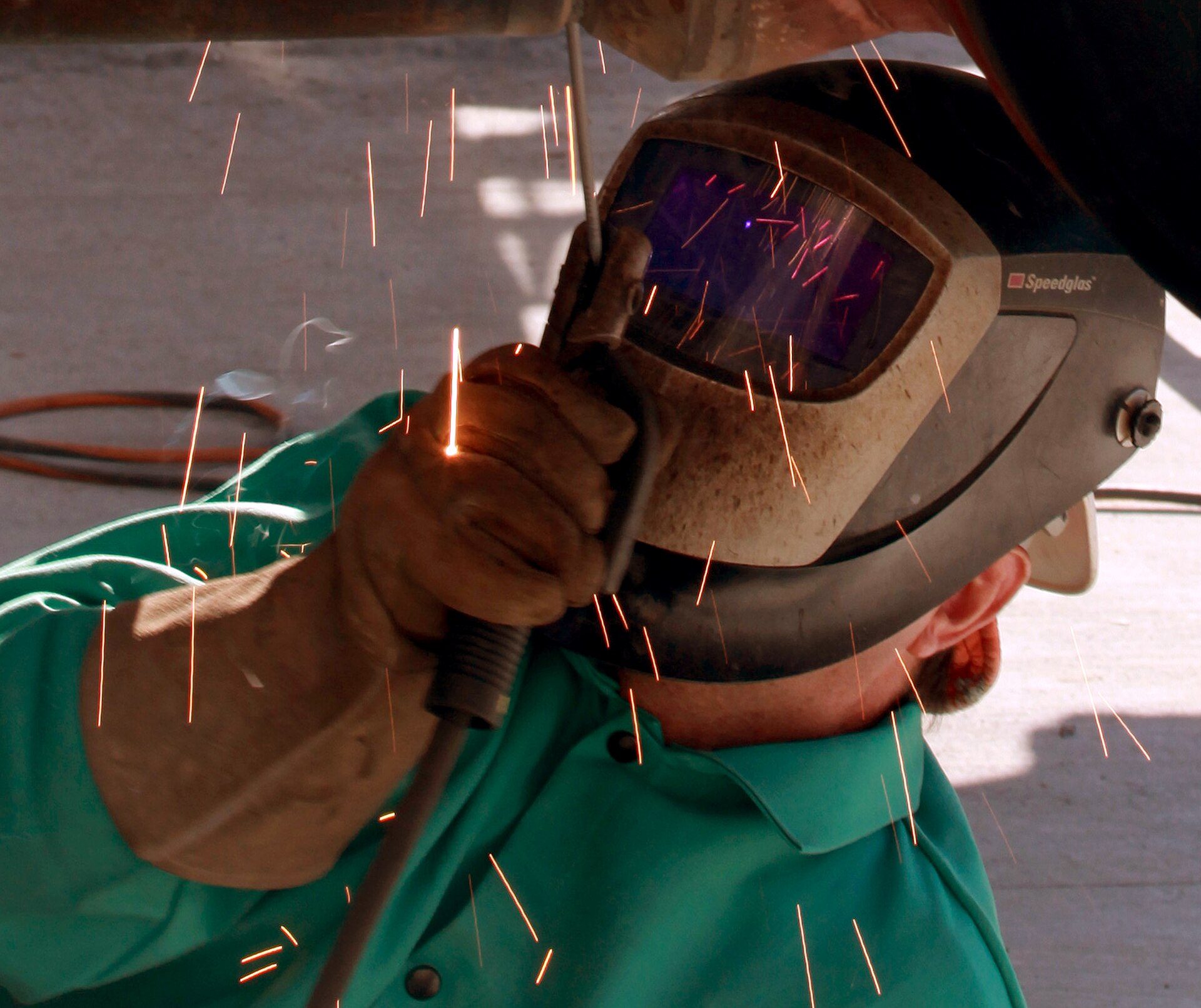
Photo: NAVFAC / Wikimedia Commons, CC BY 2.0
| Equipment | Required when | Do not use |
|---|---|---|
| Auto-darkening helmet + safety glasses underneath | Every time you strike an arc | Sunglasses, cracked filter lenses |
| Long-cuff leather gloves | Stick, MIG, cutting | Cotton, rubber or wet gloves |
| Flame-resistant or heavy cotton jacket | Every time you weld | Polyester, nylon, short sleeves |
| High-top safety boots | The whole shift in the workshop | Sandals, canvas or mesh shoes |
| Leather apron, sleeves, hood | Overhead, vertical, high current | Clothing with open front pockets |
Welding fumes: extraction, especially for stainless and galvanised steel
Welding fume does not hurt right away, but it is the trade's biggest long-term health risk. The principle: capture fumes at the source before they reach your breathing zone.
Order of fume control
- Local exhaust extraction: a hood or flexible extraction hose placed close to the weld, typically within a hand span to a few tens of centimetres depending on the type, and moved along with the weld (Figure 3).
- General ventilation: extractor fans and open doors, but never a strong draught straight onto a MIG or TIG arc, because it blows away the shielding gas and causes porosity.
- Posture: do not put your head into the plume; position yourself so the fumes drift away from your face.
- Metal fume respirator: add one when extraction is not enough, as your safety department directs.
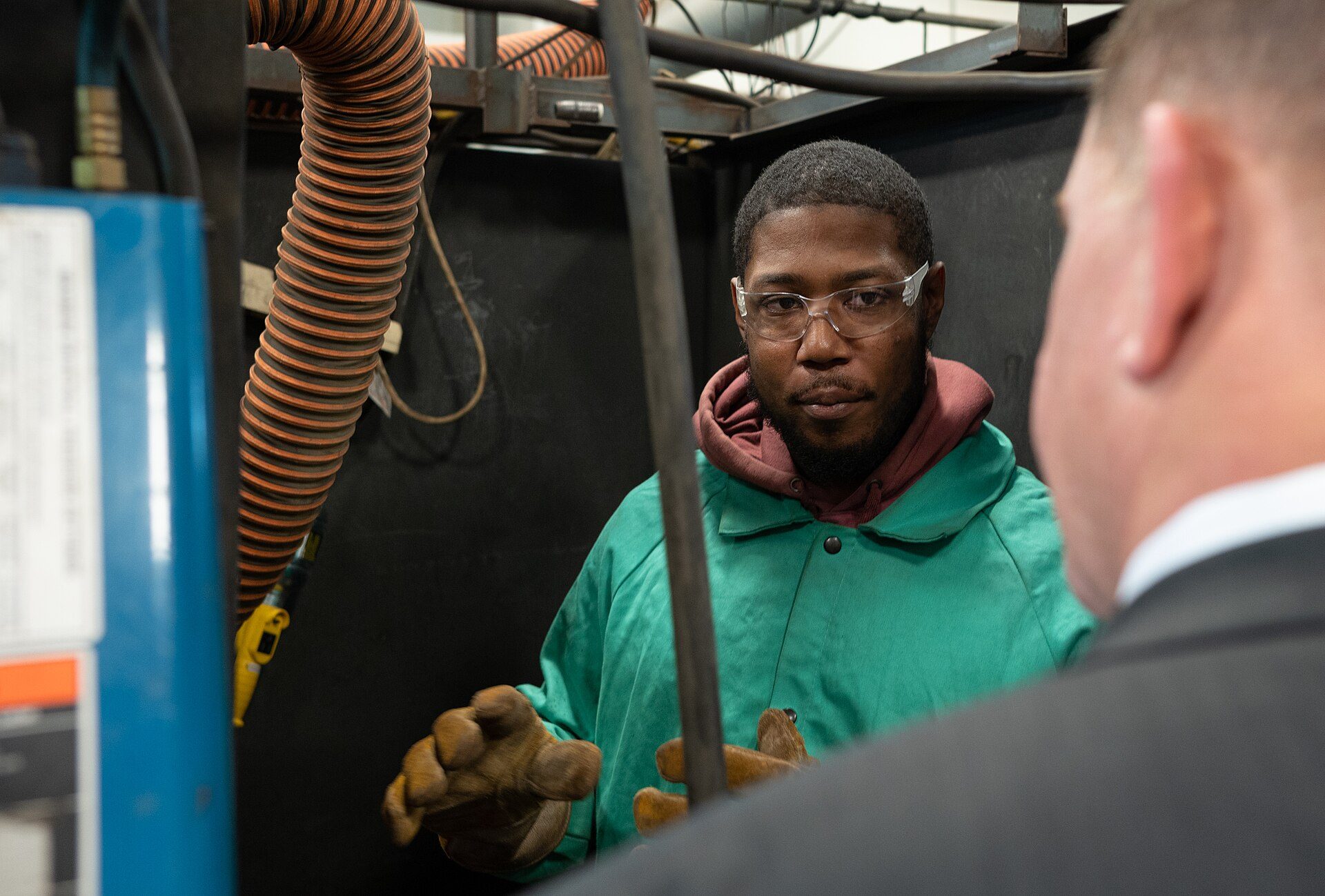
Photo: US Department of Labor / Wikimedia Commons, CC BY 2.0
Materials that give off toxic fumes
| Material | Main hazard | Control |
|---|---|---|
| Plain carbon steel | Iron and manganese fume | Local extraction, ventilation |
| Stainless steel | Fume containing chromium and nickel, including carcinogenic chromium compounds | Local extraction mandatory; suitable respirator when needed |
| Galvanised steel | Zinc fume causing metal fume fever | Grind off the coating at the weld, extract, work in open air |
| Painted or oily steel | Paint and burning oil fumes, toxic gases | Scrape or grind off paint and oil before welding |
| Aluminium (MIG, TIG) | High ozone from the intense arc | Extraction, good ventilation |
Never weld near surfaces just cleaned with chlorinated solvents: the arc's radiation can break the solvent vapour down into a highly toxic gas.
Welding in tanks, pits and enclosed spaces
Confined spaces such as tanks, pits and ship compartments have their own procedure: gas testing, forced ventilation, an attendant outside and a confined space entry permit. Beginners never go into an enclosed space to weld on their own, even for "just a few welds".
Fire prevention and hot work permits
Welding, cutting and grinding outside a dedicated welding area are called hot work. Many factories, buildings and construction sites require a hot work permit before any arc is struck.
Clearing and shielding before welding
- Remove paper, wood, cardboard, oily rags, paint and gas bottles within a radius of about 10 m; cover anything that cannot be moved with a fire blanket.
- Seal floor gaps, wall openings and door gaps that sparks could pass through; check the other side of walls and the floor below.
- Place a suitable fire extinguisher and a bucket of water or sand right at the work.
- Never weld or cut drums or tanks that once held fuel or chemicals until they have been cleaned and checked by a qualified procedure.
What a hot work permit usually includes
Location, task, start and end times, the welder, the fire watcher, the precautions taken (clearing, covering, extinguisher, isolating the local fire alarm if permitted), and signatures of the issuer and the receiver. The exact form is set by each workplace; use your site's form and do not skip steps.
Fire watch during and after welding
The fire watcher stands nearby with an extinguisher ready, watching where sparks land (Figure 4). After the welding is finished, keep watching for at least 30 minutes, longer where the site requires it, because sparks can smoulder and then flare up. Feel walls and floors near the weld for heat before leaving.
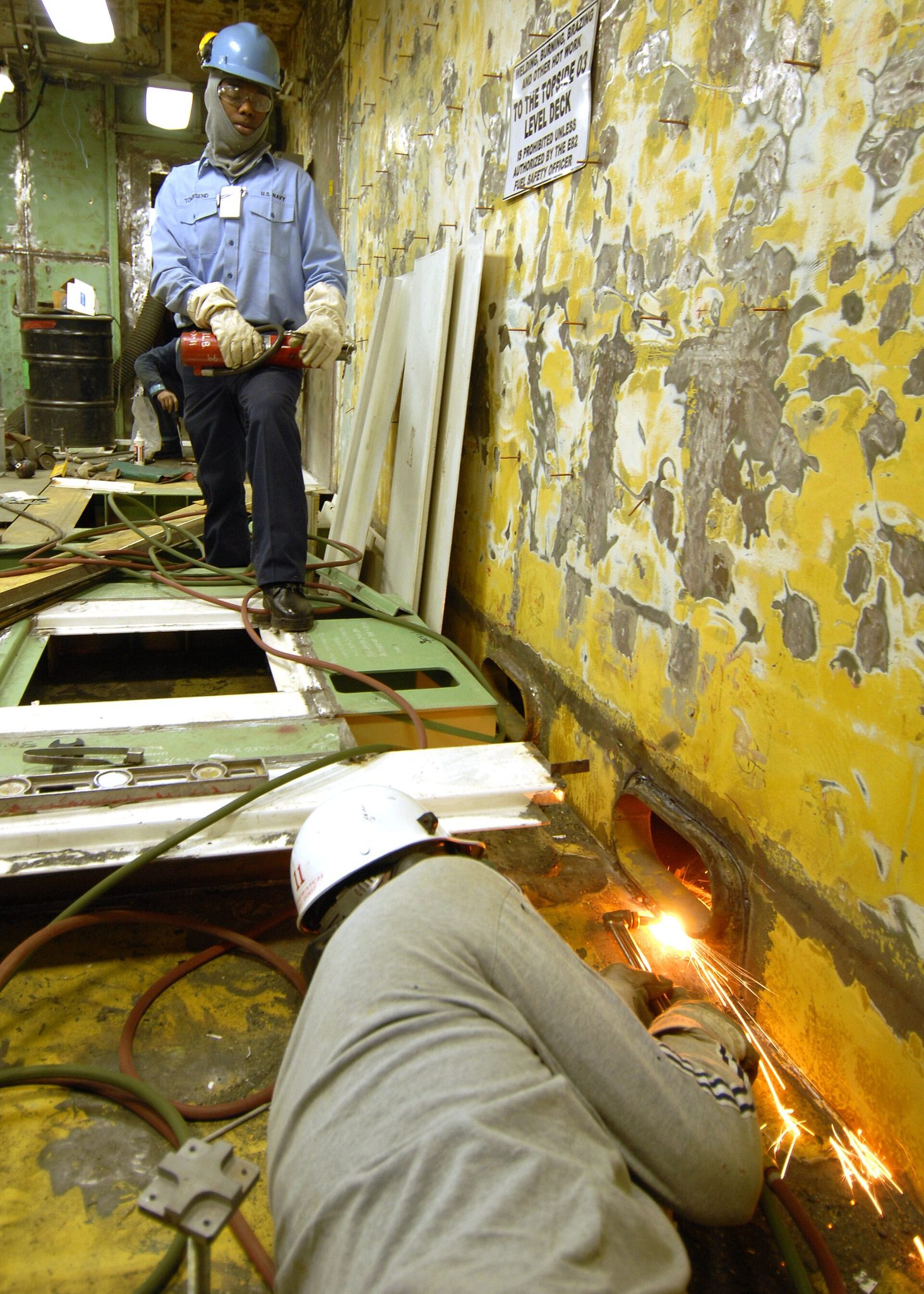
Photo: U.S. Navy photo by Mass Communication Specialist 3rd Class Myriam M. Padilla / Wikimedia Commons, Public domain
Gas cylinder and welding machine electrical safety
Cylinders for MIG and TIG (CO2, argon, mixtures) and for oxy-fuel cutting (oxygen, acetylene, LPG) hold gas at high pressure. A welding machine is a high-power electrical appliance.
Gas cylinders
- Always keep cylinders upright and chained or clamped to a wall, rack or trolley (Figure 5); never leave a cylinder lying on the floor.
- Move cylinders on a trolley with a chain and the valve cap fitted; never drag or roll them.
- Open valves slowly, standing to the side of the regulator, never facing the gauge. Close the valve during breaks and at the end of the shift.
- Oxygen must never touch oil or grease: no grease on threads, no oily gloves.
- Oxy-fuel sets must have flashback arrestors as the manufacturer specifies. Test for leaks with soapy water, never with a flame.
- Store oxygen cylinders well away from fuel gas cylinders and heat sources, in a ventilated place.
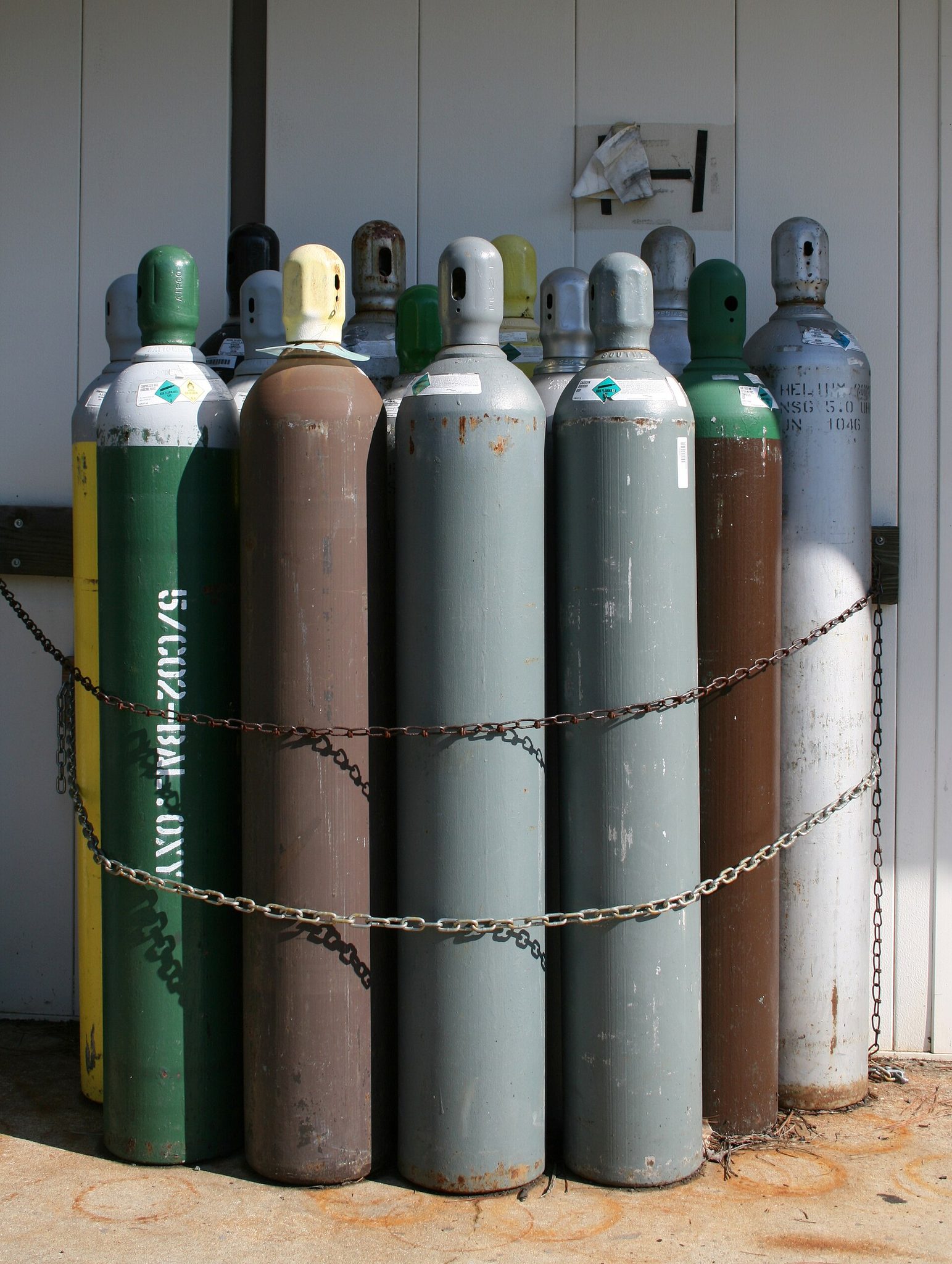
Photo: Ildar Sagdejev ( Specious ) / Wikimedia Commons, CC BY-SA 4.0
Welding machine electrics
Plug the machine into a breaker of the right rating, with the casing earthed. Check that welding cables, the electrode holder and the gun have no cracked insulation; the work clamp must be tight and close to the weld. Do not stand on wet floors or weld when you are soaked by rain or sweat; stand on dry wood or a rubber mat. If the machine smells of burning or a cable gets unusually hot, switch off and report it. Handling the electrode holder and rods is covered in Stick welding for beginners.
Worked example: repairing a galvanised steel gate at a customer's house
Situation: Khoa, an apprentice, goes with Son to re-weld a hinge and 4 broken bars on a galvanised steel gate at a townhouse. Motorbikes are parked by the gate, and inside is a storeroom of cardboard boxes under a plastic awning. They use an inverter stick welder powered from the customer's 220 V socket.
Safety plan and time
| Task | Details | Time (minutes) |
|---|---|---|
| Clear and shield | Move 2 motorbikes, close the storeroom door, cover the plastic awning with a fire blanket | 20 |
| Electrical check | Socket, breaker, cables, work clamp | 5 |
| Grind off galvanising | Grind about 2–3 cm clean around each weld | 25 |
| Welding | 4 bars + 1 hinge, standing upwind, a fan blowing fumes out to the street | 60 |
| Fire watch after welding | Check the awning, storeroom and gate base; chip slag, clear stubs | 30 |
| Total | 140 | |
Check: 20 + 5 + 25 + 60 + 30 = 140 minutes, about 2 hours 20 minutes. Arc time is only 60 minutes, less than half; the rest is preparation and safety. When quoting, Son charges for all 140 minutes, not just the welding.
Khoa's personal protective kit (2026 reference prices in Vietnam, varying by area and type)
| Item | Low (VND) | High (VND) |
|---|---|---|
| Auto-darkening welding helmet | 350,000 | 1,500,000 |
| Long-cuff leather welding gloves | 60,000 | 200,000 |
| Flame-resistant or leather welding jacket | 250,000 | 900,000 |
| High-top steel-toe boots | 300,000 | 800,000 |
| Safety glasses, earplugs, dust mask | 80,000 | 250,000 |
| Total | 1,040,000 | 3,650,000 |
Check: 350,000 + 60,000 + 250,000 + 300,000 + 80,000 = 1,040,000 VND; 1,500,000 + 200,000 + 900,000 + 800,000 + 250,000 = 3,650,000 VND (roughly 40–140 USD). Workshops usually supply protective gear; if you buy your own, invest in a good helmet and gloves first.
First aid and when to see a doctor
Safety warning: Never strike an arc before your helmet is down, combustibles are cleared and an extinguisher is at hand. Never weld galvanised, stainless or painted steel without fume extraction. Never weld or cut drums or tanks that once held fuel or chemicals, and never go into a tank or pit to weld without a procedure and an attendant. Cylinders must be upright, chained and closed during breaks. Do not weld when you, your gloves or the floor are wet. If a fire spreads: raise the alarm, call 114 (Vietnam's fire emergency number), and only fight it while it is small and you have a way out.
Arc eye
Symptoms usually appear a few hours later: gritty, painful, red, watering eyes and sensitivity to light. Do not rub your eyes or use eye drops of unknown type. Rest in a dark room, use cool compresses and see an eye doctor, especially if the pain is severe or vision is blurred. If slag or metal particles get in the eye: rinse with clean water, do not try to remove them, and see a doctor immediately.
Burns from slag and sparks
Cool under running water for 15–20 minutes; do not apply toothpaste, oil or grease, and do not pop blisters. Large or deep burns, or burns on the face, hands or genitals, need a medical facility.
Metal fume fever and breathing problems
If, a few hours after welding galvanised steel, you develop fever, chills, aching muscles and a metallic taste, it may be metal fume fever. Get to fresh air, rest, drink water and see a doctor, telling them what you welded. Breathing difficulty, chest pain or heavy coughing after welding in an enclosed space: call 115 (Vietnam's emergency medical number).
Electric shock
Switch off the welding machine first, never touch the victim with bare hands, and call 115. Anyone who has had a shock should see a doctor even if they seem fine, because heart rhythm problems can appear later.
Common beginner mistakes
Squinting and "test striking" without the helmet
Sign: a quick strike to mark the spot before lowering the helmet. Cause: the helmet gets in the way and the rod is hard to position. Fix: use an auto-darkening helmet, position the rod while the lens is light, lower the helmet, then strike.
Welding galvanised steel without grinding or extraction
Sign: thick white fumes, a fever that evening. Cause: saving time. Fix: grind off the coating at the weld, extract fumes or work in open air, and stand upwind.
Leaving straight after welding
Sign: packing up and going right after the last weld. Cause: not knowing sparks can smoulder. Fix: always keep a fire watch for at least 30 minutes and check behind walls and the floor below.
Welding in a polyester T-shirt
Sign: small burn holes in the shirt and burns on the skin underneath. Cause: wearing everyday clothes. Fix: wear only heavy cotton or flame-resistant clothing, buttoned at the collar and cuffs.
Frequently asked questions
Is welding bad for your eyes, and how long does arc eye last?
Yes, if you do not wear a helmet with the right shade. Mild arc eye usually eases within about 1–2 days, but see a doctor to rule out more serious damage or a foreign body. Repeated exposure to the arc can cause long-term harm.
Which auto-darkening helmet is best for beginners?
Choose one with an adjustable shade (for example 9–13), adjustable sensitivity and delay, replaceable cover lenses and clear safety standard information. Do not choose on price or graphics alone.
Is welding stainless steel toxic?
Stainless steel welding fume contains chromium and nickel, including chromium compounds that cause cancer with long-term exposure. Welding stainless requires local fume extraction, good ventilation and a suitable respirator when needed.
What is a hot work permit and who issues it?
It is a document authorising welding, cutting or grinding at a specific location for a set time, listing the fire precautions taken. It is usually issued by the safety department, building management or site management under internal rules; ask the person in charge where you work.
Do welders need a safety certificate in Vietnam?
Workers in jobs with strict safety requirements must receive safety training under current regulations; welding qualifications such as 3G or 6G are a separate matter. Ask your employer and check the current official documents. Once you have the safety basics, you can move on to MIG welding for beginners.
Practice tasks and self-assessment
- Put on the full set of protective gear and have a senior welder check you from head to toe; note anything missing.
- Set an auto-darkening helmet for 3 situations: stick at 100 A, MIG at 180 A, TIG at 80 A; record the shade, sensitivity and delay.
- Draw up a hot work permit for welding a gate at a townhouse, with location, times, fire watcher and precautions.
- Under supervision, stand, chain, open and close a CO2 or argon cylinder, and leak-test with soapy water.
Self-assessment criteria
- Pass: no exposed skin, no synthetic clothing, trousers worn over the boots.
- Pass: the shades you chose fall within the reference ranges in the table and you can still see the weld pool clearly.
- Pass: your permit has every section and a post-weld fire watch of 30 minutes or more.
- Pass: the cylinder is upright and chained, you open the valve standing to the side, close it afterwards, and there are no soap bubbles at the joints.
- Not yet: striking an arc without the helmet, welding galvanised steel without extraction, or leaving straight after welding.
Once you know the safety rules, move on to the next roadmap step: Materials, drawings and weld symbols, where you learn to tell carbon steel, stainless steel and aluminium apart, read fillet and butt weld symbols, and choose the right rods, wire and shielding gas.
Keep learning welding: after safety come materials and weld symbols, cutting, bevelling and tacking, stick welding, MIG/MAG, TIG, out-of-position welding and weld inspection. See the 8-step welder roadmap.