Seller fees on Shopee and Lazada fall into 3 main groups: a fixed fee (charged per completed order according to product category), a payment fee (transaction processing), and service fees for programmes you choose to join, such as free shipping or voucher packages; on top of that come advertising and shipping subsidies if you opt in. The exact percentages change often and differ by category and shop type, so always check the announcements and policy pages in the current Seller Centre, and never trust screenshots of fee tables online. This is the first lesson for marketplace store operators in Vietnam: you will understand how the marketplaces are structured, read the real payout of an order, know which mistakes earn penalty points, and understand your tax obligations as an online seller at the level of principles.
By the end of this lesson, you will be able to:
- Tell Shopee from Lazada and Mall shops from regular shops, and choose the shop type that fits your product source.
- Name the types of seller fees, separate compulsory from optional ones, and know where to find the real rates.
- Calculate the payout and profit of an order from the order details, with figures that add up.
- List the mistakes that earn penalty points (Shopee's "Sao Qua Ta" points) and set up a daily routine to avoid them.
- Understand the principles on prohibited goods, counterfeits and tax when selling on a marketplace.
Starting out as a Shopee or Lazada store operator? This is step 1 of the roadmap: marketplace structure, fees, policies and penalty points, the foundation before listing products, running promotions and ads. See the 8-step roadmap for Shopee and Lazada store operators to learn in the right order.
How does an e-commerce marketplace work?
A marketplace is an online "market": it gives you a stall (your shop), brings buyers to you, holds the buyer's money until the order is complete, connects you with carriers and sets the rules. In return, it charges fees on each order and sells extra services such as advertising.
Four parties in one order
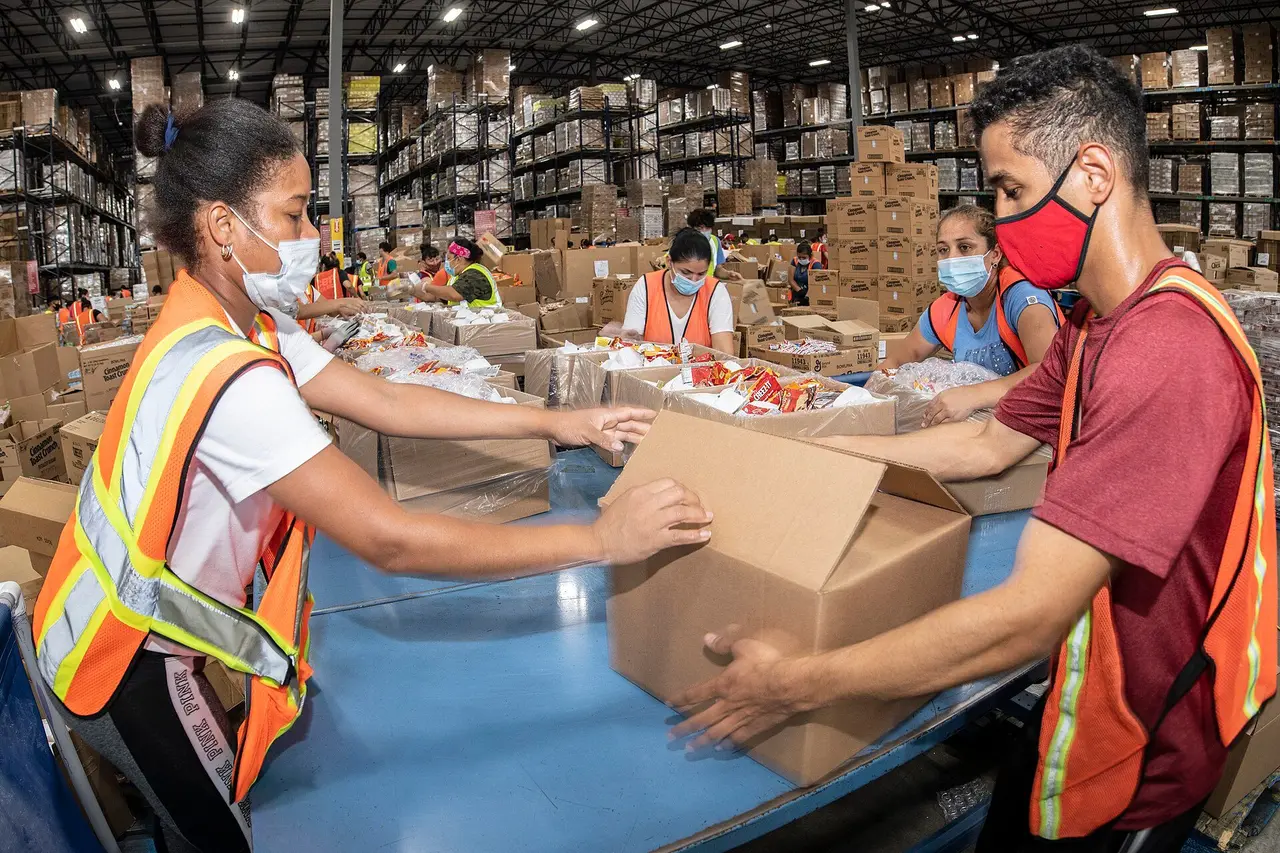
- Seller: lists products, prepares stock, packs orders (Figure 1) and hands them to the carrier on time.
- Buyer: orders, pays through the platform or cash on delivery, reviews after receiving.
- Marketplace: holds the money, deducts fees, credits the rest to the seller's balance when the order completes, handles disputes.
- Carrier: picks up, delivers and updates status; usually connected through the platform.
The Seller Centre is your control panel
Everything an operator does happens in the Shopee Seller Centre (called "Kenh Nguoi Ban" in Vietnamese) or Lazada Seller Center, on a computer or the app: listing products, processing orders, checking revenue, viewing penalty points, reading policy announcements. The first habit of this job: every morning, open the Seller Centre and read the announcements before doing anything else. Fee and policy changes are announced there.
How the money flows
The buyer pays and the marketplace holds the money. When the order completes (the buyer has received it and the dispute window has passed, or the buyer confirms receipt), the marketplace deducts its fees and credits the rest to your shop balance, which you withdraw to a bank account in the shop owner's name. So the sales figure shown on the platform is not the money you receive.
Shopee, Lazada, Mall shops and regular shops
The two marketplaces work in basically the same way but differ in interface, customer base, promotions and detailed policies. Good operators can run both, but it pays to learn one thoroughly first.
Mall shops and regular shops
Shopee Mall and LazMall are areas reserved for official brands and authorised distributors. To join, a shop usually has to prove rights to the brand (trademark registration, distribution authorisation) and commit to stronger return policies and service levels. In return, Mall shops get a special badge, more customer trust and access to some major campaigns, but fees are usually higher than for regular shops. Regular shops are easy to open and suit beginners, small household businesses and self-made products without a major brand.
Comparison by principle
| Criterion | Regular shop | Mall shop (Shopee Mall, LazMall) |
|---|---|---|
| Requirements | Identity verification, bank account, pickup address | Plus trademark or distribution documents and business papers |
| Fees | Lower | Usually higher |
| Return policy | Platform's general policy | Stronger commitment, return window may be longer |
| Best for | Beginners, small shops, handmade goods | Brands, official distributors |
| Where to check the real conditions | Policy pages and announcements in the current Seller Centre | |
Trusted shop badges
Besides Mall, each marketplace awards badges to regular shops with good metrics (Shopee calls them Preferred and Preferred+). Criteria usually include sales, order count, late shipment rate, non-fulfilment rate, chat response rate, ratings and not having too many penalty points. Avoiding penalty points is not just about avoiding punishment; it is how you earn a badge and buyers' trust.
Seller fees: compulsory and optional
This lesson deliberately gives no fee percentages: rates change several times a year and differ by category, shop type and programme. You need to understand the fee structure; read the numbers in the Seller Centre at the time you work and in each order's details.
Types of fees
| Item | When charged | Compulsory or optional | Where to see it |
|---|---|---|---|
| Fixed fee | Per completed order, by category | Compulsory | Fee schedule page, order details |
| Payment fee | Per order, for transaction processing | Compulsory | Fee schedule page, order details |
| Programme service fees (free shipping, voucher packages) | Per order once the shop has joined | Optional | Programme sign-up page, order details |
| In-platform advertising | Per click or as the package defines | Optional | Ads page, ads reports |
| Shop vouchers, shipping subsidies | When buyers use vouchers the shop created | Optional | Promotions page, order details |
| Tax withheld by the platform (if any) | Under current tax rules | By law | Payment details, the platform's tax report |
Read the order details for the real fees
Open a completed order and go to the payment details (Figure 2): you will see the product price, vouchers, every fee deducted and the final amount the shop receives. These are the real figures, more accurate than any fee table online. Beginners should open their first 10 completed orders and copy every line into a spreadsheet to understand what is deducted.
When to join programmes with service fees
Free shipping and voucher packages bring more orders because buyers love free shipping, but each order carries an extra fee. Join only when the profit per order after fees is still positive and your goal is more orders. Low-priced, thin-margin products can lose money in these programmes. The worked example below shows how to calculate it.

Photo: Anonymous Unknown author / Wikimedia Commons, CC0
Worked example: the payout on one T-shirt order
A regular shop sells a cotton T-shirt for 189,000 VND (about 7 USD). The shop has joined a free shipping service package. The buyer uses a shop voucher worth 10,000 VND. The fees below are hypothetical amounts copied from one order's details for practice, not the platform's real fee schedule; when you do this for real, copy the exact numbers from your own shop's orders.
Step 1: from price to platform payout
| Item | Amount (VND) | Running total (VND) |
|---|---|---|
| Selling price | 189,000 | 189,000 |
| Shop voucher | − 10,000 | 179,000 |
| Fixed fee (per order details) | − 17,000 | 162,000 |
| Payment fee (per order details) | − 5,000 | 157,000 |
| Free shipping package fee (per order details) | − 9,000 | 148,000 |
| Platform payout to the shop | 148,000 | |
Check: 10,000 + 17,000 + 5,000 + 9,000 = 41,000 VND deducted; 189,000 − 41,000 = 148,000 VND, matching the last line. If the platform withholds tax on the order, that also appears in the payment details and must be deducted too.
Step 2: subtract the shop's costs to get profit
- Cost of the T-shirt: 85,000 VND.
- Packaging (bag, label, tape): 4,000 VND.
- Thank-you card: 2,000 VND.
- Gross profit per order: 148,000 − 85,000 − 4,000 − 2,000 = 57,000 VND.
Step 3: look at the whole month
This month the shop had 300 orders: 288 completed and 12 returned (288 + 12 = 300). Each return costs about 25,000 VND in return shipping and packaging. In-platform ads cost 3,000,000 VND.
- Gross profit on completed orders: 288 × 57,000 = 16,416,000 VND.
- Loss on returns: 12 × 25,000 = 300,000 VND.
- Ads: 3,000,000 VND.
- Remaining: 16,416,000 − 300,000 − 3,000,000 = 13,116,000 VND, before tax not withheld by the platform, wages and premises.
The lesson: monthly sales were 288 × 189,000 = 54,432,000 VND, but what remained before wages and tax was only about a quarter of that. How to handle returns and cut that loss is covered in handling Shopee returns: inspecting goods, evidence and disputes.
Marketplace policies and penalty points
Each marketplace has a penalty point system for sellers who break the rules. On Shopee they are called "Sao Qua Ta" points (literally "weight points"); Lazada has its own penalty and seller rating system. Points accumulate over a cycle set by the platform; as they reach thresholds, the shop is progressively restricted: lower product visibility, no access to promotions, no ads, and at worst account suspension. Exact thresholds, penalties and reset cycles are on the current policy pages.
Mistakes that commonly earn penalty points
| Group | Example | Prevention |
|---|---|---|
| Late shipment | Not handing orders to the carrier within the preparation time | Process orders daily before pickup; set a realistic preparation time |
| Non-fulfilment caused by the shop | Cancelling for lack of stock, not shipping, wrong item | Keep real stock levels, check items before packing |
| Listing violations | Duplicate listings, wrong category, prohibited items, misleading content | Read the prohibited list, list in the right category |
| Counterfeits, IP infringement | Selling brand knock-offs, using other shops' photos | Sell only goods with known origin, take your own photos |
| Off-platform transactions | Posting a phone number, asking buyers to pay directly | Communicate only through the platform's chat |
| Poor customer care | Ignoring chats, insulting buyers | Reply templates, check chat several times a day |
A daily routine to avoid penalties
- Morning: read platform announcements, check the performance page and penalty points.
- Process all new orders, print labels and pack before the carrier's pickup time (Figure 3).
- Check stock for items running low; deactivate or update quantities immediately.
- Answer chats at least 3 times a day, disputes first.
- End of day: check handed-over and uncollected orders, log mistakes and fix the root cause.

Photo: User:Mattes / Wikimedia Commons, Public domain
When penalty points are unfair
If the fault lies with the carrier (handed over but not updated in the system) or a buyer acting in bad faith, file an appeal through seller support with evidence: photos, handover videos, tracking numbers and times. Keeping evidence from the start matters more than any explanation later.
Prohibited goods, counterfeits and tax on online sales
Legal warning: Selling counterfeits, brand knock-offs or prohibited goods does not only cost penalty points and shop suspension; depending on the severity, it can bring administrative fines or criminal liability in Vietnam. Do not take on operating a shop that sells goods of unknown origin, even for good pay. A hired operator can still share liability if they knowingly took part.
Prohibited goods and goods needing documents
- Prohibited on marketplaces: weapons, illegal substances, wildlife, prescription drugs and many other groups under the law and the platform's list.
- Restricted goods that need documents: cosmetics (which must be notified to the authorities), food, health supplements, medical devices, children's products; the platform may ask for documents before listing.
- Counterfeits and knock-offs: using another brand's name or logo on goods that are not genuine.
The detailed lists change, so read each platform's prohibited and restricted goods policies before buying stock.
Tax obligations: principles
- Selling on a marketplace is business activity and income is taxable under the rules for individuals, household businesses or companies.
- Under recent Vietnamese rules, marketplaces with a payment function withhold and pay part of the tax on behalf of individual and household business sellers; this shows in the platform's reports. Sellers still need to know what other obligations remain, especially when selling on several channels.
- Companies declare tax and issue invoices under their own rules.
- Keep full records: revenue reports, tax reports from the platform, purchase invoices. Ask the tax office or an accountant about current rates, thresholds and declaration methods.
Business registration
Platforms require identity verification of the shop owner; some categories, programmes or Mall shops also require business registration. As regular sales grow, ask about registering a household business to make invoices, purchasing and tax easier.
Day-one checklist for running a shop
You can do this list straight away when you take over a new shop or someone else's shop.
Setup and checks
- The owner's identity is verified; the payout bank account is in the owner's name.
- Pickup address and contact number are correct; carriers are enabled.
- Preparation time matches your real packing capacity.
- You have read the current fee schedule and noted the date.
- You have read the penalty point policy and the prohibited and restricted goods lists.
- Check the performance page: current penalty points, late shipment rate, chat response rate.
- Access: the operator uses a sub-account with granted permissions, never the owner's shared password.
Tracking spreadsheet
Create a spreadsheet with 3 tabs: fee details per order (copied from completed orders), a daily error log (late orders, cancellations, disputes and causes), and a monthly profit and loss using the worked example as a template. This is the basis for the profit report at the end of the roadmap.
Account security
Turn on two-factor authentication, never share one-time codes, and never click "platform verification required" links sent by unknown messages. A hijacked shop account can lose both its balance and its review history.
Common beginner mistakes
Measuring profit by sales
Sign: seeing tens of millions in monthly sales and assuming big profits. Cause: not subtracting platform fees, vouchers, returns and ads. Fix: calculate profit from the platform payout as in the worked example.
Using old fee tables from the internet
Sign: quoting the shop owner based on a screenshot of last year's fees. Cause: not reading platform announcements. Fix: always take numbers from the Seller Centre and order details, with the date.
Joining every programme "to be complete"
Sign: orders rise but payouts fall. Cause: service fees eat the margin on low-priced products. Fix: calculate profit per product before signing up.
Putting a phone number in descriptions or chat
Sign: penalty points and hidden listings. Cause: trying to pull buyers off the platform. Fix: use only the platform's chat.
Frequently asked questions
What fees does selling on Shopee involve?
Usually a fixed fee by category and a payment fee on each completed order, plus service fees if you join programmes such as free shipping or voucher packages; advertising and shop vouchers are optional costs. Check the exact rates in the current Seller Centre.
Are Lazada seller fees the same as Shopee's?
The structure is similar (per-order fees, payment fees, programme fees, advertising) but names, rates and conditions differ. Read the fee schedule in Lazada Seller Center.
What are Shopee penalty points?
They are points Shopee gives sellers who break its policies, such as late shipment, cancellations, prohibited listings, counterfeits or off-platform transactions. Too many points bring restrictions on visibility, promotions and ads, and serious cases can lead to shop suspension.
Do online sellers in Vietnam have to pay tax?
Yes, selling on a marketplace is business activity. Marketplaces with a payment function withhold and pay part of the tax for individuals and household businesses under current rules; sellers should ask the tax office about any remaining obligations.
Should a beginner open a Mall shop or a regular shop?
Most beginners open a regular shop. Mall shops are for brands or distributors with trademark documents, authorisation and the capacity to meet higher service standards.
Practice and self-assessment
- Open the Seller Centre (your shop or one you have access to) and note the fee types currently applied and the date you read them.
- Take 10 completed orders, copy every line of the payment details, and calculate the payout and profit of each using the template.
- Read the penalty point policy and list the 6 most likely mistakes for your shop with how to prevent them.
- Write a 5-step daily routine for the shop and pin it at the packing table.
Self-assessment criteria
- Pass: your 10-order sheet has columns for price, each fee, payout, cost and profit; totals match the platform's balance report.
- Pass: every fee figure comes from the Seller Centre or order details, with a date.
- Pass: the daily routine includes checking penalty points and checking stock.
- Not yet: profit measured by sales, or fee tables from unknown sources.
Now that you know the rules and how money reaches your account, move on to the next step of the roadmap: Marketplace-SEO listings & variations, where you learn to title products with keywords, pick the right category, attributes and variations so listings are not hidden. Detailed lesson: Shopee product listing SEO: titles, categories, photos, keywords.
Keep learning marketplace operations: after policies and fees come listings, photos and descriptions, stock and packing, double-day promotions, in-platform ads and profit reports. See the 8-step roadmap for Shopee and Lazada store operators.