Hygiene when caring for a newborn comes down to three things: washing your hands with soap at the right moments and for long enough, keeping everything that goes into the baby's mouth (bottles, teats, breast pump parts) clean and sterilised, and not getting close to the baby while you yourself are ill. Alongside these come the limits of the job: a paid mother-and-baby carer does not give the baby medicine, does not treat illness, and does not use herbal steaming or risky folk remedies, but follows the doctor's instructions and tells the family as soon as something looks wrong. This is the first lesson for newcomers to the trade in Vietnam, based on common guidance from the World Health Organization (WHO), Vietnam's Ministry of Health and health bodies such as the CDC (USA) and NHS (UK); it does not replace the advice of the doctor or midwife looking after the mother and baby.
By the end of this lesson, you will be able to:
- Wash your hands with soap for 40–60 seconds using the correct steps, and remember the 6 moments when handwashing is mandatory.
- Clean and sterilise bottles, teats and breast pump parts by boiling or with a steriliser, and store them without recontamination.
- Check your own health before a shift and know when to call in sick and when a mask is enough.
- Name 8 things a carer must not do on their own initiative (medicines, herbal steaming, folk remedies) and turn down such requests politely.
- Draw up a one-day hygiene schedule for a bottle-fed baby on 8 feeds, with time and equipment costs that add up.
Just starting out as a mother-and-baby carer? Hygiene and role limits are step 1, the foundation for everything that follows: bathing, feeding support, safe sleep. See the 8-step postnatal mother-and-baby care roadmap to learn in the right order.
Why hygiene is the first lesson in mother-and-baby care
A newborn's immune system is still immature and the baby has not yet had all its vaccinations, so an infection that gives an adult a mild cold can put a baby in hospital. In babies under 3 months, a fever is usually a reason to see a doctor straight away, not to watch and wait at home. That is why the carer's hands and the objects that go into the baby's mouth are the two routes of infection you control the most.
How germs reach a baby
- Hands: hands touch a phone, a door handle, money or a dirty nappy, then touch the baby's mouth, face or a teat.
- Droplets: adults coughing, sneezing, talking close to the baby's face or kissing the baby.
- Equipment: bottles with milk residue, teats left uncovered on the table, breast pump parts rinsed carelessly.
- Milk: made-up milk left too long at room temperature, half-finished milk kept for the next feed, expressed breast milk stored incorrectly.
The carer is a "barrier", not a doctor
Your job is to stop the baby catching infections, to observe, and to report early. Diagnosing, prescribing and treating are the doctor's job. Families hire you because they trust you to do things right, even when doing it right means saying "I'm not allowed to do that, let's ask the doctor."
Handwashing done properly: 6 moments and 40–60 seconds
Washing with soap and clean water is the cheapest and most effective measure there is. According to WHO guidance, a proper handwash with soap takes about 40–60 seconds, with at least 20 seconds of rubbing with soap (Figure 1). An alcohol hand rub can be used when your hands are not visibly dirty; rub for about 20–30 seconds until dry.
Steps for washing hands with soap
- Take off rings, bracelets and your watch; roll your sleeves above the wrist.
- Wet your hands under clean running water and apply enough soap to cover both hands.
- Rub palm to palm, then each palm over the back of the other hand.
- Interlace your fingers to clean between them; rub the backs of the fingers against the opposite palm.
- Grip and rotate each thumb; bunch your fingertips and rotate them in the other palm to clean the tips and under the nails.
- Rinse well under running water, dry with your own clean towel or a paper towel, and use the paper towel to turn off the tap if you can.
The 6 moments you must wash your hands
| Moment | Why | How |
|---|---|---|
| On arriving at the family's home, before touching the baby | Hands carry germs from the street, motorbike, market | Soap and water; change your outer layer if possible |
| Before making up milk, washing bottles or preparing the mother's food | Hands touch things that go into the baby's or mother's mouth | Soap and water, dry with a clean towel |
| Before bottle feeding, or cleaning eyes, nose, mouth or the cord | Contact with mucous membranes and the cord wound | Soap and water, or alcohol rub if hands are not dirty |
| After changing a nappy, cleaning up waste, using the toilet | Stool contains large numbers of gut bacteria | Soap and water is mandatory; alcohol rub is not enough |
| After coughing, sneezing, blowing your nose, touching a phone or money | Hands pick up droplets and surface dirt | Soap and water or alcohol rub |
| After handling the mother's soiled items (pads, cloths with lochia) | Contact with blood and body fluids | Wear gloves, then remove them and wash with soap |
Nails, jewellery, clothes
Keep your nails cut short to the fingertip, with no polish and no false nails: under long nails is where bacteria hide and soap struggles to reach, and long nails scratch a baby's skin easily. Do not wear rings or bracelets while caring for the baby. Wear clean clothes, tie your hair back, and bring a spare top to change into when you arrive.
When you are ill: call in sick or wear a mask?
Before every shift, ask yourself 5 questions: do I have a fever; a cough, runny nose or sore throat; diarrhoea or vomiting; blisters or sores on my lips; an infected, pus-filled cut on my hands? If the answer to any of them is "yes", tell the family before your shift so you can decide together.
When to call in sick and not care for the baby directly
- Fever, or a fever in the last 24 hours.
- Diarrhoea or vomiting: many gut infections spread very fast by hand.
- Blisters or sores on the lips (cold sores): this virus can cause serious illness in newborns, so never kiss the baby or touch the sore and then the baby.
- An infected wound on your hand, or a swollen finger with pus.
- A confirmed or suspected infectious disease such as flu, chickenpox, measles or tuberculosis, or recent close contact with someone ill when a doctor has told you to isolate.
A mild cold, and nobody else can cover
Only work if the family agrees: wear a medical mask covering nose and mouth throughout the shift, change it when damp, do not pull it down to your chin to talk, wash your hands more often and do not hold the baby's face against you. This is a temporary fix, not a habit.
Cleaning bottles, teats and breast pump parts
Milk is a medium in which bacteria grow very quickly. Milk residue in the grooves of a teat, the thread of a bottle neck or a pump valve becomes a breeding ground if it is not washed out, even if you sterilise afterwards. The rule: clean first, then sterilise; sterilising never replaces washing.
Wash straight after every feed
- Take everything apart: bottle, cap, screw ring, teat, anti-colic valve if any (Figure 2 shows how many parts a breast pump has).
- Rinse with clean water to flush out leftover milk; never leave milky bottles for hours.
- Wash in warm water with a baby-bottle detergent in a separate basin, not in the sink with dishes and pans.
- Use a dedicated bottle brush and teat brush, scrubbing the base, the neck thread and the teat hole; squeeze water through the teat.
- Rinse thoroughly under clean running water until no foam remains.
- Leave to drain on a clean drying rack or clean paper towel; never dry with a kitchen cloth.
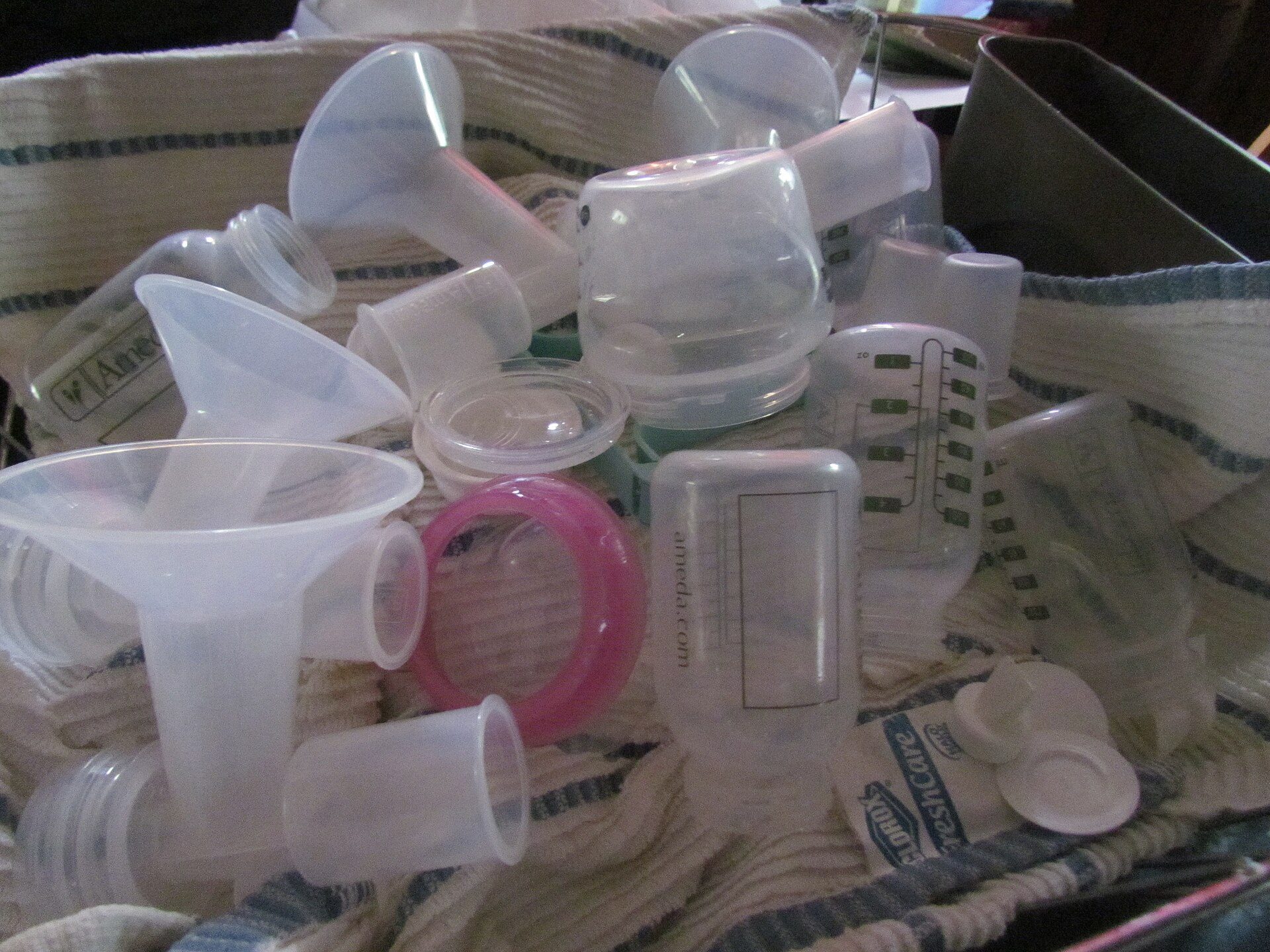
Photo: ParentingPatch / Wikimedia Commons, CC BY-SA 3.0
Sterilising by boiling
The most common and cheapest method is boiling in a pot used only for the baby's things (Figure 3). The CDC's instructions: put the washed parts in the pot, cover them with water, bring to the boil and keep it boiling for 5 minutes, then lift them out with clean tongs. Make sure no air bubbles are trapped inside the bottles. Some parts (silicone teats, valves) have the maker's own boiling times; read the instructions on the box.
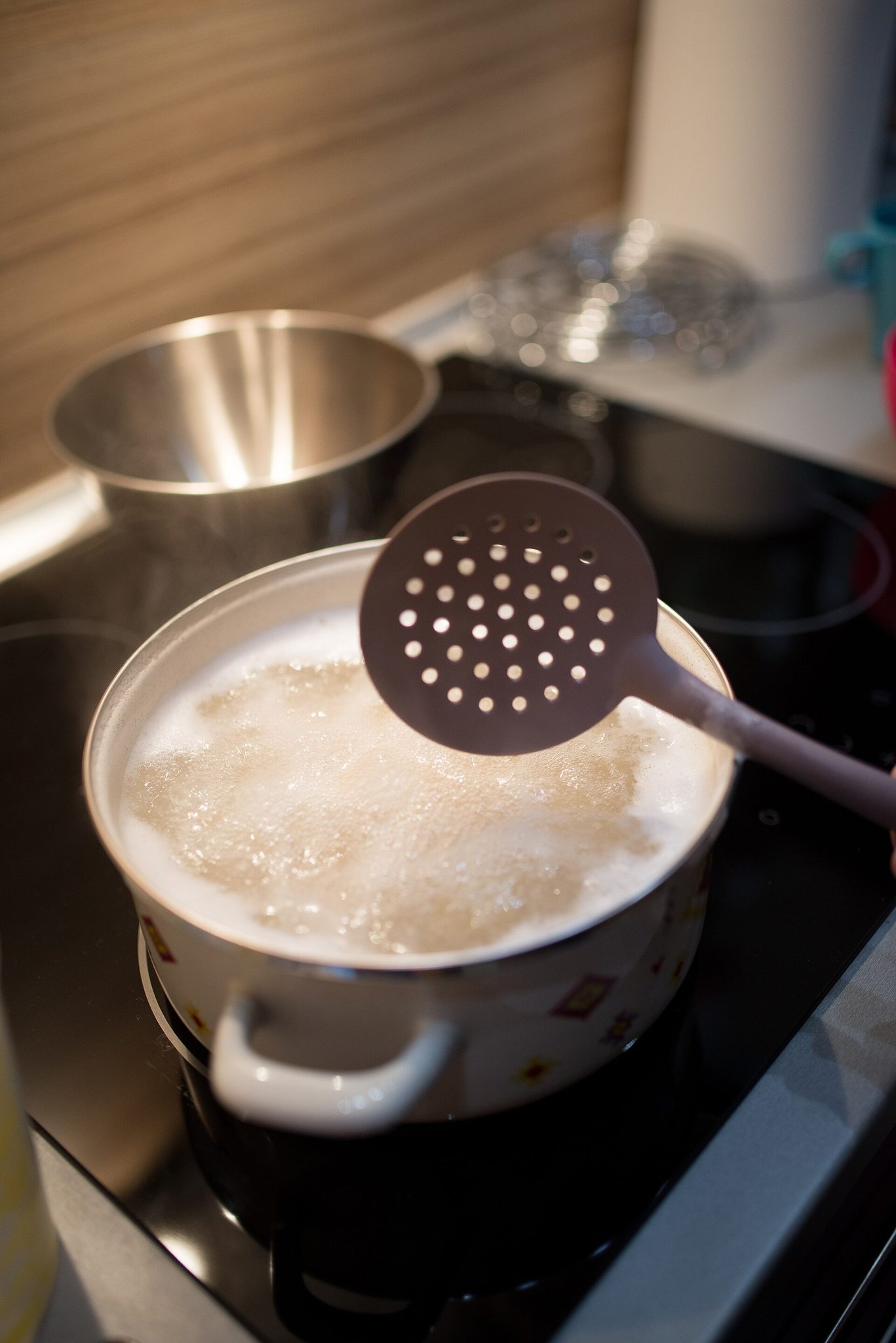
Photo: Shixart1985 / Wikimedia Commons, CC BY 2.0
Steam sterilisers and sterilisers with dryers
With a steam steriliser (some include a dryer), follow the maker's instructions on water volume, loading bottles mouth down and regular descaling. A steriliser only works when the items have already been washed free of milk residue.
How often to sterilise, and until what age
Health bodies give different advice. The NHS (UK) recommends sterilising all bottle-feeding equipment until the baby is at least 12 months old. The CDC (USA) recommends sterilising at least once a day, especially for babies under 3 months, babies born prematurely or babies with weakened immune systems. For a newborn carer, the safe approach is to wash after every feed and sterilise on the schedule the family has agreed with the paediatrician; if there is no instruction yet, suggest sterilising at least daily.
Storing after sterilising
Let items air-dry on a clean rack (Figure 4) or in a steriliser with a dryer, reassemble the bottles with freshly washed hands, cap the teats and keep everything in a closed box. Sterilised items left uncovered on the kitchen counter for hours, touched with dirty hands or dropped on the floor must be washed and sterilised again.
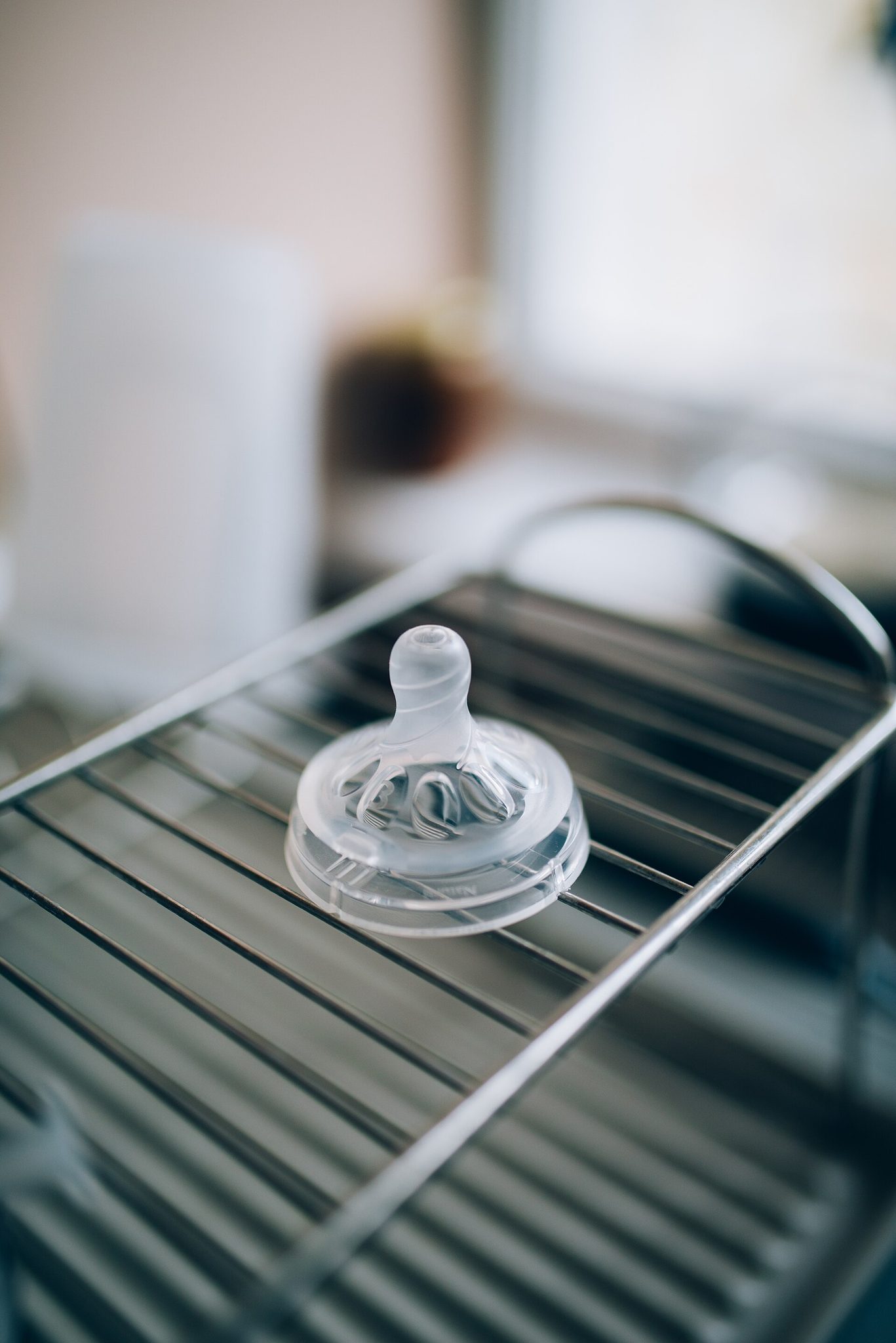
Photo: Shixart1985 / Wikimedia Commons, CC BY 2.0
Role limits: 8 things a carer must not do on their own
Older relatives sometimes ask you to follow word-of-mouth remedies. You need to know which tasks lie outside the job so you can decline gently but firmly.
Safety warning: A mother-and-baby carer never gives the baby any medicine, syrup, herbal water or probiotic without a doctor's instruction and the parents' agreement. No herbal steaming, no leaves, powders or medicines on the umbilical cord, no medicated oils, no "coin rubbing", no honey on the tongue or by mouth (honey is not given to babies under 12 months). Do not overheat the baby or let it sleep near a charcoal brazier or heater. If the baby has a fever, refuses feeds, is unusually drowsy, struggles to breathe, has a seizure or turns blue: tell the family at once; for serious signs call emergency number 115 (Vietnam).
What you may and may not do
| Situation | Do not | The carer's correct action |
|---|---|---|
| The baby feels hot | Give fever medicine, sponge with herbal water | Take the temperature with a thermometer, note the time and reading, tell the family immediately |
| The baby is wheezy or blocked up | Herbal steaming, rubbing medicated oil on the chest or soles | Clean the nose the way the doctor showed, watch the breathing rate, tell the family |
| White patches on the baby's tongue | Scrape the tongue with honey, lemon or leaves | Tell the family so they can ask the doctor; do not scrape |
| The cord is oozing | Apply leaves, powder or ointment someone recommended | Keep it clean and dry as instructed; report spreading redness, pus or smell |
| The mother's caesarean wound or stitches hurt | Remove dressings, apply ointment, give her painkillers | Remind her of her own prescribed medicine if she takes it herself; report worsening pain or fever |
| The mother wants traditional heat or steam treatments | Light charcoal in a closed room or give her hot steam baths | Explain the risks of burns and smoke poisoning; suggest asking the doctor |
| The baby cries a lot | Give herbal water, syrups or sedatives | Check hunger, nappy and room temperature, note when the baby cries, tell the family |
| The baby looks jaundiced | Put the baby in strong sun, give herbal water | Observe how far the yellowing goes, tell the family to take the baby to a doctor |
How to decline politely
Talk about the baby's safety, without judging the elders' experience: "The doctor told us carers not to do this ourselves, because the baby is so small and it would be hard to deal with if something went wrong. Let me write it down and you can ask the paediatrician at the next check-up, or call now." Note in your shift log that you reported it and the family knows.
When to tell the family, and when to call 115
Tell the family to take the baby to a doctor the same day if: a baby under 3 months has a temperature of 38°C or above, feeds poorly or refuses feeds, vomits a lot, the cord shows spreading redness or pus, or jaundice spreads to the arms and legs. Call 115 at once if the baby struggles to breathe, the chest sucks in with each breath, the lips turn blue, the baby has a seizure, is hard to wake or floppy. The "danger signs" step of the roadmap covers this in depth.
Keeping the baby's surroundings clean, and the mother's soiled items
Clean hands do not help much if the nappy-changing and milk-making areas are dirty. Split the home into a "clean zone" (making milk, storing bottles, the cot) and a "dirty zone" (nappy changing, dealing with soiled items), and never share cloths or basins between them.
The milk station and the changing station
- Milk station: wipe the surface with a clean cloth before each feed is made up; never put phones, keys or bags on it.
- Changing station: use its own changing mat, wipe it with its own damp cloth after each change, and keep a lidded bin right beside it.
- Roll dirty nappies up, put them in a bag and into a lidded bin; empty the bin at least daily.
Items soiled with the mother's blood or lochia
After birth, the mother has vaginal discharge (lochia) for several weeks. When you help her change pads or wash stained clothes, wear disposable gloves, wrap used pads in paper or a bag and put them in a lidded bin, then take off the gloves and wash your hands. Never wash the mother's bloodstained items together with the baby's clothes.
Worked example: a one-day hygiene schedule for a 2-week-old on 8 bottle feeds
The situation: a 2-week-old boy fed expressed breast milk and formula by bottle, about 8 feeds a day roughly 3 hours apart. The mother pumps 6 times a day. The family has 6 bottles and the doctor has asked for feeding equipment to be sterilised daily. You work a 12-hour day shift and handle 4 feeds and 3 pumping sessions during it.
Step 1: count the washes in your shift
- Bottles: 4 feeds × 1 set = 4 bottle sets to wash.
- Breast pump: 3 sessions × 1 set = 3 pump sets to wash.
- Total: 4 + 3 = 7 sets of equipment to wash during the shift.
Step 2: work out the hygiene time in your shift
| Task | Times × duration | Total time |
|---|---|---|
| Washing bottles | 4 × 4 minutes | 16 minutes |
| Washing pump parts | 3 × 5 minutes | 15 minutes |
| Sterilising by boiling (one batch at the end of the shift: bring to the boil, boil 5 minutes, lift out to dry) | 1 × 20 minutes | 20 minutes |
| Handwashing with soap | 15 × 1 minute | 15 minutes |
| Wiping the milk station and changing station | 6 × 2 minutes | 12 minutes |
| Total | 78 minutes | |
Check: 16 + 15 + 20 + 15 + 12 = 78 minutes, about 1 hour 18 minutes in a 12-hour shift. The family has 6 bottles and your shift uses 4, leaving 2 clean spares until the end-of-shift sterilising batch; if the baby feeds more than expected, sterilise an extra batch mid-shift rather than using a bottle that has only been washed.
Step 3: starter hygiene equipment and cost (2026 reference prices, varying by area and product)
| Item | Price range | Price used in the example |
|---|---|---|
| Bottle brush and teat brush set | 50,000–150,000 VND | 100,000 VND |
| Baby-bottle detergent | 80,000–250,000 VND | 150,000 VND |
| Separate pot for sterilising | 150,000–400,000 VND | 250,000 VND |
| Bottle tongs | 30,000–80,000 VND | 50,000 VND |
| Drying rack and lidded storage box | 100,000–350,000 VND | 200,000 VND |
| Total | 750,000 VND | |
Check: 100,000 + 150,000 + 250,000 + 50,000 + 200,000 = 750,000 VND (about USD 29). If the family buys a steam steriliser with dryer, typically around 600,000–2,500,000 VND depending on the model, the separate pot is not needed, but the brushes, detergent and tongs still are.
Common mistakes and how to fix them
Only rinsing bottles with boiling water and reusing them
Signs: a cloudy film in the bottle, a sticky teat, a sour smell. Cause: skipping the scrub with bottle detergent because boiling water seems enough. Fix: always take apart and scrub thoroughly before sterilising; replace teats that are cracked, sticky or misshapen.
Using alcohol rub after changing a dirty nappy
Signs: your hands still smell after rubbing. Cause: convenience, not wanting to leave the baby. Fix: put the baby down safely in the cot and wash with soap; alcohol does not remove dirt on your hands.
Going along with folk remedies to please the elders
Signs: you agree to herbal steaming or herbal water for the baby although you know you should not. Consequence: if something happens to the baby, you are responsible for acting outside your role. Fix: use the polite refusal above, record it in the shift log and tell the parents.
Frequently asked questions
Is boiling water enough to clean a newborn's bottles?
Not if you only rinse. Take everything apart, wash off milk residue with bottle detergent and a brush, rinse, and only then sterilise by boiling or in a steriliser. Boiling water only works on a surface that is already clean.
Until what age should baby bottles be sterilised?
Advice differs between countries: the NHS (UK) recommends until the baby is at least 12 months, while the CDC (USA) stresses daily sterilising for babies under 3 months, premature babies or those with weak immunity. The family should ask the baby's paediatrician; the carer follows the agreed schedule.
Can a carer give a newborn fever medicine?
Not on their own initiative. Take the temperature, write it down and tell the family at once; a baby under 3 months with a fever needs to be seen by a doctor. Only give medicine when a doctor has prescribed a specific dose and the parents have handed the task to you directly.
Practice tasks and self-assessment
- Wash your hands in 6 steps in front of a mirror, timing yourself to reach 40–60 seconds; ask someone to put food colouring or lotion on your hands first and check for missed spots.
- Take apart, wash and boil-sterilise one bottle set, writing down each step and its time.
- Write your 5-question health checklist for before a shift, and one polite sentence for declining when the family asks you to steam the baby with herbs.
- Draw up a hygiene schedule for a 12-hour shift with 5 feeds and 2 pumping sessions, using the table above as a template.
Self-assessment criteria
- Pass: handwashing lasts long enough and misses no finger gaps, thumbs or fingertips; you can name all 6 handwashing moments.
- Pass: the bottle is fully taken apart, the thread and teat hole are scrubbed, it boils for the full 5 minutes, is lifted out with clean tongs and stored in a lidded box.
- Pass: you can list at least 6 things you must not do yourself and 4 signs that mean calling 115.
- Not yet: rinsing with boiling water only, using alcohol rub instead of soap after a nappy change, or agreeing to give the baby anything not prescribed by a doctor.
With hygiene and role limits in place, move on to the next roadmap step: Holding, bathing, cord care and nappy changing. Start with how to bathe a newborn: preparation, order of washing and cord care, then read how to burp a newborn when you reach feeding support.
Keep learning mother-and-baby care: after hygiene and role limits come holding, bathing, cord care, nappy changing, feeding support, safe sleep and postnatal care for the mother. See the 8-step postnatal mother-and-baby care roadmap.