A residential electrician's salary in Vietnam in 2026 (reference figures, varying by region) is roughly 6–9.6 million VND a month for a helper, 10.8–15.6 million for an electrician and 15.6–21.6 million for a master tradesman, based on day rates of 250,000–900,000 VND and 24 working days. For orientation, 1 million VND is about 40 US dollars, so a qualified electrician typically earns about 430–620 USD a month. Electricians who take on their own projects can earn 18–35 million in some months, but other months they earn less than an employee. What you actually take home depends on three things: how your labour is priced, the costs you must cover yourself, and your skill level.
By the end of this lesson, you will be able to:
- State the reference day rates and monthly income for each level: helper, electrician, master tradesman and self-employed contractor.
- Distinguish the three ways of pricing labour — day rate, fixed price per m² or per point, and per-job repairs — and know when each pays off.
- Draw up your own monthly income and cost sheet when self-employed, and calculate net income and the annual average.
- Compare employment and self-employment on 5 criteria to choose the right path.
- Plan your progress from helper to running your own projects, linked to the 4 levels of the NAMBIN roadmap.
Just starting and know nothing about electricity? The first income you will reach is a helper's day rate. Learn the safety basics, tools and simple circuit installation in the Residential Electrician Level 1 – Helper course. Already working and wondering how much to charge for a job? Try NAMBIN's quick quote tool.
How much does a residential electrician earn at each level?
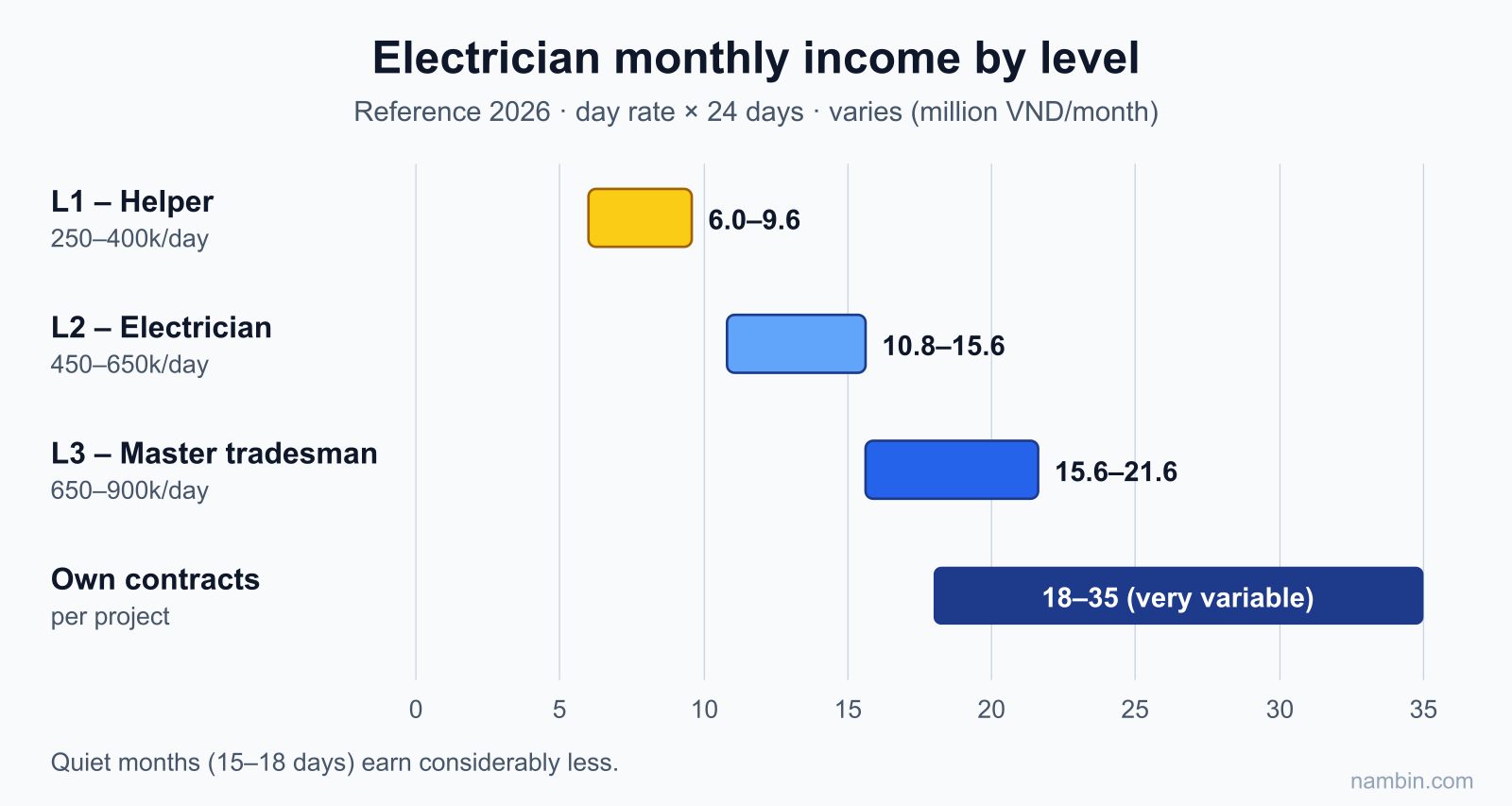
In the Vietnamese residential electrical trade, "salary" is usually not a fixed monthly wage but a day rate multiplied by the number of days with work. So the correct comparison is day rate and days worked, then convert to a month. The table and Figure 1 below assume 24 working days a month — typical when work is steady.
| Level | Reference day rate | Monthly income (24 days) | Typical work |
|---|---|---|---|
| Helper, apprentice | 250,000–400,000 VND | 6.0–9.6 million | Chasing walls, laying conduit, pulling cable, fitting lights and sockets under direction |
| Electrician | 450,000–650,000 VND | 10.8–15.6 million | Reading drawings, dividing circuits, installing consumer units, fault finding, commissioning |
| Master tradesman | 650,000–900,000 VND | 15.6–21.6 million | Three-phase, pumps, large loads, lightning protection, solar |
| Self-employed, crew leader | Per project | 18–35 million (highly variable) | Surveying, quoting, design, coordinating workers, warranty |
Helpers and apprentices
Newcomers usually start at 250,000–300,000 VND a day and, after a few months of getting used to tools and safety procedures, move up to 300,000–400,000 VND. Example: 300,000 VND × 24 days = 7.2 million a month. Subtract around 600,000 VND for fuel and phone and about 6.6 million remains. At this level, the most valuable thing is not the pay but the hours spent working beside a careful qualified electrician.
Electricians
An electrician can read drawings independently, take responsibility for a whole house and sign off commissioning. The day rate is around 450,000–650,000 VND. Example: 550,000 VND × 24 days = 13.2 million; subtract about 1 million for fuel and tool wear and roughly 12.2 million a month remains.
Master tradesmen and self-employed contractors
A master tradesman handles difficult work that few people do: three-phase supplies, pump and motor circuits, large loads such as induction hobs and EV chargers, rooftop solar. Day rates are 650,000–900,000 VND, sometimes higher for urgent or highly technical work. Self-employed contractors no longer have a "wage" per day: income is labour revenue minus costs, so it ranges from 18–35 million in busy months and less in quiet ones.
Why do people at the same level earn so differently?
- Region: in big cities labour rates are usually higher; in many provinces they are typically about 10–25% lower (an estimate that varies by place).
- Type of project: new houses, apartment renovations, shops or small workshops all pay differently.
- Days with work: 24 days is a steady month; after Tet (the Lunar New Year holiday) or in the rainy season it may be only 15–18 days.
- Reputation: electricians with referrals from regular clients rarely need to cut prices to compete.
Three ways electricians are paid
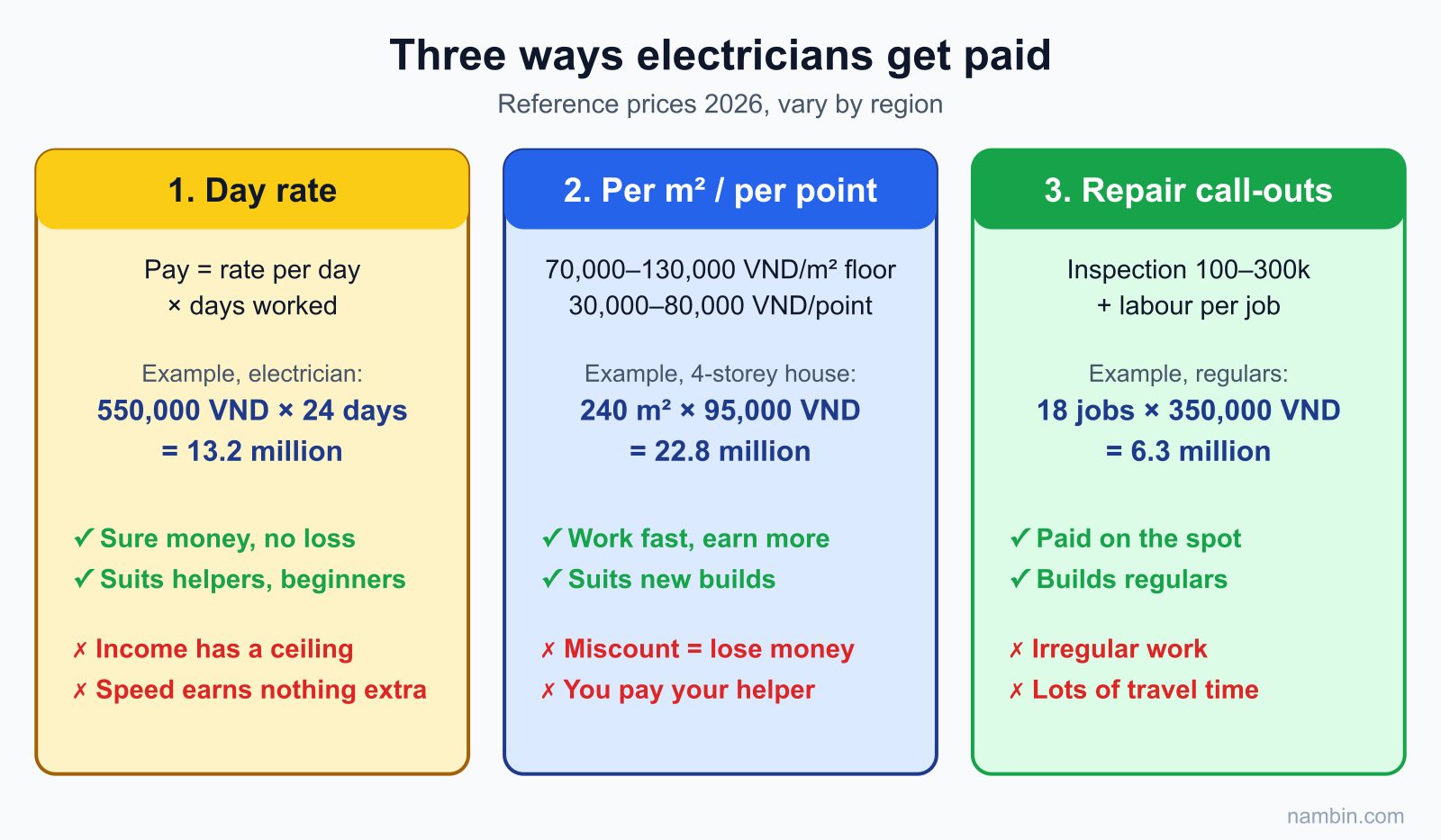
With the same skill, the way your labour is priced decides how much you earn and what risk you carry. Figure 2 summarises the three common methods; the sections below explain when to use each.
Day rate — an electrician's price for one day
You are paid per day worked, usually 8 hours, and the homeowner or contractor supplies materials. This is the safest method for helpers and beginners: no risk of loss, no need to estimate quantities. The drawback is a ceiling on income — fast or slow, you earn the same. When accepting day-rate work, agree in advance on start time, lunch break, how overtime is paid and who pays for fuel when the site is far away.
Fixed price per m² of floor area or per point
New houses are often contracted for labour per m² of floor area, roughly 70,000–130,000 VND/m² (reference 2026). Small renovations are priced per point — each socket, switch or light is one point — around 30,000–80,000 VND per point when replacing or adding on existing wiring. Example: replacing 12 sockets and 8 switches: 20 points × 50,000 VND = 1,000,000 VND, done in half a morning.
Fixed pricing pays off when you work fast and estimate quantities correctly. Always check by dividing the contract price by the expected number of worker-days. Example: a 240 m² house × 95,000 VND = 22.8 million; if a crew of 2 takes 14 days, that is 28 worker-days, so each worker-day earns about 814,000 VND — more than the day rate of both the electrician and the helper, so it is profitable. If the result is below the day rate, you are working at a loss. How to build a detailed quote is covered in the lesson Quoting, taking jobs and working with clients for residential electricians.
Per-job repairs
A client calls because a breaker trips, a socket has burned or one floor has lost power. Typically there is an inspection fee of 100,000–300,000 VND per visit plus the repair labour, with materials charged separately. Each job is small but you are paid immediately and it builds regular clients. To repair quickly and correctly, you need a systematic diagnostic procedure like the one in the lesson diagnosing a breaker that keeps tripping. Drawback: work is irregular and travel takes a lot of time.
Worked example: one month of a self-employed electrician
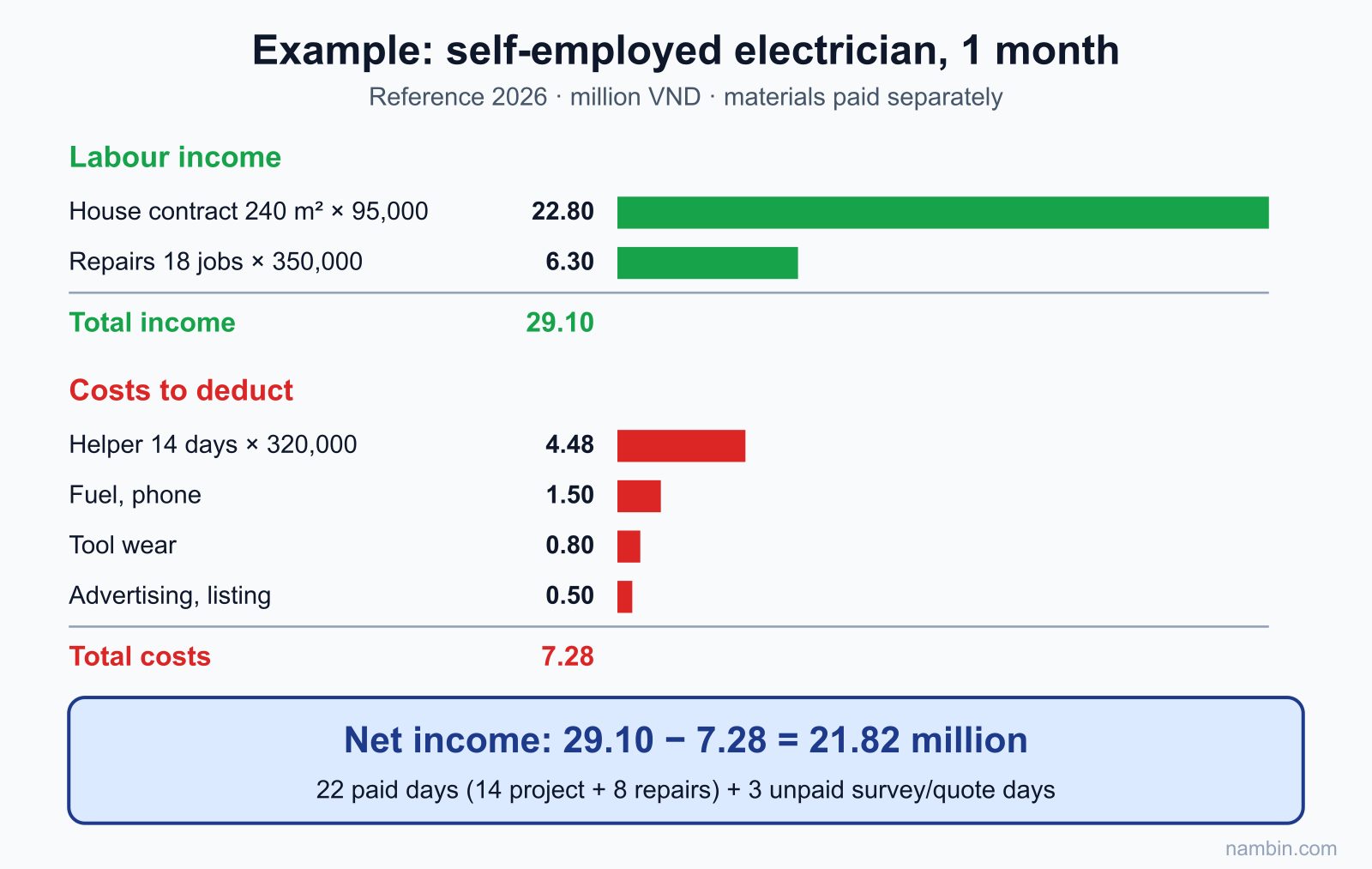
Situation: Tuan, 32, is a qualified electrician with 5 years' experience in a suburban district of a big city. This month he takes a labour-only contract for the electrics of a four-storey tube house (a narrow terraced home) with 240 m² of floor area, plus repair jobs for regular clients. The client pays for materials under a separate quote, so they are not counted as income. Figure 3 and the table below total all income and costs.
Labour income
- Labour contract for the tube house: 240 m² × 95,000 VND = 22,800,000 VND, done in 14 days with one helper.
- Repairs: 18 jobs averaging 350,000 VND labour each = 6,300,000 VND, grouped into 8 days.
- Total income: 22,800,000 + 6,300,000 = 29,100,000 VND.
Costs to deduct
| Item | Calculation | Amount (VND) |
|---|---|---|
| Tube house electrical contract | 240 m² × 95,000 | 22,800,000 |
| Repairs | 18 jobs × 350,000 | 6,300,000 |
| Total income | 29,100,000 | |
| Hired helper | 14 days × 320,000 | 4,480,000 |
| Fuel, phone | Whole month | 1,500,000 |
| Tool wear, drill bits, cutting discs | Estimate | 800,000 |
| Advertising, service listing | Whole month | 500,000 |
| Total costs | 4,480,000 + 1,500,000 + 800,000 + 500,000 | 7,280,000 |
| Net income | 29,100,000 − 7,280,000 | 21,820,000 |
Net income and the annual average
This month Tuan had 22 paid days (14 on the project + 8 on repairs) and 3 unpaid days surveying and quoting. Net income was 21.82 million; divided by 25 busy days that is about 873,000 VND a day — clearly more than working for a day rate as an electrician (about 12.2 million a month, as above).
But not every month is like this. Suppose a year has 8 busy months like this one and 4 quiet months (after Tet, rainy season) earning only about 12 million: 8 × 21.82 + 4 × 12 = 174.56 + 48 = 222.56 million a year, an average of about 18.55 million a month. That is the figure to use when deciding whether to leave employment and go self-employed — and it does not yet include what you must cover yourself, such as insurance, sick days and free warranty call-backs.
Company job or self-employed?
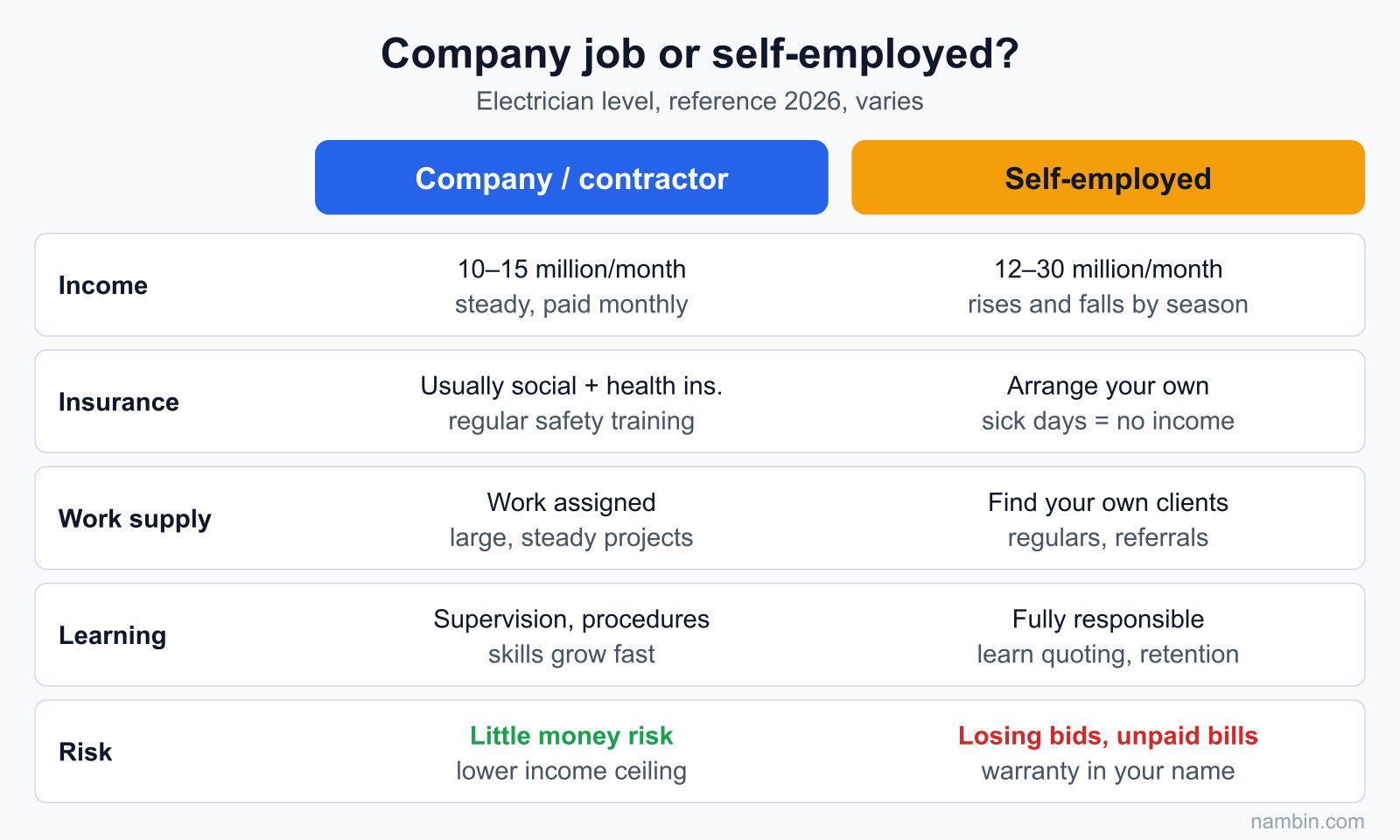
There is no universal answer. Working for a company or contractor gives stability and a place to learn; self-employment gives a higher income ceiling but you carry the risk. Figure 4 compares them on 5 criteria.
Working for a company or contractor
Usually a monthly salary: helpers about 7–9 million, electricians about 10–15 million, team leaders 15–20 million VND (reference 2026, varies by employer and region), possibly with allowances for distant sites and overtime. Many employers pay social and health insurance and organise regular safety training. You work on larger projects with technical supervision and formal commissioning — an excellent environment to build skills. Before accepting, ask whether there is a labour contract, how insurance is paid and on what day salary is paid.
Self-employed, taking your own jobs
Self-employed electricians typically earn about 12–30 million a month depending on the season, as in the example above. In return, you find your own clients, quote, collect payment, provide warranty and pay your own insurance if you want it. The biggest risks are underestimating a fixed-price job, clients who do not pay, and problems after handover that carry your name.
How to get started?
The low-risk path: work as a helper for an electrician or company for 1–2 years, become a qualified electrician, then take extra repair jobs at weekends to test the market. Only when regular clients fill 15–20 days a month should you consider running your own projects full-time. Do not leave a stable job because of one "lucky" contract.
The career ladder: from helper to running your own projects
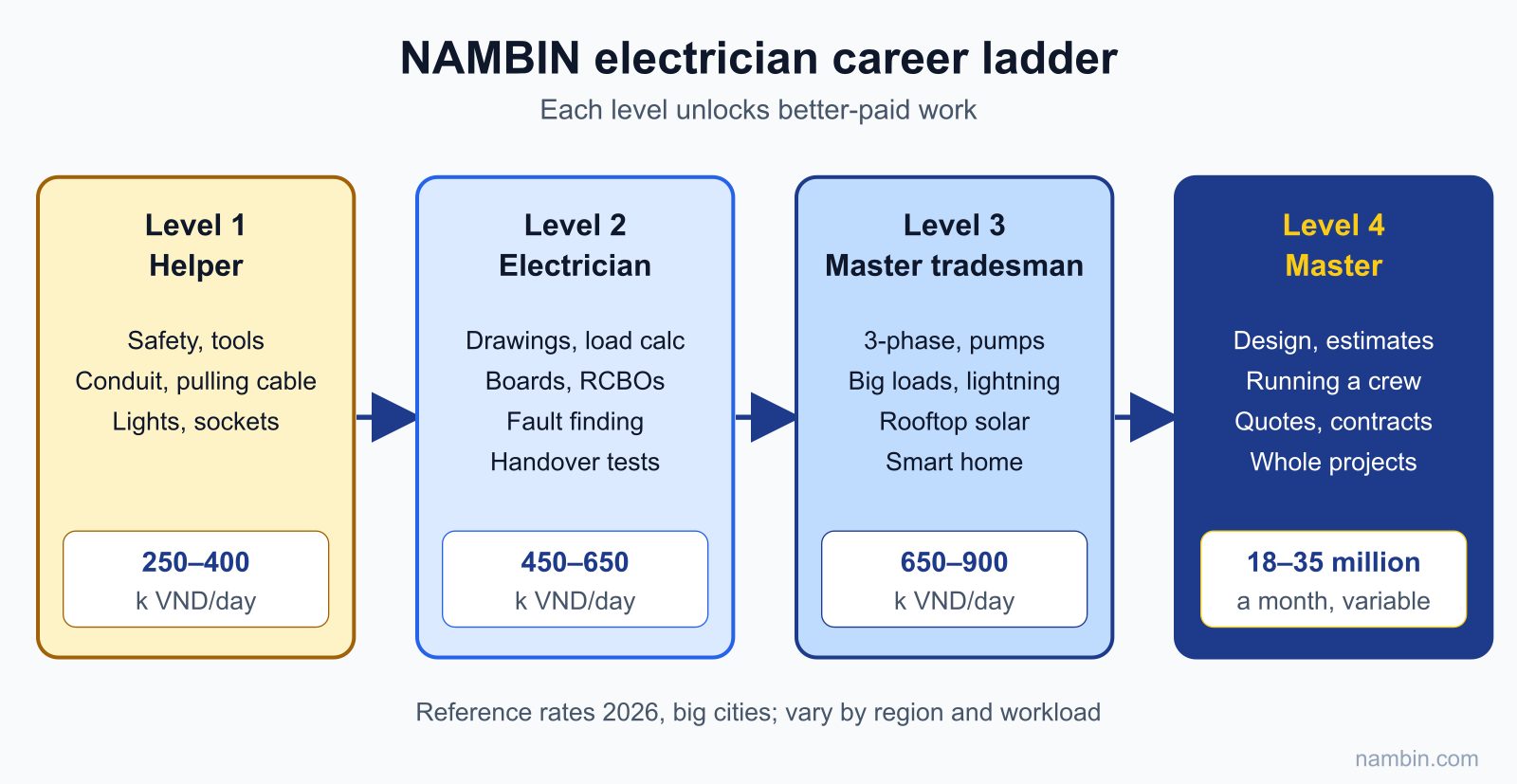
An electrician's income grows with the work you can do alone without anyone checking it again. NAMBIN's Residential Electrician roadmap has 4 levels, each unlocking a group of better-paid work (see Figure 5).
Level 1 to Level 2: from following directions to taking responsibility
Level 1 – Helper covers electrical safety, tools, measurement and installing light and earthed socket circuits. The most important foundation is 5 safety rules before touching any wire. At Level 2 – Electrician you read drawings, calculate loads, choose cables and breakers, install consumer units, diagnose faults and write commissioning reports. This is the biggest jump: day rates usually rise from about 300,000 to 450,000–650,000 VND.
Level 3: high-value work few people do
Level 3 – Master tradesman covers three-phase, motors and pumps, large loads, lightning protection, rooftop solar and smart homes. Clients are willing to pay more because few electricians do this work confidently, and mistakes are costly.
Level 4: from tradesman to contractor
Level 4 – Master covers design, estimating, managing a crew, site safety, maintenance and running an electrical services business. Income now comes from the number of projects you coordinate, not just from your own hands. This is also the level where this lesson sits in the roadmap — the step "Quoting, contracts & running an electrical services business".
Mistakes that make electricians earn less than their skill
Pricing fixed jobs by gut feeling
Symptom: only after the job do you find the labour per day is below the day rate. Cause: not counting points or estimating worker-days before accepting. Fix: always divide the contract price by expected worker-days, as in the 814,000 VND per worker-day example; if it is below the day rate, renegotiate or decline.
Forgetting hidden costs
Symptom: high income but little money left at month end. Cause: not recording fuel, wear on drill bits and cutters, unpaid survey time. Fix: keep a daily income and cost log like the table above and total it each month.
No paperwork, unpaid invoices
Symptom: clients pay late and argue about extras. Cause: verbal quotes, no payment milestones. Fix: written quotes, a deposit and stage payments tied to completed work.
Cutting prices by cutting safety
Symptom: you win the job by being cheap, then something goes wrong. Cause: leaving out RCDs, using undersized cable, skipping earthing to lower the price. Fix: compete on speed, neatness and warranty, never on safety devices.
Safety before pay: No rate is worth working on live wiring, skipping the isolate – lock – tag – re-test sequence, or taking on work beyond your competence such as anything upstream of the meter, medium-voltage lines or substations. Helpers must not work alone when the electrician is absent. One electrical accident can take away both your health and your career — and working at height or in a house under construction also needs a safety harness, insulated footwear and sound scaffolding.
Frequently asked questions
How much does an electrician earn per month?
For reference in 2026, varying by region: helpers about 6–9.6 million, electricians 10.8–15.6 million, master tradesmen 15.6–21.6 million VND with a full 24 days of work. Self-employed contractors can earn 18–35 million in a good month, but the annual average is lower than peak months — about 18.55 million a month in the example above.
What is an electrician's day rate?
About 250,000–400,000 VND for a helper, 450,000–650,000 VND for an electrician and 650,000–900,000 VND for a master tradesman (reference 2026). Urgent work, night work, work at height or distant sites usually cost extra; agree before starting.
Is residential electrical work a good trade?
Demand is steady because every home needs new installations, renovations and repairs; once you reach electrician level you can take small jobs yourself. In return, the trade involves electric shock risk, work at height, dust and heat, so it suits only people disciplined about safety. Income grows clearly with skill level, not just with years served.
How long until I can earn money?
Serious learners can usually work as a helper once they have mastered safety and basic circuit installation, and then learn on the job. The time to become a qualified electrician depends on the person and how much real work they do, and is usually measured in years, not months.
Do I need a certificate to take jobs?
Companies and contractors usually require a vocational certificate and an electrical safety training certificate. When self-employed, certificates and a portfolio of projects help clients trust you. Specific regulations can change; ask a training provider or the local labour authority.
Practice exercises and self-assessment
Exercises
- Calculate your monthly income (or that of an electrician you know) on a day rate: rate × actual days worked over the last 3 months, minus fuel and tool wear.
- An electrician takes a fixed-price house of 180 m² × 90,000 VND, 12 repair jobs × 300,000 VND, hires a helper for 10 days × 300,000 VND, spends 1.2 million on fuel and 0.6 million on tool wear. Calculate total income, total costs and net income.
- For the project in exercise 2, if a crew of 2 works 10 days, calculate the average labour per worker-day from the fixed price and conclude whether it is profitable compared with a 550,000 VND day rate.
- Write down your current level from the table above and 3 skills you need to reach the next level.
Self-assessment criteria
- Pass: exercise 2 gives total income 16.2 + 3.6 = 19.8 million; total costs 3.0 + 1.2 + 0.6 = 4.8 million; net income 15.0 million. Not yet: forgetting to deduct the helper or wrongly adding materials to income.
- Pass: exercise 3 gives 16.2 million ÷ 20 worker-days = 810,000 VND per worker-day, concluding the fixed price is profitable. Not yet: dividing by 10 days and forgetting there are 2 people.
- Pass: exercise 1 uses actual days worked, not an assumed 30. Not yet: using day rate × 30.
- Pass: exercise 4 names concrete skills (for example "install a consumer unit with RCBOs, measure earth resistance"), not vague ones like "get better".
Next step: this lesson belongs to the roadmap step "Quoting, contracts & running an electrical services business", followed by "Completing Level 4 – Master". If you are new to the trade, start from the beginning with the Residential Electrician Level 1 – Helper course to earn your first day rate safely, see the full 4-level Residential Electrician roadmap, and when you start taking your own jobs, use the quick quote tool so you never quote at a loss.