A plumber's salary in Vietnam in 2026 (reference figures, varying by region) is roughly 7–10 million VND a month for a plumber's mate, 11–17 million for a qualified plumber on a day rate, and 8–25 million for a self-employed repair plumber — high in busy months, low in quiet ones. For orientation, 1 million VND is about 40 US dollars, so a qualified plumber earns roughly 440–680 USD a month. The exact figure depends on three things: how you work, how skilled you are, and whether you know how to quote correctly so you never work for nothing.
This lesson is for people considering learning the trade and for new plumbers starting out on their own: where the money comes from, how much to charge for each job, and how to take on work so you build regular clients.
By the end of this lesson, you will be able to:
- Distinguish the three ways plumbers earn money (day rate, fixed-price contracts, repair services) and know the reference income for each skill level.
- Use the 2026 reference labour price list to quote 10 common plumbing repairs: replacing taps, clearing blockages, installing water heaters, leak detection and more.
- Calculate your own net monthly income: labour revenue minus fuel, advertising, tool wear and consumables.
- Quote by phone and at the customer's home in 6 steps, avoiding 4 mistakes that cost you money or customers.
Not sure where to start? Follow the 8-step Residential Plumber roadmap on NAMBIN — from pipe materials, PPR welding and pressure testing to leak repair and quoting. Once you are taking jobs, use the quick quote tool to put together a price list for a customer in a few minutes.
How much does a plumber earn in Vietnam in 2026?
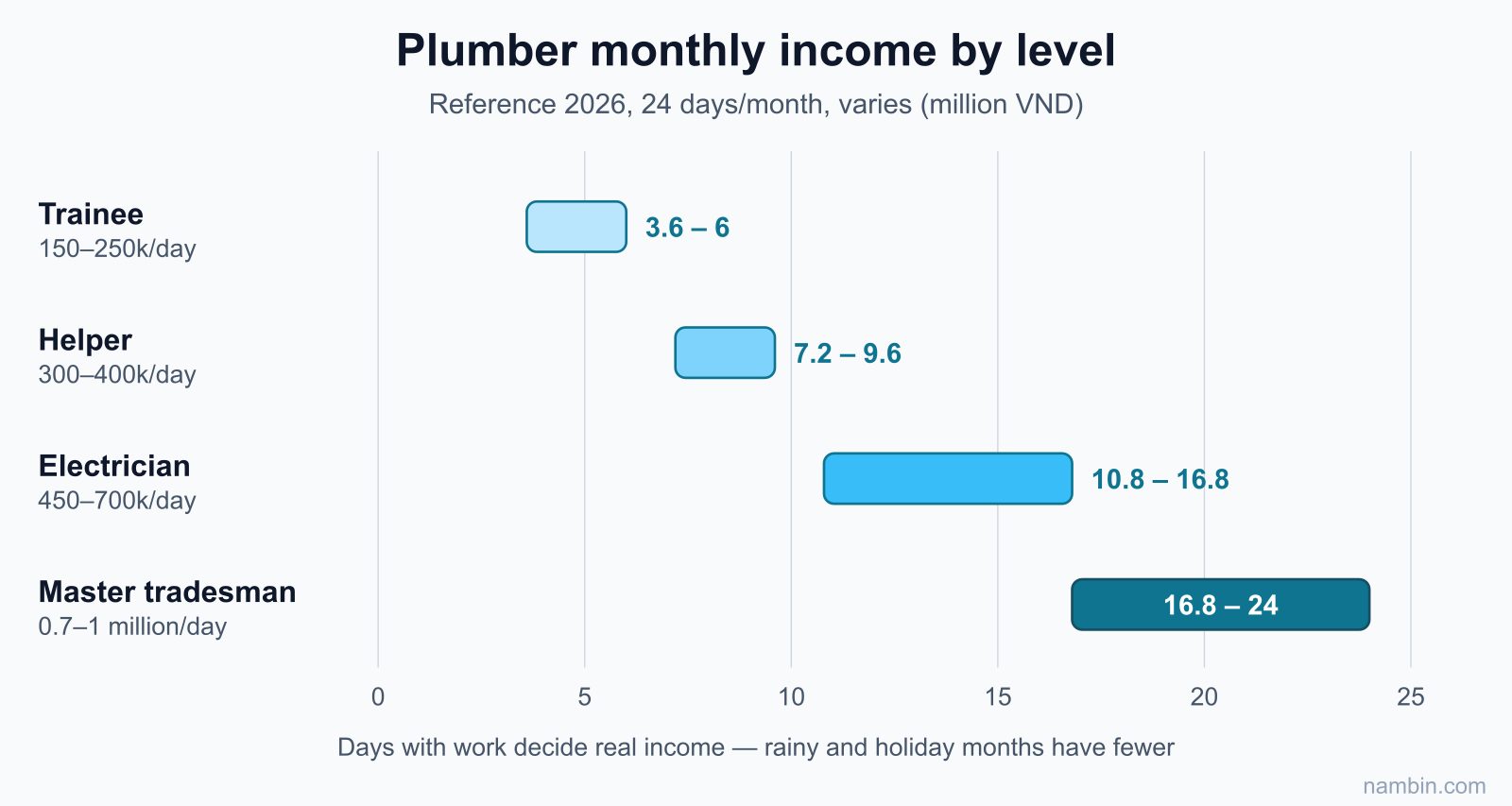
There is no common "pay scale" for plumbers as there is in a company. Most plumbers are paid per day or per job, so monthly income = number of days (or jobs) × price per day (or per job) − costs you pay yourself. The table below shows reference day rates for 2026 in big cities, rounded to 24 working days a month.
Income by skill level
| Level | What they can do | Day rate (VND/day) | 24 days/month (VND) |
|---|---|---|---|
| Apprentice (0–6 months) | Carrying, cutting pipe, cleaning up, fetching tools | 150,000 – 250,000 | 3,600,000 – 6,000,000 |
| Plumber's mate | PPR welding, solvent-welding uPVC under direction, fitting connectors | 300,000 – 400,000 | 7,200,000 – 9,600,000 |
| Qualified plumber | Running supply and drainage pipes independently, pressure testing, fitting sanitaryware | 450,000 – 700,000 | 10,800,000 – 16,800,000 |
| Master plumber / crew leader | Reading drawings, taking off quantities, assigning work, signing off | 700,000 – 1,000,000 | 16,800,000 – 24,000,000 |
The last column is simple multiplication: for example a qualified plumber at 450,000 × 24 = 10,800,000 VND, or 700,000 × 24 = 16,800,000 VND. In reality many months fall short of 24 days because of rain, waiting for the site to be ready or public holidays, so allow a reserve. See Figure 1 for a quick comparison of the levels.
Regional differences
In Hanoi, Ho Chi Minh City and large industrial zones, day rates usually sit in the upper half of the range; in small towns and rural areas they are typically about 15–30% lower, but so is the cost of living. Areas with many older apartment blocks and long-established tube houses (the narrow terraced houses typical of Vietnamese cities) have more, and steadier, repair work than areas of all-new houses.
Why two plumbers at the same level earn differently
The biggest difference is not welding skill but the number of days with work. Plumbers who get it right first time, keep appointments and quote clearly get called back by customers and contractors. Plumbers who often have to return to fix things, or who "quote one price and charge another", lose customers even if their skills are not bad.
Three ways plumbers earn money: day rate, fixed price and repair services
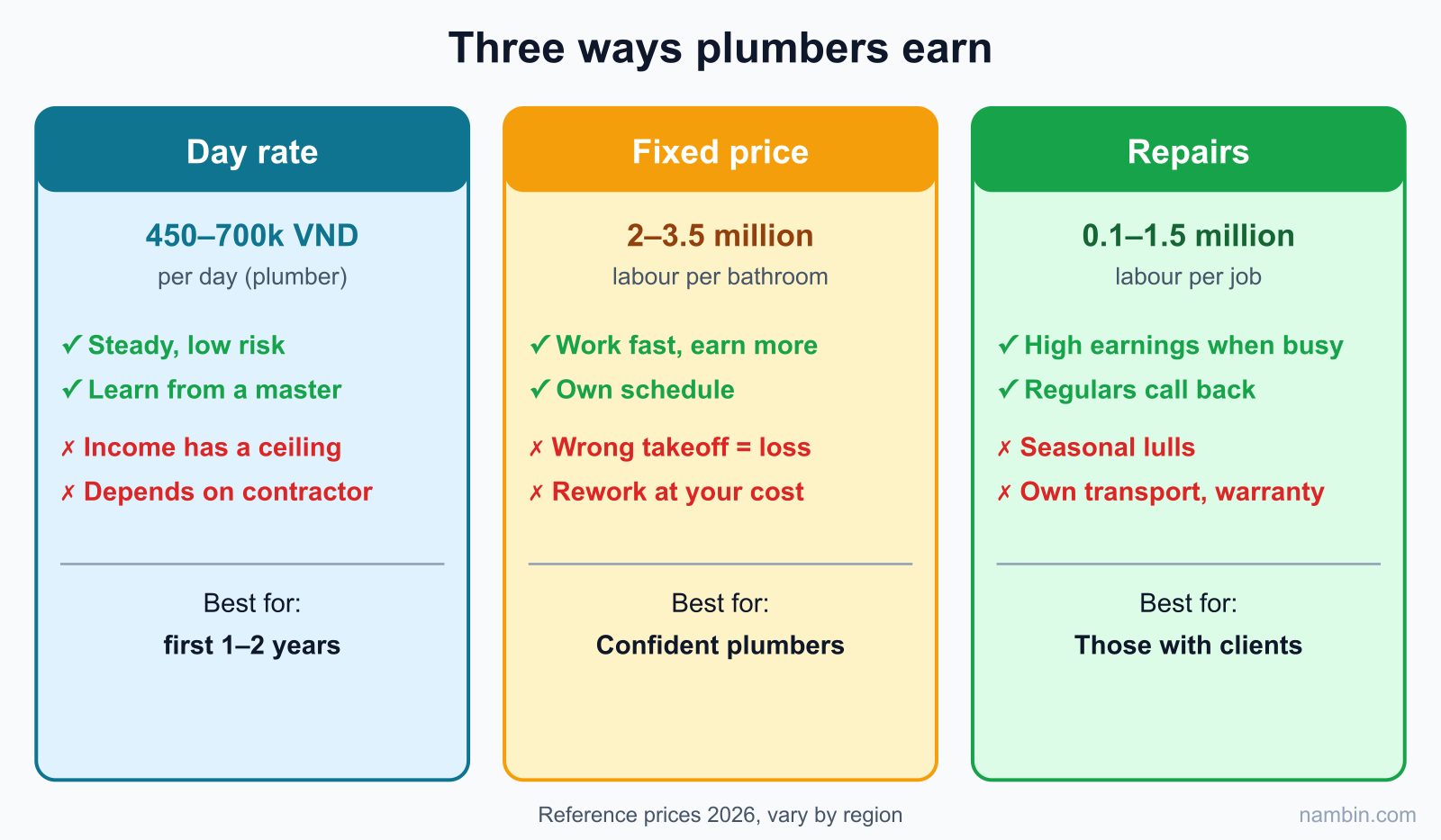
The same plumber may use all three methods within one year. Understanding the pros and cons of each helps you choose the right one for your stage, rather than rushing to go solo before your skills are solid (see Figure 2).
Day rate: steady, suits beginners
You work with a crew building new houses or with a master plumber and are paid per day, usually weekly or twice a month. Advantages: no need to find customers or handle materials, and you learn a lot from experienced people. Disadvantages: income has a ceiling and depends on whether the contractor has work. This is the best route for your first 1–2 years.
Fixed price: profitable if you work fast and right
A homeowner or contractor hands you an entire work package at a fixed price, for example labour for the supply and drainage of one bathroom at 2,000,000–3,500,000 VND, or a price per outlet point (each supply or drain point) of about 150,000–250,000 VND depending on the region. Finish neatly in 2–3 days and you earn more per day than a day rate; misjudge the quantities or have to redo work and you carry the loss.
Repair services: the highest earnings once you have regular customers
Customers call when a tap leaks, a toilet is blocked or a water heater breaks. Each job takes from 30 minutes to half a day, with labour of 100,000–1,500,000 VND depending on the work. You pay for your own vehicle, tools, phone, advertising and warranty call-backs, so revenue is high but you must subtract costs to see your real income. Demand is uneven: the rainy season, Tet (the Lunar New Year holiday) and early summer (water heaters, pumps) are busy; some weeks in mid-year are very quiet.
Quick comparison of the three methods
| Criterion | Day rate | Fixed price | Repair service |
|---|---|---|---|
| Skill needed | Apprentice and up | Qualified plumber | Qualified plumber, good at diagnosis |
| Income risk | Low | Medium | High, seasonal |
| Costs you pay yourself | Few (fuel, personal tools) | Tools, sometimes advancing materials | Vehicle, tools, advertising, warranty |
| Customer communication skills | Little | Moderate | A lot |
Common plumbing repair labour rates in 2026 (reference)
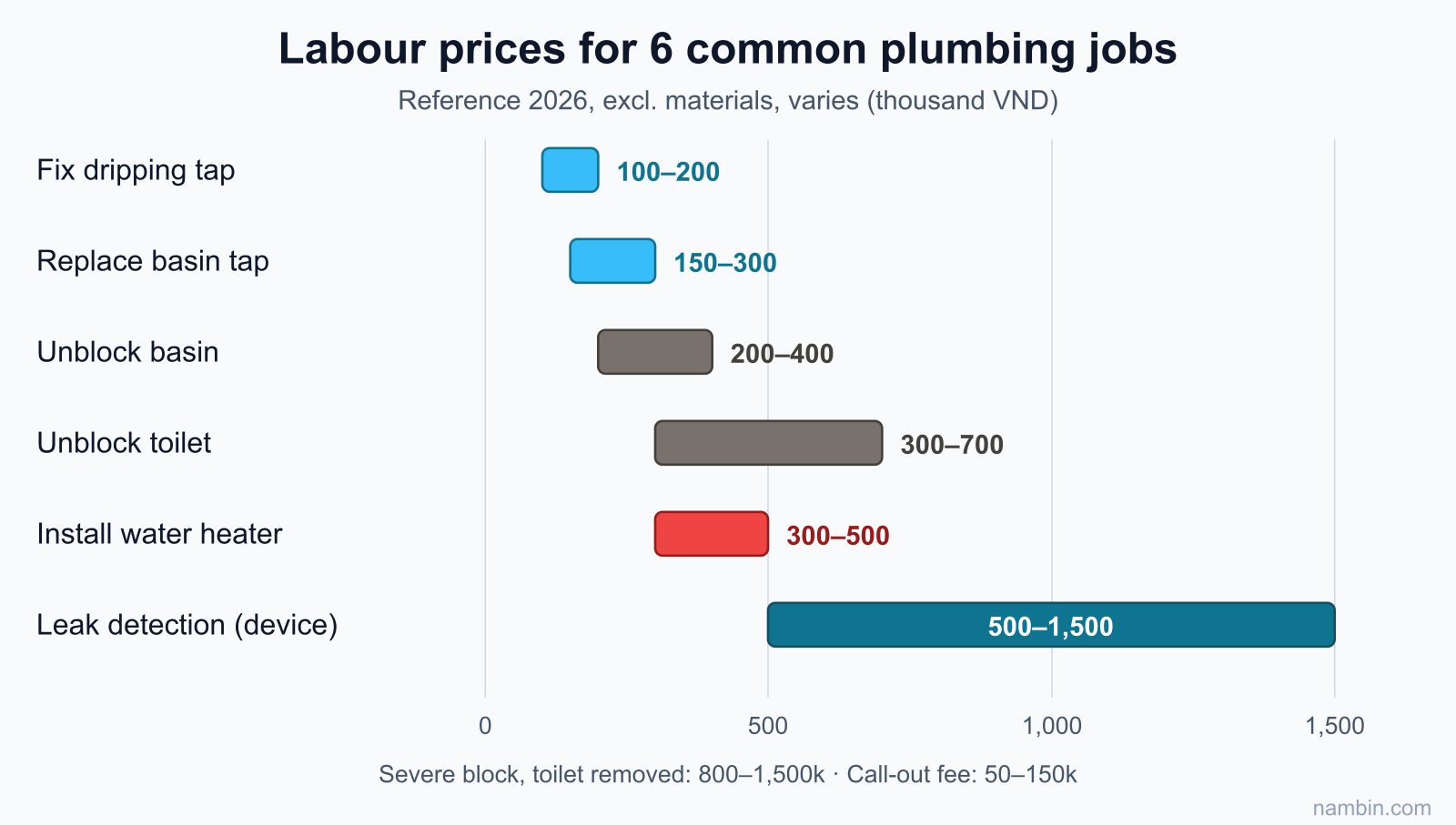
The table below shows labour only, excluding materials and equipment, in big cities in 2026. Actual prices vary with region, floor level, difficulty (concealed in walls, behind plasterboard ceilings), call-out time (night, public holidays) and season. Ask a few plumbers and shops around your area and adjust the figures to match.
| Job | Unit | Labour (VND) | Notes when quoting |
|---|---|---|---|
| Inspection and call-out fee | visit | 50,000 – 150,000 | Usually deducted from labour if the customer goes ahead |
| Fix a dripping tap, replace a tap cartridge | tap | 100,000 – 200,000 | Ask the tap type and a photo of the tap base first |
| Replace a basin or kitchen tap | set | 150,000 – 300,000 | Mixer taps and new supply hoses charged separately |
| Replace a basin or sink trap | set | 100,000 – 200,000 | Check that the wall waste outlet fits |
| Clear a blocked basin or floor drain | point | 200,000 – 400,000 | Manual, hand drain snake |
| Unblock a toilet | unit | 300,000 – 700,000 | Severe blockage, toilet must be removed: 800,000 – 1,500,000 |
| Replace a cistern flush valve or fill valve | set | 200,000 – 350,000 | Ask the toilet model to buy the right kit |
| Install a storage water heater (plumbing side) | unit | 300,000 – 500,000 | Wiring and breaker quoted separately by an electrician |
| Remove and replace a water pump | unit | 300,000 – 600,000 | Rooftop pumps and deep tanks cost more |
| Detect a concealed leak in a wall or floor with equipment | visit | 500,000 – 1,500,000 | Excluding breaking out, repair and re-tiling |
| Repair one concealed leak point after detection | point | 300,000 – 800,000 | Re-tiling by a mason or quoted separately |
Small jobs: taps, traps and cistern valves
These jobs take 20–60 minutes, pay little per job but come often. Customers usually do not know the names of the parts, so ask for photos of the tap base, the underside of the basin and the cistern lid before you go, so you bring the right parts and avoid a second trip. Detailed methods are in the lesson fixing a dripping tap and clearing a blocked basin.
Blockages: quote by severity, not one price
A basin blocked by hair and soap is usually quick to clear by removing the trap and using a drain snake. A toilet blocked by paper, wet wipes or children's toys is hard to predict: some jobs take 15 minutes, others require lifting the toilet off the floor. So when a customer asks "how much to unblock a toilet?", quote a range (for example 300,000–700,000 VND) and make it clear that if the toilet has to be removed you will quote again before doing it.
Water heaters, pumps and leak detection
These three jobs cost more because they involve pressure, heat and electricity. Water heaters: you do the plumbing side (safety valve, cold inlet, hot outlet), while the electrical side is done by an electrician — see the lesson installing pumps, rooftop tanks and water heaters. Detecting concealed leaks needs a leak detector, a pressure test gauge and experience in reading damp stains; separate the "detection fee" clearly from the "repair fee" so the customer is not surprised.
Safety on repair jobs: Before removing a water heater or pump, always switch off the circuit breaker, confirm with a voltage tester pen and let the water in the tank cool — water above 50°C can scald within seconds. Never touch electrical equipment while standing in water. Do not use concentrated caustic drain cleaners on toilets, and never mix two chemicals; if the customer has already poured in a chemical before you arrive, wear gloves and goggles and ask exactly what it was before putting any tool in.
Worked example: one month's income of a self-employed plumber
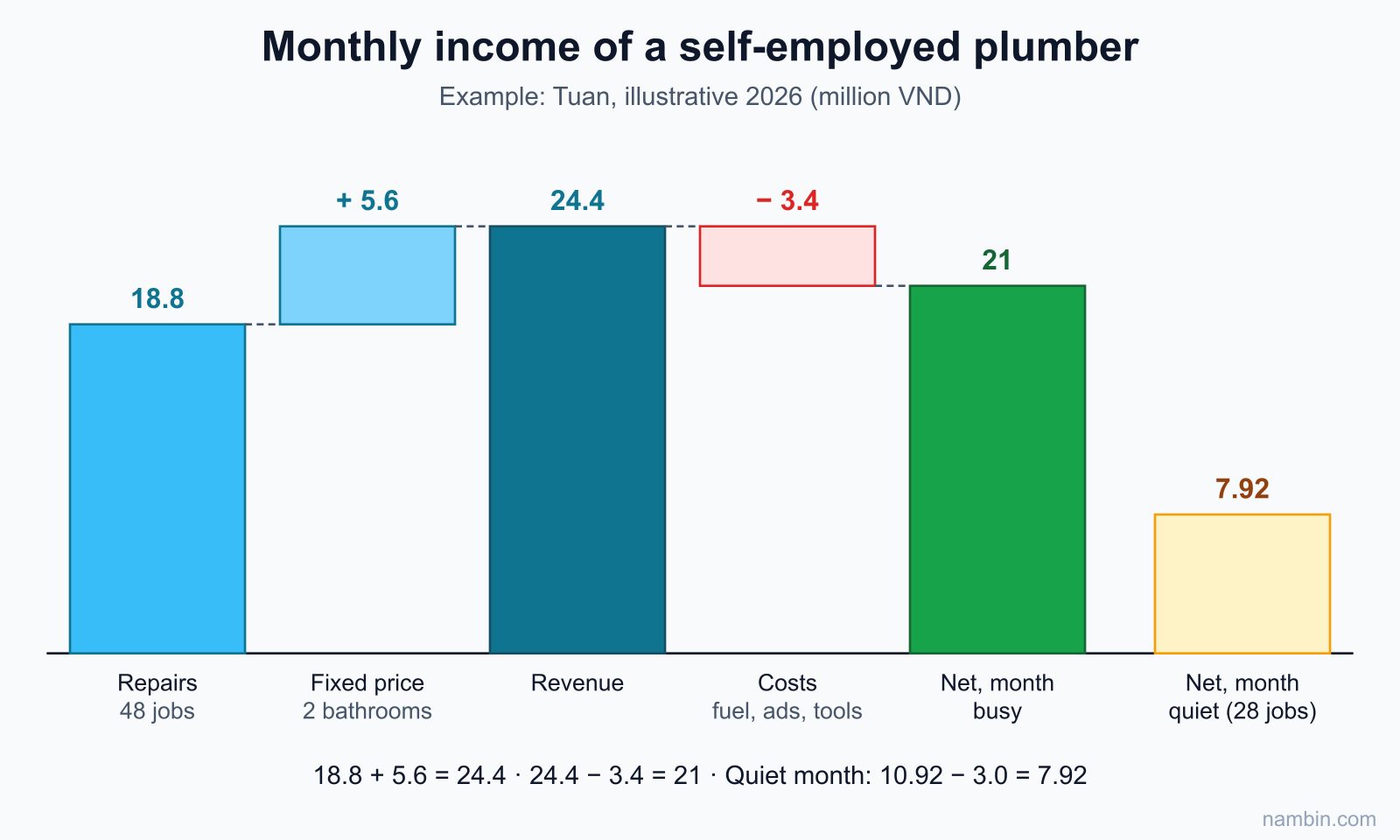
Situation: Tuan, 28, worked for 3 years as a qualified plumber on a day rate, then went out on his own doing repairs in a suburban district of a big city. In October 2026 he worked 22 days: 16 days on repairs (an average of 3 jobs a day) and 6 days on fixed-price work for 2 bathrooms, 3 days each.
A busy month
| Item | Calculation | Amount (VND) |
|---|---|---|
| Replacing and fixing taps, traps | 20 jobs × 220,000 | 4,400,000 |
| Clearing basins, floor drains, toilets | 16 jobs × 450,000 | 7,200,000 |
| Installing water heaters, replacing pumps | 8 jobs × 450,000 | 3,600,000 |
| Leak detection and leak repair | 4 jobs × 900,000 | 3,600,000 |
| Total repairs (48 jobs) | 4.4 + 7.2 + 3.6 + 3.6 million | 18,800,000 |
| Fixed-price bathroom labour | 2 bathrooms × 2,800,000 | 5,600,000 |
| Labour revenue | 18,800,000 + 5,600,000 | 24,400,000 |
| Fuel | − 1,500,000 | |
| Phone, advertising | − 700,000 | |
| Tool wear (welding machine, drain snake, drill…) | − 800,000 | |
| Consumables not charged to customers (PTFE tape, glue, silicone) | − 400,000 | |
| Net income | 24,400,000 − 3,400,000 | 21,000,000 |
Check: 20 + 16 + 8 + 4 = 48 jobs; costs 1,500,000 + 700,000 + 800,000 + 400,000 = 3,400,000 VND. Average labour per repair job is 18,800,000 ÷ 48 ≈ 392,000 VND. Figure 4 shows this calculation visually.
A quiet month
The next month Tuan had only 28 repair jobs and no fixed-price work. At an average labour of about 390,000 VND a job: 28 × 390,000 = 10,920,000 VND. Less driving means fuel drops to 1,100,000; the other items stay the same, for total costs of 1,100,000 + 700,000 + 800,000 + 400,000 = 3,000,000 VND. Net income: 10,920,000 − 3,000,000 = 7,920,000 VND — less than a plumber's mate working a full month.
Compared with a day rate
Average over the two months: (21,000,000 + 7,920,000) ÷ 2 = 14,460,000 VND a month. If Tuan had stayed a qualified plumber on 550,000 VND × 24 days = 13,200,000 VND, minus about 800,000 for fuel, he would keep 12,400,000 VND. Going solo earns only about 2 million a month more at first, but grows strongly as regular customers build up. The lesson: before you leave a day-rate job, save at least 2–3 months of living costs and have a few sources of customers lined up.
How to quote for customers when you are new to the trade
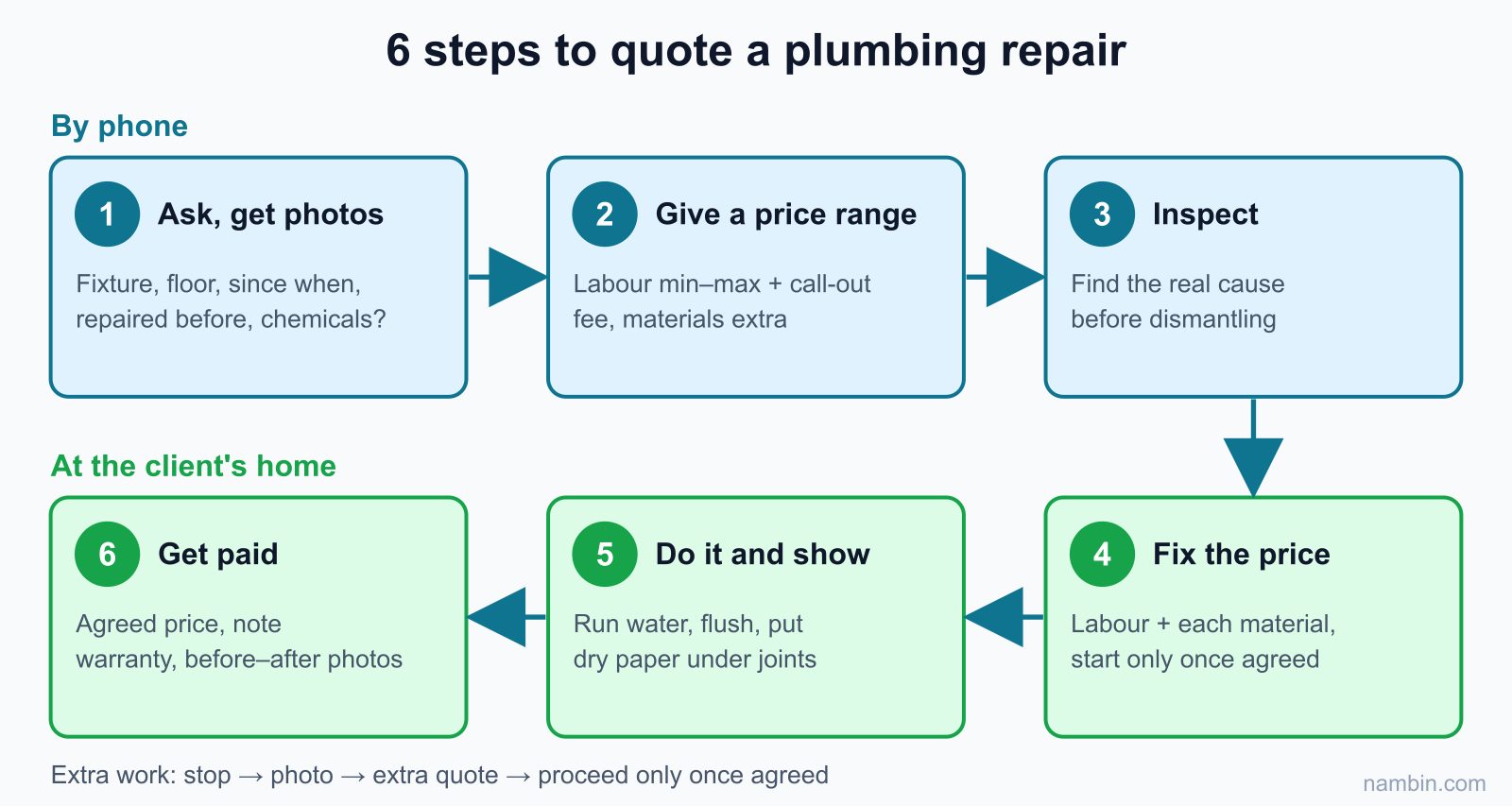
New plumbers lose most money not from lack of work but from quoting badly: quoting low to win the job and then working at a loss, or quoting one price and then demanding more, which upsets the customer. The 6-step process in Figure 5 helps you avoid both.
By phone: ask for photos, give a range
- Ask the customer: what fixture, which floor, since when, has anyone tried to fix it, has any chemical been poured in.
- Ask for 2–3 photos or a short video: the leak, the tap base, the underside of the basin, the water heater label.
- Give a labour price range and the inspection fee, and say clearly that materials are charged separately at shop prices. For example: "Unblocking a toilet is 300 to 700 thousand labour depending on how bad it is. I'll come and look and give you a firm price before starting. The inspection fee is 100 thousand, deducted from the labour if you go ahead."
At the customer's home: agree the price before starting
- Find the real cause first: is the leak at the supply hose or the tap body, is the blockage in the trap or the horizontal pipe?
- Give a firm price covering labour plus each item of material; start only when the customer agrees (verbally in person, and ideally confirmed by text message).
- When finished, show the customer the result: run the water, flush the toilet several times, dry the joints and place paper underneath to check for leaks.
- Collect exactly the quoted price, note the warranty period and take before-and-after photos for your records.
Separate labour and materials, be open about any mark-up
List materials on separate lines and keep the shop receipts in case the customer asks. Customers may buy their own materials, but tell them in advance that you only guarantee your workmanship, not items they bought. For larger jobs such as bathrooms, prepare a full quote by work item as in the lesson technical inspection, quoting and taking jobs for plumbers, or use the quick quote tool.
How to find work and keep regular customers
Plumbers live on repeat customers and referrals. A happy customer will often call you for their whole family, the neighbours and relatives — so every small job is a piece of "advertising".
Sources of work for new plumbers
- Working with a master plumber or construction crew: you get a day rate and also referrals for small repairs the crew does not take.
- Local plumbing and electrical supply shops: leave your phone number; customers buying taps or toilets often ask the shop "is there anyone who can fit this?".
- Zalo and Facebook groups for neighbourhoods and apartment blocks (Zalo is Vietnam's most popular messaging app): post photos of jobs you have done, clear labour prices, and reply quickly.
- A Google Maps business profile: include your phone number, service area and photos of your work; ask past customers to leave reviews.
Keep customers with warranties and punctuality
The common practice is a workmanship warranty of 1–3 months for small repairs and about 12 months for new pipework. State clearly what is not covered (re-blocking from hair or rubbish; materials the customer bought). When a customer reports a problem, arrive within 24–48 hours; if it was your fault, fix it free without argument.
Before-and-after photos and a customer log
For every job take 2 photos before and 2 after. Keep a notebook (or spreadsheet) with the customer's name, address, work done, date, price and warranty end date. Six months later, message past customers to remind them to clean their water tank or flush sediment from the water heater, and you get extra work without spending on advertising.
Is plumbing a good trade? Pros, cons and how to earn more
Advantages
- There is always work: every home has taps, toilets and drains, and they all wear out over time.
- Low start-up costs: a basic repair toolkit (PPR welding machine, drain snake, wrenches, drill, pressure test pump) costs from a few million to around ten million VND depending on the type.
- You can become a competent plumber's mate in 6–12 months of real work, and a qualified plumber in another 1–2 years.
Disadvantages and risks
- Heavy, dirty work: crawling under fixtures, clearing blockages, working on hot rooftops.
- Irregular income if self-employed; illness or injury means lost income — so buy accident insurance and voluntary social insurance.
- A leaking joint behind a wall can mean paying for breaking out and re-tiling, so your workmanship and pressure testing must be reliable.
How to increase your income
Income rises when you sell higher-value work, not when you work more hours: leak detection with equipment, booster pump systems, solar water heaters, whole-house water filters, and complete bathroom supply-and-drainage packages. Learn basic residential electrics so you can work safely with electricians on pump sets and water heaters, and after a few years you can form a crew of 2–3 people.
Common mistakes when quoting and taking jobs
- Giving one fixed price by phone: the symptom is arriving to find a severe blockage, then working at a loss or asking for more. Cause: not having seen the situation. Fix: give only a range by phone and confirm the price after inspecting.
- Lumping labour and materials into one figure: the symptom is the customer suspecting they are being ripped off when they compare tap prices at the shop. Cause: reluctance to itemise. Fix: list each line separately and keep receipts.
- Cutting prices to win customers: the symptom is working a lot but having nothing left at month end. Cause: not counting fuel, tool wear and warranty. Fix: count all costs as in Tuan's example and set a minimum labour charge per job.
- Taking on the electrical side without training: the symptom is wiring breakers, water heater and pump power cables yourself. Cause: wanting to offer a complete package. Fix: partner with an experienced electrician and state clearly who does which part.
Frequently asked questions
How much does a plumber earn per month?
For reference in 2026, varying by region: a plumber's mate about 7–10 million, a qualified plumber on a day rate about 11–17 million, and a master plumber about 17–24 million VND a month with 24 working days. Self-employed repair plumbers vary widely, about 8–25 million depending on the month and the number of regular customers, after costs.
How much does it cost to unblock a toilet?
Reference labour in 2026 is about 300,000–700,000 VND for an ordinary blockage cleared with tools; a severe blockage requiring the toilet to be removed is about 800,000–1,500,000 VND, excluding seals and refitting materials. A careful plumber inspects first and gives a firm price before starting.
Is plumbing a good trade?
Yes, if you can handle manual work, enjoy fixing things and keep your word: demand is steady year-round, start-up costs are low, and income grows with skill. It does not suit you if you need a fixed salary from day one — in that case work on a day rate for a construction crew for 1–2 years first.
How long does it take to learn plumbing well enough to work?
Usually about 6–12 months of real work to become a plumber's mate, and another 1–2 years to run pipework and pressure test independently as a qualified plumber. Following a structured roadmap shortens this because you understand the "why", not just "follow along".
Do I need a certificate to take plumbing repair jobs?
Household customers rarely ask for certificates; they want a plumber who can do the job and stands behind it. Companies and large projects may require a vocational skills certificate; check the current regulations if you want to work for a business.
Practice exercises and self-assessment
Exercises
- Make your own labour price list for 8 jobs from the table above, after asking at least 2 plumbers or shops in your area.
- Calculate net income for a hypothetical month: 36 repair jobs at an average labour of 350,000 VND per job, 1 fixed-price bathroom at 2,500,000 VND, costs of 3,200,000 VND.
- Role-play with a fellow learner: one is a customer calling to say "the toilet is blocked and the water is rising", the other collects all the information, asks for photos and gives a price range within 3 minutes.
- Write a template text message confirming the price, with labour, each material item and the warranty period, to send to a customer after inspection.
Pass / not yet criteria
- Exercise 1 passes when each job has a min–max price range, labour and materials are clearly separated, and there is an inspection fee; not yet if only one overall price is given.
- Exercise 2 passes with the correct result: 36 × 350,000 = 12,600,000; plus 2,500,000 = 15,100,000; minus 3,200,000 leaves 11,900,000 VND.
- Exercise 3 passes when all 5 questions are asked (fixture, floor, since when, already repaired, chemicals poured in) and you clearly say "firm price after inspection".
- Exercise 4 passes when a customer reading the message immediately understands the total, what it includes and the warranty end date.
This lesson belongs to the final step of the roadmap — step 8: Technical inspection, quoting & taking jobs. To review, take the three-part test in the lesson technical inspection, quoting and taking jobs, then grow further with high-value work such as leak detection, booster pumps and complete bathroom packages.
Start learning the plumbing trade today: work through the 8 steps of the Residential Plumber roadmap to build the skills to take on jobs, and use the quick quote tool for your first repair job.