Low water pressure in a house has three groups of causes: blockages at taps and fixtures (aerators, shower heads and filter cartridges full of scale), restrictions in the pipework (valves not fully open, old rusty pipes, undersized pipes, hidden leaks), and a lack of pressure at the source (a rooftop tank set too low, weak mains supply). The right way to boost pressure is to narrow it down and measure first, fix the cheap faults first, and only fit a booster pump when the source really lacks pressure. Many homeowners spend millions of dong on a pump when the real cause is a tap aerator clogged with scale. This lesson shows a plumber how to diagnose in order, with a worked example in a 4-storey tube house that calculates pump head and a quote that adds up.
By the end of this lesson, you will be able to:
- Tell low flow from low pressure, and measure both with a pressure gauge and a marked bucket.
- Narrow the fault down by symptom: one tap, one bathroom, the top floor, the whole house, hot water only, peak hours only.
- Fix the cheap causes first: clean aerators, shower heads and filters, adjust valves, find hidden leaks.
- Compare ways to increase pressure: new pipes, raising the tank, a booster pump, a pump with a pressure tank.
- Work out flow and head to choose a booster pump, and write a quote whose figures add up.
Learning to be a plumber? This lesson belongs to step 6, "Pumps, water tanks and water heaters", of the roadmap. See the 8-step residential plumber roadmap to learn in the right order, from pipe materials to quoting.
Is it low flow or low pressure?
When a client says "the water is weak" it can mean two different things. Flow is how much water comes out per minute (litres per minute). Pressure is the force pushing the water, measured in bar; for water stored in a tank, every 10 m of height difference gives about 1 bar (1 m of water column is about 0.1 bar).
Two kinds of weak water and their signs
- Enough pressure, not enough flow: the jet is strong but thin and a bucket takes a long time to fill. Usually a blockage: aerator, shower head, filter, a valve not fully open.
- Low pressure: the jet droops, the shower runs as a stream rather than a spray, and it gets worse on higher floors. Usually the source: a low tank, weak mains, or undersized pipes when several taps are open.
Measuring flow with a bucket and a stopwatch
Open the tap fully, fill a bucket marked at 5 litres and time it. Flow (litres per minute) = 5 × 60 ÷ seconds. Common reference values: a basin tap about 6 litres per minute (0.1 l/s), a shower about 12 litres per minute (0.2 l/s). A shower that fills 5 litres in 25 seconds gives 12 litres per minute; over 50 seconds (under 6 litres per minute) is clearly weak.
Measuring pressure with a 1/2" gauge
A water pressure gauge with a 1/2" thread screws onto the shower outlet or the outlet of an angle valve. Read the static pressure with all taps closed, then the dynamic pressure while another tap on the same branch is open. Low static pressure means the source lacks pressure; good static pressure that drops sharply in use means undersized pipes or a restriction. Figure 1 shows a gauge fixed on a pipe, the kind worth fitting right after a booster pump for monitoring.
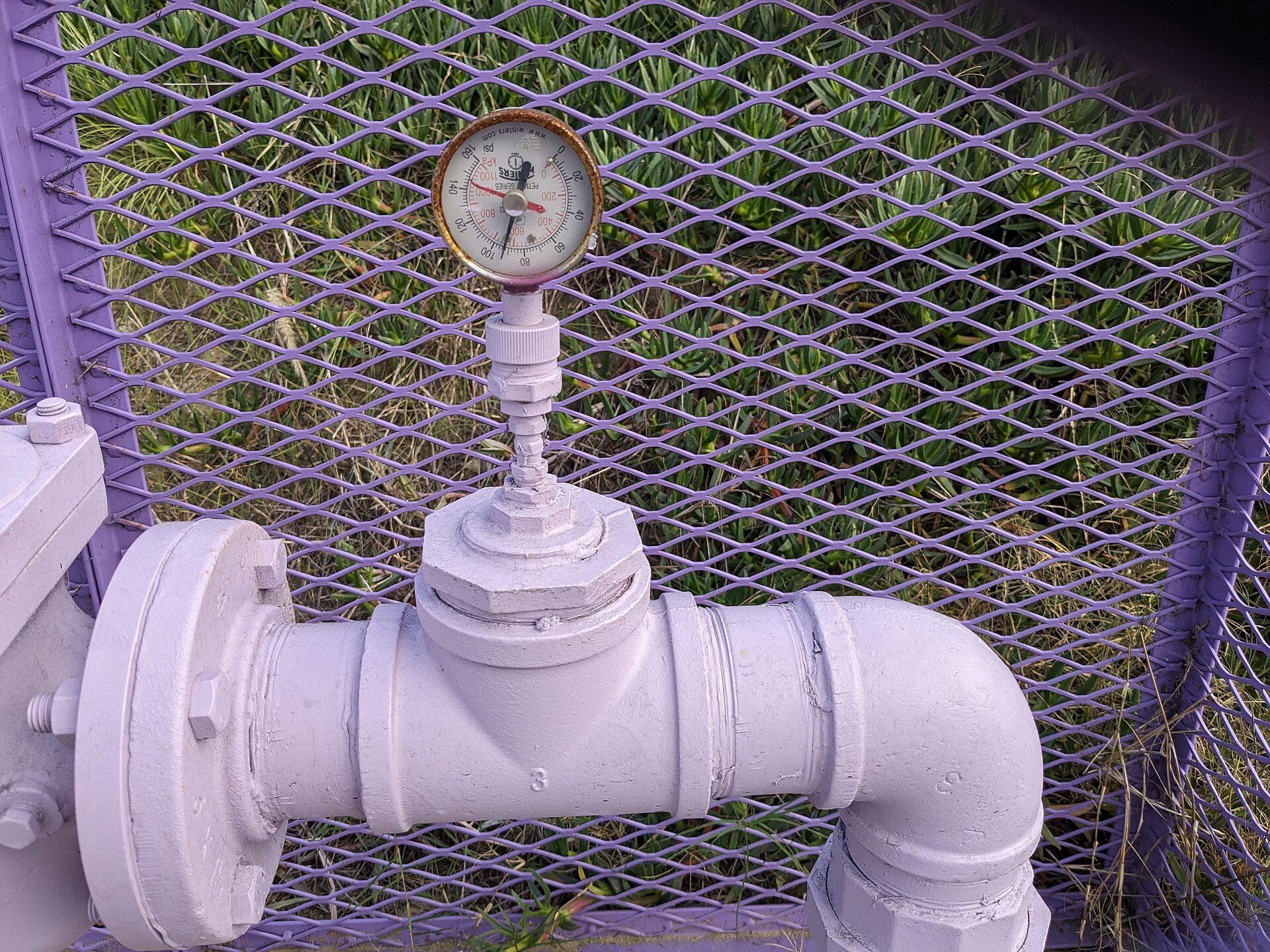
Photo: Mds08011 / Wikimedia Commons, CC BY 4.0
Narrowing down weak water by symptom
Before you take anything apart, ask the client questions and try the taps around the house. Where and when the water is weak points to the cause: the tap, the pipework or the source.
| Symptom | Common causes | First check |
|---|---|---|
| One tap or shower weak, others normal | Scaled aerator or shower head; angle valve not fully open; kinked flexible hose | Remove the aerator or shower head and run the tap without it |
| One whole bathroom weak | Branch valve not fully open or faulty; undersized branch; blocked branch filter | Check the branch valve; measure pressure in that bathroom and the next one |
| Top floor weak, lower floors strong | Rooftop tank too low above the shower head; undersized riser | Measure the height from tank base to shower head; measure static pressure |
| Whole house weak | Main valve not fully open; blocked main filter; old galvanised pipe; empty tank; hidden leak | Check the tank, main valve and main filter; close all taps and watch the water meter |
| Only hot water weak | Scale in the water heater, the inlet check valve; small hot pipe | Compare hot and cold flow at the same tap |
| Weak only at peak hours | Weak local mains; several taps open on small pipes | Measure mains pressure at off-peak and peak times |
Ask the right questions
- Since when: since the house was built, getting weaker over time, or suddenly after a water cut or a repair?
- Is it weak on both hot and cold, or only one?
- Has the water bill risen unusually (a sign of a leak)?
Reading the answers
Weak since the house was built points to a design fault: a low tank or small pipes. Getting weaker over the years points to scale and rust. Suddenly weak after a water cut or a repair usually means debris pushed into an aerator or valve, or air trapped in the pipes.
Causes at taps and fixtures: cheapest, check first
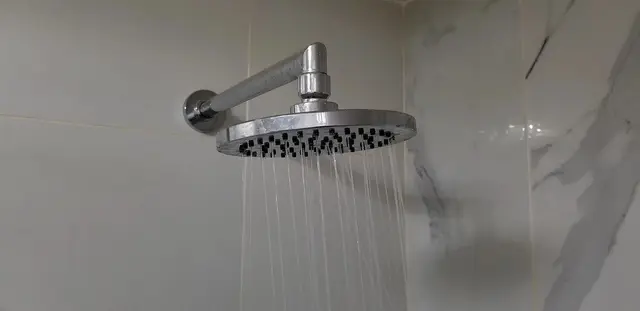
Bore water and mains water in many parts of Vietnam carry a lot of calcium, iron and fine sand. Deposits build up on aerator screens, shower head holes and filter cartridges, cutting the flow while the pressure is still there.
Aerators and shower heads
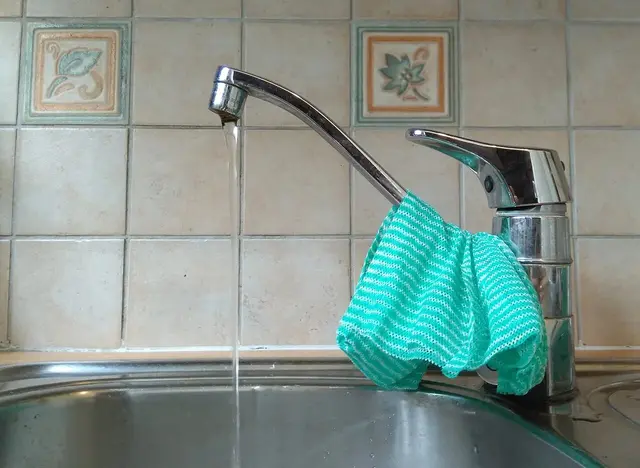
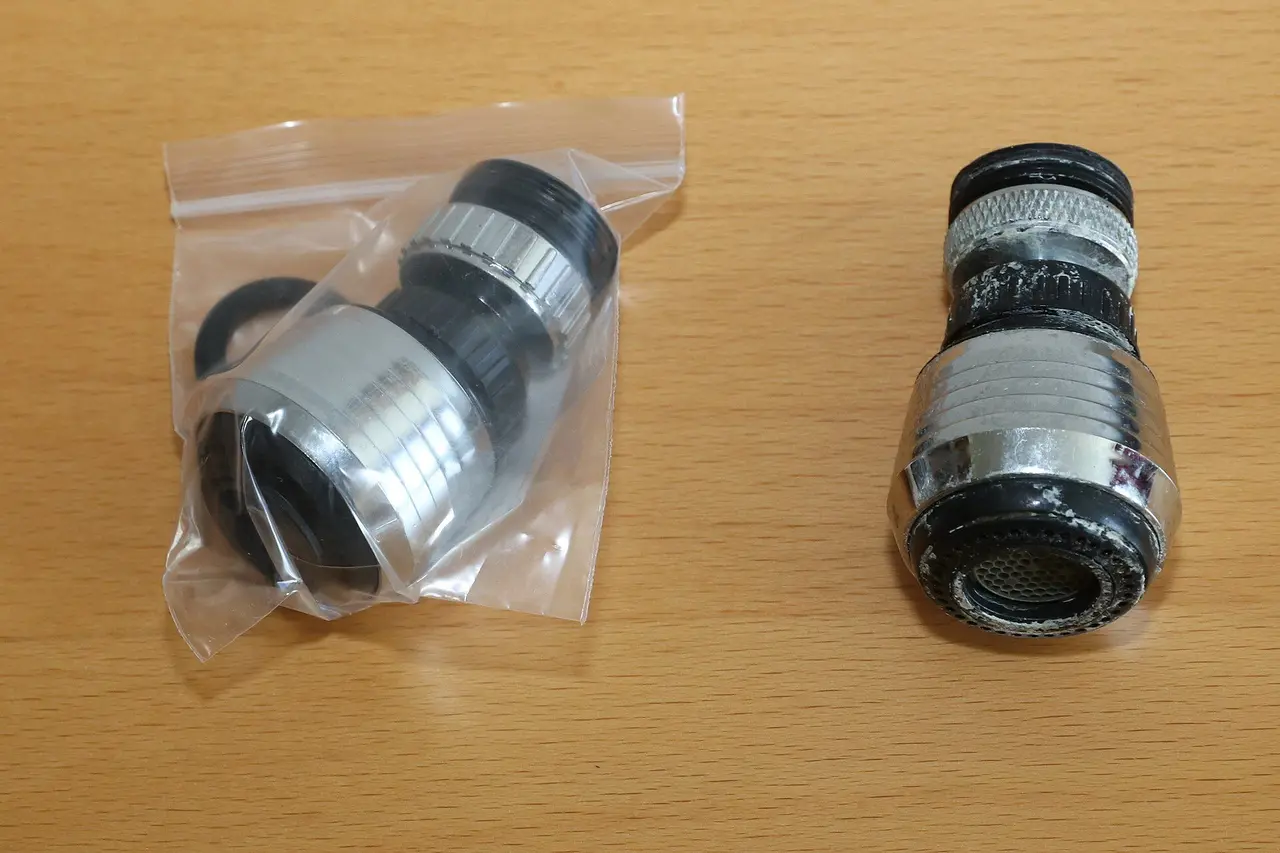
Unscrew the aerator (by hand, or with a spanner padded with cloth so the plating is not scratched) and run the tap without it. If the water comes back strong, the aerator was blocked. Figure 2 shows a worn-out old aerator beside its new replacement. Soak aerators and shower heads in household vinegar or a descaling solution for a few hours, scrub with a soft brush and rinse. Replace aerators that are damaged.
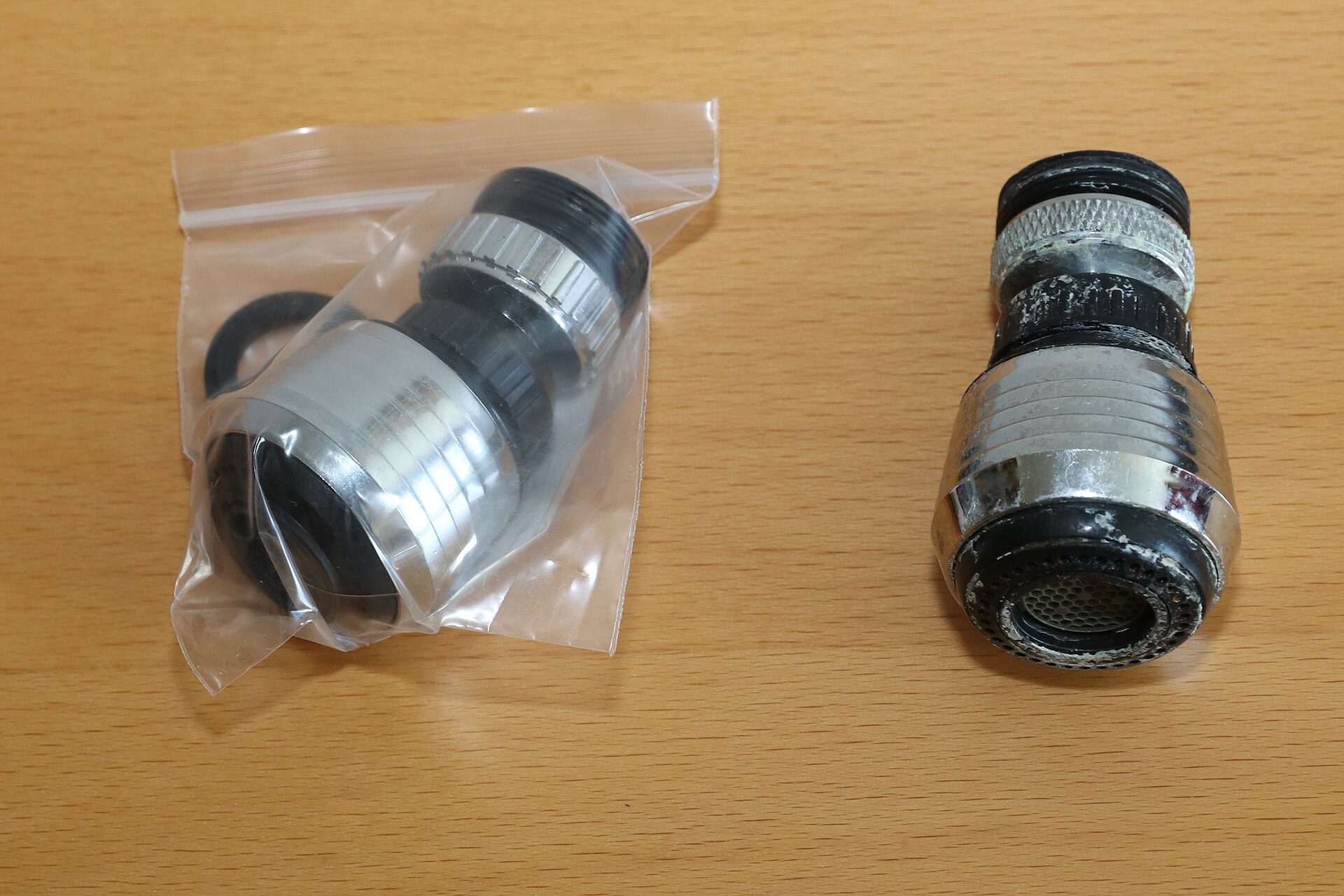
Photo: MKFI / Wikimedia Commons, Public domain
Angle valves, flexible hoses and inlet filters
Angle valves under basins and toilets may not be fully open or may have scale in the cartridge. A flexible hose kinked or twisted when a cabinet is pushed back also chokes the flow. Washing machines, water heaters and sensor taps often have a small inlet screen; turn off the water, take it out and rinse it.
The main filter cartridge
Many houses have a sediment filter housing after the pump or after the water meter. A cartridge that is never changed fills with rust as in Figure 3 and makes the whole house weak. Close the valves before and after the housing, release the pressure and remove the cartridge: rinse mesh cartridges, replace paper or spun cartridges.
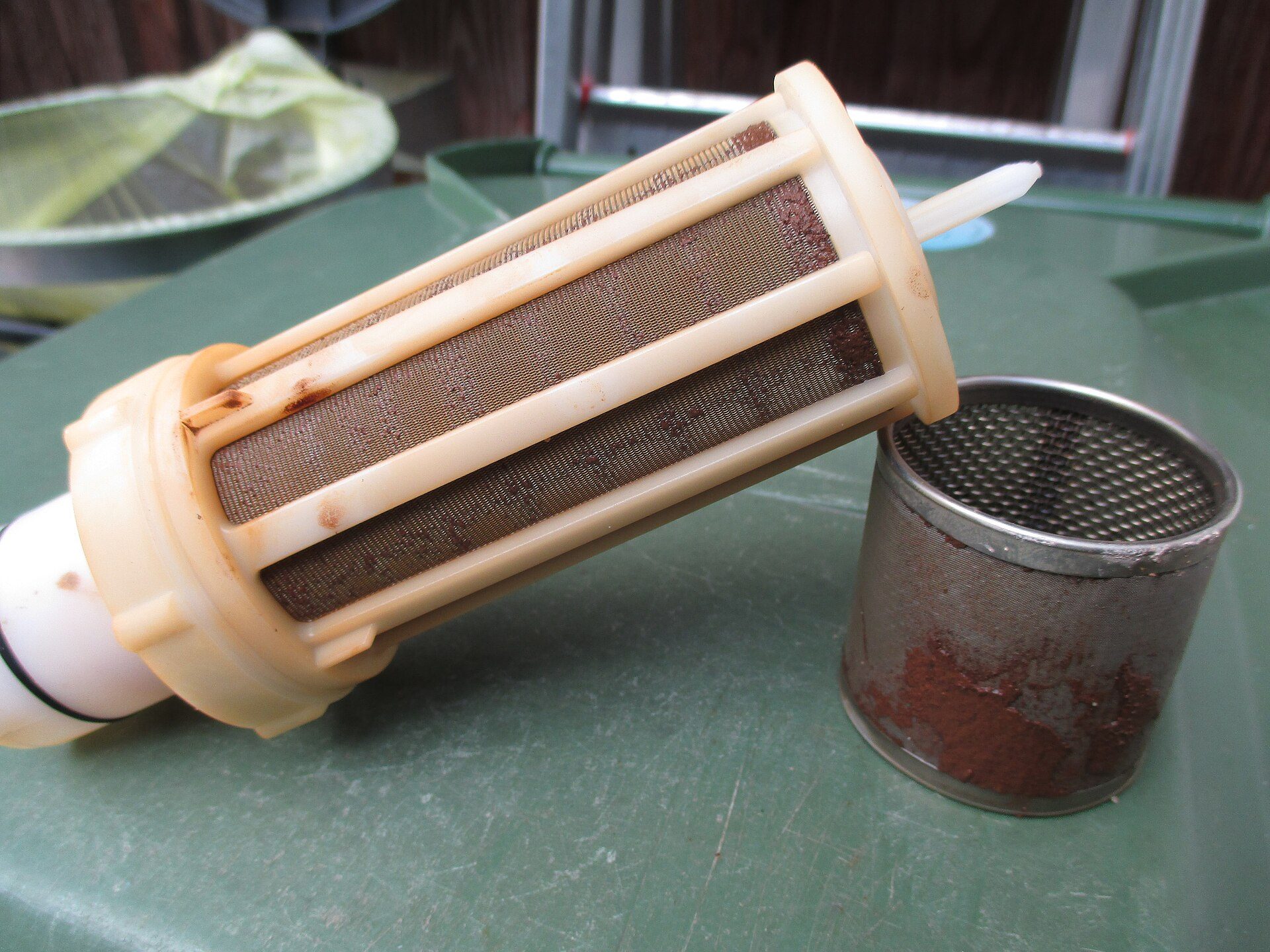
Photo: Hungchaka / Wikimedia Commons, CC BY-SA 4.0
Causes in the pipework: valves, old pipes, small pipes, leaks
If the water is still weak with the aerator removed, and all taps on the same branch are weak, the cause is in the pipework.
Main or branch valves not fully open or faulty
A ball valve (lever valve) is fully open when the lever is parallel to the pipe. With the lever at an angle the ball is only partly open (see how a ball valve is built in Figure 4). Old-style screw-down gate valves can drop their gate or jam with scale: fully open, yet the flow stays small. Replace a faulty valve with one of the same size as the pipe, never smaller.
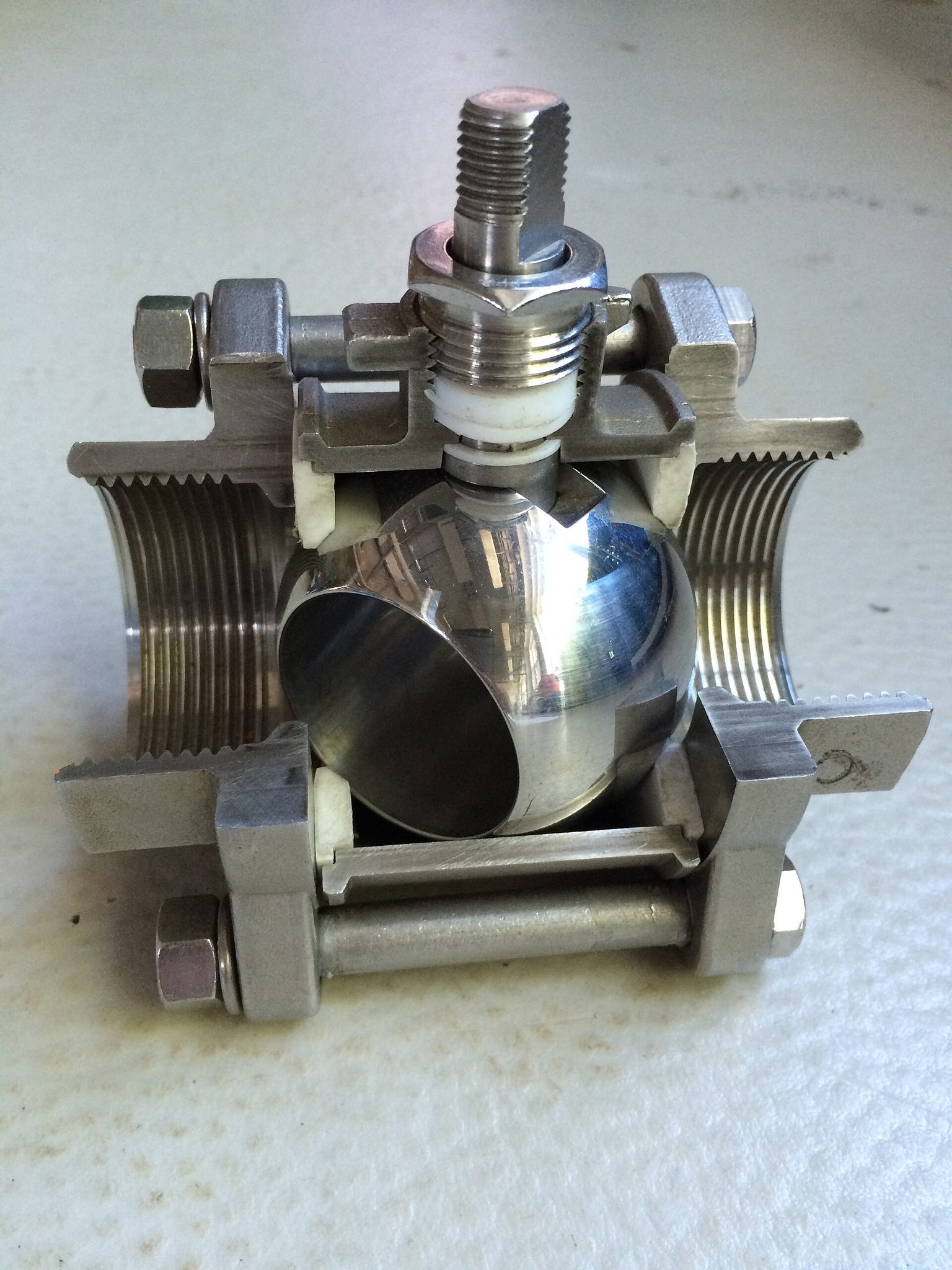
Photo: Bitjungle / Wikimedia Commons, CC BY-SA 4.0
Old galvanised pipes and undersized pipes
Houses built before the 2000s often still have galvanised steel pipes. After a few decades, rust inside the pipe can halve the internal diameter, and the water is often yellow when first turned on. The proper fix is to replace them with PPR. Branch or riser pipes smaller than needed also cause weak water when several taps are open; how to size each run is covered in the lesson pipe size for a 3-storey house.
Hidden leaks and air in the pipes
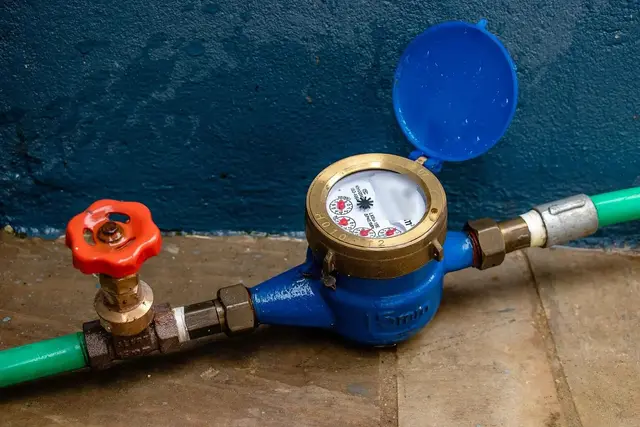
- Hidden leaks: close all taps, note the water meter reading and use no water for 30–60 minutes. If the reading rises, there is a leak. Water leaking out means less reaches the taps, and the pump has to run more.
- Air in the pipes: after a water cut or an empty tank, air collects at high points, the water sputters and surges. Open the taps one by one from the lowest floor upwards to let the air out.
Causes at the source: a low tank and weak mains
When taps are clean, pipes are the right size and valves are fully open but static pressure is still low, the source does not provide enough pressure. Only now is it time to think about boosting.
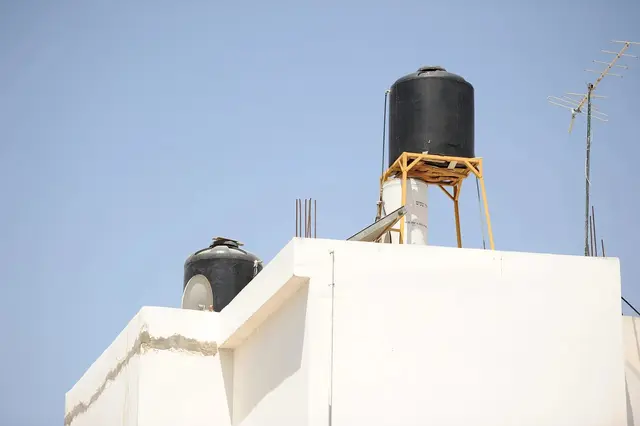
Rooftop tank too low above the top floor
The static pressure at a tap is roughly the height from the water level in the tank to that tap. A tank on the roof terrace whose base is only 2–3 m above the top-floor shower head gives that shower only 0.2–0.3 bar. A shower feels strong at about 1–1.5 bar, so the top floor of a house fed by a rooftop tank is almost always weak without a pump.
Weak mains and a tank that does not fill
A house fed directly from the mains (no tank, no pump) depends on the local network pressure, which can be very weak at peak times. Do not pump directly from the mains pipe: many water utilities forbid it because it drops pressure for the whole area and can draw dirty water back into the network. The correct way is to let mains water flow into an underground or storage tank and pump from there. Check the rules of the water utility where you work.
Ways to boost water pressure and when to use them
These are ordered from cheapest to most expensive. Only move to the next one if the previous one does not solve the problem.
| Method | Effect | 2026 reference cost in Vietnam | Suitable when |
|---|---|---|---|
| Clean or replace aerators, shower heads, filters | Recovers lost flow | 50,000–300,000 VND | One tap or the whole house slowly weakened by scale |
| Adjust or replace valves | Clears the water path | 100,000–500,000 VND per valve incl. labour | Valve not fully open, dropped gate |
| Replace old pipes, upsize pipes | Reduces losses, does not raise static pressure | A few million to tens of millions of VND | Rusty galvanised pipe, undersized pipe |
| Raise the tank on a taller stand | About 0.1 bar per extra metre | 2–6 million VND depending on the stand | The roof can carry it and 0.2–0.4 bar more is enough |
| Booster pump after the rooftop tank | Brings pressure to 1.5–2.5 bar | 2–5 million VND installed | Top floor or whole house lacks pressure |
| Pump with a pressure tank | Steady pressure, fewer pump starts | 5–12 million VND | Houses with many bathrooms and constant use |
Do "high-pressure" shower heads work?
A "high-pressure" shower head has smaller holes so the jets feel stronger, but the flow is usually lower. It improves the feel when pressure is slightly low, but cannot rescue a shower at 0.2 bar. It is not a substitute for a pump.
How an automatic booster pump works
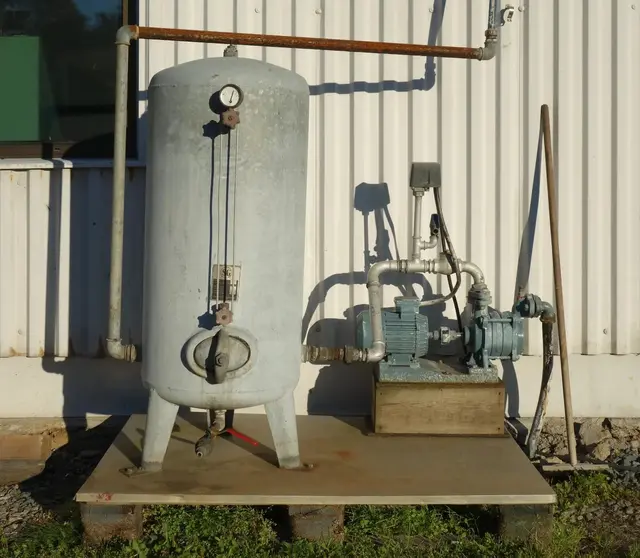
Household booster pumps usually have a pressure switch or a flow sensor: open a tap and the pump starts, close it and the pump stops. Units with a pressure tank, as in Figure 5, hold a reserve of pressurised water, so a small draw does not start the pump straight away; fewer starts means a longer life. Detailed pump, tank and float switch installation is covered in the lesson installing the water pump, rooftop tank and water heater in a townhouse.
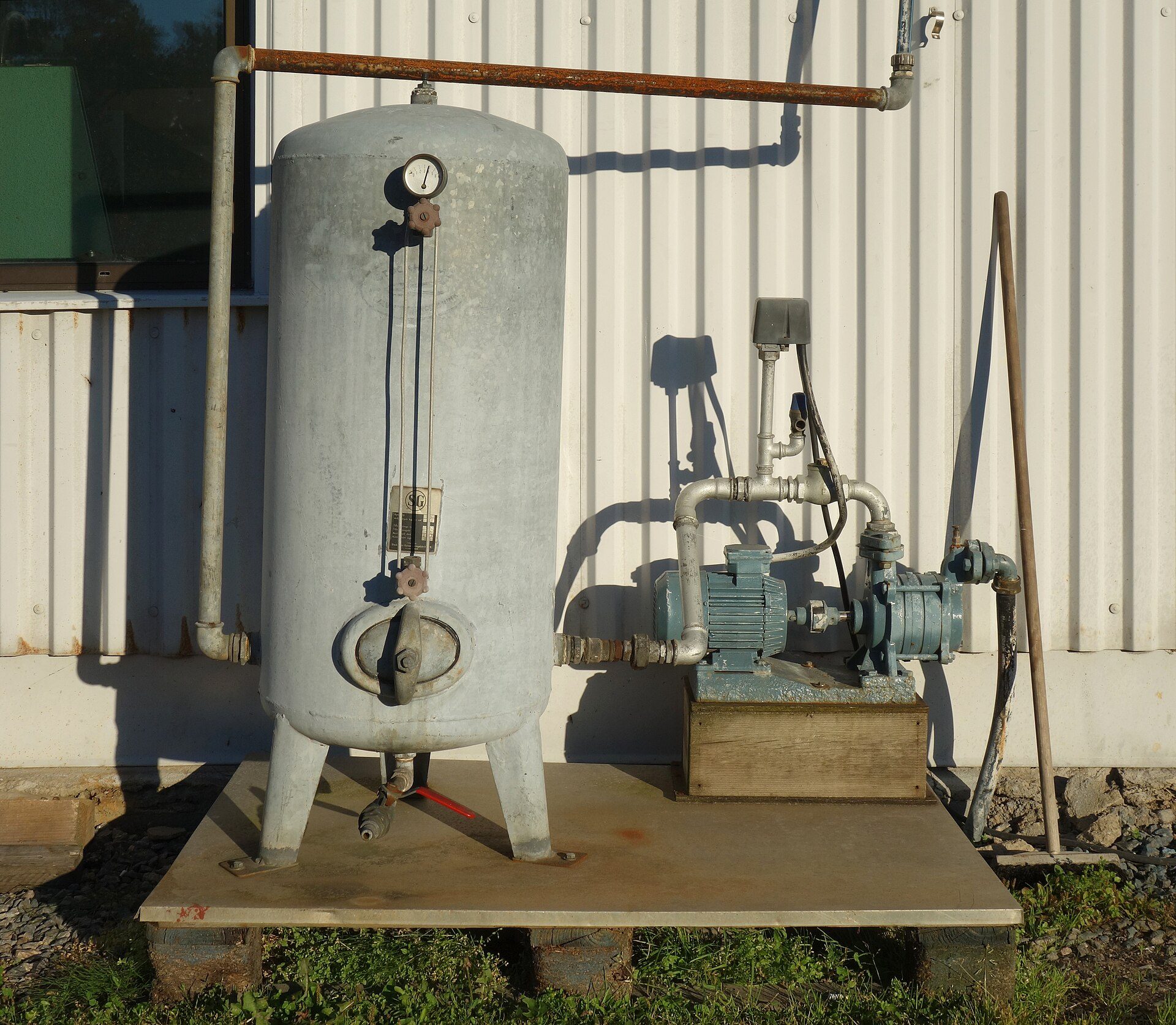
Photo: W.carter / Wikimedia Commons, CC BY-SA 4.0
Choosing a booster pump by flow and head
Choose a pump by two figures on its performance curve (the table or graph in the catalogue): the flow you need and the head you need at that flow. Do not choose by wattage.
Flow required
Add up the flow of the fixtures that are really used at the same time in the area the pump serves. For example, a top floor with 2 showers and 1 basin in use together: 0.2 + 0.2 + 0.1 = 0.5 l/s = 30 litres per minute.
Head required
Extra head from the pump = desired pressure at the tap (in metres) − existing static pressure + pipe losses at that flow. For a shower at 1.5 bar (15 m), with 2.5 m of static pressure and an estimated 2 m of losses: 15 − 2.5 + 2 = 14.5 m. Choose a pump giving at least about 15 m at 30 litres per minute.
Must-haves when installing
- Dry-run protection built in or added; a pump running dry when the tank is empty will ruin its seal.
- A bypass with a check valve in parallel with the pump so water still flows by gravity during a power cut.
- A cut-out pressure no higher than the working pressure of the water heater and other fittings downstream; fit a pressure reducing valve if needed.
- A pump with a pressure switch belongs on a closed line after the tank, never for filling an open tank (it would run forever).
Safety warning: A pump is an electrical appliance next to water. Switch off the breaker before working on it; the pump must have an earth wire and its own 30 mA RCD, and sit under a cover; leave the electrical connection to an electrician. On a roof terrace or tank platform without railings, wear a safety harness. Before opening hot water pipes, switch off the water heater and let the water cool. When using descaling chemicals, wear gloves and goggles, ventilate the area, and never mix them with chlorine-based cleaners.
Worked example: 4-storey tube house with a weak 4th-floor shower
A 4-storey tube house in Hanoi has a 1,500-litre stainless steel tank on a stand on the roof terrace. The owner complains that the 4th-floor shower is very weak, the 3rd-floor shower is a bit weak, and the kitchen tap on the ground floor has also been weak for a few months. The house uses bore water through a filter tank, pumped up to the rooftop tank.
Step 1: narrow it down and fix the cheap faults
- Kitchen tap: remove the aerator and the water comes back strong at once. The aerator is full of yellow scale; soak it in vinegar and fit a new one.
- Floors 3 and 4: the 4th-floor branch valve lever is at about 45 degrees; open it fully. The 3rd-floor shower improves clearly.
- Static pressure at the 4th-floor shower outlet: 0.25 bar. Height from tank base to shower head: about 2.5 m, which matches the reading.
- All taps closed for 60 minutes, water meter unchanged: no hidden leak.
Step 2: size the booster pump for floors 3–4
Floors 3 and 4 have one bathroom each. Fixtures in use together: 2 showers and 1 basin, 0.5 l/s = 30 litres per minute. Target shower pressure 1.5 bar. Head required: 15 − 2.5 + 2 = 14.5 m, so choose an automatic booster pump giving about 15–18 m at 30 litres per minute, with dry-run protection. Install it after the tank's main valve with a bypass, on a separate branch feeding floors 3–4; floors 1–2 stay on gravity.
Step 3: the quote (2026 reference, varies by area and brand)
| Item | Amount |
|---|---|
| Clean aerators, replace the kitchen aerator, adjust the branch valve | 150,000 VND |
| Household automatic booster pump | 2,500,000 VND |
| Fittings: valves, unions, check valve, PPR pipe, pressure gauge | 400,000 VND |
| Cable and a dedicated RCD for the pump | 350,000 VND |
| Labour: pump, bypass, test run | 500,000 VND |
| Total | 3,900,000 VND |
Check: 150,000 + 2,500,000 + 400,000 + 350,000 + 500,000 = 3,900,000 VND (about 150 USD). After installation, measure again: the 4th-floor shower reads about 1.6 bar while running, and still above 1.2 bar with both showers open. Had the owner only bought a "high-pressure" shower head, they would have spent money and the 4th floor would still have only 0.25 bar.
Common mistakes when fixing low water pressure
Fitting a pump before finding the cause
Sign: after the pump goes in, one tap is still weak. Cause: that tap has a blocked aerator or valve, which a pump cannot fix. Prevention: always work in the order tap, pipework, source.
Pump cycling on and off when nobody uses water
Sign: the pump runs for a few seconds, stops, and starts again. Cause: a leak in the house, a running toilet, a leaking check valve, a pressure tank that has lost its air. Fix: close branch valves one at a time to find the leak, replace the check valve, re-pressurise the tank to the maker's figure.
No bypass, so no water in a power cut
Sign: during a power cut the upper floors have no water even with a full tank. Cause: all water has to pass through the pump. Fix: fit a bypass with a check valve in parallel with the pump.
Higher pressure makes old fittings leak
Sign: after the pump is fitted, the toilet fill valve, hoses or old taps start to drip. Cause: old fittings that coped with 0.3 bar cannot take 2 bar. Prevention: inspect and tell the client in advance which fittings need replacing, and set the pressure just high enough.
Frequently asked questions
What should I do about low water pressure at home?
Check in order: remove the aerators and shower heads to look for scale; make sure the main and branch valves are fully open; clean the filter; check that the tank is full. Only if all of these are fine and the static pressure is still low should you consider a booster pump.
Should I fit a booster pump for the whole house?
In a tube house with a rooftop tank, usually only the top floor lacks pressure, so a pump on the top-floor branch is enough. A whole-house pump with a pressure tank suits houses with many bathrooms, rain showers or instant water heaters.
How high should I raise the water tank?
Each extra metre gives about 0.1 bar. For 1 bar at the top-floor shower, the tank base would have to be about 10 m above the shower head, which is rarely possible, so raising the tank only helps partly. The stand must be designed for the weight of a full tank and for storm winds.
Can undersized pipes be replaced without breaking walls?
A new run can go surface-mounted in a service duct or behind trunking. Old galvanised pipes buried in walls are best replaced completely during a renovation.
Practice tasks and self-assessment
- Measure the flow at 3 taps in your house with a 5-litre bucket, record the seconds and work out litres per minute.
- Measure static and dynamic pressure at a shower outlet with a 1/2" gauge.
- Prepare a diagnosis table and a quote for a 3-storey house with a weak 3rd-floor shower, following the worked example.
Self-assessment criteria
- Pass: your flow calculation is correct (5 × 60 ÷ seconds), and you can tell a blockage from a lack of pressure.
- Pass: your diagnosis follows the order tap, pipework, source, and includes a hidden-leak check.
- Pass: the pump is chosen by flow and head, with a bypass, dry-run protection and an RCD; the quote adds up.
- Not yet: recommending a pump before removing aerators or checking valves, or choosing a pump by wattage.
Once you can fix weak water and fit a booster pump, move on to the next roadmap step: Fixing common leaks and blockages, where you learn to find and repair leaks such as running toilets and leaking valves mentioned in this lesson.
Keep learning plumbing: after pumps and tanks come leak repairs, unblocking drains, technical inspection and quoting. See the 8-step residential plumber roadmap.