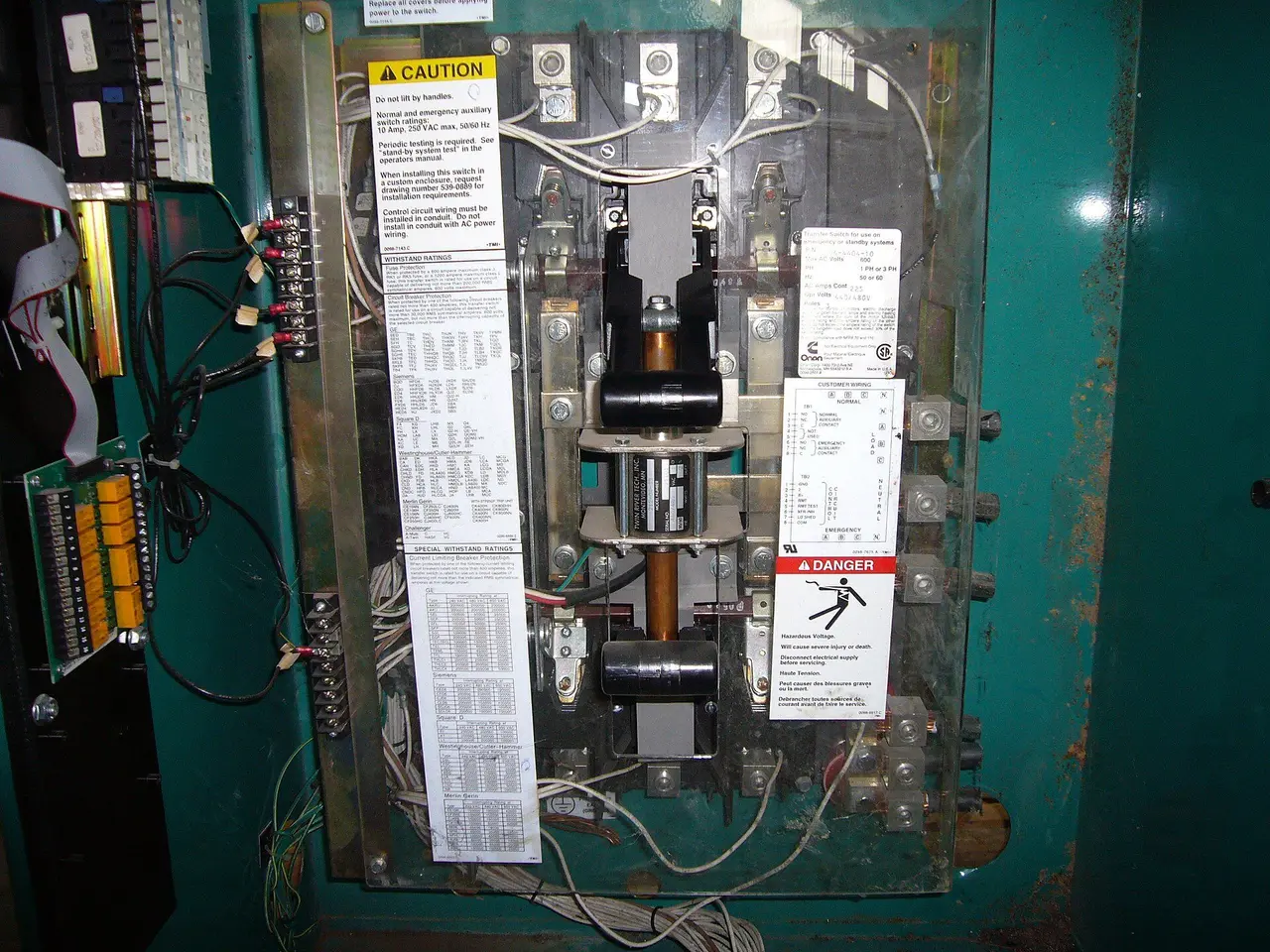
A few hours of power cuts in summer, a whole day without power during a storm or when the power company shuts down a line for maintenance – that is when customers call an electrician to "put in a generator" or "fit a UPS for the computer and cameras". It sounds simple, but done wrong it is one of the most dangerous jobs a residential electrician can take on. A generator wired straight into a socket, or into a distribution board without a changeover device, will backfeed the grid, can kill a utility line worker repairing the line a few hundred metres from the house, and will blow up the generator when grid power comes back. This lesson teaches you to size generators and UPS units, design a changeover circuit with interlocking, wire an ATS correctly, and handle the neutral conductor and earthing for a backup source.
By the end of this lesson, you will be able to:
- Explain why a changeover device is mandatory and what happens when power is backfed into the grid.
- Tell apart manual changeover with a mechanical interlock, the changeover switch and the automatic ATS.
- Size a generator from a list of priority loads, taking motor starting current into account.
- Design a priority load board, wire an ATS, set the time delays and commission it following a procedure.
- Choose between offline, line-interactive and online UPS types, and calculate backup time from battery capacity.
- Handle the neutral conductor correctly during changeover and earth the generator frame.
Why you must never connect a generator straight into the house
When the grid goes down, the house wiring is still connected to the grid through the meter and the service cable. If you feed power from a generator into the house distribution board without disconnecting the grid:
- Backfeed: 230 V from the generator flows back through the meter onto the low-voltage line, and through the distribution transformer it is stepped up to thousands of volts on the medium-voltage side. The utility workers have isolated the line and believe it is safe – but in fact it is live.
- The generator is destroyed when grid power returns: two sources that are not synchronised in phase are connected together, a huge current flows through the generator windings, and it can burn out the windings, shear the shaft and burn the cables.
- A "male-to-male" plug lead (a cable with a plug at both ends, used to plug a generator into a socket) is strictly forbidden: the exposed pins of the free plug are live while the other end is plugged in.
Mandatory rule: A generator may only feed the house installation through a changeover device with interlocking, which ensures that at any moment the load is connected to one source only: either the grid or the generator, never both.
Three ways to change over between sources
| Method | Construction | Advantages | Limitations | Suitable for |
|---|---|---|---|---|
| Manual changeover switch | One lever with 3 positions: Grid – 0 – Generator (I – 0 – II) | Cheap, durable, impossible to connect both sources | Needs someone to operate it, generator started by hand | Town houses, portable generators of 3–8 kW |
| Two MCBs/MCCBs with a mechanical interlock | A mechanical bar between the two breakers: closing one blocks the other | Overcurrent protection for each source | Manual operation; must use the manufacturer's matching interlock kit | Large house distribution boards, shops |
| Automatic ATS | A controller monitors the grid, starts the generator automatically and transfers the load, with electrical and mechanical interlocking | Automatic, short interruption (5–30 s) | More expensive; needs a generator with electric start and a remote start input | Villas, offices, homes with elderly people, home medical equipment |
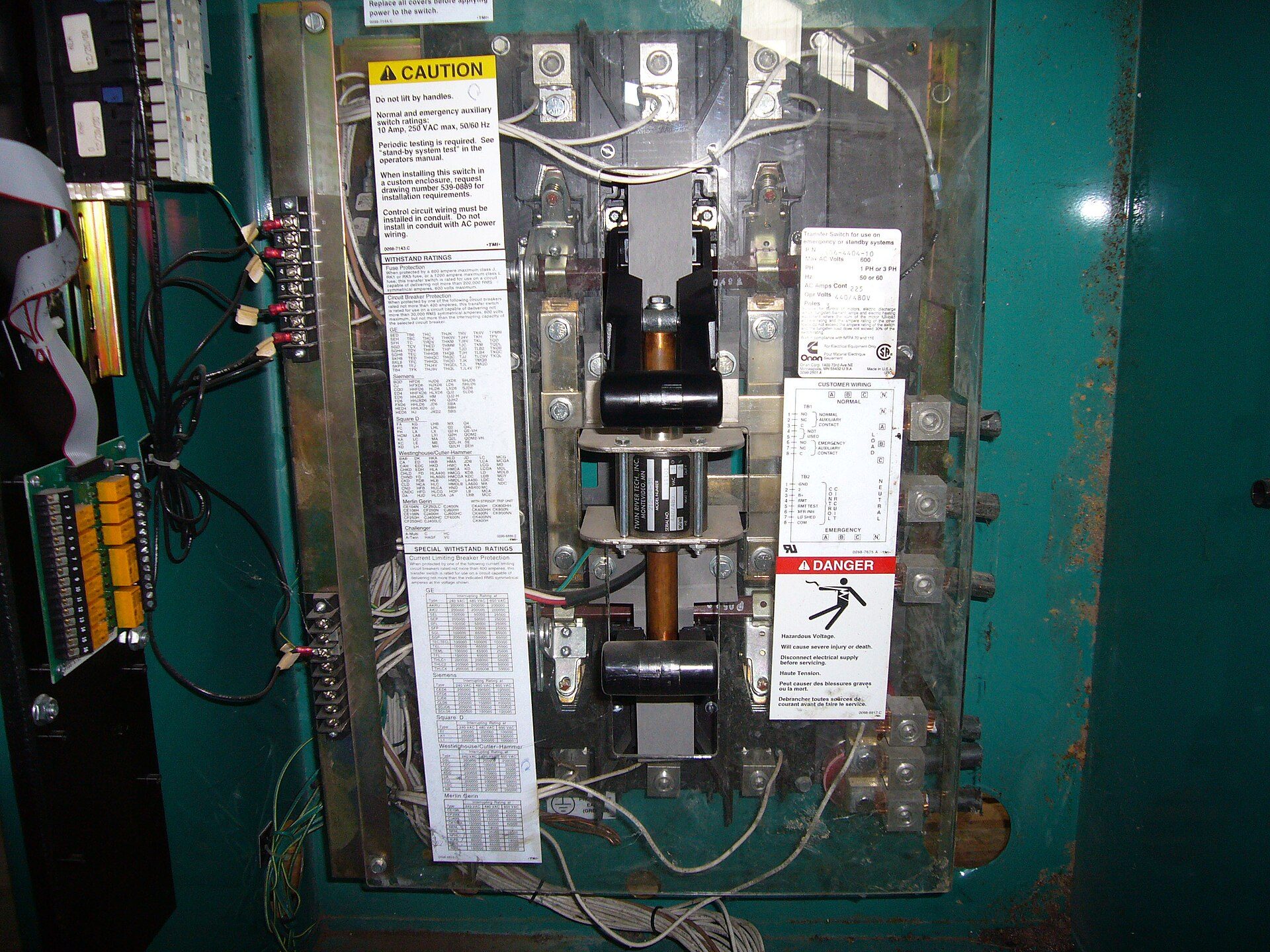
Photo: StcudorPrewoP / Wikimedia Commons, CC BY-SA 3.0

Sizing the generator
A common mistake is choosing a generator for "the total power of the whole house". The right way is to select the priority loads that must run during an outage, then calculate running power and starting power.
- List the priority loads together with the customer: lights, fans, fridge, water pump, router and cameras, 1 bedroom air conditioner, phone charging sockets.
- Running power: add up the electrical power of the loads that may run at the same time.
- Starting power: motor loads (pumps, fridges, non-inverter air-conditioner compressors) draw a starting current 3–6 times their running current. Take the largest motor load × its starting factor + the other loads already running.
- Choose a generator whose continuous rating (continuous/prime, not standby/max) is about 20–25% higher than the running power, and whose peak rating is higher than the starting power.
- Units: generators are rated in kVA; real power in kW ≈ kVA × 0.8 for industrial generators. Small portable units are often rated directly in W.
Example
| Priority load | Running power | Starting factor | Notes |
|---|---|---|---|
| LED lighting for the whole house | 300 W | 1 | |
| 4 fans | 240 W | 1–2 | |
| Fridge | 150 W | 5 | Compressor |
| 0.75 kW water pump | 750 W | 4–5 | Largest motor |
| Router, cameras, recorder | 100 W | 1 | Should have its own UPS |
| 9000 BTU inverter air conditioner | 850 W | ≈ 1.2 | Soft start |
| Total running | ≈ 2.4 kW |
Starting power when the pump starts while the other loads are running: 2.4 kW − 0.75 kW + 0.75 × 5 ≈ 5.4 kW for a few hundred milliseconds. Choose a generator with a continuous rating of about 3–3.5 kW and a peak above 5.5 kW, or use a 5 kVA unit to have some margin. If the customer also wants to run a 2.5 kW water heater, a much bigger generator is needed – advise the customer not to put the water heater on the priority board.
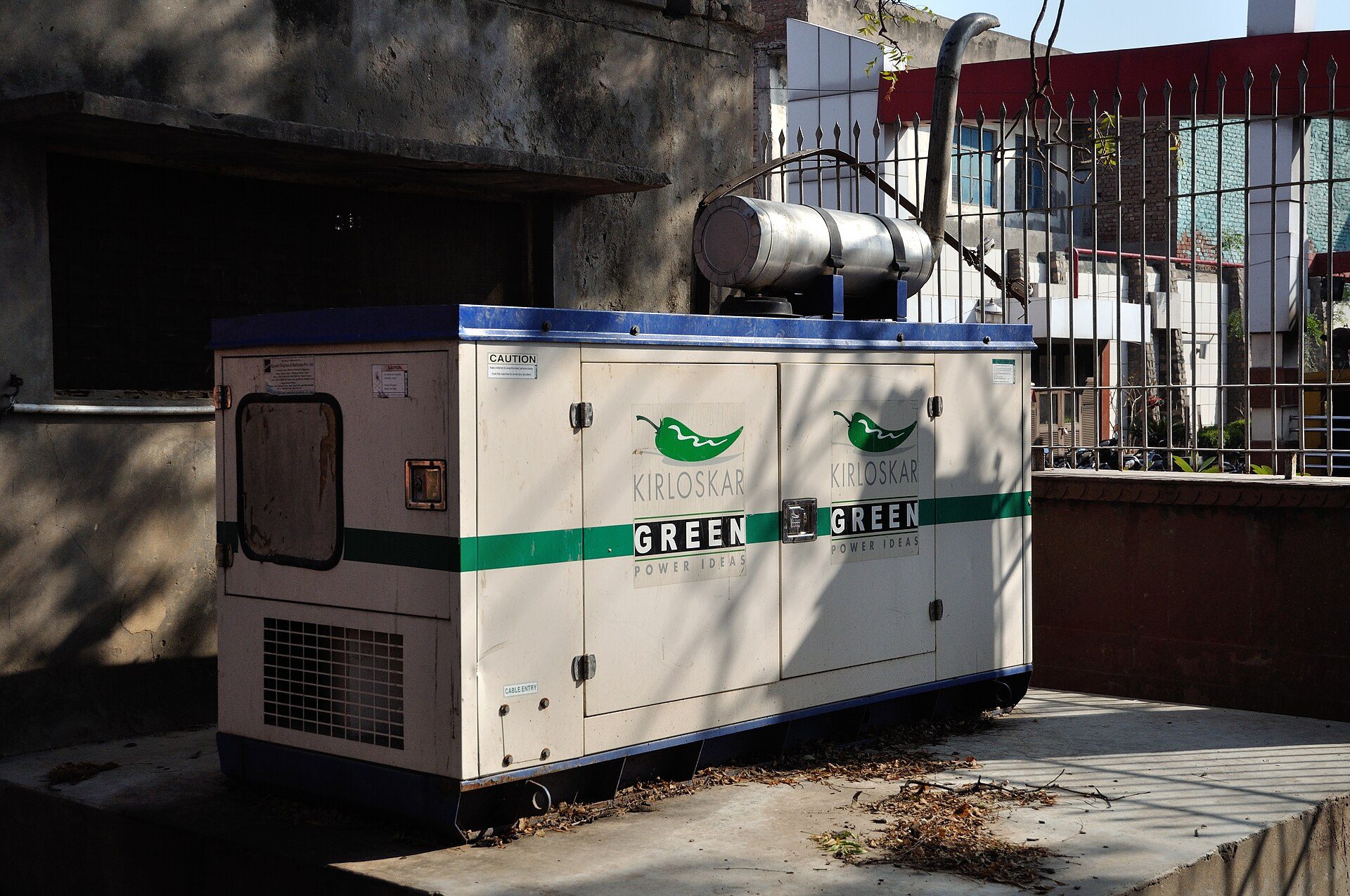
Photo: Biswarup Ganguly / Wikimedia Commons, CC BY 3.0

Designing the priority board and wiring the ATS
For a home, the most practical approach is to move the priority circuits onto a separate priority load board (or a priority busbar inside the board). The ATS (or changeover switch) feeds only this board, so the generator is not overloaded by the water heater, induction hob or air conditioners in other rooms.
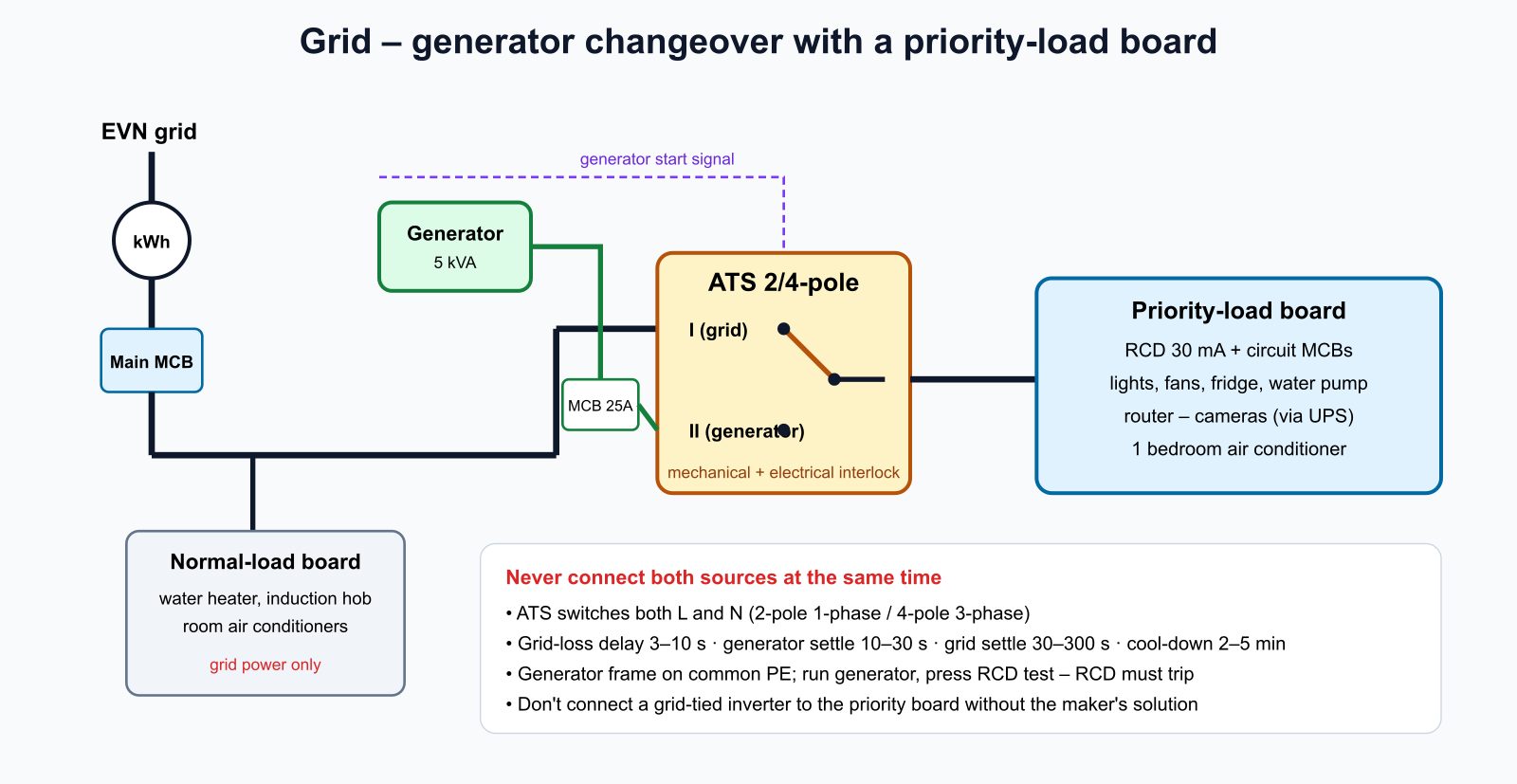
ATS wiring procedure
- Isolate, lock off, tag and re-test for dead – including the generator side (lock the generator key switch, disconnect the starter battery terminal).
- Install the ATS in a dry location close to the main board. Check that the ATS current rating is higher than both the grid-side breaker feeding the priority board and the generator's rated current.
- Connect the grid supply to terminal I (Normal), the generator supply to terminal II (Emergency), and the load to the output. Mark everything clearly – swapping an input with the output is a serious error.
- The generator side has a breaker to protect the cable, sized to the generator's rated current (for example a 5 kVA single-phase generator: ≈ 22 A → 25 A MCB, 4–6 mm² cable depending on length).
- Connect the remote start signal wires (the 2-wire "start contact") from the ATS to the generator controller; connect the controller power supply and the starter battery charger according to the documentation.
- Set the parameters: grid undervoltage/overvoltage thresholds, delay to confirm loss of grid (3–10 s to avoid transferring on flickers), generator start time, wait for the generator to stabilise before transferring the load (10–30 s), wait to confirm the grid has returned (30–300 s), and generator cool-down run after the load is returned to the grid (2–5 minutes).
Neutral and earthing during changeover
- With TN-C-S or TT domestic systems and small generators, use an ATS or changeover switch that is 2-pole (single-phase) or 4-pole (three-phase), switching the neutral too. That way the generator neutral is never paralleled with the grid neutral – avoiding circulating neutral currents and nuisance RCD tripping.
- The generator is treated as a separate source: the generator neutral is earthed according to the manufacturer's instructions (many portable units have a "floating" neutral). When it supplies the house installation through a 2/4-pole switch, a neutral–earth bond must be established for the generator so the RCDs in the house still work when running on the generator. Refer to IEC 60364-5-55 and the manufacturer's instructions; if in doubt, ask a design engineer.
- The generator casing and frame are connected to the common earthing system of the house with a separate PE conductor.
- Mandatory check: while running on the generator, press the test button of the RCD on the priority board – the RCD must trip. If it does not trip, the earthing arrangement on the generator side is not correct.
Commissioning the ATS
- Test the insulation of the new cable runs, check polarity and torque every terminal.
- Put the ATS in Manual mode, run the generator off load, and measure voltage and frequency (230 V ± 10%, 50 Hz ± 1%).
- Switch manually to the generator, add load in steps, and measure current and voltage. Test starting the pump.
- Switch back to Auto mode. Open the grid breaker upstream of the ATS to simulate a power cut: the ATS must start the generator and transfer the load within the set time.
- Close the grid breaker again: the ATS waits for the set time, returns the load to the grid, lets the generator run to cool down and then stops it.
- Record the configuration settings, the measured transfer time, voltage and frequency. Show the customer how to operate it manually if the ATS fails, and give them a monthly generator test schedule.
UPS: backup power for sensitive equipment
A generator with an ATS leaves a 5–30 second gap in supply. For computers, camera recorders, modems and home medical equipment, that gap is enough to lose data or force a reboot. That is the job of a UPS.
| UPS type | Principle | Transfer time | Waveform on battery | Used for |
|---|---|---|---|---|
| Offline (standby) | Normally the load is fed directly from the grid; it switches to the inverter only when the grid fails | 4–10 ms | Usually a simulated (stepped) wave | Office computers, modems |
| Line-interactive | Like offline, with an added automatic voltage regulator (AVR) | 2–4 ms | Simulated or sine depending on the model | Computers, recorders, places with fluctuating voltage |
| Online (double conversion) | Always rectifies AC → DC → inverter → AC | 0 ms | Pure sine wave | Servers, medical equipment, boiler circulation pumps, sensitive equipment |
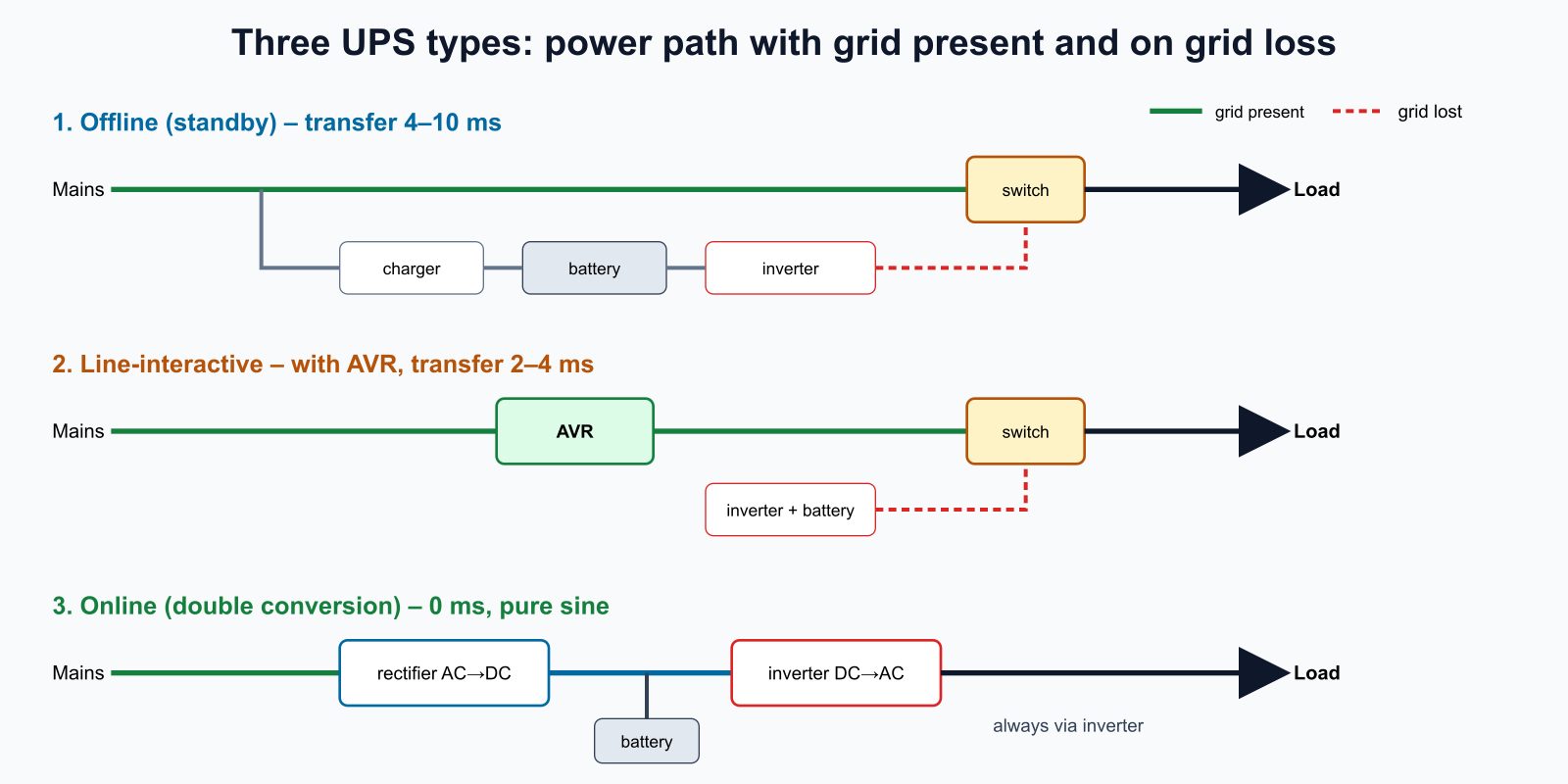
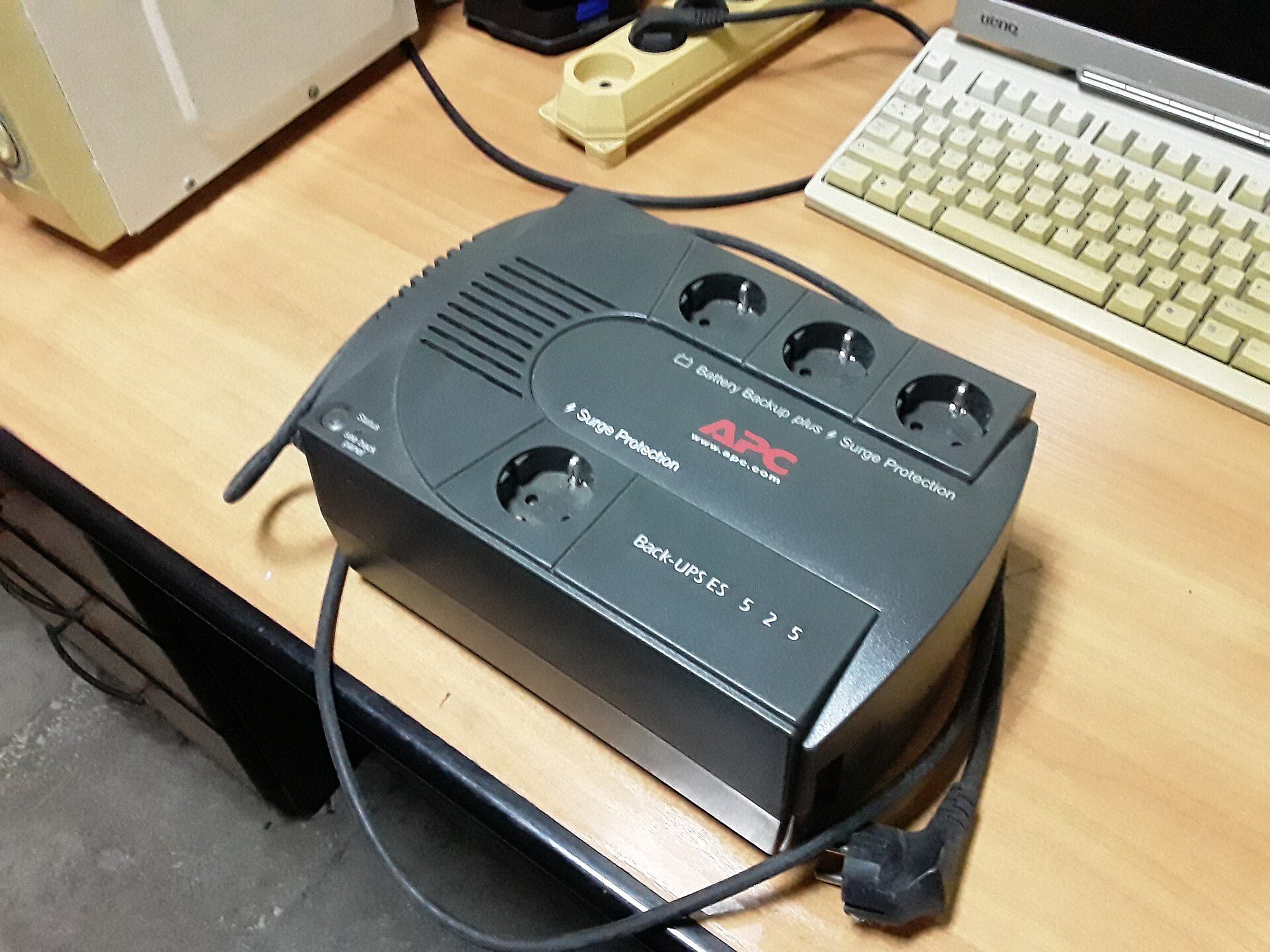
Photo: MSDN.WhiteKnight / Wikimedia Commons, CC0

Choosing the rating and calculating backup time
- UPS units are rated in VA and W. Choose a UPS whose W rating is about 25–30% higher than the total load. For example, a recorder + 4 PoE cameras + switch + modem ≈ 120 W → a 600 VA/360 W UPS is enough.
- Estimated backup time: t (hours) ≈ (battery voltage × capacity in Ah × number of batteries × inverter efficiency of about 0.85 × allowed depth of discharge) / load power. Example: a UPS with one 12 V 9 Ah battery, 80% discharge, 120 W load: (12 × 9 × 0.85 × 0.8) / 120 ≈ 0.61 hours ≈ 35 minutes (less in practice when the battery is old or the discharge current is high).
- For long backup times: choose a UPS with an external battery port (long-run model) and calculate the additional batteries.
- Sealed lead-acid batteries in a UPS usually need replacing after 2–4 years; high room temperatures shorten their life significantly. Show the customer how to do a periodic discharge test.
Installing a UPS safely
- Plug the UPS into an earthed socket on an RCD-protected circuit. A large hard-wired UPS has its own breaker on the input.
- Do not plug laser printers, hair dryers or electric kettles into a UPS – their high peak power overloads it.
- The UPS output is a separate source of supply: when you need to work on a circuit downstream of a hard-wired UPS, switch off the UPS and disconnect the battery – switching off the input breaker alone is not enough.
- Fix labels reading "Circuit supplied by a UPS – still live when the breaker is off" at the board and at the sockets fed by the UPS.
Combining a UPS, a generator and solar power
- UPS for sensitive equipment + generator via ATS for priority loads: the UPS covers the 5–30 second changeover, the generator covers long outages.
- Generator feeding an online UPS: choose a generator rated about 1.5–2 times the UPS rating, because the UPS draws non-sinusoidal current and charges its batteries.
- Houses with a grid-tied inverter: do not connect the grid-tied inverter to a priority board fed by the generator unless the manufacturer provides a coordination solution. A grid-tied inverter can "synchronise" to the generator and push power back into it, damaging it. For hybrid inverters with a dedicated generator port, follow the manufacturer's documentation.
Common mistakes
| Mistake | Consequence | The right way |
|---|---|---|
| Using a lead with plugs on both ends to plug the generator into a socket | Backfeed into the grid, live plug pins, fatal accidents | A changeover switch or an ATS with interlocking |
| Two ordinary breakers without an interlock | Both sources closed together, generator blows up | The manufacturer's mechanical interlock kit, or an I–0–II changeover switch |
| Sizing the generator on running power and forgetting starting current | Generator voltage dips, engine stalls when the pump starts | Calculate the starting power of the largest motor |
| Putting the water heater and induction hob on the priority board | Generator overload | Only essential loads on the priority board |
| Changeover that switches only the phase, not the neutral | Circulating neutral current, nuisance RCD tripping, safety risk | 2-pole (single-phase) or 4-pole (three-phase) ATS/changeover switch |
| Placing the generator in a closed garage | Carbon monoxide (CO) poisoning | Place it outdoors, well ventilated, away from windows |
| Plugging motor loads into an offline UPS | UPS overload; the non-sine wave overheats the motor | A correctly rated online UPS, or no UPS for motors |
Pass criteria for this lesson
- Draw up a priority load table and size a generator for a sample house, including starting power; the result is accepted by the instructor.
- Draw a single-line changeover diagram with a priority board, showing the ratings of the ATS, breakers and cables.
- Wire a changeover switch or ATS on the practice bench, test it in manual and automatic modes, and record the measured transfer time.
- While running on the generator, press the RCD test button and the RCD trips.
- Choose the right UPS type and calculate the backup time for a recorder + cameras + modem cluster.
Frequently asked questions
Does a portable inverter generator need an ATS?
Not if you only plug appliances directly into the sockets on the generator with suitable extension leads. But if you want to feed the house installation (lights, fixed fans, the water pump), it must go through a changeover switch or an ATS.
Can a UPS replace a generator?
Only for small loads and short periods. For several hours of backup for the whole house, a better solution is a hybrid inverter with lithium batteries, or a generator through an ATS.
How often should the generator be test-run?
Run it on load for 15–30 minutes every month, and check the oil, fuel, coolant and starter battery. A generator that is not run regularly tends to fail exactly when it is needed.
Further reading
Review distribution boards and RCDs in the lesson Installing an MCB/RCBO distribution board and earthing and diagnosing tripping breakers in the lesson Diagnosing breakers that keep tripping.