People who are new to electrical work are often afraid of "high voltage" yet take the 220V socket at home lightly. In reality, Vietnam's annual workplace accident statistics show that most fatal electric shocks happen on the low-voltage network: repairing sockets, running temporary wiring, water pumps, and leaking water heaters. The first lesson of Level 1 does not teach you how to wire anything. It teaches you to understand the enemy: how current flows through a person, what makes it larger, and what can stop it.
By the end of this lesson, you will be able to:
- Roughly calculate the current through a person using Ohm's law and explain why 220V is enough to kill.
- Name the dangerous paths current can take through the body and the three factors that decide how severe the injury is: magnitude, path and duration.
- Tell the difference between direct contact, indirect contact, step voltage and arcing, and state the protective measure for each.
- Explain the role of 30 mA residual current devices (RCD, RCBO) and earthing in line with TCVN 7447 (the Vietnamese adoption of IEC 60364).
- Recognise "mild tingle" situations as early warning signs and know how to report and deal with them.
It is current, not voltage, that does the damage
Voltage is like the water pressure in a pipe; current is the amount of water flowing through it. The body is only injured when current flows through it, and current only flows when the body becomes part of a closed circuit: one point touches a live object and another point touches earth or another conductor. A bird sitting on a power line is not shocked because both of its feet are at the same potential, so no current flows through its body.
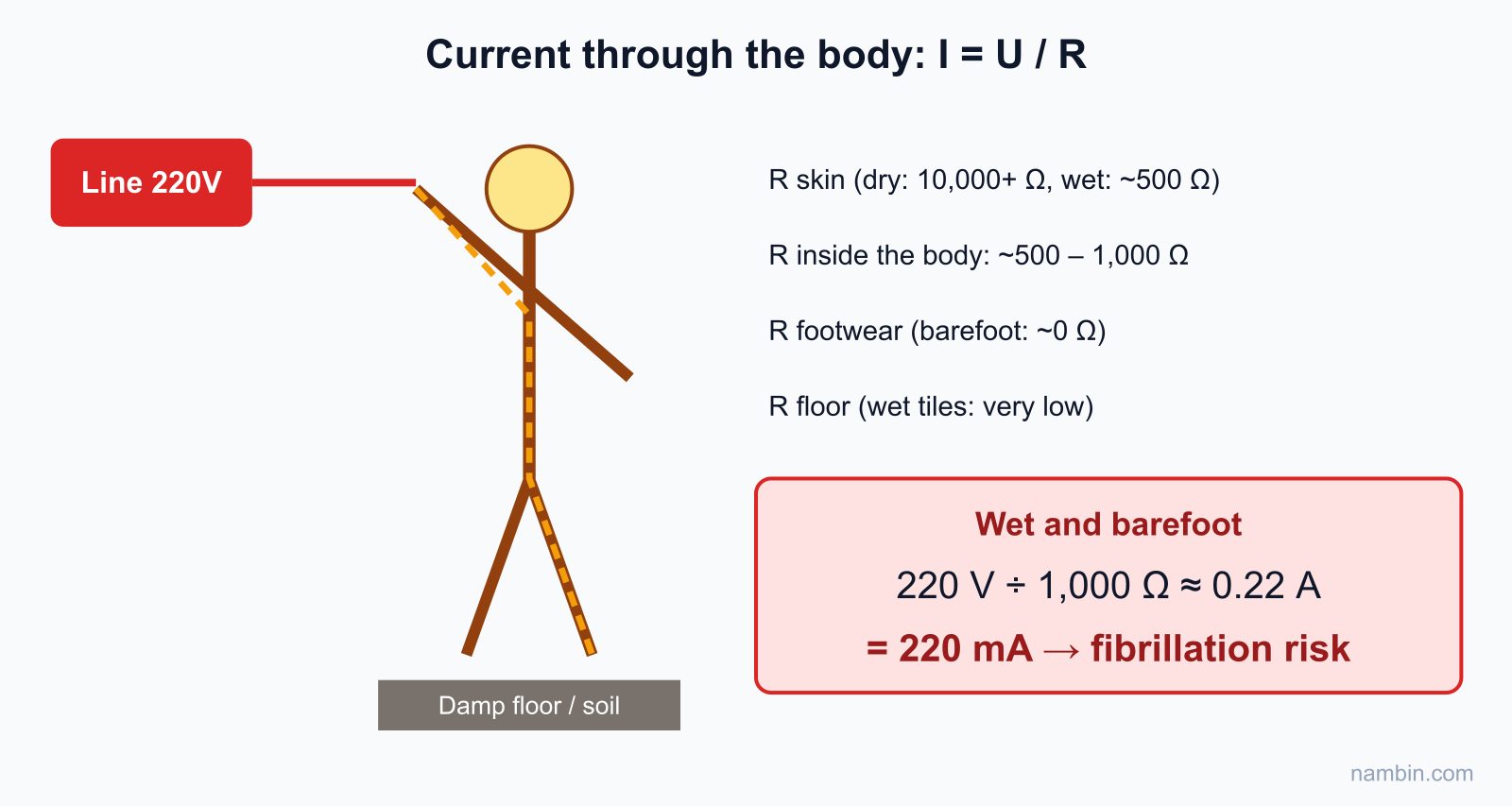
With the 50 Hz alternating current used in homes, the current through a person can be estimated with I = U / R. Here U is the voltage the person is exposed to, and R is the total resistance of the whole path: the contact resistance of the skin, the internal resistance of the body, and the resistance of footwear and the floor. The body's internal resistance is quite low, about 500 to 1,000 ohms, because blood and tissue contain a lot of salty water that conducts well. What really resists current is dry skin and your shoes.
Body resistance varies enormously
Dry, thick, calloused skin on the palm can have a resistance of several tens of thousands of ohms. But when the skin is wet with sweat, scratched, or makes contact over a large area (a whole hand gripped around a metal pipe), resistance drops to about 1,000 ohms. The higher the voltage, the more easily the skin breaks down, which lowers the resistance even further. That is why touching the same socket on a dry day may only make your hand tingle, while after mopping the floor and walking barefoot it can be a fatal accident.
Do one calculation and remember it for the rest of your life: 220V divided by 1,000 ohms equals 0.22A, or 220 mA. That is more than four times the level that can cause ventricular fibrillation. Dry plastic sandals on a dry tiled floor can push the total resistance up to hundreds of thousands of ohms, leaving a current of only a few mA. That is why protective equipment and a dry place to stand matter so much, and it is also why you must never rely on your sandals to work on a live circuit.
Three factors that decide how severe the injury is
Magnitude of the current
The thresholds below are approximate values for 50 Hz alternating current flowing from hand to feet, based on research summarised in the international standard IEC 60479. Every person is different, so treat this as a picture to help you understand, not as a safety limit.
| Current through the body | Typical effect | What it means for the electrician |
|---|---|---|
| 0.5 – 1 mA | Threshold of perception, slight tingling | There is leakage; the cause must be found |
| 5 – 10 mA | Painful shock, can still let go | Risk of being startled and falling off a ladder |
| 10 – 30 mA | Muscle contraction, hard to let go, difficulty breathing | The reason RCDs for personal protection are rated 30 mA |
| 50 – 100 mA | Ventricular fibrillation if it lasts longer than about 1 second | Can be fatal |
| Above 500 mA | Ventricular fibrillation within a very short time, deep burns | Easily reached when the person is wet |
The "let-go" threshold is the most important figure to remember. When the current rises above about 10 mA, the flexor muscles of the forearm contract more strongly than the extensors, so a hand holding a wire will grip even tighter. The victim cannot free themselves, contact time gets longer, and the current keeps rising because the skin heats up and its resistance falls. This is the classic scenario in accidents where someone grabs a bare wire or the body of a drill that is leaking current.
Path of the current
Current flowing from the left hand to the feet, from hand to hand, or from hand to foot passes across the chest, where the heart and the breathing muscles are. A path from one finger to another on the same hand causes severe burns but rarely stops the heart. Experienced electricians always try to work with one hand when they are near anything that might still be live, keeping the other hand off metal cabinet enclosures, water pipes and steel door frames. This habit does not replace isolating the supply, but it reduces the chance of current passing through the heart if something goes wrong.
Duration of contact
For the same current, the longer it lasts, the more dangerous it is. During each heartbeat there is a short, highly sensitive period; if current flows through it, the risk of ventricular fibrillation rises sharply. That is why protective devices must not only trip at small currents but also trip fast. A standard RCD must trip within no more than 300 ms when the leakage current equals its 30 mA rating, and much faster, about 40 ms, when the leakage is five times that.
Four types of electrical accident a helper must recognise
Direct contact
This is when a person touches a conductor that is normally live: the end of a line conductor, a socket terminal, a busbar in a panel. Common reasons: you think you have switched off the breaker but switched off the wrong one, there are two supply sources, someone else switched the power back on, or you tried to work live because you did not want to cut power to the whole house. Main protective measures: isolate, lock, tag and test again (next lesson), good insulation, covering live parts, and a 30 mA RCD as an additional layer of protection.
Indirect contact
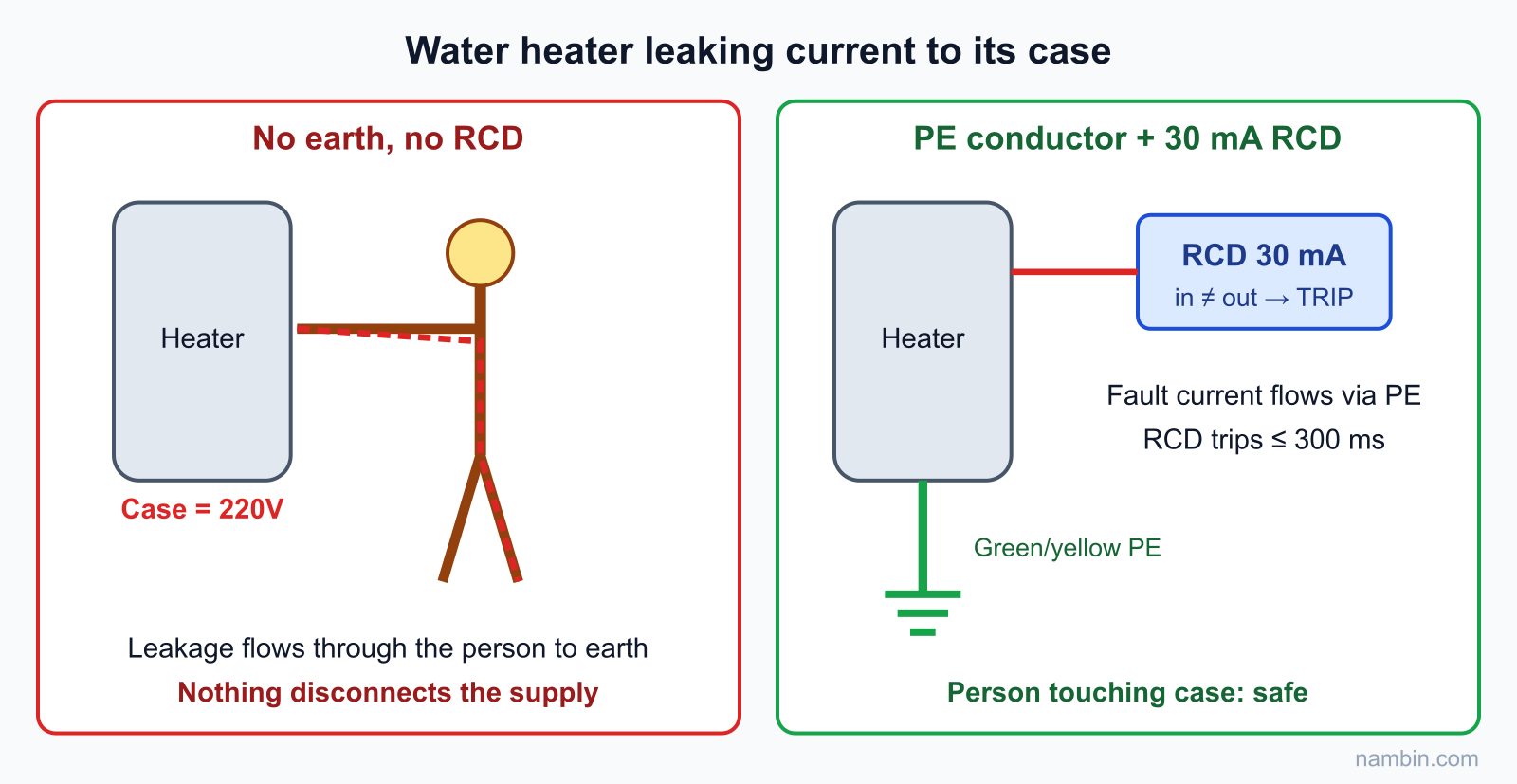
This is when a person touches a metal part that is not normally live, for example the casing of a washing machine, the body of a water heater, or the housing of a pump, but which has become "energised" because of an internal insulation fault. This is a very common accident in bathrooms and at well pumps. Protective measures: protective earthing of the appliance casing through the green-and-yellow PE conductor, so that when a fault reaches the casing the fault current flows to earth and makes the protective device trip; combined with an RCD. TCVN 7447 (IEC 60364-4-41) calls this protection by automatic disconnection of supply.
Step voltage and touch voltage
When a broken wire falls onto damp ground, or when fault current flows into an earth rod, the ground around it has a potential that decreases with distance. Two feet placed at two different points are exposed to a voltage called step voltage. If you come across a fallen wire, do not run with long strides; instead keep your feet together and hop, or shuffle with very short steps until you are at least 8–10 metres away, then call the power company. Inside homes step voltage is less common, but after storms in yards, gardens and rice fields it is very important to remember.
Arcing and burns
Causing a short circuit on a live circuit, for example a screwdriver slipping between line and neutral inside a panel, produces an arc at thousands of degrees, spraying molten metal and ultraviolet light into the eyes. At a main panel close to a transformer substation, the short-circuit current can reach several thousand amperes. Protective measures: isolate the supply, use insulated tools, wear safety glasses and long-sleeved cotton clothing (synthetic fabric melts and sticks to the skin when it burns).
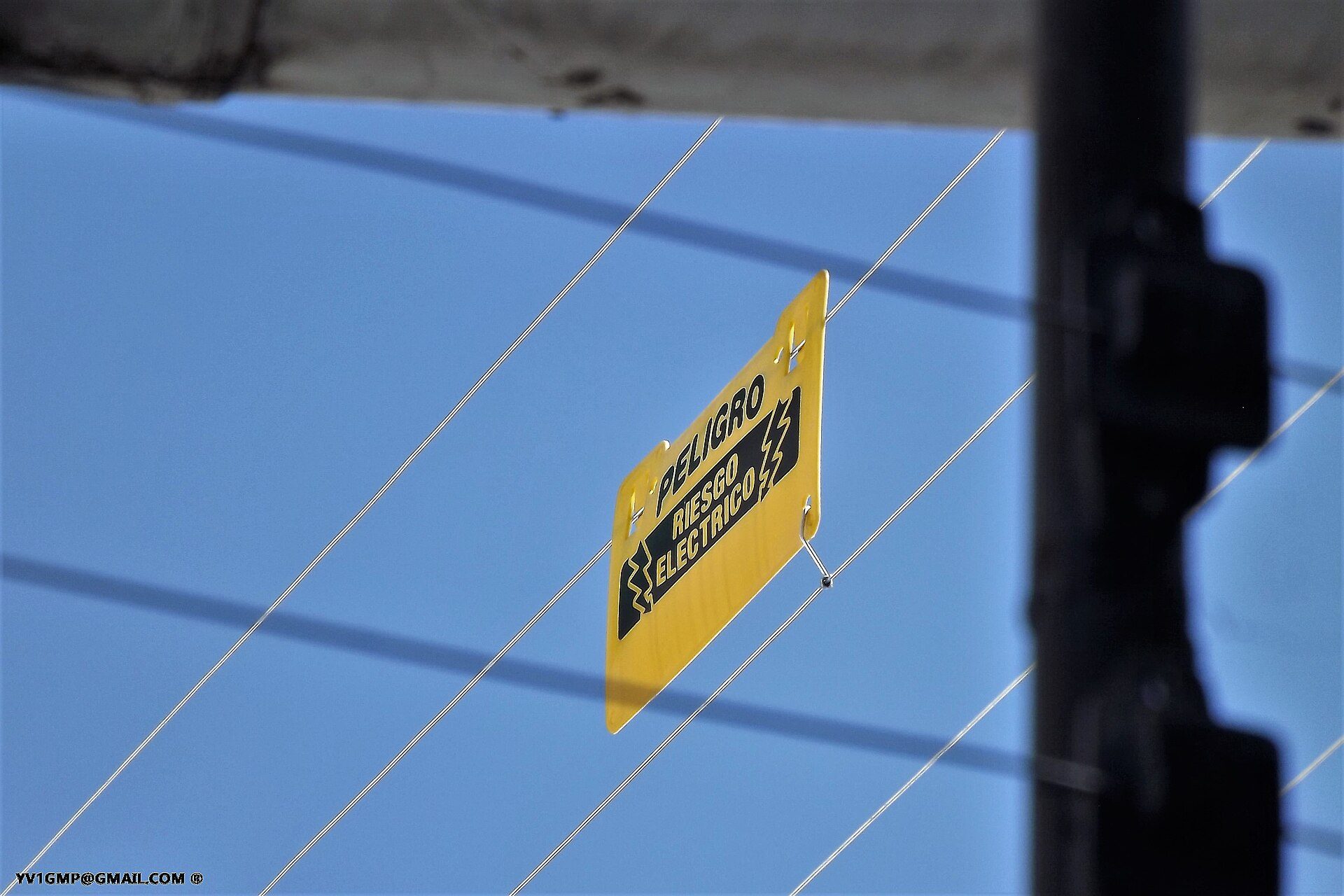
Photo: Carlos E. Perez S.L / Wikimedia Commons, CC BY-SA 4.0

Warning: The neutral conductor (N) can carry a dangerous voltage when the circuit is wired incorrectly, when the neutral is broken on the supply side, or when there is load running on the circuit. Never grab the N conductor "because it's the cold wire". Treat every conductor as live until you yourself have measured that it is not.
The second layer of protection: 30 mA RCDs and earthing
A safe electrical system does not depend on people never making mistakes. It has several layers. The first layer is basic insulation: cable sheaths, appliance casings and covers. The second layer is fault protection: metal casings are earthed, and circuit breakers (MCBs) and residual current devices (RCD/RCBO) trip automatically. The additional layer is a high-sensitivity 30 mA RCD, which can save a life even in the case of direct contact.
How an RCD works
An RCD compares the current going out on the line conductor with the current coming back on the neutral. Normally the two are equal. When part of the current strays, through a person or through an appliance casing to earth, less current returns than went out. If the difference exceeds the threshold (30 mA for the personal-protection type), the RCD trips the circuit. The important point: an RCD does not protect you if you are standing on a plastic stool and touch both the line and neutral conductors at the same time, because the outgoing and returning currents are still equal; you are just a "load" connected between the two wires.
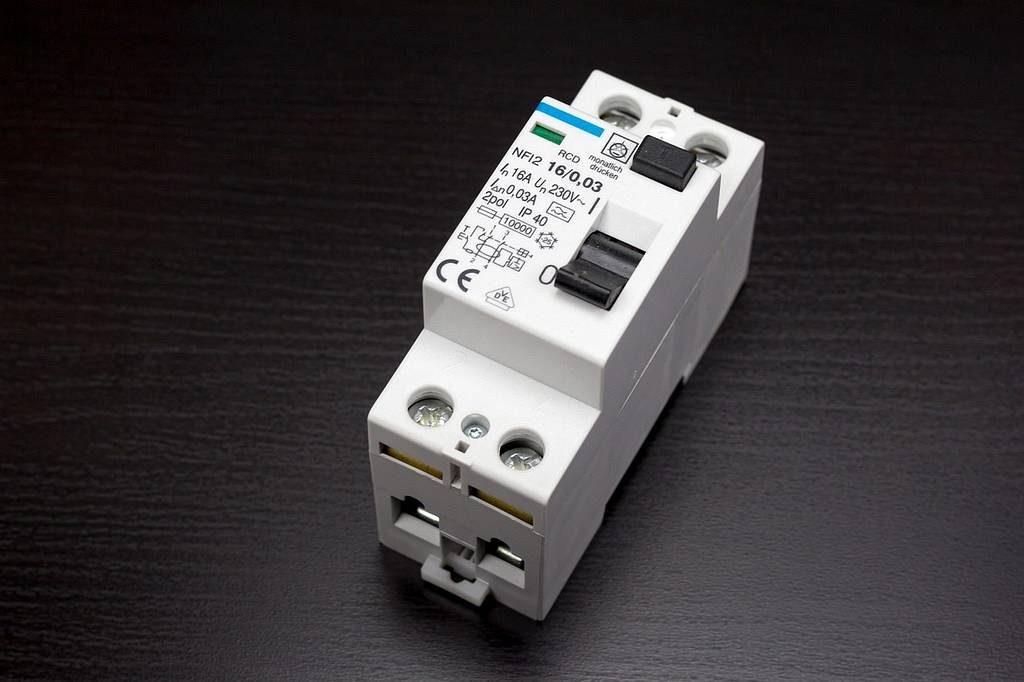
Photo: Diermaier / Wikimedia Commons, CC0

What earthing does
The earth conductor (PE, green and yellow) connects the metal casing of an appliance to an earth rod or to the earthing point of the supply. When a water heater leaks current to its casing, the fault current has a clear return path, so the RCD or MCB detects it and trips immediately; a person touching the casing is only exposed to a small touch voltage for a short time. Without earthing, the heater casing "waits" at 220V until someone touches it and becomes the path to earth. In Vietnam, QCVN 12:2014/BXD (the national technical regulation on electrical installations in dwellings and public buildings) requires sockets to have an earth terminal and appliances with metal casings to be protectively earthed.
Risk assessment routine before every job
Before taking on any job, even something as small as replacing a socket, a helper should build the habit of asking five questions, which takes less than a minute. The lead electrician will judge you by whether you ask these questions, not by how fast you can wire things up.
- Where is the supply? Which breaker feeds this circuit, and is there a second source (generator, solar power, UPS)?
- Who could switch the power back on? The homeowner, a tenant, another tradesperson working downstairs? Have you locked and tagged it?
- Is the environment wet? Bathroom, kitchen, rooftop, well pump, rain? Do you need an insulating mat or rubber boots?
- Are you working at height? Is the ladder sturdy, and is someone holding it? A mild shock on a ladder can turn into a serious injury.
- If something goes wrong, what will you do? Where is the main breaker, who knows first aid, and the emergency number 115.
Write these five questions on the inside of your toolbox lid. After a few months you will ask them automatically, just like a driver checking the mirror before changing lanes.
A "mild tingle" is a warning, not something normal
Many people say "my socket makes my hand tingle a bit" or "the shower head buzzes when I touch it", and then keep using it. For an electrician, any tingling means current is leaking through a person, and the amount of leakage can increase at any moment as the insulation keeps deteriorating or the person gets wetter. A helper who comes across this situation must:
- Immediately tell the lead electrician or the homeowner and recommend stopping use of that appliance or circuit.
- Not test it again by hand. Use a voltage tester or a meter to measure the voltage between the appliance casing and earth.
- Check whether the circuit has an RCD and press the T test button to see whether the RCD trips.
- Note down the location, the appliance and the time so the lead electrician can carry out an insulation test later.
One of the most valuable things a helper can do is spot problems early and report them to the right person. Do not worry about being seen as "overreacting".
Common mistakes made by beginners
| Mistake | Why it is dangerous | The right way |
|---|---|---|
| Testing for voltage with the back of the hand | Current still flows through the body; on a circuit without an RCD it can cause muscle contraction and a fall | Always use a voltage tester or meter that has been checked on a known live source |
| Treating the neutral as safe | The N conductor can be live if wired wrongly or if the neutral is lost | Measure both line and neutral to earth before touching |
| Believing that an RCD makes live work acceptable | An RCD does not trip for contact between line and neutral | Isolate, lock, test again; the RCD is only an additional layer |
| Working with wet hands or bare feet | Body resistance drops to about 1,000 ohms | Dry your hands, wear shoes with insulating soles, stand on a dry mat |
| Ignoring a "mild tingle" | Leakage usually grows gradually to a dangerous level | Report it, stop using it, test it |
Pass criteria for this lesson
You can consider this lesson mastered when you can check off all of the following items, ideally by explaining them out loud to the lead electrician or a fellow learner:
- Correctly calculate the body current for three cases: 220V and 1,000 ohms; 220V and 10,000 ohms; 220V and 100,000 ohms (answers: 220 mA, 22 mA, 2.2 mA), and say which level of effect each case corresponds to.
- Name all three factors that decide how severe an injury is and give a real job-site example for each.
- Correctly classify 4 out of 4 situations: touching the line conductor while repairing a socket (direct), touching a leaking washing machine casing (indirect), a broken wire lying in the yard (step voltage), a screwdriver shorting inside a panel (arcing).
- Explain in no more than 1 minute why a 30 mA RCD does not protect you when you touch line and neutral at the same time.
- Correctly answer the five risk assessment questions for a specific job given by the lead electrician.
Frequently asked questions
Can 12V or 24V electricity kill you?
Under normal conditions, extra-low voltage below about 50V AC or 120V DC is considered low-risk for people, because the current through dry skin is very small. But in bathtubs, swimming pools and flooded areas the safe threshold is much lower; that is why pool lights run on 12V through a safety transformer. In addition, a 12V battery can still cause short circuits, fires and serious burns if its terminals are shorted.
Why are shock victims sometimes thrown off and sometimes stuck to the source?
When the current makes the extensor muscles contract, or when the person reacts by reflex, they can be thrown back and fall. When they are gripping a wire or a tool, the flexor muscles of the hand contract more strongly, so they get "stuck". Both are dangerous: one leads to injuries from falling, the other to prolonged contact time.
If the house already has circuit breakers, why does it need an RCD?
A circuit breaker (MCB) protects the cables from overload and short circuits; it only trips when the current reaches tens or hundreds of amperes. A current of 50 mA through a person is already enough to kill, yet it is only a tiny fraction of the rating of a 16A MCB. To protect people, you need a device that is sensitive to leakage current, such as a 30 mA RCD or RCBO.
After a mild shock, if I feel fine, do I still need to see a doctor?
You should get checked if the current passed across the chest (hand to hand, hand to foot), if you lost consciousness at any point, had difficulty breathing, chest pain or an irregular heartbeat, or if there are burns at the entry and exit points. Electrical injuries can be deep inside the body even when the skin only shows a small mark. The first aid lesson in this module covers this in more detail.
Further reading
After completing the whole safety module, you can see how electricians are assessed in the practical exam in the article Safety and circuit installation test.