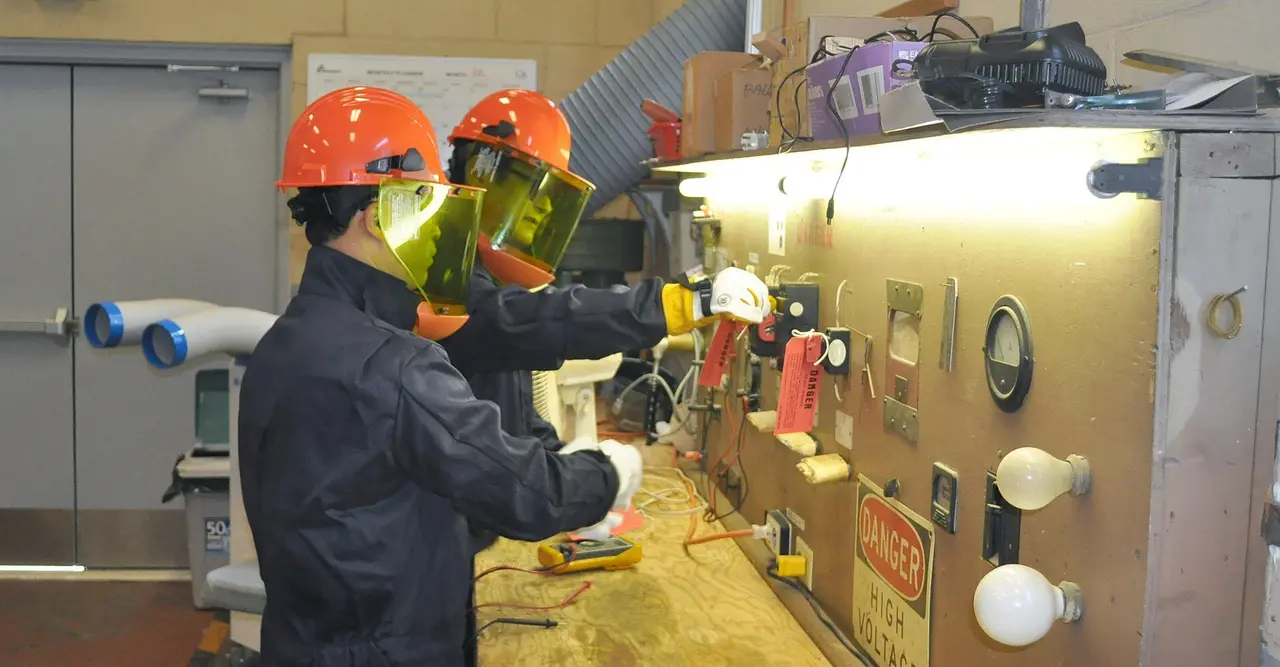
A familiar story on job sites: the helper switches off the breaker and climbs a ladder to replace a light; downstairs, the homeowner notices the power "suddenly went off" and switches it back on. Or the electrician switches off the wrong breaker because the panel label is wrong, and touches a wire that is still live. Both of these accidents can be prevented by a procedure that the electrical industry worldwide calls LOTO (lockout – tagout), combined with testing again using a reliable measuring instrument.
By the end of this lesson, you will be able to:
- Carry out the full 6-step procedure: identify the source – notify people – isolate – lock and tag – test to prove the circuit is dead – earth or shield when needed.
- Check your voltage tester and meter using the "test – measure – test again" principle on a known live source.
- Choose and correctly use breaker locks, multi-person hasps and warning tags.
- Handle difficult situations: wrong panel labels, multiple sources, breakers that cannot be locked, and work on shared circuits.
- Restore power in the correct order so that nobody is caught by surprise.
Why "switching off the breaker" does not mean it is safe yet
Switching off a breaker is just an action. Safety is a proven state: you know for certain that the circuit you are working on is dead, that nobody can switch it back on, and that if someone tries, something will stop them. There are at least five reasons why a circuit can still be live after the breaker is switched off:
- The panel label is wrong or missing. After several renovations, the breaker marked "bedroom" may actually feed the kitchen.
- The circuit is fed from two places. Two-way staircase lighting, a socket tapped from another floor, a ring circuit.
- There is a backup source. A generator, a UPS or a solar inverter can feed power back into the circuit.
- A single-pole breaker only disconnects the line. If the wiring is reversed (line running through the N conductor), switching off a single-pole breaker disconnects the neutral by mistake while the line conductor remains live.
- Capacitors still hold a charge. Fan capacitors, lamp capacitors, LED drivers and variable-frequency drives can retain voltage for some time after the supply is cut.
That is why the procedure does not stop at isolation. The most important step is the one where you measure it yourself and see with your own eyes that there is no voltage, at exactly the point you are about to touch.
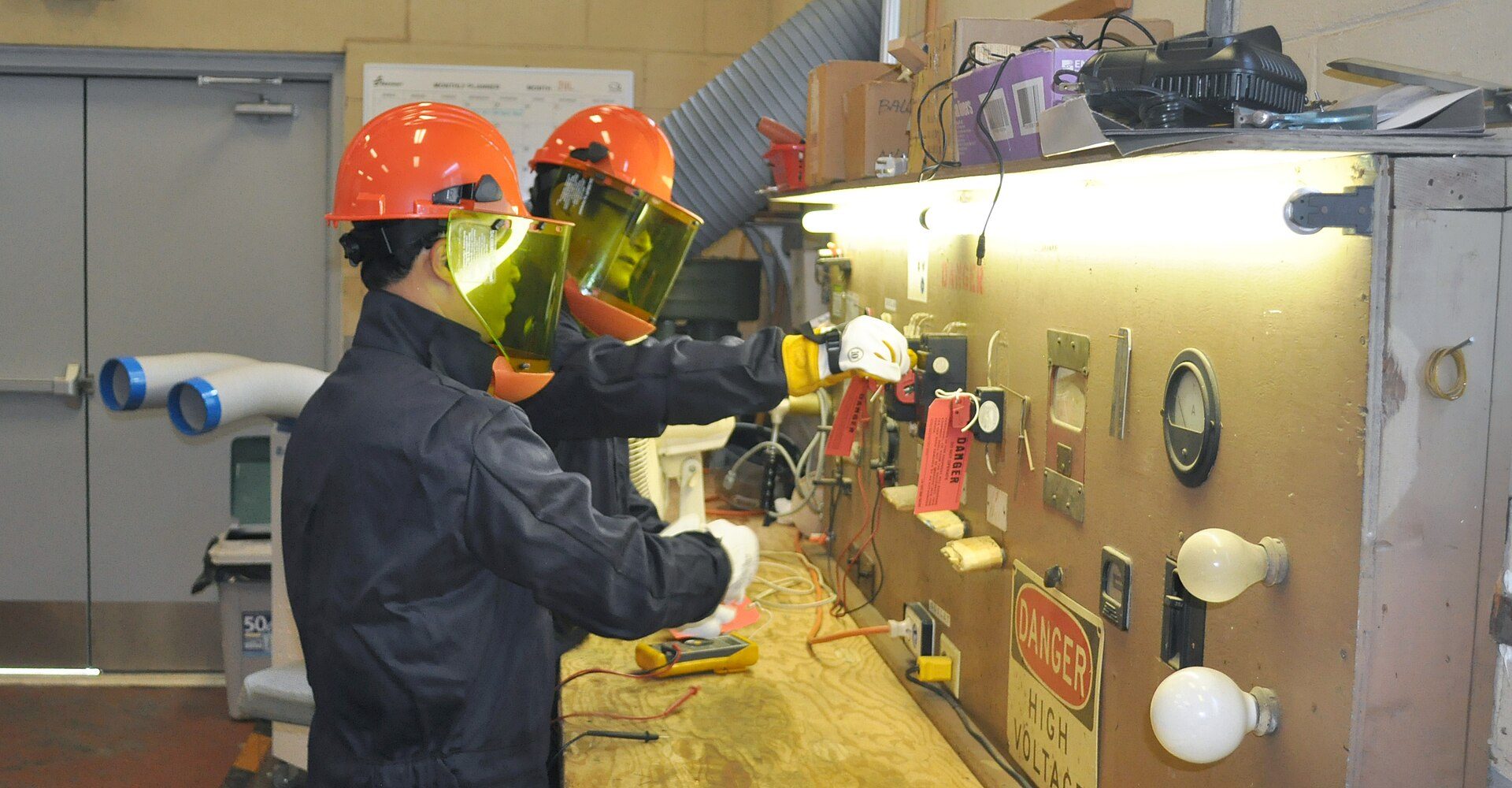
Photo: NAVFAC / Wikimedia Commons, Public domain

The 6-step procedure in detail
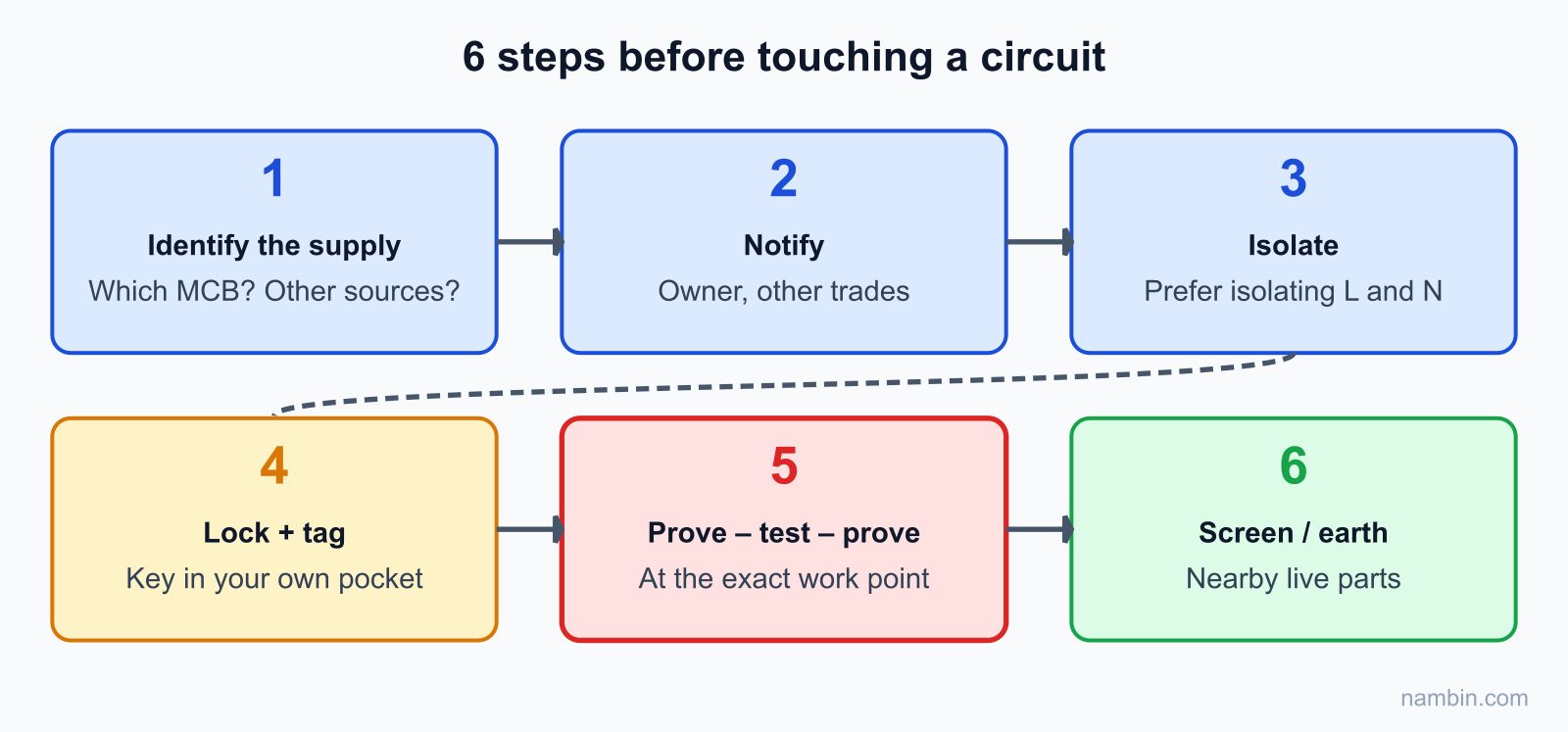
Step 1. Identify the supply source
Read the wiring diagram (if there is one), look at the panel labels, ask the homeowner and follow the cable routes. Write down: the circuit you need to work on, the breaker that feeds it, and whether there are any other sources (generator, inverter, UPS, a supply tapped from next door). If you are not sure which breaker it is, there are two options. The safest is to switch off the main breaker. The second option, when other areas need to keep their power, is to plug an easily visible load (a desk lamp, a circuit finder) into the socket you will work on, then switch off breakers one by one until the load goes off. After that you must still carry out step 5 in full.
Step 2. Notify the people concerned
Tell the homeowner, the people in the house and any other tradespeople working there: which circuit will lose power, for how long, and who is allowed to switch it back on. In households with elderly people using ventilators or oxygen concentrators, or with a fridge storing medicine, you must agree on this beforehand. Verbal notice is not enough on a site with many people; write it on a note and stick it to the panel door.
Step 3. Isolate the supply
Switch off the circuit breaker or isolator for the circuit. Give priority to devices that disconnect both line and neutral (a 2-pole breaker, or a 1P+N RCBO that also breaks N) to guard against reversed wiring. If the panel only has single-pole breakers, consider switching off the 2-pole main breaker. Stand to one side when operating old knife switches, and do not face the panel directly, in case of an arc.
Step 4. Lock and tag
Fit a breaker lock (a plastic clamp that fits around the toggle and has a hole for a padlock), attach your personal padlock and keep the key in your own pocket. Hang a tag that says: "Do not switch on – work in progress", with your name, phone number, date and time. If the panel has a lockable door, locking the door is the bare minimum when you do not have a breaker lock. When several people are working on the same circuit, use a multi-person lockout hasp: each person attaches their own padlock, and power can only be switched back on after the last person has removed theirs.
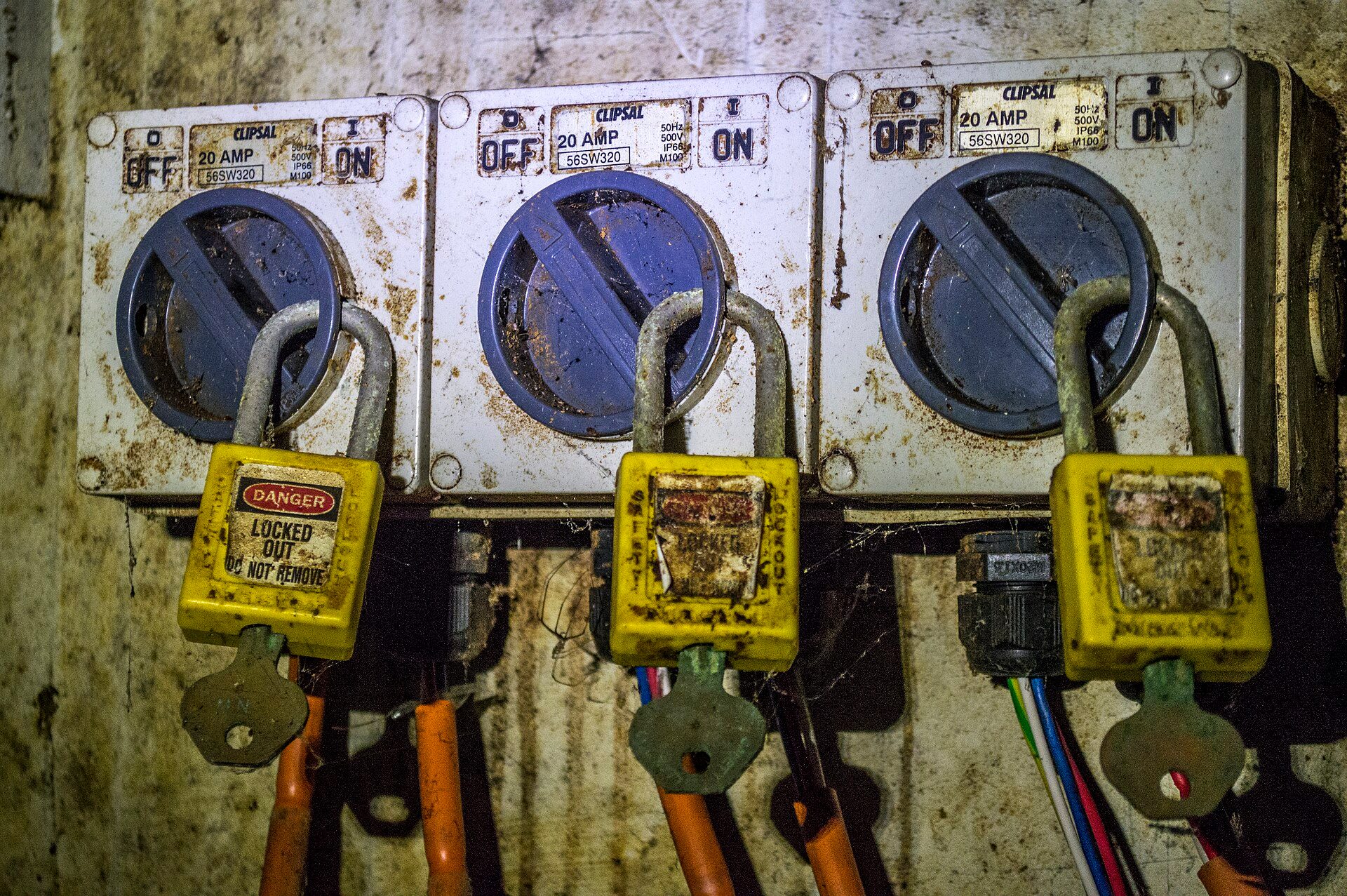
Photo: darkday from Brisbane, Australia / Wikimedia Commons, CC BY 2.0

Step 5. Test to prove there is no voltage
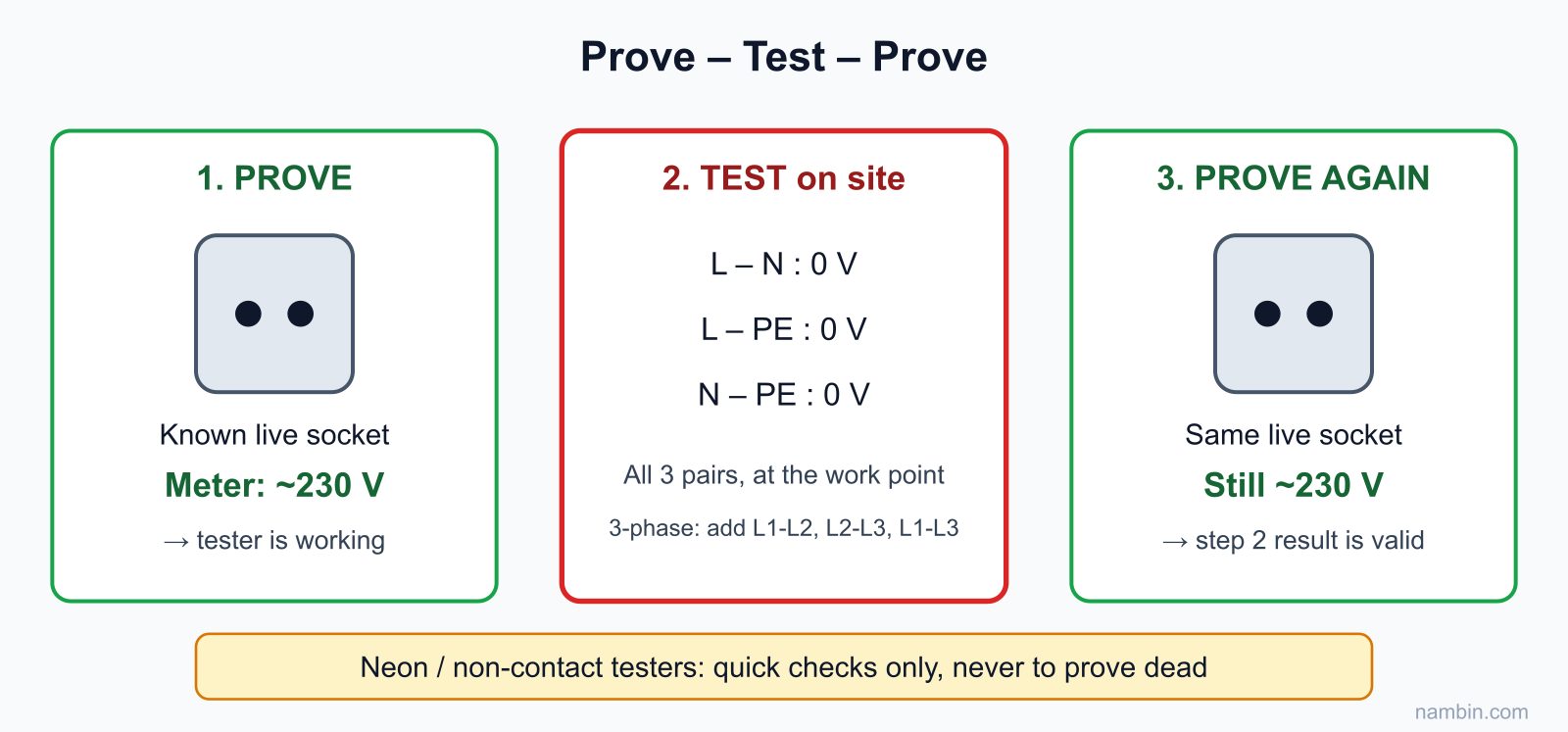
This is the step that people skip most often. Follow the principle of test – measure – test again:
- Test the measuring instrument on a known live source (another socket that is live, or a dedicated proving unit) to make sure the instrument is working.
- Measure at exactly the point where you are going to work: between line and neutral, line and earth (PE), and neutral and earth. On a 3-phase circuit, measure all pairs L1-L2, L2-L3, L1-L3 and each phase to N and to PE.
- Test again on the live source once more, to make sure the instrument did not fail in the middle of your measurement.
Only when all three steps give a clear result can you consider the circuit dead. An ordinary neon screwdriver tester is only an auxiliary tool: it gives false readings when its battery is weak, when you are wearing well-insulated shoes, or when it is too bright to see the lamp. Use a multimeter or a two-pole voltage tester with a display. The standard TCVN 9385 and the safety regulations of the power industry all require verifying the absence of voltage right at the place of work.
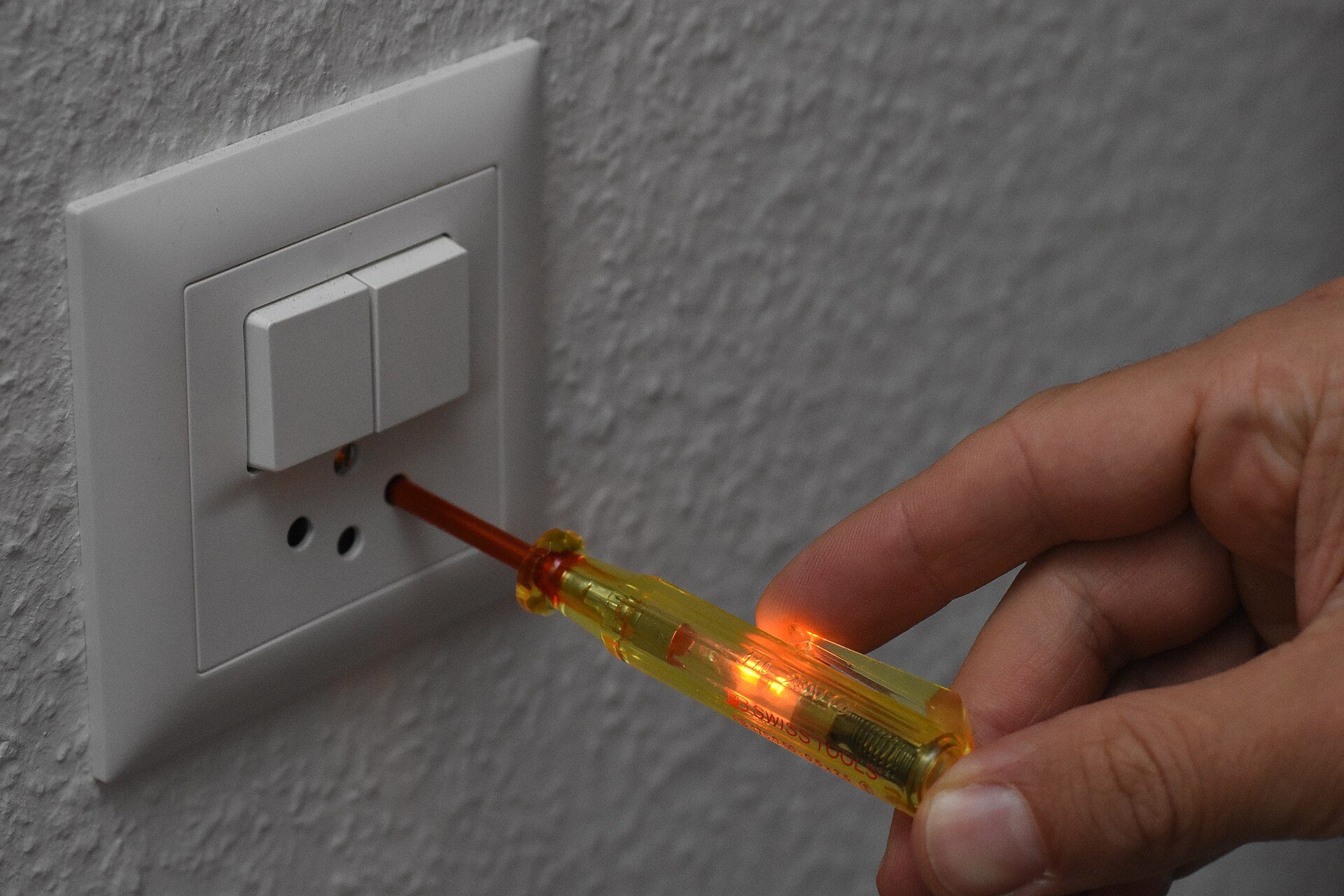
Photo: Simon A. Eugster / Wikimedia Commons, CC BY-SA 4.0

Step 6. Earth and short-circuit, or shield
In low-voltage residential work, earthing and short-circuiting is usually applied to overhead lines, long lines that can pick up induced voltage, or when working on a panel with another source nearby. Inside homes, this step usually means shielding parts that are still live close to where you are working: the busbar above the main breaker, or the terminal blocks of other circuits. Use insulating plastic sheets, temporary wrapping with insulating tape, or an insulating mat.
Minimum LOTO kit for a residential electrician
| Item | Purpose | Buying tips |
|---|---|---|
| Breaker lock | Holds the toggle in the OFF position | Buy 2–3 sizes for DIN-rail MCBs and old knife switches |
| Personal safety padlock | Locks onto the breaker lock or hasp | Insulating plastic body, one key per padlock |
| Multi-person lockout hasp | Lets 2–6 people lock out together | Plastic-coated steel, 6 holes |
| "Do not switch on" tag | Shows who is working and how to contact them | Has space for name, phone number, date and time |
| CAT III 600V multimeter | Measures to prove the circuit is dead | Test leads with shrouded probe tips, no cracks in the leads |
| Two-pole voltage tester or proving unit | Tests the instrument before and after | Has a display or a multi-level LED indicator |
| Plastic sheets, insulating tape | Shields parts that are still live | Good-quality PVC tape that is not brittle |
The whole kit only costs a few hundred thousand VND, less than one day's wages. A helper who has their own LOTO kit shows a level of professionalism that both homeowners and lead electricians notice.
Difficult situations and how to handle them
Wrong or missing panel labels
Do not trust the labels. Use the plug-in load method to trace the circuit, or switch off the main breaker. When the job is finished, offer to relabel the panel correctly with the homeowner's permission; it is a useful service and makes the next job faster.
Breakers that cannot be locked
Old breakers, enclosed knife switches or fuses may not accept a lock. Options: disconnect the conductor completely from the terminal and insulate its end (done by the lead electrician); pull the fuse and keep it in your pocket; lock the panel door; or assign one person to stand guard at the panel for the whole time. The last option is the weakest and should only be used for very short jobs when the guard fully understands their responsibility.
Multiple sources
Houses with a generator, an ATS (automatic transfer switch), solar power or a UPS must have all sources isolated and locked. With solar power, the direct current (DC) side from the panels is still live whenever it is light outside, even after the AC breaker has been switched off; this part belongs to Level 3 and helpers must not work on it on their own.
Circuits shared with neighbours or a boarding house
Boarding houses and older apartment blocks may have shared meters and breakers located in the corridor. Contact the landlord or building management so that the lock is applied at the right place and someone is accountable. Never cut power to another unit on your own initiative.
Equipment with capacitors
After isolating, wait a few minutes and measure the voltage across the capacitor before touching it. For ceiling fan capacitors and pump capacitors, you can discharge them using a dedicated discharge resistor; do not short the two terminals with a screwdriver, because this creates an arc and damages the capacitor.
Restoring power correctly
Switching power back on is just as dangerous as switching it off. The standard sequence:
- Check that the work is complete: connections tightened, covers fitted, no tools left behind, spare cable tucked into the box.
- Call everyone out of the work area and announce "getting ready to switch on".
- Remove any shielding and temporary earths (if used).
- Whoever fitted a lock removes their own lock and tag. Never remove one for someone else, even if they have gone home.
- Switch on the breaker while standing to one side. Check that the circuit works and test the RCD with the T button.
- Tell the homeowner that the circuit is live again.
Warning: If someone's padlock is still on the panel and that person is not present, never cut the lock off to restore power. You must reach them and confirm that they have left the work area. This is the golden rule of every LOTO procedure.
Common mistakes
| Mistake | Possible consequence | How to avoid it |
|---|---|---|
| Only switching off the breaker without locking it | Someone else switches it back on while you are working | Always lock and tag, even for a 5-minute job |
| Testing with a neon screwdriver and drawing a conclusion | The tester is faulty and the conclusion is wrong | Test – measure – test again with a meter |
| Measuring line to neutral but not line to earth | Missing a lost-neutral fault | Measure all three pairs L-N, L-PE, N-PE |
| Measuring at the panel instead of at the work point | The circuit is fed from somewhere else | Measure at exactly the point you are about to touch |
| Removing a lock for a colleague | Power is switched on while that person is still working on the circuit | Whoever locks it removes it |
Pass criteria for this lesson
- Recite and carry out the 6 steps in the correct order in front of the lead electrician, without skipping any step, in under 5 minutes for one socket circuit.
- Perform test – measure – test again and read the results correctly for all three pairs L-N, L-PE, N-PE; say which result means "still live".
- Fit a breaker lock and a personal padlock onto a DIN-rail MCB in no more than 1 minute; fill in the tag with name, phone number, date and time.
- Give the correct way to handle 4 situations: wrong label, breaker that cannot be locked, a generator on site, equipment with capacitors.
- Carry out the power restoration sequence, including testing the RCD with the T button after switching on.
Frequently asked questions
For a very small job, like replacing a light bulb, do I need all 6 steps?
Replacing a bulb by hand with the switch off does not require locking the panel. But removing a lamp holder or rewiring a light means touching conductors, so you need the full procedure. Many lighting circuits have the switch wired in the neutral, so even with the switch off there is still line voltage at the lamp holder.
What if the homeowner won't let me cut power to the whole house?
Explain the risks and suggest isolating only the circuit you need and locking that particular breaker. If you cannot identify a dedicated breaker and the homeowner still refuses to switch off the main breaker, a helper must never decide to work live; report it to the lead electrician.
Can a non-contact voltage tester be used to prove there is no voltage?
No. A non-contact tester is very handy for quickly finding which wire is live, but it may not respond on cables with thick sheathing or armoured cables, or when its battery is weak. It is only a screening tool; the final decision must be based on a contact measurement with a meter or a two-pole voltage tester.
Do I need to keep a record every time I lock out?
For small jobs in private homes, the tag hanging on the panel is enough. On sites with several crews, you should keep a log: who locked out, which circuit, the time it was locked and the time it was released. In Level 4 you will learn how to set up this procedure for a whole team.
Further reading
To understand in detail how to use a meter to prove that a circuit is dead, read the article Using a multimeter for electricians.