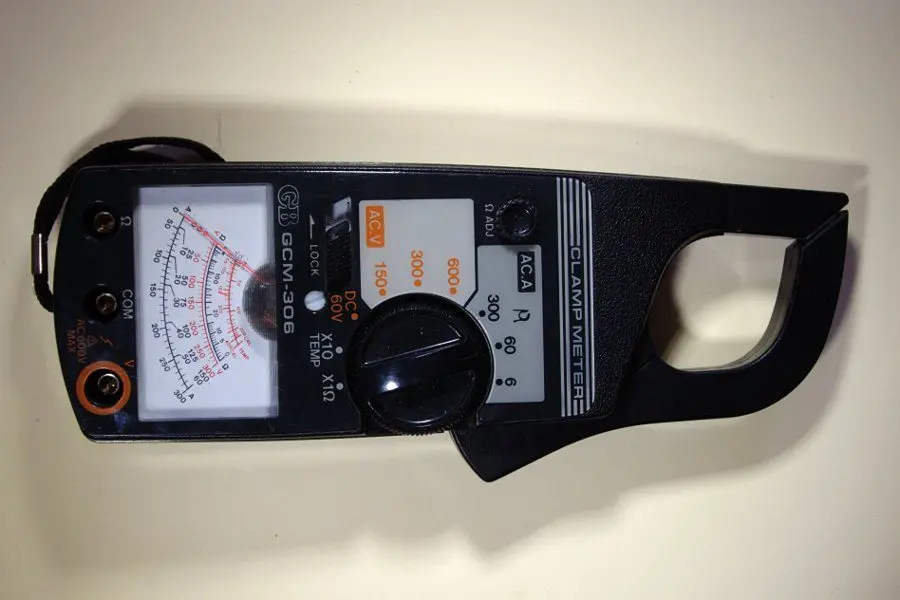
Many helpers think formulas are for engineers. In reality, an electrician uses three simple formulas every day without pen or paper: the homeowner wants to add a 2,500W water heater, so can the old wiring handle it; the breaker trips when the air conditioner is switched on, so is that an overload or a short circuit; this month's electricity bill has shot up, so which appliance is responsible. This lesson teaches you to do these calculations in your head, accurately enough to make decisions on site.
By the end of this lesson, you will be able to:
- Use Ohm's law U = I × R and the power formula P = U × I to work out an appliance's current from the power rating on its label.
- Quickly estimate current on a 220V supply using the rule of thumb "1,000W is about 4.5A".
- Read an appliance rating plate: voltage, power, current and power factor cos φ.
- Calculate energy consumption in kWh and estimate the electricity bill under a tiered tariff.
- Use the formula P = I² × R to explain why loose connections and undersized wires heat up and cause fires.
The basic quantities and their units
| Quantity | Symbol | Unit | Water analogy | Measuring instrument |
|---|---|---|---|---|
| Voltage | U (or V) | Volt (V) | Water pressure | Multimeter on the V range |
| Current | I | Ampere (A) | Flow rate of water | Clamp meter |
| Resistance | R | Ohm (Ω) | How narrow the pipe is | Meter on the Ω range (with power off) |
| Power | P | Watt (W), kW | The force of the water turning a wheel | Energy meter, power meter |
| Energy | A | kWh ("units" on the bill) | Total amount of water used | Electricity meter |
Prefixes to remember: 1 kW = 1,000 W; 1 mA = 0.001 A; 1 MΩ = 1,000,000 Ω; 1 kWh is the energy used by a 1,000W appliance running for 1 hour.
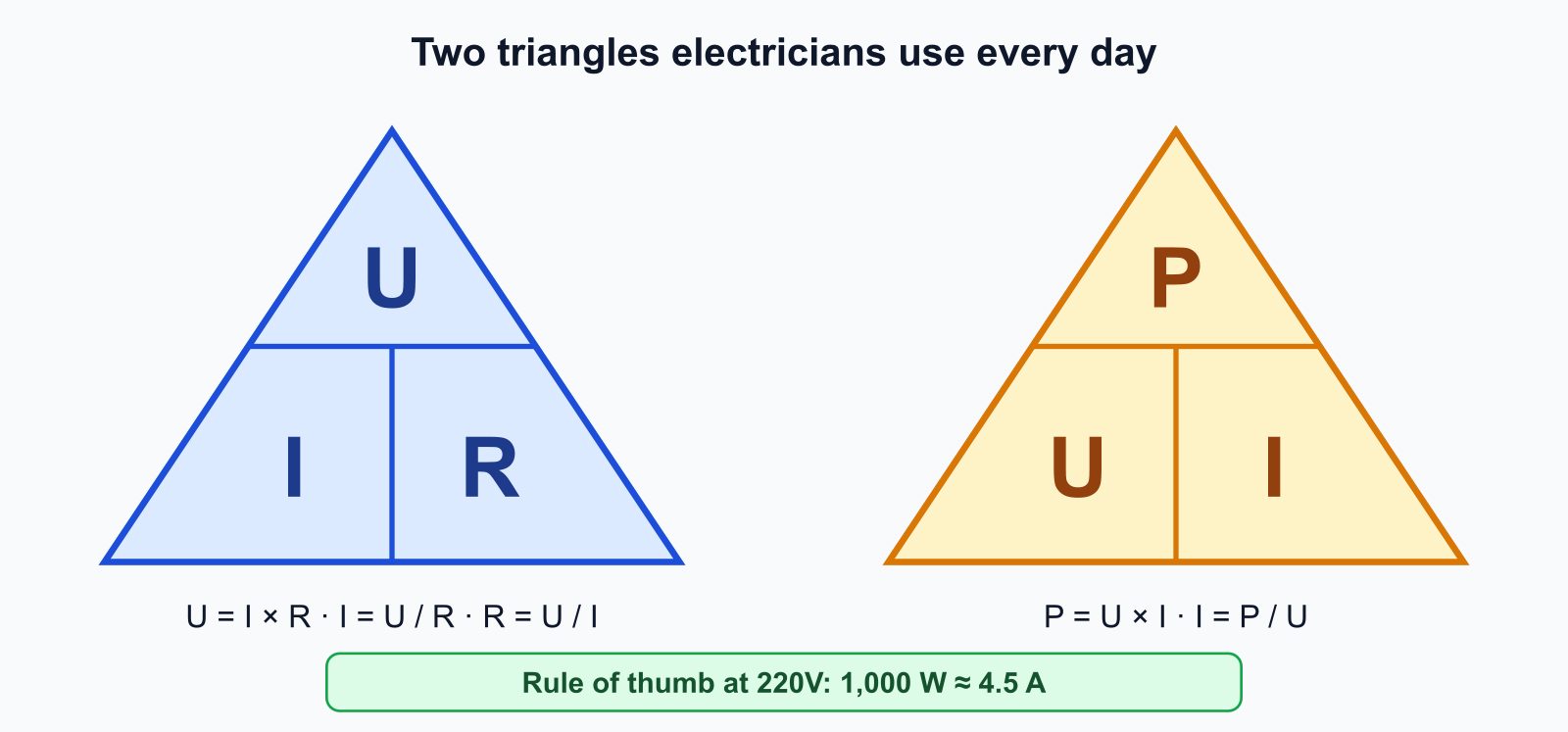
Ohm's law: U = I × R
Ohm's law states that the current through a conductor is directly proportional to the voltage applied across it and inversely proportional to its resistance. There are three equivalent ways to write it:
- U = I × R: if you know the current and the resistance, you can calculate the voltage drop.
- I = U / R: if you know the voltage and the resistance, you can calculate the current (the first lesson used this to work out the current through a human body).
- R = U / I: if you know the voltage and the current, you can calculate the resistance.
Field example: voltage drop along a cable
A 2.5 mm² copper wire run of 30 m (60 m in total, there and back) has a resistance of about 0.0074 Ω per metre, so about 0.44 Ω overall. When a pump draws 10A, the voltage drop along the wire is U = 10 × 0.44 = 4.4V. The pump receives only about 215V instead of 220V. If the run is 100 m long or the wire is smaller, the voltage drop grows considerably; the pump struggles to start, runs hot and fails early. This is the basis of the Level 2 lesson on sizing cables by voltage drop.
Power: P = U × I
For purely resistive loads such as water heaters, electric kettles, irons and incandescent bulbs, power equals voltage multiplied by current. From this you get the way to calculate an appliance's current: I = P / U.
Mental-arithmetic rule at 220V
220V is roughly 1,000 / 4.5. So every 1,000W corresponds to about 4.5A. Electricians usually estimate like this:
| Appliance (example) | Power | Approximate current at 220V |
|---|---|---|
| Recessed LED downlight | 9W | 0.04A |
| Refrigerator while running | 150W | 0.7A (starting current can be several times higher) |
| Rice cooker | 700W | 3.2A |
| 12,000 BTU air conditioner | about 1,100W | 5–6A |
| Electric kettle | 1,800W | 8.2A |
| Water heater | 2,500W | 11.4A |
| Double induction hob | 4,000W | 18A |
From this table you can see at once that a 4,000W double induction hob and a 2,500W water heater cannot share a 16A socket circuit (about 3,500W). This is the kind of calculation homeowners really appreciate when an electrician can explain it.
Power factor cos φ
With motor loads (pumps, fans, air conditioners, washing machines) or electronic loads (LED lights, computers), current and voltage are not in step. Real power is P = U × I × cos φ, where cos φ is usually between 0.6 and 0.95. This means that for the same rated power on the label, the actual current is higher than for a purely resistive load. For example, a 750W pump with cos φ = 0.75 draws about 750 / (220 × 0.75) ≈ 4.5A, not 3.4A. In addition, a motor draws 3–7 times its rated current for a few seconds when it starts.
Photo: K. Krallis SV1XV / Wikimedia Commons, CC0

Energy and the electricity bill
Energy consumed A = P × t. With P in kW and t in hours, the result is in kWh, exactly the "units" shown on the meter.
Examples
- A 2.5 kW water heater heating for an average of 1 hour a day: 2.5 kWh/day, about 75 kWh/month.
- A 1.1 kW air conditioner running 8 hours every night; an inverter unit uses on average only about 60% of its rated power: 1.1 × 8 × 0.6 ≈ 5.3 kWh/night, about 160 kWh/month.
- A 150W refrigerator whose compressor runs only about 40% of the time: 0.15 × 24 × 0.4 ≈ 1.4 kWh/day, about 43 kWh/month.
Household electricity in Vietnam is charged on a tiered (block) tariff: the more you use, the more expensive each kWh becomes in the higher tiers. When a homeowner complains that the bill has gone up, the electrician can read the meter at two points in time, use a clamp meter to measure each circuit, and find the appliance with abnormal consumption, such as a water heater with a failed thermostat that runs continuously, or a large leakage current.
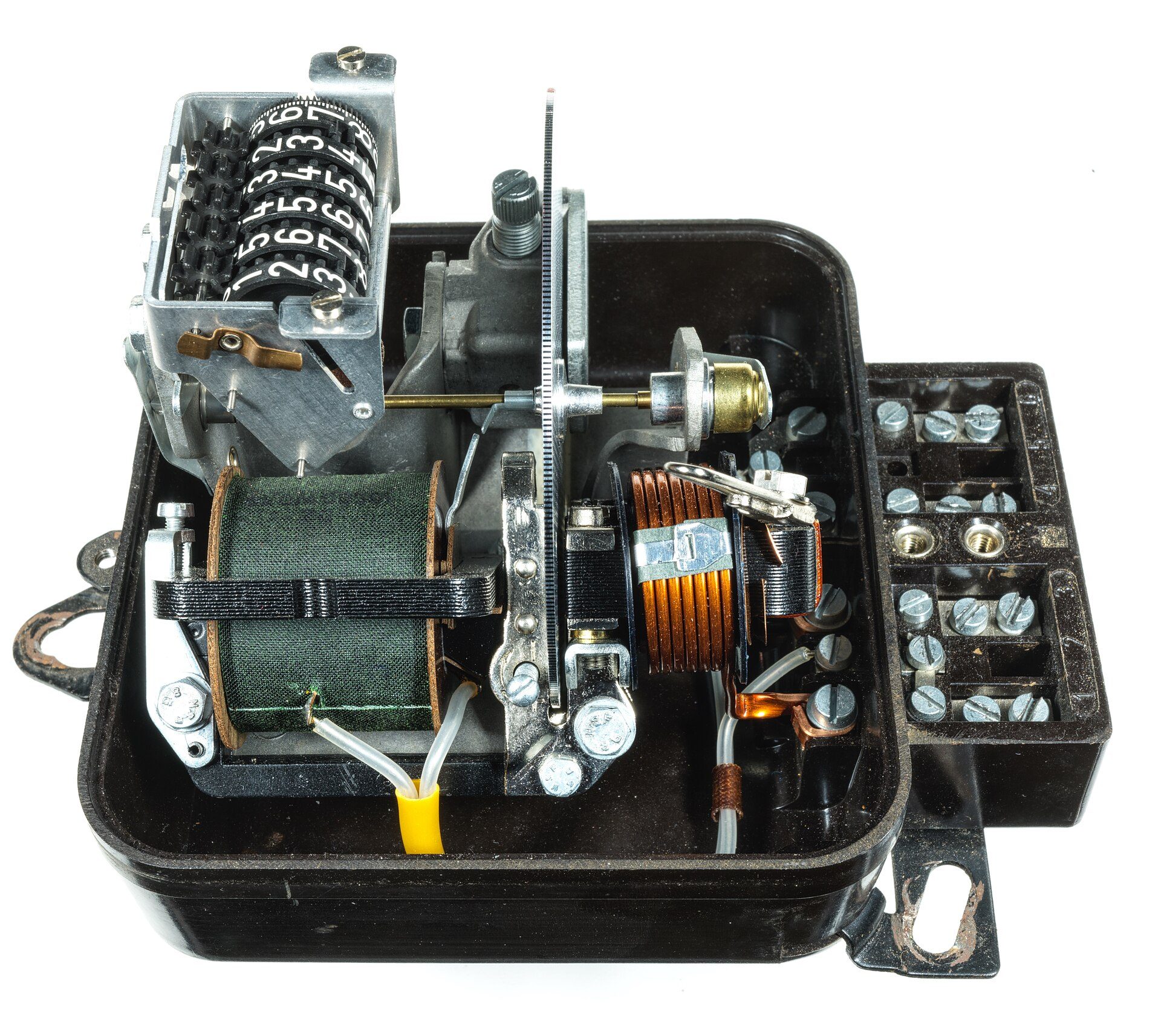
Photo: Hannes Grobe / Wikimedia Commons, CC BY-SA 4.0

P = I² × R: why loose connections cause fires
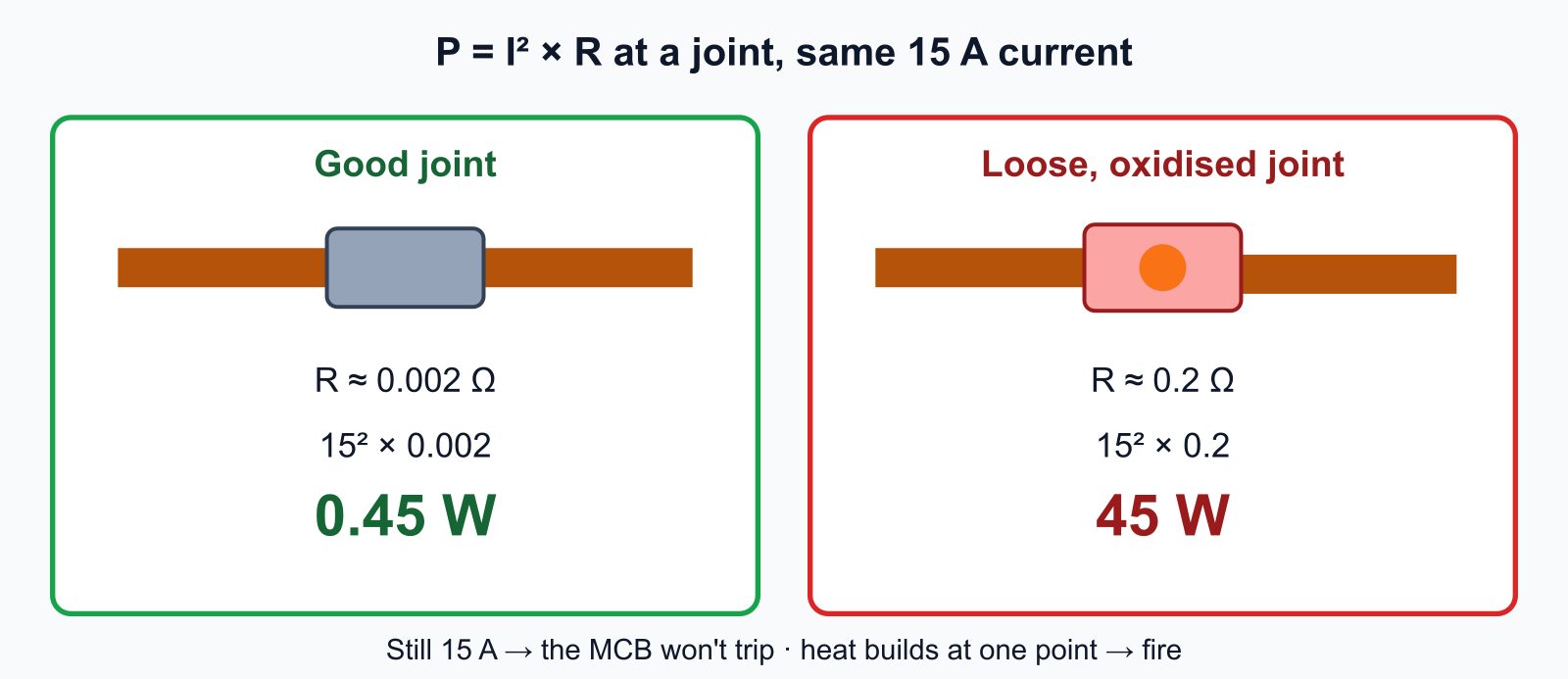
Substituting U = I × R into P = U × I gives the power dissipated as heat in a resistance: P = I² × R. This is the most important formula for fire safety in an electrical installation, because it shows that the heat produced rises with the square of the current.
Loose connections
A good connection has a very small contact resistance, a few thousandths of an ohm. A loose, oxidised connection can reach 0.1–0.5 Ω. At a current of 15A:
- Good connection, 0.002 Ω: P = 15² × 0.002 = 0.45W. Negligible.
- Poor connection, 0.2 Ω: P = 15² × 0.2 = 45W. As much as a small soldering iron, concentrated at a single point inside a closed plastic box.
The heat oxidises the connection further, the resistance rises further, and the heat rises again: a vicious circle that ends with burnt cable insulation, a burnt socket or a burnt junction box. A circuit breaker cannot trip in this situation, because the current is still only 15A, a perfectly normal value. That is why the lesson on joining wires and crimping lugs (Lesson 8) is so important, and why electricians must tighten terminals to the correct torque.
Undersized wire
The same formula explains why a small wire heats up: a smaller cross-section means higher resistance, and with a high current the heat rises with the square of the current. A 1.5 mm² wire can carry about 15–18A continuously, depending on how it is installed; force it to carry 25A and the heat increases almost threefold, so PVC insulation rated for a maximum of 70°C will soften, melt and gradually become brittle.
Warning: A socket or plug that feels warm when used with a heavy load is a sign of poor contact or overload. Do not "let it cool down and carry on". Switch off the power, check the connections, check the wire cross-section and the socket rating.
Mental-arithmetic exercises
- How much current does a 3,000W water heater draw at 220V? (Answer: about 13.6A.)
- A room has 12 LED bulbs of 9W each. What is the total current? (Answer: 108W, about 0.5A.)
- What is the maximum resistive load in W that a 20A socket circuit can supply? (Answer: about 4,400W.)
- A 1.1 kW pump runs 2 hours a day. How many kWh does it use per month? (Answer: 66 kWh.)
- How much heat does a 20A current produce through a 0.1 Ω connection? (Answer: 40W.)
- You measure 220V and 5A on a kettle. What is the resistance of the heating element? (Answer: 44 Ω.)
Applying it: checking whether a kitchen socket circuit is overloaded
The homeowner complains that the kitchen breaker often trips at cooking time. The helper is asked to record the loads so the lead electrician can decide what to do. Here is how to do it using the formulas in this lesson:
- List the appliances used at the same time and the power on their labels: rice cooker 700W, electric kettle 1800W, microwave oven 1200W, refrigerator 150W.
- Add up the power: 700 + 1800 + 1200 + 150 = 3850W.
- Calculate the current: I = P / U = 3850 / 220 ≈ 17.5A.
- Compare with the breaker: the circuit uses a 16A breaker and 2.5 mm² wire. A current of 17.5A exceeds the breaker rating, so the breaker tripping after a while is exactly its job of protecting the wire.
- Check with a clamp meter: switch on exactly those appliances, clamp the line conductor of the kitchen circuit at the panel and record the actual reading (usually slightly different from the calculated value, because the real power of an appliance differs from its label).
- Report: write down the calculated and measured results and suggest to the lead electrician that the kitchen be split into two circuits, or that the kettle be moved to a socket on another circuit. Never fit a larger breaker on your own initiative: the breaker protects the wire, and 2.5 mm² wire cannot carry the current of a 25A breaker continuously.
This example shows how two simple steps, I = P/U and a comparison with the ratings, let you explain what is happening instead of guessing that "the breaker is weak".
Starting current and motor loads
One point that often confuses beginners: a 150W refrigerator or a 750W pump can draw 3–7 times its running current for a few hundred milliseconds when starting. That is why breakers for circuits with motors usually use a C curve instead of a B curve (covered in detail in Level 2). When measuring with a clamp meter, a reading that jumps up as the machine starts and then gradually falls is normal; many clamp meters have an "INRUSH" function to measure this starting current separately.
Common mistakes when calculating on site
| Mistake | Consequence | Correct approach |
|---|---|---|
| Dividing the label power by 220 for pumps and air conditioners | Current underestimated, wire too small | Also take cos φ and starting current into account |
| Confusing W and kW, mA and A | Off by a factor of 1,000 | Write the unit next to every number |
| Adding up the power of all appliances as if they all run at once | Breaker and wire oversized, money wasted | Use a diversity (simultaneity) factor (covered in Level 2) |
| Thinking the breaker protects against loose connections | Connection checks skipped | Tighten to the correct torque, check for heat |
Pass criteria for this lesson
- Solve all 6 of the mental-arithmetic exercises above correctly within 5 minutes, without a calculator.
- Read the labels of 3 real appliances at home (voltage, power, current), calculate their current and check it with a clamp meter, explaining any difference.
- Explain in 1 minute, to someone who knows nothing about electricity, why a loose connection can cause a fire without the breaker tripping.
- Estimate the monthly energy consumption of the 3 largest appliances in a specific household.
Frequently asked questions
Why are some appliances marked 230V and others 220V?
The nominal low-voltage supply under IEC and current Vietnamese standards is 230/400V, but many older appliances and everyday habit still say 220V. Appliances are designed to work within a tolerance band, usually ±10%. For mental arithmetic, using 220V gives a slightly higher current, which is on the safe side.
Is the rating on an air conditioner in BTU or W?
BTU/h is the cooling capacity, not the electrical power. A 9,000 BTU air conditioner has a cooling capacity of about 2.6 kW, but its electrical input is only about 0.8–0.9 kW. When calculating current, look for the "power consumption" or "rated current" line on the label.
Low-power LED lights don't need any attention, do they?
Each bulb is small, but LED drivers have a very high inrush current for a short time. Putting too many lights on one B-curve breaker can make it trip when the switch is turned on. This is covered in the Level 2 lesson on MCBs.
Further reading
An article that applies these formulas to selecting wires and breakers: Choosing wire sizes and circuit breakers.