A lead electrician can look at a helper's toolbox and guess how that person works. A proper tool kit does not have to be expensive, but it must be the right type, the right size, in good condition and organised so that you can pick up a tool and use it straight away. The wrong tool can ruin the job (a screwdriver that strips the screw head, pliers that cut through the conductor while stripping), and worse, it can cause accidents: a non-insulated screwdriver slipping and shorting onto a busbar, an aluminium ladder touching a power line.
By the end of this lesson, you will be able to:
- Draw up a list of and buy a starter kit of about 25 items for a residential electrician, prioritised according to your budget.
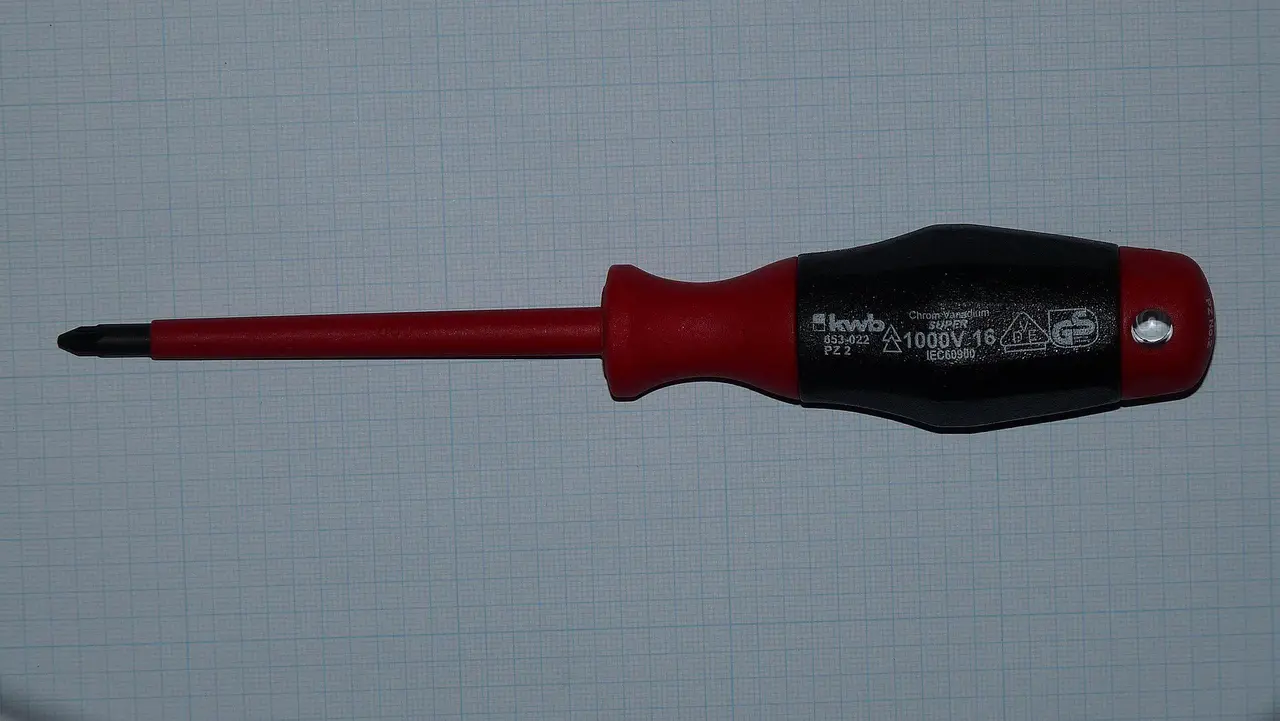
- Recognise properly rated insulated tools by the 1000V marking, the double triangle symbol and the IEC 60900 standard.
- Choose suitable protective equipment: insulating gloves by class, safety glasses, footwear, clothing and insulating mats.
- Inspect your tools and protective equipment in 3 minutes before every shift and know when they must be thrown away.
- Use ladders safely when working with electricity.
Insulated tools: read the markings before you buy
Screwdrivers and pliers sold at the market usually have plastic handles, but a plastic handle is not necessarily insulated. A decorative plastic layer may be thin, contain air bubbles and never have been voltage-tested. Genuine insulated tools for electricians are manufactured and tested to IEC 60900 (equivalent to EN 60900); each individual tool is tested at 10,000V in the laboratory so it can be used safely at up to 1000V AC.
How to recognise them:
- The double triangle symbol (two nested triangles) together with 1000V moulded on the handle.
- The insulation usually has two colours: an orange or red outer layer and a yellow or differently coloured inner layer. When the outer layer wears through and the inner colour shows, it is a sign that the tool must be replaced.
- The metal shaft of the screwdriver is insulated almost to the tip, with only a few millimetres exposed at the tip.
- The tool carries the manufacturer's name, a product code and the year of manufacture.
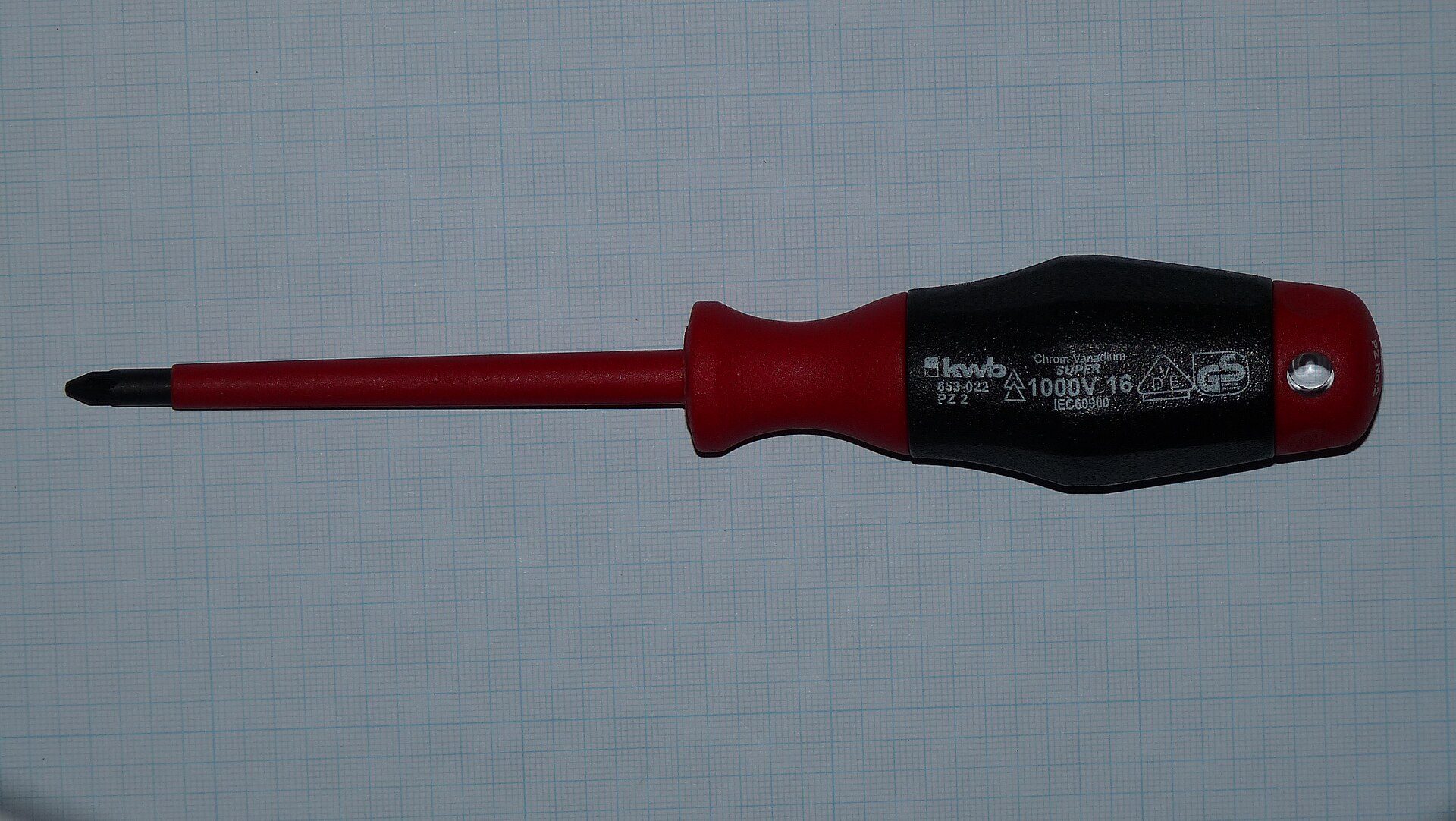
Photo: Dmitry G / Wikimedia Commons, CC BY-SA 3.0

Warning: Insulated tools are a secondary layer of protection, not a licence to work live. Residential electricians always isolate, lock and test again first; insulated tools protect you if something goes wrong or when you are working near other parts that are still live.
Starter tool kit for a helper
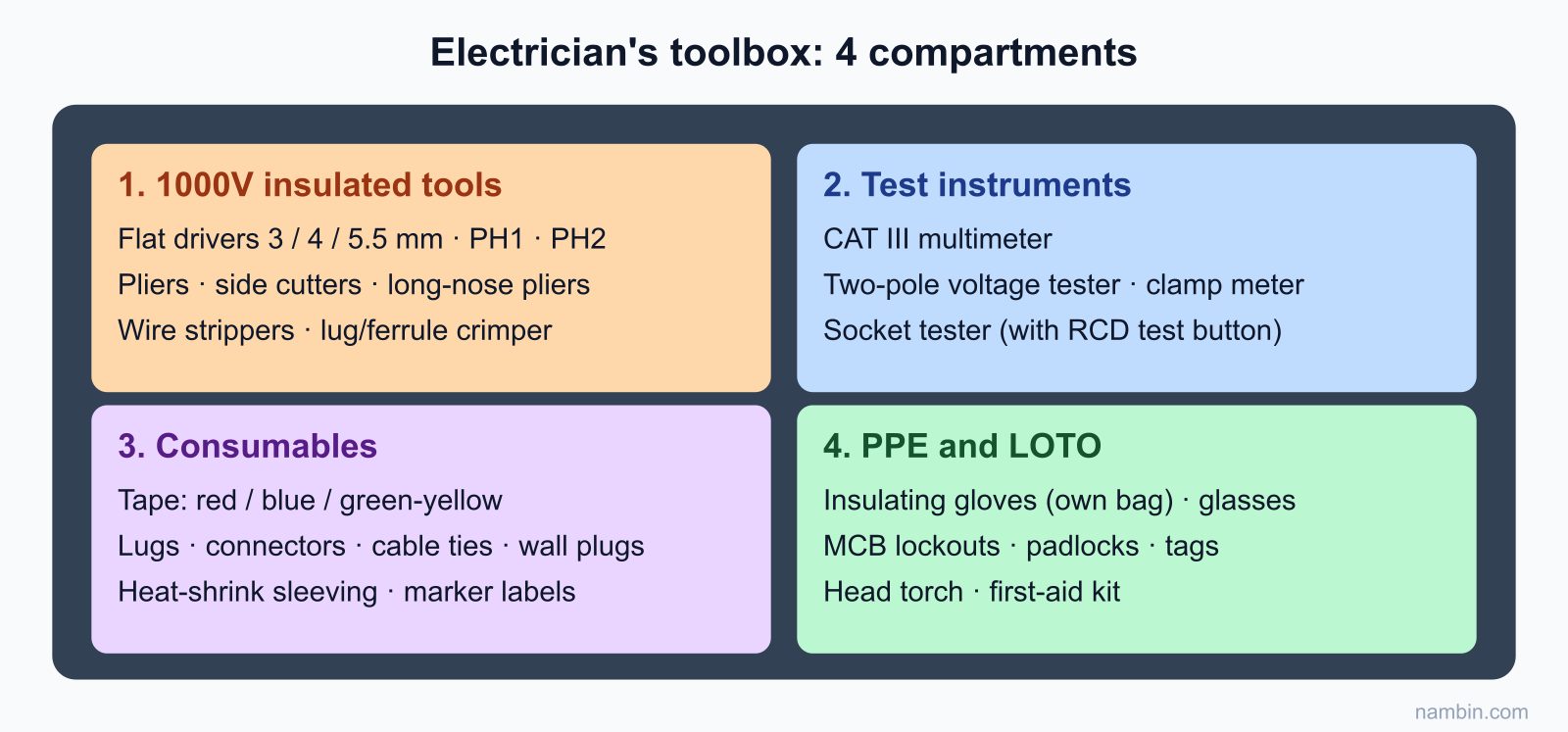
The table below divides tools into three levels. Level 1 items are mandatory before your first day at work; level 2 items should be bought within 1–2 months; level 3 items can be bought gradually as you move up to lead electrician.
| Level | Tool | Recommended specification | Used for |
|---|---|---|---|
| 1 | Set of insulated flat-blade and Phillips screwdrivers | 1000V, sizes 3, 4, 5.5 mm and PH1, PH2 | Tightening terminals, sockets, breakers |
| 1 | Combination pliers | Insulated to 1000V, 180–200 mm long | Gripping, twisting, bending wire |
| 1 | Side cutters | Insulated to 1000V, 160 mm | Cutting wire up to 6 mm² |
| 1 | Wire strippers | With holes for 0.5–6 mm² or an automatic type | Stripping insulation without cutting the conductor |
| 1 | Two-pole voltage tester or multimeter | CAT III 600V or higher | Test – measure – test again |
| 1 | 5 m tape measure, pencil, marker pen | Tape with a lock | Marking out positions |
| 1 | PVC insulating tape | Flexible type, rated 80°C | Temporary wrapping, colour marking |
| 2 | Crimping pliers | For 0.5–6 mm² lugs, with a ratchet | Crimping lugs and connectors |
| 2 | Cable stripping knife | Hook blade, non-slip handle | Slitting multi-core cable sheaths |
| 2 | Hammer drill | With hammer mode, 6–12 mm bits | Drilling walls for boxes and wall plugs |
| 2 | Head torch | USB rechargeable | Working when power to the whole house is off |
| 2 | Clamp meter | Measures AC up to 400A, with voltage measurement | Measuring load current, checking phase balance |
| 3 | Wall chaser | Twin blades, with dust extraction | Running concealed wiring in walls |
| 3 | Insulation resistance tester | Test voltage 250/500/1000V | Commissioning tests, finding leakage |
| 3 | Fish tape (cable puller) | 15–30 m long | Pulling wire through conduit |
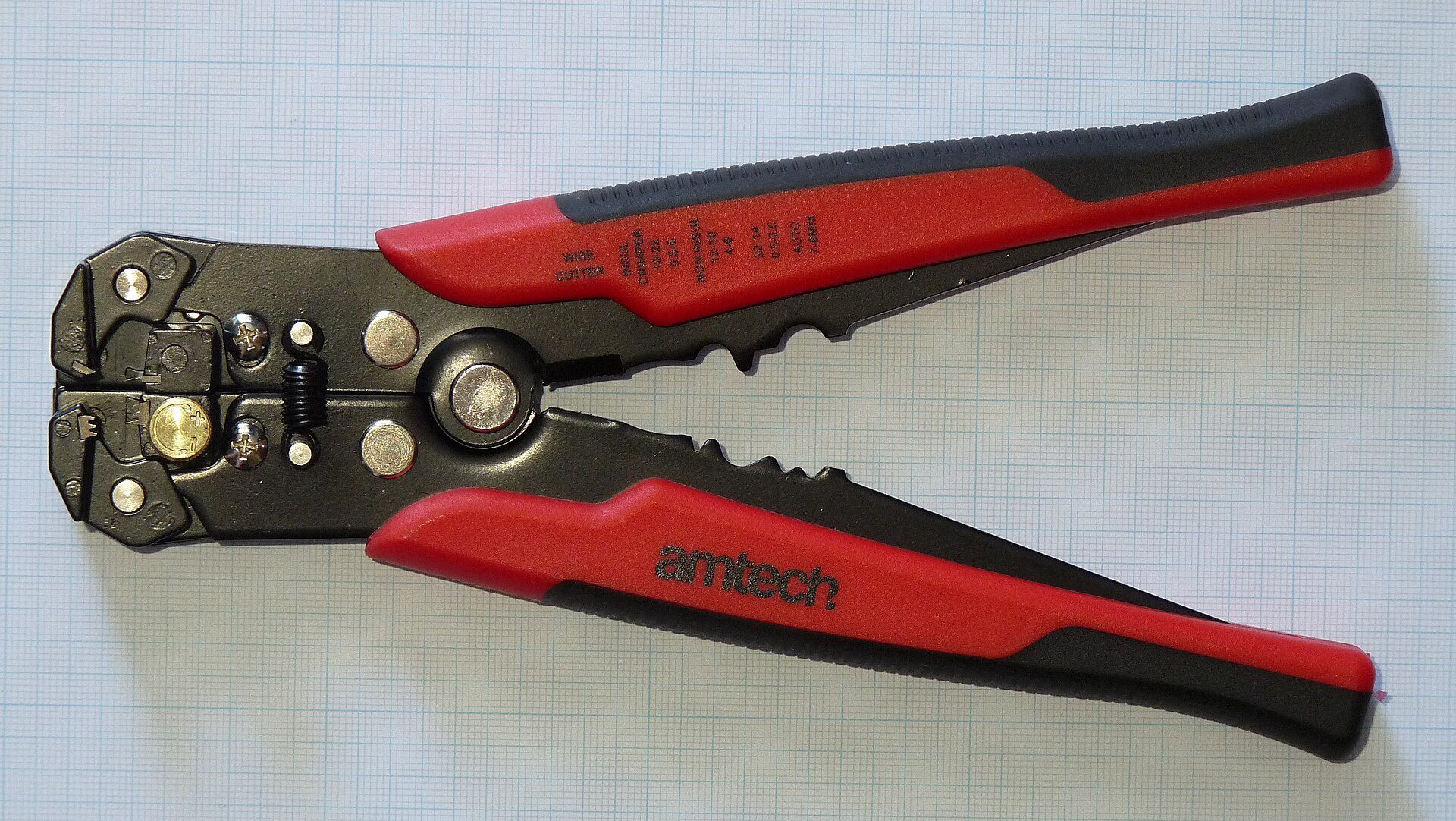
Photo: Dmitry G / Wikimedia Commons, CC BY-SA 3.0

Why the right size of wire stripper matters
Beginners often strip wire with side cutters or a knife, which easily nicks the copper conductor. The nick becomes a weak point: when the wire is bent back and forth it will break there, and the reduced cross-section causes local heating. With stranded wire, cutting through a few strands makes the actual cross-section smaller than the nominal size. A simple test: after stripping, look closely at the conductor; there must be no nicks and no broken strands. If there are, cut off that section and strip it again.
Personal protective equipment
Gloves
There are two types of gloves an electrician must tell apart. Work gloves (fabric, leather) protect your hands from scratches when pulling cable or drilling walls; they are not insulating. Insulating gloves made of rubber are manufactured to IEC 60903 and classified by voltage: class 00 is for up to 500V, class 0 is for up to 1000V AC. A residential electrician should own a pair of class 00 or class 0 gloves for jobs such as testing in a live main panel or operating old knife switches.
Inspect insulating gloves before every use: roll up the cuff to inflate the fingers, then look and listen for holes, cracks or cuts. Gloves showing any sign of damage must be discarded immediately. Do not leave gloves in the sun, near oil and grease, or folded for long periods.
Safety glasses
They protect your eyes from dust when drilling or chasing walls, and from arc flash and flying metal in the event of a short circuit. Choose clear, wraparound glasses with an anti-fog coating.
Footwear
Safety shoes with insulating soles (marked EH or an equivalent standard) resist nails and protect the toes from impact. Shoes with torn soles, or that are wet or covered in mud, have much lower insulating ability.
Clothing
Long-sleeved shirts and long trousers made of cotton. Synthetic fabrics (polyester, nylon) melt and stick to the skin when exposed to an arc, causing more severe burns. Do not wear metal rings, bracelets or necklaces when doing electrical work; a gold ring shorting between two terminals can cause a deep burn to the finger.
Insulating mats and helmets
Place an insulating rubber mat in front of the panel when working on a main panel. Wear a safety helmet on construction sites to protect against falling objects.
Ladders: the most dangerous secondary accident
Most of a residential electrician's work is installing lights and ceiling fans and running cables across ceilings, which means working on a ladder. A mild 5 mA shock does not cause direct harm, but it can startle you, and a fall from 2–3 metres can cause head and spinal injuries.
- Choose an aluminium ladder with non-slip rubber feet or a fibreglass (composite) ladder. Composite ladders do not conduct electricity and should be used when working near outdoor power lines.
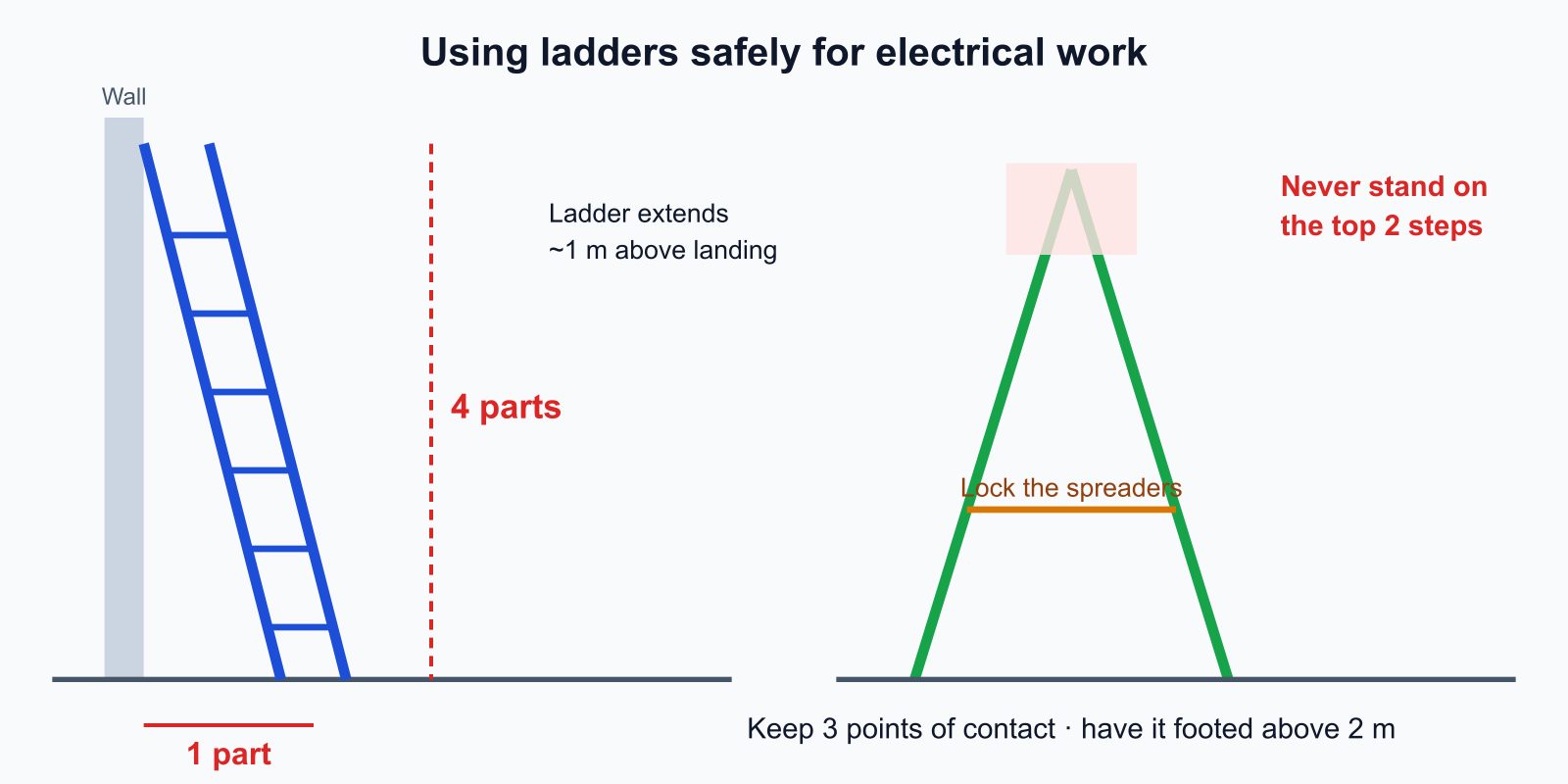
- A-frame stepladders must be fully opened with the spreader bars locked. Do not stand on the top two steps.
- Lean ladders should be set at a ratio of 4:1 (if it reaches 4 m high, the foot is 1 m from the wall), with the top extending about 1 m above the support point.
- Always maintain three points of contact (two feet and one hand, or two hands and one foot). Carry tools in a tool belt, not in your hands, when climbing.
- Have someone hold the foot of the ladder when working at heights above 2 m.
The 3-minute check before every shift
Professional electricians have the habit of quickly checking their tools before starting, just as a driver walks once around the vehicle. The following checklist takes about 3 minutes:
- Insulated tools: plastic not cracked or peeling, inner colour not showing, no burn marks.
- Meter test leads: leads not cracked, no exposed conductor, probe tips have shrouds; the meter switches on and the battery is not showing low.
- Voltage tester: test it on a live source and see that it indicates.
- Insulating gloves: inflation test, no holes.
- Ladder: rubber feet in place, steps not bent, spreader locks working.
- Extension cords and extension sockets: sheath not torn, plug not loose, with a portable RCD when working in damp places.
- Drills and wall chasers: power cord not scuffed, trigger releases properly, blades not chipped.
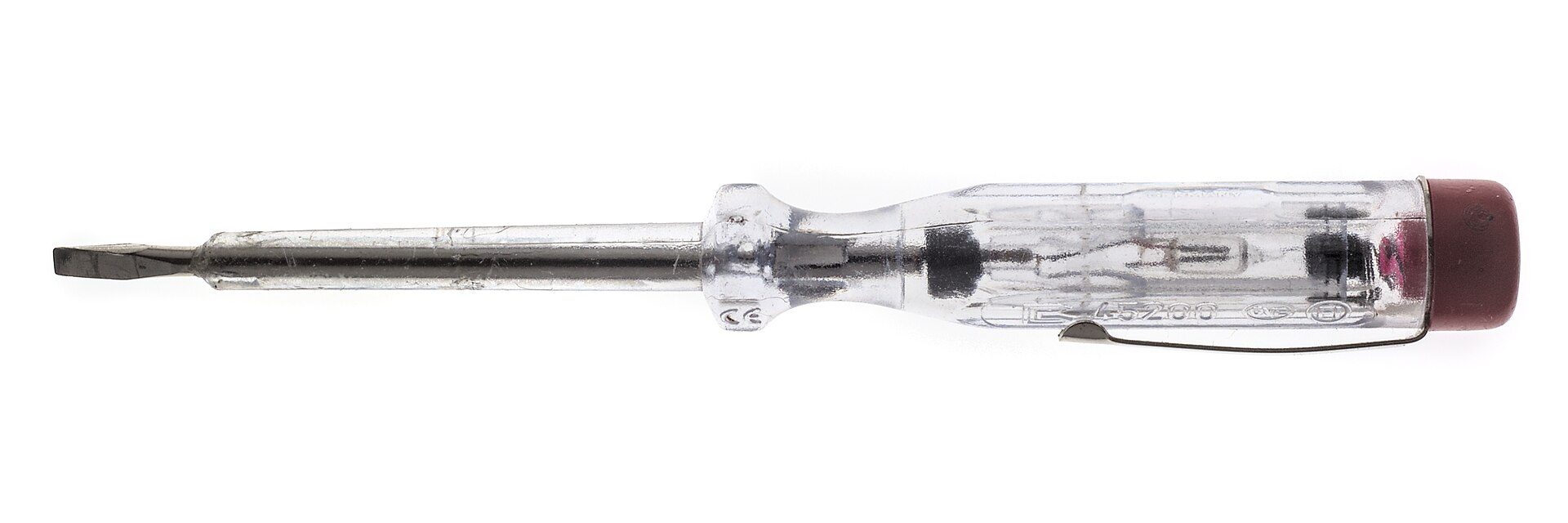
Photo: August Geyler / Wikimedia Commons, CC BY-SA 4.0

Storage and when to throw tools away
| Tool | Signs it must be replaced | Storage |
|---|---|---|
| Insulated screwdrivers and pliers | Cracked, peeling, inner layer showing, screwdriver tip worn round | Keep dry; do not use as a chisel or hammer |
| Insulating gloves | Holes, cracks, sticky, hard and brittle | Separate bag, out of the sun, not folded |
| Test leads | Cracked lead sheath, loose probe tip | Coil loosely, do not kink sharply |
| Ladder | Bent steps, cracked welds, missing rubber feet | Hang horizontally, do not leave out in the rain |
| Extension cords | Torn sheath, scorched plug | Coil properly, do not let vehicles run over them |
Buying tools in stages: safe even on a small budget
New helpers usually have a limited budget. Instead of buying an expensive full set at once or buying cheap tools of unknown origin, split your purchases into stages and give priority to items directly related to safety:
- First week (mandatory): 1000V insulated flat-blade and Phillips screwdrivers, combination pliers, wire strippers, a non-contact voltage tester, a CAT III multimeter, gloves, safety glasses, shoes with insulating soles. These are the things you use every day and they decide whether or not you get a shock.
- First month: ratchet crimping pliers, tape measure, marker pens, head torch, tool belt pouch, insulating tape, spare connectors.
- When you become a lead electrician: clamp meter, insulation resistance tester, torque screwdriver, drill, wall chaser. At first you can share the crew's equipment.
The rule: save money on bags and toolboxes; never save money on insulated tools and measuring instruments.
Common mistakes
- Using a screwdriver as a chisel or a lever: bends the shaft and cracks the insulation.
- Using the wrong size of screwdriver: strips the terminal screw head, does not tighten enough, the loose connection heats up.
- Buying "insulated" tools without the 1000V marking: it is just decorative plastic.
- Wearing rings or metal watches when doing electrical work.
- Standing on the top step of an A-frame ladder to "reach a little further".
- Keeping insulating gloves together with knives and pliers in the tool bag, where they get punctured without you noticing.
Pass criteria for this lesson
- Own all 7 level 1 items in the table, with every insulated tool carrying the 1000V marking and the double triangle.
- Carry out the 3-minute checklist in front of the lead electrician and correctly identify any damaged tool that has been slipped in.
- Strip 10 pieces of 1.5 mm² and 2.5 mm² wire with wire strippers, with no nicked conductors or broken strands on any of them.
- Set up a lean ladder at the correct 4:1 ratio and an A-frame ladder with the spreaders locked; explain why you must not stand on the top two steps.
- Tell work gloves and insulating gloves apart, and state the maximum voltage for class 00 and class 0.
Frequently asked questions
Should I buy a cheap tool set to practise with first?
For cutting tools, ordinary pliers and tape measures, standard-grade products are fine while you are learning. But insulated screwdrivers and pliers and measuring instruments protect your life, so buy certified ones from the start. A good insulated screwdriver lasts for many years.
Can a voltage tester pen replace a multimeter?
No. A voltage tester only tells you whether or not there is voltage at a point, and it can give false readings. A multimeter tells you how much voltage there is and can measure continuity and resistance. The next lesson explains this in detail.
Do I need to wear insulating gloves all the time for electrical work?
Once the power has been isolated and tested again, many residential jobs require finger dexterity, and thick insulating gloves make that difficult. Insulating gloves are used when testing, or switching where there is live voltage or near live parts. Thin work gloves are used when pulling cable, drilling and cutting.
Are aluminium ladders dangerous for electrical work?
Aluminium conducts electricity. Indoors, once the power is isolated, an aluminium ladder with rubber feet is safe enough. Near outdoor wiring and overhead lines, use a composite ladder and always keep a safe distance from the power company's lines.
Further reading
Once you have your tool kit, see how to estimate labour and materials for a job in the article Quoting and taking on electrical jobs.