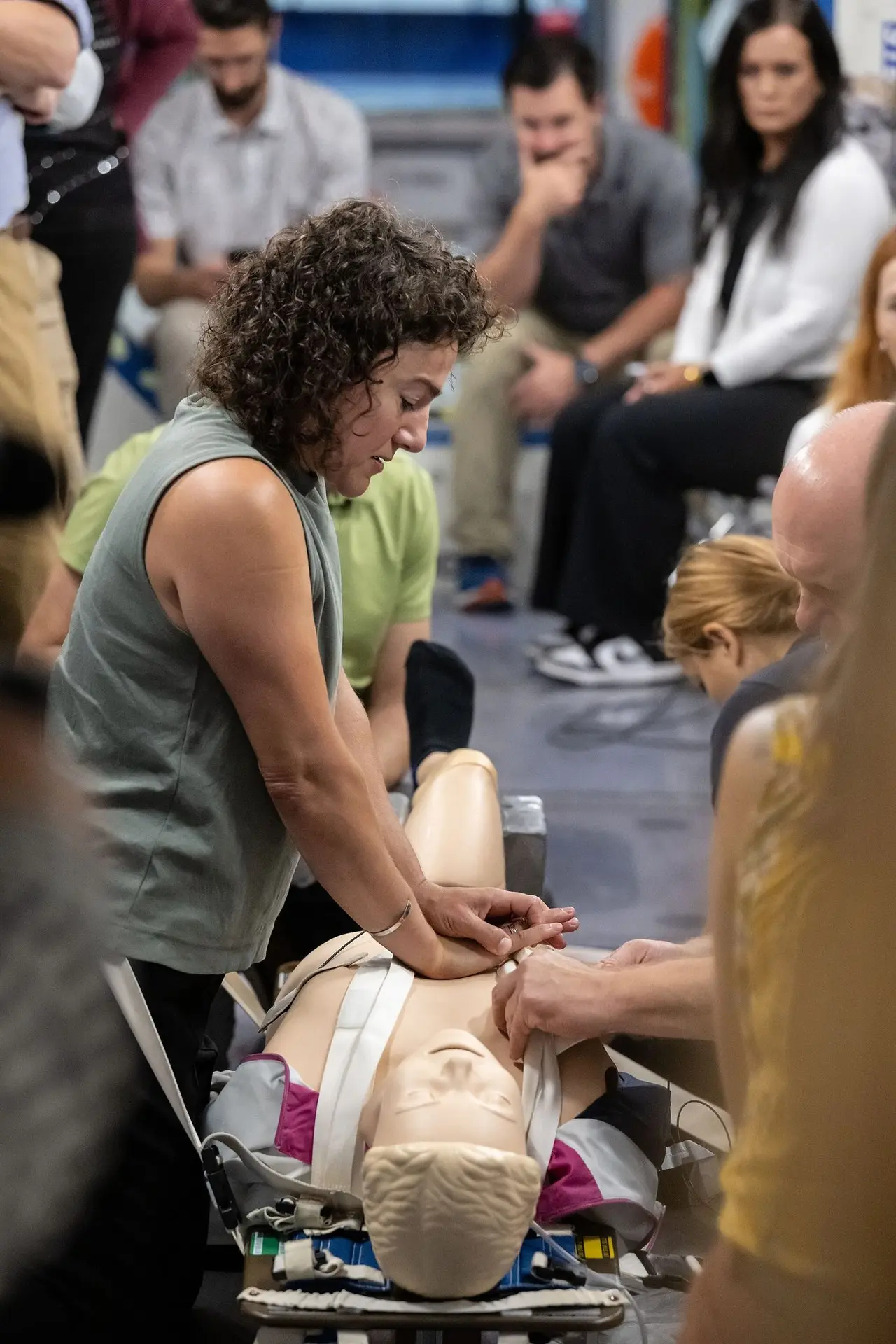
When someone receives an electric shock, the first few minutes decide whether they live or die, and the person closest to them is usually a co-worker, not a doctor. According to the American Heart Association (AHA) and the European Resuscitation Council (ERC), every minute of delay in starting chest compressions after the heart stops reduces the chance of survival by about 7–10%. Yet rescuers often become the second victim because they rush in to pull the victim away while the power is still on. This lesson teaches you to do things in the right order: make yourself safe first, then save the person.
By the end of this lesson, you will be able to:
- Separate the victim from the electrical source without putting yourself in danger.
- Quickly assess consciousness and breathing within 10 seconds and call emergency number 115 with complete information.
- Give external chest compressions in the correct position, 5–6 cm deep, at 100–120 compressions per minute, combined with rescue breaths at 30:2 if you have been trained.
- Use an automated external defibrillator (AED) by following the device's voice instructions.
- Give first aid for electrical burns, place the victim in the recovery position, monitor them and hand over to medical staff.
How an electric shock harms the body
To give first aid correctly, you need to know what you are fighting against. An electric shock can cause several injuries at the same time:
- Ventricular fibrillation or cardiac arrest: the heart quivers chaotically and does not pump blood. Without chest compressions and defibrillation, the brain dies after about 4–6 minutes.
- Respiratory arrest: the current passes through the breathing centre or causes the breathing muscles to cramp. In some cases the heart is still beating but the person has stopped breathing.
- Electrical burns: small burns at the entry and exit points, while inside, muscles, blood vessels and nerves along the current path can be "cooked".
- Secondary injuries: falling from a ladder, broken bones, neck and spinal injuries, head impacts.
- Delayed heart rhythm disorders: a victim who is fully conscious can still develop an irregular heart rhythm several hours later, so they must always be taken for a medical check-up.
Step 1: Separate the victim from the source safely
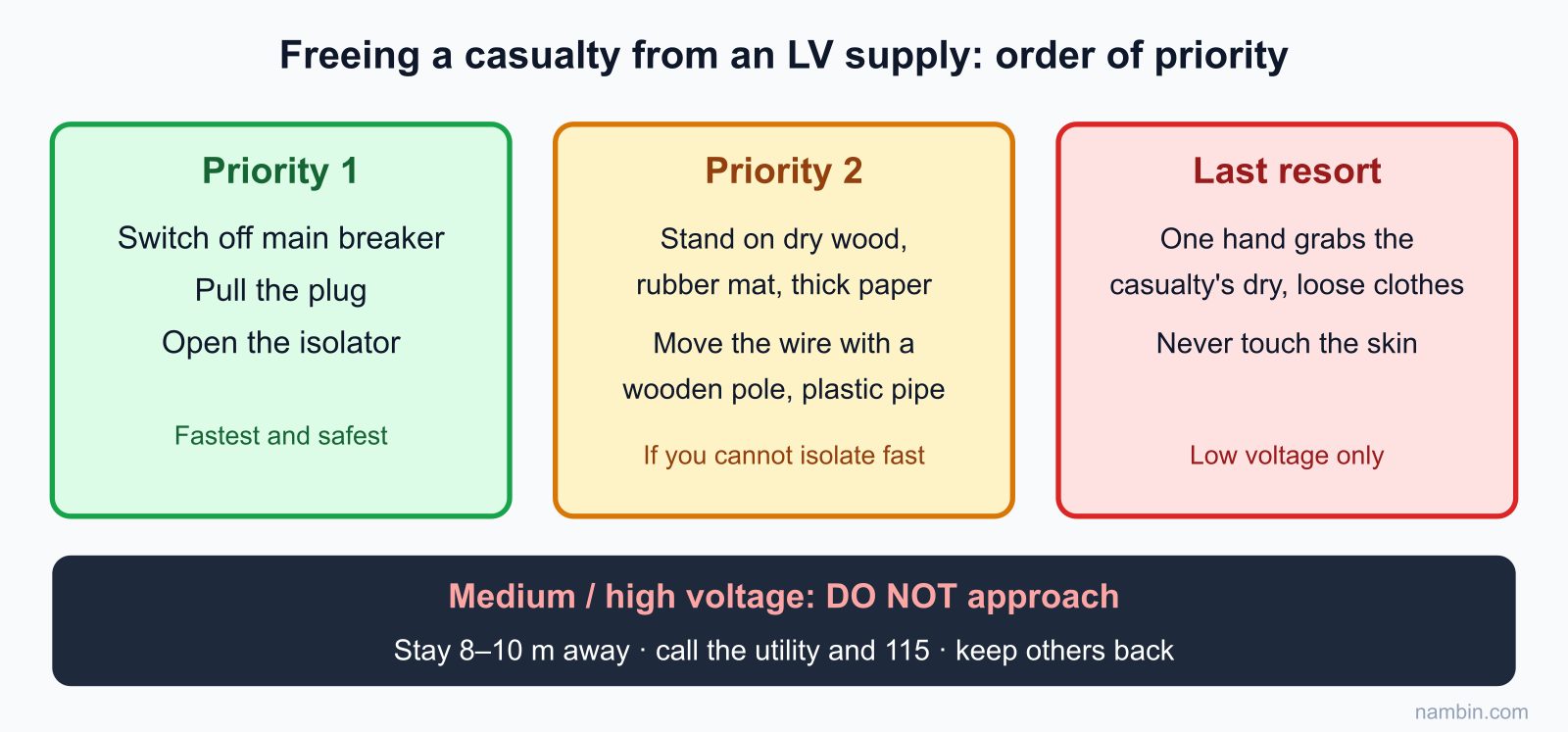
A person who is stuck to a live conductor is part of the electrical circuit. If you touch them with bare hands, you also become part of the circuit. The order of priority is as follows:
- Cut the power: switch off the main breaker, pull the plug, open the isolator. This is always the best option. Wherever an electrician works, they must know where the main breaker is before starting.
- If you cannot cut the power immediately: stand on something dry and insulating (a dry wooden board, a thick stack of newspapers, a rubber mat) and use a dry non-conductive object such as a wooden broom handle, a plastic chair or a PVC pipe to push the wire away from the person, or push the person away from the wire.
- You may grab the victim's dry, loose clothing with one hand, without touching their skin, and pull them away. This is the last resort for low-voltage circuits.
With medium-voltage and high-voltage lines (wires on large poles, transformer substations), do not approach. Keep at least 8–10 metres away, call the power company and 115 immediately, and keep other people back. A "dry" object cannot insulate you against thousands of volts.
Warning: If the victim is working at height, they may fall when the power is cut. If other people are around, have someone ready to catch them or prepare padding, but do not let this delay cutting the power. A fall can cause injury, but prolonged contact with electricity is almost certain to be fatal.
Step 2: Assess and call for emergency help
Check consciousness
Once you are sure the source has been separated, approach the victim, tap them on the shoulder and shout: "Can you hear me?". If the victim answers, moves or groans, they are conscious. Keep them lying still, do not let them get up and walk around, check for burns and injuries, and call 115 or take them to hospital.
Check breathing for no more than 10 seconds
If there is no response: tilt the head back and lift the chin to open the airway (take care if you suspect a neck injury from a fall), watch whether the chest rises and falls, and listen and feel for breath on your cheek. Gasping (occasional, irregular gasps) is not normal breathing; treat it as if the person is not breathing.
Call 115 correctly
Ask one person to call 115 and another to fetch an AED if the building has one. If you are alone, put the phone on speaker and call while doing chest compressions and talking. Information to give:
| Information | Example |
|---|---|
| Exact address and an easy-to-find landmark | No. 12, Lane 45, X Street, next to Y pharmacy |
| What happened | Person shocked by 220V, power already cut |
| Condition of the victim | Unconscious, not breathing, chest compressions in progress |
| Number of victims | One person, male, about 30 years old |
| Call-back phone number | The caller's number |
Do not hang up until the dispatcher tells you to. They can guide you through chest compressions over the phone.
Step 3: External chest compressions
When the victim is unconscious and not breathing normally, start chest compressions immediately. Do not waste time checking for a pulse if you are not medically trained.
- Lay the victim on their back on a firm, flat surface (the floor, not a mattress).
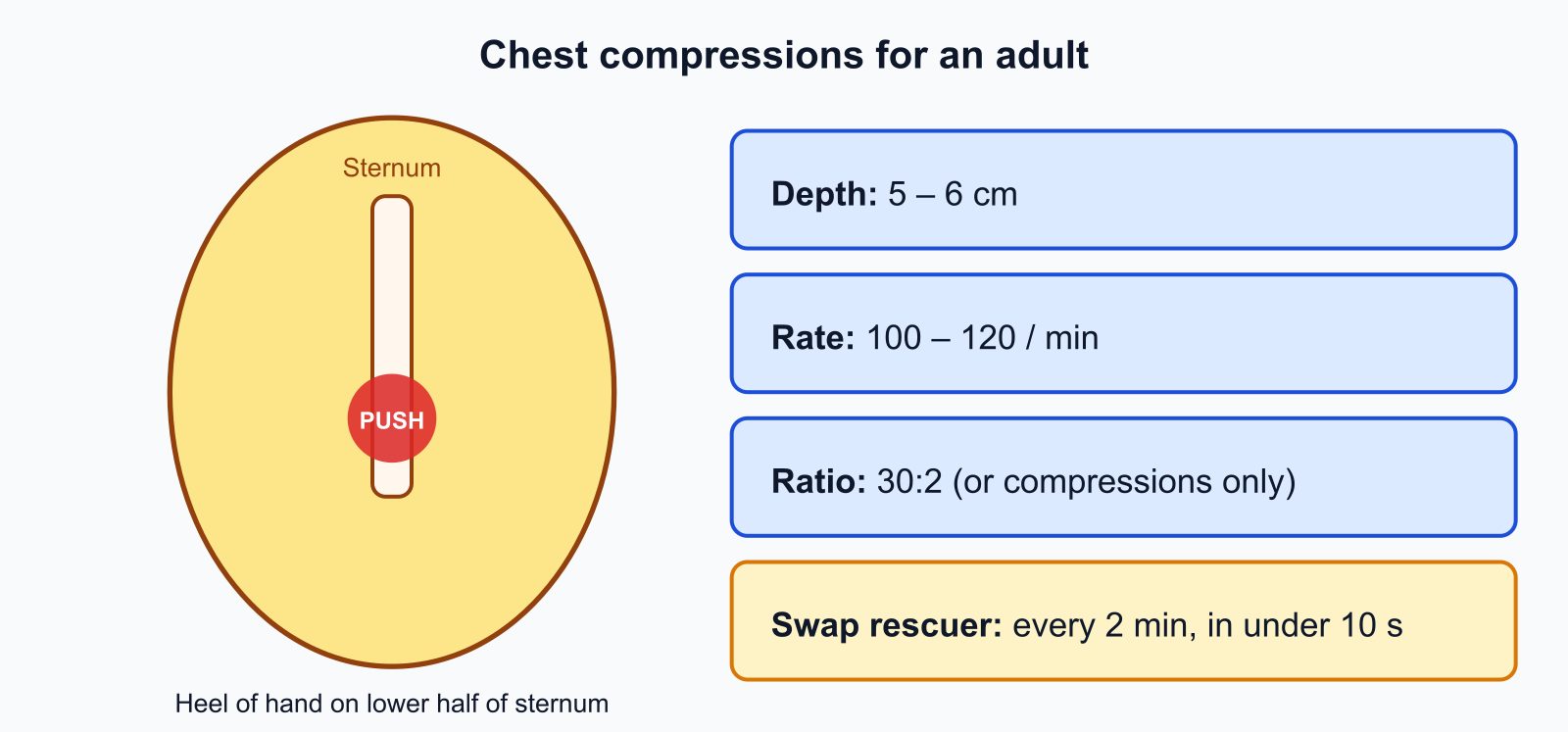
- Kneel beside the victim's chest. Place the heel of one hand in the centre of the chest, on the lower half of the breastbone, place the other hand on top and interlock your fingers, keeping your fingers off the ribs.
- With straight arms and your shoulders directly above your hands, use your body weight to press straight down 5–6 cm deep for an adult.
- Compress at a rate of 100–120 per minute (roughly the beat of the song "Stayin' Alive"), letting the chest rise fully after each compression.
- If you have been trained in rescue breathing: after 30 compressions, give 2 breaths of about 1 second each, watching the chest rise. If you have not been trained or do not want to give breaths: give continuous chest compressions only, which still has great life-saving value.
- Swap the person doing compressions every 2 minutes if someone else is available, because the rescuer gets tired and compressions become shallower. The changeover should take less than 10 seconds.
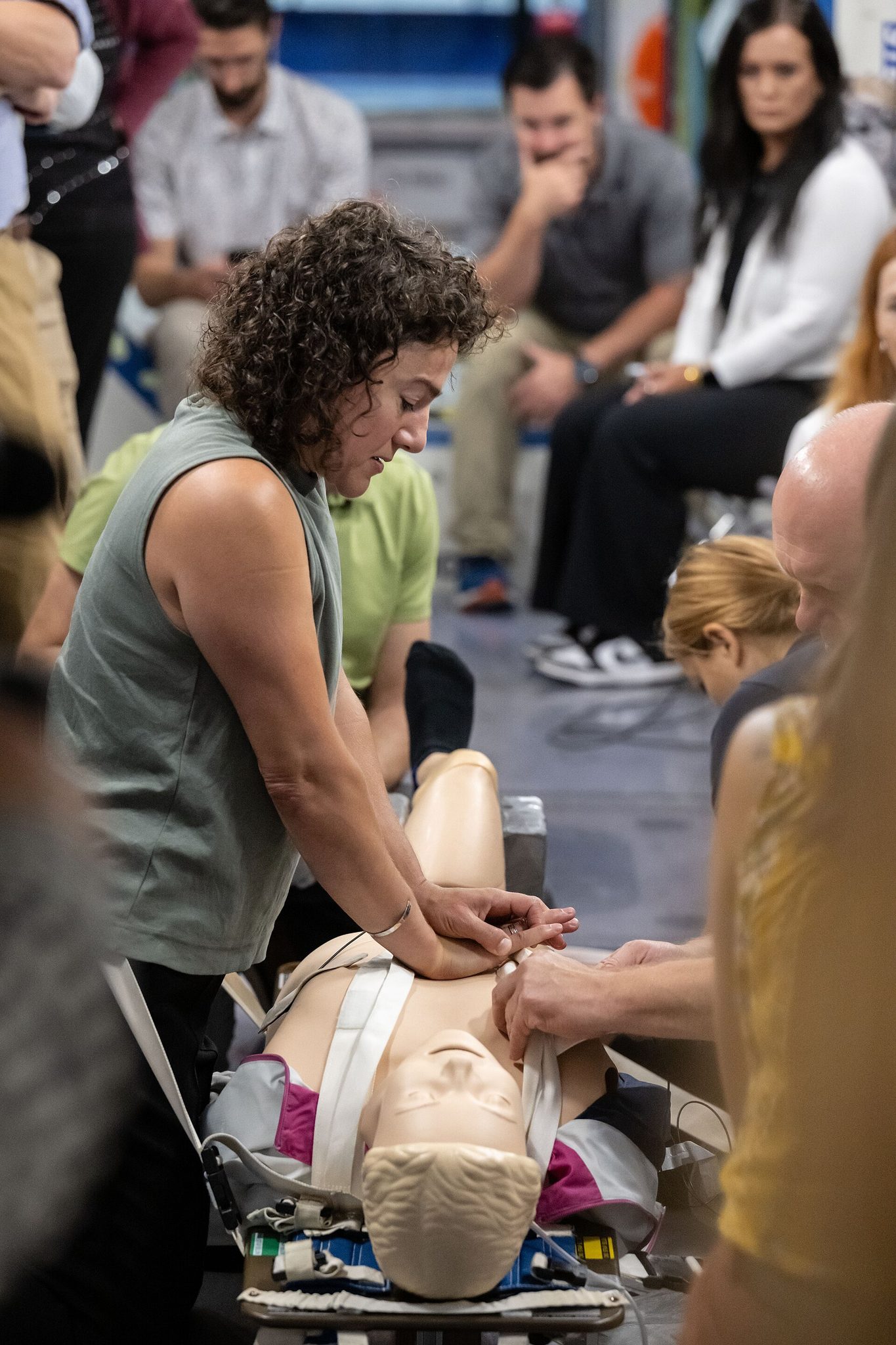
Photo: NASA Johnson Space Center / NASA/PHOTO BILL STAFFORD / Wikimedia Commons, Public domain

Step 4: Using an automated external defibrillator (AED)
An AED analyses the heart rhythm and, if it detects ventricular fibrillation, delivers an electric shock to "restart" the heart. In electric shock accidents, ventricular fibrillation is a very common cause of cardiac arrest, so an AED is especially valuable. AEDs are increasingly available at airports, shopping centres, train stations and office buildings in Vietnam.
- Open the lid and switch the device on. It will guide you with voice instructions.
- Bare the victim's chest and dry it if it is wet. Stick one electrode pad below the right collarbone and the other on the left side of the chest below the armpit, exactly as shown on the pads.
- When the device says "analysing", nobody should touch the victim.
- If the device says a shock is needed: shout "Stand clear!", check that nobody is touching the person, and press the shock button. A fully automatic device will deliver the shock by itself.
- Immediately after the shock, continue chest compressions for 2 minutes until the device analyses again.
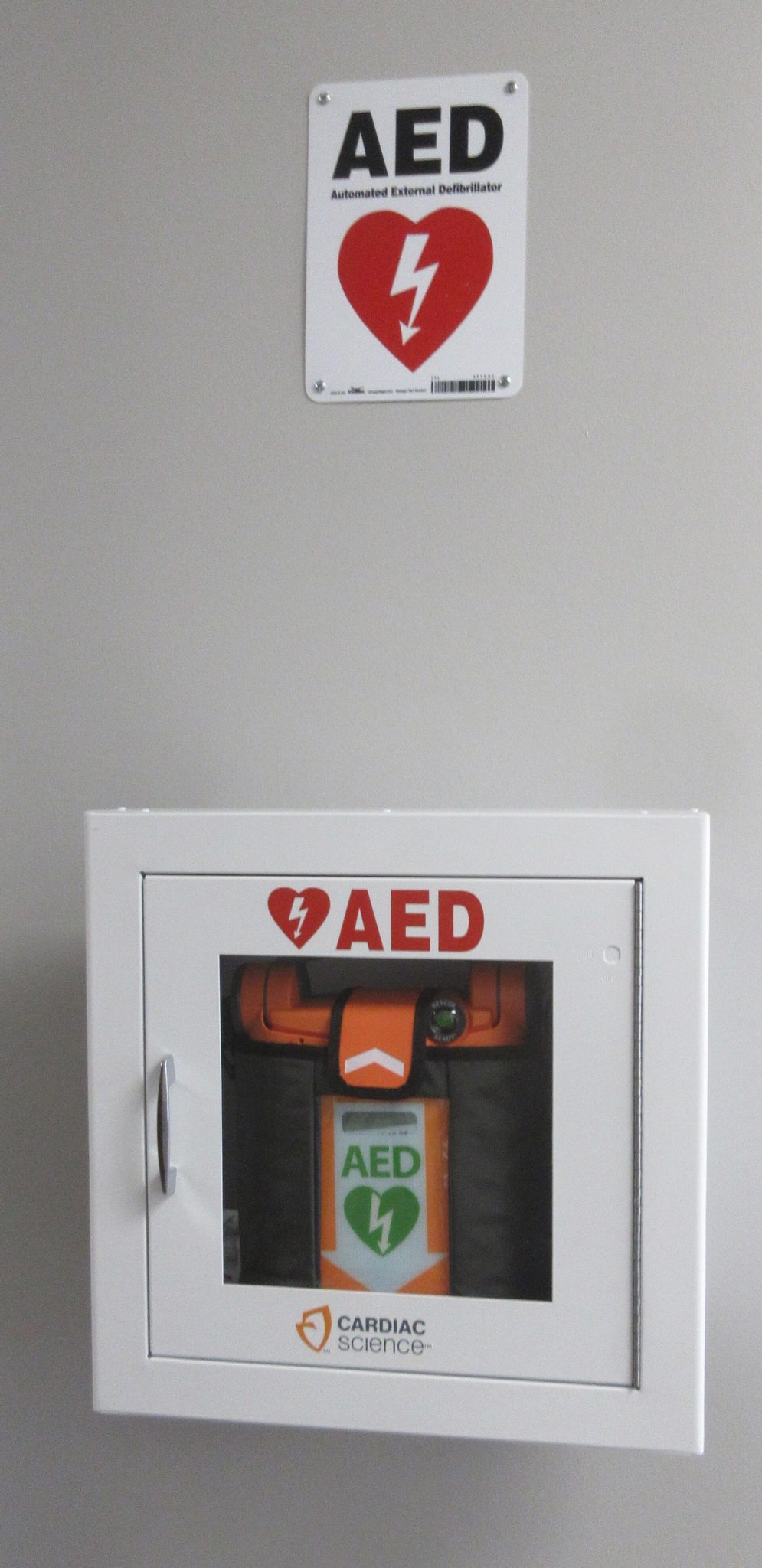
Photo: Infrogmation / Wikimedia Commons, CC BY-SA 4.0

When the victim starts breathing again, and dealing with electrical burns
The recovery position
If the victim is breathing again but not yet conscious, place them in the recovery position so that saliva, mucus and vomit can drain out instead of blocking the airway. The lower arm is stretched out at a right angle, the upper hand is placed under the cheek, and the upper leg is bent at the knee. Keep monitoring their breathing continuously; if they stop breathing again, go back to chest compressions.
First aid for electrical burns
- Cool the burn with clean, cool water (not ice water) for about 20 minutes, as long as this does not delay resuscitation.
- Remove rings, watches and bracelets before swelling sets in.
- Cover the burn with a clean gauze dressing or cling film. Do not apply toothpaste, fish sauce or python fat.
- Do not burst blisters and do not peel off burnt skin that is stuck to clothing.
Every electrical burn must be seen in hospital, because the internal damage is much greater than the mark on the skin.
Preparing before an accident happens
Good first aid starts before any accident occurs. Every crew should have:
- At least two people who have taken a first aid and cardiopulmonary resuscitation (CPR) course with hands-on practice on a manikin. The Red Cross and many hospitals run short courses.
- A first aid kit: sterile gauze, roller bandages, cling film, medical gloves, single-use rescue breathing face shields.
- The habit of asking "where is the main breaker?" and "what is the exact address here?" when arriving at every new site.
- A no lone working rule for jobs with a high electrical risk, such as working on the main panel or working at height near power lines.
Three common situations in homes
Bathroom: a person is shocked when touching the shower head, by a leaking water heater, on a wet floor. Do not step into standing water before the main breaker has been switched off, because the water on the floor may be live. After switching off, pull the victim out of the bathroom and dry their chest before applying the AED pads.
Well pumps and garden pumps: temporary cables run across damp ground, a pump casing leaking current. Disconnect the power at the socket or the breaker feeding the pump; if you do not know which one, switch off the main breaker. Do not hold the water pipe connected to the pump.
On a ladder: an electrician is shocked while connecting a ceiling light and falls. Once you are sure the power is off, give priority to checking breathing and giving chest compressions if needed; avoid twisting the victim's neck because there may be a spinal injury, but opening the airway and chest compressions still take priority.
Common mistakes in first aid
| Mistake | Consequence | The right way |
|---|---|---|
| Rushing in to pull the victim with bare hands | The rescuer gets shocked too | Cut the power first, or use a dry insulating object |
| Giving compressions on a mattress | The mattress absorbs the force, so compressions are ineffective | Move the victim onto a hard floor |
| Compressing too shallow or too slowly | Not enough blood reaches the brain | 5–6 cm deep, 100–120 per minute |
| Repeatedly stopping compressions to check the pulse | Loses the blood pressure you have built up | Only stop when the AED is analysing or the victim regains consciousness |
| Letting the victim go home because they "seem fine" | Missing delayed heart rhythm disorders and deep injuries | Always take them for a medical check-up |
Pass criteria for this lesson
- State the correct order of actions: make yourself safe – separate from the source – check consciousness – call 115 and get an AED – chest compressions – AED, without swapping any steps.
- On a manikin or a firm pillow, compress in the correct position and keep a rate of 100–120 per minute for 2 continuous minutes (use a metronome app to check).
- Give the 5 pieces of information needed for 115 in a simulated scenario set by the lead electrician.
- Correctly describe how to place the two AED electrode pads and say "Stand clear" before delivering a shock.
- Point out where the main breaker is and state the exact address of the site you are working on.
Frequently asked questions
If I am not trained, should I still give chest compressions, even though I might break ribs?
Yes. Correct chest compressions can crack or break ribs, but a person in cardiac arrest who receives no compressions will almost certainly die. International guidelines encourage untrained bystanders to give continuous chest compressions without rescue breaths.
Can an AED shock someone whose heart is still beating by mistake?
An AED analyses the heart rhythm by itself and only allows a shock when it detects a shockable rhythm such as ventricular fibrillation. The user does not need to know how to read an ECG. Your job is to follow the device's instructions and make sure nobody is touching the victim during the shock.
The victim had a mild shock, is still conscious and talking normally. Is there anything I need to do?
Let them rest, check for burns at the entry and exit points, and ask whether they have chest pain, palpitations or difficulty breathing. They should be taken for a check-up, especially if the current passed across the chest, if they lost consciousness at any point, if they have burns, or if they have a heart condition. Record the incident so the whole crew can learn from it.
How often should I retake first aid training?
Chest compression skills fade quickly without practice. You should refresh them at least once a year, ideally on a manikin with depth feedback.
Further reading
The electrician's practical exam always includes a safety scenario section; see Safety and circuit installation test.