You have the drawings and the cost estimate. The next step decides whether you win the job at all, and whether that job wears you out for three months: the quotation and the contract. Most disputes between electricians and homeowners do not come from technical problems but from phrases like "I thought that was included", "but we agreed on it verbally" and "why are there so many extras?". A clear quotation and a short but complete contract settle 90% of those situations before they happen.
This lesson is not a substitute for legal advice. It gives you a practical quotation and contract framework that a master electrician in Vietnam can use for residential projects, together with a warranty policy and a method for handling variations.
By the end of this lesson, you will be able to:
- Prepare a structured quotation: scope, assumptions, detailed price table, exclusions and validity period.
- Choose the right pricing method: lump sum, unit price per point, or labor plus materials at cost.
- Draft a residential electrical installation contract with the core clauses.
- Design a staged payment schedule tied to inspections.
- Manage variations with signed change request forms.
- Build a warranty policy and a procedure for handling warranty claims.
Three pricing methods
| Method | How it is calculated | Advantages | Risks | Best for |
|---|---|---|---|---|
| Lump sum (fixed price) | One total price for a defined scope | Easy for the client to understand and agree; good profit for electricians who take off accurately | The electrician carries the take-off risk; arguments about scope | New houses with clear drawings |
| Unit price per point / meter | A unit price for each light point, socket, meter of wire, panel and so on × the quantity actually measured at inspection | Fair when quantities are uncertain; variations are easy to price | Quantities must be measured carefully at inspection; the client finds the total hard to predict | Houses where the interior is not finalized, renovations |
| Fixed labor + materials at cost | The electrician is paid for labor; the client buys or pays for materials against invoices | Transparent materials; the electrician needs little capital | The client buys poor-quality materials; late materials delay the schedule | Clients who want to choose brands themselves, small jobs |
In practice, many master electricians use a combination: a lump sum for the rough-in (conduit, wire, panels, earthing) and unit prices for the finishing devices (lights, switches, sockets), because clients often change models.
Structure of a professional quotation
1. Details and scope
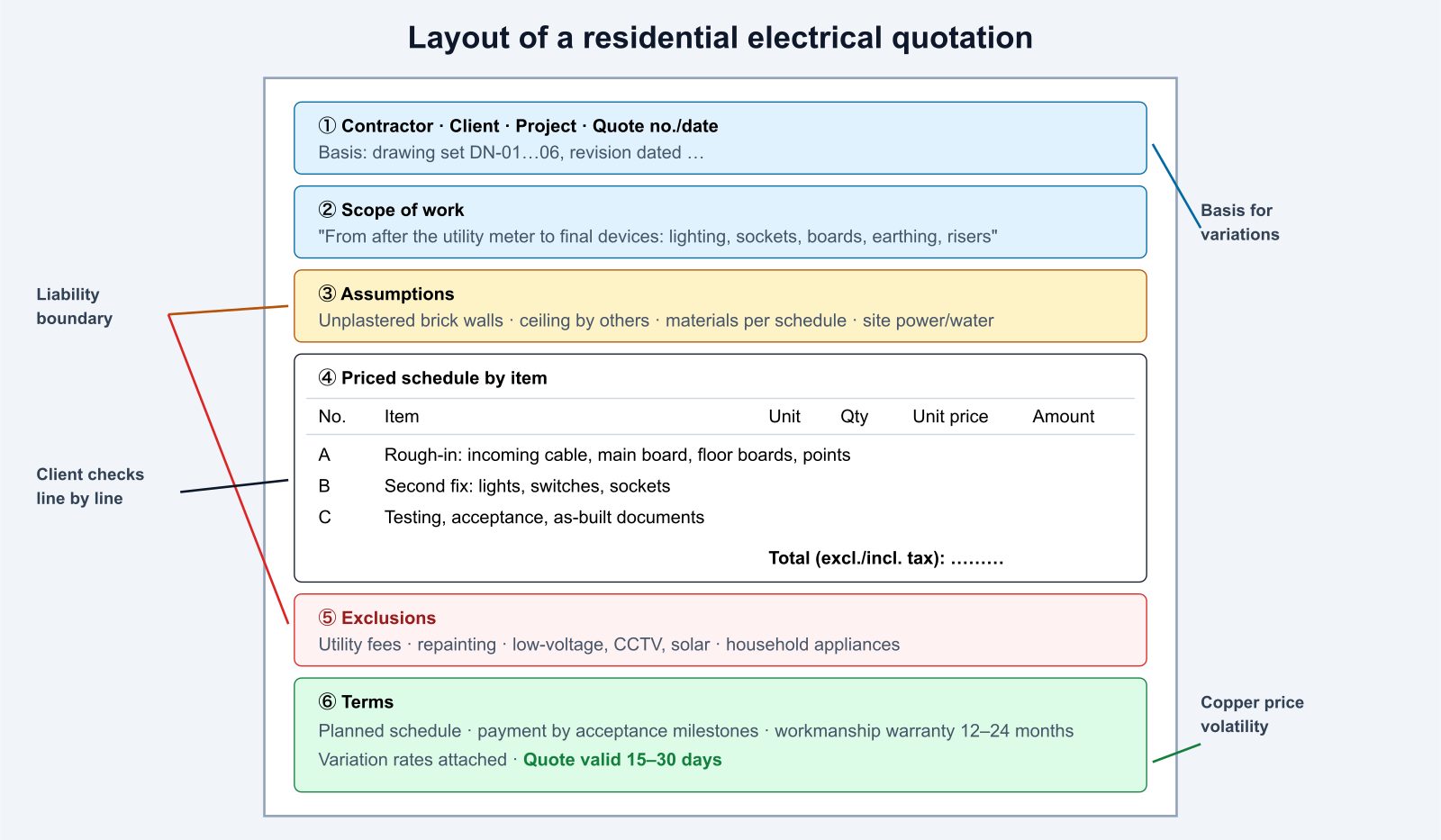
State the project name and address, and the drawing numbers and dates the quotation is based on (for example "Electrical drawing set ĐN-01 to ĐN-06, revision dated 12/10"). Describe the scope in clear sentences: "Supply of materials and installation of the lighting, socket, distribution panel, earthing and riser cable systems for a four-storey house, from the utility meter to the end devices".
2. Assumptions
- Brick walls, not yet plastered (chasing done before plastering). Concrete walls priced as a variation per meter.
- Gypsum ceilings installed by another crew; the electrical crew waits for the ceiling framing before running conduit.
- Material brands and types as per the attached list. A change of brand is priced at the difference.
- Construction power and water supplied by the owner.
3. Price table by item
| No. | Item | Unit | Quantity | Unit price | Amount |
|---|---|---|---|---|---|
| A | Rough-in | ||||
| A1 | CXV 4×10 mm² cable from the meter to the main panel | m | 19 | … | … |
| A2 | Complete three-phase main panel as per the single-line diagram | panel | 1 | … | … |
| A3 | Complete floor panel | panel | 3 | … | … |
| A4 | Lighting point (conduit, wire, box, labor, light fitting not included) | point | 60 | … | … |
| A5 | Socket point (conduit, wire, box, labor, faceplate not included) | point | 37 | … | … |
| A6 | Large-load supply point (air conditioner, water heater, cooker) | point | 9 | … | … |
| A7 | 3-rod earthing system, measurement, report | system | 1 | … | … |
| B | Finishing | ||||
| B1 | Installing recessed downlights (fittings as chosen by the client) | set | 44 | … | … |
| B2 | Switches, sockets and faceplates (as per the list) | set | 48 | … | … |
| C | Testing, inspection, as-built documents | package | 1 | … | … |
You do not need to show the client your in-house norms or profit margin. But every line must carry enough detail for the client to check it: what a "socket point" includes and what it does not.
4. Exclusions
- Utility fees for connection, capacity upgrades or conversion to three-phase (the electrician helps with the paperwork if the client asks).
- Filling, plastering and repainting wall chases after the conduit is installed (or state clearly "rough mortar fill only, no painting").
- Low-voltage systems, cameras, solar power (quoted separately).
- Household electrical appliances, special decorative lighting, ceiling fans.
5. Terms
Expected schedule, payment terms, warranty and the validity period of the quotation (15–30 days, because copper wire prices fluctuate).
Photo: Richard Lloyd & Sons / Wikimedia Commons, Public domain

Installation contract: the core clauses
A residential contract does not need to be 20 pages long. Three to four pages covering the following clauses are enough for most family homes. The contract should be in writing, signed by both parties, with each party keeping a copy.
| Clause | What it must contain |
|---|---|
| Parties | Full names, ID numbers, addresses, phone numbers; for a household business or company, the tax code and legal representative |
| Scope of work | Reference to the quotation and the attached drawing set (as an integral appendix) |
| Contract value | Total price, pricing method, whether tax is included, how variations are priced |
| Schedule | Start date, duration, milestones; conditions for extensions (waiting for other crews, the client changing the design, weather) |
| Payment | Installments, percentages, conditions for each installment (tied to inspections), bank transfer details |
| Materials | Types and brands; who buys them; checking materials on delivery to site; who owns surplus materials |
| Inspection | Inspection of concealed work (before plastering and closing ceilings), completion inspection with testing, signed minutes |
| Changes and variations | Every change by signed request form; variation unit prices from the attached price schedule |
| Safety and responsibility | The contractor is responsible for the crew's safety; the owner ensures access to the site; care of property |
| Warranty | Period, scope, exclusions, response time |
| Termination and disputes | Conditions for suspension and termination; payment for work done; negotiate first, then proceed according to law |
Note: The contract should take into account the provisions of the Civil Code on service contracts and contracts for work. For large projects or business clients, ask someone with legal expertise to review your contract template once, then use it as your standard template.
Staged payments
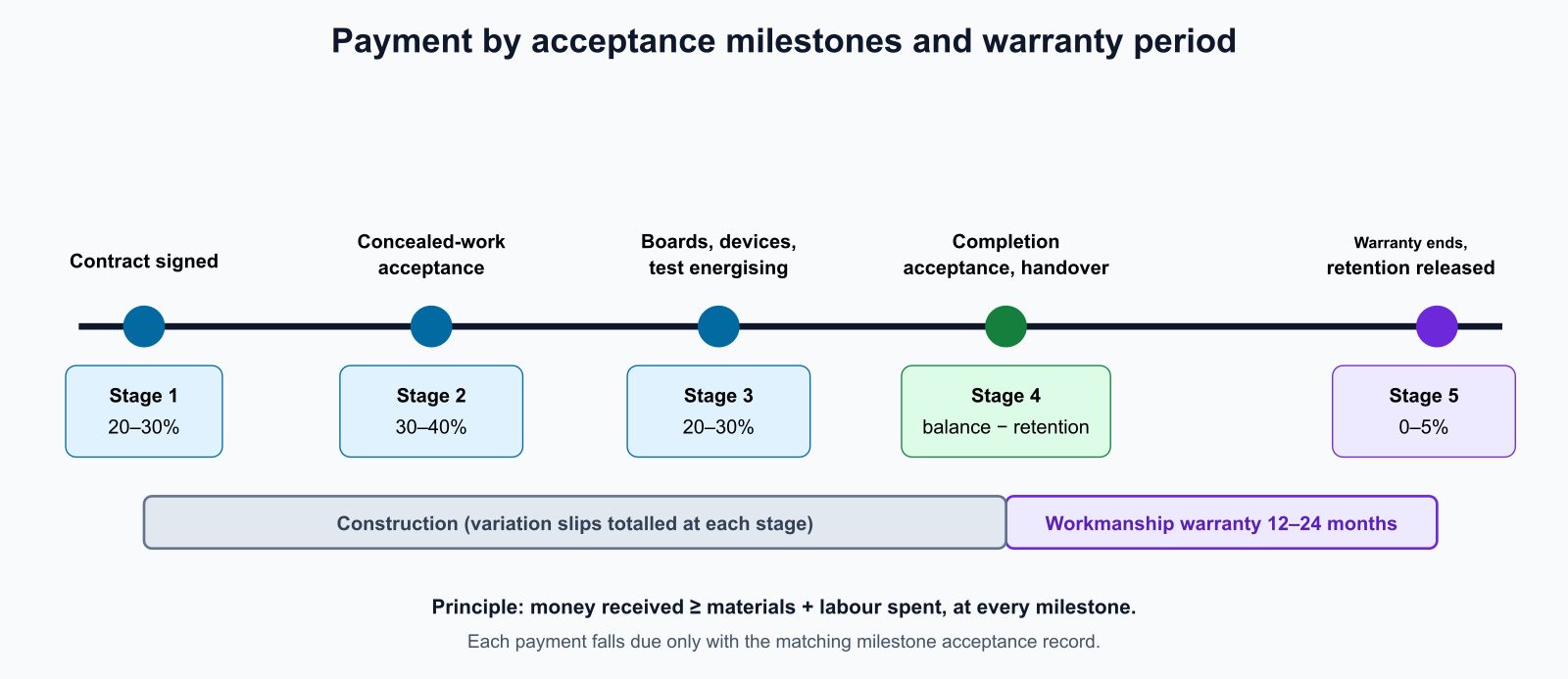
| Installment | Milestone | Reference percentage | Documents |
|---|---|---|---|
| 1 | Contract signed (advance for materials) | 20–30% | Signed contract |
| 2 | Conduit and wiring concealed in walls and ceilings completed – concealed-work inspection | 30–40% | Concealed-work inspection minutes + photos of the conduit routes |
| 3 | Panels and devices completed, trial energizing | 20–30% | Energizing minutes |
| 4 | Completion inspection, handover of documents | The balance less the retention | Test report, as-built documents |
| 5 | End of the warranty retention period | 0–5% | Confirmation that no defects remain |
The cash flow principle: the money the client has paid must always be greater than or equal to the value of the materials and labor you have put in. If you are paying out of your own pocket to work for the client, you are taking on credit risk with no interest.
Managing variations
Variations are normal: the client adds sockets, moves lights, upgrades the panel. The problem is variations that are not recorded. The procedure:
- The client requests a change (or you find that a change is needed): fill in a change request form with a description, the reason, the quantity, the unit price (from the price schedule in the contract) and the impact on the schedule.
- The client signs it (or confirms by a text message containing the form's content) before the work is done.
- Number the form and file it in the project records.
- At the end of each payment stage, prepare a summary of additions and deductions (items the client removes must also be deducted – transparency builds trust).
Be polite but firm on the principle: "If you'd like to add it, I'll do it right away. I'll just write up a variation form so we can check everything clearly at the end of this stage."
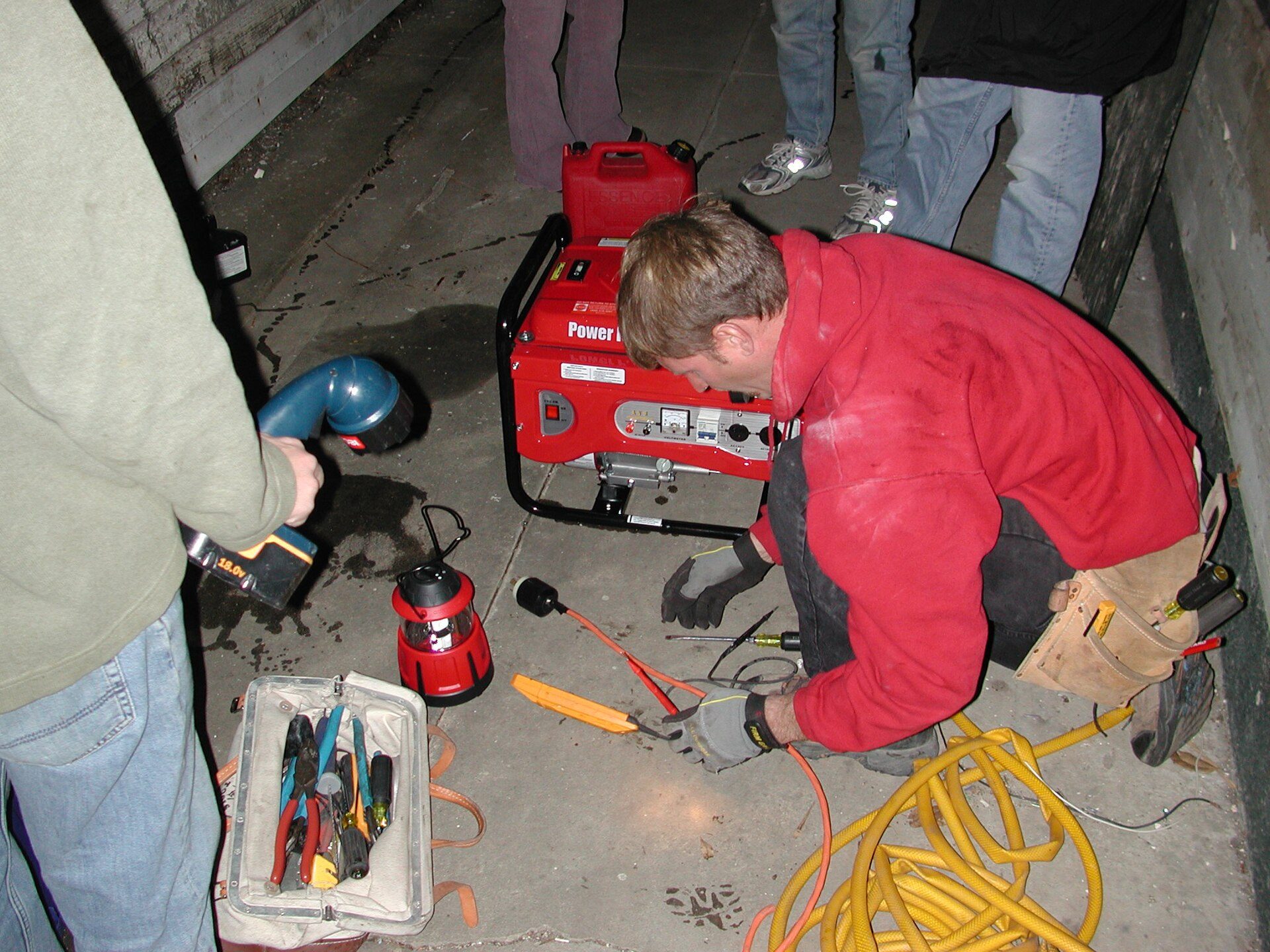
Photo: photo taken by flickr user editor B / Wikimedia Commons, CC BY 2.0

Warranty policy
Two layers of warranty
- Equipment warranty: provided by the manufacturer (breakers, RCDs, lights and sockets are usually 1–2 years or as per the brand). You are the point of contact who receives and exchanges items for the client if you supplied them; keep the invoices and warranty stickers.
- Workmanship warranty: your own commitment – faulty connections, loose terminals, wrong circuits, conduit and wiring defects caused by installation. Common practice is 12–24 months for homes; reputable electricians may commit to a longer period for concealed wiring.
Warranty exclusions (state them clearly)
- Damage caused by lightning, overvoltage from the grid, natural disasters or flooding.
- Repairs or additional connections by third parties, drilling into cable routes.
- Use beyond the design load (adding an air conditioner to a socket circuit, and so on).
- Natural wear of devices with a limited life (lamps, LED drivers past the manufacturer's warranty period).
Claims procedure
- A fixed phone number or messaging channel printed on the panel label and in the handover documents.
- Committed response times: power failure or a burning smell – the same day; non-urgent faults – within 48–72 hours.
- Keep a warranty log: date, symptoms, cause, action taken, parts replaced. This is the data you use to improve your installation process.
- After the fix, the client confirms. If the cause falls under an exclusion, quote for the repair before doing it.
Good warranty service is the cheapest sales channel: clients who are satisfied after a fault refer more new clients than clients who never had a fault at all.
Common mistakes
| Mistake | Consequence | The right way |
|---|---|---|
| Quoting a single total figure with no scope | Arguments about "is that included?" | Item table + exclusions + assumptions |
| Verbal agreements | No evidence in a dispute | A written contract with the drawings as an appendix |
| A small advance, collecting only at the end | You finance the job and risk not being paid | Payments tied to inspection milestones |
| Doing variations without a form | The client does not accept them at the end of the job | A change form signed before the work |
| Promising a vague "lifetime" warranty | Unlimited liability | A specific period, scope and exclusions |
| Quotations with no validity period | The client accepts three months later, after wire prices have risen | Valid for 15–30 days |
Pass criteria for this lesson
- Prepare a quotation for a sample house with all 5 sections: details and scope, assumptions, item price table, exclusions, terms and validity.
- Choose and justify the pricing method for 3 situations: a new house with drawings, a renovation, and a client who buys their own materials.
- Draft a sample contract with all 11 clause groups in the table.
- Design a payment schedule in which money received is always ≥ the costs incurred at every milestone.
- Write a change request form and a warranty policy with a period, scope, exclusions and response times.
Frequently asked questions
The client compares my price with another electrician who is 20% cheaper. What should I do?
Ask the client to put the two quotations side by side and compare them line by line: material brands, wire sizes, number of circuits, whether there are RCDs, earthing, testing and documentation. The cheaper quotation usually leaves those things out. If the scope really is the same, review your own norms and costs.
Do I need to issue invoices?
It depends on how your business is set up and what the client needs. Household businesses and companies have tax and invoicing obligations under the regulations. State clearly in the quotation whether prices include tax to avoid misunderstandings. The lesson on running an electrical services business covers this in more detail.
What if the client does not pay on time?
The contract should include a clause allowing you to suspend work when payment is late by more than a set number of days. Give notice in writing or by text message and stay polite. Never remove installed equipment on your own initiative – that could put you in the wrong legally and create a hazard.
Further reading
Review the lesson Quoting and taking on jobs as an electrician for small repair jobs, and the Level 2 inspection lesson to link payments to test reports.