
A good electrician can complete a job. A master electrician creates other good electricians. Once you have a team, the limit of your business is no longer your own two hands but how fast you can train other people to reach your standard. And because electrical work is a trade where one small mistake can kill someone, mentoring apprentices is not just about productivity – it is about safety.
In residential electrical work in Vietnam, most electricians learn by "following a master": working as a helper for a few years, watching and copying. This passes on real practical experience, but it has three major weaknesses: it passes on bad habits as well, there is no standard for knowing when a helper is ready, and the learning period drags on longer than it needs to. This lesson gives you a structured way to mentor, based on the very 4-level programme you have just worked through.
By the end of this lesson, you will be able to:
- Use the 4-level competency matrix to determine where an electrician stands and what they need to learn next.
- Apply the 4-step mentoring process: demonstrate – do together – do under supervision – do independently.
- Design a 6-month mentoring plan for a new apprentice.
- Assess skills with practical tests that have measurable criteria, not gut feeling.
- Give feedback that helps an electrician improve without destroying morale, and deal with safety violations.
- Build working standards for your team so that every job is delivered to the same quality.
The 4-level competency matrix
You cannot mentor well unless you know clearly what the "destination" of each level is. The competency matrix summarizes the 4-level programme as what an electrician can do at each level, across 5 competency groups.
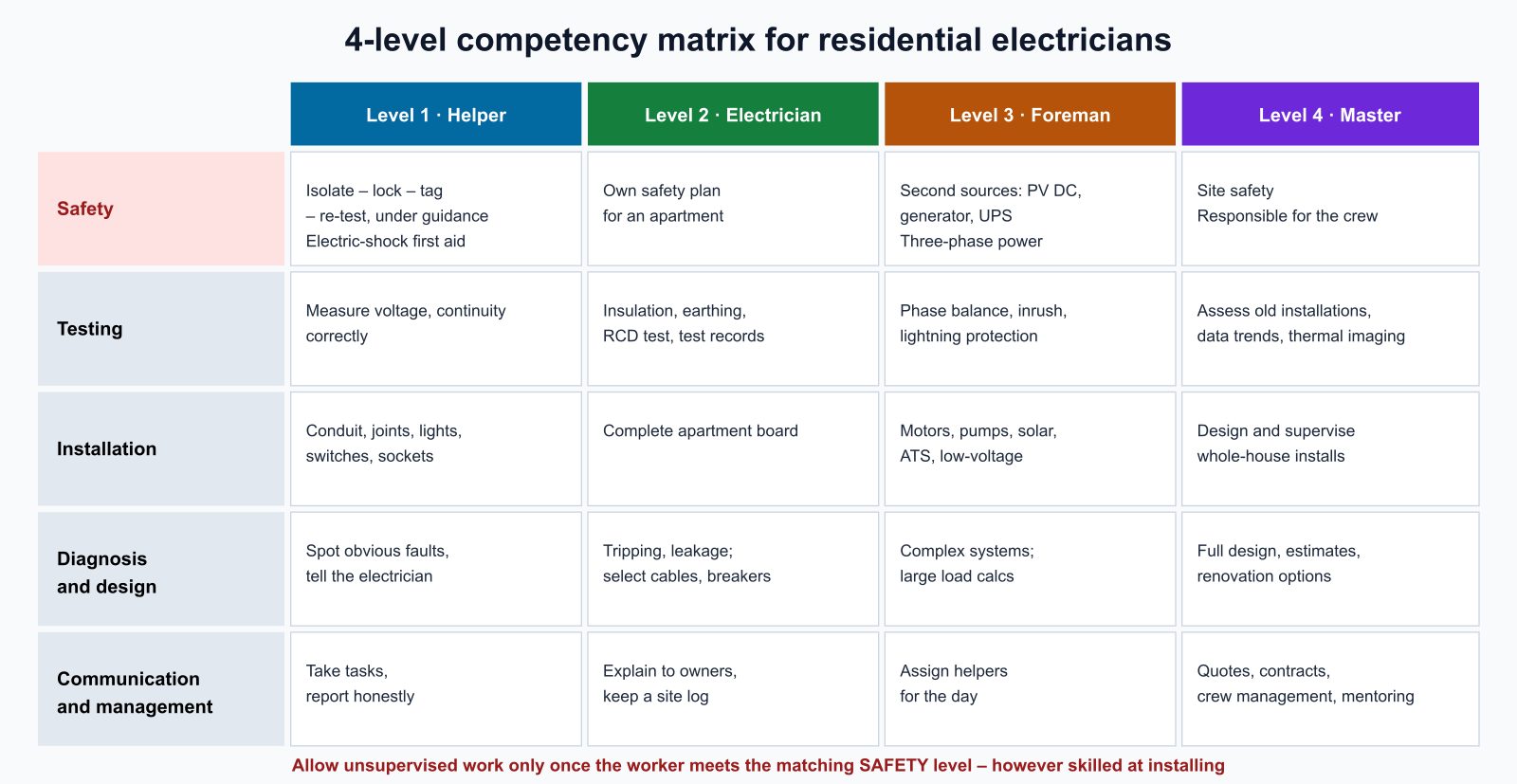
| Competency group | Level 1 – Apprentice | Level 2 – Electrician | Level 3 – Lead electrician | Level 4 – Master |
|---|---|---|---|---|
| Safety | Follows isolate – lock – tag – test under supervision; first aid | Plans safety for an apartment on their own | Safety with second sources (solar DC, generators), three-phase | Manages site safety, responsible for the whole team |
| Testing | Measures voltage and continuity correctly | Tests insulation, earthing, RCDs; fills in test records | Measures phase balance, starting current, lightning protection | Assesses older installations, analyses trends in test data |
| Installation | Runs conduit, joins cables, installs lights, switches, sockets | Installs a complete apartment board | Motors, pumps, solar PV, ATS, low-voltage systems | Designs and supervises installation of a whole house |
| Diagnosis and design | Recognizes obvious faults, reports to the electrician | Diagnoses tripping breakers, leakage; selects cables and breakers | Diagnoses complex systems; calculates large loads | Full design, estimating, preparing options |
| Communication and management | Takes instructions, reports honestly | Explains to the homeowner, keeps a site diary | Assigns daily tasks to apprentices | Quotations, contracts, team management, mentoring |
An electrician can be at different levels in different groups. For example, a young electrician might install at Level 2 but diagnose and communicate only at Level 1. That gap is exactly what tells you which area to mentor. A rule with no exceptions: only let someone work unsupervised once they have reached the matching safety competency, however good their installation skills are.
The 4-step mentoring process
Every new skill – from crimping a lug to measuring earth resistance – is passed on in 4 steps. The process rests on a simple principle: the learner needs to watch, then do it with support, then do it while being watched, and only then do it alone. Skip a step and the mistakes will show up at a later one.
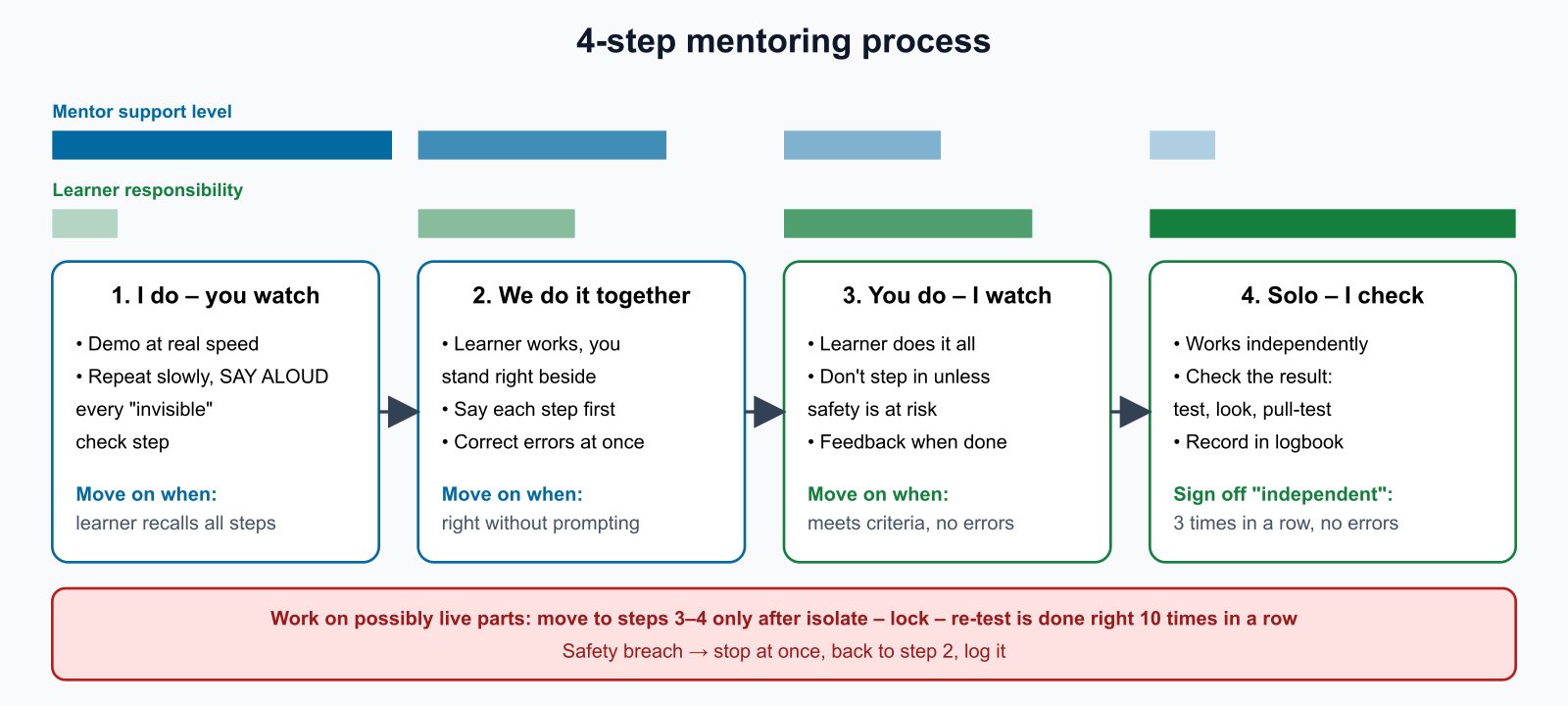
Step 1. I do – you watch
You demonstrate the whole task once at normal speed, then do it again slowly and say every step out loud, especially the checks you make in your head that nobody can see: "Before I touch anything, I test the voltage tester on a socket I know is live to make sure the tester works, and only then do I test this cable." These "invisible" steps are the most important part and the part most often missed when people learn by watching and copying.
Step 2. We do it together
The apprentice does the work while you stand right next to them, guiding each step and correcting mistakes immediately. At this step the apprentice says each step out loud before doing it. If they cannot say what comes next, they have not understood the procedure yet – go back to step 1 for that part.
Step 3. You do – I watch
The apprentice does the whole task alone. You observe and do not intervene unless there is a safety risk or a risk of damaging expensive materials. Note the points you want to comment on and discuss them afterwards. This is the hardest step for the mentor: standing and watching someone else work slowly and clumsily without taking the tool out of their hands.
Step 4. You do it alone – I check
The apprentice works independently (possibly in another room or on another floor). You check the result against the criteria: measure, look, pull-test. After 3 consecutive passes with no faults, the skill is recorded as "independent" in the logbook.
Safety note: Any work on parts that could be live may only move to steps 3 and 4 once the apprentice knows and correctly carries out the isolate – lock – tag – test procedure in at least 10 consecutive observations. There are no exceptions for "quick jobs" or "fast hands".
A 6-month mentoring plan for a new apprentice
A plan with milestones lets both sides know where they stand. Below is a sample plan for a new apprentice who works on real residential jobs while studying the Level 1 course on NAMBIN in parallel.
| Month | Focus | Skills to reach independence | End-of-month test |
|---|---|---|---|
| 1 | Safety, tools, materials | Identify materials; use hand tools correctly; isolation procedure (step 2) | Level 1 safety test passed at 100%; name 30 types of material |
| 2 | Running conduit, chasing walls, boxes | Cut, bend and run conduit to the drawing; fit boxes at the correct height | Run conduit in a sample room, height deviation ≤ 5 mm |
| 3 | Pulling cable, jointing, crimping lugs | Pull cable with the correct colours, joint inside boxes, crimp lugs of the correct size | 10 joints pull-tested without slipping; 10 lugs passed |
| 4 | Accessories | Install one-way and two-way switches, earthed sockets, lights | Install a two-way staircase lighting circuit + 2 sockets, with correct polarity |
| 5 | Basic testing | Measure voltage and continuity, check polarity; isolation procedure (step 3) | Test and record results for one room |
| 6 | Consolidation, preparing for Level 2 | Complete a room from conduit to energization under supervision; isolation procedure (step 4) | Combined Level 1 practical test + competency matrix assessment |

Photo: Oregon Department of Transportation / Wikimedia Commons, CC BY 2.0

The skills logbook
In many countries, apprentices keep a logbook that their mentor signs. You should use a similar system for your team. One line per skill, with the following columns:
- Skill: for example "Install an RCBO and wire it into an apartment board".
- Current step (1–4) and the date of moving up a step.
- Number of consecutive passes at step 4.
- Mentor's signature when the skill is recorded as "independent".
- Notes: recurring mistakes, points to watch.
The logbook has three benefits: the apprentice can see their own progress clearly (a huge motivator), you have a basis for pay rises and work allocation, and when the electrician moves to another team or sits a national skills certificate exam, they have evidence of their practical experience.
Assessing skills with measurable criteria
"Can do it" and "does it well" are subjective. Fair assessment has to be based on measurable criteria. A practical assessment should have:
- A clear brief: drawing, technical requirements, materials supplied, time limit.
- A marking sheet broken down into criteria, each with a specific description of what a "pass" looks like.
- An automatic-fail criterion (safety): one violation means failing, regardless of other marks.
Sample marking sheet for the test "Install a two-way staircase lighting circuit and 2 earthed sockets" (90 minutes):
| Criterion | Marks | Pass description |
|---|---|---|
| Safety (automatic fail) | — | Carries out the full isolate – lock – test procedure before connecting; uses the correct PPE |
| Correct circuit | 25 | Circuit works correctly: switches on/off from both positions; sockets are live |
| Polarity and cable colours | 15 | Switches break the line conductor; L-N-PE have the correct colours and positions at the sockets |
| Quality of connections | 20 | No bare copper outside terminals; pull-test without slipping; tightened to the correct torque |
| Neatness and finish | 10 | Cables neatly arranged in boxes; faceplates straight; no scratches |
| Testing and records | 20 | Tests insulation, PE continuity, polarity; records correctly on the sheet |
| Time, cleanliness | 10 | Finished within the time; work area cleaned up |
The pass mark is 70/100 with no violation of the safety criterion. Use the same marking sheet for every electrician so the assessment is fair, and record the result in the logbook.
Feedback that helps people improve
How you say something matters as much as what you say. Many skilled electricians are poor mentors because they shout at helpers in front of the homeowner, or, the other way round, never point out mistakes because they feel awkward. A few principles:
- Be specific, not general: instead of "sloppy work", say "this lug was crimped with the 4 mm² die on a 2.5 mm² cable, so a light pull pulls it off; use the 2.5 die and pull-test after every crimp".
- Talk about the work, not the person: "this joint doesn't pass yet" rather than "you're so clumsy".
- Praise what was done right first, sincerely and specifically, and only then talk about what needs fixing.
- In private: give feedback where the homeowner and outsiders cannot hear.
- End with an action: "next time, do it like this", and check again next time.
When an electrician violates safety rules
A safety violation is different from a technical mistake. A bad joint can be fixed; touching a cable that has not been tested may not give you a second chance. Deal with it at three levels:
- Stop the work immediately, state clearly what the violation was and why it is dangerous. Do not wait until the job is finished to say so.
- Step back in the mentoring process: that skill goes back to step 2 (doing it together), and this is recorded in the logbook.
- Repeated violations after a warning: no work on parts that could be live until they are re-assessed. If it still continues, that person is not right for your team.
And most important of all: you are the role model. If you "quickly touch" a cable without testing it because you are in a hurry, every safety talk you give becomes meaningless. Apprentices learn from what you do, not from what you say.
Team working standards
Photo: Mr. Reithmaier [Riethmaier] / Wikimedia Commons, CC BY 2.0

Once your team has 3 or more electricians, you cannot be everywhere at once. Quality must be maintained by written standards, not only by your presence. A set of team standards includes:
- Technical conventions: cable colours, standard mounting heights (sockets, switches), circuit numbering, types of lugs and terminals used, tightening torques.
- Mandatory procedures: isolate – lock – tag – test; checks before energizing; photographing conduit routes before plastering.
- Common forms: change orders, site diary, test record, handover record (covered in previous lessons).
- Checklists for each stage: conduit, cable pulling, board installation, accessory installation, energization.
- "Pass / fail" sample photos: a set of real photos from your own team showing a compliant board, a compliant joint. Pictures communicate faster than words.
Keep these standards short (5–10 pages), print a copy for the van, and give one to every new electrician on their first day. Update them every time the team learns a lesson from a mistake.
Common mistakes
| Mistake | Consequence | Correct practice |
|---|---|---|
| Assigning work because "they seem ready" | Electricians working beyond their competence, mistakes and accidents | Assign work based on the competency matrix and the logbook |
| Only demonstrating, without saying the "invisible" steps | The apprentice copies the movements but skips the checks | Say every check out loud when demonstrating |
| Grabbing the tool when the apprentice is slow | The apprentice never learns to do it alone | Step 3: observe, only intervene when safety is at risk |
| Shouting at a helper in front of the homeowner | The electrician loses morale, the customer loses trust in the team | Give feedback in private, specifically, with an action |
| Ignoring "minor" safety violations | Bad habits become the team's standard | Stop immediately, step back in the mentoring process, record it in the logbook |
| No written standards | Every electrician works differently; quality depends on the individual | A 5–10 page team standard, continuously updated |
Pass criteria for this lesson
- Assess an electrician (or a sample electrician profile) against the 5-group competency matrix, identifying the correct level for each group and 3 priority skills for mentoring.
- Simulate mentoring one skill (for example installing an RCBO) through all 4 steps, saying out loud at least 3 "invisible" checks during step 1.
- Prepare a 6-month mentoring plan with skill milestones and an end-of-month test for each month.
- Build a marking sheet for a practical test with at least 6 measurable criteria and 1 automatic-fail safety criterion.
- Draft a team standard with at least 5 sections: technical conventions, mandatory procedures, forms, checklists, sample photos.
Frequently asked questions
Mentoring slows the job down – how do I balance it?
It is true that mentoring slows things down during the first few months. Build that cost into the plan: give apprentices lower-risk tasks that are not on the critical path of the schedule (covered in the scheduling lesson). After 6 months, a well-mentored apprentice does twice as much work as a helper who has only "tagged along".
What if I teach them everything and they leave to set up on their own and compete with me?
This is a real concern. But keeping your skills to yourself will not keep good people; they will learn elsewhere. Electricians who are well trained, paid according to their competence and given a clear career path tend to stay longer. And if they do go independent, a network of electricians you trained is a source of collaboration (sharing work, referring customers), not just competition.
Should apprentices take the online courses on NAMBIN?
Yes. Online lessons provide the theory and standard procedures that you do not have time to teach again. You spend your mentoring time on practical work and real-life situations. Ask apprentices to complete the module tests before each assessment milestone.
Further reading
Use the lesson Safety and circuit installation test as an entry assessment for new electricians, together with foundation lessons such as Safety rules before touching electrical wires and Installing two-way switches and earthed sockets.