This is the final lesson of the 4-level programme. You have come all the way from someone who did not know how to hold a voltage tester to someone who designs, estimates, manages a team and hands over a complete project. The last question is: how do you turn those skills into a sustainable business – one with a steady income, that does not depend on whether someone happens to call today, and that can grow over time?
Many skilled electricians still struggle because they run their business like an employee: they take whatever job comes along, quote by gut feeling, do not separate their own money from material money, and do not keep in touch with past customers. This lesson gives you a simple framework for looking at your work as a small business.
By the end of this lesson, you will be able to:
- Choose a suitable business model and combine several revenue streams.
- Calculate your real cost per labour hour and price your services profitably.
- Build customer acquisition channels: referrals, partners, online.
- Set up a customer care process so customers come back and refer others.
- Manage cash flow, separate material money from labour money, and prepare for your tax obligations.
- Draw up a 12-month growth plan with measurable indicators.
Four business models for electrical services
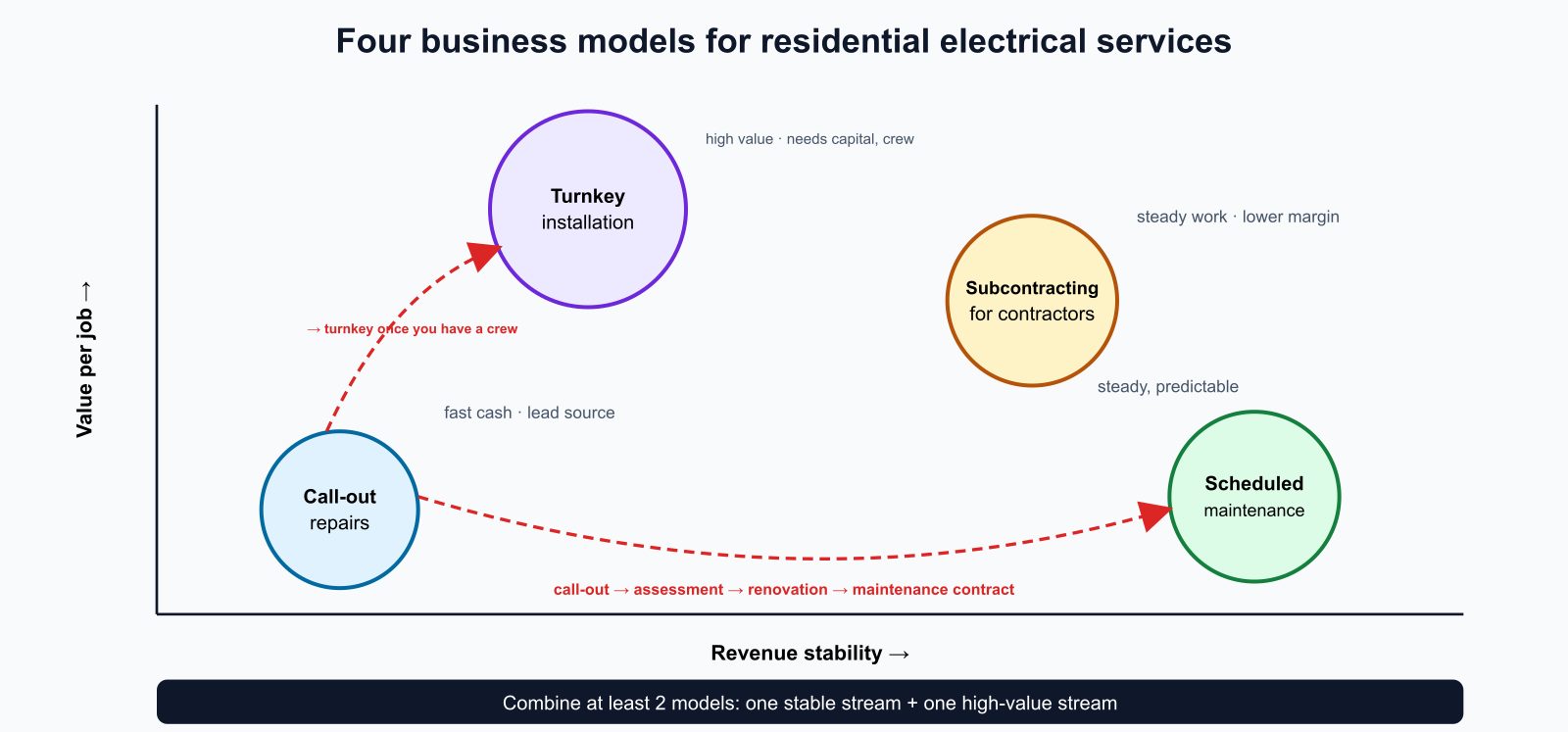
| Model | Characteristics | Advantages | Disadvantages |
|---|---|---|---|
| Call-out repairs | The customer calls when something goes wrong; small, quick jobs | Fast cash flow; paid the same day; a source of customers for bigger jobs | Irregular income; time lost travelling; price competition |
| Turnkey installation | Wiring new houses, major renovations; under contract | High value; shows your design and management capability | Needs working capital and a team; schedule and payment risks |
| Periodic maintenance | Annual contracts with homes, retail chains, rental-room buildings, small offices | Steady, predictable revenue; long-term customer relationships | Small value per visit; needs discipline with scheduling and records |
| Subcontracting | Taking the electrical package for building contractors and interior design companies | Regular work through partners; no need to find individual customers yourself | Lower profit margin; dependence on partners; slow payment |
A common path: start with call-out repairs to build a customer base and cash flow; use those call-outs to sell system assessments and upgrades (covered in the lesson on maintenance and assessment); turn upgraded customers into maintenance contracts; in parallel, build subcontracting relationships with 2–3 reliable building contractors. Once you have a team and capital, take on turnkey installation.
Photo: Jeromi Mikhael / Wikimedia Commons, CC0

Calculating your real cost per labour hour
The most common pricing mistake electricians make is setting their "day rate" equal to an employee's wage. But when you are self-employed, you have to pay for everything your employer used to pay for, and you do not have work every day. Work it out in 4 steps.
Step 1. Annual fixed costs
| Item | Example (VND/year) |
|---|---|
| Desired income for yourself | 180,000,000 |
| Motorbike: depreciation, fuel, servicing | 24,000,000 |
| Tools and test instruments: depreciation, replacement, calibration | 15,000,000 |
| Phone, internet, online advertising | 12,000,000 |
| Insurance (voluntary social insurance, health, accident) | 10,000,000 |
| Warranty fund (free fixes during the warranty period) | 8,000,000 |
| Training, certificates, materials | 5,000,000 |
| Contingency for sickness and days without work | 16,000,000 |
| Total | 270,000,000 |
Step 2. Billable hours per year
A year has about 300 working days if you take Sundays and public holidays (including Tet) off. But not every hour can be billed: travelling, surveys that do not become contracts, buying materials, writing quotations, paperwork, phone calls. For a freelance electrician, the share of billable hours is usually only 50–65%.
Billable hours = 300 days × 8 hours × 60% = 1,440 hours.
Step 3. Cost per labour hour
Cost per labour hour = 270,000,000 ÷ 1,440 ≈ 187,500 VND/hour.
This is your break-even rate – there is no profit yet to save, invest in new tools or grow the team.
Step 4. Selling price
Add your desired profit margin (for example 20%): selling price per labour hour ≈ 225,000 VND/hour. For small repairs, many electricians also apply a minimum charge (for example a call-out fee that includes the first hour) to cover travel time.
Note: the figures above are examples to illustrate the method. You must enter your own real figures and compare them with market rates in your area. If your cost is clearly higher than the market, the answer is not to sell at a loss but to increase your share of billable hours (schedule jobs by area, cut down on surveys that go nowhere) or move into a customer segment that pays for quality.
Three ways to price
- Labour hours + materials: suits repairs and jobs where the amount of work is hard to predict. Transparent, but the customer finds it hard to predict the total.
- Unit rates per item: a price for each socket point, each light point, each metre of conduit, each board – based on the labour norms learned in the quantity take-off lesson. Easy for customers to compare, and you keep control of your margin if your norms are correct.
- Lump sum: one figure for the whole scope. Customers like it best, but you carry the risk if the scope is unclear. Only use it when you have surveyed thoroughly and the scope is clearly written into the contract (covered in the lesson on quotations and contracts).
Materials: a source of profit and risk

Photo: Jlgay38 / Wikimedia Commons, CC BY 4.0

In turnkey installation, materials usually account for 50–70% of the contract value. Managing materials well means managing most of the project's money:
- Open accounts with 1–2 main distributors: trade prices, short-term credit, delivery to site, returns of leftover goods in unopened boxes.
- Use only genuine products of known origin: keep the invoices as proof for warranty claims. Counterfeit goods (especially breakers, RCDs and cables) are the biggest safety and legal risk in the trade.
- Materials handling fee: if you buy materials for the customer, add a reasonable amount (time spent buying, transport, storage, risk of loss). Show this transparently in the quotation.
- Advance payments for materials: never fund all the materials for a large job with your own money. Staged payments (covered in the contract lesson) must include an advance large enough to cover the materials for the first stage.
Customer acquisition channels
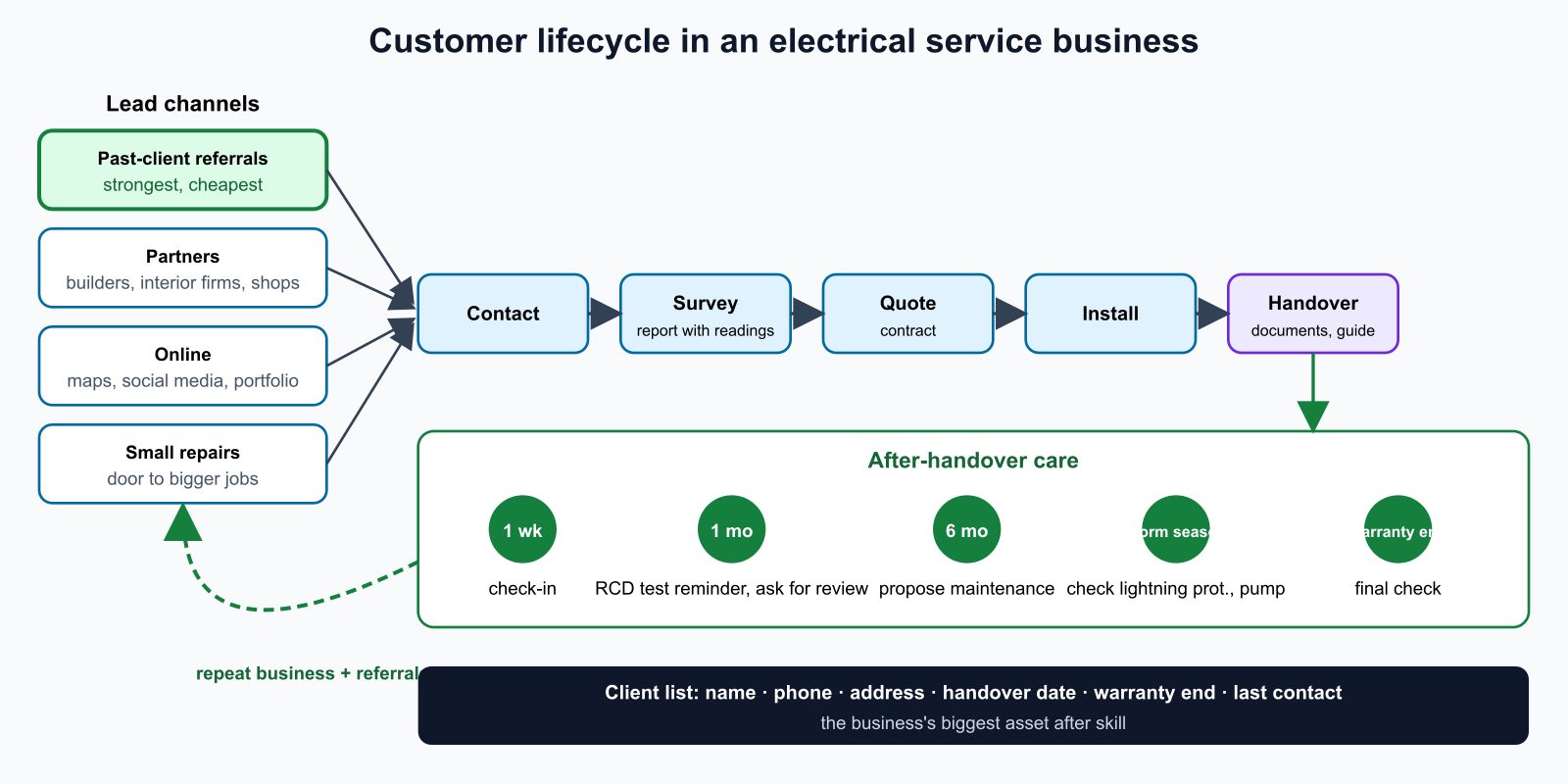
1. Referrals from past customers
This is the strongest and cheapest channel. Referred customers already trust you before you meet, and haggle less over price. To get more referrals:
- Do good work and hand over professionally (documentation, board labels, user guide) – that is what customers tell other people about.
- Ask directly when the customer is most satisfied (at handover): "If you know anyone who needs electrical work done, I would really appreciate a referral."
- Leave business cards, and a sticker with your phone number inside the distribution board (in a suitable spot, with the homeowner's agreement).
2. Partners
- Building contractors, interior design companies, plumbers, painters: people who work in the customer's home before you or alongside you. Refer work to each other in both directions.
- Electrical supply shops: customers buying materials often ask "do you know a good electrician?".
- Apartment building management boards, rental-room landlords, retail chains: potential customers for maintenance contracts.
3. Online
- A business profile on online maps (name, service area, phone number, photos of jobs, customer reviews). Customers searching for "electrician near me" will find you.
- A social media page with real before-and-after photos and a short explanation of what you did and why (do not post customers' addresses or faces without consent).
- A company profile: a 4–6 page PDF with an introduction, certificates, 5–10 representative projects, your working process and your warranty commitment. Send it to larger customers and partners.
Customer care after handover
Selling to past customers is much easier than finding new ones. A simple care process:
| When | Action | Purpose |
|---|---|---|
| 1 week after handover | Call to check: is the system working well, are there any questions? | Catch problems early; the customer feels looked after |
| 1 month | Send a reminder to test the RCDs with the T button; ask for feedback | Safety habit; ask for an online review |
| 6 months | Offer a periodic inspection (maintenance package) | Convert into a maintenance customer |
| Before the rainy and storm season | Send a reminder to check lightning protection, outdoor sockets, pumps | Seasonal revenue; the customer sees you as professional |
| Before the warranty expires | Offer an end-of-warranty inspection | Fix faults under warranty; renew maintenance |
A simple customer list (a spreadsheet) is enough to start: name, phone number, address, handover date, type of job, warranty expiry date, last contact, notes. After your skills, this is the biggest asset of your business.
Handling complaints
A complaint handled well creates a more loyal customer than one who never had a problem. The process: listen to the end without arguing; confirm the problem back to the customer; book the earliest possible visit to check; if the fault is yours, fix it free of charge and say so clearly; if it is not, explain using your test readings and propose a solution. The as-built documentation and test records are very powerful tools in these situations.
Basic financial and legal management

Photo: Wilfredor / Wikimedia Commons, CC BY-SA 4.0

- Separate bank accounts: one account for the business, one for personal spending. This is the single most important habit for knowing whether you are really making a profit or a loss.
- Separate material money from revenue: money the customer pays for materials is not your money. Record it separately so you do not "accidentally spend it" and then come up short when paying the distributor.
- Record income and expenses daily: a phone app or a simple notebook. At the end of each month you know your revenue, costs, profit, receivables and payables.
- Contingency fund: build up at least 3 months of fixed costs to get through quiet months or late-paying customers.
- Business registration and tax: once you operate regularly, you need to register in a suitable form (usually a household business, later possibly a company when you grow larger) and meet your tax obligations. The rules on how household businesses calculate and declare tax are changing a lot; ask the local tax office or an accountant so you apply the current rules correctly. Being registered and able to issue VAT invoices helps you win work from businesses and large contractors.
- Insurance: consider accident insurance for yourself and your team; for large jobs you may need liability insurance (discussed in the lesson on site safety and legal responsibility).
A 12-month growth plan
Set targets as numbers and review them every month. Here is an example plan for an electrician who currently works alone and wants a team of 3 within a year:
| Quarter | Goal | Indicator |
|---|---|---|
| 1 | Standardize: price list, quotation template, contract, handover documentation; online profile | Complete set of templates; ≥ 10 online reviews |
| 2 | Recruit and mentor 1 apprentice; sell assessments of older installations | Apprentice reaches the month-3 milestone of the mentoring plan; ≥ 8 paid assessments |
| 3 | Sign maintenance contracts; 2 subcontracting partners | ≥ 10 maintenance contracts; ≥ 2 jobs through partners |
| 4 | Sit the vocational skills certificate exam; take on 1–2 turnkey jobs | Certificate obtained; billable-hour share ≥ 65%; 3-month contingency fund |
Indicators worth tracking every month: revenue, gross profit (revenue minus materials and labour), share of billable hours, quote-to-contract conversion rate, number of new customers from referrals, overdue receivables.
Common mistakes
| Mistake | Consequence | Correct practice |
|---|---|---|
| Pricing to match the cheapest competitor | Lots of work but no profit; no money to invest | Calculate your cost per labour hour; compete on quality |
| Mixing material money with personal money | Not enough money to pay the distributor; no idea of profit or loss | Separate accounts, daily records |
| Funding all materials with your own money | Capital tied up; risk of the customer not paying | Staged advance payments in the contract |
| Using cheap materials of unknown origin to lower the price | Failures, fires; lost reputation; legal liability | Genuine products with invoices |
| Not keeping in touch with past customers | Losing your cheapest source of customers | Customer list, care schedule |
| Taking every job, even beyond your competence | Poor quality, safety risks | Decline, or partner with someone who has the expertise |
Pass criteria for this lesson
- Calculate your own cost per labour hour from a fixed-cost table and your actual billable-hour share, with zero arithmetic errors.
- Prepare a price list for at least 10 common service items, each with a basis for calculation (labour-hour norm + materials).
- Build a sample customer list with all the columns and a 5-point care schedule.
- Prepare a 4–6 page company profile with at least 5 projects (real ones or from practical exercises).
- Draw up a 12-month growth plan with at least 4 goals, each with a measurable indicator.
Frequently asked questions
Should I cut prices to win customers when I'm starting out?
You can offer a time-limited discount with a reason (first customers in a new area, in exchange for a review and photos of the job), but do not build your name on low prices. Customers who come for a low price will leave when someone cheaper comes along. Compete on professionalism: arrive on time, quote clearly, hand over with documentation.
When should I hire an electrician?
When you regularly have to turn down work, or when most of your time is spent on tasks an apprentice could do (running conduit, pulling cable). Work it out first: the extra revenue from the new person must cover their wages, insurance and your mentoring time. Start with one person and the mentoring process from the previous lesson.
How do I get customers to accept a higher price than other electricians?
Show customers what extra they get: a survey and a report with readings, a detailed quotation, a clear contract and warranty, as-built documentation, board labels, a user guide, and after-handover care. Bring photos of a sample handover package when you meet a customer – it is more convincing than anything you can say.
Further reading
Review quotations and taking on jobs in the lesson Quoting and taking on jobs as an electrician, and expand your services with the lesson Installing water pumps, water tanks and water heaters – a group of jobs customers very often ask for together with electrical work.