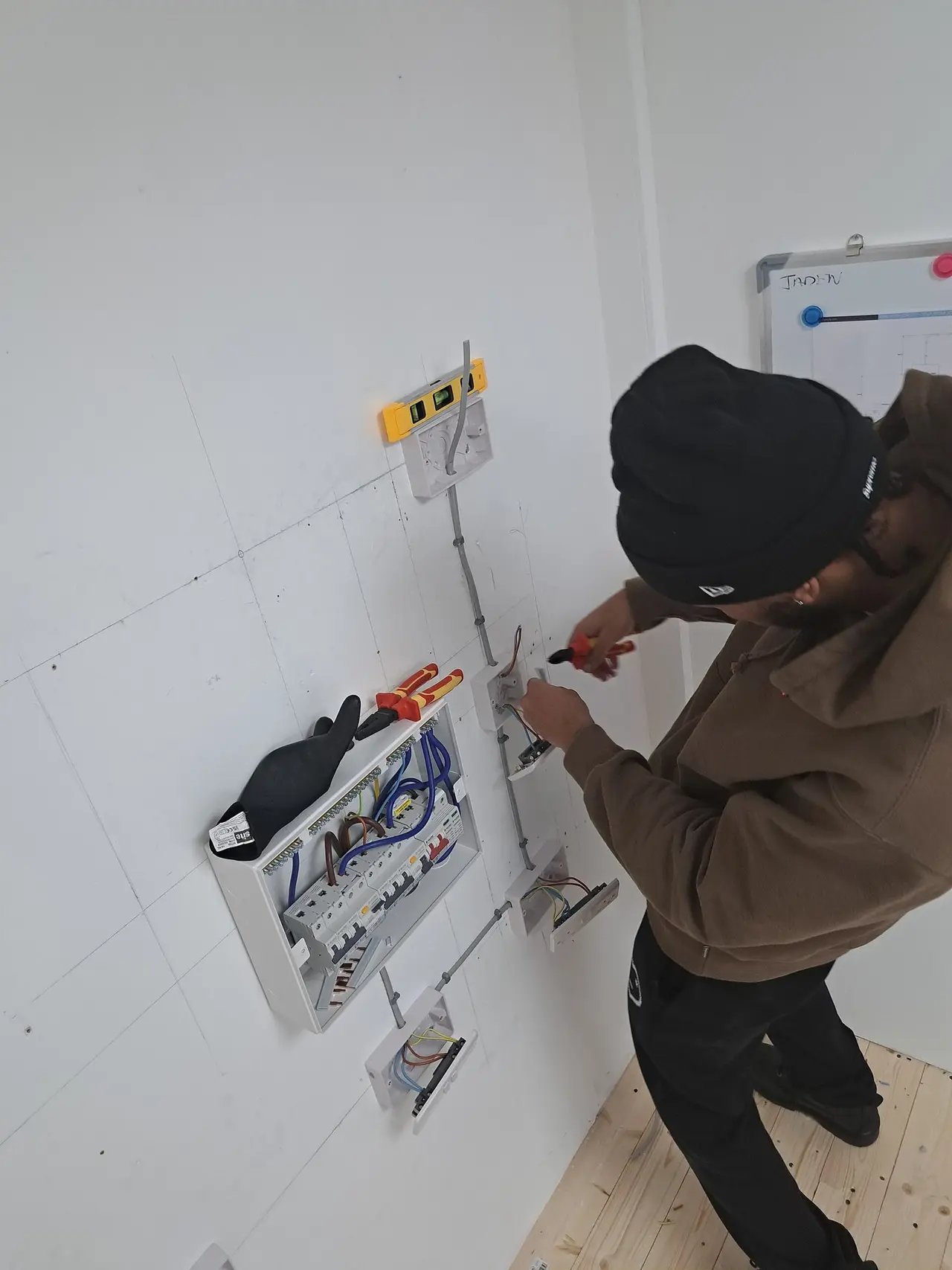
You have completed three levels of this programme and are finishing the fourth. You have the skills, the experience and regular customers. So why do you still need a certificate? Because apart from the people who have already worked with you, nobody knows how good you are. An investor building a row of rental rooms, a construction company looking for an electrical subcontractor, a business recruiting maintenance electricians, a programme sending workers to jobs abroad – all of them need evidence that is recognized by everyone. The national vocational skills certificate (in Vietnamese, chứng chỉ kỹ năng nghề quốc gia) is that evidence.
This lesson explains Vietnam's national vocational skills certification system in enough detail for you to plan your exam, describes the typical structure of an electrical trade exam, and shows how to use this 4-level programme to prepare. The legal rules in this area are revised over time, and the names of the government agencies responsible may also change when the state administration is reorganized; before registering, check the latest information with the skills assessment organization where you plan to sit the exam.
By the end of this lesson, you will be able to:
- Distinguish the national vocational skills certificate from a vocational diploma, an elementary vocational certificate and an electrical safety card.
- Explain the 5-level framework of vocational skill levels and identify the right level to register for.
- Prepare the registration file and evidence of work experience.
- Understand the typical structure of the theory and practical exams for the electrical trade.
- Draw up an 8-week preparation plan based on the 4-level programme and practise a sample practical exam.
Types of credentials in the electrical trade
Electricians often confuse the different types of credentials. Each one has its own purpose:
| Type | What it certifies | How to obtain it | What it is used for |
|---|---|---|---|
| Vocational training diploma / certificate (elementary, intermediate, college level) | Completion of a training programme | Study at a vocational education institution | Proves that you went through training |
| National vocational skills certificate | Achievement of a skill level according to national standards | Pass an assessment at a licensed organization; attending a school is not required | Proves your real working competence |
| Electrical safety card | Has been trained and examined in electrical safety at a given grade | Training at the employer or at a training provider | Mandatory for people working in the power sector and on the power grid |
| Manufacturer certificate | Has been trained on the manufacturer's products | Manufacturer training course (inverters/VFDs, solar PV, smart home) | Dealership, authorized installation, warranty work |
| Online course certificate (such as NAMBIN) | Has completed the lessons and passed the tests | Study and take the tests online | Records self-study, preparation for the exam |
The most important difference: the national vocational skills certificate assesses what you can do, not where you studied. An electrician who learned the trade from a master over 10 years, without any formal qualification, can still sit the exam and reach a high level if their skills meet the standard and they satisfy the experience requirements.
The 5-level framework of vocational skill levels
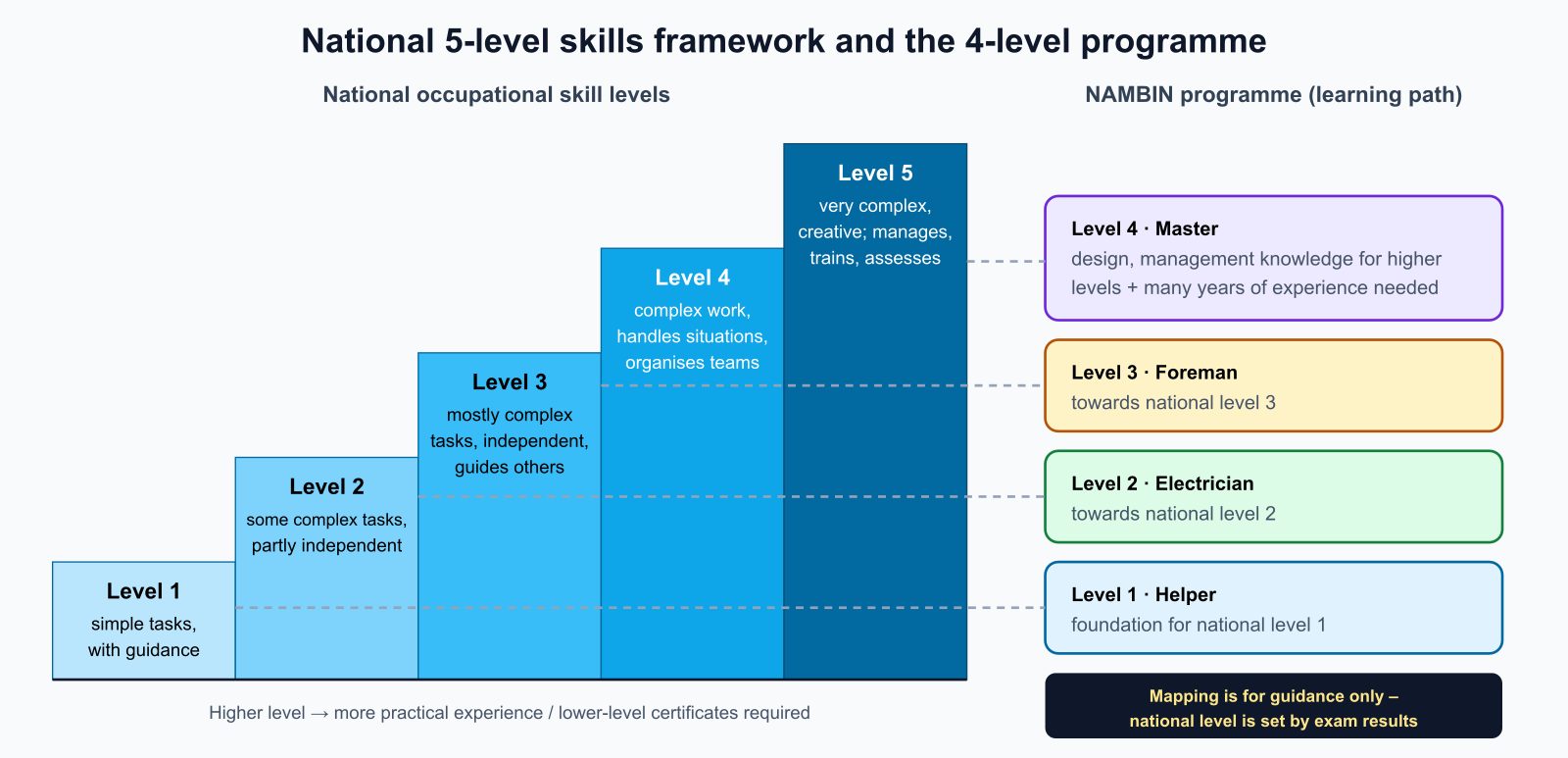
Vietnam's national vocational skills system is divided into 5 levels. A general description of each level (in the spirit of the regulations on vocational skill levels):
- Level 1: can carry out some simple, repetitive tasks under guidance.
- Level 2: can carry out some tasks of moderate complexity; can work partly independently and as part of a team.
- Level 3: can carry out most of the complex tasks in the trade; works independently; can guide people at lower levels.
- Level 4: can carry out complex tasks and handle unexpected situations; able to organize and guide a team.
- Level 5: can carry out very complex tasks with creativity; able to organize, manage, train and assess others.
Note the naming: "Level 4 – Master" in the NAMBIN programme does not mean the same as level 4 in the national system. Our programme is a learning pathway; the national level is the result of an official assessment. In general, the content of Levels 1–2 of the programme is the foundation for national levels 1–2, Level 3 is aimed at national level 3, and Level 4 prepares the management and design knowledge needed for higher levels – but the higher levels also require years of practical experience that no course can replace.
Eligibility requirements
Each level has its own requirements regarding training and/or years of practical work in the trade. General principles:
- Lower levels: simple requirements, usually just having completed training or having some time working in the trade.
- The higher the level, the more years of experience or lower-level certificates are required.
- There may be a route to sit a higher level directly if you meet the corresponding experience or training requirements.
Because the specific requirements (number of years, supporting documents) are set by legal regulations and may be amended, your first step is to contact a skills assessment organization that has "Residential electrical work" or a related trade (Industrial electrical work) on its licensed list, and ask for the list of required documents and the exam schedule.
A registration file usually includes
- An exam registration form using the assessment organization's template.
- Identity documents and photos.
- Any diplomas and certificates you already hold.
- Confirmation of your working time in the trade – from an employer, or other evidence as instructed by the assessment organization. This is the part freelance electricians most often lack.
- The prescribed fee.
Trade tip: If you work freelance, start collecting evidence today: contracts, handover records, as-built documentation with your name on it, confirmation letters from the main contractors you have worked with. The as-built documentation package you learned about in the previous lesson serves your customers and is also evidence of your own experience.
Typical exam structure
A vocational skills assessment usually has two parts: theory and practical, with the practical part taking most of the time and deciding the result. The exam papers are built from the national occupational skills standard for the relevant trade.
Theory section
Usually a multiple-choice test or short written answers, checking foundation knowledge and safety. Common topics for residential electrical work:
- Electrical safety: effects of electric current on the body, protective measures, first aid.
- Basic circuits: Ohm's law, power, single-phase and three-phase circuits.
- Electrical materials and devices: cables, circuit breakers, RCDs, contactors, relays.
- Electrical measurement: instruments, methods, measurement error.
- Reading drawings, electrical symbols.
- Sizing cables and protective devices.
- Electrical machines: single-phase and three-phase motors, small transformers.
Practical section
Candidates receive the brief (drawings, requirements), materials and tools, then carry out the work within a time limit at an exam station (booth or test board). Examiners observe the process and mark the result against a criteria sheet.
Photo: Charanjitmannu / Wikimedia Commons, CC BY-SA 4.0

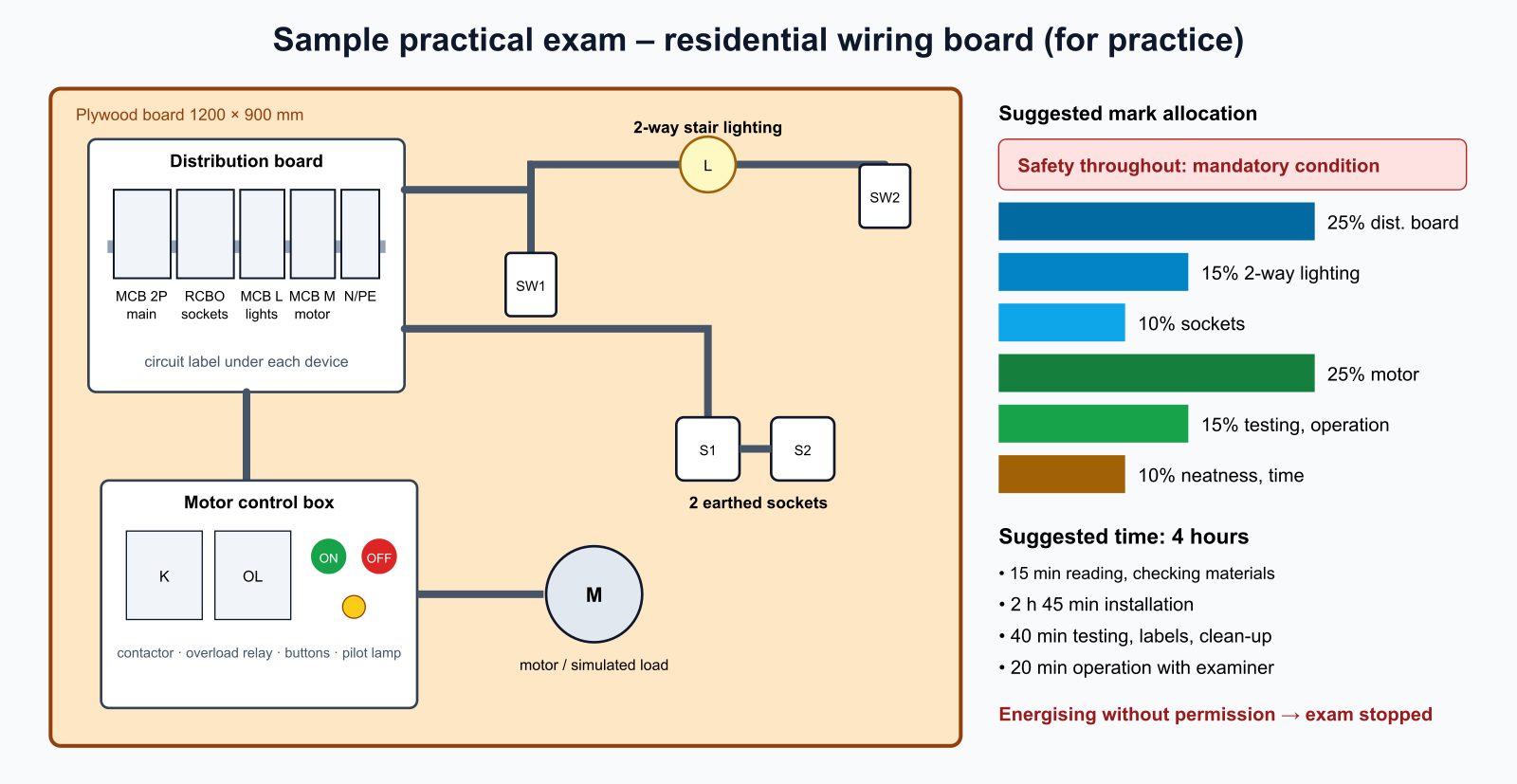
A sample practical exam (for practice, modelled on a common structure):
| Item | Requirement | Suggested weighting |
|---|---|---|
| Preparation and safety | Check materials and tools; organize the workstation; follow safety rules throughout the exam | Mandatory condition |
| Distribution board installation | 2-pole main MCB, 1 RCBO for sockets, 1 MCB for lighting, 1 MCB for the motor; N and PE bars; circuit labels | 25% |
| Lighting circuit | Staircase light controlled from 2 positions | 15% |
| Socket circuit | 2 earthed sockets with correct polarity | 10% |
| Motor circuit | Direct-on-line starting with a contactor, ON/OFF push buttons, thermal overload relay, indicator lamp | 25% |
| Testing and commissioning | Test insulation, PE continuity, RCD; fill in the record; energize and operate in the presence of the examiner | 15% |
| Finish and time | Neat cabling, correct colours, lugs; clean up; finish on time | 10% |
Note: in electrical trade exams, a serious safety mistake (energizing without the examiner's permission, touching live parts, not testing before energizing) usually results in the exam being stopped, no matter how well the rest was done.
International trade tests and skills competitions

Photo: WorldSkills UK / Wikimedia Commons, CC BY 2.0

Electrical Installations is included in national, ASEAN-regional and world skills competitions. Even if you do not plan to compete, the test projects and marking criteria of these competitions are an excellent reference for the "highest standard" of the trade: installation tolerances measured in millimetres, evenly bent conduit, clear labelling, complete testing.
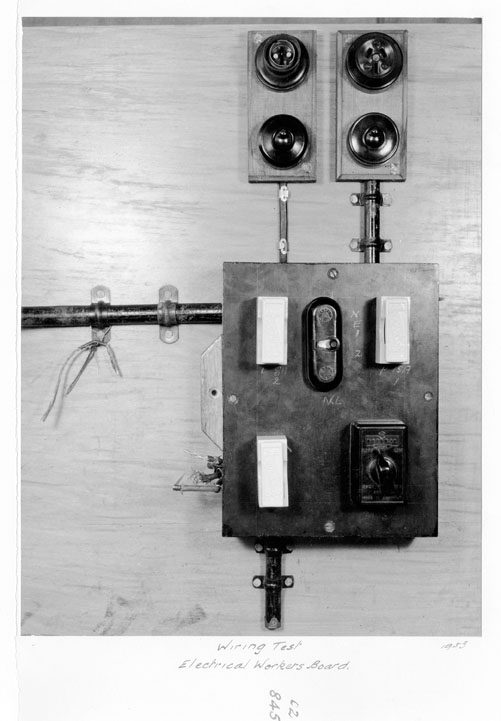
Photo: Lands Department, Survey Office, Cartographic Branch, Photographic Section / Wikimedia Commons, Public domain

An 8-week preparation plan
Below is a preparation plan for an electrician who already has practical experience and can spend 6–8 hours per week (outside working hours). The plan is based on the courses in the 4-level programme.
| Week | Theory (on NAMBIN) | Practical |
|---|---|---|
| 1 | Review the Level 1 Safety module, redo the quiz until you score 100% | Set up a practice board at home (wooden board, DIN rail, basic materials) |
| 2 | Review the Level 1 Foundations module: Ohm's law, power, cables | Practise crimping lugs and jointing: 20 lugs, pull-test each one |
| 3 | Level 2: reading drawings, load calculation, cable selection | Practise a two-way staircase lighting circuit + sockets, against the clock |
| 4 | Level 2: MCBs, RCDs, earthing systems | Install a small distribution board with an RCBO, add labels, against the clock |
| 5 | Level 3: three-phase power, motors, magnetic starters | Practise a direct-on-line starter circuit with a thermal overload relay and an indicator lamp |
| 6 | Level 2: testing and acceptance | Test insulation, PE continuity, RCDs; practise filling in test records quickly and correctly |
| 7 | Redo all the quizzes for every level, note the questions you got wrong | Full mock exam on the sample task, against the clock, marked by another electrician using the criteria sheet |
| 8 | Review wrong answers and safety | Second mock exam, focusing on the mistakes from the first; rest before exam day |
Tips for the exam room
- Read the whole brief before picking up a tool, and mark any special requirements (cable colours, heights, label positions).
- Check the materials supplied against the brief; tell the examiner immediately if anything is missing or faulty.
- Plan your time: keep at least the last 15% of the time for testing, labelling and cleaning up.
- Test before asking to energize. Always ask the examiner's permission before energizing.
- Don't rush because of the person next to you. Vocational skills exams are marked against criteria and do not rank speed (except in competitions).
Common mistakes
| Mistake | Consequence | Correct practice |
|---|---|---|
| Practising only the practical part and skipping theory | Failing the theory section despite good practical skills | Redo the quizzes for every level; review basic calculations |
| Not practising against the clock | Running out of time before testing, losing a lot of marks | Do at least 2 full-length mock exams |
| Working by site habit instead of following the brief | Wrong requirements (cable colours, positions), lost marks | Read the brief and mark the special requirements |
| Energizing on your own to test | The exam is stopped | Always ask the examiner's permission |
| No confirmation of experience | Not eligible to register for the desired level | Collect evidence of experience early |
Pass criteria for this lesson
- Explain the differences between the national vocational skills certificate, a vocational diploma, an electrical safety card and a manufacturer certificate.
- Identify the vocational skill level that suits you and list the documents you need to prepare.
- Complete the sample practical exam within the time limit with a score of ≥ 70% and no safety errors.
- Pass all module quizzes of the 4 programme levels with a score of ≥ 80% (100% for the safety modules).
- Draw up a personalized 8-week preparation plan based on your own weak points.
Frequently asked questions
Does the NAMBIN certificate replace the national vocational skills certificate?
No. The NAMBIN course completion certificate records that you have studied and passed the programme's tests. The national vocational skills certificate is issued by a licensed assessment organization after an official exam. The 4-level programme helps you prepare for that exam.
Can I retake the exam if I fail?
Usually yes, according to the assessment organization's next exam schedule. Ask for a detailed score sheet (if available) to see which parts you did not pass and focus your preparation on them.
Is the certificate mandatory to work as a residential electrician?
For freelance electricians doing repairs and installations in homes, this certificate is currently not usually a mandatory requirement. However, some jobs, projects or employers may require it; and for programmes that send workers abroad, a skills certificate is a big advantage. The rules on which jobs require a certificate may change, so check the latest regulations.
Further reading
Use the lesson Safety and circuit installation test to assess yourself before registering for the exam, and review Installing two-way switches and earthed sockets and Installing an MCB/RCBO distribution board and earthing – two types of practical task that come up very often.