At Level 1 you learned safety for yourself: isolate the supply, lock it, tag it, re-test, wear protective equipment, give first aid. At Level 4, when you are the one assigning the work, the safety question changes: if one of your workers has an accident, who is responsible? The short answer: whoever organizes the work is responsible for organizing it safely. If you send an untrained helper up a ladder to connect wires while the circuit is still live, you do not just lose a worker – you may have to pay compensation, be fined, and in serious cases face criminal prosecution.
This lesson helps you organize an electrical site safely and systematically: identifying hazards, assessing risks, control measures, temporary construction power, working at height, permit-to-work procedures and training – and understanding the legal framework of responsibility in Vietnam so you can protect yourself and your crew.
By the end of this lesson, you will be able to:
- Identify the main hazards on a residential electrical site and assess risks with a likelihood – consequence matrix.
- Apply the hierarchy of controls: elimination, substitution, engineering, administrative and personal protective equipment.
- Set up a safe temporary construction power panel with a 30 mA RCD.
- Organize work on ladders, scaffolding and roofs with fall protection measures.
- Roll out a lockout – tagout procedure for the whole crew and a permit to work for live panels.
- Understand the legal framework of responsibility for employers and those in charge of installation work.
The legal framework you need to know
These are the documents you should read, and you should keep a summary of them in the crew's records. Laws can be amended, so check the version currently in force when you apply them.
| Document | Relevant content |
|---|---|
| Law on Occupational Safety and Health 2015 | Rights and obligations of employers and workers; training; reporting and investigating workplace accidents; compensation and allowances |
| Decree 44/2016/NĐ-CP (government decree on occupational safety training and inspection) and its amendments | Occupational safety training by group; people doing work with strict safety requirements (including electrical work and work at height) must be trained and issued a safety card |
| QCVN 01:2020/BCT – National technical regulation on electrical safety (Ministry of Industry and Trade) | Safety requirements when working on electrical equipment: work permits, isolation measures, earthing, warning signs, safety grades |
| QCVN 18:2021/BXD – Safety in construction (Ministry of Construction) | Construction power, scaffolding, ladders, work at height, guarding openings |
| Civil Code 2015 | Non-contractual liability for damage caused to other people, the owner's property or the neighbors |
| Criminal Code (offense of violating occupational safety regulations) | A responsible person who violates occupational safety regulations and causes serious consequences may face criminal prosecution |
When are you an "employer"?
When you hire workers to work for you and pay them – even on a verbal agreement, even by the day – you have an employment or service relationship with them, and you are responsible for organizing the work safely: training, providing protective equipment, assigning work to match competence, and stopping work when there is a danger. Treat this as the default, not the exception.
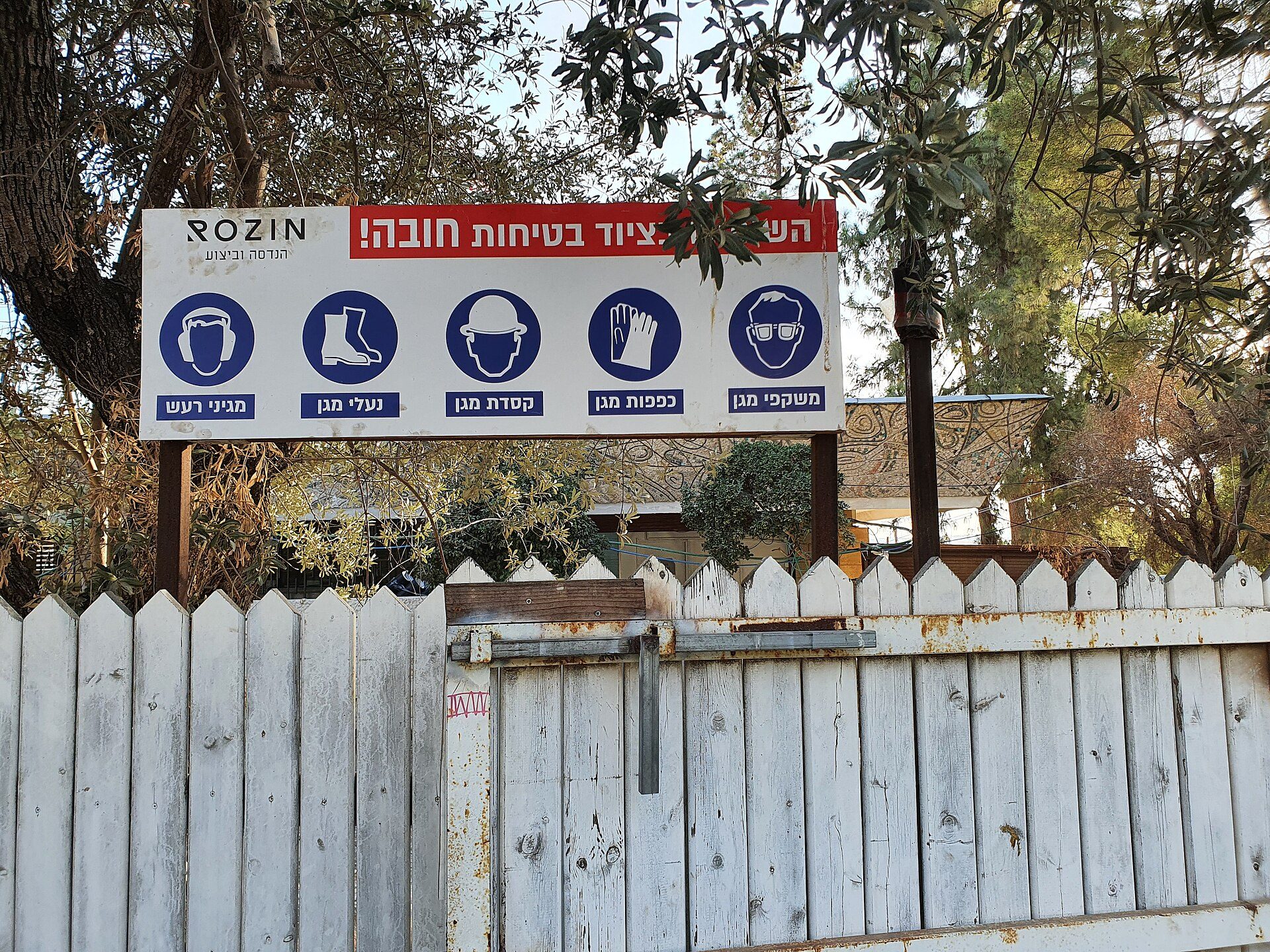
Photo: Korenn / Wikimedia Commons, CC BY-SA 4.0

Identifying hazards and assessing risks
Before every project (and whenever conditions change), prepare a short risk assessment table. Typical hazards for a residential electrical crew:
| Hazard | Typical situation |
|---|---|
| Electric shock | Working on a live panel, construction power without an RCD, a crushed cord on a wall chaser, drilling into old wiring during a renovation |
| Falls from height | A stepladder on uneven ground, scaffolding without guardrails, metal roofs, uncovered stair openings |
| Arc flash | Connecting on the supply side of the main breaker while it is live, a short circuit from measuring on the wrong meter range |
| Dust and noise | Chasing brick and concrete walls: silica dust, noise |
| Hand tools | Wall chaser kickback, shattered discs, jammed drill bits |
| Falling objects | Working on scaffolding with people below, tools falling from the ceiling |
| Fire | Exothermic welding near flammable materials, overloaded construction power cables |
| Heat | Working on roofs or in hot ceiling spaces in summer |
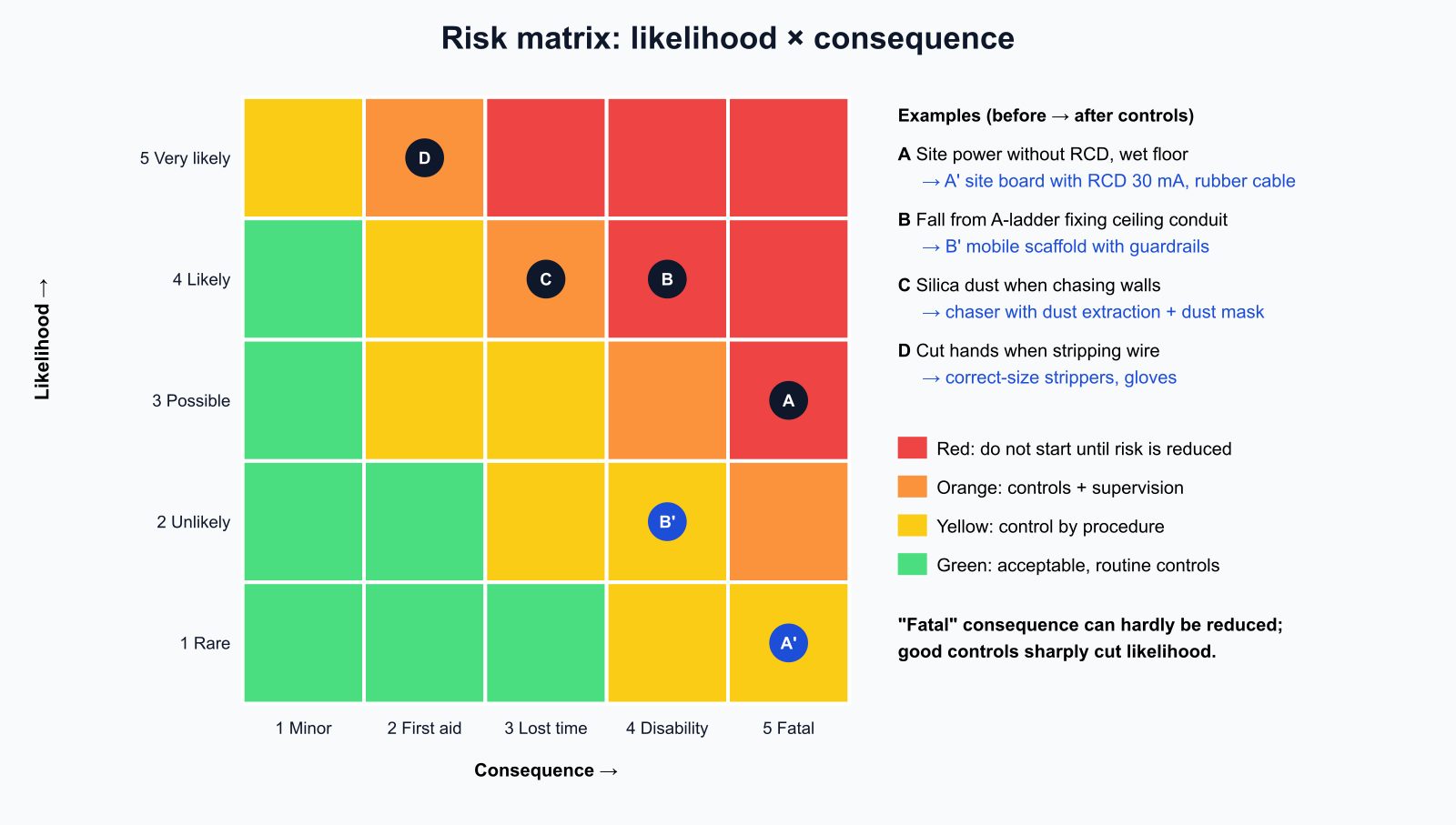
The hierarchy of controls
- Elimination: isolate the supply completely instead of working live. This is the strongest measure.
- Substitution: use a mobile scaffold with guardrails instead of a stepladder for long ceiling runs; use a wall chaser with dust extraction instead of chiseling by hand with a drill.
- Engineering controls: a 30 mA RCD for construction power, shrouding live parts, guardrails, covers over floor openings.
- Administrative controls: procedures, permits to work, training, assigning work by skill level, morning safety briefings.
- Personal protective equipment: insulating gloves, glasses, hard hats, boots, dust masks, safety harnesses. This is the last layer and does not replace the layers above.
Temporary construction power
Many electric shock accidents on residential sites do not come from the system being installed but from construction power cables: twin cord run from the neighbor's house, extension sockets lying on wet floors, wall chasers with crushed cords. The electrical crew must have the safest construction power on the whole site.
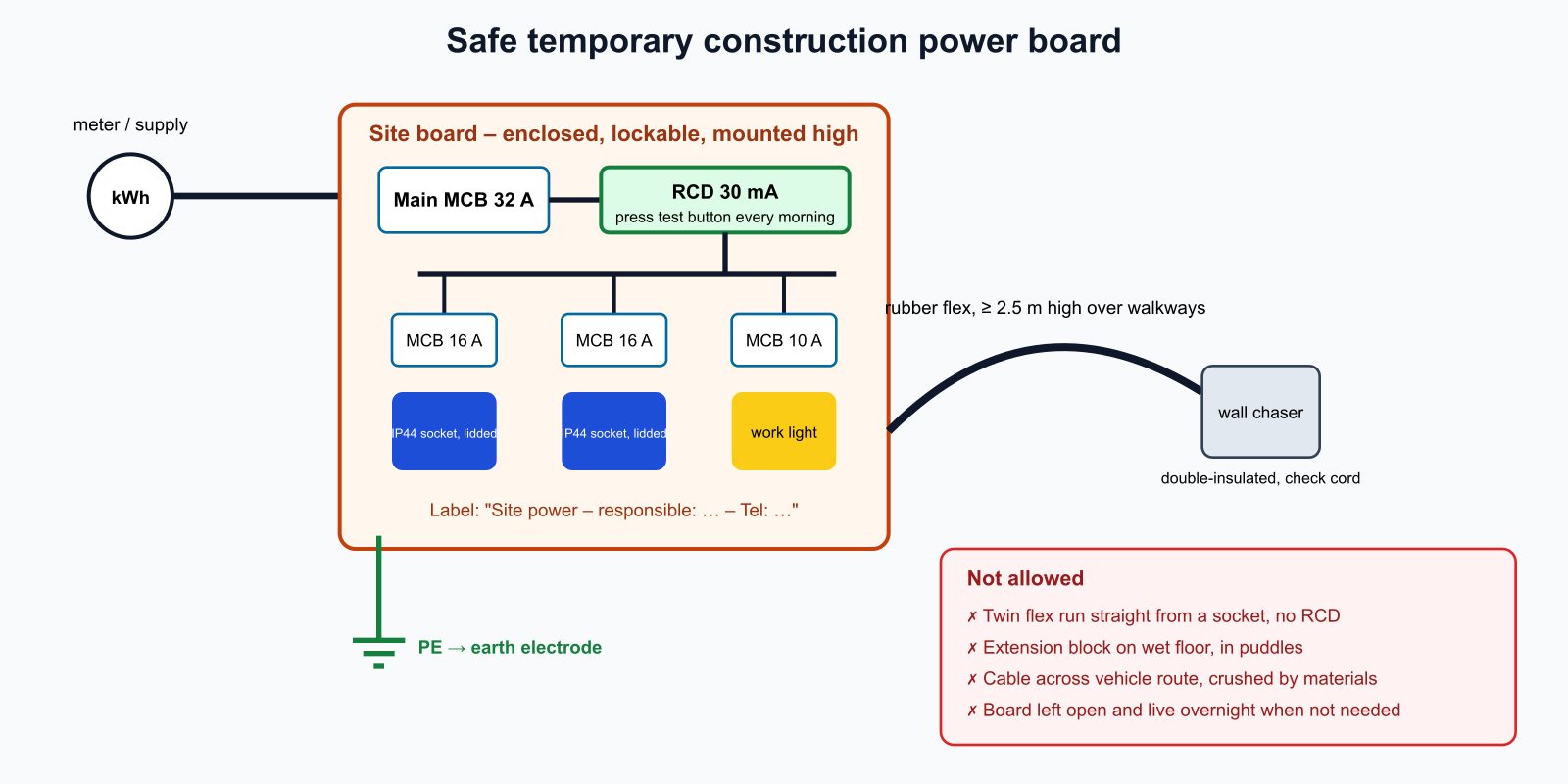
- The construction panel has a closed, lockable enclosure, is mounted off the ground and carries the label "Construction power – person in charge: …".
- A main breaker + 30 mA RCD for every socket; press the RCD test button every morning.
- Rubber-sheathed flexible cable (impact-resistant type), never household flexible twin cord; check the cable sheath before every shift.
- Sockets with covers, industrial plugs in damp areas.
- Portable power tools are inspected regularly: casing, cord, plug; double-insulated tools are preferred.
- Do not leave construction power on overnight when it is not needed; switch off and lock the panel when leaving the site.
Working at height
Falls from height are the leading cause of death in construction. For electricians, a fall from a 2 m ladder after a mild shock is a typical case: the shock is not enough to kill, but the fall is.
| Equipment | Requirements |
|---|---|
| Stepladder | Flat, firm ground; spreader bars locked; never stand on the top 2 steps; use an insulating (fiberglass) ladder for electrical work; someone holds the ladder when working above 2 m |
| Leaning ladder | An angle of about 75° (ratio 4 up : 1 out); extends 1 m above the landing point when accessing a roof; tie off the top of the ladder |
| Scaffolding | All diagonal braces fitted, a fully boarded working platform, guardrails and toe boards; wheels locked; never move it with someone on it |
| Roofs and roof terraces without parapets | A lifeline and a full-body harness clipped to a secure anchor point; no work in rain or strong wind |
| Floor openings, stair openings | Covered with solid, marked boards, or protected with temporary guardrails |
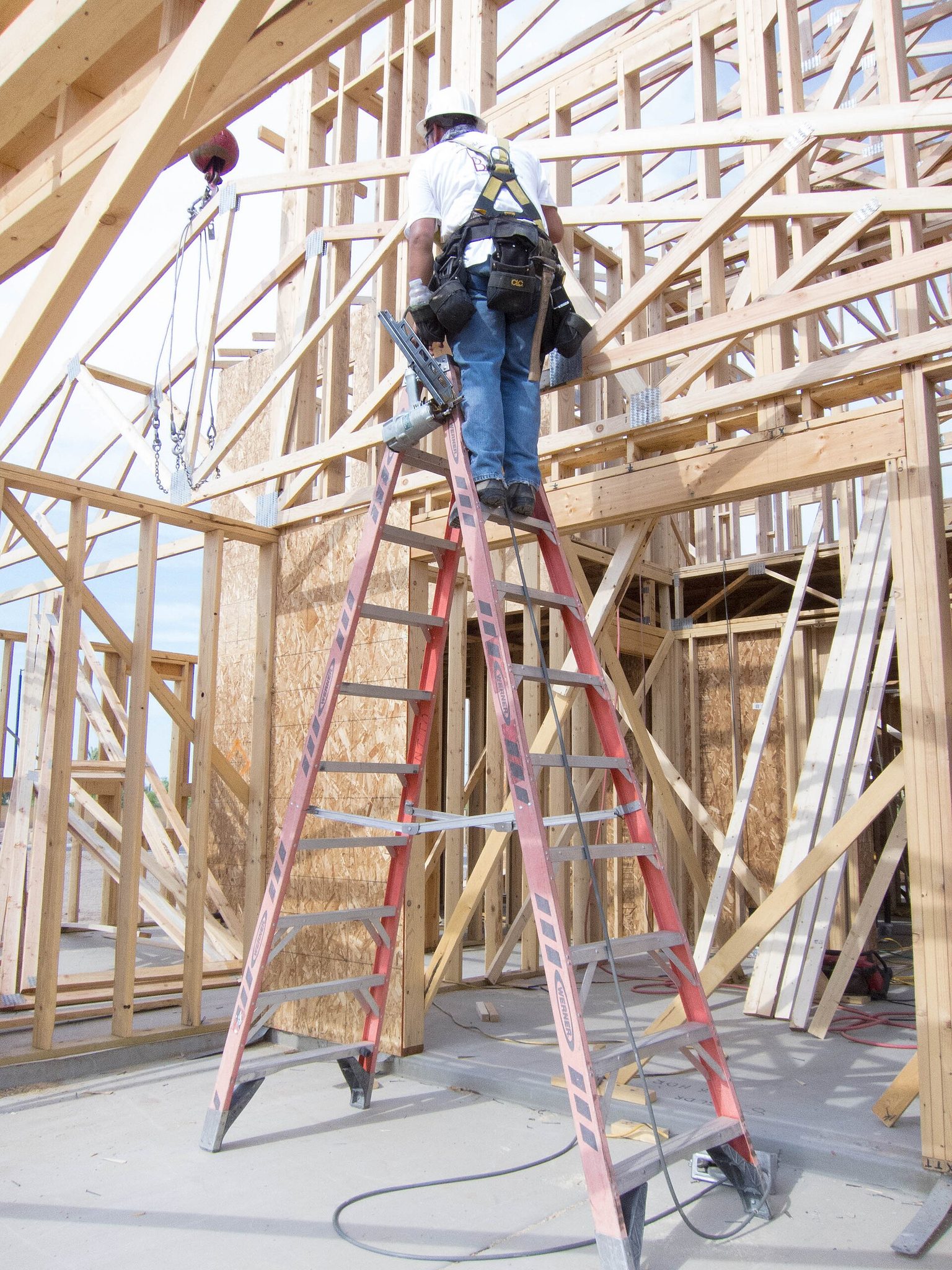
Photo: National Institute for Occupational Safety and Health (NIOSH) from USA / Wikimedia Commons, Public domain

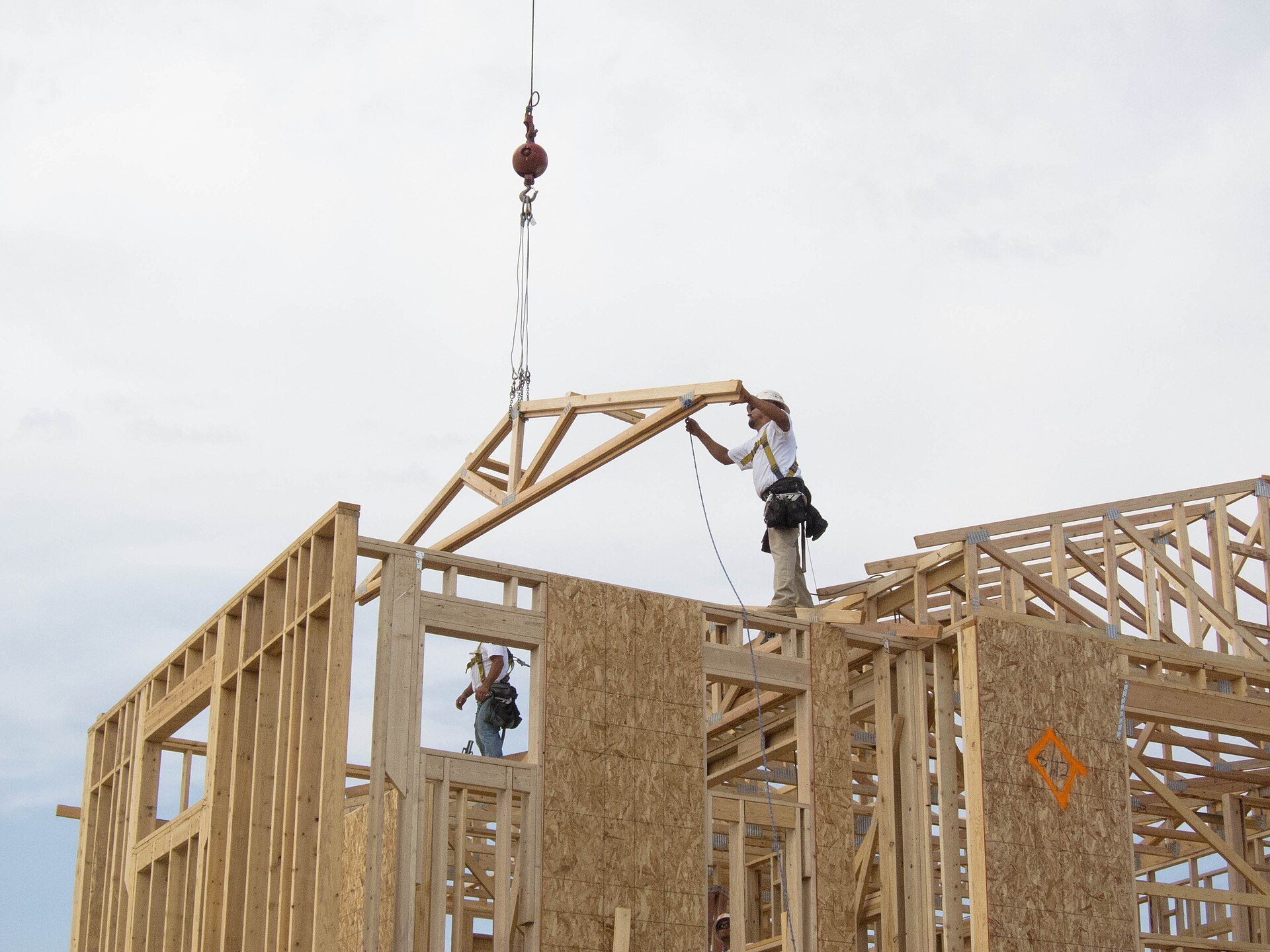
Photo: National Institute for Occupational Safety and Health (NIOSH) from USA / Wikimedia Commons, Public domain

Lockout – tagout for the whole crew and permits to work
When you work alone, you isolate, lock, tag and re-test yourself. When the whole crew works on several circuits in one panel, the procedure has to be stepped up:
- One lock and one key per person: use a multi-lock hasp so several people can lock the same isolating device. The device can only be switched back on when the last person removes their lock.
- Tags state the person's name, the date and the task.
- Re-test for absence of voltage with a voltage tester or meter that has been checked on a known live source (test – verify – test).
- A permit to work for high-risk tasks: connecting into a client's panel that is in service, working on the supply side of the main breaker, working near overhead lines. The permit states the task, the scope, the isolation points, the person authorizing, the person doing the work, the safety measures and the time; it is signed before work starts and signed off at the end.
- The utility side (before the meter) is not your scope: contact the power utility to isolate it under their own procedure.
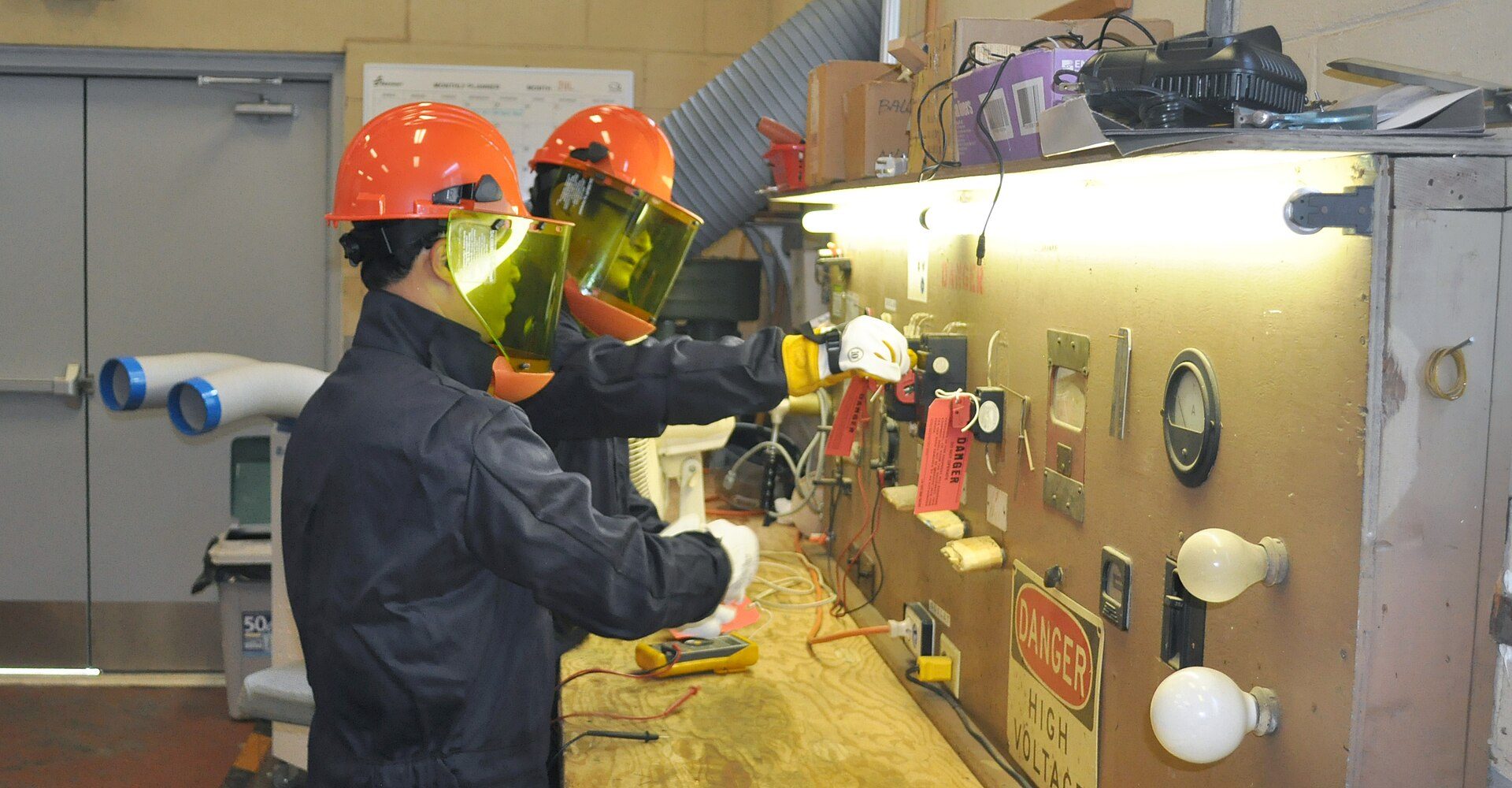
Photo: NAVFAC / Wikimedia Commons, Public domain

Training and crew safety records
- Induction training for new workers: the crew's safety rules, hazard identification, isolation procedure, first aid – before any work is assigned.
- Periodic training and safety cards for people doing work with strict safety requirements under the regulations – organized through a licensed training provider.
- A 5-minute morning safety briefing: today's hazards, who is working at height, who is doing electrical work.
- Records: a list of workers and their skill levels, training certificates, the project risk assessment, permits to work, tool inspection records, and a log of incidents and near misses.
- Insurance: consider accident insurance for your workers and third-party liability insurance for your business; workers with contracts who fall under the compulsory scheme must be enrolled in social insurance as required by law.
When an accident happens
- Isolate the source of danger, make sure the rescuer is safe, give first aid (as you learned at Level 1) and call emergency services on 115.
- Keep the scene unchanged as far as possible (unless needed to rescue someone or prevent a further accident), and take photos.
- Inform the owner and the site coordinator; report the workplace accident to the competent authority as required by the regulations when it falls into a reportable category.
- Record what happened and the witnesses; assist the investigation; look after the injured person and their family.
- Analyze the root cause and fix the procedure so it does not happen again. Share the lessons learned with the whole crew.
Responsibility to the owner and third parties
- Faulty installation that causes a fire or an electric shock to the occupants after handover: you may be liable for compensation if the fault lies in the installation. Test reports and inspection records are the evidence that you did the work correctly.
- Damage to the owner's or neighbors' property (drilling through a water pipe, dropping materials): compensation by agreement or under civil law.
- Do not take on work beyond your competence and licensing: connections to the medium-voltage grid, interfering with the utility meter, or fire protection systems that require a specially licensed contractor.
Common mistakes
| Mistake | Consequence | The right way |
|---|---|---|
| Construction power without an RCD | Fatal electric shock from a crushed cable or a wet floor | A construction panel with a 30 mA RCD, tested every morning |
| One shared lock for the whole crew | Someone switches the power back on while another person is still working | One lock per person, a multi-lock hasp |
| New workers start work straight away | Accidents because they do not know the hazards | Induction training before assigning work |
| A stepladder on broken brick rubble | A fall from height | Flat ground, someone holding the ladder, or scaffolding |
| No safety records kept | Unable to prove the work was organized safely | Training records, risk assessments, work permits |
Pass criteria for this lesson
- Prepare a risk assessment for a sample project with at least 8 hazards, place them in the matrix and propose controls following the hierarchy of controls.
- Build and test a temporary construction power panel with a 30 mA RCD, with a measured RCD trip time that meets the requirements.
- Practice the multi-person lockout procedure with a multi-lock hasp and a permit to work on the training bench.
- Inspect and set up a leaning ladder at the correct angle, and inspect a full-body harness before use.
- State correctly the employer's main obligations regarding training, protective equipment and accident reporting.
- Score 100% on the safety module quiz.
Frequently asked questions
Do I have to train workers I hire by the day?
Anyone working for you, even by the day, must receive safety instructions before starting work, and must be qualified if they do work with strict safety requirements. At a minimum, hold an induction session and have them sign to confirm it.
What if the client wants the work done live so the shop does not lose power?
Live work is an exception, only when it is truly impossible to isolate, done by a person with the right safety grade, using insulated tools of the correct rating and under a permit to work. For homes and small shops, a short shutdown can almost always be arranged. Explain the risks to the client and propose a shutdown outside business hours.
Do I need an electrical safety card?
People doing electrical work and work at height belong to the group with strict occupational safety requirements; under the regulations, they must be trained and issued a card. Contact a licensed safety training provider in your area.
Further reading
Review the fundamental principles in the lesson Safety rules before touching electrical wires and the lesson Safety test and circuit installation exercise.