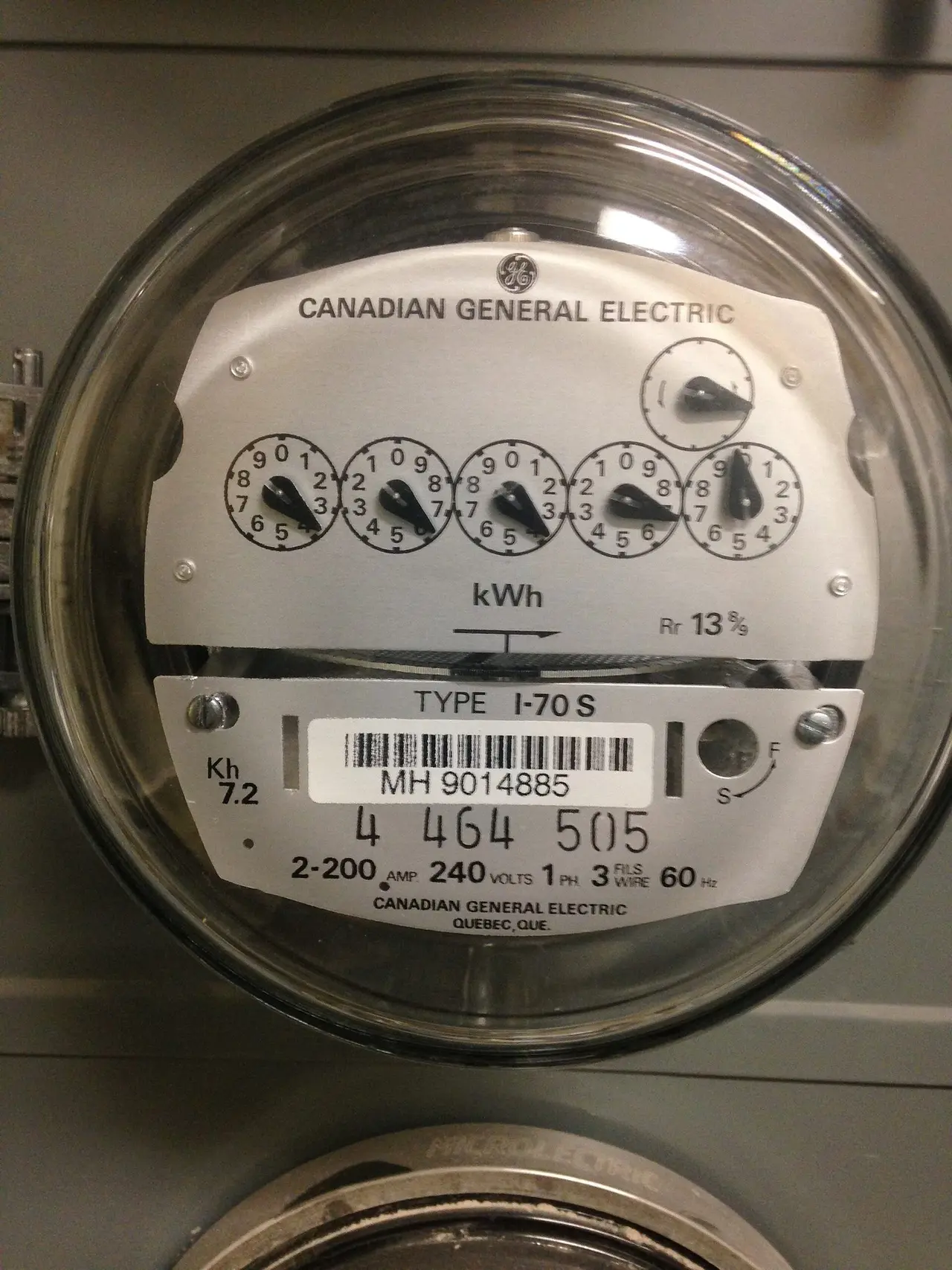
The owner asks: "My house has 3 air conditioners, a water heater, an induction hob and a washer-dryer. What meter rating should I apply for, what size cable do I need into the house, and how many amps should the main breaker be?" If you add up the power on the rating plate of every appliance, you get a very large number, and the cable and board end up far too expensive. If you guess by feel, the main breaker will trip every summer afternoon. The right answer comes down to two concepts: installed load and diversity factor. This is the calculation a lead electrician must be able to do before selecting cables in the next lesson.
By the end of this lesson, you will be able to:
- Draw up a load schedule for a house: appliances, power, quantity and circuit.
- Distinguish between installed load, design load, diversity factor and power factor cos φ.
- Calculate the design current for each final circuit and for the incoming supply to the house.
- Make a preliminary selection of the main circuit breaker and check it against the meter's contracted capacity.
- Verify your calculation by taking real measurements with a clamp meter.
Four concepts you need to know
| Concept | Symbol | Meaning |
|---|---|---|
| Installed (rated) load | Pđ | The power shown on the appliance rating plate, when running at full power |
| Diversity factor | ks | The ratio of the power actually running at the same time to the total installed load, always ≤ 1 |
| Design load | Ptt = ks × ΣPđ | The power used to select cables and circuit breakers |
| Power factor | cos φ | For loads with motors, compressors or electronic power supplies: the current is higher than P/U |
The idea behind the diversity factor is very down-to-earth: nobody runs both zones of an induction hob at full power while drying their hair, ironing clothes, running all 3 air conditioners at maximum and heating the water heater, all at the same moment. The cable and breaker only need to handle the largest realistic load that can actually occur, plus a margin.
Step 1. Draw up the load schedule
Go room by room and list the existing appliances and the ones the owner plans to buy in the next few years. Record the power from the rating plate; if the appliance has not been bought yet, use a reference value:
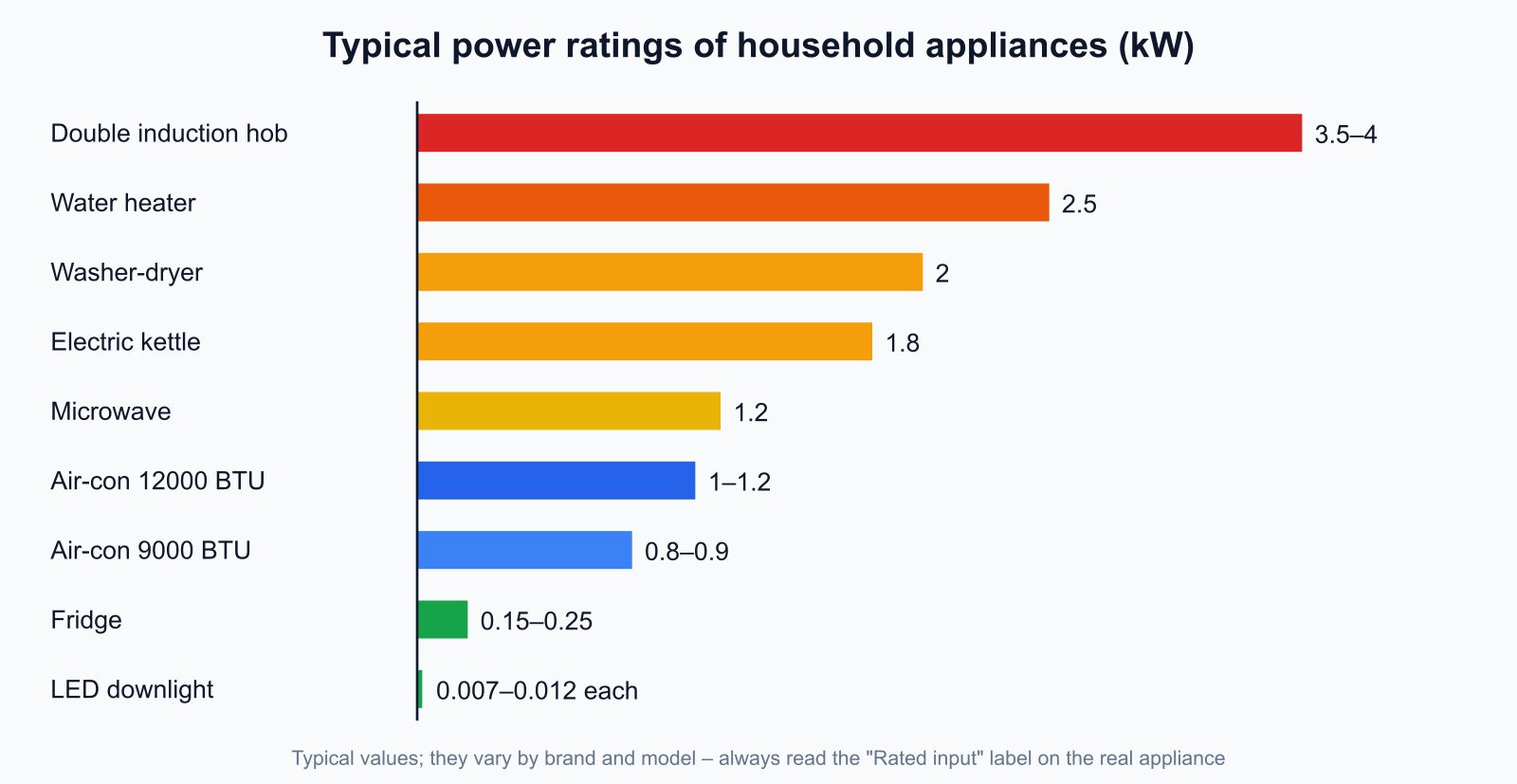
Two points people often get wrong:
- Air conditioners: 9000 BTU is the cooling capacity (about 2.6 kW of cooling), while the electrical input power is only about 0.8–1 kW. Read the "Rated input" line (or "Electrical power") on the rating plate.
- Double induction hobs: the plate may show a total of 3.5–4 kW or more; some hobs have an adjustable total power limit. An induction hob should have its own dedicated circuit (Level 3 has a lesson on large loads).
Step 2. Divide into circuits and calculate each final circuit
Each final circuit is calculated separately to select its cable and breaker. For a final circuit feeding a single fixed appliance (water heater, air conditioner), do not apply a diversity factor: the circuit must carry the full power of that appliance.
For a socket circuit feeding several portable appliances, the lead electrician estimates the largest load that could be plugged in at the same time. Example, the kitchen socket circuit: electric kettle 1.8 kW + rice cooker 0.7 kW + microwave 1.2 kW = 3.7 kW. Design current:
I = P / (U × cos φ) = 3700 / (220 × 1) ≈ 16.8 A
These appliances are mainly heating loads, so cos φ is close to 1. A current of 16.8A is above 16A, so the lead electrician considers splitting the kitchen sockets into two circuits, or using 4 mm² cable with a 20A breaker if the design allows. This is exactly the "kitchen breaker keeps tripping" situation from Level 1.
Power factor cos φ
Appliances with motors or compressors (air conditioners, pumps, washing machines) have a cos φ below 1, typically 0.8–0.95. The current is then higher than P/U. Example: a 750W pump with cos φ = 0.8: I = 750 / (220 × 0.8) ≈ 4.3A instead of 3.4A. Inverter air conditioners usually have a high cos φ thanks to their power factor correction circuit, but read the rated current on the plate if it is given: that is the most reliable figure.
Step 3. Apply the diversity factor to the incoming supply
The cable from the meter to the board and the main breaker supply the whole house. This is where the diversity factor is applied:
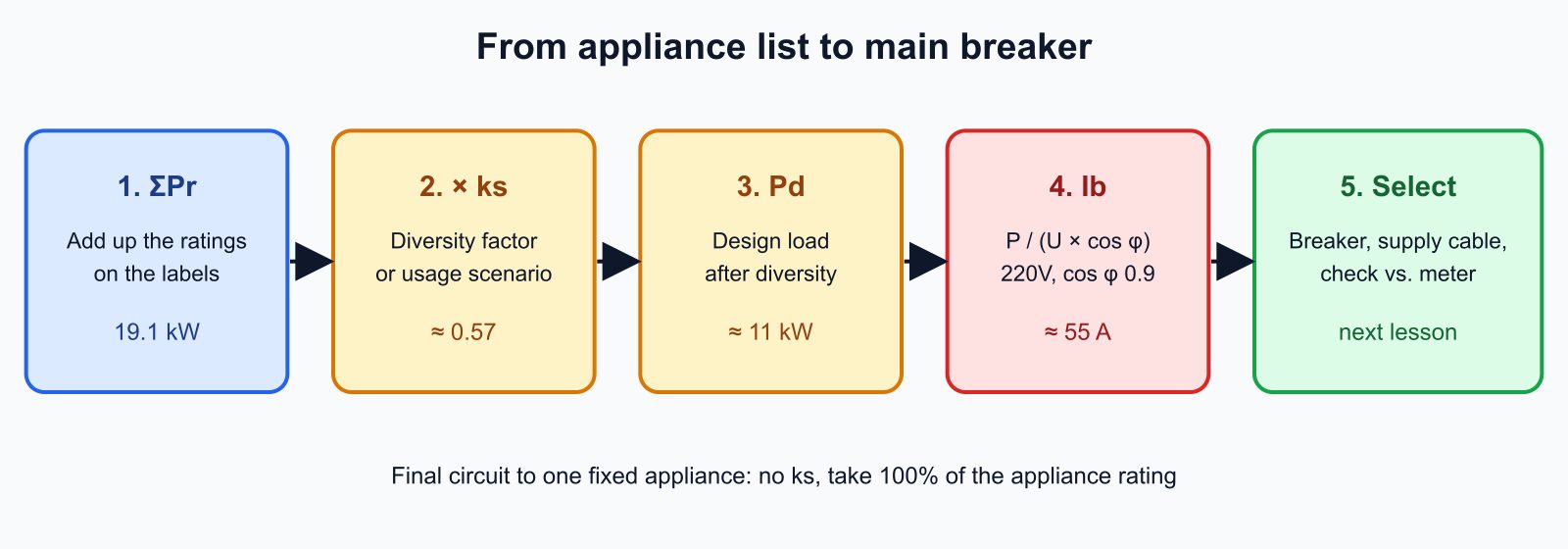
TCVN 9206:2012 (Vietnamese standard: installation of electrical equipment in dwellings and public buildings – design standard) gives tables of specific load and diversity factors for apartment buildings by number of apartments, used by designers to size transformer stations and rising mains. For a single house, lead electricians usually use an experience-based ks in the range 0.5–0.8, depending on the number and type of appliances:
- A house with many small appliances and spread-out usage habits: lower ks.
- A house with few appliances but high power ratings that are often used together (for example in the evening: air conditioners in every room + water heater + hob): higher ks.
- When in doubt, calculate using a peak-hour scenario instead of a single ks figure: list exactly what runs at the same time on a summer evening.
Worked example: a 3-bedroom townhouse
| Load | Quantity | Pđ each (kW) | Total (kW) |
|---|---|---|---|
| 12000 BTU inverter air conditioner | 3 | 1.1 | 3.3 |
| Water heater | 2 | 2.5 | 5.0 |
| Double induction hob | 1 | 3.5 | 3.5 |
| Kitchen sockets (kettle, rice cooker, microwave) | 1 group | 3.0 | 3.0 |
| Washing machine | 1 | 2.0 | 2.0 |
| Refrigerator | 1 | 0.2 | 0.2 |
| LED lighting for the whole house | – | – | 0.6 |
| Room sockets (TV, computer, chargers) | – | – | 1.5 |
| Total installed load | 19.1 |
Heaviest summer evening scenario: 3 air conditioners (3.3 kW) + 1 water heater (2.5 kW) + induction hob cooking on one zone at high power (2 kW) + kitchen sockets (1.5 kW) + refrigerator, lights and TV (1.5 kW) ≈ 10.8 kW. The ratio 10.8 / 19.1 ≈ 0.57, which corresponds to ks ≈ 0.57.
Take Ptt ≈ 11 kW. Design current with an overall cos φ of about 0.9: I ≈ 11000 / (220 × 0.9) ≈ 55A. Preliminary conclusions:
- This house exceeds the capacity of the common 10(40)A single-phase meter at its 40A limit. You need to discuss a higher-rated meter or a three-phase supply with the power company.
- Or reduce the simultaneous load: choose water heaters with timers and schedule appliance use.
- The main breaker and the incoming cable are selected based on the design current plus a margin (next lesson).
Warning: Never "fix" a tripping main breaker by fitting a bigger breaker without checking the incoming cable and the meter. A breaker larger than the cable can carry removes a layer of protection: the cable can overheat and burn before the breaker trips.
Reading the meter and the contracted capacity
Common single-phase electronic meters are marked in the form "5(20)A" or "10(40)A": the first number is the basic current, and the number in brackets is the maximum current the meter measures accurately and can carry continuously. The design current of the house should not exceed the meter's maximum current. The electricity supply contract with the power company also states a contracted capacity; any large increase in load (several more air conditioners, an electric vehicle charger) should be reported to the power company so they can upgrade the meter and the service cable from the grid.
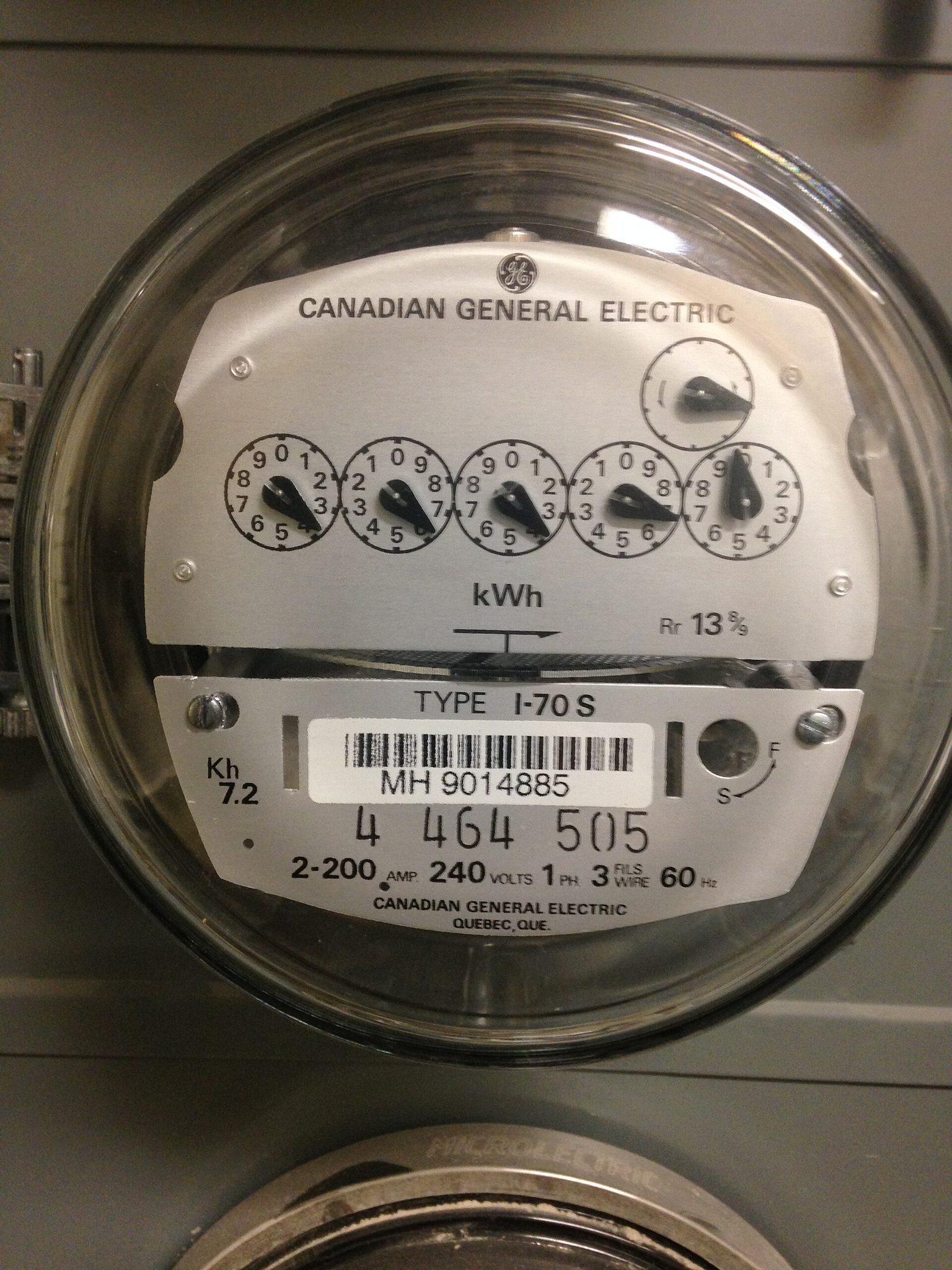
Photo: NellieBly / Wikimedia Commons, CC BY-SA 3.0

Step 4. Verify by real measurement
A calculation is an estimate. In a house that is already occupied, real measurements help verify it:
- At peak time (a summer evening), clamp the phase conductor after the main breaker with a clamp meter and record the current.
- Clamp each final circuit to find out which one is the most heavily loaded.
- Switch on the large appliances one at a time and record the increase in current for each one.
- Compare with your calculation. If the measured current is close to or above the main breaker's rated current, the installation needs upgrading or the loads need to be redistributed.
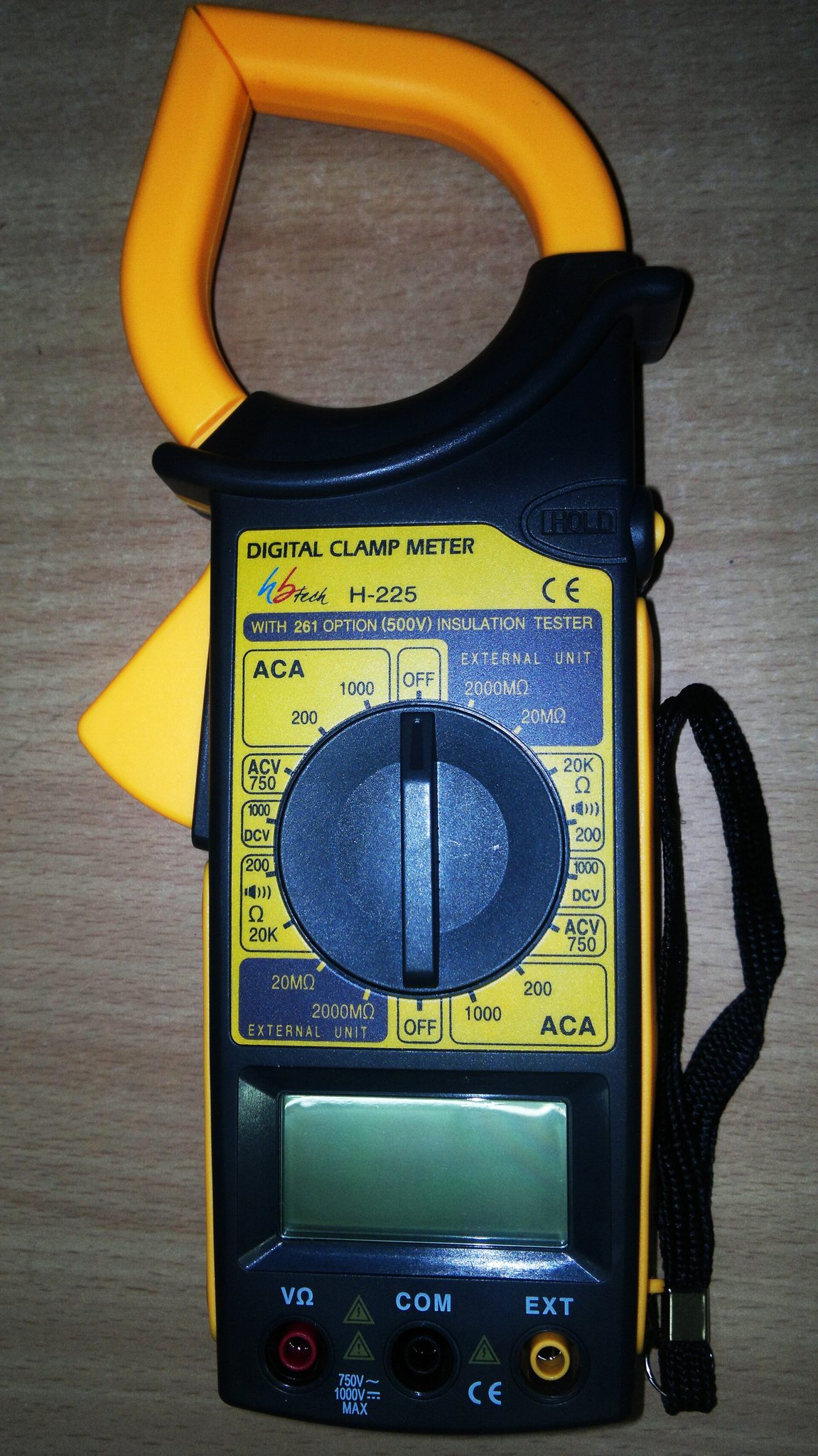
Photo: Shriram / Wikimedia Commons, CC BY-SA 3.0

Allowing for the future, and extension leads
Household loads usually grow over time: another air conditioner, a tumble dryer, an electric vehicle charger. When designing, the lead electrician should:
- Add a margin of about 20–30% for the incoming cable and the board (spare module ways, rising main cable size).
- Install spare conduits in advance to locations where an air conditioner or vehicle charger may be fitted.
- Advise the owner not to use extension leads for large loads: a typical extension lead is only rated at 10A, and many poor-quality ones are rated even lower.
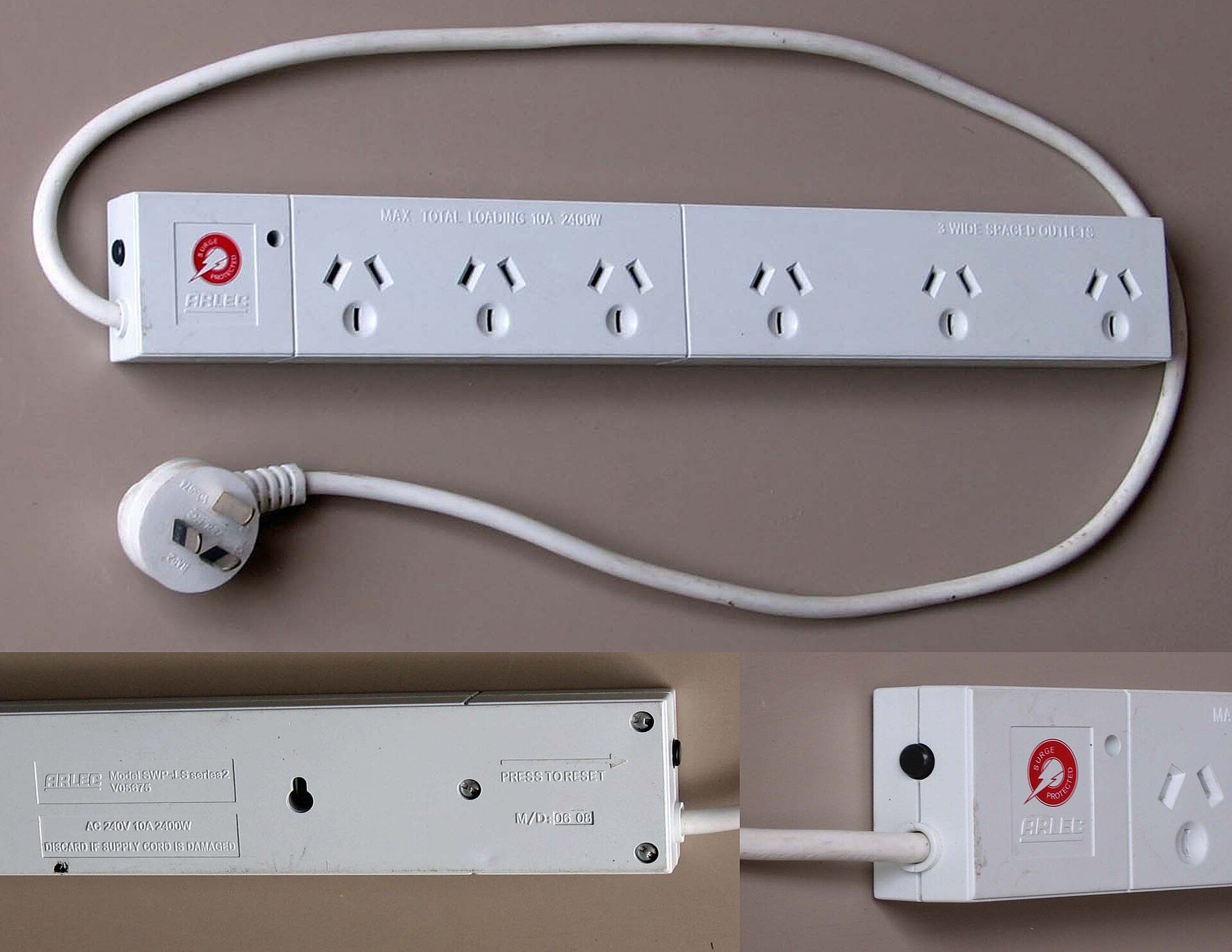
Photo: Fredquint / Wikimedia Commons, CC BY-SA 4.0

Practice exercise: a 2-bedroom apartment
Try it yourself before looking at the hints. A 70 m² apartment has: 2 air conditioners of 9000 BTU (0.85 kW electrical each), 1 water heater of 2.5 kW, a 3.5 kW double induction hob, a 2 kW washing machine, a 0.2 kW refrigerator, 25 LED lights of 9W, room sockets estimated at 1.2 kW, and kitchen sockets (kettle, rice cooker) at 2.5 kW. The apartment's meter is 10(40)A.
- Calculate the total installed load ΣPđ.
- Write a peak-hour scenario for a summer evening and calculate Ptt.
- Calculate the total current with cos φ = 0.9 and decide whether the meter is sufficient.
- Calculate the current of the dedicated water heater circuit and of the kitchen socket circuit.
Suggested answer: ΣPđ = 1.7 + 2.5 + 3.5 + 2 + 0.2 + 0.225 + 1.2 + 2.5 ≈ 13.8 kW. Evening scenario: 2 air conditioners (1.7) + water heater (2.5) + one hob zone (1.8) + electric kettle (1.8) + refrigerator, lights and TV (0.8) ≈ 8.6 kW, corresponding to ks ≈ 0.62. Total current ≈ 8600 / (220 × 0.9) ≈ 43A: slightly above the meter's 40A limit. A sensible solution: set the water heater timer to heat before cooking time; Ptt then drops to about 6.1 kW and the current to ≈ 31A, which is within the limit. Water heater circuit: 2500 / 220 ≈ 11.4A, dedicated circuit. Kitchen socket circuit: 2500 / 220 ≈ 11.4A, which fits a 16A circuit.
This exercise shows the real value of a load calculation: it is not only for selecting cables, but also for advising the owner on how to use electricity in a way that suits the existing infrastructure, before they have to pay for an upgrade.
Common mistakes
| Mistake | Consequence | The right way |
|---|---|---|
| Taking the air conditioner's BTU rating as its electrical power | Load calculated 2–3 times higher than reality | Read "Rated input" on the rating plate |
| Adding up the whole installed load for the incoming supply | Oversized cable and board, wasted money | Apply ks or a peak-hour scenario |
| Applying ks to a circuit for a single fixed appliance | Final circuit cable smaller than required | A dedicated circuit is sized for 100% of the appliance's power |
| Ignoring cos φ of motor loads | Real current higher than calculated | Use the rated current on the rating plate |
| Not comparing with the meter | Overloaded meter and service cable from the grid | Check the meter's maximum current and notify the power company |
Pass criteria for this lesson
- Draw up a load schedule for a sample house with at least 12 types of appliance, with power ratings taken correctly from the rating plate or the reference chart.
- Correctly calculate the current of 5 final circuits (error ≤ 5%), taking cos φ into account for motor loads.
- Build a peak-hour scenario, calculate Ptt and the total current, and explain the corresponding ks.
- Correctly decide whether the existing meter is sufficient, and propose a solution if it is not.
- Measure the real current with a clamp meter on at least 3 final circuits and compare it with your calculation.
Frequently asked questions
Does the diversity factor have a fixed value?
No. Its value depends on the number of appliances, the type of appliances and the occupants' habits. For apartment buildings, TCVN 9206:2012 has tables that designers apply according to the number of apartments. For a single house, a concrete peak-hour scenario is more reliable than one general figure.
Should I oversize generously to be safe?
A reasonable margin (20–30%) is good. Oversizing too much increases the cost of cable and the board, and can leave the main breaker too large for the cable upstream of it if the two are not coordinated. Safety comes from correctly coordinating cable and breaker, not from making everything as big as possible.
Does home electric vehicle charging count as load?
Yes, and it is a large load that runs continuously for many hours. A home charger can be anywhere from about 3.7 kW to 7.4 kW on a single-phase supply. Level 3 has a dedicated lesson on electric vehicle charging.
Further reading
Once you have the design current, select the cable and breaker in the lesson Selecting cable sizes and circuit breakers.