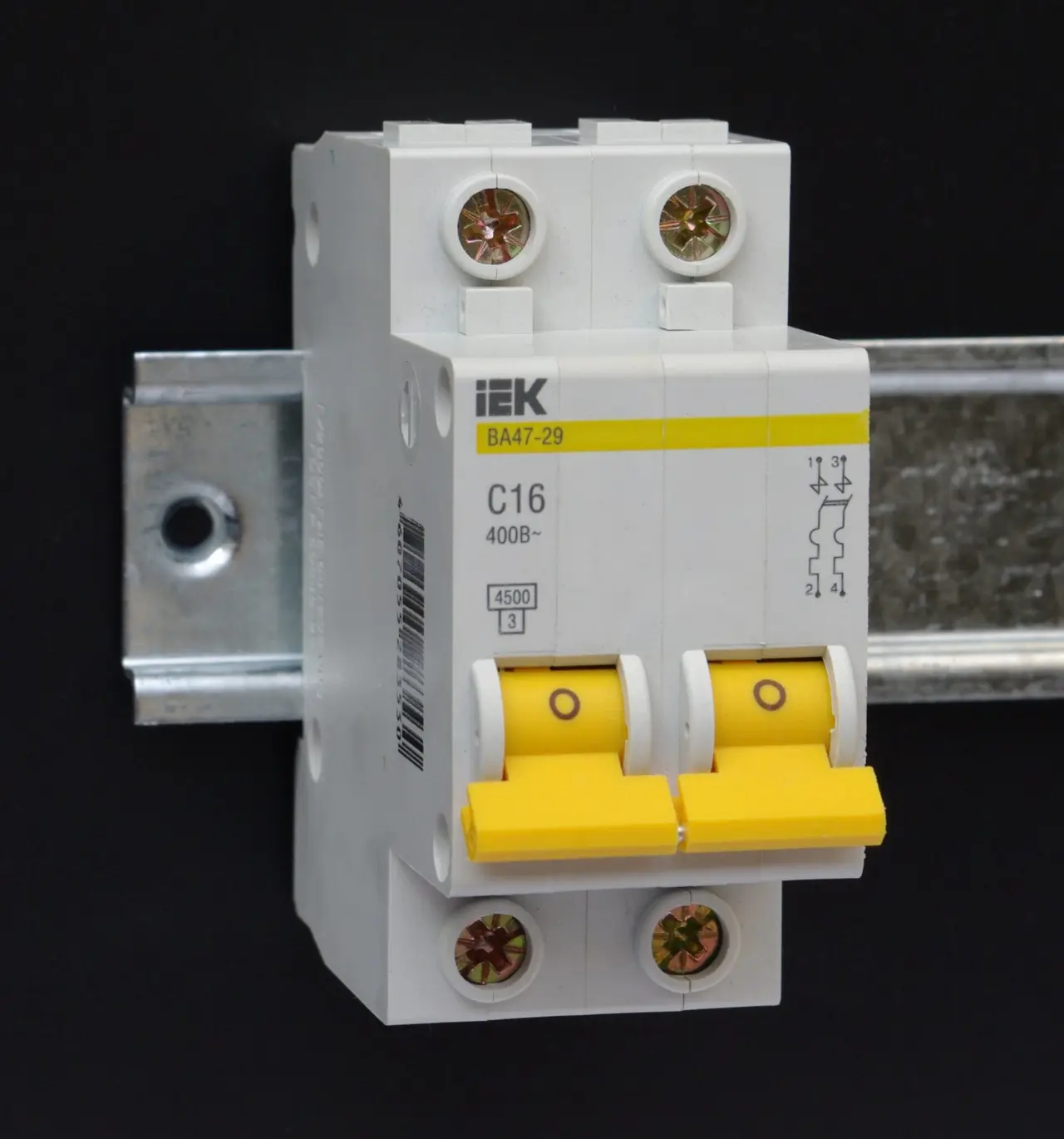
The miniature circuit breaker (MCB) is the device you will install more than any other in your career as an electrician, yet most electricians only read one marking on its face: "C20". A lead electrician must be able to read all of it: what the letter C means, what 20 means, what the "6000" in the box means, and why a short circuit at one socket blacks out the whole house instead of just one circuit. This lesson explains the construction, the tripping characteristic curves, the short-circuit breaking capacity, and the principle of selectivity, so that only the breaker closest to the fault operates.
By the end of this lesson, you will be able to:
- Read all the ratings printed on the face of an MCB according to TCVN 6434-1 (IEC 60898-1).
- Explain the two protective mechanisms: thermal (overload) and magnetic (short circuit).
- Choose a B, C or D curve to suit the type of load.
- Choose a short-circuit breaking capacity Icn that suits the installation location.
- Design basic selectivity between the main breaker and the final circuit breakers in a house.
Reading the face of an MCB
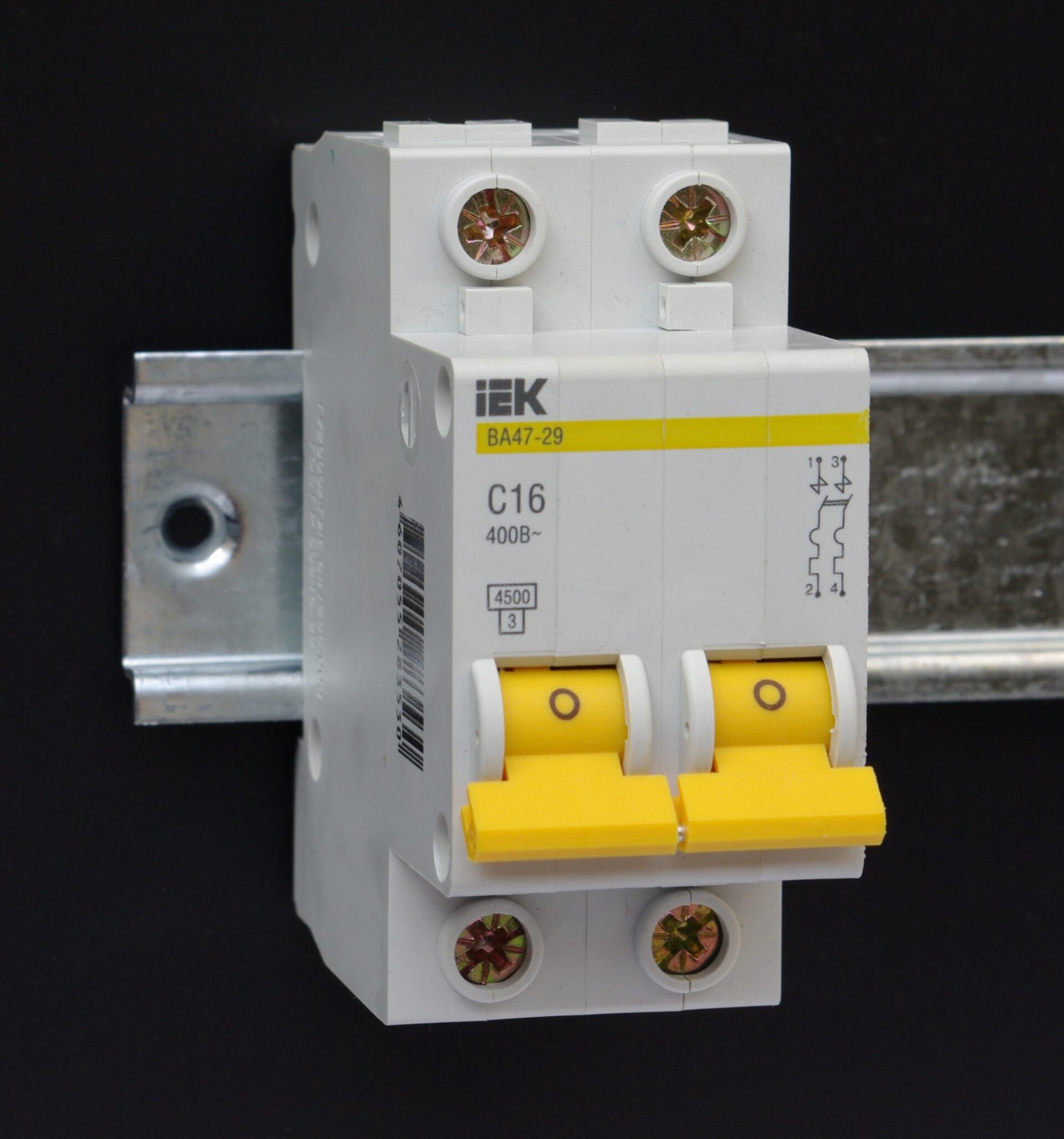
Photo: Kae / Wikimedia Commons, CC BY-SA 3.0

| Marking on the face | Meaning | Example |
|---|---|---|
| Letter + number | Tripping curve + rated current In | C20: curve C, In = 20A |
| Number in a rectangle | Rated short-circuit breaking capacity Icn (A) | 6000 = can break a 6 kA short-circuit current |
| Small number in a square | Energy limiting class | 3 = best energy limiting |
| 230/400V ~ | Rated voltage | For use on 220/380V networks |
| IEC/EN 60898-1 | Product standard for household use | To distinguish it from industrial IEC 60947-2 |
Number of poles: 1P (breaks the phase only), 1P+N or 2P (breaks both phase and neutral), 3P and 4P for three-phase supplies. For the main breaker in a single-phase house, use 2P so that it breaks the neutral as well when it opens, which is safer when working downstream.
The two protective mechanisms inside
Thermal mechanism: overload protection
A bimetallic strip heats up when current flows through it. The more the current exceeds In, the faster the strip bends and pushes the release mechanism. It trips slowly: a slight overload may take tens of minutes, and double the rated current may take from several tens of seconds to a few minutes. According to IEC 60898-1, at 1.13 In the breaker must not trip within 1 hour; at 1.45 In it must trip within 1 hour (for In ≤ 63A). This is why a 20A breaker can "carry" 22A without tripping straight away.
Magnetic mechanism: short-circuit protection
An electromagnetic coil pulls in a steel plunger when the current surges, tripping almost instantaneously (in less than 0.1 seconds). The operating threshold of the magnetic mechanism is exactly what distinguishes the B, C and D curves.
B, C and D curves
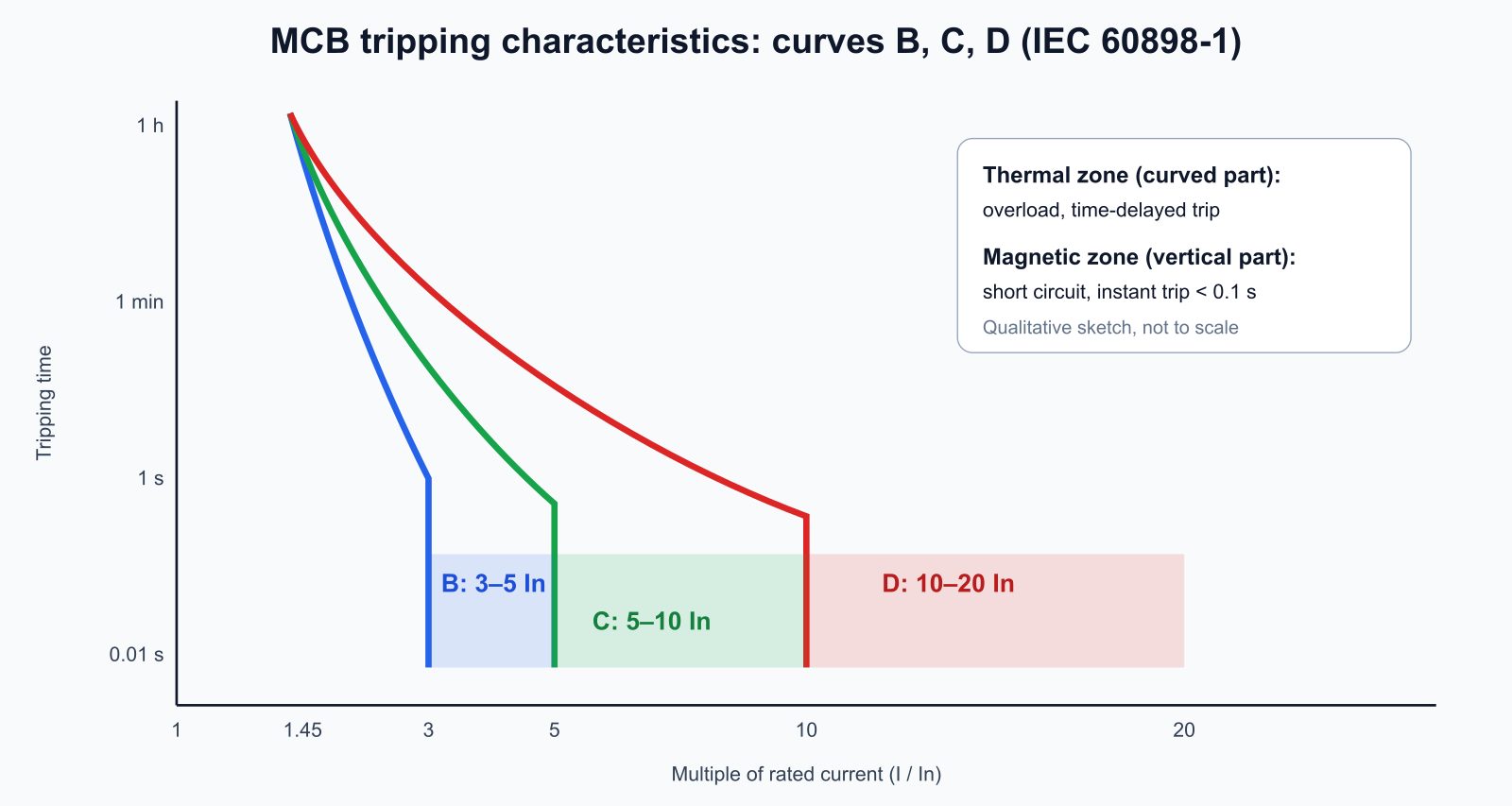
| Curve | Instantaneous tripping threshold | Used for |
|---|---|---|
| B | 3–5 × In | Purely resistive loads, long cables, locations with low short-circuit current: lighting, water heaters, sockets on long runs |
| C | 5–10 × In | Most homes: sockets, air conditioners, mixed loads with moderate inrush current |
| D | 10–20 × In | Loads with very high inrush current: large motors, transformers, welding machines |
Why not choose D for everything to "stop it tripping"? Because the magnetic mechanism only trips quickly when the fault current exceeds its threshold. At the end of a long cable run, the short-circuit current is limited by the cable resistance and may be only 150–250A. With a C20, the maximum threshold is 200A: it can trip. With a D20, the maximum threshold is 400A: the magnetic mechanism does not operate, and only the thermal mechanism is left, tripping slowly over many seconds. That is long enough for the cable to overheat and arc, and dangerous for anyone touching the casing of a live appliance. Choosing a curve is always a trade-off between "no nuisance tripping" and "fast disconnection under fault conditions".
Warning: Disconnection time on an earth fault to an exposed metal casing is a life-or-death safety factor. According to IEC 60364-4-41, final circuits up to 32A in a TN system at 230V must disconnect within 0.4 seconds. For that, the fault current must exceed the breaker's magnetic tripping threshold, or there must be an RCD. This is why the next lesson on RCDs is compulsory.
Short-circuit breaking capacity Icn
When a short circuit happens right next to the distribution board, the current can reach several thousand amps. The breaker must be able to interrupt this current without exploding and without its contacts welding together. Common Icn values: 4.5 kA, 6 kA, 10 kA.
- Houses far from the substation, supplied by a long service cable: low short-circuit current, 4.5–6 kA is usually enough.
- Houses close to a substation, apartment buildings with their own substation, building main boards: higher short-circuit current, choose 6–10 kA or follow the designer's calculation.
- With no data available, choosing at least 6 kA for the main breaker of a house is a common safe choice for the lead electrician.
Poor-quality breakers marked with a high Icn that they do not actually achieve are a serious risk: in a short circuit, the casing can crack and the contacts can weld shut and fail to break. Only use products with a clear origin and a certificate of conformity.
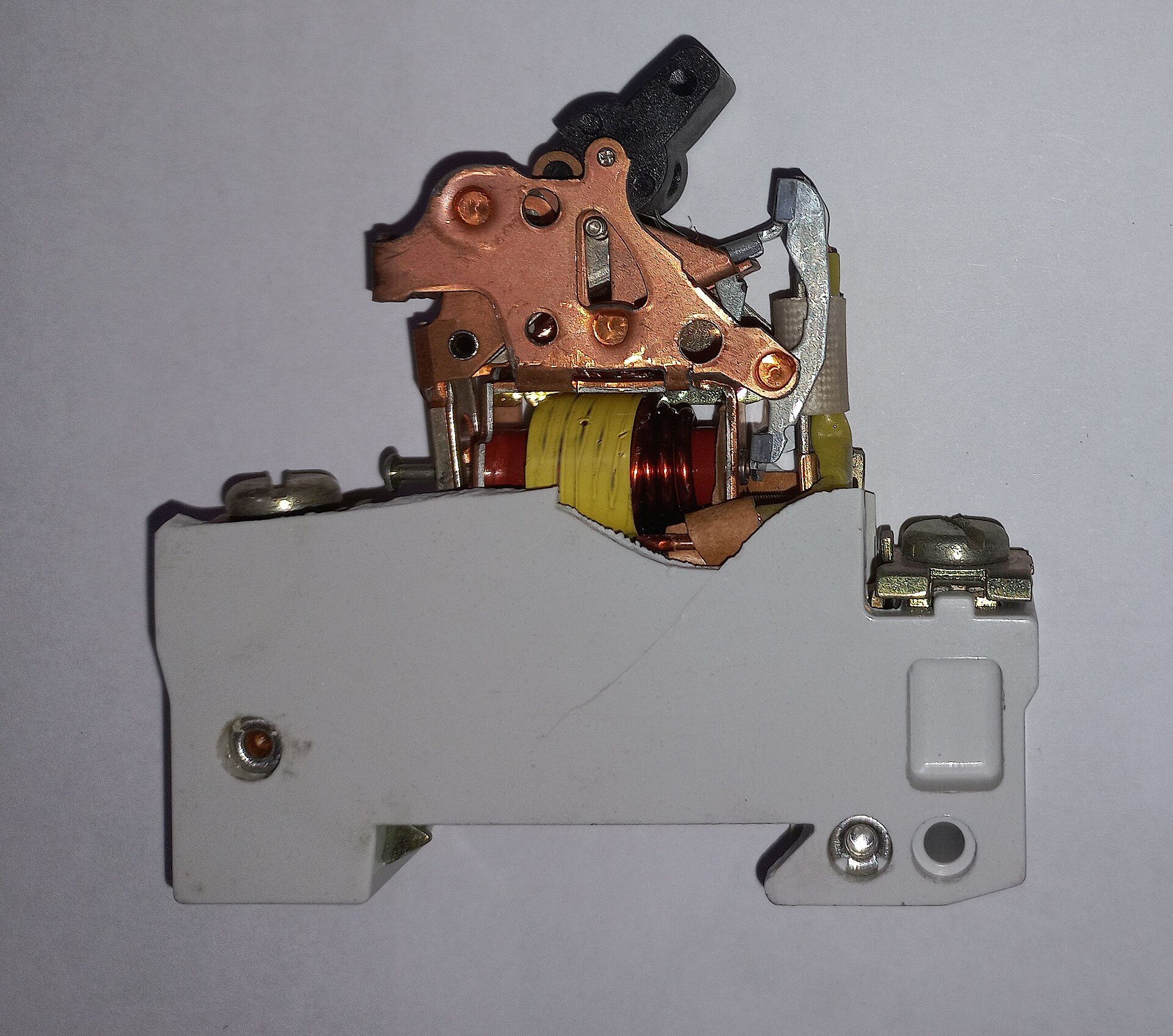
Photo: Asurnipal / Wikimedia Commons, CC BY-SA 4.0

Selectivity: only the breaker closest to the fault should trip
A familiar situation: someone plugs in a faulty iron and the whole house goes dark, because the main breaker trips together with, or before, the final circuit breaker. A system like this is not selective. The goal is that a fault on one circuit only cuts power to that circuit.
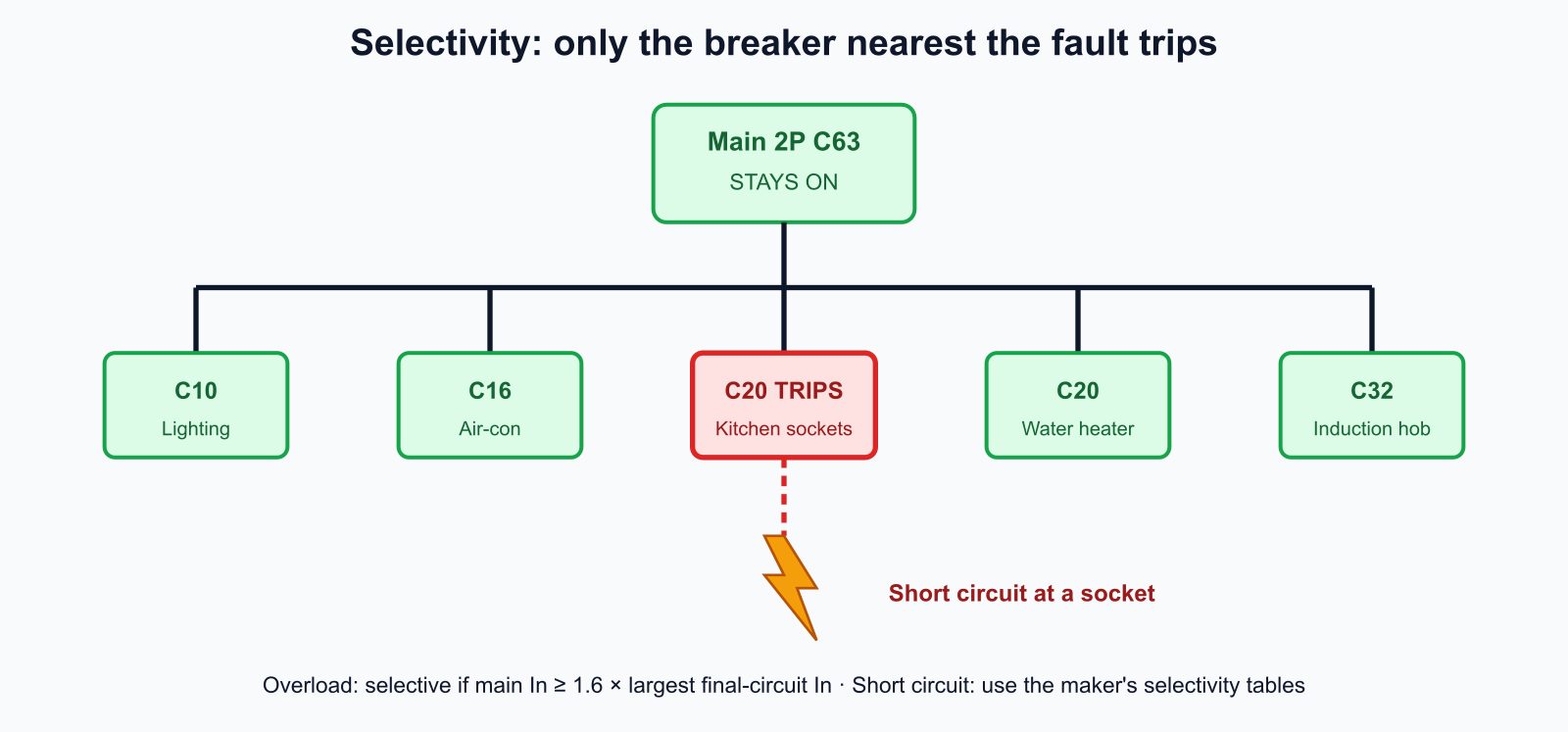
Selectivity under overload
Easy to achieve: the main breaker's rated current just needs to be significantly higher than the largest final circuit. Rule of thumb: In main ≥ 1.6 × In of the largest final circuit (for breakers of the same brand and product range, the manufacturer usually gives a specific ratio).
Selectivity under short circuit
Much harder. In a large short circuit, the current exceeds the magnetic threshold of both breakers, and both trip instantaneously. Two MCBs in series are usually only selective up to a certain current level, called the selectivity limit, which the manufacturer publishes in its coordination tables. Ways to improve it:
- Use a selective main circuit breaker (marked SHU or similar): it has a time delay that allows the final circuit breaker to trip first.
- Use an MCCB with adjustable time settings as the main breaker on larger projects.
- Look up the selectivity coordination tables from the same manufacturer: the manufacturer publishes which main–final combinations are selective and up to how many kA.
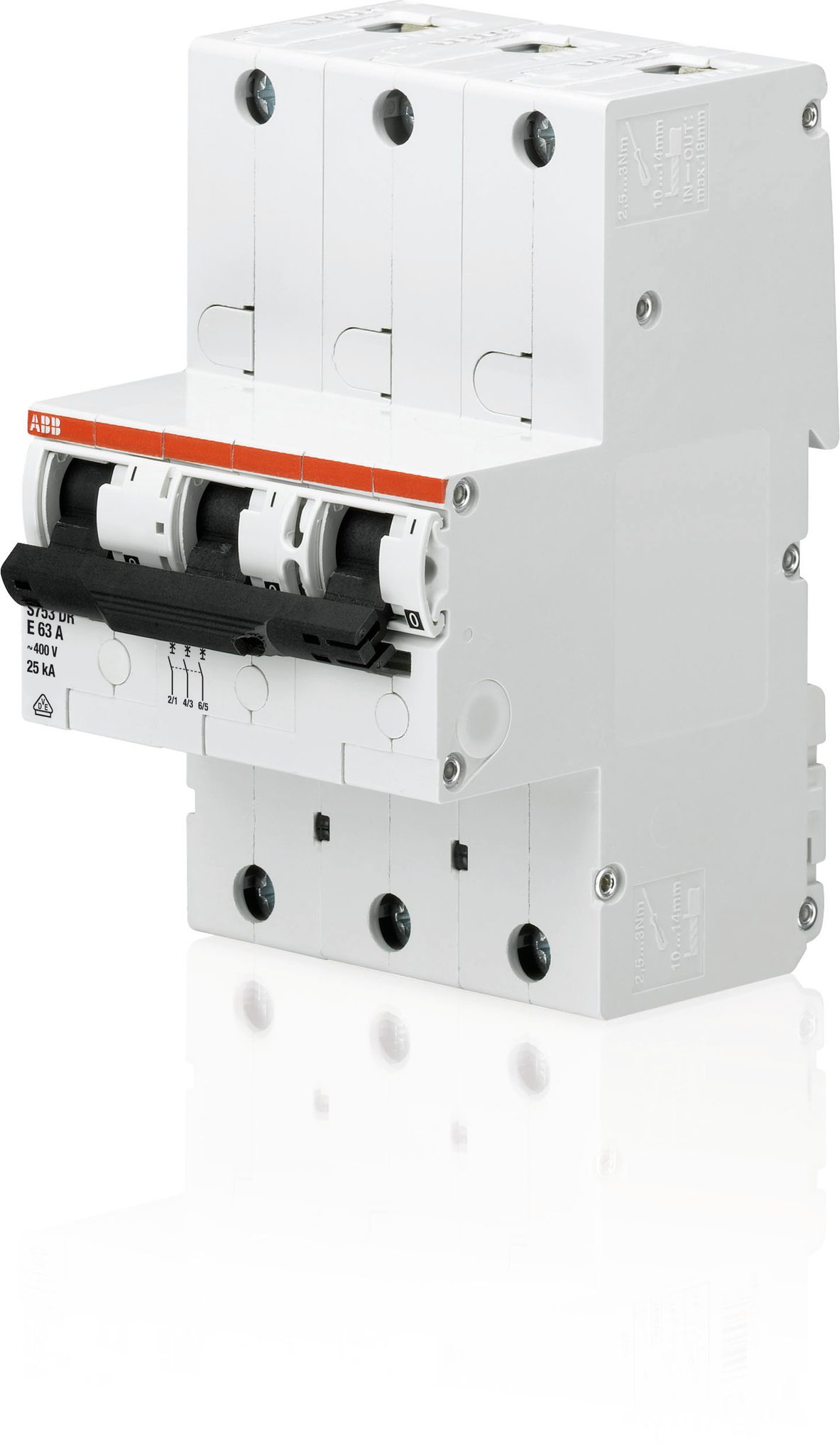
Photo: tomashiovp / Wikimedia Commons, CC BY-SA 3.0

MCB selection table for homes by circuit type
| Circuit | Cable | Suggested MCB | Notes |
|---|---|---|---|
| Lighting | 1.5 mm² | B10 or C10 | LED lights have an inrush current at switch-on; with many lights on one circuit, use C |
| General sockets | 2.5 mm² | C16 or C20 | According to the corrected Iz |
| Water heater | 2.5–4 mm² | C16/C20 + RCD | Shock protection is mandatory |
| Air conditioner ≤ 12000 BTU | 2.5 mm² | C16 | The compressor has an inrush current |
| Induction hob | 4–6 mm² | C25–C32 | According to the hob manufacturer's instructions |
| Pump 0.75–1.5 kW | 2.5 mm² | C16 or D16 | D when the inrush current is high and the cable is short |
| Main breaker | As calculated | 2P C40–C63, Icn ≥ 6 kA | ≥ 1.6 × the largest final circuit |
MCB checking procedure during installation
- Check the label: correct curve, In, Icn and standard; the manufacturer's anti-counterfeit sticker.
- Switch it on and off a few times: the mechanism must operate crisply, with no looseness or sticking.
- Connect the cables to the terminals in the correct supply–load direction as marked (some breakers allow supply from either end, some do not).
- Tighten the terminal screws to the torque specified by the manufacturer (typically 2–3.5 N·m for MCBs), using a torque screwdriver if you have one. Loose connections are the number one cause of burnt-out breakers.
- Once under load, check the temperature of the breaker body by hand or with an infrared thermometer: warm is normal; too hot to keep your hand on is abnormal.
Three real-life situations to train your thinking
Situation 1: the lighting breaker trips every time a whole row of LED lights is switched on
A living room has 24 recessed LED downlights on one B10 circuit. Every time the switch is turned on, the breaker trips, even though the total power is only about 220W. The cause: each LED driver has a very large capacitor-charging inrush current for a few milliseconds; 24 drivers together can exceed the 3–5 In magnetic threshold of a B curve (30–50A). How to fix it: change to a C10 (threshold 50–100A), split it into two circuits, or use LED drivers with inrush current limiting. Do not increase In to 20A, because 1.5 mm² cable does not allow it.
Situation 2: a short circuit at a third-floor socket trips the main breaker on the ground floor
A townhouse has a main board on the ground floor with a C40, and each floor has a sub-board with a C32 floor main breaker and C20 socket circuits. When a short circuit happens at a socket, a fault current of about 800A exceeds the magnetic threshold of the C20 (200A), the C32 (320A) and the C40 (400A): all three can trip together, and the occupants have to go down to the ground floor to reset it. How to improve it: use a selective main breaker on the ground floor, look up the manufacturer's coordination tables to choose a combination with a higher selectivity limit, or accept it and record it in the handover documents so the owner knows.
Situation 3: a borehole pump trips the C16 breaker when it starts
A 1.5 kW pump has a rated current of about 8.5A and a starting current of 6–7 times that, i.e. 50–60A for about 1 second. A C16 has a magnetic threshold of 80–160A, so in theory it should not trip. If it still trips, suspect a failed start capacitor making the motor take too long to start, or low voltage caused by a long cable. Check the capacitor and measure the voltage during starting before thinking about a D16.
Safely replacing a breaker in a live distribution board
- Inform the owner, switch off the main breaker, and lock off and tag as in the Level 1 procedure.
- Prove dead at the terminals of the breaker to be replaced with a voltage tester that has been checked before and after the test.
- Photograph the board before removing anything so you can reconnect it correctly.
- Disconnect the cables and remove the breaker from the rail; fit a new breaker of the same rating, or the correct rating as recalculated.
- Connect the cables, tighten to the correct torque, and gently pull each cable to make sure it is secure.
- Switch on the main, switch on the circuit, test under load, and check the temperature after 15–30 minutes.
Common mistakes
| Mistake | Consequence | The right way |
|---|---|---|
| Using D for every circuit to "stop it tripping" | Fails to disconnect in time on an earth fault on a long circuit | C for most circuits, D only when there is a reason |
| Main breaker equal to or smaller than a final circuit breaker | Loss of selectivity, the main trips first | In main ≥ 1.6 × the largest final circuit |
| 1P main breaker | The neutral stays connected when switched off | Use 2P for the main breaker |
| Tightening terminals by feel | Loose connections heat up and burn the terminal | Tighten to the correct torque and re-check after 1–2 weeks |
| Buying cheap breakers of unknown origin | Real Icn is low; it may explode in a short circuit | Genuine products with certification |
Pass criteria for this lesson
- Correctly read 5 ratings on the faces of 5 different types of MCB.
- Explain in your own words why a D20 may fail to protect a 50 m circuit.
- Choose the correct curve and In for 8 circuits in a sample house.
- Draw a board diagram with overload selectivity and state clearly which short-circuit selectivity limit needs to be looked up in the manufacturer's tables.
- Tighten terminals to the correct torque with a torque screwdriver in the practical exercise.
Frequently asked questions
What is the difference between an MCB and a moulded case circuit breaker (MCCB)?
An MCB is compact, mounts on a DIN rail, is rated up to about 125A and has fixed characteristics. An MCCB is larger, rated up to thousands of amps, can have adjustable thermal and magnetic thresholds, and is used for building main boards and workshops. Homes mainly use MCBs.
Is it OK to reset a breaker straight away after it trips?
Do not reset it until you know the cause. If it tripped on overload, reduce the load; if it tripped on a short circuit, find and repair the fault. A breaker that has interrupted large short-circuit currents several times should be replaced.
Should I use breakers with indicator lights or Wi-Fi connectivity?
You can, as long as they meet IEC 60898-1 and still have the right protective ratings. Smart features do not replace choosing the correct curve and rated current.
Further reading
See the lesson Diagnosing a breaker that keeps tripping and the board layout in Installing a distribution board with MCBs, RCBOs and earthing.