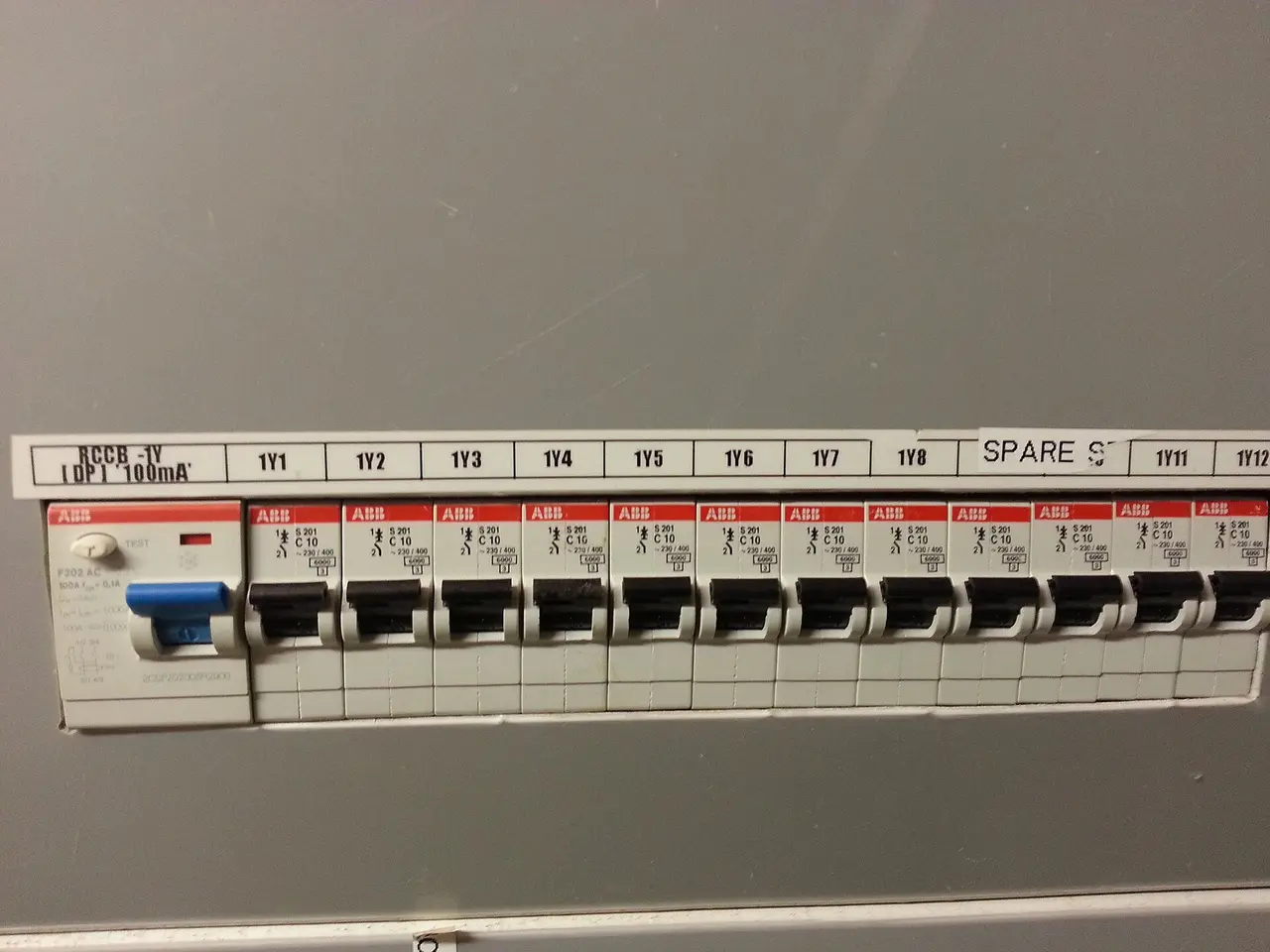
An MCB protects cables and equipment against overload and short circuit. But a current of just a few tens of milliamps through the human body can cause ventricular fibrillation, and that is far too small for any MCB to notice. The device that protects people is the RCD (Residual Current Device), which electricians often call the "anti-shock breaker". This lesson explains what an RCD measures, why 30 mA, how types AC, A, F and B differ, whether to choose an RCCB or an RCBO, and why RCDs suffer from nuisance tripping.
By the end of this lesson, you will be able to:
- Explain the RCD principle of comparing outgoing and returning current.
- Distinguish between an RCCB (residual current protection only) and an RCBO (residual current + overload + short-circuit protection).
- Choose a sensitivity IΔn of 10/30/100/300 mA according to the purpose.
- Choose type AC, A, F or B to suit modern electronic loads.
- Arrange RCDs in the board so that one leakage fault does not cut power to the whole house.
- Test an RCD with the test button and with a tester, and teach the owner to test it regularly.
Principle: comparing outgoing and returning current
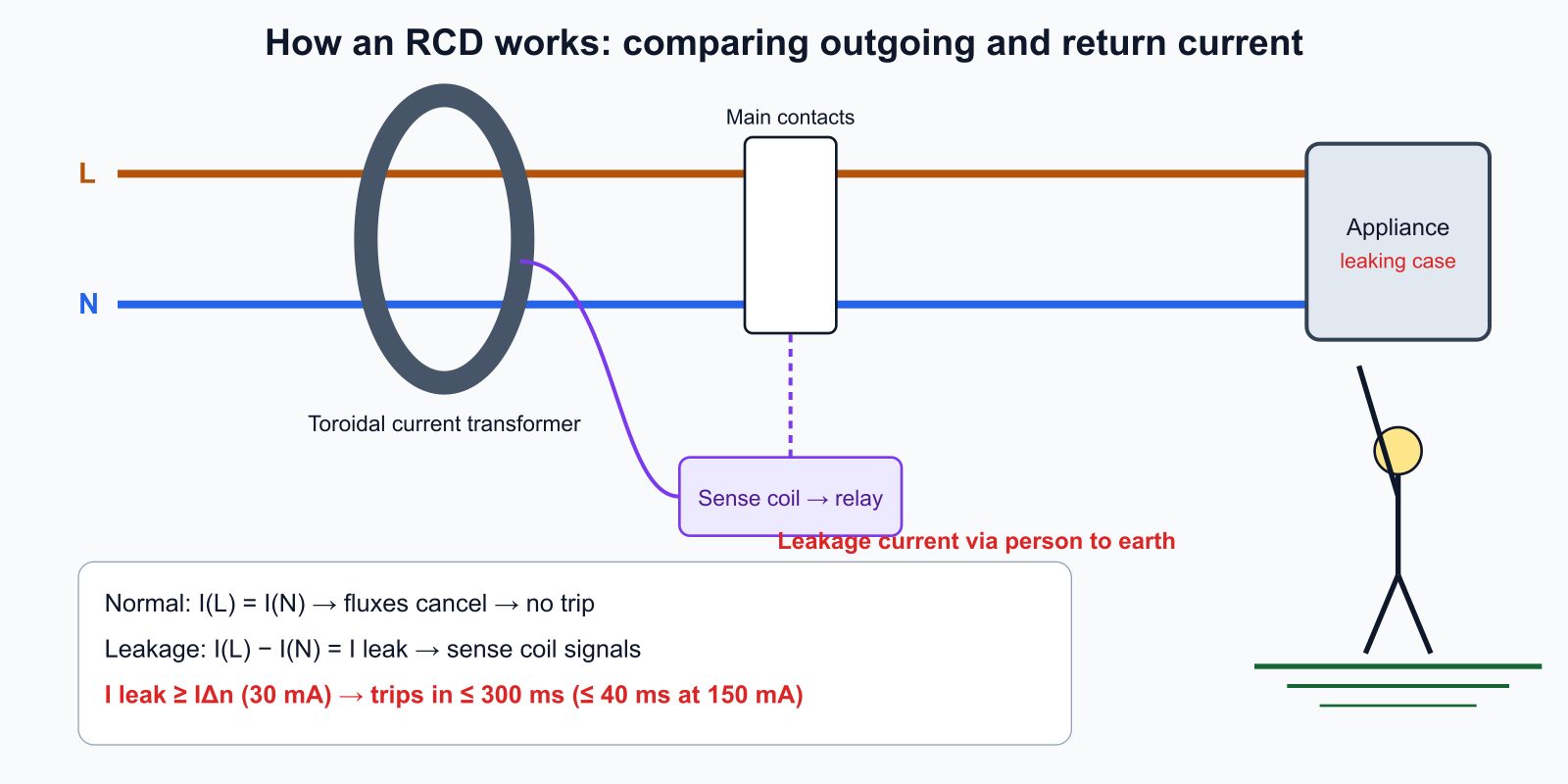
In a healthy circuit, the current going out on the phase conductor is exactly equal to the current returning on the neutral. An RCD passes both conductors through a toroidal current transformer core. The two opposing currents cancel each other out, and the sensing coil sees no signal. When there is leakage – through a person touching a live casing, or through damp insulation to earth – part of the current does not return on the neutral. That difference (the residual current) creates a magnetic flux in the core, the sensing coil produces a signal, and the release mechanism opens the circuit.
Key points that many electricians misunderstand:
- An RCD does not detect a person touching both the phase and the neutral conductor at the same time (the current flows through the person and returns on N, so there is no imbalance). A person standing on a plastic stool holding both conductors can still receive a severe shock.
- An RCD does not protect against overload and short circuit if it is a plain RCCB; you still need an MCB upstream, or use an RCBO.
- An RCD can still trip when there is no earth conductor: when a person touches a live casing, the current through the person to earth is leakage current. But with a PE conductor, the RCD trips as soon as the casing becomes live, before anyone touches it.
Sensitivity IΔn: why 30 mA
According to IEC 60479 on the effects of current on the human body, for 50 Hz alternating current the danger zone for ventricular fibrillation begins at a few tens of milliamps if it lasts long enough. A 30 mA RCD to IEC 61008/61009 must trip within a maximum of 300 ms at IΔn and a maximum of 40 ms at 5 × IΔn (150 mA). That combination of threshold and time keeps a person out of the fibrillation zone in most situations.
| IΔn | Main purpose | Typical location |
|---|---|---|
| 10 mA | Protecting people in especially hazardous locations | Some bathroom and swimming pool circuits, as required by the design |
| 30 mA | Additional protection of people against electric shock | Sockets, bathrooms, water heaters, outdoors |
| 100 mA | Protection against indirect contact, selective with 30 mA downstream | Floor main, house main (time-delayed type S) |
| 300 mA | Fire protection against earth leakage | At the origin of the installation |
IEC 60364-4-41 requires additional protection by an RCD ≤ 30 mA for sockets up to 32A used by ordinary (non-skilled) persons, and for portable equipment used outdoors. IEC 60364-7-701 requires an RCD ≤ 30 mA for circuits in bathrooms. In practice, in a modern home: every socket circuit, bathroom, water heater, washing machine and outdoor circuit must have a 30 mA RCD.
Warning: An RCD is an additional layer of protection; it does not replace good insulation, an earth conductor and a safe isolation procedure when working. Never work on a live circuit on the grounds that "it has shock protection".
RCCB and RCBO
| Device | Standard | Protection | Advantages | Disadvantages |
|---|---|---|---|---|
| RCCB | IEC 61008 | Residual current only | Cheap; one RCCB protects several MCB circuits | Leakage on one circuit cuts power to all the circuits behind it |
| RCBO | IEC 61009 | Residual current + overload + short circuit | Each circuit is independent; a fault on a circuit trips only that circuit | More expensive, and takes more space in some product ranges |
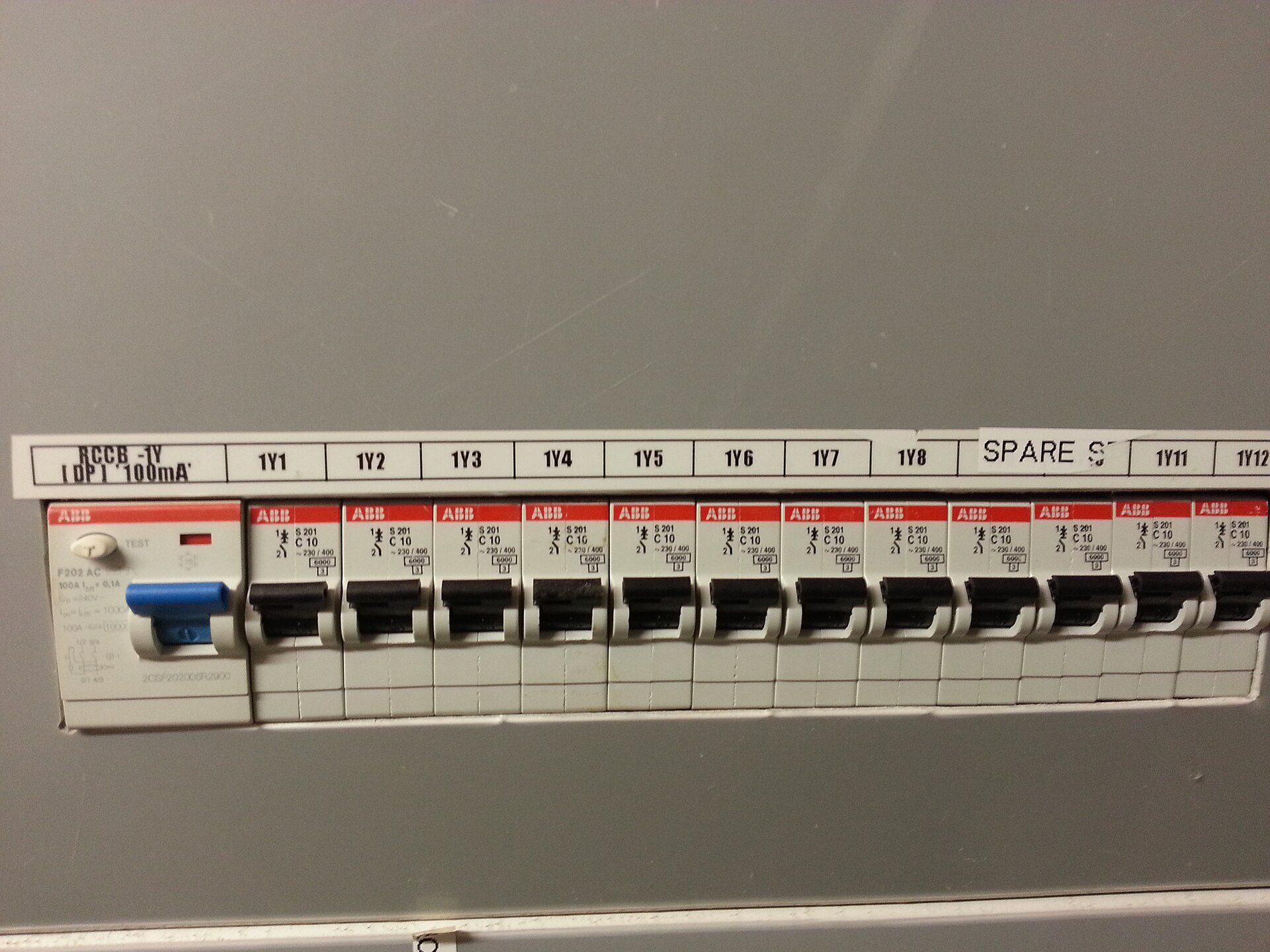
Photo: Balurbala / Wikimedia Commons, CC BY-SA 3.0

The rated current of an RCCB must be greater than or equal to the total actual current of the circuits behind it, and it must be protected by an MCB whose In does not exceed the In of the RCCB (or according to the manufacturer's coordination table). A 40A RCCB placed after a 63A main breaker without a sensible split of the loads is a common incorrect configuration.
Types AC, A, F and B: choosing by the form of leakage current
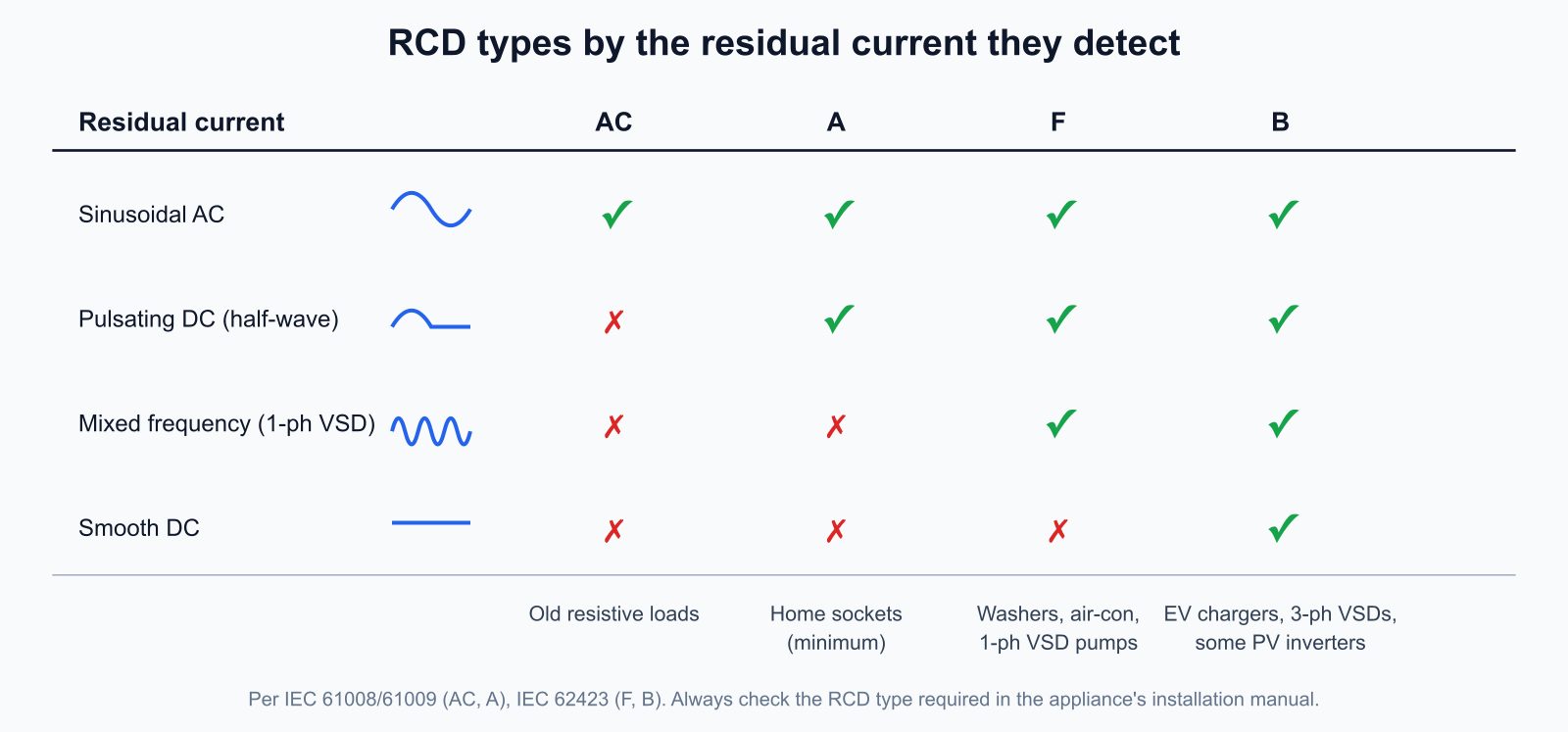
Modern electronic equipment (air conditioner inverters, inverter washing machines, induction hobs, electric vehicle chargers, solar inverters) can produce leakage current that is not a pure sine wave when a fault occurs: pulsating DC, a smooth DC component, or high frequency. The core of a type AC RCD can saturate and become "blind" to these forms.
| Type | Detects | Used for |
|---|---|---|
| AC | Sinusoidal alternating residual current | Older purely resistive loads; many countries have restricted its use |
| A | AC + pulsating DC (with smooth DC component up to 6 mA) | The default for sockets and modern homes |
| F | A + mixed-frequency residual current | Washing machines, air conditioners, single-phase inverter pumps |
| B | F + smooth DC residual current | Electric vehicle chargers (if the charger has no 6 mA RDC-DD), three-phase inverters, some PV inverters |
The type is marked on the face of the RCD with a waveform symbol: a sine wave (AC), a sine wave plus a half-wave (A), plus a frequency symbol (F), plus a straight line (B). When advising customers, recommend at least type A for all socket circuits and for loads with power electronics.
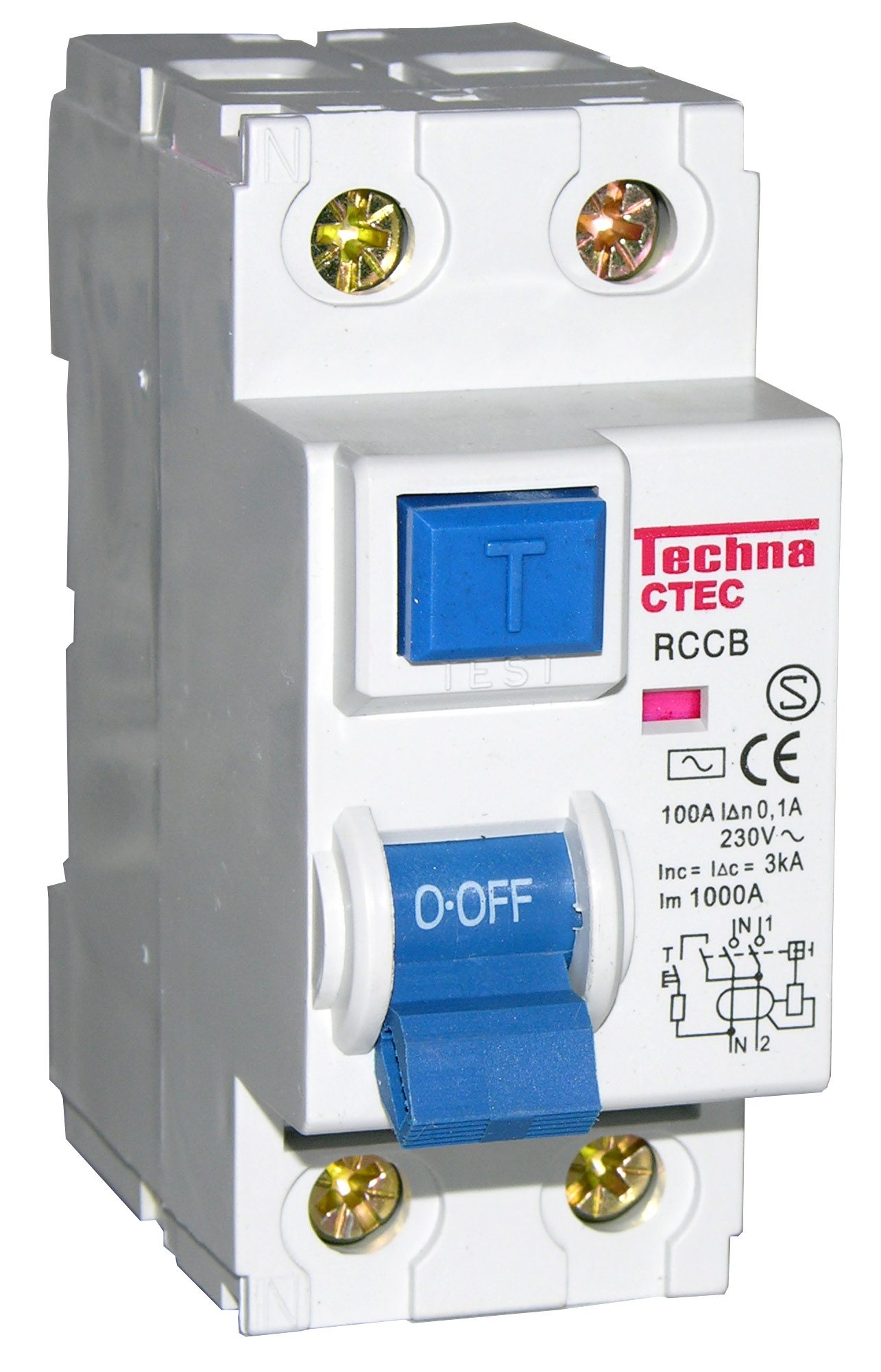
Photo: Jimbob82 (at en.wikipedia.org) / Wikimedia Commons, Public domain

Arranging RCDs in an apartment board
Three common options, from cheapest to best:
- One 30 mA main RCCB for the whole house: the cheapest but the worst. The combined natural leakage current of many appliances easily causes nuisance tripping, and every leakage fault blacks out the whole house, including the refrigerator and the stair lights. Not recommended.
- Split into groups: 2–3 RCCBs of 30 mA, each feeding a group of circuits (for example a socket group, a bathroom and water heater group, an air conditioner group). Lighting circuits and the refrigerator can be in a separate group. A balance between cost and reliability.
- An RCBO for each circuit: the best. A leakage fault at the water heater trips only the water heater. It costs more but is becoming common.
If there is a 100 mA or 300 mA main RCD upstream, it must be type S (selective, time-delayed) so that it does not trip at the same time as the 30 mA RCDs downstream.
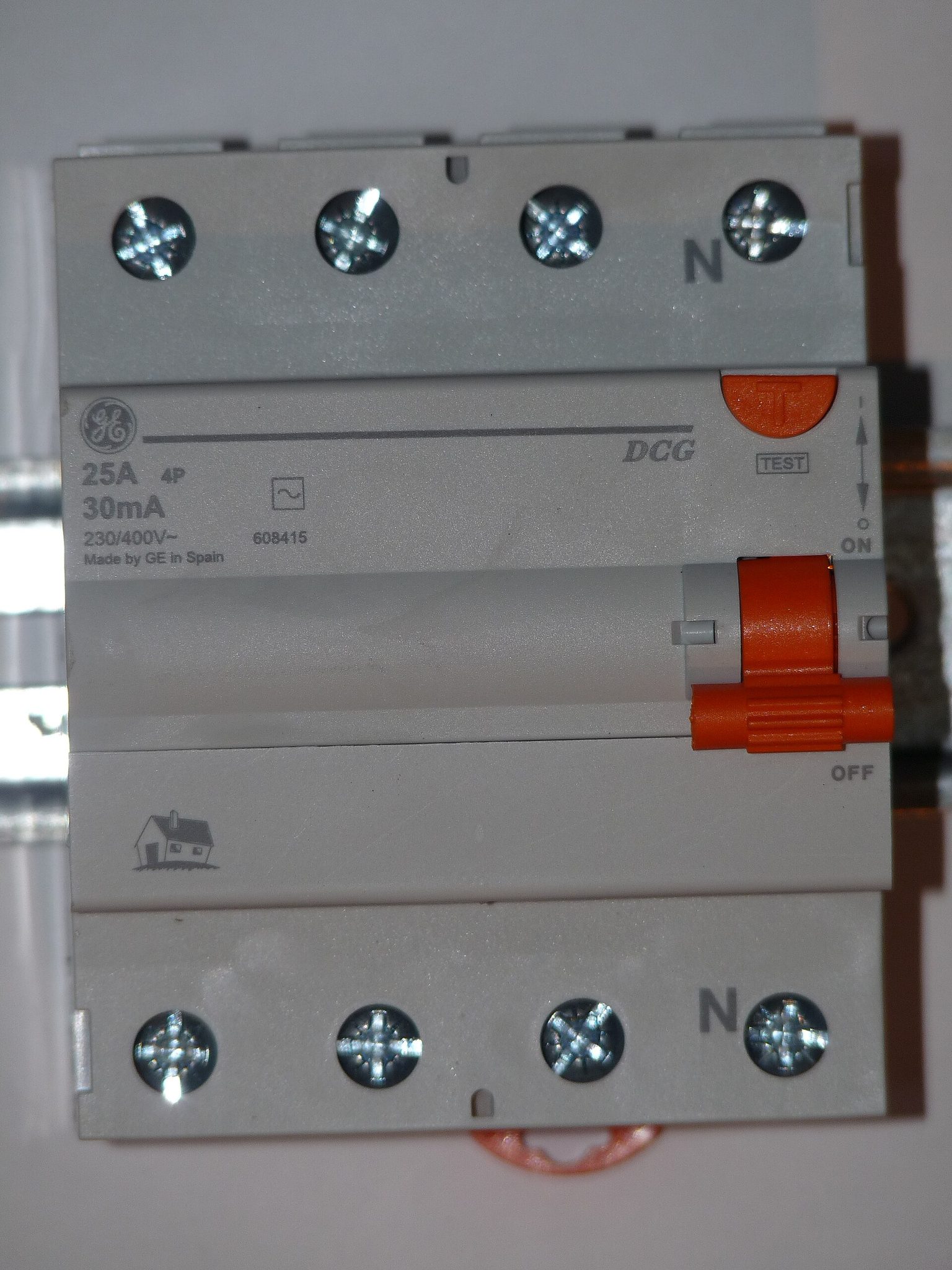
Photo: Dmitry G / Wikimedia Commons, CC BY-SA 3.0

Why RCDs nuisance-trip, and how to deal with it
| Cause | Symptom | Remedy |
|---|---|---|
| Real leakage in an appliance (water heater, washing machine) | Trips when that appliance is switched on | Unplug the appliances one by one and test the appliance insulation |
| Damp cable insulation, water in the conduit | Trips when it rains or early in the morning | Test the insulation of each circuit (insulation testing lesson) |
| Combined natural leakage current too high | Random tripping when many appliances are running | Split into groups, keeping the background leakage on each RCD to about 30% of IΔn at most |
| Neutral shared between two RCD groups | Trips when a load in the other group is switched on | Separate N bar for each RCD |
| Lightning surges, overvoltage | Trips during thunderstorms | Add surge protective devices (Level 3) |
The shared-neutral fault deserves special emphasis: if the N conductor of a circuit belonging to RCD 1 is mistakenly connected to the N bar of RCD 2, RCD 1 sees the outgoing current but not the returning current, and trips as soon as there is load. This is the most common board-building mistake made by electricians who are new to building boards.
Testing an RCD
- The T test button: press it with the power on, and the RCD must trip immediately. It only checks the mechanism; it cannot measure the tripping time or threshold. Teach the owner to press it every 3–6 months (many manufacturers recommend monthly or every 6 months).
- An RCD tester (usually built into a multifunction installation tester): measures the tripping time at IΔn (≤ 300 ms for the general type) and at 5 × IΔn (≤ 40 ms), and measures the actual tripping current (which must be within 50–100% of IΔn). Record the results in the test report as in the inspection and testing lesson.
- Do not test by connecting phase directly to earth through a light bulb or a piece of wire: it is dangerous and the current is uncontrolled.
Procedure for finding why an RCD trips at a customer's house
- Ask the owner: when does it trip, which appliance is switched on, is it related to rain or thunderstorms, has any repair work been done recently?
- Switch off all the MCB circuits downstream of the RCD, then switch the RCD on. If the RCD still trips with no circuits connected: suspect a faulty RCD or leakage on the cable section between the RCD and the MCBs.
- Switch the circuits on one at a time, waiting a few minutes for each. Mark the circuit that makes it trip.
- On the suspect circuit, unplug all appliances from the sockets and switch off the fixed appliances. Switch it back on: if it still trips, the leakage is in the cable; if it does not trip, the leakage is in an appliance.
- Plug the appliances back in one at a time to find the leaking one; test the insulation of that appliance.
- If the leakage is in the cable: move on to the insulation testing and sectioning procedure (insulation testing lesson).
Practical experience in Vietnam: the main culprits are water heaters (the heating element starts leaking after a few years), outdoor sockets with water ingress, washing machines, and damp junction boxes inside walls. Record the results and tell the owner which appliance needs repairing or replacing, instead of just "switching it back on so there is power".
Common mistakes
| Mistake | Consequence | The right way |
|---|---|---|
| One 30 mA RCD for the whole house | Nuisance tripping, total power loss | Split into groups or use RCBOs |
| Sharing an N bar between RCD groups | RCD trips when there is load | Separate N bar for each RCD |
| Using an RCCB without MCB protection | The RCCB cannot withstand a short circuit | An MCB upstream, or an RCBO |
| Choosing type AC for inverter loads and vehicle chargers | The RCD may fail to trip on leakage | Type A as a minimum, F or B depending on the load |
| Leaving out the PE conductor because "there is shock protection" | The casing stays live until someone touches it | Always have both PE and an RCD |
Pass criteria for this lesson
- Draw and explain the RCD principle, and state 2 situations in which an RCD cannot protect.
- Choose the correct IΔn, type AC/A/F/B and RCCB/RCBO for 8 circuits in a sample apartment.
- Install a group of 2 RCCBs with separate N bars, with no shared-neutral fault, and check it with a load test.
- Measure the RCD tripping time at IΔn and at 5 × IΔn with a tester, and record it correctly in the test report.
- Teach the owner how to press the T button and what to do when the RCD trips.
Frequently asked questions
If an RCD trips, does that mean the RCD is faulty?
Rarely. In most cases, when an RCD trips it is doing its job correctly. Find the cause by switching off all the circuits, switching the RCD on, and then switching on one circuit at a time; on the circuit that makes it trip, unplug the appliances one by one. Only suspect a faulty RCD when it trips even with no load at all, or when the tester shows an abnormally low tripping current.
Will a 30 mA RCD still let a person get a shock?
A person may still feel a brief shock before the RCD trips, but the time is short enough not to cause ventricular fibrillation in most situations. That is why safety rules must still be followed.
Do I need an RCD if I already have a good earth conductor?
Yes. Good earthing makes the fault current large enough for the breaker to trip and keeps the casing at a low voltage, but it does not protect a person who directly touches an exposed live phase conductor. A 30 mA RCD is the additional layer of protection for that situation.
Further reading
See how to arrange RCBOs in the board in the lesson Installing a distribution board with MCBs, RCBOs and earthing, and review the Safety rules before touching electrical wires.