You open a switch box in an older house and find a red wire, a yellow wire and two black ones. Or you take down a ceiling light and see brown, blue and green-and-yellow, plus one extra black wire nobody can explain. Which one is live? Which is neutral? Is there an earth at all? Wire colours are the first clue every electrician uses, but they are only a clue. This guide explains the colour codes you are likely to meet, why you must never rely on colour alone, and a step-by-step method to identify live (line), neutral and earth (ground) wires with a tester before you connect anything.
Colour tells you what the installer intended, not what the wire is actually doing. Always switch off, lock off and prove the circuit dead before touching conductors, following the 5 mandatory safety rules before you touch any electrical wire. Live testing in this article is done only with properly rated test instruments, insulated probes and no bare skin near terminals. If you are a learner, do live tests only under a qualified supervisor. Numbers given here are for reference; your local regulations and the equipment manufacturer's instructions take priority.
Live, neutral and earth: what each wire does
Before memorising colours, be clear about the job of each conductor in a typical single-phase home supply. In Vietnam and most of Asia and Europe, homes receive single-phase AC at a nominal 220–230 V, 50 Hz.
Live (line, phase, “L”): carries the supply voltage from the distribution board to the load. Measured to earth, it sits at roughly the full supply voltage. Touching it while standing on the ground can drive current through your body. In Vietnamese it is called dây pha or dây nóng.
Neutral (“N”): the return path for current. In a healthy system it is close to earth potential, but it does carry current whenever a load is on, and it can become dangerous when something is wrong (more on that below). In Vietnamese: dây trung tính or dây nguội.
Protective earth (ground, “PE”): connects exposed metal parts (appliance casings, metal boxes) to earth so that a fault makes the protective device trip instead of leaving the metal live. It should carry no current in normal operation. In Vietnamese: dây tiếp địa or dây PE.
Two more terms: a switched live runs from a switch to a light and is live only when the switch is on; strappers (travellers) link two two-way switches, and either one can be live depending on switch position (see installing two-way switches and earthed sockets).
The international (IEC) colour code
Most countries that follow IEC standards, including the EU and the UK since the 2000s, use the colours set out in IEC 60445. Vietnam's national standards for low-voltage installations are largely adopted from IEC standards, and many new buildings, especially larger projects, use these colours. For single-phase home wiring the important ones are:
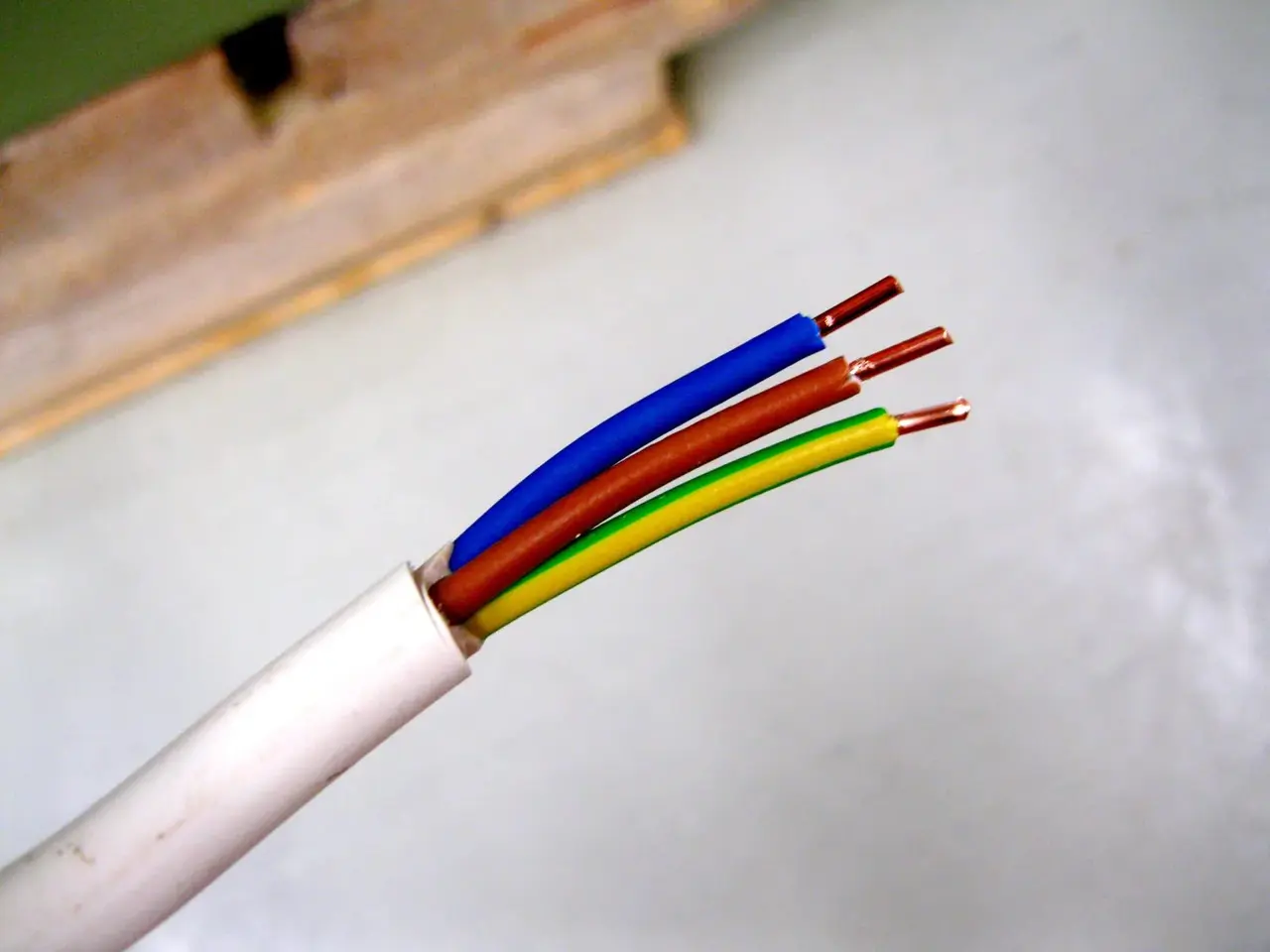
Brown: line (live). In three-phase systems the three lines are usually brown, black and grey.
Blue (light blue): neutral.
Green-and-yellow (striped): protective earth, and only protective earth. This is the one rule almost every modern code agrees on: green-and-yellow must never be used as a live or neutral conductor.
Notice that black is a line colour under IEC rules, not a neutral. Learners who have seen US wiring diagrams often get this backwards.
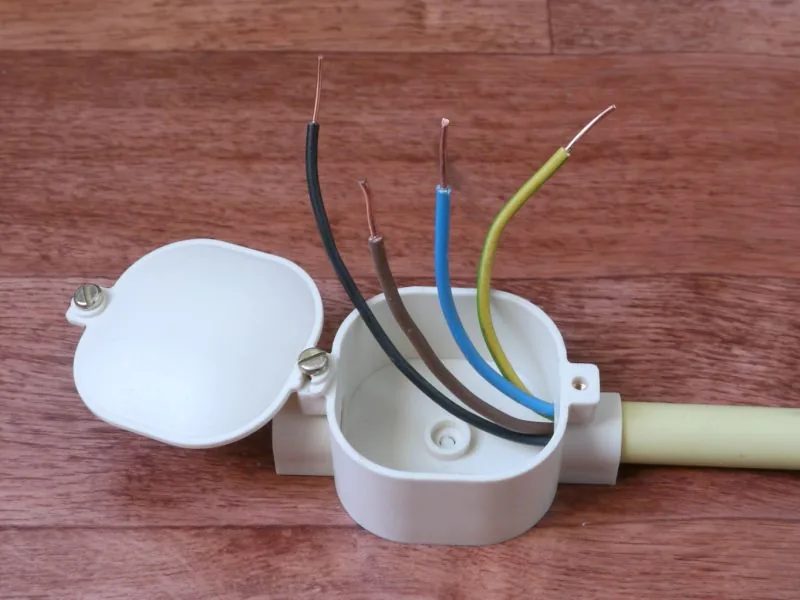
Figure 1. Four single-core installation wires in the IEC colours, entering a small surface junction box through conduit: black and brown (line conductors), blue (neutral) and green-and-yellow (protective earth). The photo shows wires only, not connected to any supply. The manufacturer's mark on the lid has been blurred. (Photo: Erik Wannee, Wikimedia Commons, CC0)
Colour codes in other countries and in older wiring
Imported appliances, foreign manuals, online tutorials and expatriate clients mean you will meet other systems too. Codes change over time and have local exceptions, so treat this summary as a reference only.
Reference table: common wire colour codes
System / region | Live (line) | Neutral | Protective earth | Notes |
|---|---|---|---|---|
IEC 60445 (EU, UK today, many IEC countries) | Brown (3-phase: brown, black, grey) | Blue | Green-and-yellow | The best default for new work where local rules allow |
Older UK and some older Commonwealth wiring | Red | Black | Green-and-yellow (very old: green, or bare in twin-and-earth cable) | Black here is neutral, the opposite of the IEC meaning |
Australia / New Zealand | Red (brown also seen) | Black (blue also seen) | Green-and-yellow | Uses the term “active” for live |
USA / Canada (120/240 V, 60 Hz) | Black, red (other colours possible) | White or grey | Green, green-and-yellow or bare copper | White can be re-marked and used as a live conductor in switch loops |
Common practice in many existing Vietnamese homes | Often red, but very inconsistent | Often blue, black, yellow or another colour | Often missing; when present, usually green-and-yellow or green | Treat as “unknown until tested” |
Flexible appliance cords (IEC style) | Brown | Blue | Green-and-yellow | Two-core cords have no earth; some cheap cords have two identical cores |
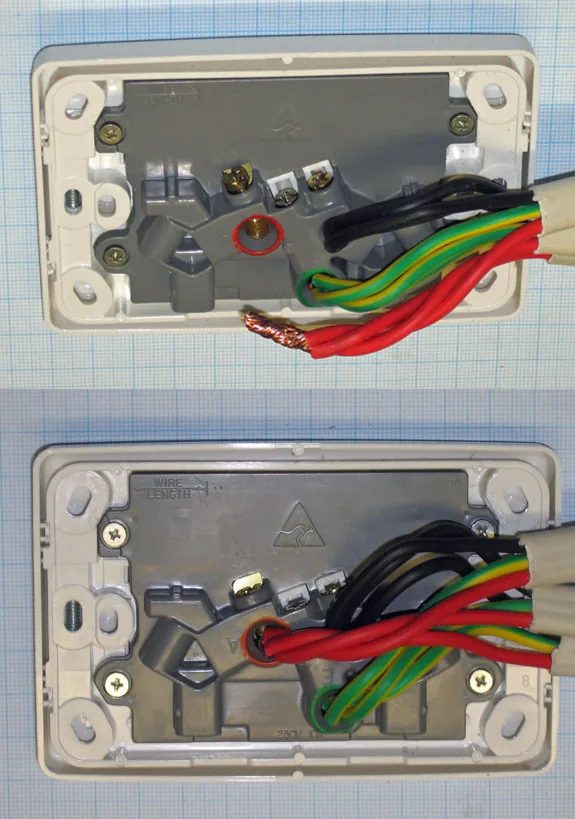
Figure 2. The back of an Australian double socket outlet (230 V, 10 A) shown on a desk, not installed: red (active), black (neutral) and green-and-yellow (earth) conductors, with some bare copper ends twisted together ready for the terminals. Here black is neutral, while under the IEC code black is a line colour. (Photo: Fredquint, Wikimedia Commons, CC BY-SA 4.0)
Why you must never trust colour alone
Colour codes only work if every installer before you followed them. In older or self-built houses you will regularly find:
Whatever wire was in stock. A whole house in red and yellow, or one colour for everything.
Switch loops in two-core or three-core cable. The cable carries live down to the switch and switched live back up to the light, so a blue or white core may be live. It should be re-marked with brown or red sleeving at both ends; often it is not.
Swapped live and neutral. Two-pin sockets and plugs common in Vietnam can be inserted either way round, so many installers do not care which side is live. The result: switches that break the neutral, leaving the lamp holder live when “off”.
Old colour codes mixed with new. A house extended over decades may have red-black wiring next to brown-blue, so black means neutral in one part and line in another.
Faded insulation. Heat and age change colours: old brown can look red, and green-and-yellow can fade.
Non-standard cable. Cheap cable may use unusual colours, or two cores of the same colour separated only by a printed line or a ridge on the insulation.
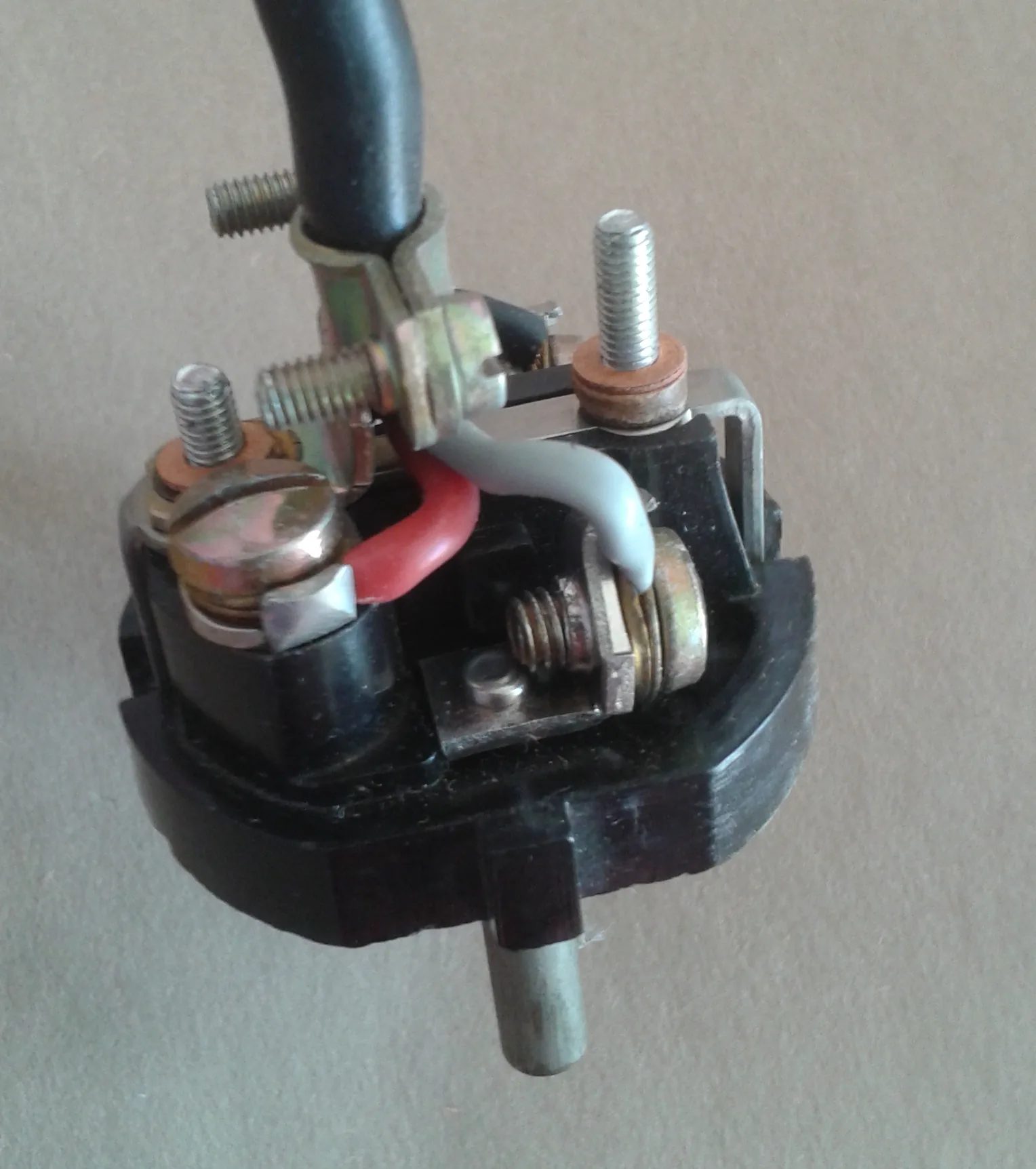
Figure 3. An opened old earthed plug with a black outer sheath and red and grey inner conductors. According to the photographer's description, the red conductor here is the protective earth, a colour that most people today would read as live. This is exactly why colours must be confirmed by testing. (Photo: R a mueller, Wikimedia Commons, CC BY-SA 3.0)
Neutral can be dangerous too
Learners often think of neutral as “the safe wire”. It is not, for three reasons:
Neutral carries the same current as the live in a single-phase circuit. If you disconnect a neutral while the load is running, the full supply voltage appears across the gap, and between the load-side neutral and earth.
If a neutral breaks upstream (a loose terminal in the board or a burnt joint), every neutral after the break can rise to near line voltage through the connected loads. A typical sign is that a neon screwdriver tester lights on both wires at a socket while nothing works.
In some installations, neutrals of different circuits are shared or cross-connected. Switching off one breaker does not make that neutral dead.
Rule: every conductor is live until proved otherwise.
Tools for identifying wires
Know what each tool can and cannot tell you. For details of using a meter, see using a multimeter as an electrician.
Digital multimeter with insulated, shrouded probes and a measurement category (CAT) rating suitable for household circuits, for example CAT III. Measures AC voltage between any two points and continuity when the circuit is dead.
Two-pole voltage tester: the preferred tool for proving dead in many countries. Many have a low-impedance load that suppresses “ghost” voltages.
Neon screwdriver tester (bút thử điện): very common in Vietnam and cheap. It lights when the tip touches a conductor at a high voltage relative to earth, with a tiny current flowing through your body via the cap. Useful for a quick live/neutral indication, but not reliable for proving dead (see the FAQ).
Non-contact voltage tester (pen-style detector): beeps near a live conductor. It can miss live wires (shielded cable, flat battery, wire deep in a wall) and falsely beep near other cables, so never use it alone to decide a wire is safe.
Proving unit (or a known live socket) to check your tester, plus coloured sleeving and cable markers.
A long test lead (sometimes called a wander lead): a long insulated wire used with a multimeter on continuity to identify both ends of a cable when the circuit is dead.
Step-by-step: identifying live, neutral and earth safely
This procedure assumes a single-phase circuit, such as a socket or light point, where you have found unknown wires.
Step 1: Look and record before you touch
Note every wire in the box: colour, size, which cable it belongs to and what terminal it was on. Take a clear photo before you disconnect anything.
Look for clues: wires already on an earth screw, groups joined in one connector (often neutrals), wires running to a switch.
Step 2: Check your tester
Set the multimeter to AC volts (V~), plug the leads into COM and V, and measure a known live socket or a proving unit. You should see the normal supply voltage. If it shows nothing, stop: the meter, leads or fuse may be faulty.
Step 3: Measure between pairs (circuit on, hands off)
If you must identify wires while the circuit is energised, make sure the wire ends are separated, not touching anything, and positioned so you can reach them with probes only. Wear insulating footwear, keep your body away from earthed metal, and never hold bare conductors. Measure every combination:
wire A to wire B,
wire A to a known earth (the earth terminal of a properly earthed socket or the main earth bar),
wire B to the same earth.
Use the reference table below to interpret the readings.
Reference table: what the readings usually mean
Measurement | Typical reading on a healthy 230 V circuit (for reference) | What it tells you |
|---|---|---|
Live to neutral | Close to supply voltage (in practice often about 200–240 V) | The circuit is energised |
Live to earth | Close to supply voltage | This wire is live, and the earth is connected |
Neutral to earth | Close to 0 V, often only a few volts | Normal neutral; a higher value needs investigation |
Both wires show high voltage to earth, but almost 0 V between them | Abnormal | Possible broken neutral upstream, with the “neutral” fed back through a load. Stop and trace the fault |
A wire reads a low, unsteady voltage (tens of volts) to earth, with no load connected | Abnormal or misleading | Possibly a “ghost” voltage induced from a nearby live cable into a disconnected wire. Re-check with a low-impedance (LoZ) setting or a two-pole tester |
No reading between any pair | 0 V | Circuit off, breaker tripped, or a broken conductor. Not yet proof of safety until you have tested all combinations and checked your tester again |
All values are approximate and for reference. Supply voltage varies by location and time of day.
Step 4: If there is no earth to measure against
Many older Vietnamese homes have no protective earth at all. In that case you cannot use the “to earth” readings above. Options, in order of preference:
Run a temporary test lead from a confirmed earth point (such as the board earth terminal, if the house has an earth electrode) and measure against it.
Use a two-pole tester that has a single-pole phase indication function, following the maker's instructions.
As a quick indication only, use a neon screwdriver tester: it normally lights on the live wire and not on a healthy neutral. Confirm the result with a meter before you rely on it.
Do not use water pipes, window frames or building steel as an “earth” for testing: they may be plastic-isolated, not connected to earth at all, or connected to a faulty appliance.
Step 5: Switch off and prove dead
Now turn off the breaker for that circuit. Do not trust labels on the board: switch off, then test at the work point. Repeat the measurements from Step 3. Every pair must read close to 0 V. Then test your meter again on the known live source (Step 2). This “test – prove – test” sequence protects you against a tester that failed during the job. If you can, lock the breaker off or tape it and put a warning note on the board.
Step 6: Identify cable ends with continuity (circuit dead)
To find which wire in box A is the same wire in box B, with the circuit proven dead:
At box A, connect the chosen wire to your long test lead (or temporarily join it to a known wire such as the earth).
At box B, set the meter to continuity (beep) and test between the long lead (or earth) and each wire in turn.
The wire that beeps is the other end. Label both ends immediately.
Remove the temporary link before you restore power.
Step 7: Label and correct
Once you know what each wire is:
Wrap or sleeve the end of any wire whose colour does not match its function, at both ends: brown or red for line, blue for neutral (or the colours used in your country).
Never re-mark another colour as earth, and never use green-and-yellow as live or neutral, even when you are short of wire.
Make sure switches break the live, not the neutral.
Update the circuit chart in the distribution board, or leave a written note for the client.
Practical examples
Example 1: A ceiling light with red, yellow and black wires
A client in an older townhouse wants a new LED ceiling light. With the old fitting removed, there are three wires: red, yellow and black. With the light switch on and the breaker on, you measure (probes only, wires separated): red to black about 225 V, yellow to black about 225 V, red to yellow 0 V. You then switch the wall switch off: red to black still about 225 V, yellow to black now 0 V. Conclusion: black is the neutral, red is the permanent live (probably a feed going on to another light), and yellow is the switched live from the wall switch. Connect the new light to yellow and black only, leave red joined to whatever it was feeding, sleeve the yellow with brown or red tape, and note it for the client. There is no earth wire, so choose a double-insulated (Class II) fitting or recommend running an earth later.
Example 2: A socket where the neon tester lights on both holes
A client complains that the sockets in one room stopped working, but “the tester shows power”. The neon tester lights on both holes. With a meter, each contact reads about 225 V to earth but almost 0 V between them. This pattern points to a broken neutral upstream: the neutral of this circuit is being pulled up to line voltage through connected appliances. Switch off, prove dead, then check neutral connections back towards the board, starting with the nearest junctions and the neutral terminal of the breaker or the neutral bar. Related fault-finding: circuit breaker keeps tripping.
Example 3: An imported appliance with a different colour code
A water heater bought abroad has brown (L), blue (N) and green-and-yellow (PE) leads; the bathroom supply is red, black and green. You test and confirm red is live, black is neutral and green goes to the earth bar, then connect brown to red, blue to black and green-and-yellow to green, check residual current protection is present, and write the colour mapping inside the box cover for the next technician.
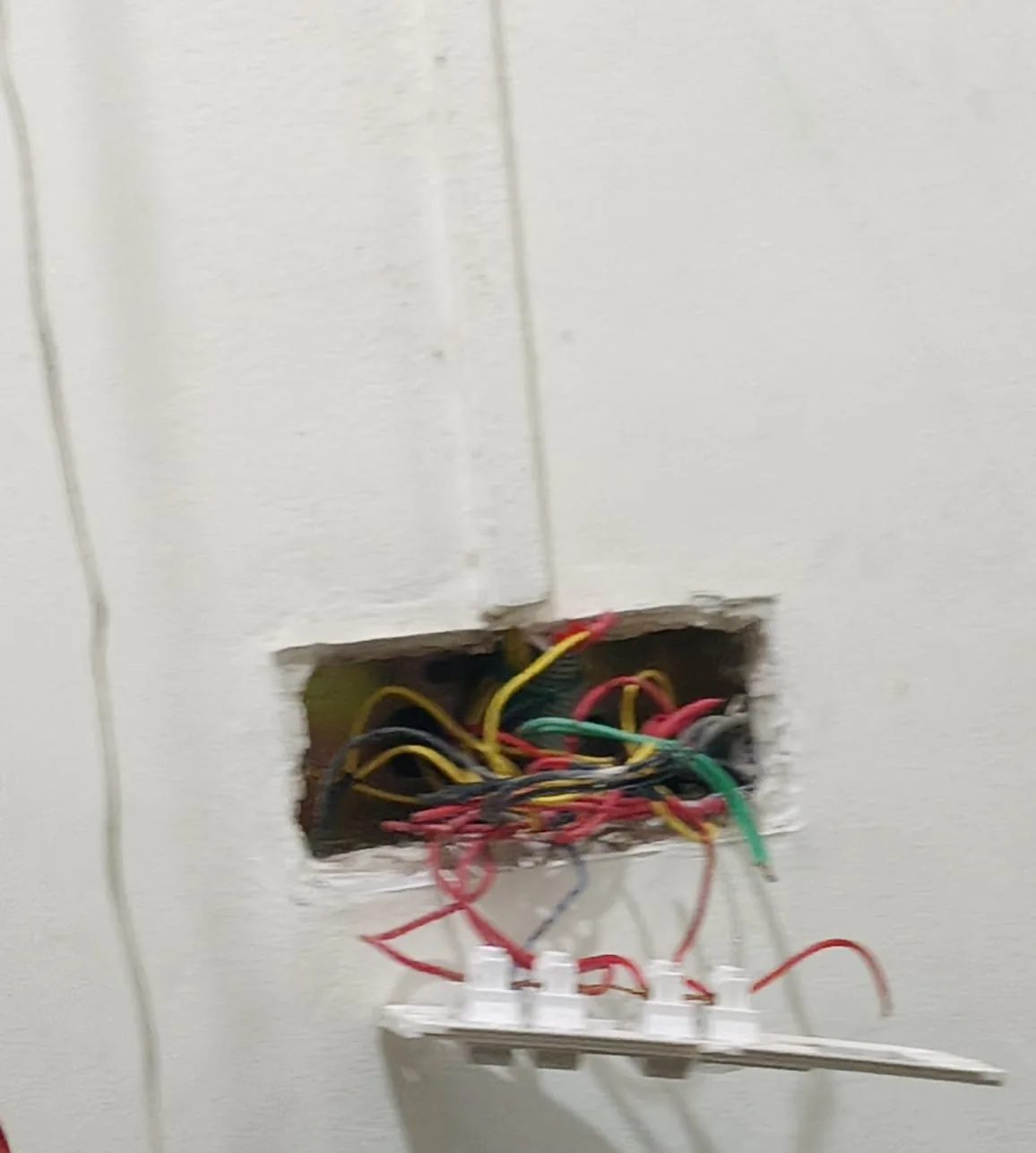
Figure 4. A rectangular opening in a painted wall packed with red, yellow, black, grey and green wires, with the switch plate pulled forward on red leads. When colours are this mixed, only testing can tell you what each wire does. Treat every wire as live until proven dead. (Photo: ShriniwasGajare, Wikimedia Commons, CC BY-SA 4.0)
Common mistakes beginners make
Assuming black is always neutral. It is a line colour under IEC rules.
Switching off the wrong breaker because the labels are wrong, then working without testing at the work point.
Disconnecting a neutral under load and getting a shock from a “safe” wire.
Using green or green-and-yellow wire as live because it was the only piece left.
Not re-marking a re-purposed wire, leaving a trap for the next electrician.
Misreading ghost voltages: a disconnected wire can show tens of volts on a digital meter. Confirm with a LoZ setting or two-pole tester instead of guessing.
Explaining it to the client
A short, honest explanation of why testing takes time builds trust (see quoting and working with clients):
“The wire colours in this house don't follow one system, so I test every wire before connecting. That way the switch really cuts the power, and nobody gets a shock when changing a bulb.”
“There is no earth wire at this point. For metal light fittings or a water heater, I recommend adding an earth and a residual current device.” (See installing a home distribution board with MCBs and RCBOs.)
If you find widespread problems, such as no earth anywhere, burnt neutrals, switches on the neutral throughout the house, or undersized wire (see how to choose wire size and circuit breakers), report them in writing and quote the corrective work separately rather than quietly patching around them.
Safety checklist
I have checked my tester on a known live source before starting.
I treat every conductor, including neutral and any unknown wire, as live until proven dead.
Live measurements were taken with insulated probes only, with wire ends separated and no bare skin near terminals.
I switched off and locked off (or tagged) the correct breaker, and proved dead at the work point between all pairs: L–N, L–PE, N–PE.
I re-checked my tester after proving dead.
I did not use a non-contact tester or neon screwdriver as my only proof of dead.
I did not use pipes or building metal as a test earth.
Green-and-yellow is used only for protective earth.
Every re-purposed wire is marked at both ends.
Switches and single-pole devices break the live conductor.
Earth continuity is confirmed for metal fittings and appliances that need it, and residual current protection is present where required.
The client has been told about defects in writing.
Frequently Asked Questions
What colour is the live wire in Vietnam?
There is no single colour you can rely on in existing homes. Newer projects often use the IEC colours (brown for line, blue for neutral, green-and-yellow for earth), while many older or smaller houses use red for live and almost any other colour for neutral. Always confirm with a tester.
Is black wire live or neutral?
It depends on the system. Under IEC rules, black is a line (live) colour. In older UK and Australian wiring, black is neutral. In the USA, black is normally a hot (live) conductor. In a house with random colours, black could be anything.
Can I use the green-and-yellow wire as a live or neutral if I mark it?
No. Under IEC-based rules, green-and-yellow is reserved for protective earth only, and re-marking it with tape is not accepted. Use a correctly coloured wire.
Why does my meter show voltage on a wire that is switched off?
A disconnected wire running next to a live cable can pick up an induced “ghost” voltage that a high-impedance digital meter will display. Re-test with a low-impedance (LoZ) function or a two-pole tester.
Is a neon screwdriver tester enough to check a wire is dead?
No. It is fine as a quick indicator of which wire is live, but it can fail to light in bright light, if you are standing on an insulating floor, or if it is damaged. Prove dead with a multimeter or two-pole tester, checked before and after use.
My house has only two wires at every socket. Is that dangerous?
Two-wire circuits are common in older Vietnamese homes. They work, but metal-cased appliances have no fault path to earth. Residual current protection (RCD/RCBO) plus an earth, at least for bathrooms, water heaters and washing machines, greatly improves safety; have a qualified electrician assess the installation.
Practice Exercises
Exercise 1: Colour quiz (theory). Without notes, write the meaning of these colours under (a) IEC rules, (b) older UK rules, (c) US rules: black, red, blue, white, brown, green-and-yellow.
Exercise 2: Reading interpretation. At a socket you measure: A–B = 0 V, A–earth = 226 V, B–earth = 224 V. What is the likely fault, what would the client have noticed, and what are your next three steps?
Exercise 3: Training board (with a supervisor). On a training board fed through a residual current device, have your supervisor wire a light circuit using deliberately “wrong” colours: one switch loop with a blue switched live and one neutral in red. Using only a meter and the procedure in this article, identify every conductor, prove dead correctly (test – prove – test), then re-mark each wire with sleeving at both ends. Your supervisor checks the result.
Exercise 4: Cable ends and client talk. With the training board dead, run three unlabelled wires through a length of conduit and match each end using continuity and a long test lead in under five minutes. Then explain to a “client” (your partner), in two or three sentences, why wiring without consistent colours needs extra testing time.
Related lessons: using a multimeter as an electrician and installing two-way switches and earthed sockets.