In many Vietnamese spas, regular clients often say the same thing: "Scrub it really well for me, it's only clean if you scrub hard." New trainees tend to go along with it, using plenty of exfoliating grains, very hot steam and very long facial massage. A week later that same client comes back with red, burning cheeks; every cream stings, and sometimes patches of skin have darkened. The fault is not the product but the fact that the person doing the work did not yet understand how the skin is built and which layer is protecting the client. The first lesson of Level 1 does not teach movements. It teaches you to see the skin under your hands: each layer, each function, and the limit that no therapist's technique may cross.
By the end of this lesson, you will be able to:
- Name the three layers of the skin (epidermis, dermis, hypodermis) and the five sub-layers of the epidermis in order from the inside out, and state the main function of each layer.
- Explain the epidermal cell renewal cycle (about 4 weeks in young people) and why exfoliating more often does not make the skin "new" any faster.
- Describe the skin barrier using the "bricks and mortar" model, state the normal pH range of the skin surface (about 4.5–5.5) and what damages it.
- Distinguish the five common skin types and understand the mechanism behind each, not just the outward signs.
- Apply the 6-step "safe skin contact" routine to every technique, and recognise the signs that the skin is being overworked so that you stop in time.
Skin is an organ, not a piece of cloth
The skin is the largest organ of the body, covering about 1.5–2 square metres in an adult. It holds water in, blocks bacteria and chemicals, regulates temperature, and senses touch, heat, cold and pain. When a therapist touches a client's skin, you are touching a working organ, not a piece of cloth that needs washing clean.
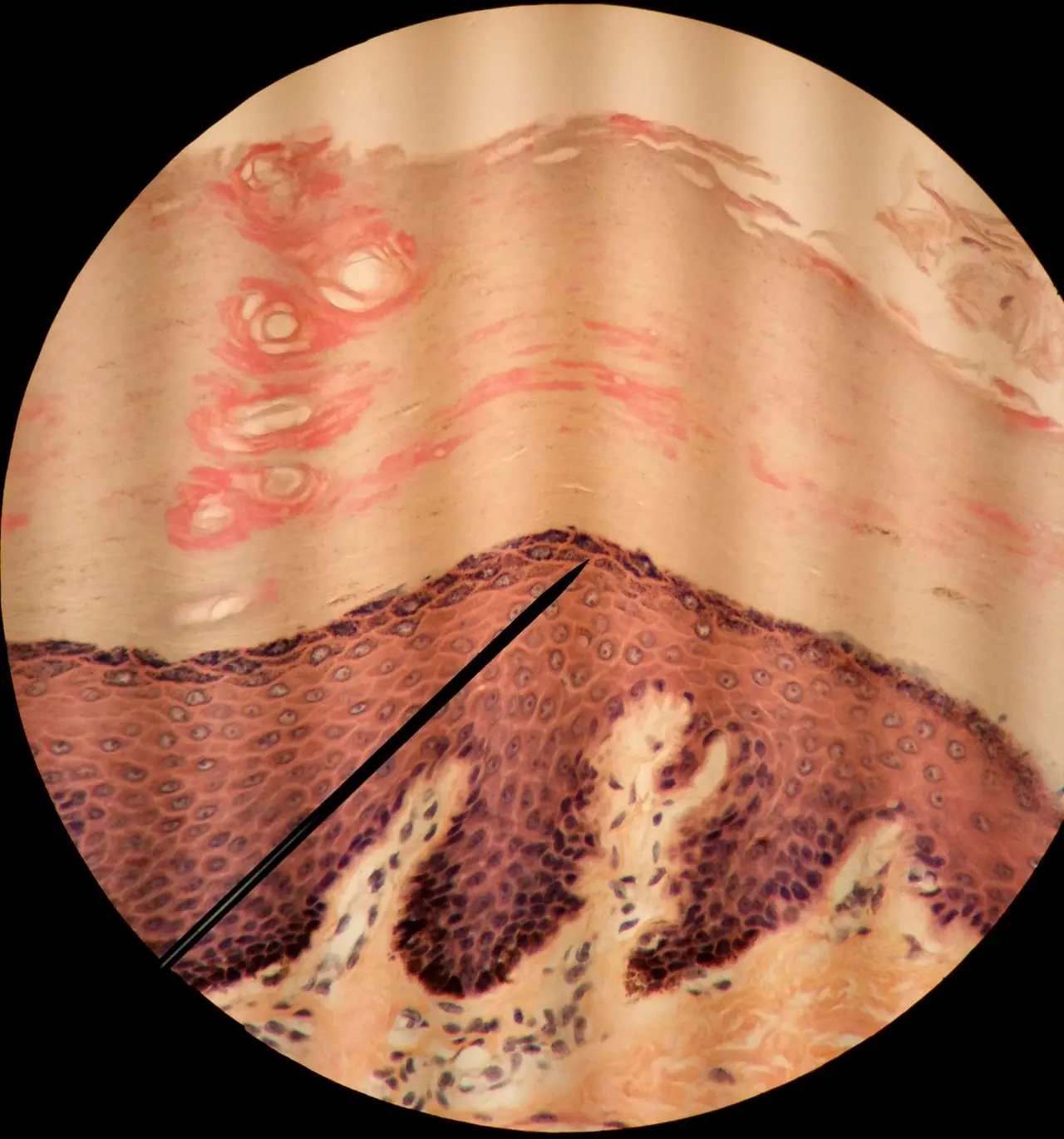
From the outside in, the skin has three layers: the epidermis (the outer layer), the dermis and the hypodermis (subcutaneous tissue, also called the subcutis). Beneath the hypodermis lie muscle and bone. These three layers are not equally thick everywhere. The epidermis on the eyelid is only about 0.05 mm, thinner than a sheet of printer paper; on the heel it can be as thick as about 1.5 mm. That is why the same hand pressure feels pleasant to the client on the sole of the foot but stings under the eyes.
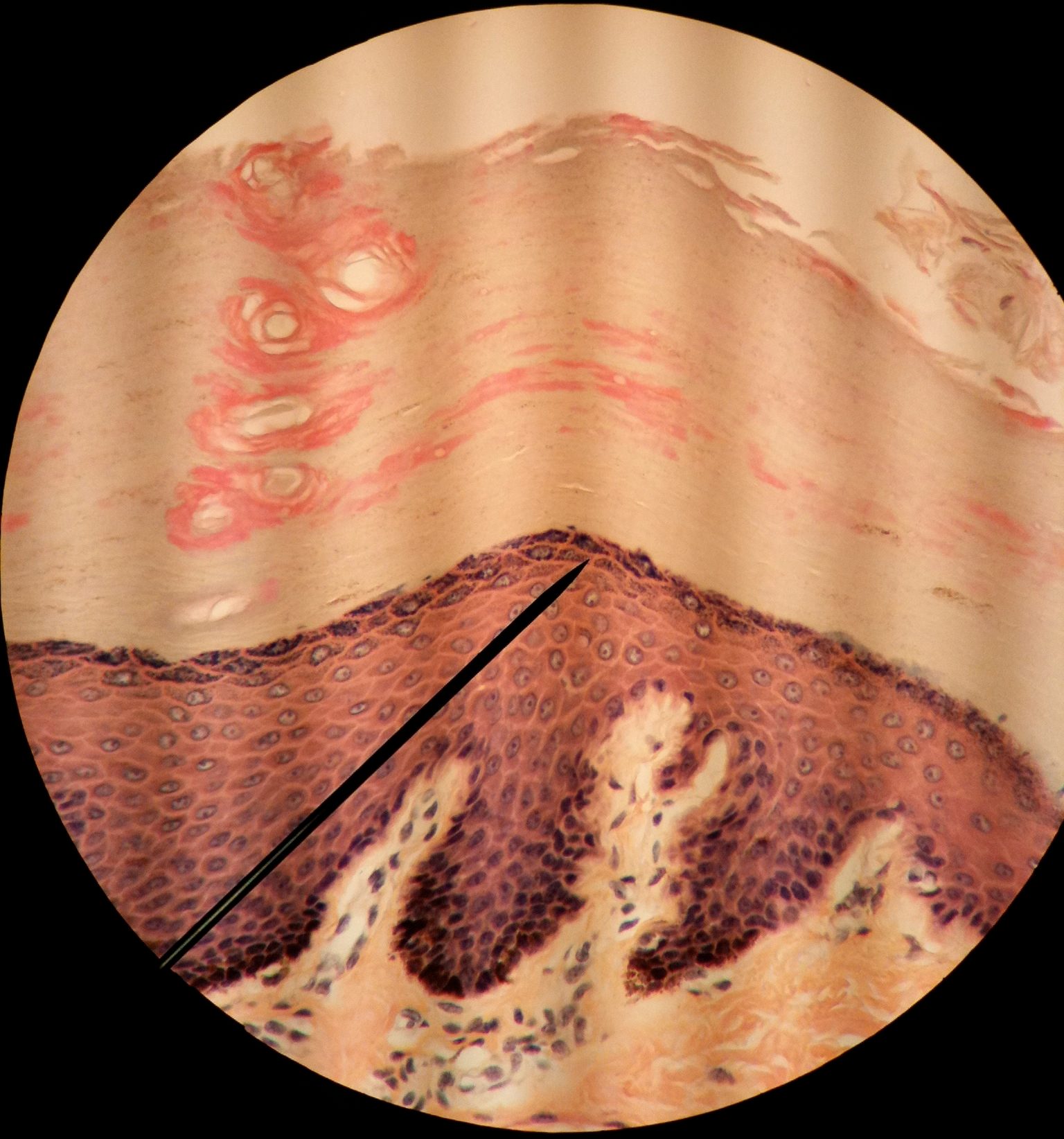
Photo: Iceclanl / Wikimedia Commons, CC BY-SA 3.0

The epidermis: five sub-layers and a cell's 4-week journey
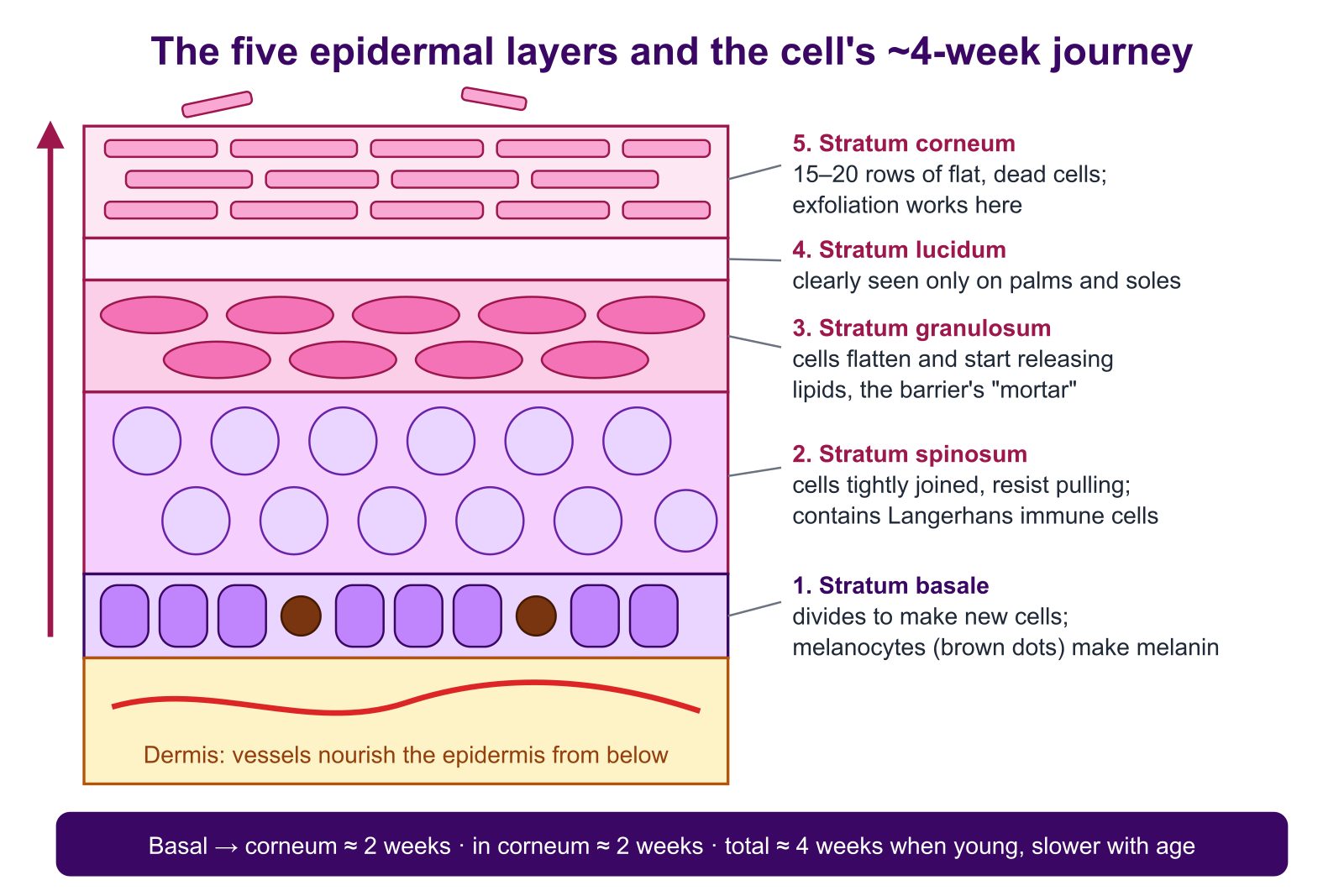
The epidermis has no blood vessels. It is nourished by nutrients that diffuse up from the dermis below. Most of its cells are keratinocytes, the cells that produce the horny protein keratin. Scattered among them are melanocytes, which make the pigment melanin, and Langerhans cells, immune cells that act as "sentries".
The five sub-layers from the inside out
- Basal layer (stratum basale): a single row of cells lying against the dermis, dividing continuously to make new cells. Melanocytes live here. When the skin is irritated, inflamed or exposed to sun, melanocytes increase melanin production.
- Spinous layer (stratum spinosum): several rows of cells joined by strong "bridges" that help the epidermis withstand pulling and friction. Langerhans cells are often found in this layer.
- Granular layer (stratum granulosum): cells begin to flatten, contain granules involved in making keratin, and start to release the lipids that will become the "mortar" of the protective barrier.
- Lucid layer (stratum lucidum): a thin, clear layer that is only distinct in thick skin such as the palms and soles. It is almost absent on the face.
- Horny layer (stratum corneum): about 15–20 rows of dead, flattened, scale-like cells stacked on top of each other and held together by lipids. This is the layer that exfoliants, cleansers and moisturisers act on directly.
The cell renewal cycle
A cell born in the basal layer takes about two weeks to travel up to the horny layer, and spends roughly another two weeks in the horny layer before it is shed. In total that is about 4 weeks (often rounded to 28 days) in young adults. The older the person, the slower the cycle; in older adults it may take one and a half to two times as long. Dead cells then cling to the surface for longer and the skin looks duller and rougher.
Understanding this cycle helps you answer three questions clients often ask:
- "Why can't I see a difference after one session?" Because the skin needs at least one cycle to replace its surface layer. This is also why the sessions of a facial treatment programme are usually booked a few weeks apart.
- "Will it brighten faster if you scrub harder?" No. Exfoliation only helps cells that are already ready to shed come away more evenly. Scrubbing hard to strip off cells that are not yet due to shed destroys the barrier; it does not speed up the cycle.
- "Why do dark marks take so long to fade?" Because the pigment sits in the basal layer and sometimes drops into the dermis. The horny layer renews quickly, but deep pigment cannot keep up. A spa only offers supportive care; persistent dark marks and melasma are a matter for a dermatologist.
The dermis and hypodermis: home of blood vessels, nerves and sebaceous glands
The dermis is many times thicker than the epidermis. It is divided into two parts. The upper part is the papillary dermis, thin, with many tiny capillaries that push upwards like fingers to nourish the epidermis. The lower part is the reticular dermis, thick, containing bundles of collagen and elastin fibres woven across each other. Collagen keeps the skin firm and elastin keeps it supple; both are made by fibroblasts.
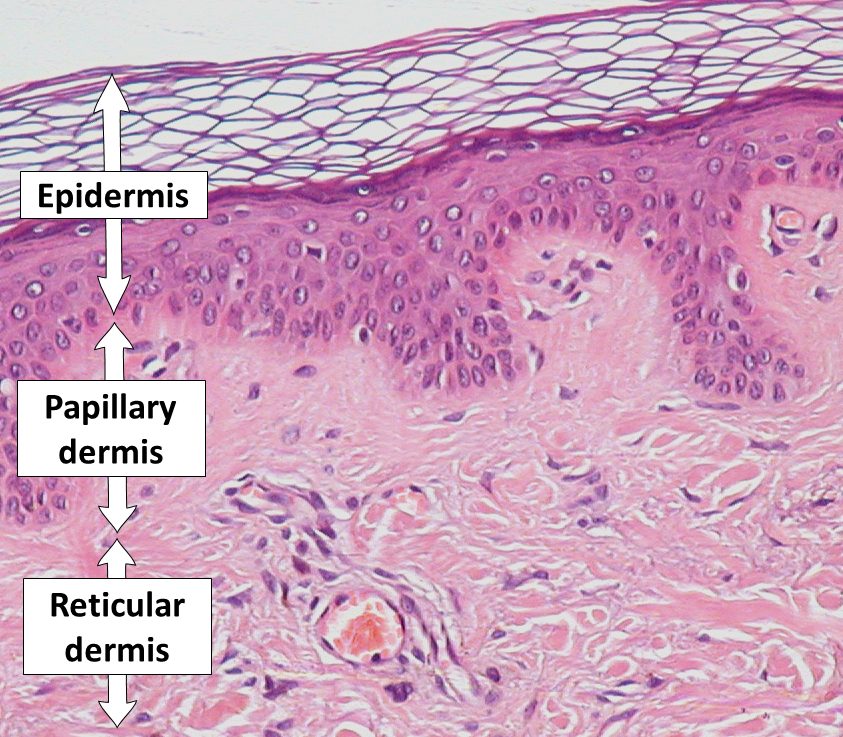
Photo: Original by Kilbad. Derivative by Mikael Häggström , M.D. Author info - Reusing images - Conflicts of interest: None Mikael Häggström , M.D. Consent note : Consent from the patient or patient's relati / Wikimedia Commons, CC0

The dermis also contains hair follicles, sebaceous glands (which release sebum onto the surface through the pores), sweat glands, nerve endings and a network of blood vessels. Three of these matter directly to your skill as a therapist:
- Blood vessels: massage dilates the vessels and the skin turns pink. A light flush that fades is normal. But in people with thin skin, skin that is already red, or dilated capillaries on the cheeks, hot and prolonged rubbing can cause lasting redness.
- Nerves: the dermis has a great many sensory nerve endings. Cold hands, an over-hot towel or sudden pressure are all felt by the client instantly, making the muscles tense and spoiling the sense of relaxation.
- Sebaceous glands: these lie deep and are influenced by hormones, age and climate. Frequent washing or hard scrubbing does not make the glands "produce less"; it only strips the surface oil and damages the barrier.
The hypodermis
The hypodermis is mostly fatty tissue, which retains heat and acts as a cushion. In body massage, the thickness of the hypodermis decides how much pressure you need to reach the muscle: a slim client has a thin layer of fat, so the same hand pressure can press straight onto the ribs or the shoulder blade. The area around the eyes has almost no cushioning, so use only very light pressure with the ring finger.
The skin barrier: the "bricks and mortar" model
When professionals talk about the "skin barrier", they mainly mean the horny layer. Picture a wall: the dead, flattened corneocytes packed with keratin are the bricks; between them lie lipids arranged in many thin layers, acting as the mortar. In this mortar, about half is ceramides, and the rest is mainly cholesterol and free fatty acids. Inside each brick is the "natural moisturising factor" (NMF), made up of amino acids, urea and lactate salts, which helps the cell attract and hold water.
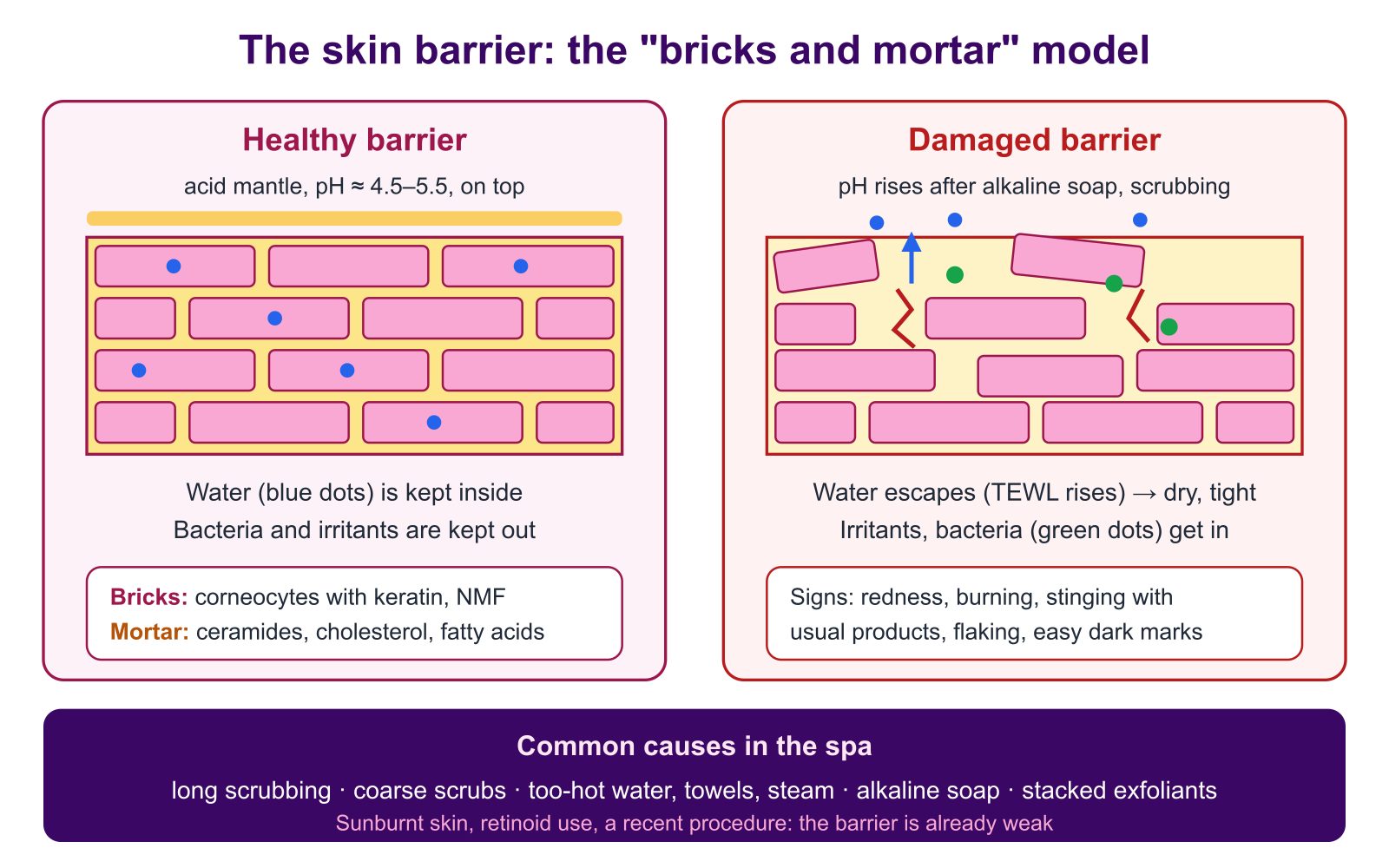
This barrier does two jobs in opposite directions. It keeps water in: if the barrier is damaged, the amount of water evaporating through the skin (called transepidermal water loss, TEWL) rises, and the skin becomes dry, tight and flaky. It keeps the outside out: bacteria, dust, chemicals in cosmetics, even essential oils. When the mortar cracks, things that are harmless to healthy skin start to cause stinging, redness and itching.
The acid mantle and pH
The surface of healthy skin is slightly acidic, with a pH usually in the range of 4.5–5.5. This thin acidic film is called the "acid mantle", and it is formed from sweat, sebum and substances produced as corneocytes mature. This acidity is no accident: the enzymes that make ceramides and the enzymes that help dead cells shed at the right time work best in a slightly acidic environment, while many harmful bacteria struggle to grow there. The skin's natural microbiome is also adapted to this pH.
The pH scale runs from 0 to 14, with 7 being neutral; each step is a tenfold difference, so pH 5 is about a hundred times more acidic than pH 7. Traditional bar soap usually has a pH of about 9–10 (alkaline). After washing with alkaline soap, the skin's surface pH rises and may take several hours to return. Gentle synthetic-detergent cleansers (syndets) usually have a pH closer to that of the skin.
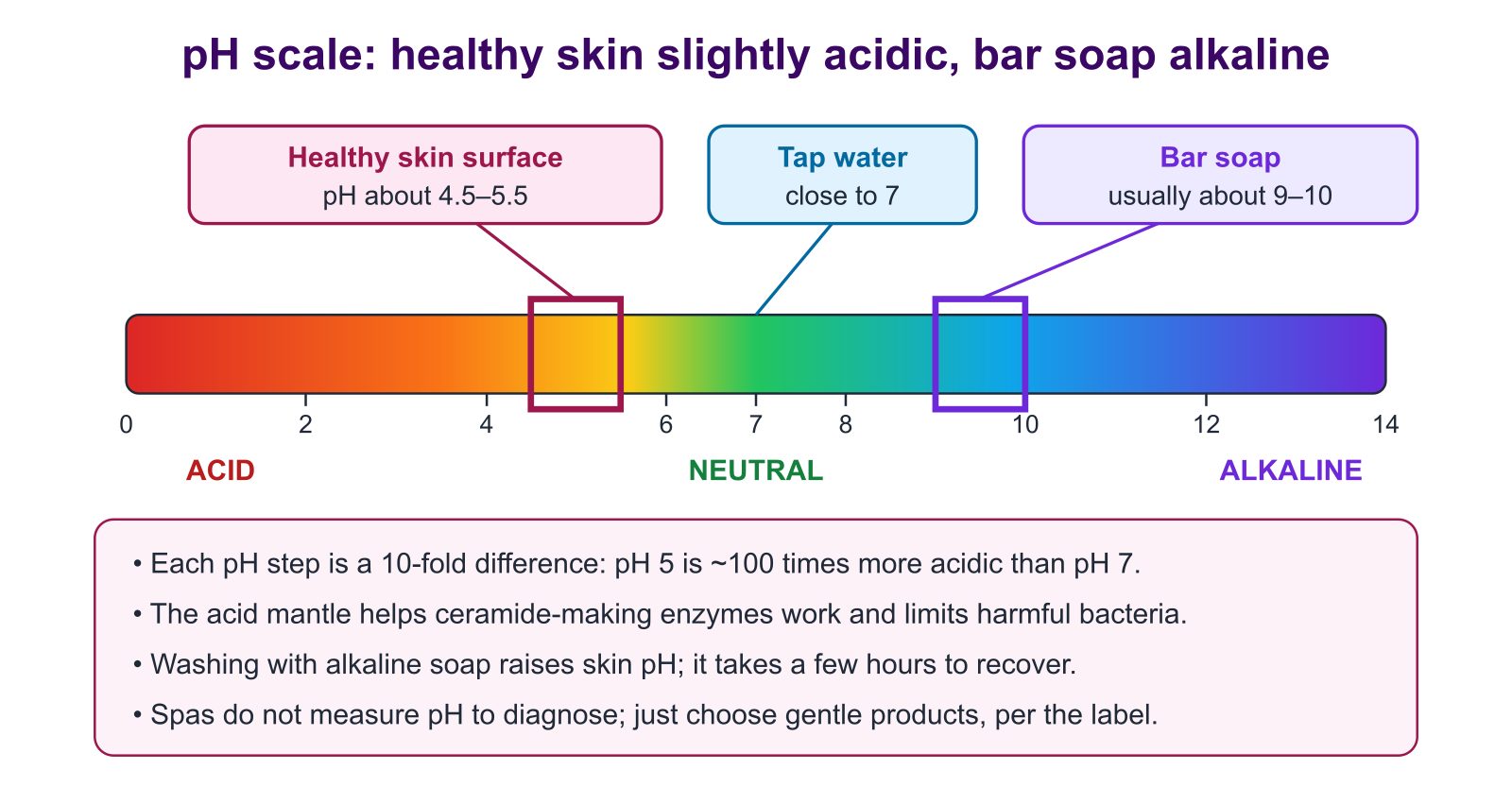
A therapist does not need to measure a client's skin pH, and spas do not use test strips to "diagnose". You learn about pH so that you understand why the shift supervisor tells you: never wash a client's face with body soap, never leave an acid-containing product on longer than the time stated on the label, and never mix products on the spot yourself.
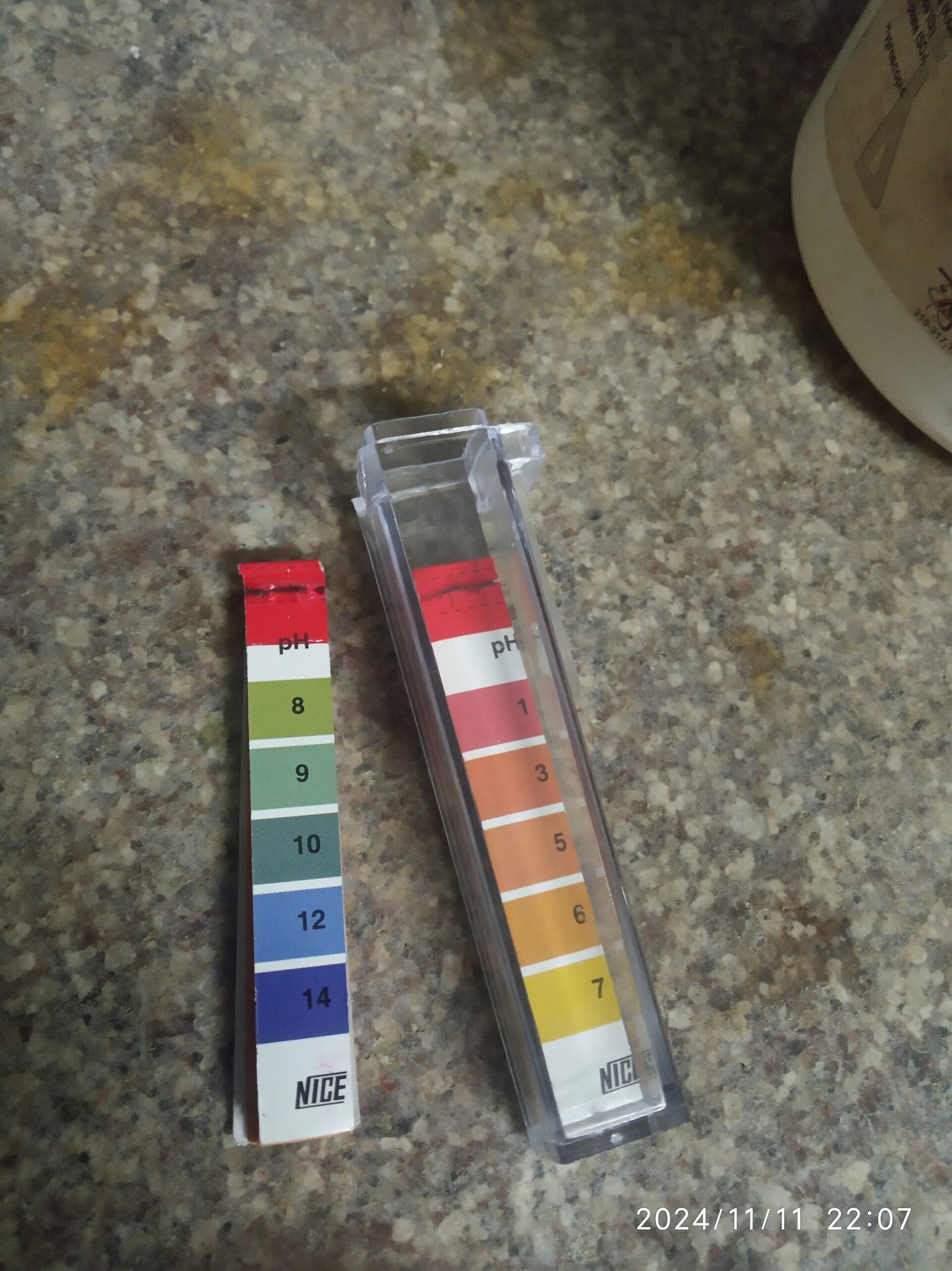
Photo: SAHAYA RAJAN S / Wikimedia Commons, CC0

In the spa, the barrier is usually damaged by four groups of factors: friction (rubbing with towels, coarse exfoliating grains, rotary brush machines), heat (water, towels or steam that are too hot soften the "mortar" and wash it away), harsh cleansers (alkaline soap, repeated cleansing, alcohol wipes on the face) and stacking several exfoliation steps in one session. Skin that is freshly sunburnt, on retinoids or has just had a procedure already has a weakened barrier; the next lesson teaches you how to screen for this.
Five skin types and the mechanisms behind them
The foundation article showed you how to observe the skin and record the skin type on the client record card. Here you learn why the skin behaves as it does, because the mechanism determines how you touch it.
| Skin type | Main mechanism | What the therapist must remember when working |
|---|---|---|
| Normal skin | Sebaceous glands produce just enough, barrier intact, retains water well | Maintain; do not "add steps to fill the package" when the skin does not need them |
| Dry skin | Lack of lipids in the mortar and surface sebum; water escapes easily through the skin | Limit exfoliation, use warm not hot water, prioritise hydrating and sealing in moisture |
| Oily skin | Sebaceous glands are very active, influenced by hormones and a hot, humid climate | Cleanse thoroughly but gently; hard scrubbing does not reduce oil but easily causes irritation and dehydration |
| Combination skin | The T-zone (forehead, nose, chin) has more sebaceous glands than the cheeks | Treat each zone separately; do not use one level of exfoliation for the whole face |
| Sensitive skin | Weak barrier and nerve endings that react more strongly than normal | Light pressure, few steps, little fragrance, test products first, no long hot steaming |
Two things beginners often get wrong
First, oily skin can still be dehydrated. Oil is lipid produced by the sebaceous glands; water is what the barrier holds in the horny layer. An oily-skinned client who is scrubbed and washed too much will be both shiny and tight and sore. If you keep choosing strong "oil-control" products, the condition gets worse.
Second, "sensitive" is sometimes a skin type and sometimes a temporary condition. Normal skin can become sensitive after over-exfoliation, after sunburn or when changing products. Record both the skin type and today's condition on the card. Most Vietnamese clients have skin with a lot of pigment; when irritated or inflamed it easily develops post-inflammatory hyperpigmentation (dark marks after inflammation) that lasts for many weeks. This is a very practical reason not to over-scrub.
Why every technique a therapist uses must take the skin barrier into account
Cleansing removes some of the surface lipids. Exfoliation removes the top few rows of bricks. Steam and hot towels soften the mortar. Massage creates friction and dilates the blood vessels. Each step on its own, in the right amount and for the right time, is something healthy skin can recover from. The problem appears when these effects add up within one session, or are repeated too often between sessions, faster than the skin can repair itself.
An easy professional rule: do enough, never extra. When in doubt, choose the gentler step and note it down so that the shift supervisor can decide for the next session.
Signs that the skin is being overworked
- Clear redness with a defined edge following the line of your scrubbing or the area the machine touched, which does not fade after about 15–30 minutes.
- The client complains of burning or stinging when a toner or serum they normally use is applied.
- The skin looks shiny and tight like "plastic", or flakes finely a few days after the session.
- Small itchy bumps appear in an area that has just been exfoliated or massaged for a long time.
If you see any of these signs during a session: stop the step you are doing, rinse off the product with cool water, do not apply any further active ingredients, and tell the shift supervisor. Note the time, the area of skin and the products used. A severe reaction such as swelling of the lips or eyes, a rapidly spreading rash or difficulty breathing is an emergency: call 115 (the Vietnamese emergency number) and tell the manager immediately.
The 6-step "safe skin contact" routine
This is the routine you apply to every technique on a client's skin, from cleansing the face and applying towels to body massage. It does not replace the spa's technical protocol; it is the safety frame wrapped around it.
- Wash your hands and check your own hands. Wash your hands using the WHO 6-step technique before touching the client. Short nails, no rings. If you have a scratch on your hand, cover it completely and wear gloves.
- Ask and look before you touch. Ask the client whether anything is different about their skin today, and whether they have recently had a procedure or started a new topical medication. Look at the area you are about to work on under a bright light: is there any redness, abrasion, inflamed spots or unusual marks?
- Test the temperature on your own skin. Hold the warm towel or soaking water against the inside of your own wrist first. Face towels and face-washing water should only be warm, close to skin temperature, not hot. Do not ask the client "Is it too hot?" instead of testing it yourself.
- Choose pressure and time to suit the area. The face takes lighter pressure than the body; the eye area takes the lightest, using only the ring finger; reduce pressure on thin skin and slim clients; do not massage one area for too long just to "fill the time".
- Monitor while you work. Every few minutes, check the skin colour and the client's facial expression. Ask briefly: "Is this pressure all right for you?" If the client winces, holds their breath or tenses their muscles, that is a signal to reduce the pressure.
- Check afterwards and complete the record card. Before the client leaves, look again at the area you worked on. Record on the card: skin type, today's condition, the steps performed, any reaction, and suggestions for the next session.
Scope of the spa: A spa only provides non-invasive care on the surface of the skin: cleansing, gentle exfoliation according to the product label, masks, massage and moisturising. Injections, deep microneedling, therapeutic laser and IPL, and extraction involving medical intervention belong to licensed medical facilities under the Law on Medical Examination and Treatment No. 15/2023/QH15. For inflamed skin, widespread pustular acne, ulcers, or moles that change colour or size: advise the client to see a dermatologist.
Common mistakes made by trainee therapists
| Mistake | Why it is wrong or dangerous | The right way |
|---|---|---|
| Scrubbing with exfoliating grains for a long time because the client asked you to "scrub well" | Strips off cells not yet due to shed, cracks the lipid mortar; skin becomes red, sore and prone to post-inflammatory dark marks | Exfoliate for the time on the label with light pressure, and explain to the client why you do not scrub hard |
| Washing the client's face with body soap | Alkaline soap raises skin pH, weakening the barrier and leaving the skin dry and tight | Use the spa's gentle facial cleanser, one cleanse, warm water |
| Placing a hot towel on the face without testing it yourself | Facial skin is thin; the client may get a mild burn or lasting redness | Test it on the inside of your own wrist first and let some of the heat out |
| Stacking several exfoliation steps in one session | The combined effect exceeds the skin's ability to repair itself | Only one type of exfoliation per session, decided after skin analysis |
| Seeing oily skin and choosing only strong oil-control products | Oily skin can still be dehydrated; drying it further only makes it tight and sore | Record skin type and condition separately; still hydrate with a light texture |
Pass criteria for this lesson
You pass this lesson when you can do the following in front of your instructor:
- Name the three layers of the skin and the five epidermal layers in order from the inside out (basal, spinous, granular, lucid, horny) in no more than 1 minute, and state that the lucid layer is only distinct in thick skin.
- State correctly that the epidermal renewal cycle is about 4 weeks in young people, and explain in 3 sentences why harder exfoliation does not make the cycle faster.
- Draw the "bricks and mortar" model on paper, labelling the bricks as corneocytes and the mortar as ceramides, cholesterol and fatty acids; name the 4 factors in the spa that damage the barrier.
- State the healthy skin-surface pH range of 4.5–5.5 and explain why you do not wash a client's face with bar soap.
- Determine the skin type of 5 people (classmates, acquaintances) and match at least 4/5 results with your instructor; each card records skin type and condition separately.
- Perform all 6/6 steps of "safe skin contact" on a classmate during a facial cleansing session, including testing the towel temperature on your own wrist and asking for pressure feedback at least twice.
- Name at least 3 signs of overworked skin and state the correct order of action: stop, rinse with cool water, apply no further active ingredients, tell the shift supervisor, complete the record card.
Frequently asked questions
The client says "My skin is thick, just scrub hard, it's fine." Should I do as they ask?
No. The feeling of "thick skin" is usually a build-up of the horny layer or oily skin, but the horny layer on the face is still only a few dozen rows of thin cells. Explain briefly: "Your skin is healthy, so I'll do just enough to keep its protective layer intact; scrubbing hard can easily cause redness and dark marks." You may extend the gentle cleansing time, but do not increase the scrubbing pressure.
Is pink skin after a facial massage a good sign?
A light, even pink flush that fades within about 15–30 minutes is a normal reaction caused by dilated blood vessels. Redness in streaks, burning, lasting redness, or redness with itching or bumps is a sign of irritation. Do not tell the client "the redness means toxins are coming out"; that is untrue and can lead the client to ignore a real reaction.
Why won't the shift supervisor let me exfoliate at every session?
Because the epidermis needs about one cycle to renew its horny layer, and the barrier needs time to rebuild its mortar. Exfoliating too often removes the protective layer before it has had time to recover. The exact frequency of exfoliation follows the spa's protocol and the manufacturer's instructions, and is always decided after skin analysis, never out of habit.
What if I see an unusual mole or a slow-healing sore on a client's skin?
Do not touch it, do not apply products to it, and do not make comments such as "that might be cancer". Say gently: "This spot looks a little different; it would be worth asking a dermatologist to have a look." Note it on the card and tell the shift supervisor. The next lesson in this module teaches you how to decide when to postpone, adapt, or refer to a doctor.
Further reading
Review how to analyse the skin and record the skin type on the card in the article Skin structure and the contraindications every spa therapist must know by heart, then see how to apply it in a complete treatment in the article The 8-step basic facial for newly qualified spa therapists.