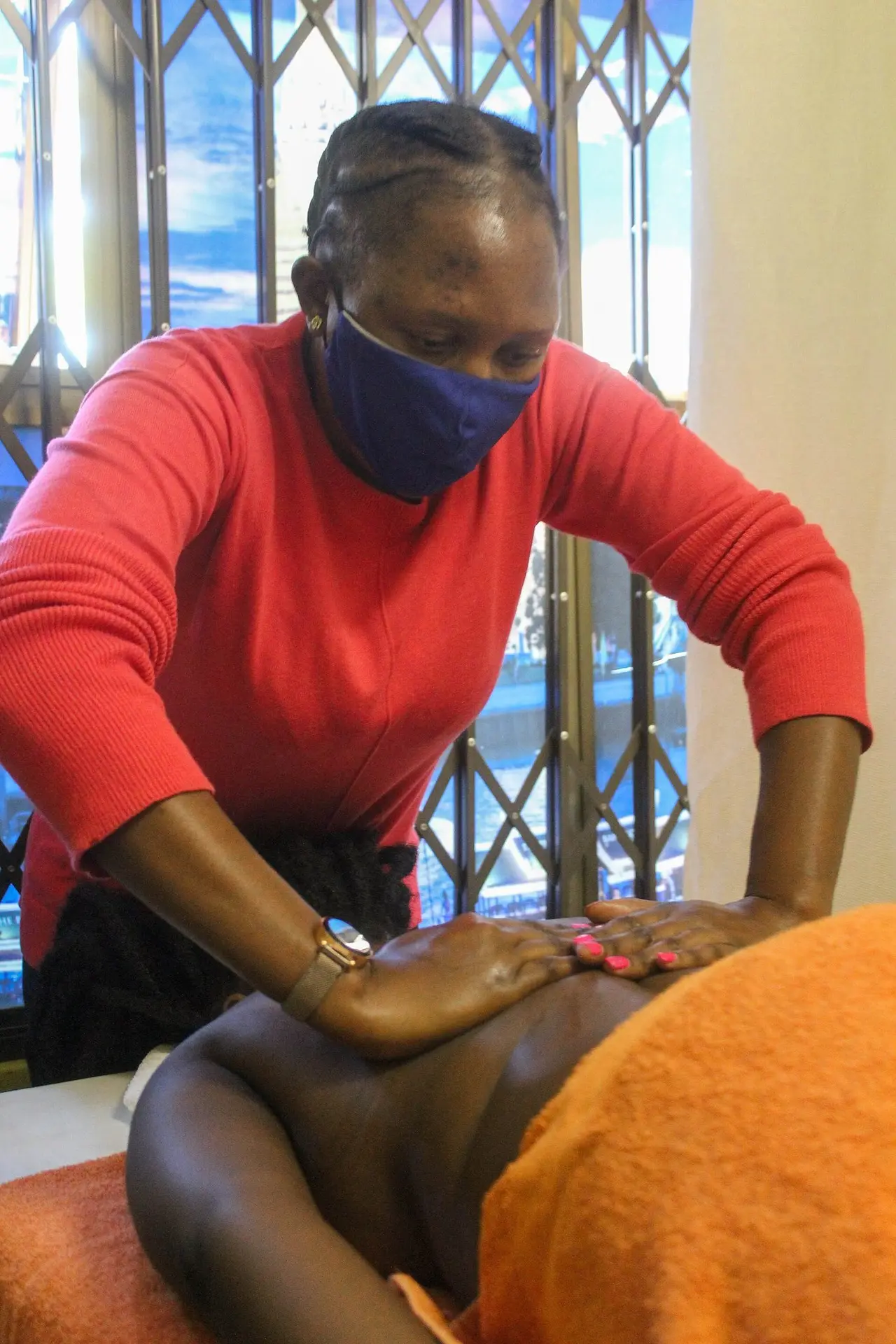
At spa job interviews, trainees are often told, "Show me 5 minutes on the back." After only a few strokes, the senior therapist already knows whether this person has a foundation or not. They are not looking at how many "tricks" you know. They look at three things: whether you clearly distinguish each group of movements, whether your hand rhythm is even, and whether your pressure rises and falls under control. Classical massage (often called Swedish massage) is built from exactly 5 groups of movements. Every body treatment you learn later, from 60-minute relaxation to hot stones or aromatherapy, is a way of combining these 5 groups in different orders, rhythms and pressures.
This lesson goes into each group of movements as a separate skill, with hand-training exercises on a pillow and on a classmate. The sequence of a 60-minute session has its own lesson; here you focus only on making each movement "clean" and correct.
By the end of this lesson, you will be able to:
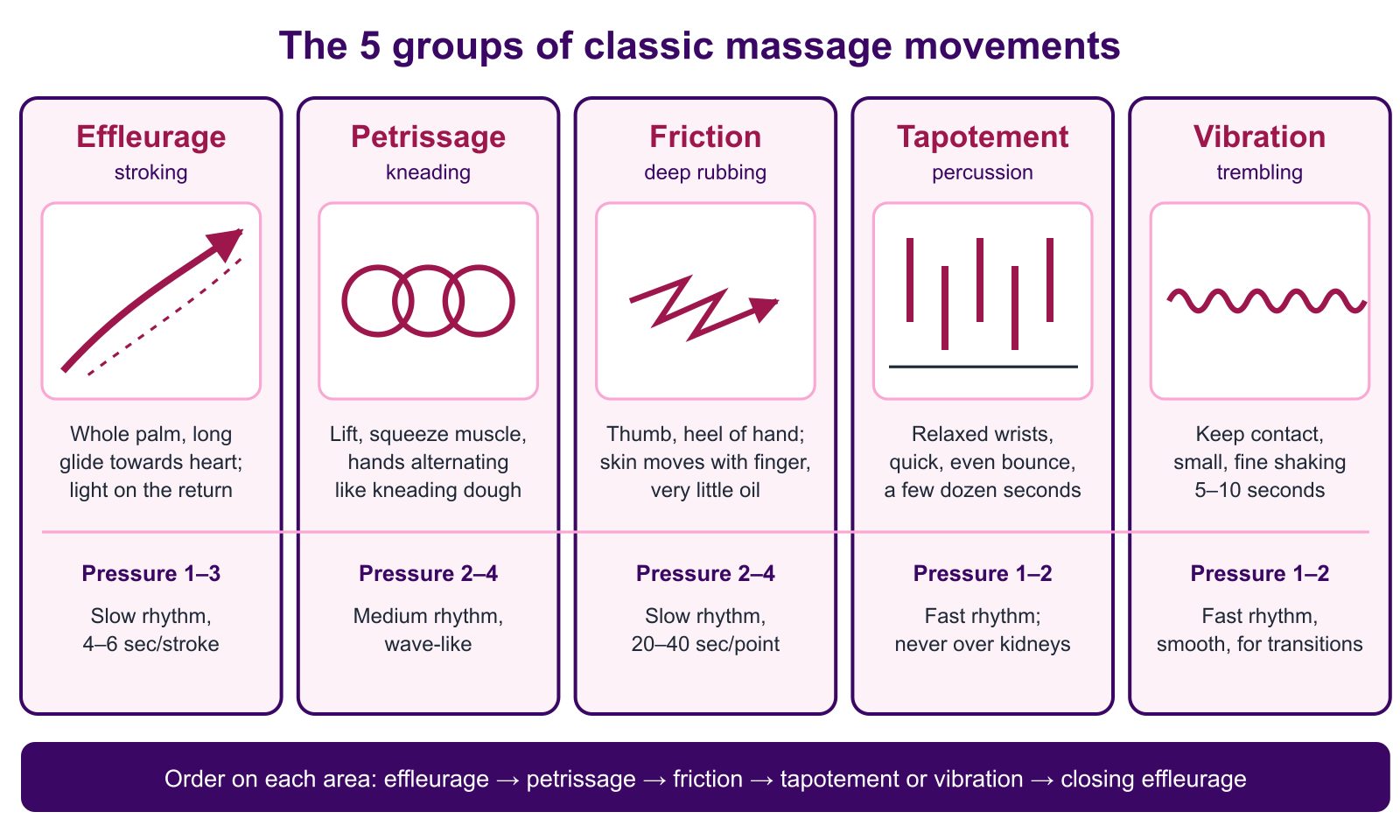
- Name correctly in Vietnamese and English the 5 groups of movements: effleurage (stroking), petrissage (kneading), friction, tapotement (percussion) and vibration.
- State the purpose, the part of the hand used, the rhythm and the usual pressure level of each group.
- Use the 1–5 pressure scale to ask about and adjust pressure according to the client's feedback.
- Recognise when not to use a group of movements: endangerment sites, contraindications, or when the client does not like it.
- Train your hands on your own following a 4-week schedule on a pillow and on classmates, with measurable criteria.
The overall picture: 5 groups, one principle
Classical massage movements were systematised in Europe in the 19th century and still use their French names today. You do not need perfect pronunciation, but you should know the names so you can read materials and talk with therapists from other countries.
| Group | English/French name | Main purpose | Rhythm | Usual pressure (1–5) | Used when |
|---|---|---|---|---|---|
| Stroking | Effleurage | Getting acquainted, spreading the oil, warming, linking movements, finishing | Slow, even, continuous | 1–3 | Opening, moving between areas, finishing each area |
| Kneading | Petrissage | Lifting, squeezing and rolling the muscle mass for deeper release | Medium, wave-like | 2–4 | After warming with effleurage; thick muscle areas such as the shoulders, thighs and calves |
| Friction | Friction | Working on a small area or a tight spot | Slow | 2–4 | Along both sides of the spine, around the shoulder blades, once the muscle has softened |
| Percussion | Tapotement | Awakening, creating a feeling of alertness | Fast, light, even | 1–2 | Briefly, at the end of an area, when the client likes it; rarely used in a relaxation session |
| Vibration | Vibration | Spreading a gentle vibrating sensation, soothing | Fast, small amplitude | 1–2 | Transitions, areas where the client is tight but sensitive |
The general principle for all 5 groups: light first, deeper later, light to finish. Each area starts with effleurage, gradually moves into petrissage and friction, may include a little tapotement or vibration, and then closes with effleurage. A session without opening effleurage will startle the client. A session without closing effleurage leaves a feeling of being "unfinished".
The 1–5 pressure scale and how to ask the client
"Light, medium, firm" means something different to each person. Many spas use a 1–5 scale so that the therapist and the client speak the same language, and so that it can be recorded on the card for next time.
| Level | What the client feels | The therapist's hands |
|---|---|---|
| 1 – Very light | Like a caress, a glide over the skin | Only the weight of the relaxed hand |
| 2 – Light | Can feel the hands, relaxing, easy to fall asleep | Light pressure, the skin moves with the hand |
| 3 – Medium | Clearly feels the muscle being worked, pleasant | Part of the body weight is transferred through the hands |
| 4 – Firm | "Intense but satisfying", still breathing evenly | More body weight transferred, slower pace |
| 5 – Very firm | Slightly painful, has to hold the breath or brace | Not used in relaxation massage |
With a new client, start at level 2 during effleurage and increase to 3 when kneading. Ask for the first time at minute 2–3: "On a scale from 1 to 5, where 1 is very light and 5 is painful, what level does the pressure feel like now?". The target is level 3–4 depending on the client. If the client says 5, or you see the client holding their breath, tensing the shoulders or curling the toes, reduce by one level immediately without needing to ask.
Pressure comes from body weight, not from the wrist. To increase from level 3 to 4, shift your centre of gravity from the back foot to the front foot and slow down; do not tense your thumb. Increasing pressure suddenly makes the client contract their muscles and will make your hands hurt after a few weeks.
Effleurage and petrissage
Effleurage: the movement that takes up the most time
Purpose: to get acquainted with the skin and muscles, spread the oil, warm the working area, link the movements together and finish the area. Effleurage is also when you "read" the client's body: which places are warm, cold, tight or soft.
Technique:
- Apply oil to your own hands, rub them warm, and place the whole palm and fingers flat against the skin, fingers gently together, not lifted.
- Glide long strokes along the fibre direction and towards the heart on the arms and legs. On the back, go from the lower back up to the shoulders and then curve down the sides of the ribs.
- Pressure is applied on the outward stroke; the return stroke glides lightly, and the hands do not leave the skin.
- Do 3–5 passes every time you enter a new area, gradually increasing pressure from 1–2 to 3.
Rhythm: one long effleurage stroke on the back takes about 4–6 seconds. Count silently "one – two – three – four" going up and "five – six" coming back. An even rhythm is more important than pressure.
Variations: parallel two-handed effleurage, alternating effleurage (one hand finishes as the other begins), and forearm effleurage on large muscles of the back and thighs when the client wants pressure level 3–4.
Petrissage: working with the muscle mass
Purpose: to lift the muscle mass away from the layer beneath, squeeze and release it, like kneading dough, helping the muscle soften and release more deeply than with effleurage.
Technique:
- Only knead after warming with at least 3 passes of effleurage.
- Place both hands on the muscle mass (for example the upper trapezius or the calf). Use the whole palm and fingers, not the fingertips.
- One hand lifts and squeezes the muscle mass towards the other hand, then the direction reverses; the two hands alternate to create a wave-like rhythm.
- Move slowly along the length of the muscle, about one hand's width every 2–3 beats.
Variations: one-handed kneading on small areas (the arm); skin rolling: lifting a fold of skin between the thumb and fingers and rolling it forward, used only lightly on the back with the client's agreement; compression: pressing the palm down onto the muscle mass and releasing, in an even rhythm.
Do not use on: thin muscle areas close to the bone (front of the lower leg, back of the hand); areas with varicose veins, bruising or swelling; clients with a recent injury. Do not pinch the skin with your fingertips; the client will feel a sharp nip as if being pinched.
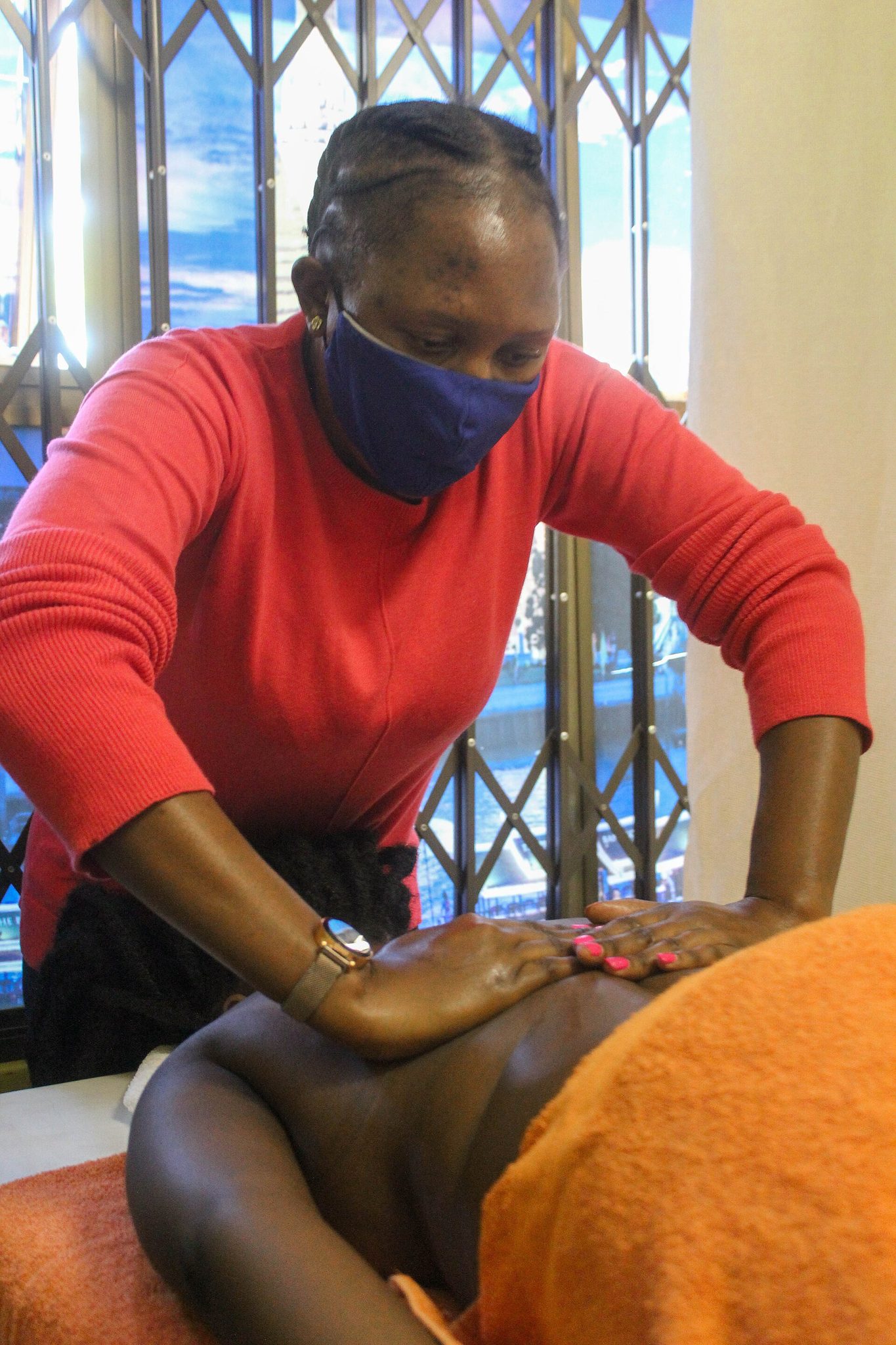
Photo: Kolobetsoo / Wikimedia Commons, CC BY-SA 4.0

Friction
Purpose: focused work on a small area where the client feels tight or where you feel stiff muscle under your hands. At Level 1, friction is used to release tight spots in relaxation massage, not to "break down" or treat injuries.
Technique:
- Use the pad of the thumb (kept in line with the forearm), the fingers held together, or the heel of the hand.
- Press down just enough for the skin and the layer beneath to move with your finger, without sliding over the skin. That is why only very little oil is needed.
- Work slowly along short paths: along the fibres (along the muscle), across the fibres (short back-and-forth), or in small circles.
- About 20–40 seconds per spot, ask the client, then soothe the area with effleurage before moving to the next spot.
Rhythm: slow. New therapists often perform friction quickly, like scrubbing a floor; the client will feel the skin burning rather than any pleasant effect on the muscle.
Do not use: on bones and the spinous processes of the spine; on endangerment sites (front of the neck, armpit, back of the knee, groin, kidney area); on bruises, new scars or damaged skin; on clients taking anticoagulant (blood-thinning) medication (they bruise easily). Working friction too long on one spot can cause bruising and soreness the next day.
Sustained pressure: a variation of friction
Press slowly into a tight spot over 2–3 breaths, hold for a few seconds and release slowly. If the client feels a "pleasant tension", it is correct; "sharp, stinging, radiating numbness" is wrong, and you must release immediately. Sustained pressure does not replace therapeutic acupressure; at the spa, it is only a relaxation technique.
Tapotement and vibration
Tapotement: short, light and deliberate
Purpose: to create a feeling of alertness and "wake up" the muscles, usually at the end of the session or the end of an area. In relaxation massage, tapotement takes only a few dozen seconds per area.
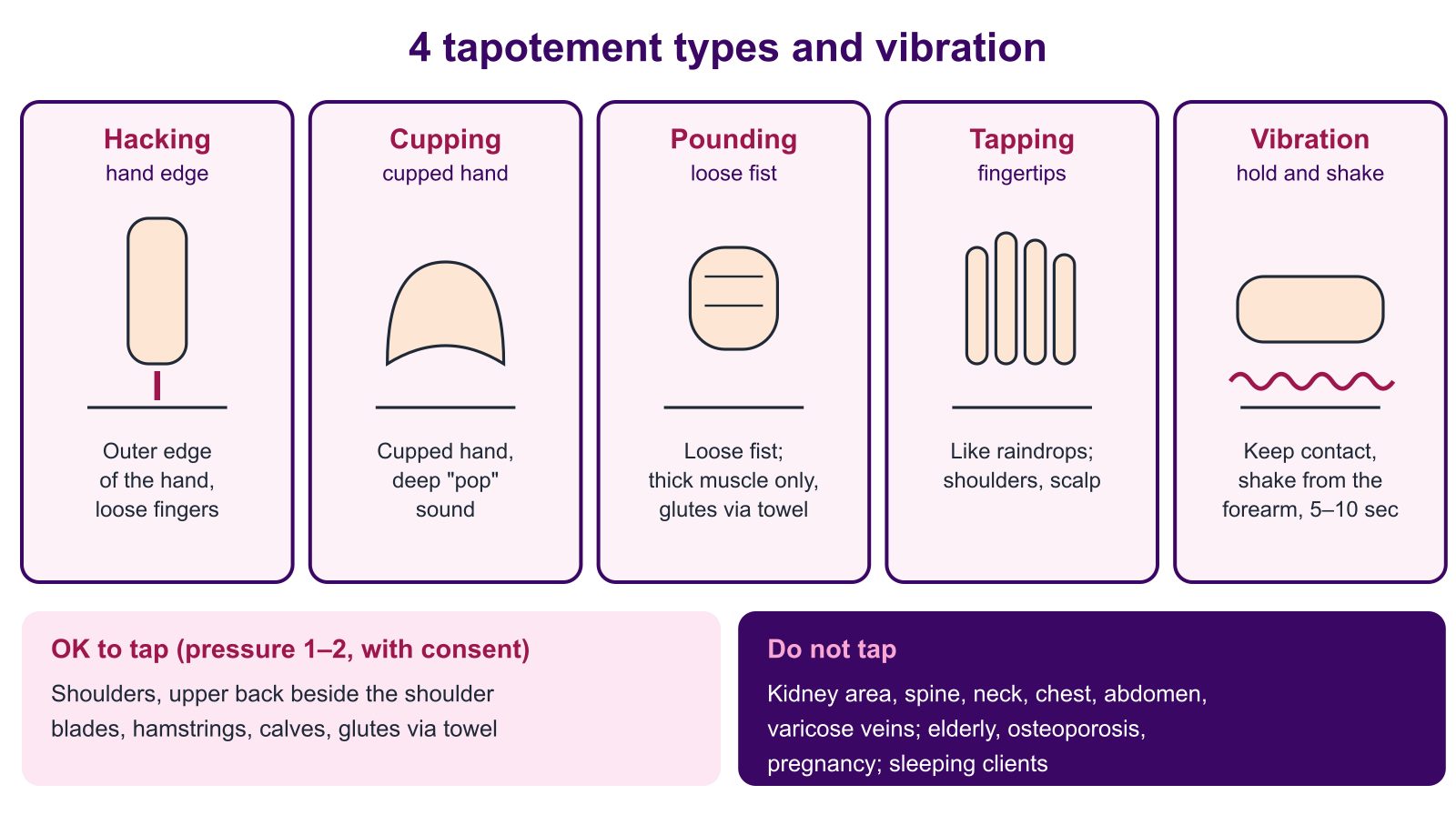
Types of tapotement:
- Hacking: the outer edge of the hand, fingers relaxed, hands alternating. It sounds like light rain.
- Cupping: the hand is cupped like a bowl, striking with a deep, hollow "pop" sound, not painful.
- Pounding: a loose fist, using the side of the fist, only for thick muscle areas such as the buttocks (through the towel) and thighs.
- Tapping: the fingertips tap lightly like falling rain; can be used on the shoulders and scalp.
Technique: the wrists are completely relaxed, the force bounces up from the wrist rather than striking down from the shoulder. Hands alternate, in a fast and even rhythm. Pressure level 1–2.
Do not use: on the kidney area, spine, neck, front of the chest or abdomen; on areas with varicose veins; on older clients, clients with osteoporosis or pregnant clients; on clients who are asleep or deeply relaxed and do not want to be woken. If you have not asked the client, do not use tapotement.
Vibration: light and spreading
Purpose: to create a gentle vibrating sensation spreading through the working area, helping the client relax in sensitive areas, or as a smooth transition movement.
Technique: place the palm or fingertips on the muscle area, keep contact, then vibrate quickly with a very small amplitude from the forearm, as if gently shaking a bottle of water. Do it for 5–10 seconds each time. Variation, shaking: gently lift the client's arm or leg and shake it lightly so the muscle loosens; often used at the end of the leg work.
Do not use: when the client feels dizzy or nauseous; on the abdomen after a meal; when the client does not like the sensation. Vibration also tires your hands if you tense up, so keep your shoulders and elbows relaxed.
When not to use: a quick reference table
Before placing your hands, you will already have read the health form and asked the client according to the consultation lesson. The table below summarises how common conditions affect each group of movements. When in doubt, choose a lighter movement or skip the area and ask the manager.
| Condition or area | Effleurage | Petrissage | Friction | Tapotement | Vibration |
|---|---|---|---|---|---|
| Fever, possibly contagious illness, open wound | No session | No | No | No | No |
| Suspected thrombosis (calf swollen, hot and painful on one side) | Do not work the area; advise seeing a doctor | No | No | No | No |
| Varicose veins | Very light, around the area | No | No | No | No |
| Bruises, new scars | Avoid the area | No | No | No | No |
| Taking anticoagulant medication | Light | Light | Avoid | No | Light |
| Older people, osteoporosis | Light to medium | Light | Light, avoid bones | No | Light |
| Kidney area, spine | Light to medium | Not on the spine | Both sides of the spine, not on the kidney area | No | Light |
Pregnant clients: trainee therapists do not treat them on their own. Only therapists trained in pregnancy massage may treat them, following the spa's procedure and the opinion of the client's doctor.
A reminder of professional limits: relaxation massage at a spa is non-invasive care that supports relaxation. You do not promise to "cure back pain", "reduce fat" or "unblock the meridians". Clients who need treatment must be referred to a medical facility.
Hand-training exercises on a pillow and on classmates
Massage skill is muscle memory. You need to repeat hundreds of controlled passes before working on real clients. Equipment: a long pillow (or body pillow) wrapped in a towel, a kitchen scale or bathroom scale, a stopwatch and a notebook.
Week 1: on the pillow, training rhythm and posture
- Effleurage: place the pillow lengthways along the edge of a table and stand in a lunge (bow) stance. Long strokes of 4–6 seconds each, 30 passes in a row, counting the rhythm aloud. Record the number of passes that "stumble" (stop or jerk).
- Petrissage: alternating two-handed kneading on the pillow for 3 minutes continuously, keeping an even wave-like rhythm.
- Tapotement: hacking with the edge of the hand on the pillow for 20 seconds, rest for 10 seconds, repeat 5 times. Keep the wrists relaxed; if your shoulders get tired, you are striking from the shoulder.
Week 2: on the scale, training pressure
Place the scale on the table and cover it with a towel. Press as if performing effleurage and watch the number on the scale. The goal is to feel the difference between each level, not to hit an exact figure. Each person records their own scale reading for levels 2, 3 and 4, then practises pressing at exactly that level with eyes closed, 10 times per level. The smaller the deviation from your own figure, the more stable your hands.
Week 3: on a classmate, training transitions
- Your classmate lies face down, draped according to the procedure, with only the back uncovered.
- Perform a 5-minute sequence: 1 minute of effleurage, 1 minute of kneading the shoulders, 1 minute of friction along both sides of the spine, 30 seconds of vibration or light tapotement (if your classmate agrees), and 1 minute 30 seconds of closing effleurage.
- Your classmate assesses: did your hands ever leave the skin, did the pressure rise or fall suddenly, and what pressure level was each movement on the scale.
Week 4: training to listen to feedback
Repeat the 5-minute sequence on at least 3 different classmates. Ask about pressure in the first minute using the 1–5 scale, adjust, and record it on a practice card as you would on a real client's card.
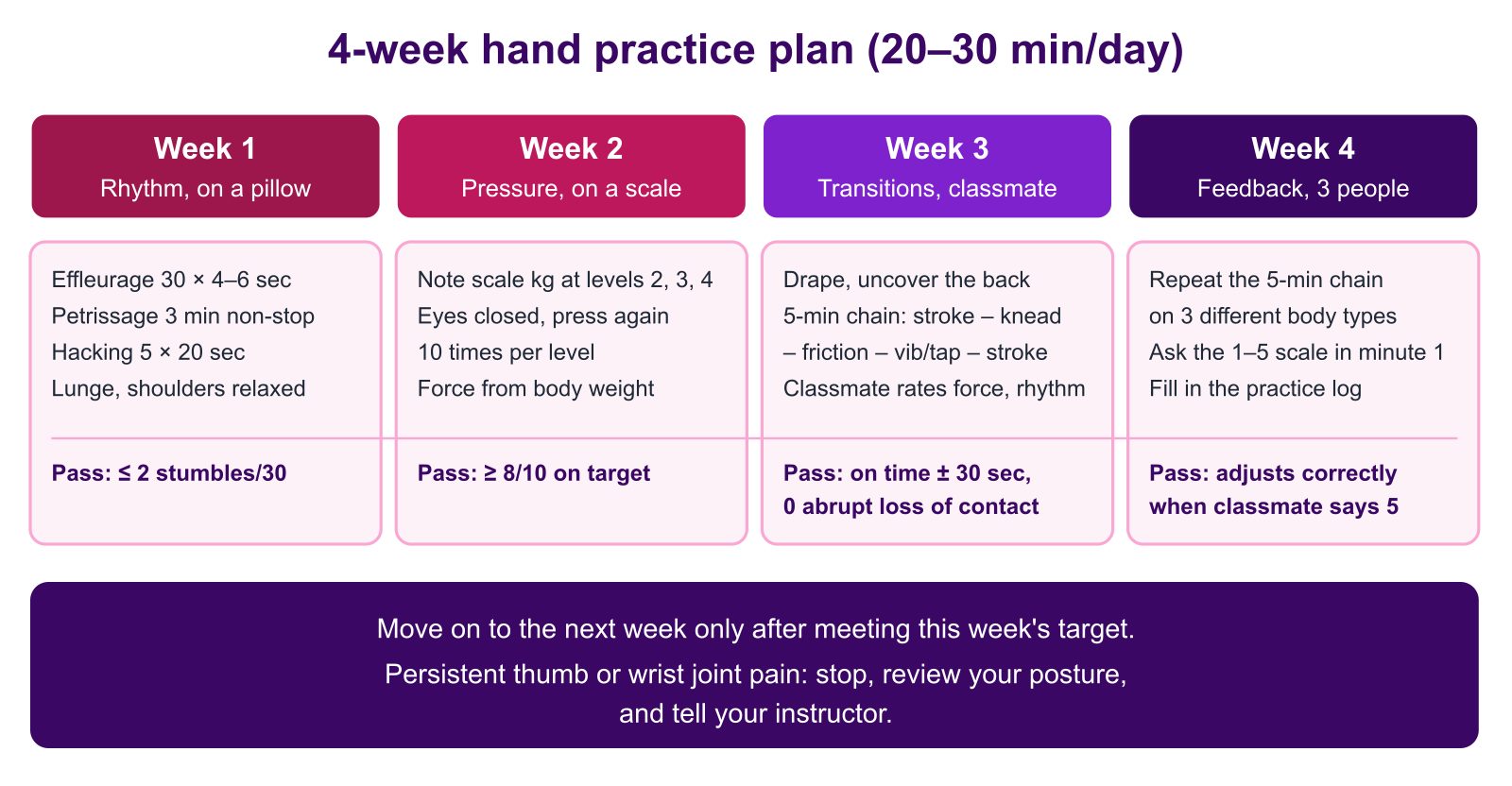
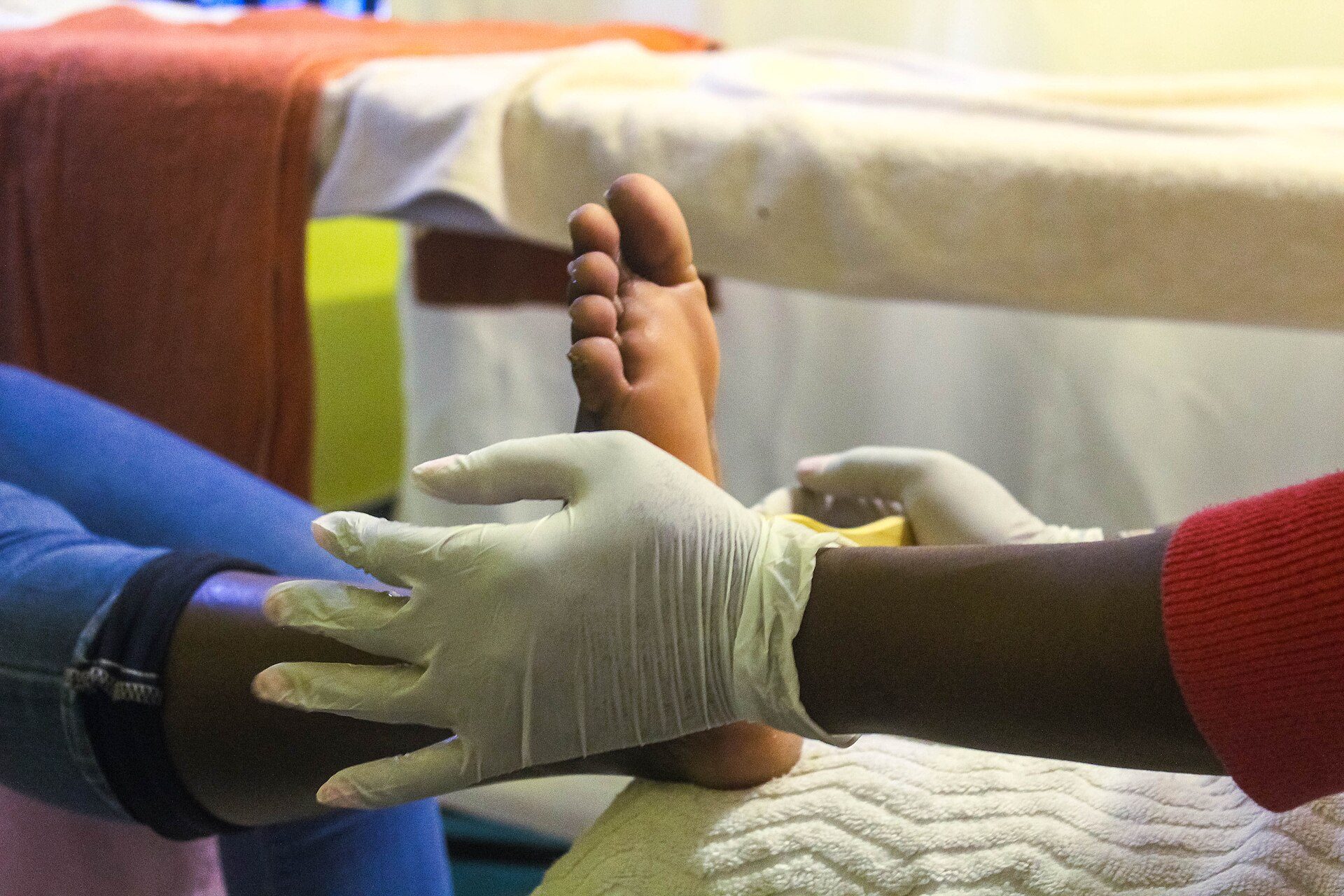
Photo: Kolobetsoo / Wikimedia Commons, CC BY-SA 4.0

Common mistakes of trainee therapists
| Mistake | Why it is wrong or dangerous | Correct practice |
|---|---|---|
| Going straight into petrissage or friction without warming with effleurage | The muscle is still cold and tight, the client is startled, and it hurts easily | Always do 3–5 passes of effleurage before working deeper |
| Effleurage as fast as wiping a table | The client cannot relax; it feels rushed | Count a rhythm of 4–6 seconds per long stroke |
| Kneading with the fingertips, pinching the skin | Causes sharp nips, discomfort, and may leave marks | Use the whole palm and fingers, lifting the muscle mass |
| Friction with too much oil | The finger slides over the skin and cannot reach the muscle | Very little oil, the skin moves with the finger |
| Tapotement on the lower back or spine | The kidney area and bones have little protection | Only use tapotement on thick muscle areas: shoulders, upper back, thighs, buttocks through the towel |
| Tensing the thumb to increase pressure | Thumb joint pain, jerky and uneven pressure | Transfer body weight, switch to the heel of the hand or the forearm |
| Not asking about pressure, assuming "the client can take it" | Bruising and soreness the next day; the client does not come back | Ask using the 1–5 scale at minute 2–3 and after each change of area |
Pass criteria for this lesson
The instructor observes and assesses you on a pillow and on a classmate. You pass when you:
- Name correctly in Vietnamese and English, and state the correct purpose and usual pressure level of 5/5 groups of movements.
- Perform 30 long effleurage strokes in a row on the pillow, each 4–6 seconds, with no more than 2 passes that stumble in rhythm.
- Perform alternating two-handed petrissage for 3 minutes continuously without stopping, with no instance of pinching the skin with the fingertips when working on a classmate.
- On the scale, press at your own 3 pressure levels (2, 3, 4) correctly with eyes closed, with at least 8/10 attempts per level close to the recorded figure.
- Perform the 5-minute back sequence in full order effleurage – petrissage – friction – vibration/tapotement – effleurage, on time ±30 seconds, with 0 sudden breaks of hand contact.
- Ask about pressure using the 1–5 scale with the correct sample phrase and adjust correctly when your classmate reports level 5.
- State at least 3 cases where tapotement is not used and 3 cases where friction is not used.
Frequently asked questions
How is classical massage different from Thai massage and acupressure?
Classical massage uses oil and the 5 groups of movements on the skin, with the client lying on the bed. Traditional Thai massage is usually performed with the client clothed and includes pressing and stretching. Acupressure is based on the acupoint system of traditional medicine. At Level 1, you master classical massage first because it is the foundation for most body services at the spa.
What if the client keeps asking for "harder, harder"?
Increase pressure gradually using your body weight and forearm on thick muscle areas, stopping at level 4. If the client still wants it harder, explain gently that excessive pressure easily causes bruising and pain the next day. Do not press firmly on endangerment sites even if the client asks.
Do I have to use all 5 groups in every session?
Not necessarily. Effleurage and petrissage are almost always present. Friction is used on tight spots. Tapotement and vibration depend on the client and the type of treatment; many clients prefer a smooth session from start to finish, so you can leave out tapotement completely.
My hands ache and my thumb hurts after a few days of practice; is that a problem?
Mild aching when you first start practising is normal. Persistent joint pain is a sign that you are tensing your thumb or wrist. Review your posture, use the heel of the hand and the forearm more, and rest between sessions. If the pain lasts several days, tell your instructor and see a doctor.
Further reading
Once each movement is clean, see how to combine them into a complete session in 60-minute relaxation body massage, and review the list of contraindications in Skin structure and contraindications in the spa.