
Seven o'clock in the evening, a woman books a 90-minute body massage package with hot stones, and ticks "no" to every question on the health form. When the therapist asks again, she mentions that she had liposuction on her abdomen last week, is taking prescribed anticoagulants, and her left leg has been slightly swollen for the past few days. Three pieces of information, three reasons not to do that package today. Trainees are often unsure what to do: refusing risks upsetting the client, going ahead risks something going wrong. This lesson gives you a clear way of thinking so that you do not have to guess.
By the end of this lesson, you will be able to:
- Distinguish three groups of contraindications: absolute, relative and local, together with the corresponding action for each group.
- Recognise the conditions commonly met in a spa (fever, skin infection, open wounds, suspected deep vein thrombosis, varicose veins, uncontrolled high blood pressure, cancer under treatment, first-trimester pregnancy, after surgery and cosmetic procedures, anticoagulants, isotretinoin) and explain why each condition is dangerous.
- Use a decision table to choose one of four routes: call an ambulance, postpone and advise a medical check, adapt the treatment, or proceed as normal.
- Question the client briefly and to the point, and decline politely using a 4-step script so that the client still feels respected.
- Complete the record card and report to the shift supervisor correctly so that the next shift and the spa have a clear record.
What is a contraindication, and why the therapist must be the first to spot it
A contraindication is a health condition that means a treatment, or part of a treatment, could harm the client. Massage increases circulation, changes blood pressure and acts mechanically on soft tissue and blood vessels. Skin care acts on the skin barrier through products and heat. For a healthy client these are benefits; for some people they are risks.
The therapist touches the client's skin and sees what the form does not record, so you are the most important layer of screening. But remember your scope: a therapist does not diagnose illness. You do not need to know what the client is suffering from. You only need to recognise a sign that is "not normal", know which group it belongs to, and take the right next step.
Photo: Matt @ PEK from Taipei, Taiwan / Wikimedia Commons, CC BY-SA 2.0

The best time to spot a contraindication is during the consultation, before the client changes. But some signs only show when you uncover an area to work on it, such as one swollen calf or an inflamed patch of skin. That is why screening happens twice: when you ask and when you touch.
Three groups of contraindications
The foundation article introduced two groups, absolute and relative. In this lesson you separate out a third group, local, because it is the one met most often in a spa and the decision is quite different from the other two.
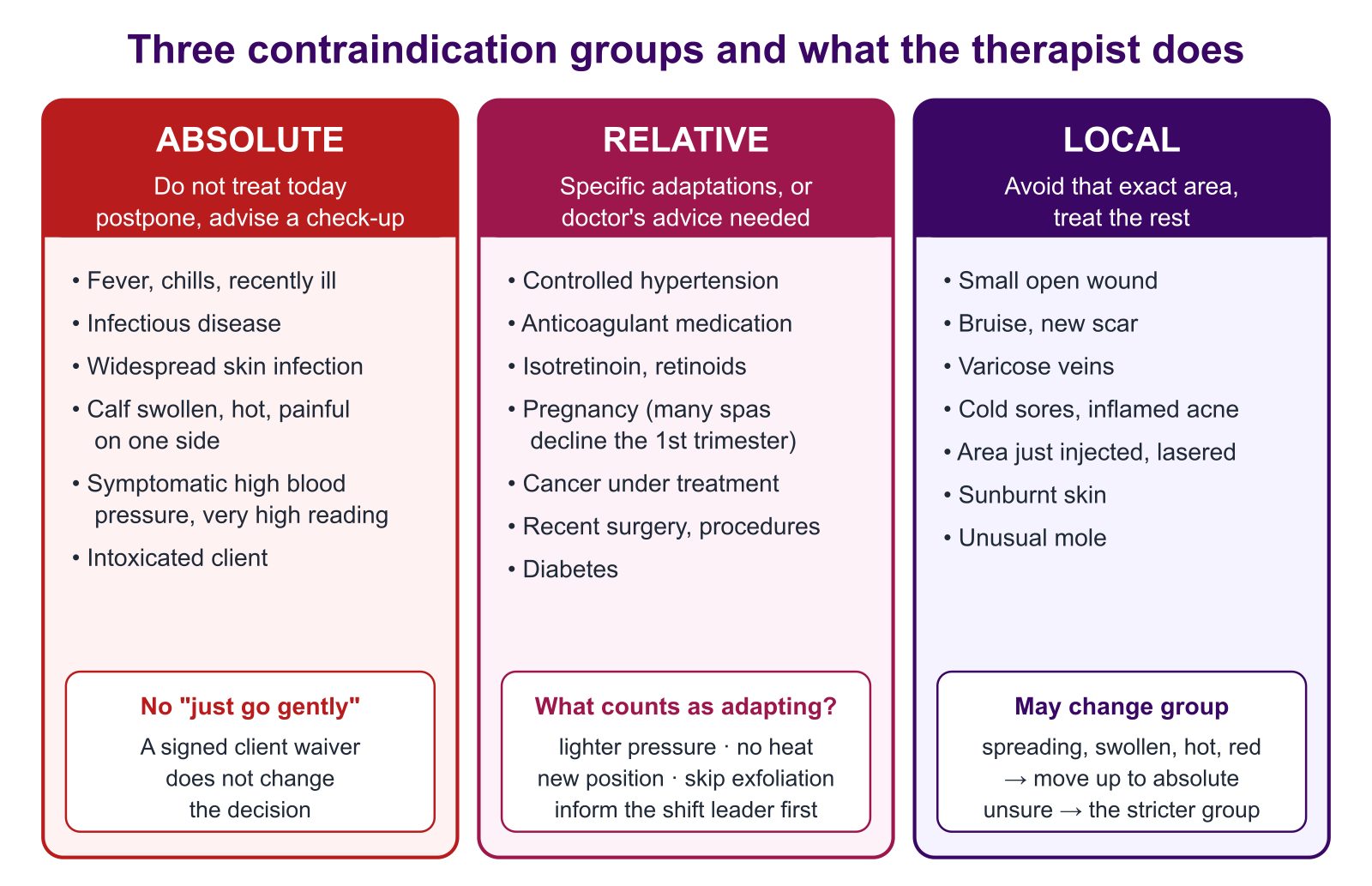
Absolute contraindication: no treatment today
The treatment could harm the whole body or spread to other people. There is no "just do it gently" in this group. Examples: fever, an active infectious illness, widespread skin infection, suspected deep vein thrombosis, high blood pressure with symptoms or a very high reading, an intoxicated client, a client showing signs of an emergency.
Relative contraindication: adapt, or obtain a doctor's opinion
Treatment may be possible, but specific changes are needed: reduce pressure, remove heat, change position, shorten the time, leave out a step. In some cases the spa only proceeds when the client has the approval of their treating doctor. Examples: high blood pressure that is treated and stable, diabetes, taking anticoagulants, cancer under treatment, pregnancy, recent surgery or cosmetic procedures, taking isotretinoin.
Local contraindication: avoid that area, treat the rest
Only one area must not be touched; the rest of the body is treated as normal. Examples: a small open wound, a bruise, a cold sore on the lip, an inflamed spot, an area of varicose veins, a fresh scar, a recently injected area, an unusual mole, sunburnt skin. The usual rule: avoid that area with a safety margin around it, apply no product to it, and use a separate covering towel if needed.
A condition can change group. A blister on the lip is a local contraindication for body massage, but a reason to postpone a facial. Fungal infection of one toenail is local; fungal infection spreading over several areas is absolute. When you are unsure which group it belongs to, put it in the more serious group and ask the shift supervisor.
Common conditions and why you must be careful
You do not need to memorise medicine, but you must understand why, so that you can work out how to handle cases you have not met before.
Fever, colds and flu, infectious illness
The body is fighting infection. Massage increases circulation and can make the client more tired and dizzy. You and the next clients also risk infection through close contact, towels and the treatment bed. Fever is generally understood as a temperature of about 38°C or above, but you do not need to measure it: if the client says "I've got a fever", "I feel shivery" or "I only got over being ill yesterday", that is enough to postpone.
Skin infections and open wounds
Impetigo, widespread pustular acne, boils, spreading fungal infection, scabies, shingles and blistering cold sores can all spread via hands, towels and equipment. An open wound is a doorway for bacteria, and spa products are not sterile. A small, localised area: avoid it and cover it. Spreading, weeping, or swollen, hot, red and painful: postpone the whole session and advise a dermatology check. Once you find it, towels and equipment that touched that area must be processed according to the spa's disinfection procedure.
Suspected deep vein thrombosis
Deep vein thrombosis (DVT) is a blood clot in a deep vein, most often in the lower leg. Signs you may see: one calf more swollen than the other, warmer, painful to touch or when walking, and the skin may be red or darker. The risk is higher in people who have just had surgery, have just flown long-haul or sat still for a long time, are pregnant or have recently given birth, take hormonal medication, or are being treated for cancer. Massage can dislodge the clot so that it travels to the lungs, causing a pulmonary embolism, a life-threatening situation. This is an absolute contraindication for the legs, and a reason to advise the client to see a doctor the same day, not "next week". If the client suddenly becomes short of breath, has chest pain or coughs up blood: call 115 (the Vietnamese emergency number).
Varicose veins
Twisted, bulging, blue-purple veins on the calves and the back of the knees. The vessel walls are weak and easily damaged. This is usually a local contraindication: no deep pressure, no kneading, no cupping, no coin scraping ("cao gio"), no direct hot compresses on the veins. You may stroke very lightly around the area or skip it. If the varicose area is swollen, painful, hot and red, has an ulcer or discoloured skin, treat it as suspected thrombosis or advise a medical check.
Uncontrolled high blood pressure
Massage, steam, hot soaks and hot stones all change circulation and heart rate. People whose high blood pressure is treated and stable can usually still have treatment with medium pressure, no strong heat, and getting up slowly. "Uncontrolled" means the client is not on treatment, has stopped their medication, or today has symptoms such as a severe headache, dizziness, blurred vision, chest pain or shortness of breath. According to common cardiology guidelines, blood pressure of about 180/120 mmHg or above requires immediate assessment by a doctor.
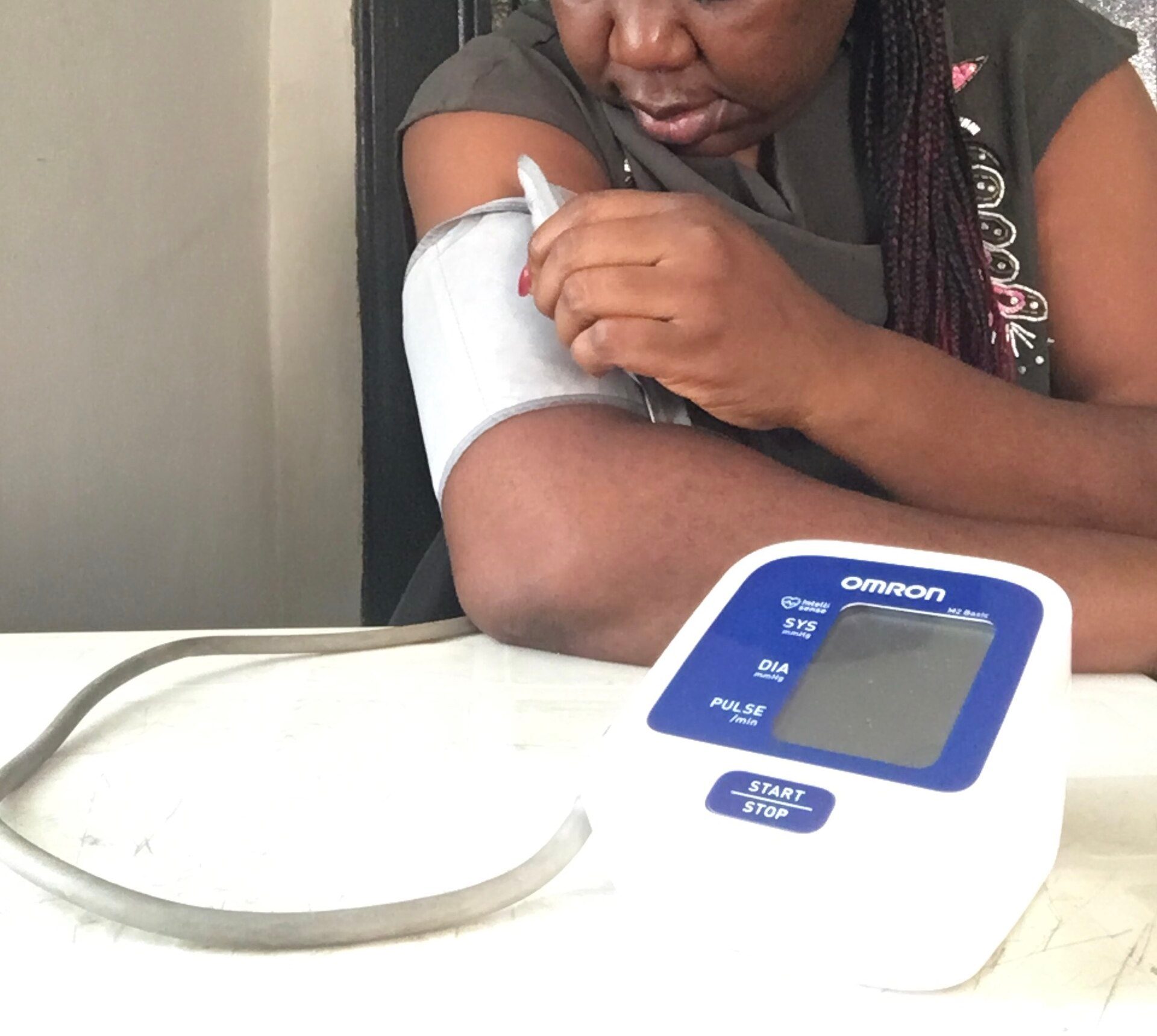
Photo: Beendy234 / Wikimedia Commons, CC0

A therapist does not diagnose high blood pressure. You ask: "Are you taking blood pressure medication? Have you taken it today? Have your recent readings been all right?" If the client has symptoms, or volunteers a very high reading: do not treat, and advise them to see a doctor. If there are signs of a stroke (drooping mouth, difficulty speaking, weakness or numbness on one side) or chest pain: call 115 immediately.
Cancer under treatment
A client having chemotherapy or radiotherapy, or who has recently had cancer surgery, may have thin, sensitive skin in the irradiated area, low blood cell counts making them prone to infection and bruising, tire easily, have a higher risk of thrombosis, have an implanted port under the skin, or have an arm prone to lymphoedema on the side where lymph nodes were removed. These are the reasons for caution, not that "massage spreads cancer". An ordinary spa only accepts the client with the approval of their treating doctor, and only therapists with specific training carry out the treatment; light pressure, avoiding the irradiated area, the port and the surgical site.
Pregnancy, especially the first trimester
The first three months are when the pregnancy is still early and the mother's body is changing a great deal; clients are often tired, nauseous and prone to dizziness. Many spas have a policy of not offering body massage in the first trimester. Throughout pregnancy, avoid heat that raises core body temperature (steam, hot tubs, hot stones), avoid essential oils not included in the spa's pregnancy protocol, and avoid lying on the back for long periods in later pregnancy. Pregnancy massage is only carried out by trained therapists following the spa's specific protocol, usually in a side-lying position with pillow support. Bleeding, abdominal pain, sudden swelling or a severe headache in a pregnant client: do not treat, and advise an immediate obstetric check.
After surgery and after cosmetic procedures
Incisions need time to heal, the risk of thrombosis rises after surgery, and the surgical area may still be swollen, numb or infected. After dermal filler or botulinum toxin injections, rubbing or pressing the injected area can make the product migrate. After laser, peels or microneedling, the skin barrier is damaged. The principle: avoid that area until the doctor who performed the procedure gives permission, according to their follow-up schedule and instructions. Post-liposuction drainage massage is done on the prescription of a medical facility; the spa does not take it on by itself.
Anticoagulants and antiplatelet drugs
Clients taking prescribed "blood thinners" (which doctors call anticoagulants, or aspirin, clopidogrel and so on) bruise easily and bleed for longer. This is a relative contraindication: reduce pressure markedly, no deep pressure, no cupping, no coin scraping, no techniques with a strong effect on the tissues; watch for bruising. When a client on anticoagulants also has one swollen leg, the situation moves into the absolute group. Never advise the client to "stop the medication for a few days and then have the treatment".
Isotretinoin and retinoid drugs
Isotretinoin is an oral medication for severe acne prescribed by a dermatologist. It makes the skin thin, dry, easily damaged and slow to heal. The information supplied with the medication advises avoiding waxing, dermabrasion and procedures that act strongly on the skin while taking it and for at least 6 months after stopping. In the spa this means: no exfoliation, no waxing, no acid-containing products, no hot facial steaming; only gentle cleansing, soothing and moisturising. Topical retinoids (tretinoin, adapalene and so on) also make the skin sensitive: no exfoliation and no waxing on the treated area.
Decision table: stop, postpone, adapt or proceed
Once you have the information, every situation falls into one of four routes. Ask the questions in order from the most dangerous downwards, and stop at the first question answered "yes".
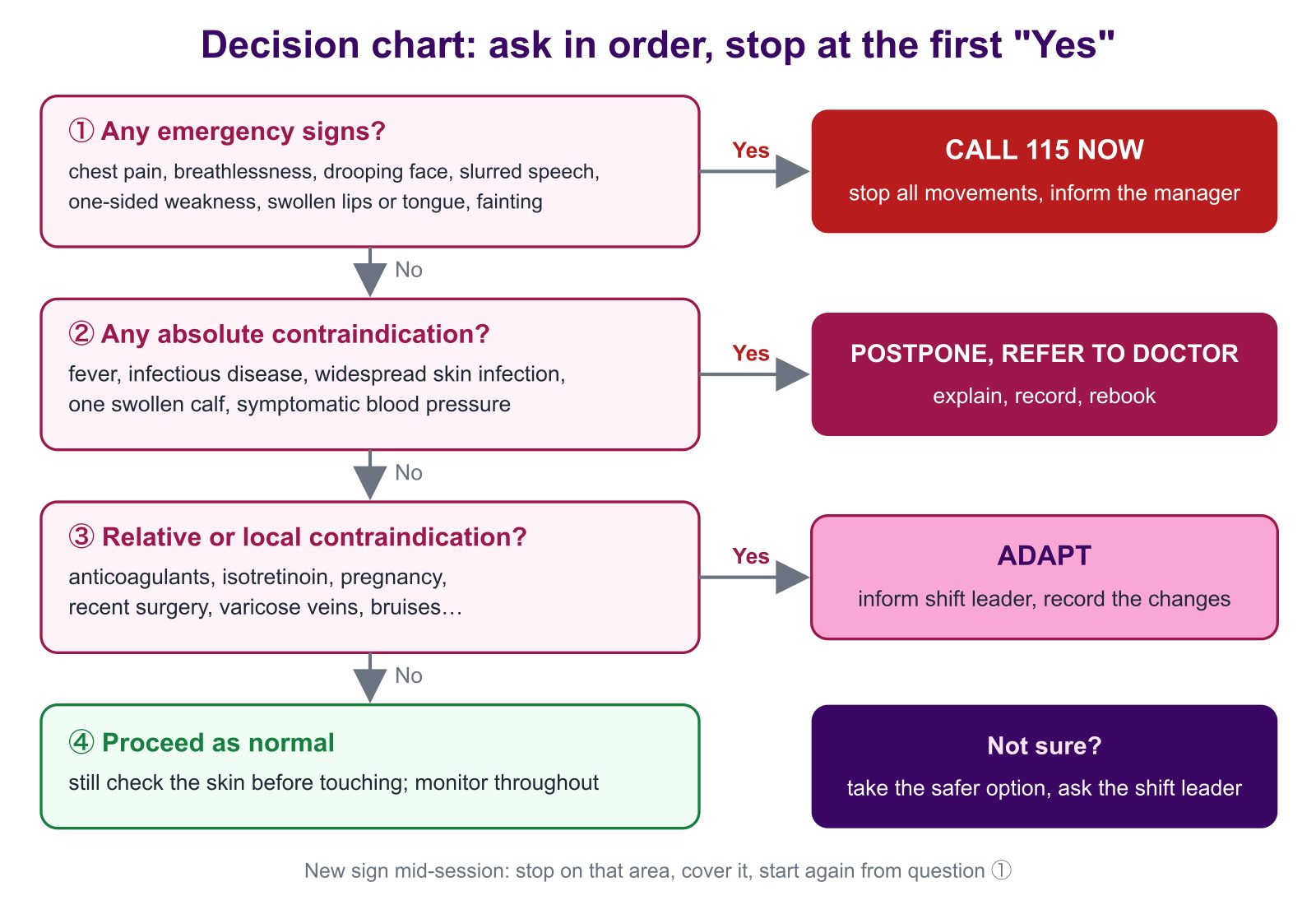
| Situation | Group | What to do today | Advise seeing a doctor? |
|---|---|---|---|
| Client has chest pain, difficulty breathing, drooping mouth, weakness on one side, swollen lips or tongue | Emergency | Stop all treatment, call 115, tell the manager | Emergency care immediately |
| Fever, chills, infectious illness | Absolute | Postpone the whole session, rebook when recovered | If not yet seen a doctor |
| One calf swollen, hot and painful | Absolute | Do not treat the legs; usually postpone the whole session | Yes, the same day |
| Widespread, weeping skin infection | Absolute | Postpone; disinfect the towels and equipment that touched it | Yes, dermatology |
| High blood pressure with symptoms or a very high reading | Absolute | Do not treat | Yes |
| High blood pressure, treated and stable | Relative | Medium pressure, no steam or hot stones, get up slowly | Not required |
| Taking anticoagulants | Relative | Light pressure, no cupping, coin scraping or deep pressure | Not required; do not discuss the medication |
| Cancer under treatment | Relative | Only treat with a doctor's approval and a specifically trained therapist | Yes, obtain approval first |
| First-trimester pregnancy | Relative, according to spa policy | Usually no body treatments; no hot treatments | Ask the obstetrician |
| Recent surgery or injections, laser, peel | Relative or local | Avoid that area until the doctor who performed it gives permission | According to the client's follow-up schedule |
| Taking isotretinoin | Relative | No exfoliation, no waxing, no acids, no hot steaming | Not required |
| Varicose veins, bruises, a small cold sore | Local | Avoid that area, treat the rest | If swollen, painful or ulcerated |
This table is a reference framework. The policy of the spa where you work always takes priority, and every "relative" case is reported to the shift supervisor before you start.
How to ask so that clients tell the truth
The health form gives you a framework, but clients often tick "no" to get it over with. The article on consultation taught you how to use the 7-section form. Here is a short set of questions you say aloud just before the treatment, even with regular clients:
- "Do you have a fever today, feel unwell, or have you just got over an illness?"
- "Have you recently had any surgery, injections, laser, peels or microneedling anywhere?"
- "Are you regularly taking or applying any medication, for example for blood pressure, blood thinners or acne treatment?"
- "Are you pregnant, or do you think you might be pregnant?"
- "Is there anywhere that is painful, swollen, bruised, or that you would prefer me not to touch?"
Three tips help clients answer honestly. One, give the reason first: "I'm asking so I can choose a pressure and products that are safe for you." Two, ask specifically: "blood thinners" is easier to answer than "do you have any illnesses?" Three, ask in private, in a normal tone of voice. If the client answers "yes", ask one more clarifying question and write down exactly what the client said.
The therapist's scope: You ask in order to decide on the treatment, not to diagnose. Do not say "you've got a thrombosis" or "you must have high blood pressure". Do not advise stopping, changing or taking extra medication. The standard line: "That's outside my expertise, so please ask the doctor who looks after you; I will only adapt the treatment to keep it safe."
Declining politely: the 4-step script
Clients get upset not because they are refused, but because they are refused curtly, without understanding why, and without any alternative.
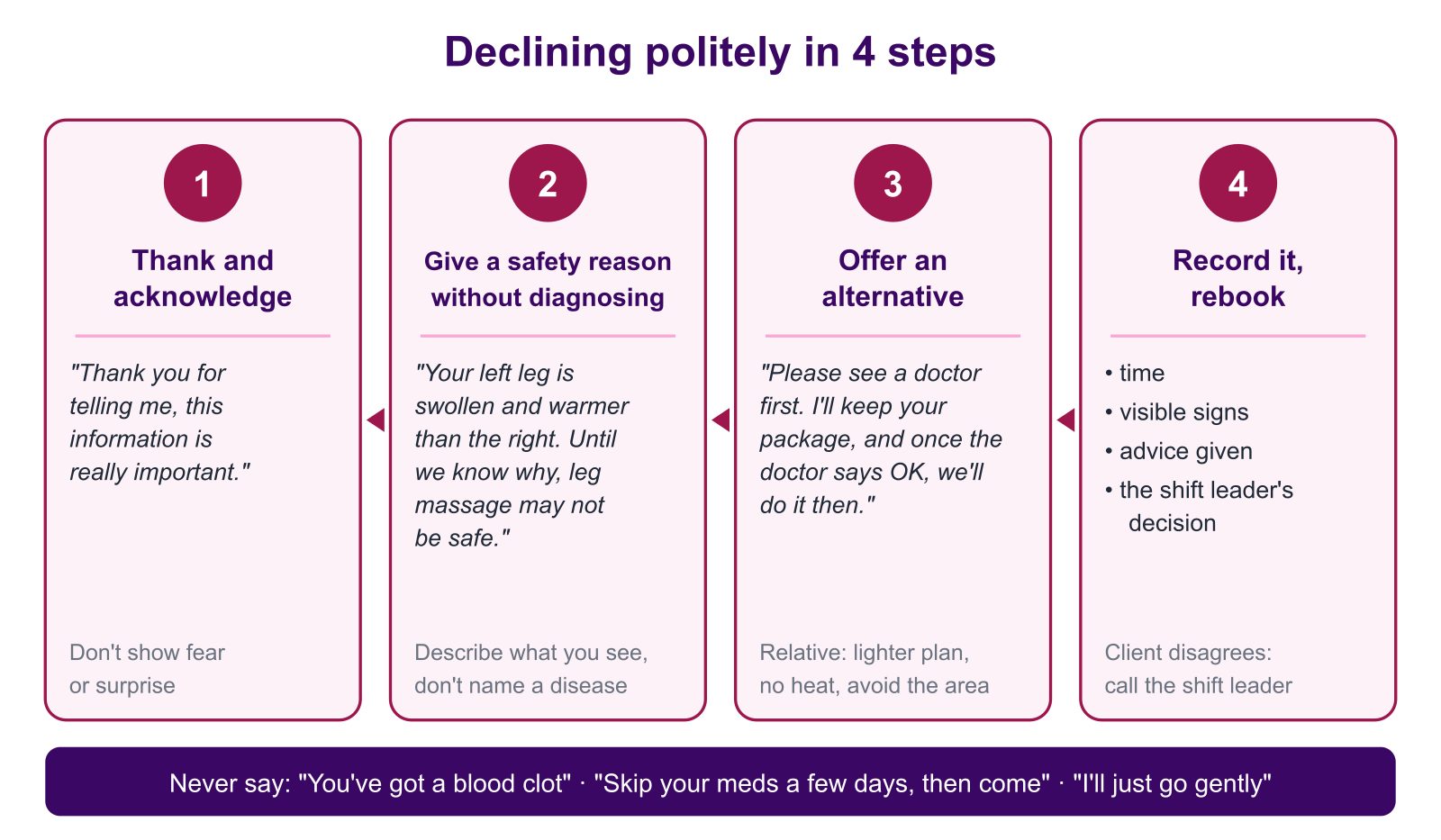
- Thank and acknowledge. "Thank you for telling me, this information is really important."
- Give the safety reason, without diagnosing. "Your left leg is swollen and warmer than the right. Until we know the cause, massaging your legs might not be safe for you."
- Offer an alternative. "Today I'd suggest you see a doctor so they can check your leg first. I'll keep the package for you, and once the doctor gives the go-ahead we can do it." For a relative contraindication: suggest a lighter package, leave out the heat step, avoid the area.
- Record and rebook. Note the time, the signs, the advice given and the shift supervisor's decision. Invite the shift supervisor to speak to the client if the client does not yet agree.
If the client says "It's fine, I'll take responsibility" in the face of an absolute contraindication: you still do not treat. Explain gently that this is a safety rule of the spa and of the profession, then call the shift supervisor. A client's signed waiver does not make a dangerous treatment safe.
The screening routine within a session
- Before the client changes: read the form, ask the 5 questions above, and place the client on one of the four routes in Figure 4.
- If the route is "adapt": tell the shift supervisor, agree on specific changes (pressure, heat, area, time), explain them to the client and note them on the card.
- When you start work: uncover one area at a time and look at the skin before touching. Compare both legs and both arms by eye.
- If you see a new sign: stop working on that area, do not press to "check", cover it again with the towel and reassess the route.
- Throughout the session: watch the client's facial expression, breathing and skin colour. If the client feels faint, is short of breath or has chest pain: stop immediately and switch to the spa's emergency procedure.
- At the end: help the client sit up slowly and rest for a moment before standing, especially clients with low blood pressure, older clients and those who have just had heat treatments. Complete the record card in full.
Common mistakes made by trainee therapists
| Mistake | Why it is dangerous | The right way |
|---|---|---|
| Seeing one swollen calf but still massaging "just gently" | May dislodge a blood clot, causing a pulmonary embolism | Stop on the legs, do not press to check, advise seeing a doctor the same day, tell the shift supervisor |
| Not asking again because the client is a regular | Health, medication and pregnancy can change within a few weeks | Ask the 5 short questions again at every session, note the update date |
| Cupping or coin scraping a client on anticoagulants | Easily causes widespread bruising and bleeding under the skin | Light pressure, leave out strong techniques, note it on the card |
| Exfoliating or waxing a client taking isotretinoin | The skin is thin, easily grazed, peels and heals slowly | Ask about acne medication before every exfoliation and waxing step |
| Advising the client to stop their medication to have the treatment | Outside your professional scope; may cause serious complications | Do not discuss medication; refer the question to the doctor |
| Guessing the illness in front of the client | Causes alarm, is outside your scope, and may be wrong | Describe only what you can see and advise a medical check |
Pass criteria for this lesson
You pass this lesson when you can do the following in front of your instructor:
- Correctly place at least 10/12 situations from the decision table into the right group (emergency, absolute, relative, local) and state what to do today, when the instructor reads them out in random order.
- State why 5 conditions are dangerous: suspected deep vein thrombosis, anticoagulants, isotretinoin, first-trimester pregnancy and cancer under treatment; each reason in no more than 2 sentences.
- Name all 4 signs of suspected thrombosis in the calf (one-sided, swollen, warm, painful) and 3 signs that mean you must call 115.
- Ask all 5 screening questions in no more than 2 minutes with a classmate playing the client, in a natural voice, without reading from paper.
- Role-play declining in all 4 steps for 2 situations (one absolute, one relative), with no sentence that diagnoses an illness or advises on medication.
- Complete the record card for a postponed appointment with all 4 items: time, observed signs, advice given, the shift supervisor's decision.
Frequently asked questions
If the client brings a doctor's note giving permission, can I treat as normal?
A doctor's opinion moves a case from "not yet" to "treat with adaptations", not to "treat as normal". You still keep the safety adaptations, write the doctor's instructions on the card and tell the shift supervisor.
What if the client doesn't know she is pregnant?
You cannot know what the client herself does not know. Asking "might you be pregnant?" helps the client consider it herself. If the client is not sure, choose the safe route: leave out hot treatments, leave out essential oils whose safety is unclear, use medium pressure, or suggest a lighter package.
At what blood pressure does the spa refuse treatment?
The spa does not diagnose blood pressure, so there is no single figure for the therapist to decide by. Follow the spa's policy. The signs that should make you stop are: the client is not on treatment or has stopped their medication, has symptoms such as a severe headache, dizziness, blurred vision or chest pain, or tells you their reading is very high, around 180/120 mmHg or above.
Is the client charged if the session is postponed?
That depends on the spa's policy. Most spas do not charge for the part not performed when postponing for safety reasons, and keep the package so that the client can rebook. The therapist does not promise refunds personally; ask reception or the shift supervisor to handle it.
Further reading
Review how to use the health information form and practise a sample consultation in the article Spa client consultation and the health form: asking the right questions to work safely, and revisit the two cases of the swollen calf and the skin after a peel in the article Skin structure and the contraindications every spa therapist must know by heart.