In a great many Vietnamese spas, the Vietnamese-style head spa (herbal hair wash with head massage, known locally as "goi dau duong sinh") is the "door-opener" service: reasonably priced, with office workers dropping in after work and older clients coming every week. Yet it is precisely at the shampoo bed that incidents often happen: water that is too hot reddens the scalp, a client whose neck is tilted back for too long becomes dizzy, water runs into the ears, the nape is not dried properly and the client leaves into a cold wind.
This lesson goes into the hand technique and safety of a head spa session of about 60 minutes. You learnt body massage in the previous lesson; here the working area is smaller and close to the large blood vessels of the neck, so your pressure and hand direction must be more precise.
By the end of this lesson, you will be able to:
- Prepare the shampoo bed, water, towels and products completely in no more than 10 minutes, and check that the water temperature is within 37–39°C.
- Ask about and recognise the cases where the wash must be postponed, adjusted or not carried out: unstable blood pressure, having just eaten a large meal, wounds or fungal infection of the scalp.
- Carry out the full 10-step procedure: cleansing and light facial massage, two shampoos, rinsing, conditioning treatment, head – neck – shoulder massage and drying.
- Point out on a model the neck areas where pressure must be avoided (carotid artery, throat, cervical spinous processes) and explain why you never crack or twist a client's neck.
- Dry the hair roots and nape correctly, and clean the shampoo bed to standard before welcoming the next client.
What the Vietnamese-style head spa is and its limits
The Vietnamese-style head spa is the common name in Vietnam for a hair-washing service combined with facial cleansing, light facial massage and massage of the scalp, neck and shoulders, often with an added hair conditioning treatment and sometimes a foot soak. The goal is cleansing, relaxation and care.
What you must not do is turn that pleasant feeling into a promise of treatment. Do not say "the head spa cures headaches", "ends insomnia" or "unblocks the meridians to treat cervical spondylosis". The Advertising Law 2012 also does not allow services that are not medical examination or treatment to be advertised as if they had a curative effect. When a client asks, the correct answer is: "The head spa helps you relax and feel more comfortable. But if you have frequent headaches, you should see a doctor to find out the cause."
Who should not have the head spa, or needs adjustments
Before every wash, even with regular clients, ask a few short health questions and look at the scalp as you part the hair. Tilting the neck back, hot water that dilates the blood vessels, and massage of the neck area are three factors that can easily affect people with circulation or neck problems.
| Situation | Why caution is needed | What the trainee therapist does |
|---|---|---|
| Uncontrolled high blood pressure, frequent dizziness, a history of fainting when changing position | Tilting the neck back, hot water and sitting up quickly can make the client faint | Ask whether the client has taken their medication and whether they feel tired today; if the client is unsure, postpone and inform the shift leader. Use moderately warm water and help the client sit up slowly |
| Having just eaten a large meal (within about 1 hour) | Lying on the back and pressure on the neck and shoulders can easily cause bloating and nausea | Suggest the client rests, drinks a little warm water and has the wash later; note the new appointment time |
| Wounds, stitches, scratches or pustules on the scalp | Water, shampoo and friction cause pain, with a risk of infection | Do not wash that area; if the wound is large, do not carry out the service and advise the client to see a doctor |
| Scalp fungus, thick scaling, patchy hair loss, head lice | Can spread to other clients via towels, combs and the neck rest | Do not wash, do not comment with a diagnosis; tactfully advise a dermatology visit; disinfect any equipment that was touched |
| Neck pain, disc herniation, neck injury or recent surgery in the head and neck area | The tilted-back position and neck massage may make it worse | No neck massage; only a gentle wash with a high support cushion, or decline; suggest the client asks their doctor |
| Pregnancy | Lying on the back for a long time may cause discomfort and dizziness | Follow the spa's rules; shorten the time lying down, use cushions, ask how she feels frequently |
| Fever, cold or flu, under the influence of alcohol | Easily faints, cannot judge sensations well, may spread illness | Postpone the wash and book another day |
When asking, use specific questions instead of "Do you have any illnesses?". For example: "How long ago did you have dinner?", "Are you taking blood pressure medication?", "Has your neck been painful lately, or do you get numbness in your arms?". Part the hair in three places (the crown and both sides behind the ears) to look at the scalp; if you see anything unusual, note it on the card and inform the shift leader.
Preparing the shampoo bed, water and equipment
With both hands full of lather you cannot run off to fetch a towel, so everything must be within reach before the client lies down.
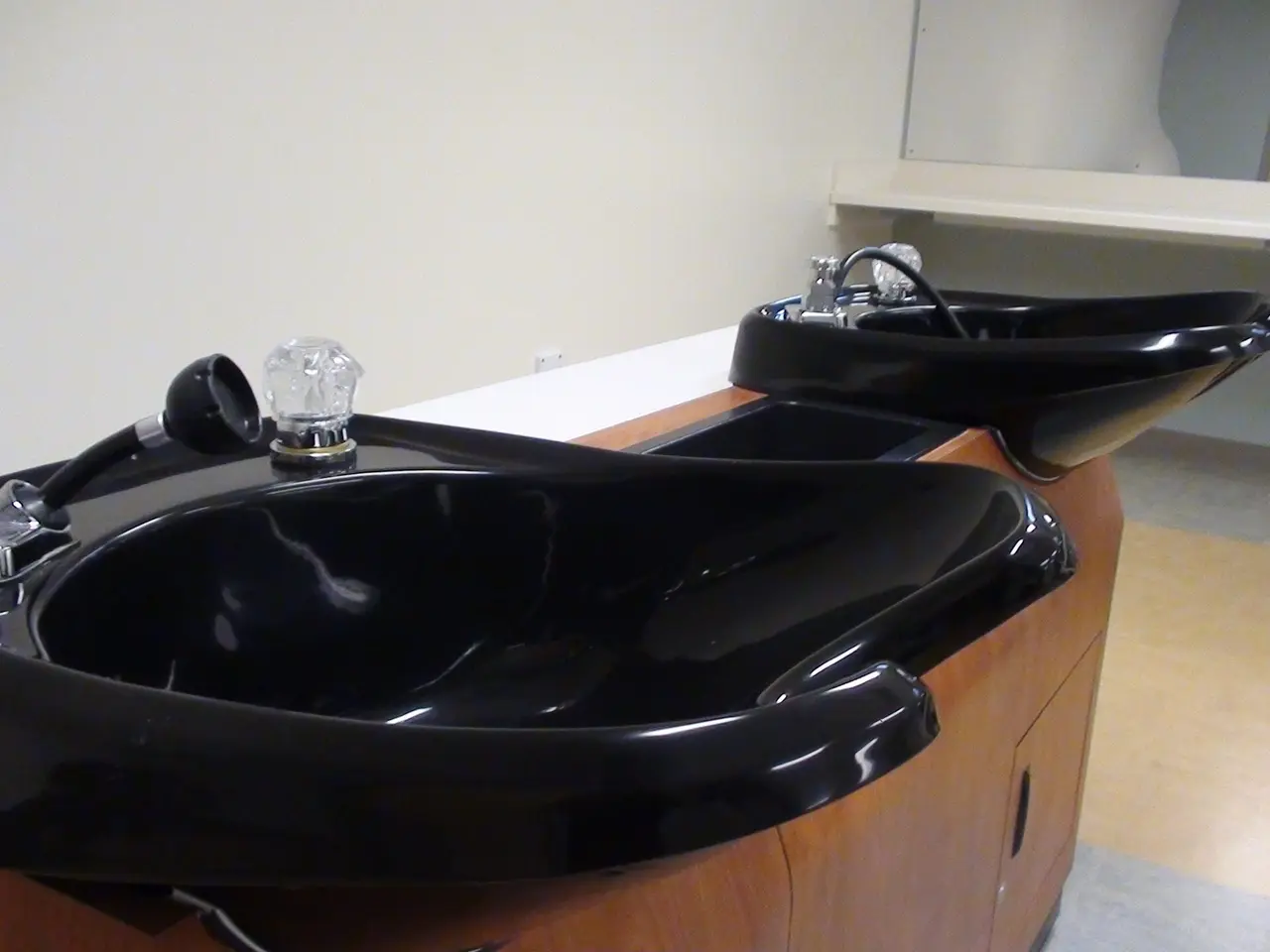
Checking the bed and basin
- The basin is clean, the hair trap has been emptied, and water drains quickly. A basin still containing the previous client's hair is a fault that loses marks immediately in the assessment.
- The basin's neck rest has a silicone cushion or a thickly folded towel and has been wiped with disinfectant. A hard basin edge pressing straight into the nape is the main reason clients get a stiff neck.
- A cushion under the client's knees so the lower back can relax; a light blanket if the room is cold.
- The floor around the basin is dry, with a non-slip mat. The water heater and hairdryer are plugged into sockets with a residual current device (RCD), and cables do not run across areas where water splashes.
Water and temperature
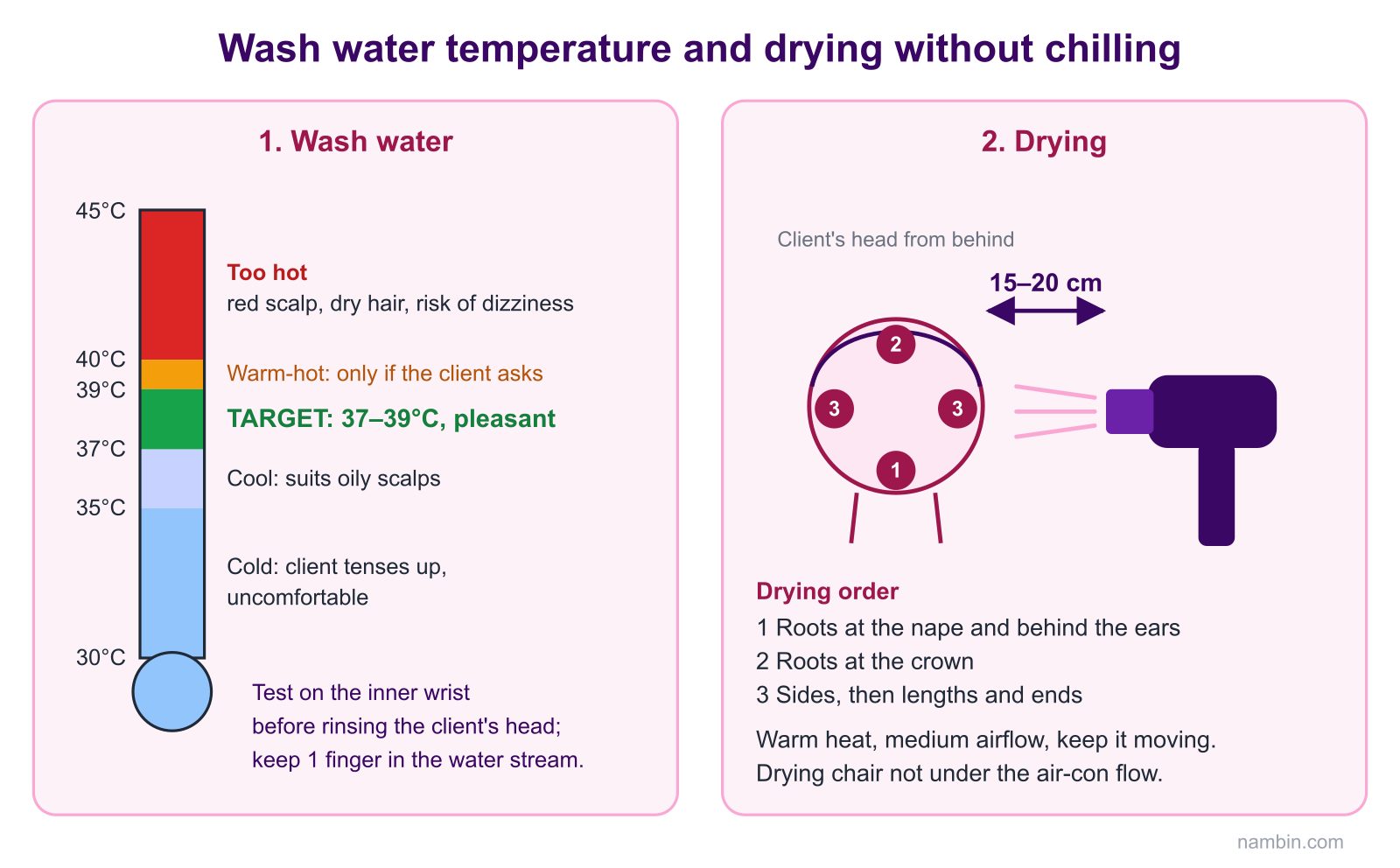
Washing water should be pleasantly warm, about 37–39°C, which is close to or slightly above body temperature. Water hotter than 40°C reddens the scalp, stimulates the oil glands, makes hair dry and brittle, and dilates the blood vessels strongly, so people with unstable blood pressure may easily faint. Without a thermometer, test it on the inside of your wrist: pleasantly warm, not burning.
Always turn on the water and test the temperature before directing the shower head at the client's head, running it into the basin until the temperature is stable. The temperature can change suddenly when someone elsewhere turns on a tap, so keep one finger in the stream of water at all times, between the shower head and the client's scalp. Ask at the very first rinse: "Is the water temperature right for you?" Note the preference on the card.
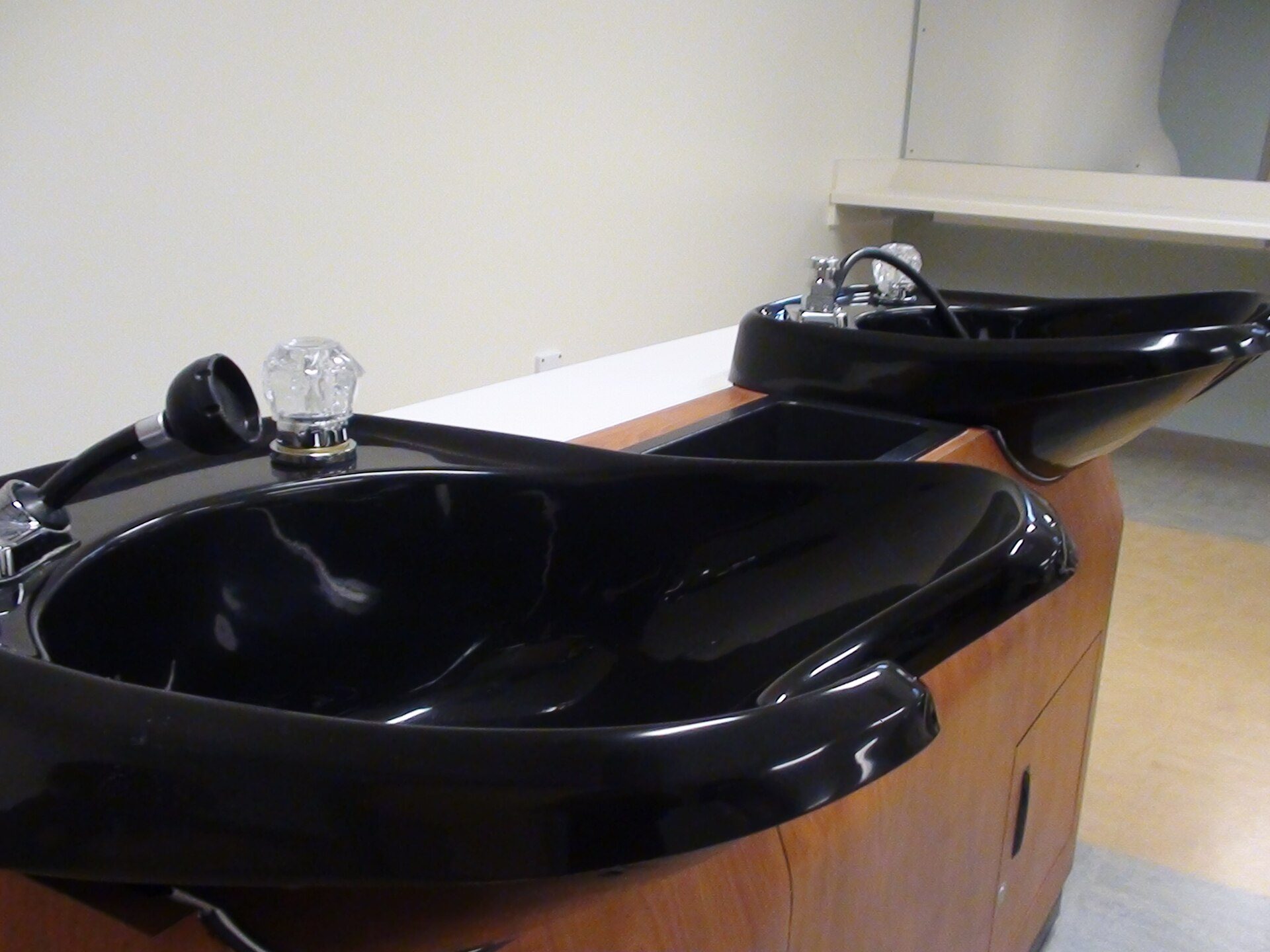
Photo: johnrosman / Wikimedia Commons, CC BY 2.0

The tray within reach
- Towels: 1 waterproof neck towel (or shampoo cape), 2 hair towels, 1 small face towel, 1 spare warm towel.
- Products: gentle facial cleanser, facial massage cream, shampoo, conditioner or hair mask, neck and shoulder massage oil (if the spa uses it). Check expiry dates and labels.
- Tools: a disinfected wide-tooth comb, hair clips, cotton or towels to cover the ears, cotton pads, and a hairdryer whose cable and nozzle have been checked.
- Hands: nails cut short, below the fingertips; rings and bracelets removed; hands washed using the WHO 6 steps before touching the client.
The 10-step head spa procedure
The frame below is for a session of about 60 minutes. The spa may add a foot soak or shorten the facial massage, but keep the order and the check points of each step.
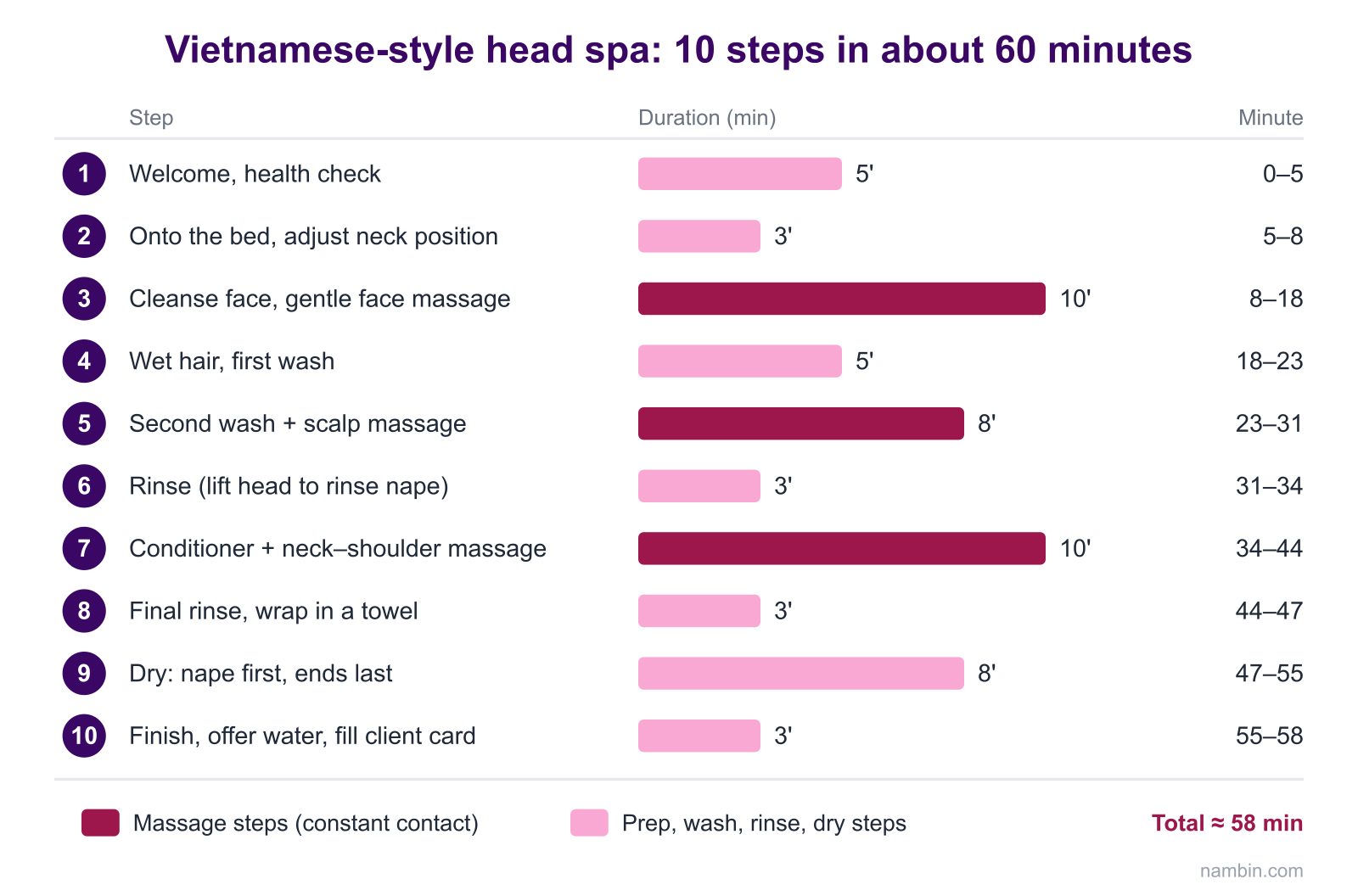
- Welcome the client, ask health questions, offer the toilet (5 minutes). Invite the client to remove earrings, glasses and hair clips and place them in a separate tray.
- Help the client onto the bed and adjust the position (3 minutes). Wrap the waterproof towel around the neck snugly but loose enough to slip two fingers under. Support the back of the client's head with one hand and lower the nape onto the neck rest slowly. Check: the nape rests on the cushion and is not pressing on the basin edge; the chin is not tilted too high.
- Cleanse the face and give a light facial massage (10 minutes). Wipe the face with cotton soaked in warm water or a gentle cleanser, then wipe again with a warm towel. Light facial massage for 5–7 minutes with massage cream: stroke from the chin up to the temples, stroke the forehead from the centre outwards, make small circles at the temples. This part is for relaxation only: no exfoliation, no steaming.
- Wet the hair and first shampoo (5 minutes). Place a towel or small piece of cotton over the ears, or cover the ear with your palm when rinsing behind it. Wet evenly from the hairline at the forehead backwards. A coin-sized amount of shampoo (double for long hair), rubbed into your palms before applying to the hair. The first shampoo removes dust, oil and hairspray; there is little lather; massage for 1–2 minutes then rinse.
- Second shampoo with scalp massage (8 minutes). Use less shampoo than the first time; it lathers more because the hair is already clean. This is when you do the scalp massage (next section). Check: do not let lather run onto the forehead or eyes; while your hands are massaging, the water is off or turned low.
- Rinse thoroughly (3 minutes). Rinse from the forehead backwards, lifting the client's head gently with one hand to rinse the nape, the area where lather most often remains. Rinse until the water runs clear and the hair feels slightly "squeaky" when stroked.
- Hair treatment with neck and shoulder massage (10 minutes). Squeeze the hair gently by hand, apply the hair mask or conditioner from the mid-lengths to the ends, avoiding soaking the roots if the scalp is oily. Wrap in a warm towel. Leave it on for the time stated on the label; while waiting, massage the neck and shoulders in the lying position.
- Final rinse and towel wrap (3 minutes). Rinse out the treatment thoroughly, checking again behind the ears and at the nape. Blot the hair with a dry towel (press gently, do not rub), wrap the towel neatly, and only then help the client sit up.
- Dry (8 minutes). Help the client sit up slowly (see the drying section below), dry the roots and nape first, then the ends.
- Finish, offer water, complete the card (3 minutes). Invite the client to sit and rest for 1–2 minutes before standing, return their personal belongings, and ask how they found the water temperature and hand pressure so you can record it on the card.
The steps add up to about 58 minutes. The remaining time is a buffer for clients with long hair.
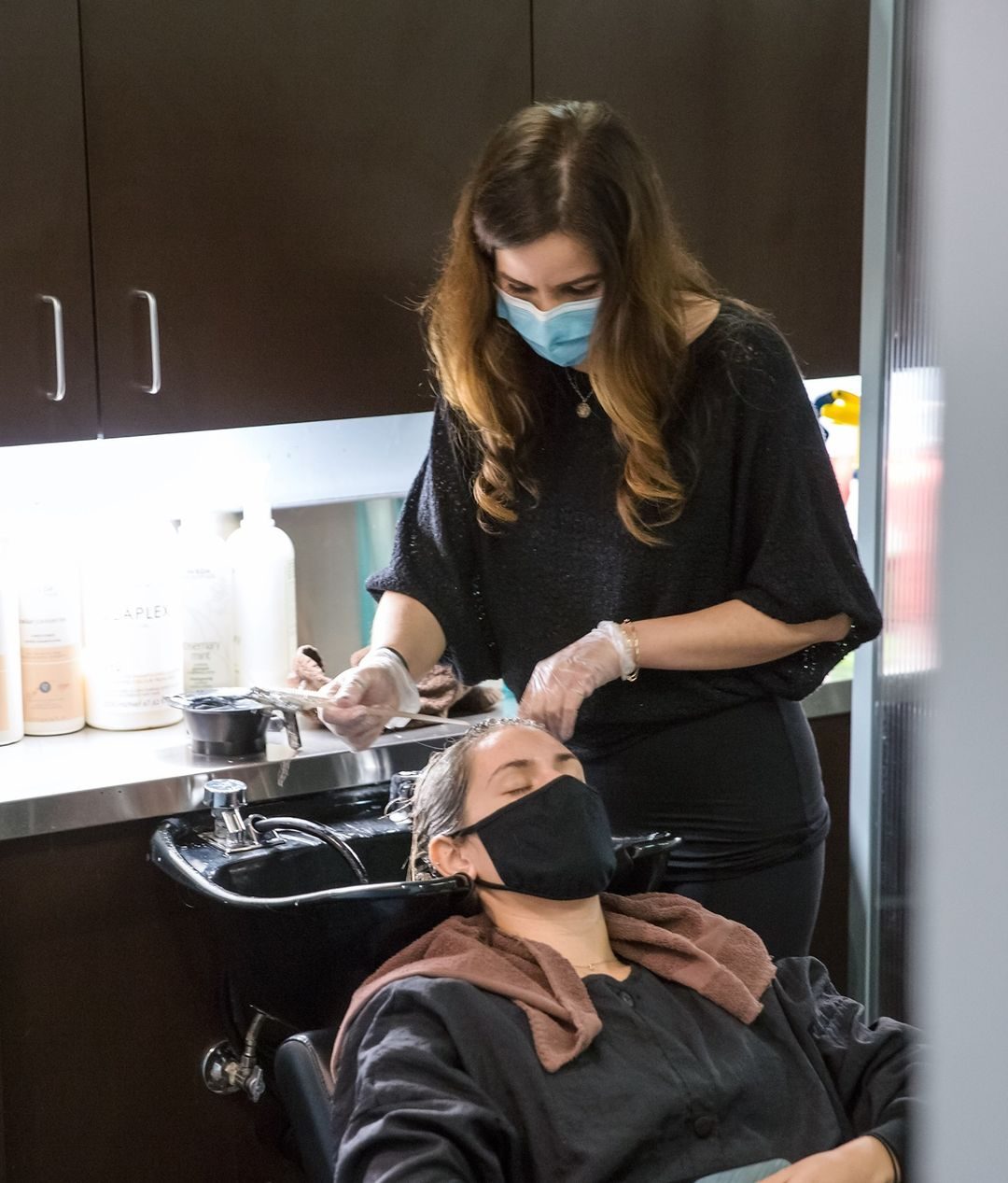
Photo: Hair Spies from US / Wikimedia Commons, CC BY 2.0

Scalp massage technique: finger pads, not fingernails
The scalp massage is done during the second shampoo, when the hair is full of lather and the hands glide easily. The golden rule: use the pads of the fingertips to move the scalp over the skull, rather than rubbing the hair or scratching the skin. Scratching with fingernails grazes the scalp.
Five basic movements
- Small circles: place all ten fingertips on the scalp and make small circles about 1–2 cm in diameter, 3–5 circles at each point before moving on. Follow three lines: the middle of the head from the forehead hairline to the crown, both temples up to the crown, and behind the ears down to the nape.
- Sustained pressure: use the pads of the thumbs to press lightly along the midline of the head, 3–5 seconds at each point, releasing slowly. Just enough pressure for the client to feel it; do not press straight down with the strength of your arms.
- Temple circles: place the pads of the three middle fingers on the temples and circle slowly 5–8 times. Light pressure.
- Combing strokes: spread your fingers like the teeth of a comb and stroke from the forehead hairline back to the nape, slowly and evenly, 5–6 times.
- Lifting the head to massage the nape: with one hand, gently lift the client's head off the neck rest, and with the other hand make circles along the hairline at the nape, an area that is often itchy and oily. Lower the client's head slowly; never let it drop onto the basin edge.
Keep the hand rhythm slow and even, about one circle per second. Maintain continuous contact: when changing movements, one hand stays on the client's head. Ask about pressure in the first minute: "Is my pressure right for you, or would you like it firmer or lighter?"
Neck and shoulder massage and the areas to avoid absolutely
The neck is an area where important structures lie just beneath the skin: the carotid arteries, which carry blood to the brain, run on both sides of the front of the neck, just below the angle of the jaw; the windpipe is in the middle; and the vertebral arteries run through openings in the cervical vertebrae and curve around the base of the skull. The medical literature records rare cases of blood vessel injury caused by prolonged excessive tilting of the neck at the shampoo basin or by forceful twisting of the neck. The rule: do not press the front and sides of the neck, do not tilt the client's neck back excessively, and never crack or twist the neck.
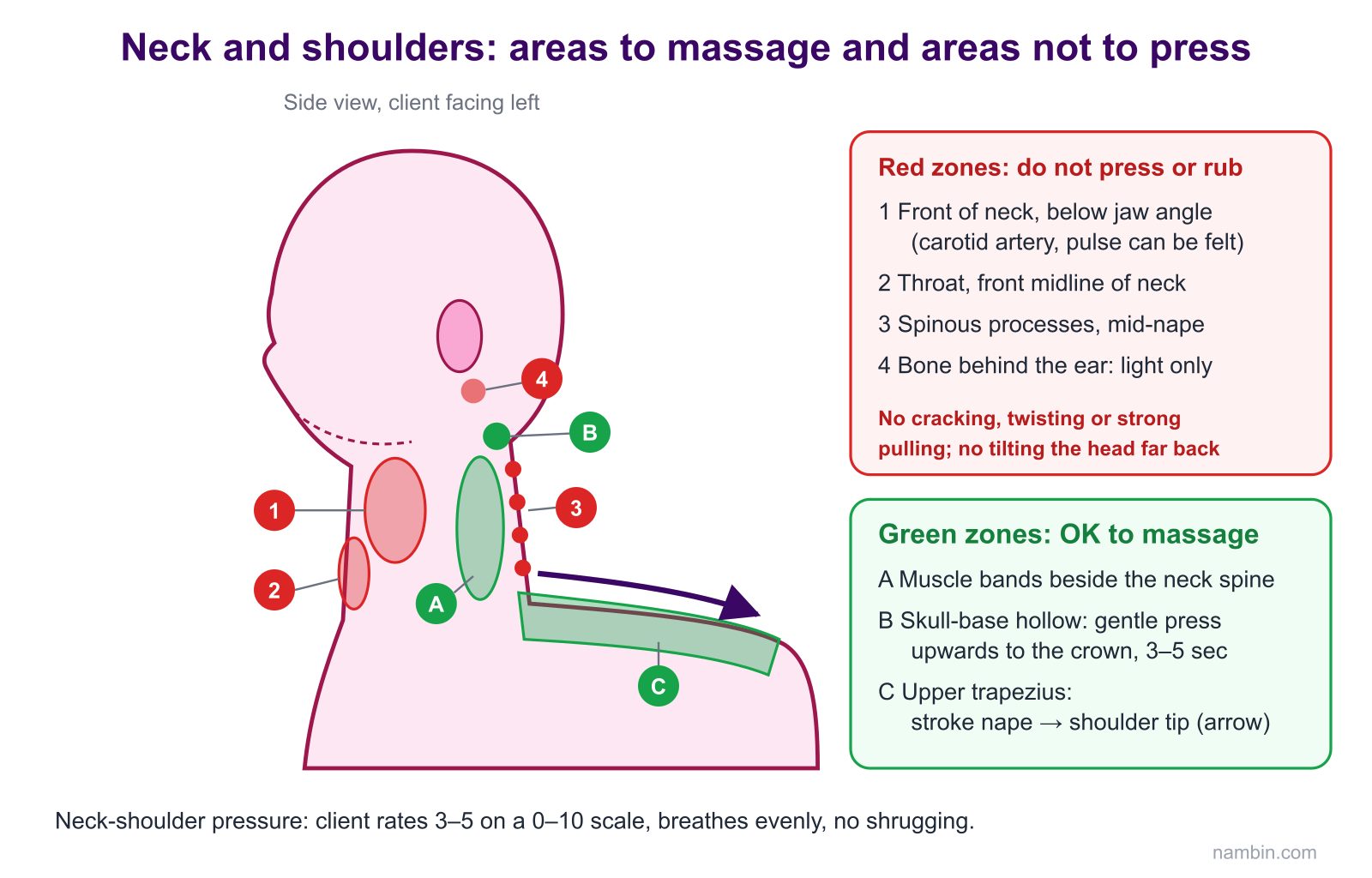
Areas that may be worked and how
- The nape, on either side of the cervical spine: with the client lying down, slide both hands under the nape and place your fingertips on the bands of muscle on either side of the spine, about one finger joint from the midline. Gently pull your fingers towards you in the direction of the top of the head (the client's head provides its own weight, and the pressure comes from the weight of the head), hold for 3–5 seconds, and move gradually from the base of the neck up to the base of the skull.
- The hollow below the base of the skull: the point spas often call "Phong tri". Press lightly with the pad of the middle finger upwards towards the top of the head, not into the neck, hold for 3–5 seconds, repeat 3 times.
- The upper trapezius on the shoulders: stroke with the palm from the nape out to the tip of the shoulder, 5–6 times on each side; then knead lightly with the thumb and fingers (squeezing the muscle, not pinching the skin), then stroke again to finish.
Areas to avoid and forbidden movements
- Both sides of the front of the neck, below the angle of the jaw: where you can feel a pulse. Do not press, do not make circles, do not squeeze. When stroking the neck, only glide lightly with the palm, without stopping to press.
- The throat (centre of the front of the neck): do not touch.
- The cervical spinous processes (the bony bumps in the middle of the nape): do not press directly on the bone; massage is on the muscles on either side.
- Behind the ears, close to the bone: only light circles, no deep pressure.
- Forbidden movements: cracking the neck so it "clicks", rotating the neck quickly, stretching the neck forcefully, putting your whole body weight onto the client's shoulders. These are not spa services.
Reading pressure with a 0–10 scale
On the neck and shoulders, many regular clients like a "firm squeeze". Ask the client using a 0–10 scale, where 0 is feeling nothing and 10 is unbearable pain. Keep the pressure at the level the client reports as 3–5: a slight, pleasant ache, breathing evenly. If the client holds their breath, grimaces or hunches their shoulders up, you are pressing too hard. If the client asks for more than level 5, explain gently that you keep the pressure moderate so their shoulders will not hurt after the session.
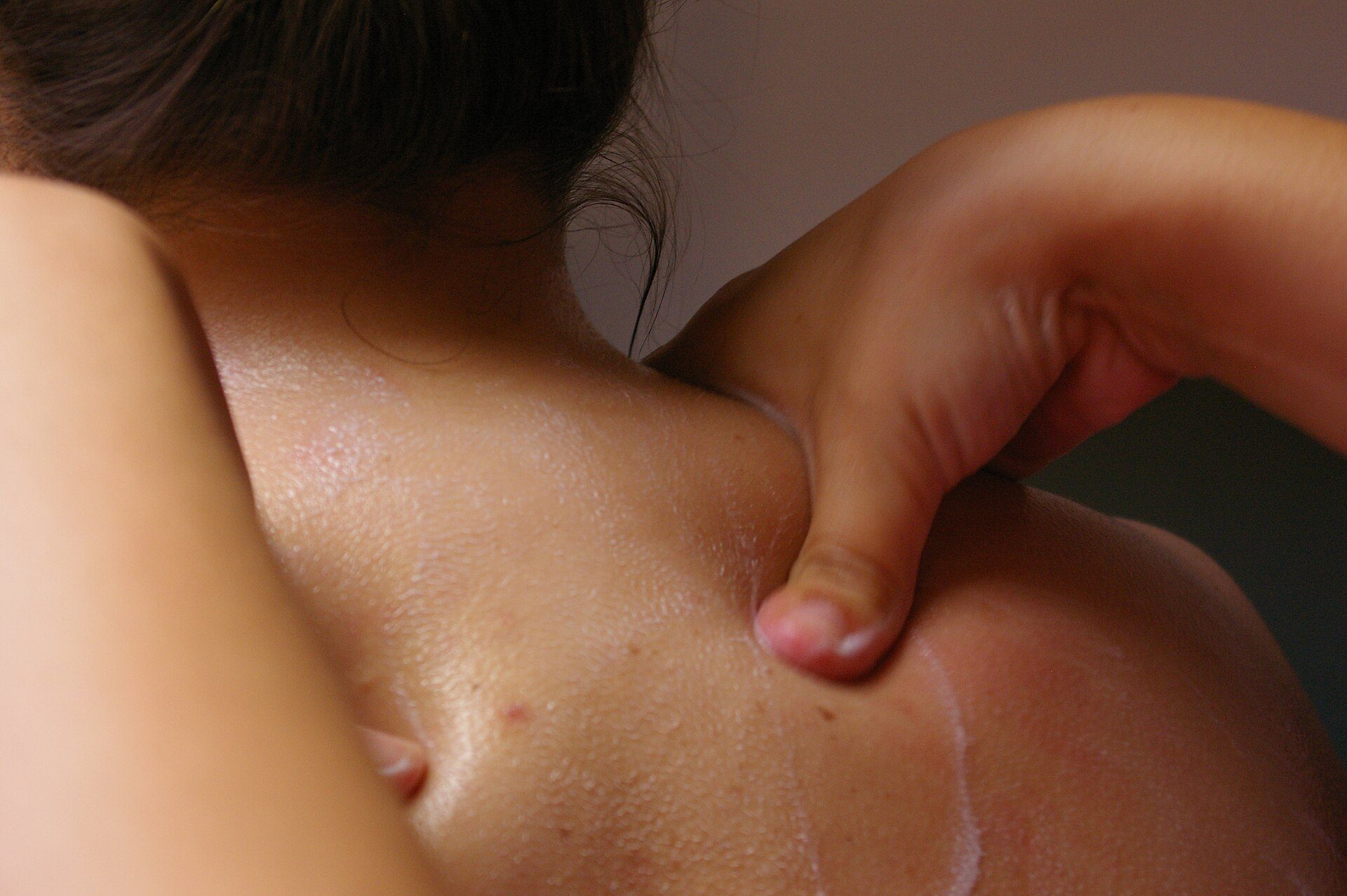
Photo: gaelx / Wikimedia Commons, CC BY-SA 2.0

Drying the hair correctly so the client does not get cold
Hair and a nape that are still damp when going out into the wind, into an air-conditioned room or onto a motorbike make the client cold and uncomfortable. Thorough drying is part of service quality.
- Help the client sit up slowly: one hand supports the upper back, the other supports the head; sit on the edge of the bed for 30–60 seconds to avoid dizziness before moving to the drying chair.
- Avoid cold air: the drying chair is not placed directly under an air-conditioning vent; put an extra dry towel over the client's shoulders.
- Dryer setting: warm heat, medium airflow; keep the nozzle about 15–20 cm from the hair, always moving, never staying in one place for more than a few seconds. Slide your other hand into the hair to feel the heat: if your hand feels hot, the client's scalp is hot too.
- Order: dry the roots at the nape and behind the ears first (the areas that take longest to dry and most easily make the client cold), then the roots at the crown, both sides, and finally the lengths and ends. Direct the airflow from the roots towards the ends so the hair is smooth.
- Check for dryness: slide your hand close to the scalp at the nape and behind the ears; there should be no damp, cold feeling. The ends of long hair may still be slightly damp if the client wishes, but the roots must be dry.
Cleaning the shampoo bed after each client
The shampoo bed is damp and warm, with plenty of shed hair and shampoo residue: an ideal environment for bacteria and fungi. The procedure below takes about 5–7 minutes between two clients.
- Collect used towels into the lidded laundry basket; do not put them on the bed or another chair. Each client gets a fresh set of towels; towels are washed in hot water (usually from 60°C) and dried completely.
- Remove all hair from the hair trap and put it into a lidded bin.
- Wash the basin with water and detergent, rinse thoroughly and wipe the basin edge dry.
- Disinfect the neck rest, silicone cushion and armrests with 70% alcohol or a surface disinfectant according to the manufacturer's instructions, allowing the full contact time stated on the label.
- Combs and clips: wash off hair and lather, soak in disinfectant solution according to the label, and dry in a clean box. Never reuse a comb that has not been disinfected on the next client.
- Dry the floor around the basin and check the water temperature again for the next client.
For clients with signs of fungus or lice (even if you declined to wash their hair), do an extra round of disinfection of everything the client touched: the waiting chair, the neck towel and the neck rest.
Common mistakes of trainee therapists
| Mistake | Why it is dangerous/wrong | Correct practice |
|---|---|---|
| Directing the shower head at the client's head before testing the temperature | Water from the heater can suddenly become hot, causing burns or making the client jerk the neck back | Run it into the basin, test on the wrist, keep one finger in the stream at all times |
| The client's nape pressing straight onto the basin edge | Stiff neck, numbness, prolonged excessive tilting of the neck | Use a towel or silicone cushion, position the client so the nape rests on the cushion and the chin is not tilted high |
| Scratching the scalp with fingernails | Grazes, stinging, risk of infection | Cut nails short, use only the finger pads, move the scalp over the skull |
| Pressing and circling on both sides of the front of the neck "to ease the ache" | Presses on the carotid artery area and may cause fainting | Only glide lightly; focus the massage on the nape and the trapezius |
| Cracking or twisting the neck so it "clicks" | May injure the neck and blood vessels; outside the scope of spa services | Do not do it; only tilt the head slowly within the range the client finds comfortable |
| Helping the client sit up quickly and stand straight away | The client may feel faint and fall | Sit on the edge of the bed for 30–60 seconds, ask how they feel, then stand |
| Drying the ends first while the nape is still wet | The client is cold and uncomfortable when going outside | Dry the roots at the nape and behind the ears first, check with your hand close to the scalp |
Pass criteria for this lesson
You pass this lesson when you can do the following in front of the instructor, on a model who is a classmate or a relative:
- Prepare the shampoo bed, tray and towels in ≤ 10 minutes; the instructor checks that nothing is missing and the basin's hair trap is clean.
- Measure or test the water at 37–39°C before rinsing the head, keeping a finger in the stream throughout rinsing; the model never complains that it is hot.
- Ask all 5 health questions (recent meal, blood pressure, neck pain or numbness, scalp wounds or itching, pregnancy) and part the hair to look at the scalp in 3 places.
- Carry out 10/10 steps in the correct order in 55–65 minutes, without leaving the model even once to fetch items.
- Point out correctly on the model's neck the 4 areas to avoid (both sides of the front of the neck below the angle of the jaw, the throat, the cervical spinous processes, close to the bone behind the ears) and explain why you never crack the neck, in no more than 1 minute.
- The model rates the neck and shoulder pressure at 3–5/10 throughout the massage, with no fingernails touching the scalp.
- After drying, the instructor slides a hand in to check that the roots at the nape and behind the ears are completely dry, with the dryer nozzle kept 15–20 cm from the hair at all times.
- Clean the shampoo bed in all 6 steps in ≤ 7 minutes, with the correct contact time stated on the disinfectant label.
Frequently asked questions
What if the client wants the water really hot to feel "satisfying"?
You can raise it slightly within the range the client finds comfortable, but never to the point that reddens the scalp, and take more care with older clients or those with unstable blood pressure. Note the preference on the card.
What do I do if the client feels dizzy while lying down for the wash?
Stop immediately, turn off the water and wrap the hair in a towel. Lift the client's head off the neck rest, use a cushion to put the head in a more upright position, and ask how the client feels. Do not rush to help the client stand up. Offer warm water and inform the shift leader. If the client shows unusual signs such as difficulty speaking, weakness in the arms or legs, a drooping mouth, blurred vision or a sudden severe headache, call emergency number 115 immediately and do not continue the wash.
Should I massage the neck and shoulders of a client with acute neck pain?
No. Newly appeared neck pain, pain radiating down the arm, numbness, or pain after an accident needs to be examined by a doctor. You may still give a gentle wash in a comfortable position if the client wishes, leave out the neck massage, and note it on the card.
Further reading
To master equipment hygiene and the classification of disinfection levels, see the lesson Cleaning and disinfection procedure for spa equipment and treatment rooms. How to ask health questions and complete the card for new clients is covered in Spa client consultation and health form: asking the right questions to work safely.