At the spa, clients rarely say "please work on my trapezius". Clients say "my shoulders and neck ache", "I have pain across my lower back", "my calves are as tight as guitar strings". A trainee who does not yet know anatomy will rub evenly all over the back and hope to hit the right spot. A therapist with a solid foundation knows straight away: an aching neck and shoulders means the upper trapezius and the posterior neck muscles; aching between the shoulder blades means the rhomboids; pain across the lower back is often related to the erector spinae, and that area has the kidneys lying deep beneath it, so use only medium pressure. Knowing where a muscle lies, which direction it runs, which bones it attaches to, and where blood vessels and nerves lie close to the surface is what separates "rubbing" from "technique".
This lesson does not turn you into a doctor. Spa therapists do not diagnose or treat musculoskeletal conditions. The goal is applied anatomy: enough to place your hands in the right place, in the right direction, with the right pressure, and to know which places to avoid.
By the end of this lesson, you will be able to:
- Point out correctly on a classmate the location of the 8 muscle groups therapists work on most: trapezius, rhomboids, latissimus dorsi, erector spinae, gluteals, hamstrings, calf muscles and posterior neck muscles.
- Palpate and name at least 10 bony landmarks used for orientation during massage.
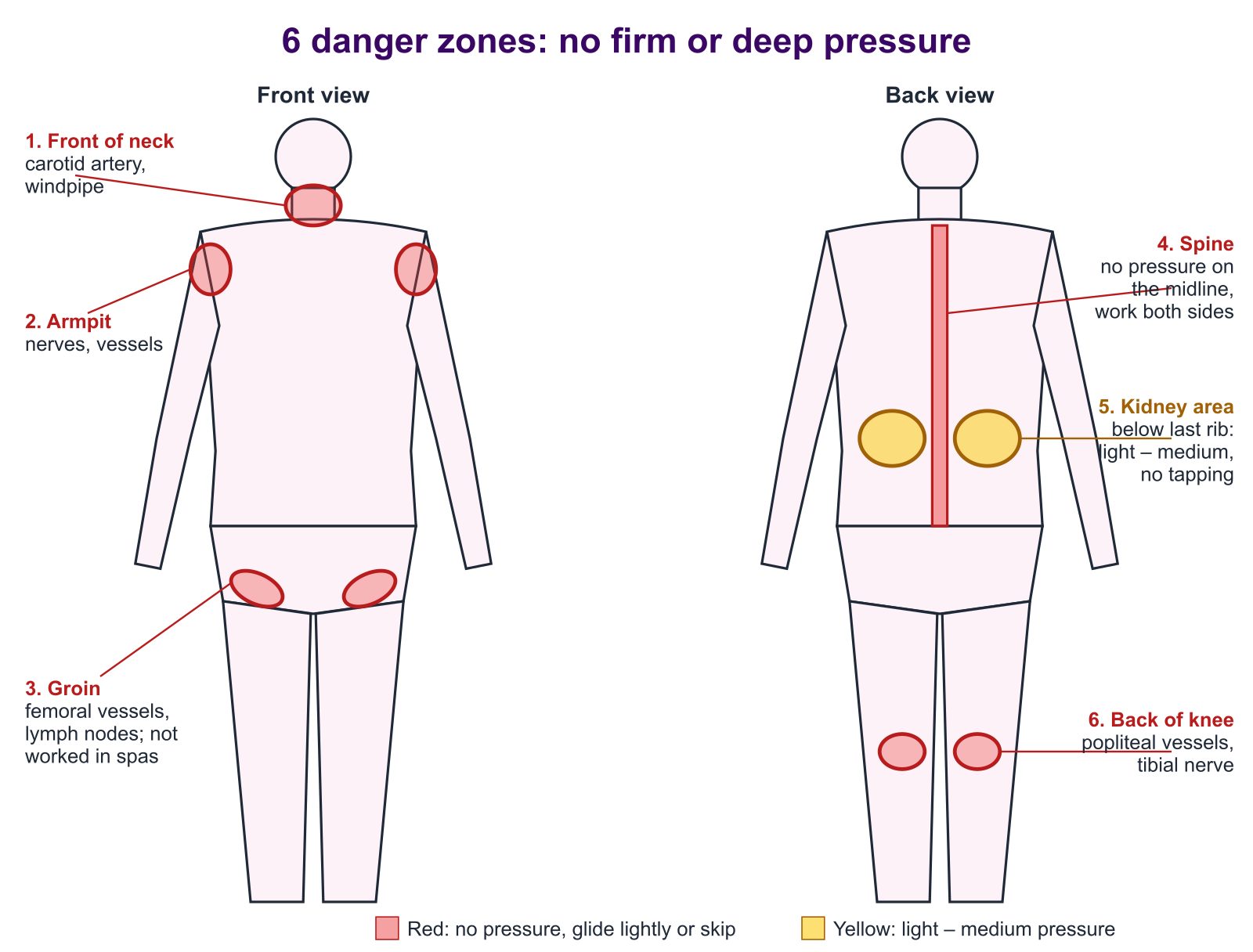
- State the 6 endangerment sites where you must not press firmly and the anatomical reason for each.
- Identify the fibre direction of each major muscle group and choose the stroke direction towards the heart on the arms and legs.
- Know which signs mean you must stop and advise the client to see a doctor instead of trying to "break it up".
Why does a therapist need anatomy?
The human body has more than 600 muscles, but in a relaxation massage session your hands spend most of the time working on only a dozen or so large muscle groups in the back, shoulders, neck, buttocks and legs. Studying these groups thoroughly helps you in three ways:
- Working where the client needs it: when the client points to the sore area, you know which muscle is there and where it attaches from and to, so you work the whole length of the muscle, not just one point.
- Working in the right direction: strokes along the muscle fibres feel smooth and pleasant; strokes across the fibres are used deliberately, shorter and lighter.
- Avoiding harm: there are areas where blood vessels, nerves and organs lie just beneath the skin, without thick muscle protecting them. Pressing firmly there can cause numbness, sharp pain, bruising or dizziness.
The most effective way to learn is on a real body: read about one muscle group, then palpate it on yourself or a classmate while they contract the muscle (for example, shrugging the shoulders to feel the trapezius), then close your eyes and palpate it again. Diagrams are only a map; your hands are what must remember.
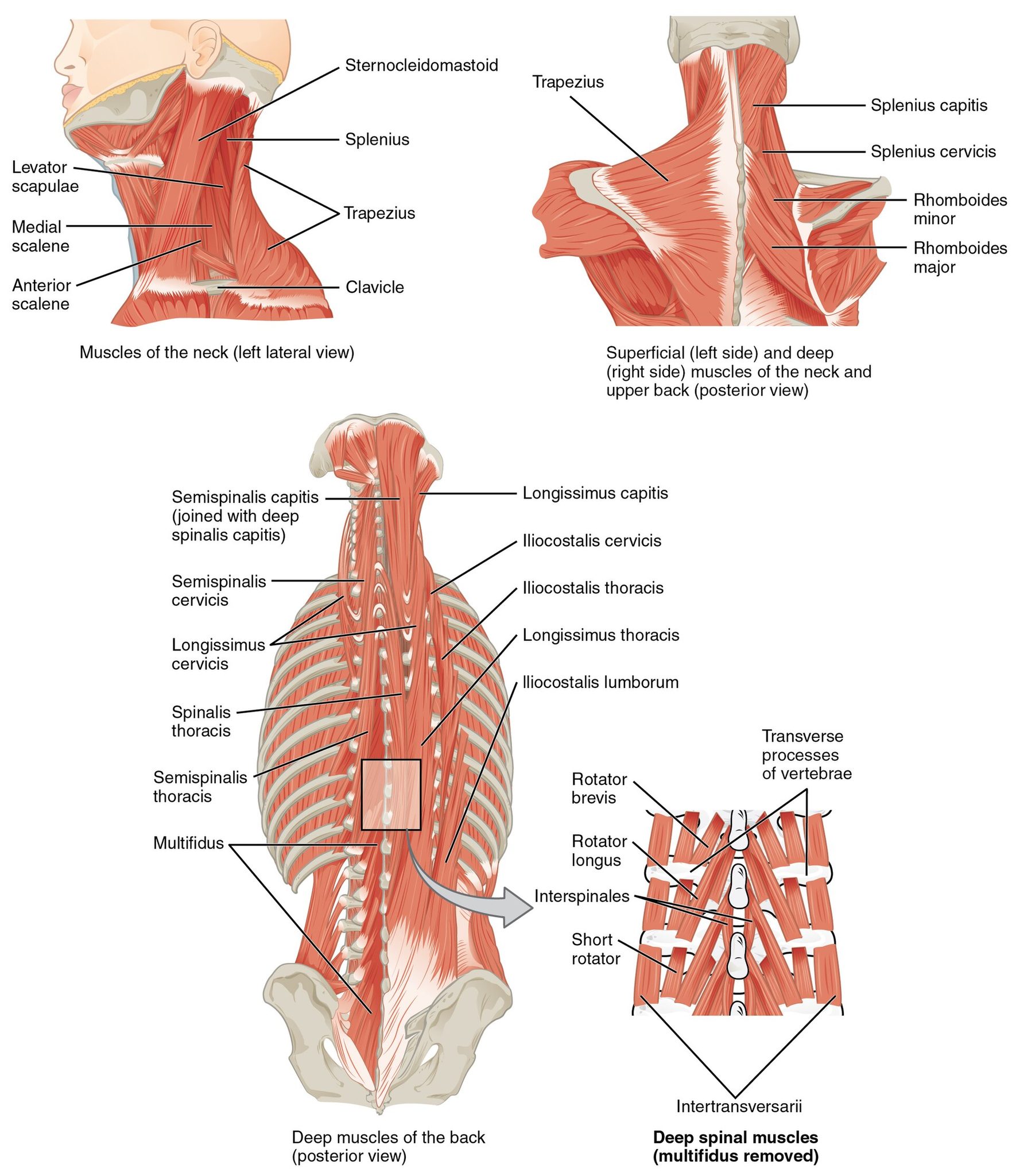
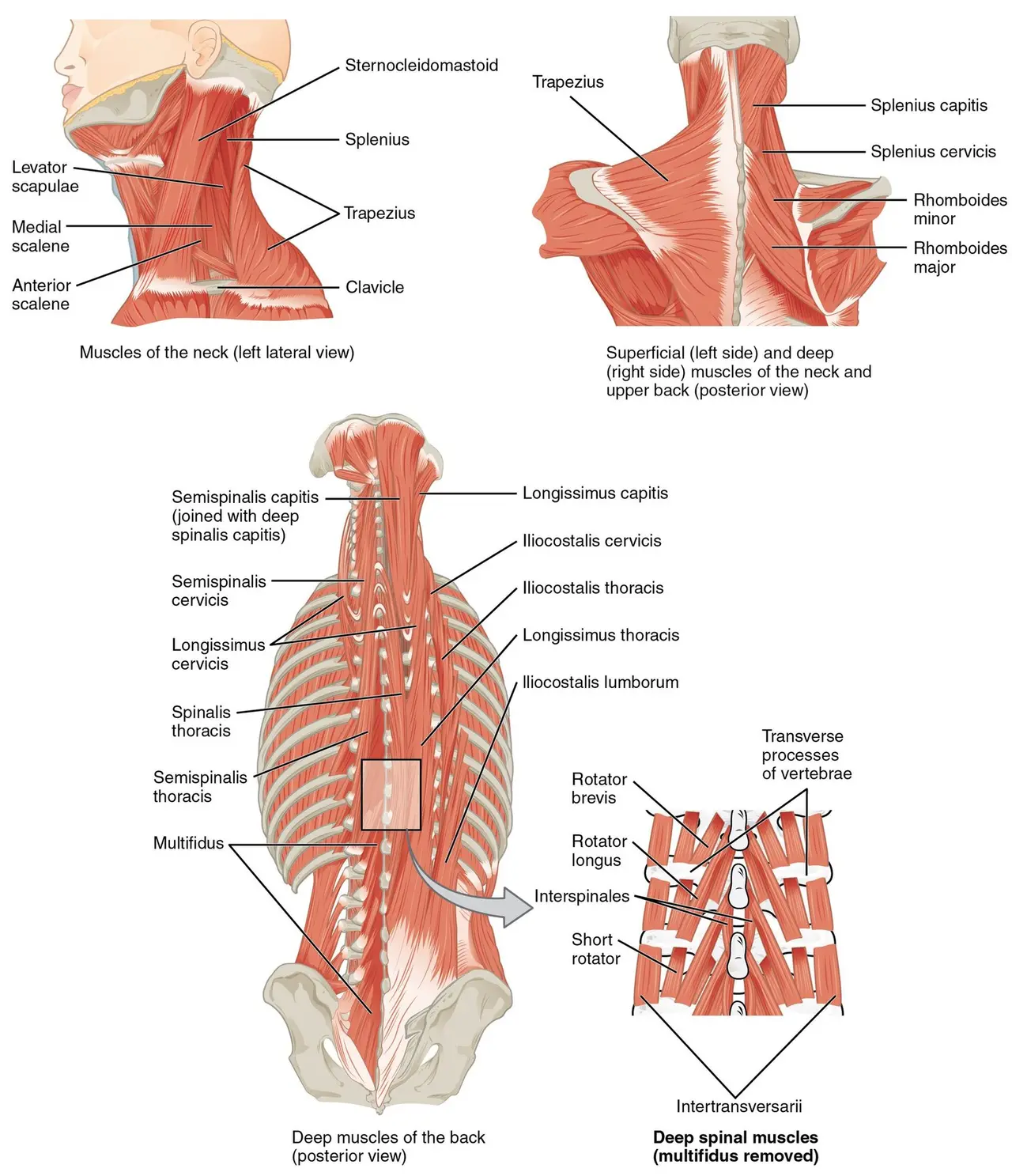
Photo: OpenStax / Wikimedia Commons, CC BY 4.0

The 8 muscle groups therapists work on most
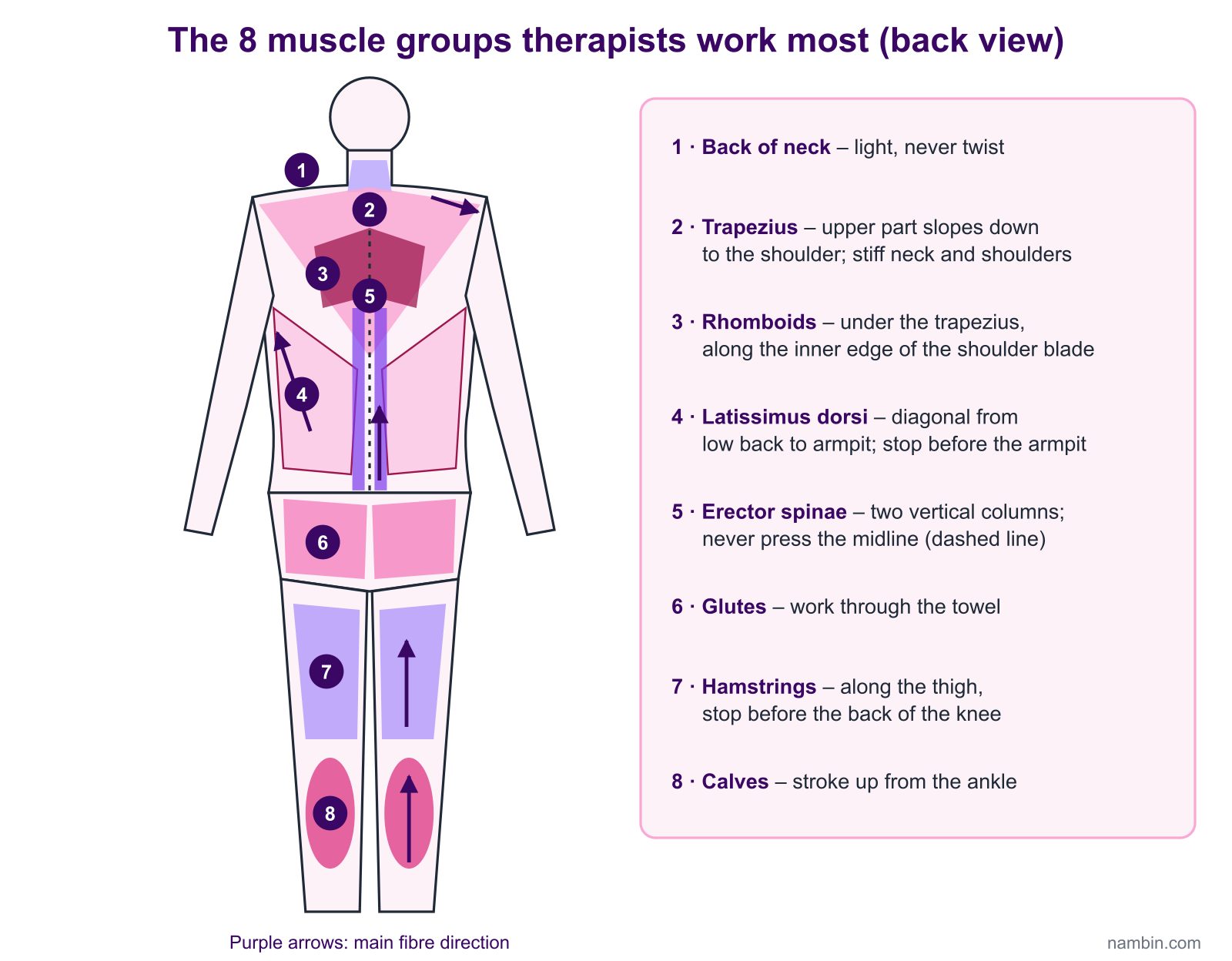
The table below is your "working map". The "Felt when" column is a tip for finding the muscle on a real body. The English/Latin names let you read foreign materials and understand colleagues who use them.
| Muscle group | Location and attachments | Main fibre direction | Felt when | Notes when working |
|---|---|---|---|---|
| Trapezius | A large diamond shape from the occiput, nape and thoracic vertebrae to the collarbone and spine of the scapula | Upper part runs diagonally down and out to the shoulder; middle part horizontal; lower part diagonally upwards | The client shrugs the shoulders up to the ears | The most tired area in office workers; knead the upper part and glide along the top edge of the shoulder |
| Rhomboids | Between the upper thoracic spine and the medial border of the scapula, lying beneath the trapezius | Diagonal from the spine down and out to the medial border of the scapula | The client squeezes the shoulder blades together | Work along the medial border of the scapula; do not press on the spinous processes |
| Latissimus dorsi | From the lower back, lower thoracic spine and iliac crest, wrapping round the ribs up to the inner upper arm | Diagonal from lower-inner to upper-outer, towards the armpit | The client presses the arm against the ribs, or pulls the arm down from above | Stroke from the lower back up the side of the ribs to the armpit; stop before the armpit hollow |
| Erector spinae | Two columns of muscle running along both sides of the spine, from the sacrum to the nape | Vertical, parallel to the spine | The client lies face down and slightly lifts the head and shoulders | Glide along both sides of the spine, about 1–2 finger-widths from the spinous processes; only medium pressure on the lower back |
| Gluteals | Gluteus maximus covers the back of the pelvis, from the sacrum and iliac crest to the femur; gluteus medius lies above and to the outside | Diagonal from upper-inner to lower-outer | The client lies face down and squeezes the buttocks | Always work through the towel or within the agreed area; avoid the middle of the buttocks |
| Hamstrings | Three muscles from the sitting bone running down the back of the thigh to both sides of the back of the knee | Along the axis of the thigh | The client lies face down and lightly bends the knee against your hand | Stroke from above the knee up to the buttock; stop before the back of the knee and before the sitting bone |
| Calf muscles (gastrocnemius, soleus) | Two muscle bellies below the back of the knee merging into the Achilles tendon, which attaches to the heel bone | Along the axis of the lower leg | The client rises onto the toes or pushes the toes against your hand | Stroke upwards from the ankle; avoid prominent veins; do not press firmly on an area that is swollen, hot and painful on one side |
| Posterior neck muscles (splenius capitis, levator scapulae, suboccipitals) | Small muscles in several layers from the occiput and cervical vertebrae down to the shoulders and upper back | Vertical and diagonal down towards the shoulder | The client bends the head slightly and turns it gently | Lighter pressure than on the back; work only the back and sides of the neck, never twist the neck |
The neck and shoulder area: trapezius, rhomboids and posterior neck muscles work together
These three groups hold up the head and shoulders when the client sits at a computer, holds a phone or rides a motorbike. When the head is pushed forward, the posterior neck muscles and upper trapezius have to hold continuously and become tight, while the rhomboids are stretched and ache dully between the shoulder blades. So when a client complains of "aching neck and shoulders", you work all three: knead the upper trapezius, glide along the medial border of the scapula for the rhomboids, then work the back of the neck with lighter pressure. The rhomboids lie under the trapezius, so you need medium pressure and a slow pace, not a very hard thumb press.
The back: latissimus dorsi and erector spinae
The latissimus dorsi is the widest muscle of the back, creating the V shape. It is used a lot by swimmers, weightlifters and people carrying children. A long stroke from the lower back curving up the ribs to the armpit follows its fibre direction exactly. The erector spinae are two "ropes" of muscle along both sides of the spine, keeping the back upright all day. This is where you use gliding strokes most, but always work on the two muscle columns, never on the midline where the spinous processes of the vertebrae are.
The buttocks and back of the legs
The gluteals are a thick muscle mass that tolerates pressure well and is often tight in people who stand or sit for long periods. At the spa, the gluteal area is always worked through the towel or only in the upper outer part agreed with the client. The hamstrings and calves work when walking, standing and climbing stairs. Both groups are long with vertical fibres, so they suit effleurage and kneading along the axis of the leg, always working upwards.
Bony landmarks: "milestones" for positioning your hands
Muscles are soft and differ from person to person, but bones are fixed. Skilled therapists use bony landmarks to know where their hands are, even when the client has a thick layer of fat or the room is dark. Bony landmarks are also points that must not be pressed firmly, because pressing bone against bone is very painful and can bruise the periosteum (the membrane covering the bone).
| Bony landmark | How to palpate it | Used for orientation |
|---|---|---|
| Occipital ridge (bony ridge at the back of the head) | Stroke up from the nape until you meet a horizontal ridge of bone at the hairline | Upper attachment of the trapezius and posterior neck muscles; work gently along its lower edge |
| Spinous process of C7 (the most prominent neck vertebra) | The client bends the head forward; feel the most prominent bump at the base of the neck | Boundary between the neck and the upper back |
| Spinous processes of the vertebrae | A row of bony "buttons" along the midline of the back | The line you must not press; the erector spinae lie on either side |
| Spine of the scapula | A bony ridge running across the top of the shoulder blade | Divides the areas above and below the spine; the middle trapezius attaches here |
| Medial border of the scapula | The client places the back of the hand on the lower back, and the edge of the shoulder blade stands out | The line for working the rhomboids |
| Inferior angle of the scapula | The pointed lowest tip of the shoulder blade, roughly level with thoracic vertebra 7 | Landmark for estimating the middle of the back |
| Acromion | The top of the shoulder, where the collarbone meets the shoulder blade | Outer stopping point when kneading the trapezius |
| Lowest ribs | Feel down the sides of the ribcage until you meet the free edge of the ribs | Start of the kidney and lower back area: reduce pressure |
| Iliac crest | Put your hands on your hips; the curved ridge of bone above the buttocks | Lower boundary of the lower back, attachment landmark for the latissimus dorsi and gluteals |
| Sacrum | A flat, triangular bone between the buttocks, below the lower back | Lower stopping point when gliding along the erector spinae |
| Sitting bone (ischial tuberosity) | The bony mass under the buttock, the part we sit on | Upper attachment of the hamstrings; stop before this point |
| Inner and outer ankle bones (malleoli) | The two bony bumps on either side of the ankle | Starting point for leg strokes; work around them, do not press |
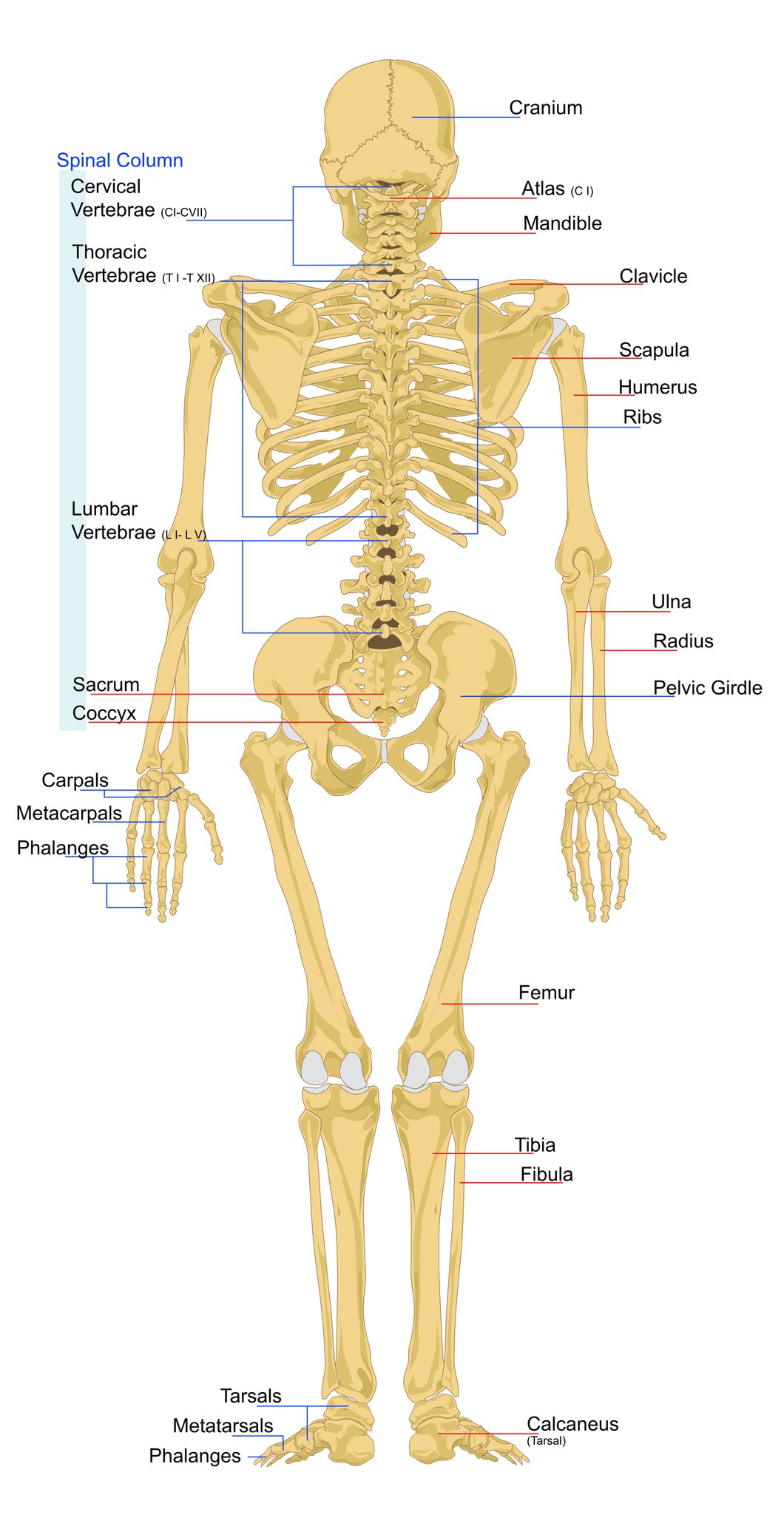
Photo: LadyofHats Mariana Ruiz Villarreal / Wikimedia Commons, Public domain

Bony landmark palpation exercise
- Your classmate lies face down, draped, with only the back uncovered.
- Close your eyes, place both hands on the back, and find and name aloud in order: occipital ridge, C7, spine of the scapula, medial border of the scapula, inferior angle of the scapula, lowest ribs, iliac crest, sacrum.
- For each landmark, the instructor checks with eyes open. Record the number of correct landmarks.
- Repeat on at least 3 people of different builds (slim, average, full-figured). You will see that the same landmark lies at quite different depths.
Endangerment sites: no firm pressure, no deep pressure
Endangerment sites are places where large blood vessels, nerves, lymph nodes or organs lie close to the surface, with little protection from thick muscle or bone. Here you may only stroke lightly or skip the area entirely. There is no "the client likes it firm" exception.
| Area | What lies beneath | Firm pressure may cause | What the therapist does |
|---|---|---|---|
| Front of the neck (both sides of the windpipe) | Carotid artery, jugular vein, windpipe, thyroid gland, nerves | Dizziness, fainting, difficulty breathing, pain | Do not press; work only the back and sides of the neck with light pressure |
| Armpit hollow | The neurovascular bundle running down to the arm, lymph nodes | Sharp numbness radiating down the arm, pain | Stop before the armpit hollow when stroking the latissimus dorsi |
| Back of the knee | Popliteal artery and vein, tibial nerve | Sharp pain, numbness; dangerous if there is a blood clot | Glide lightly over it or skip it; do not knead, do not press |
| Groin (the crease between thigh and abdomen) | Femoral artery and vein, inguinal lymph nodes; close to intimate areas | Pain, bruising; crosses professional boundaries | Not worked in relaxation massage at a spa |
| Directly on the spine (midline of the back) | Spinous processes of the vertebrae, ligaments | Pain, periosteal bruising; dangerous for people with osteoporosis | Work only on the two erector spinae columns on either side |
| Kidney area (lower back below the lowest ribs) | The kidneys lie deep, only partly protected by the lowest ribs | Pain, possible injury in people with kidney disease | Light to medium pressure; no tapping, no pounding, no deep pressure |
Besides these 6 areas, there are a few other sensitive areas you should work lightly: the groove on the inside of the elbow (where the ulnar nerve lies, the "funny bone" spot), the inner upper arm, the breastbone and xiphoid process on the chest, and the lower abdomen when the client has just eaten. Areas with twisted, prominent veins (varicose veins) should also only be stroked very lightly around them, never pressed directly.
Stop and advise the client to see a doctor when: the calf is swollen, hot, red and painful on one side (suspected deep vein thrombosis); the client feels numbness or pins and needles radiating down the arm or leg while you work; there is a lump or a new hard mass; there is a stabbing pain when pressed lightly; the client feels dizzy or nauseous. Spa therapists do not diagnose and do not try to "break up" an unusual hard lump. Record the location and report to the manager.
Fibre direction and circulation: why we stroke towards the heart
Fibre direction
Each muscle is made up of thousands of muscle fibres arranged in parallel, running from one attachment point to the other. When your hand moves along the fibres, the stroke is smooth, even and pleasant, helping to warm and relax the whole length of the muscle. When you move across the fibres (as in cross-fibre friction), you work on a narrower point, and the sensation is deeper and more "intense". New therapists should work along the fibres most of the time and use only short cross-fibre work, with medium pressure, on tight spots after asking the client.
A tip for remembering fibre direction: look at the two attachment points. The upper trapezius runs from the nape diagonally down and out to the shoulder, so knead and glide along that line. The latissimus dorsi runs from the lower back diagonally up to the armpit, so stroke from lower-inner to upper-outer. The erector spinae, hamstrings and calves run vertically, so stroke vertically.
Circulation: stroking towards the heart
Blood leaves the heart through the arteries and returns to the heart through the veins. The veins in the arms and legs have one-way valves that help blood flow only towards the heart; lymph fluid also flows in the same general direction towards the large lymph nodes and then back to the heart. That is why on the arms and legs, strokes with pressure always go from far to near the heart: from the ankle up to the thigh, from the wrist up to the shoulder. The return path of the hand glides lightly, with almost no pressure. Firm strokes in the opposite direction (from the thigh down to the ankle) go against the venous valves and easily cause discomfort, especially in people with varicose veins.
On the back, the common convention is to stroke from the lower back up to the shoulders and then curve down both sides of the ribs. This direction creates a "lifting" and relaxing sensation and also follows the fibre direction of the erector spinae and latissimus dorsi. Note: saying "massage helps improve circulation" is correct at the level of support and a feeling of warmth; it is not a treatment for heart and circulatory disease, oedema or varicose veins.
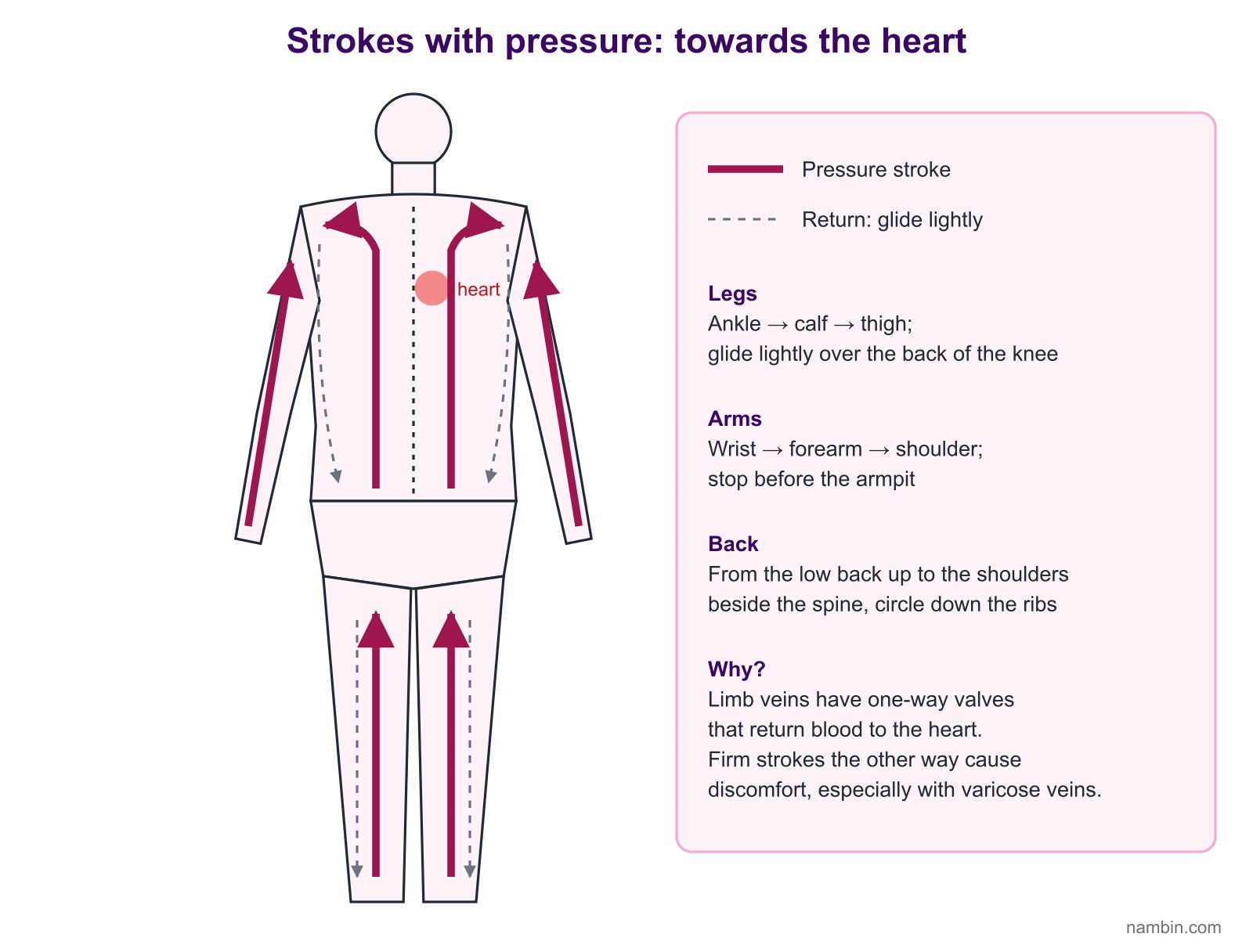
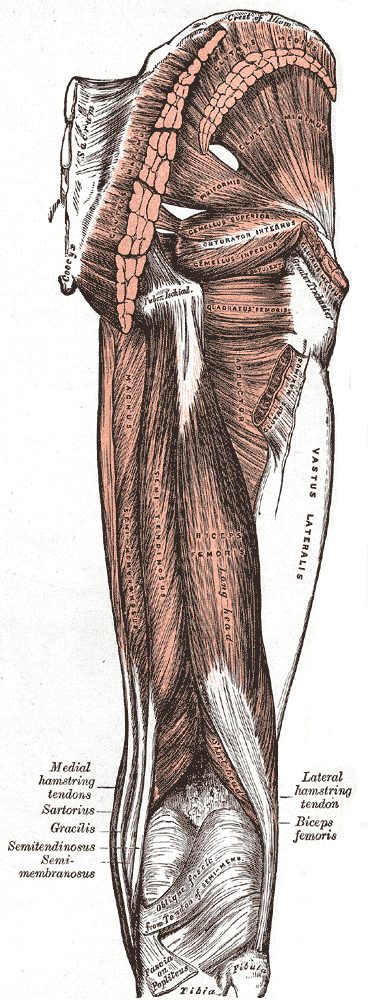
Photo: Henry Gray / Wikimedia Commons, Public domain

Application: from the client's words to the muscle group
When the client describes an uncomfortable area, you "translate" it into a muscle group, then choose a working plan. This is not a diagnosis; you are only choosing the working area for a relaxation session. Severe pain, long-lasting pain, or pain with numbness or weakness in the arms or legs is a matter for a doctor.
- Ask for the exact location: "Could you show me where it aches most?" Invite the client to point with their hand; do not guess.
- Compare with the bony landmarks: is the area above or below the spine of the scapula, inside or outside the border of the shoulder blade, above or below the lowest ribs?
- Name the muscle group: for example, between the shoulder blades are the rhomboids and the middle trapezius.
- Check nearby endangerment sites: is it close to the spine, the kidney area or the armpit?
- Choose direction and pressure: along the fibres first to warm up, only then work the tight spot with medium pressure, asking the client.
- Record on the card: note the area and muscle group worked and the client's feedback.
| The client says | Muscle groups involved | Points to watch |
|---|---|---|
| "My neck and shoulders ache, my neck is stiff" | Upper trapezius, posterior neck muscles, levator scapulae | Lighter pressure on the neck than on the shoulders; do not press the front of the neck, do not twist the neck |
| "It aches between my shoulder blades" | Rhomboids, middle trapezius | Work the medial border of the scapula; do not press on the spinous processes |
| "My lower back aches across" | Lumbar erector spinae, lower part of the latissimus dorsi | Kidney area: light to medium pressure; if the pain radiates down the leg or there is numbness, advise seeing a doctor |
| "My buttocks and hips ache from sitting too long" | Gluteus maximus, gluteus medius | Work through the towel, in the upper outer part; ask for consent first |
| "My calves are tight from walking a lot" | Calf muscles, hamstrings | Stroke upwards from the ankle; if one side is swollen, hot and red, stop |
Common mistakes of trainee therapists
| Mistake | Why it is wrong or dangerous | Correct practice |
|---|---|---|
| Gliding the thumb directly over the spinous processes | Pressing bone against bone: painful, bruising, dangerous for people with osteoporosis | Place your hands on the two erector spinae columns, away from the midline |
| Pounding or tapping hard on the lower back | The kidney area has little bony protection | Only stroke and knead with light to medium pressure; no tapping over the kidneys |
| Kneading right in the back of the knee | Blood vessels and nerves lie close to the surface | Work the calf and hamstrings separately, gliding lightly over the back of the knee |
| Pressing the front of the neck to "open the meridians" | Carotid artery, windpipe: causes dizziness and fainting | Work only the back and sides of the neck, with light pressure |
| Stroking the leg firmly from the thigh down to the ankle | Goes against the venous valves, uncomfortable | Stroke with pressure upwards, return with a light glide |
| Trying to "break up" an unusual hard lump | It may be an abnormal mass that needs medical examination | Do not work on it, record it, advise the client to see a doctor |
| Working only on one painful point | Ignores the length of the muscle; poor relaxation effect | First warm the whole muscle from one attachment to the other |
Pass criteria for this lesson
The instructor checks you on a real classmate who is draped. You pass when you:
- Point out correctly the location of 8/8 muscle groups on your classmate in no more than 3 minutes, together with how to have the classmate contract the muscle so it can be felt (for example, shrugging for the trapezius).
- With eyes closed, palpate and correctly name at least 10/12 bony landmarks from the table, on at least 2 people of different builds.
- List all 6 endangerment sites and state what lies beneath each one (6/6).
- Draw correct arrows for the main fibre direction of the upper trapezius, latissimus dorsi, erector spinae and calf muscles on a blank body outline.
- Perform arm and leg strokes in the correct direction towards the heart in 10/10 passes, with a light return path, and no pass pressing on the back of the knee or the armpit hollow.
- For 5 client descriptions given by the instructor, name the correct muscle group and one point to watch for at least 4 of them.
- State at least 4 signs that mean you must stop and advise the client to see a doctor.
Frequently asked questions
Do I need to memorise the Latin names of the muscles?
At Level 1, you need to know the Vietnamese names and the common English names (trapezius, latissimus dorsi, hamstrings...) so you can read materials and talk with colleagues. Full Latin names and the small deep muscles will be studied at later levels.
Is the hard lump clients call a "knot" a muscle in spasm?
Often it is just a tight spot in the muscle that softens gradually with warming and moderate sustained pressure. But a therapist cannot diagnose by hand. A hard lump that has newly appeared, is growing, is painful to a light touch, or lies at a lymph node (neck, armpit, groin) must not be worked on, and you should advise the client to see a doctor.
What if a client with a herniated disc wants a back massage?
This is a spinal condition and needs a doctor's opinion. Relaxation massage at a spa does not treat a herniated disc. If the doctor has given permission, use only light pressure, avoid the painful area, stop immediately if the client feels numbness radiating down the leg, and report to the manager.
Do slim and full-figured clients need different pressure?
Yes. In slim people, bony landmarks and endangerment sites lie closer to the surface, so reduce pressure and take more care to avoid bone. In full-figured people, bony landmarks are harder to feel, so you need to slow down and use large landmarks such as the iliac crest and the spine of the scapula for orientation. Whatever the build, still ask about pressure using the scale you have learnt.
Further reading
Review the structure of the skin, the subcutaneous fat layer and the list of contraindications in Skin structure and contraindications in the spa, and see how the muscle groups are arranged into a complete session in 60-minute relaxation body massage.