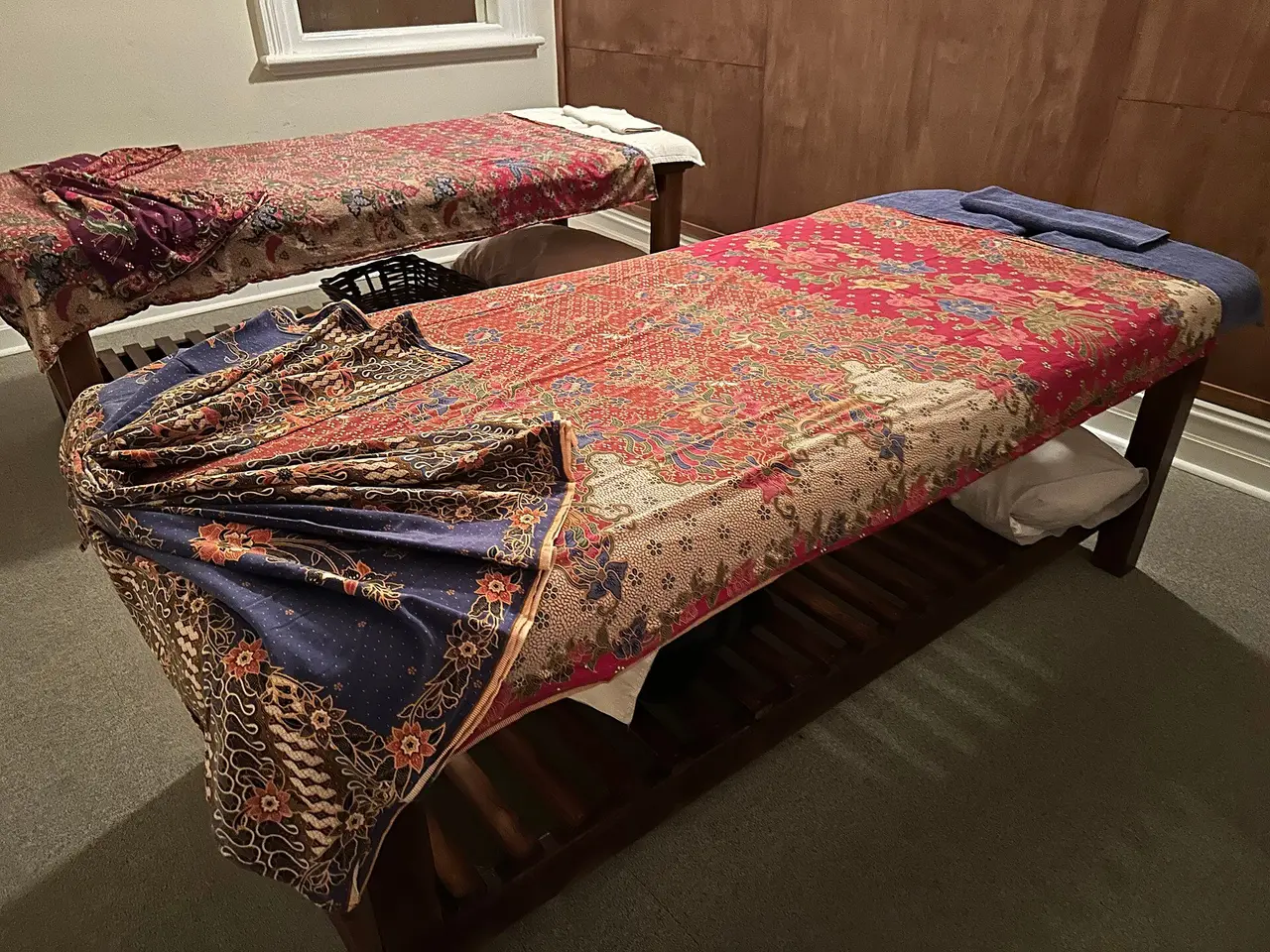
Many newly qualified therapists tell the same story: in the first month their upper arms ache, by the third month their thumbs throb every evening, and in the first year there are days when they have to wear a wrist splint to work. In busy spas, a therapist may carry out five or six body treatments a day, each lasting 60–90 minutes. The hands, wrists, shoulders and lower back repeat the same movements thousands of times, while bending and reaching. This profession does not damage your body; standing and generating force the wrong way is what damages it. This lesson teaches you to work with your legs and your body weight, so that you can stay in the profession for the long term.
By the end of this lesson, you will be able to:
- Set the couch height correctly for the person and the type of movement, before the client gets onto the couch.
- Stand correctly in the lunge and the horse stance, know when to use each, and change stance to match the movement.
- Generate pressure with your body weight instead of with your wrist and shoulder strength.
- Keep your wrists and thumbs in a safe position and rotate between the "tools" you use to apply pressure (heel of the hand, forearm, soft fist).
- Do a warm-up before your shift, take short breaks between clients and stretch at the end of the shift.
- Recognise the signs that you need to see a doctor rather than pushing on.
Why therapists get pain, and where
Occupational pain in therapists rarely comes from a single injury. It builds up from three things: repetition (the same movement hundreds of times per shift), poor posture (a bent-over back, a sharply bent wrist, a hyperextended thumb) and static holding (holding pressure on one point for a long time, shoulders tensed all session). Muscles and tendons need time to recover; when the load is repeated faster than they can recover, pain begins.
| Area | Usually painful because of | Common sensations |
|---|---|---|
| Thumb | Sustained pressure and deep gliding with the thumb; the thumb joint bending backwards when pressing | Aching at the base of the thumb, pain when twisting a bottle cap or holding a phone |
| Wrist | Bending the wrist backwards when pressing with the heel of the hand; twisting the wrist when kneading | Pain on the back of the wrist or on the thumb side, numb fingertips |
| Shoulders and neck | Tensing the shoulders to push, hunching the neck, looking down at your hands all session | Tight, tired shoulders and neck at the end of the shift, headaches |
| Lower back | A low couch without lowering yourself with your legs, bending at the waist, twisting the trunk | Aching lower back, difficulty standing upright after the shift |
| Feet and knees | Standing for long periods in thin sandals, locking the knees | Heel pain, tired knees and calves |
The good news is that most of this pain can be prevented through habits. Four principles run through this whole lesson: the right couch height, legs do the work, joints stacked in line, rest before you tire.
Setting the couch height before every client
A couch at the wrong height is the leading cause of back pain, because it forces you to compensate with your back: a couch that is too low makes you bend over, a couch that is too high makes you lift your shoulders and tense your arms. A quick way to measure: stand upright beside the couch with both arms hanging loosely, and see where the top of the couch comes to on your hand.
- Ordinary relaxing massage (stroking, kneading): the couch surface roughly level with your knuckles (the bumps when you make a fist).
- Deep pressure using a lot of body weight (gliding along the back, forearm pressure): lower, roughly level with your fingertips, so that you can lean your weight down easily.
- Light pressure and detailed work (arms, feet with the client lying face up, light techniques): higher, close to wrist level, so that you do not have to bend.
Also allow for the client's body depth: a large client, or a client lying on their side, raises the "working surface", so lower the couch by one more notch. This is a starting point, not a fixed figure; after a few sessions you will know the height that suits you. Remember your own couch setting so that you can adjust quickly when sharing a couch with colleagues.
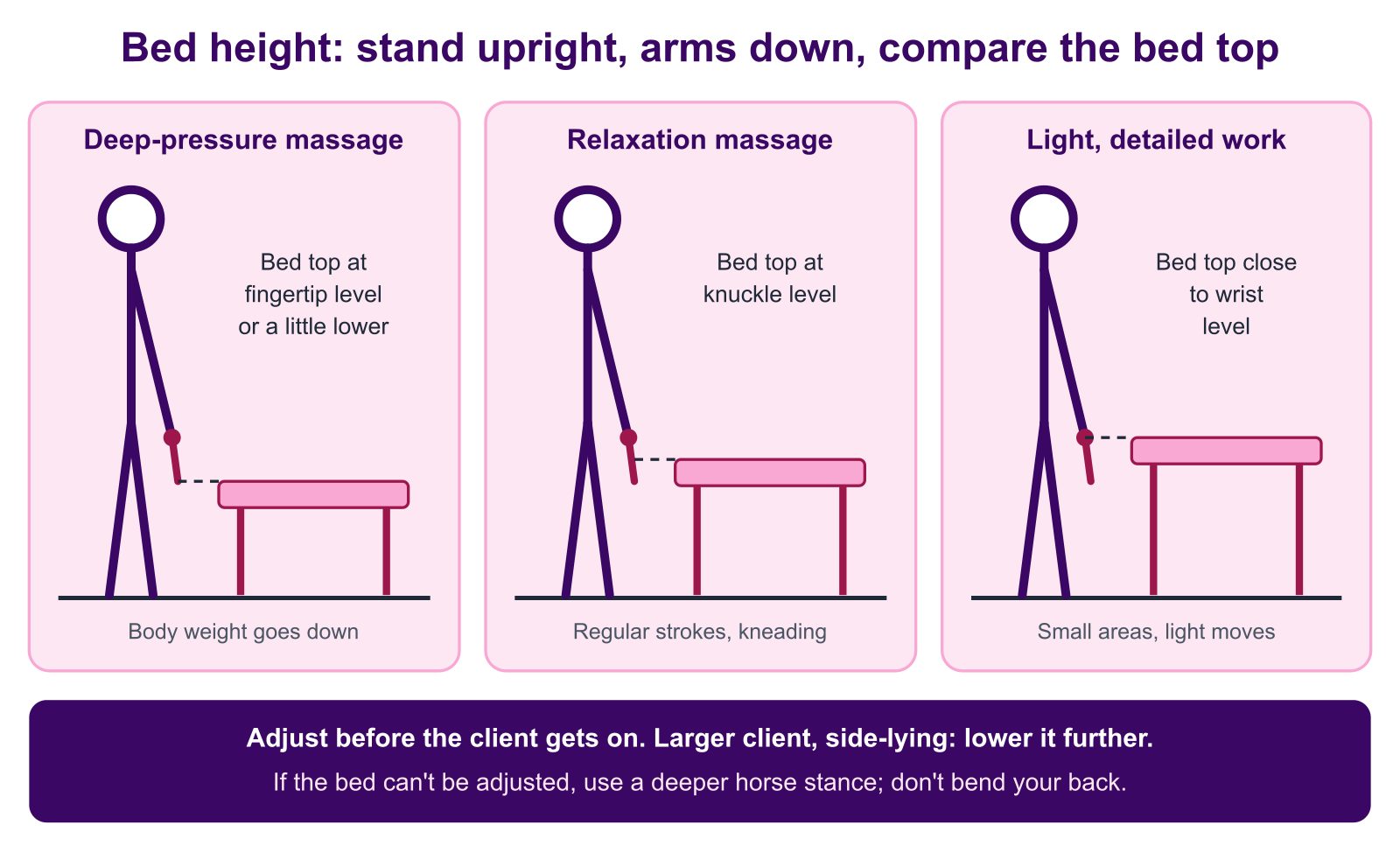
If the spa has fixed couches that cannot be adjusted, you adjust with your legs: for a low couch, lower yourself with a deeper horse stance; for a high couch, stand slightly further away and use the lunge so that the force travels diagonally downwards. Never compensate by bending at the waist or standing on tiptoe. A leather-topped couch must be sturdy and must not wobble; a wobbly couch makes you tense your body unconsciously to keep your balance.
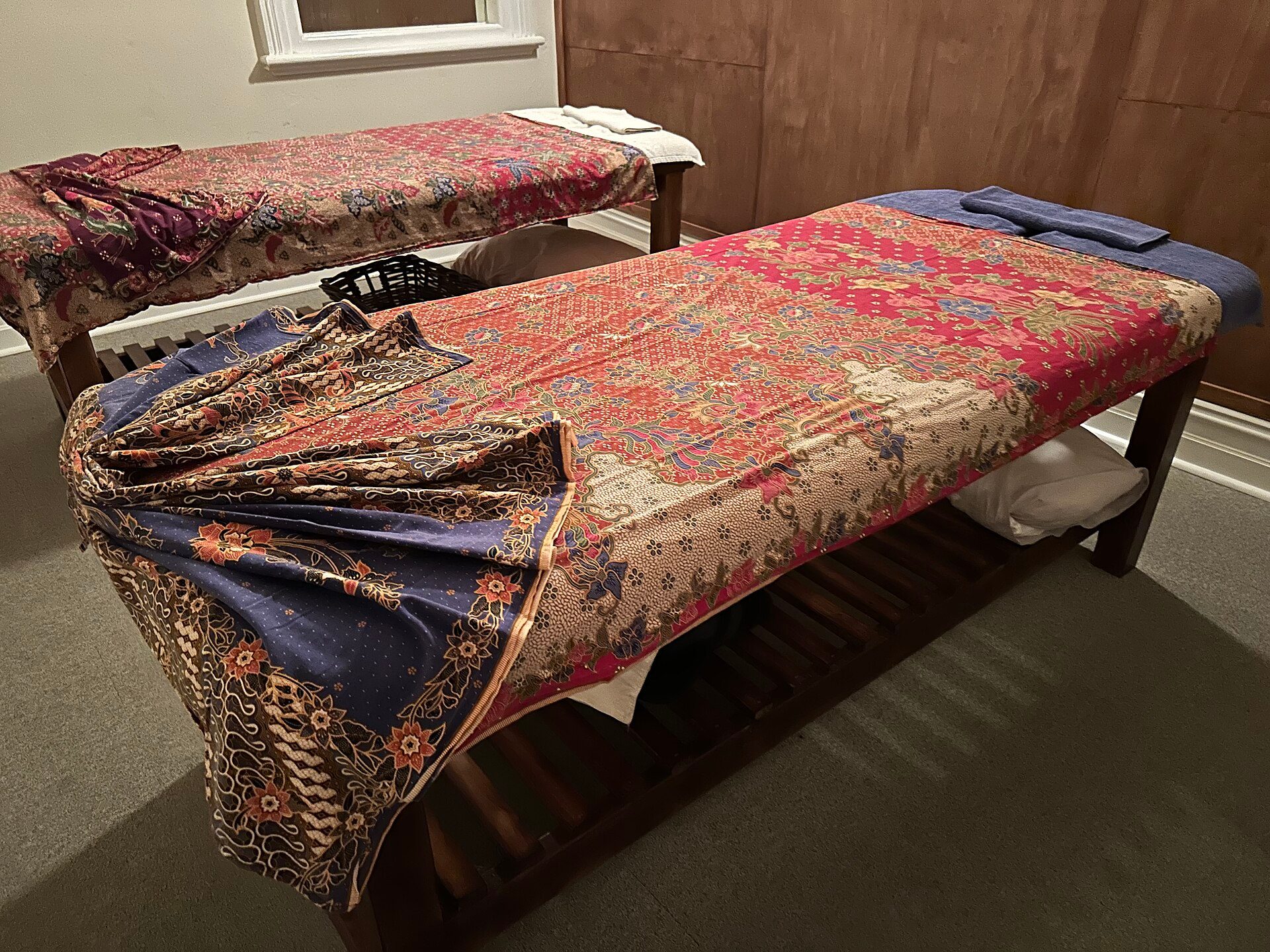
Photo: Azoma / Wikimedia Commons, CC BY-SA 4.0

Facials and head treatments: sitting correctly is also posture
For facials, hair washing and head massage you usually sit on a stool at the head of the couch. Adjust the stool so that you sit with a straight back, both feet flat on the floor, and your forearms roughly parallel to the floor when your hands rest on the client's face. Move the client up close to the head end of the couch instead of leaning forward yourself. A stool on castors lets you glide from side to side instead of twisting your back. Every 10–15 minutes of sitting, gently arch your back and drop your shoulders once.
The lunge and the horse stance
These two stances are the therapist's "engine" for generating force. What they have in common: knees slightly bent (not locked), back naturally straight, shoulders down, and the centre of gravity moved by the hips and legs.
The lunge (bow stance)
Used for movements along the length of the client's body: long strokes down the back, gliding along the legs, pushing from the lower back up to the shoulders.
- Stand at an angle to the couch with one foot in front and one behind, about a moderate stride apart; feet hip-width apart.
- Point the toes of the front foot in the direction of the movement; turn the back foot out at a moderate angle for stability.
- Begin the movement with your weight on the back leg; as you stroke, push from the back leg, shifting your weight onto the front leg as the front knee bends. Your hands simply follow your body.
- For movements longer than your reach: step forward to follow, do not reach out with your arms.
The horse stance
Used for movements across the client's body or on the spot: kneading, cross-fibre gliding, sustained pressure.
- Stand facing the couch, feet wider than shoulder-width, toes turned slightly out.
- Bend both knees and lower your hips as if about to sit on a chair; keep your back straight.
- Generate force by lowering and raising your hips, or by shifting your weight from one leg to the other, not by bending your back.
During a treatment you change stance continuously: the lunge for stroking the back, the horse stance for kneading the shoulders, then the lunge again when stroking down the legs. A rule to help you choose the stance: toes, hips and hands all point in the direction of the movement. When you find yourself twisting your trunk to make your hands go the right way, it is time to change feet or change where you stand.
Using your body weight to apply pressure
A simple experiment: stand upright and push your hands against a wall using arm strength for 30 seconds; then step back, lean your body forward and rest your hands against the wall for 30 seconds. The force on the wall is almost the same, but the second time your shoulders and arms feel much lighter. That is the principle of sustainable massage: lean in, don't push.
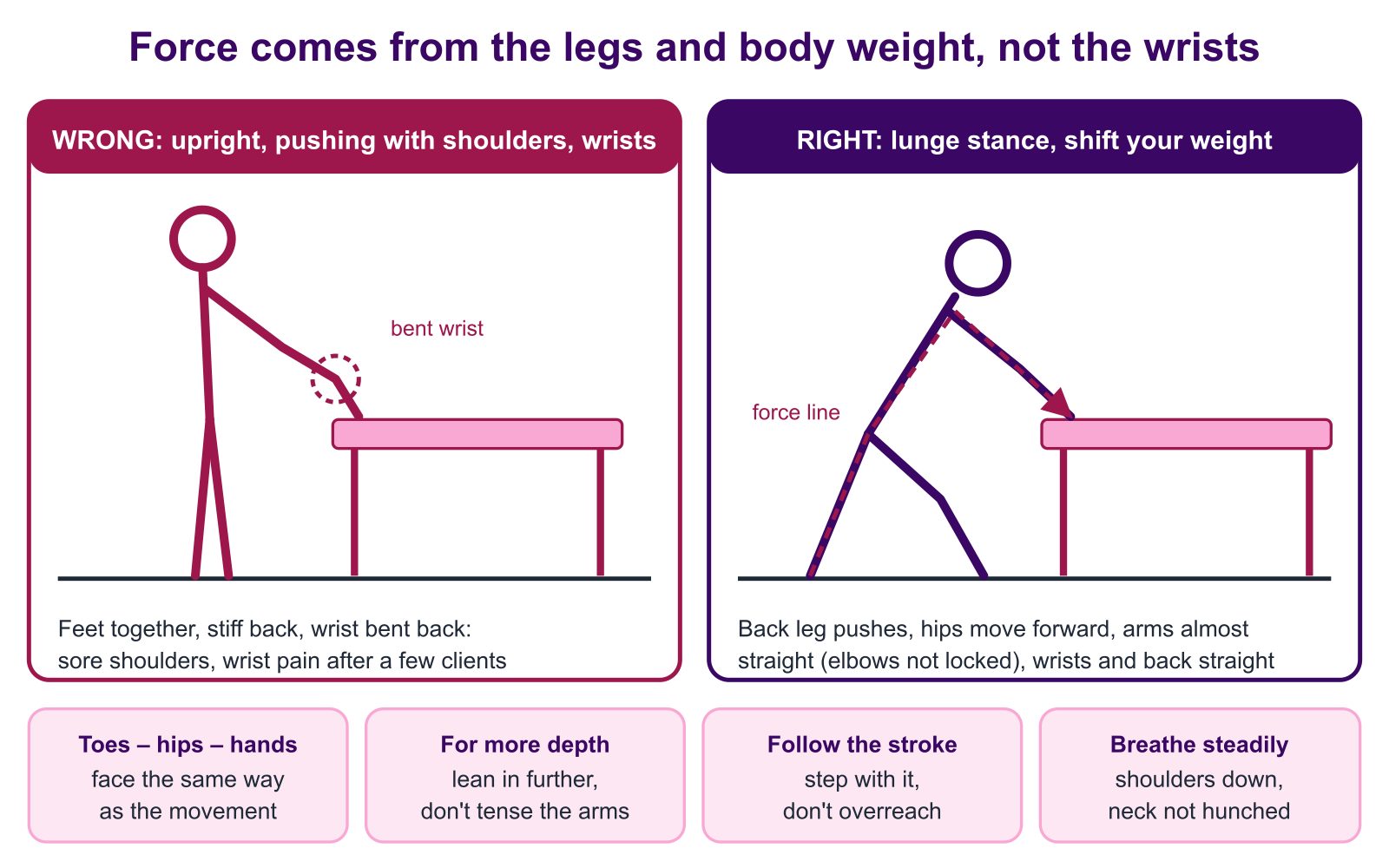
- Stack your joints in line: shoulder, elbow, wrist and point of contact lie close to one straight line. The elbow is almost straight but not locked.
- Keep the wrist straight or only very slightly bent. Pressing with the heel of the hand while the wrist is bent back almost to a right angle is the posture that causes pain fastest.
- Lean in to increase pressure: when the client wants it firmer, shift your weight forward and lower your hips, rather than squeezing harder with your arm muscles.
- Apply and release pressure gradually: lean in, hold, then release by shifting your weight back. Applying force suddenly both hurts the client and jolts your own joints.
- Breathe steadily: holding your breath while applying force makes your shoulders and neck tense up with it.
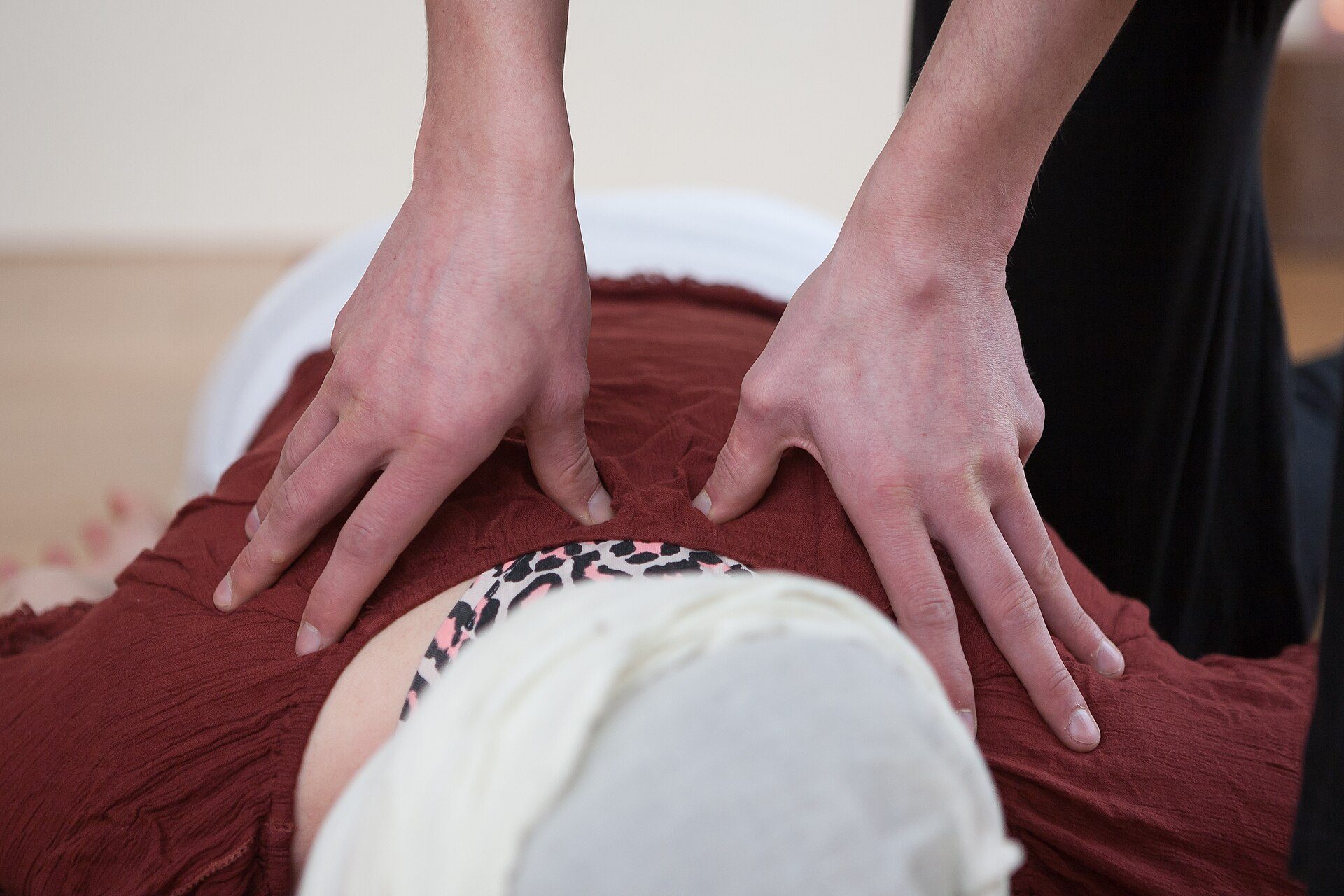
Photo: chiaravdberg / Wikimedia Commons, CC0

Choosing the right "tool" on your body
Each part of your hand and arm tolerates force differently. Rotating between them is the most effective way to protect your joints.
| Body part | Used for | Safety notes |
|---|---|---|
| Palm | Spreading oil, long strokes, large areas | Relax the fingers, use the whole hand |
| Heel of the hand | Pressing and gliding over large muscle areas (back, thighs) | Do not bend the wrist back too far; you can place the other hand on top to share the load |
| Forearm | Deep gliding along the back, thighs, calves | Use the fleshy inner surface, avoid pressing with the bone; do not use near the spine or bony prominences |
| Soft fist | Gliding over the soles of the feet, thighs, buttocks | Keep the fist loose and the wrist straight, with the flat surface of the finger joints in contact |
| Thumb | Small points, arms, feet, face | Short spells, moderate pressure; thumb in line with the forearm; do not hold deep pressure for long |
Protecting the wrists and thumbs
The thumb has many small joints, and slender tendons run along the edge of the wrist. When you press deeply with the thumb while its end joint bends backwards, all the force is concentrated on one small joint and these tendons. Doing that a few times does no harm; doing it hundreds of times a day for months inflames the tendons and leaves the joint painful for a long time.
- Keep the thumb in line with the forearm, with the end joint not bending backwards. Press with the pad of the thumb, not the tip.
- Support the thumb: when you need to press a point, place the other thumb on top, or rest your other fingers on the client's skin as a support.
- Limit sustained pressure: press for a few seconds and then release; do not hold deep pressure statically for a long time.
- Substitute: use the heel of the hand, forearm or soft fist for large muscle areas; save the thumb for small areas.
- Do not "crack" your finger joints to relieve tiredness, and do not flick your wrists hard; use gentle stretches instead.
- Short nails and no rings: long nails force you to press with the fingers bent in the wrong position.
When a client asks for "harder, harder", that is when therapists are most likely to misuse their thumbs. Switch to the forearm or the heel of the hand and lean in further; the pressure is deeper and your hands feel lighter. If you are already using correct posture and still cannot reach the pressure the client wants, be honest with the client about the safe level of pressure, and recommend a more suitable service the spa offers, if there is one. A relaxing massage does not need to hurt to be effective.
Warm-up, short breaks and stretching across the shift
"Cold" muscles and tendons tolerate load less well than muscles that have been warmed up. A few minutes before the shift, a minute between clients and ten minutes at the end of the shift are part of the job, just like preparing the room.
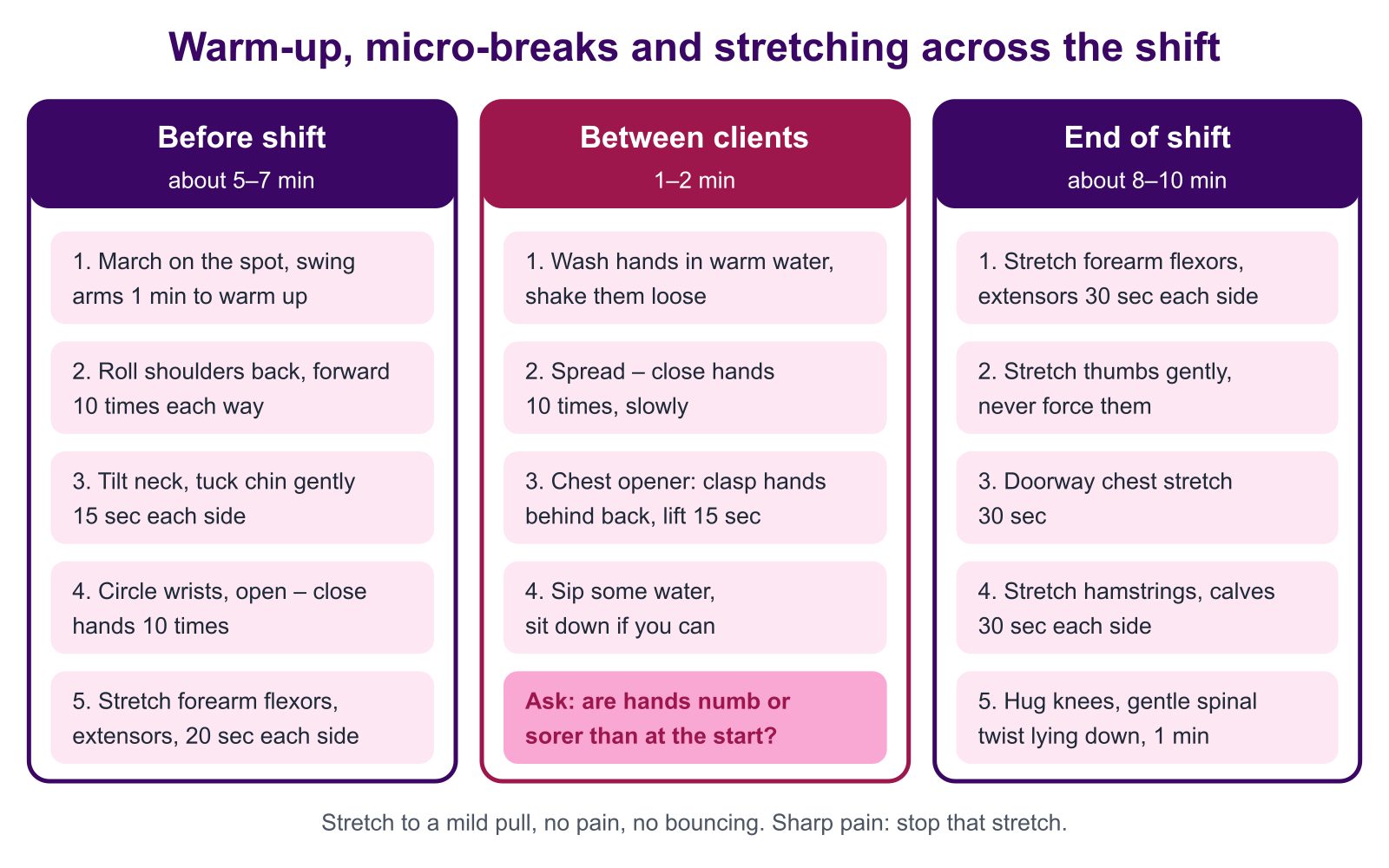
Before the shift: 5–7 minutes
- March on the spot, swinging your arms, for about 1 minute to warm up.
- Roll your shoulders backwards and forwards, 10 times in each direction.
- Tilt your head to each side and tuck your chin gently, holding each position for about 15 seconds; do not roll your neck round forcefully.
- Circle your wrists in both directions, and make a fist and open your hands 10 times.
- Forearm flexor stretch: stretch your arm straight out in front, palm facing away, and use the other hand to pull the fingers gently towards you; then the extensor stretch: palm facing down, gently pull the back of the hand towards you. Hold each position for about 20 seconds on each side.
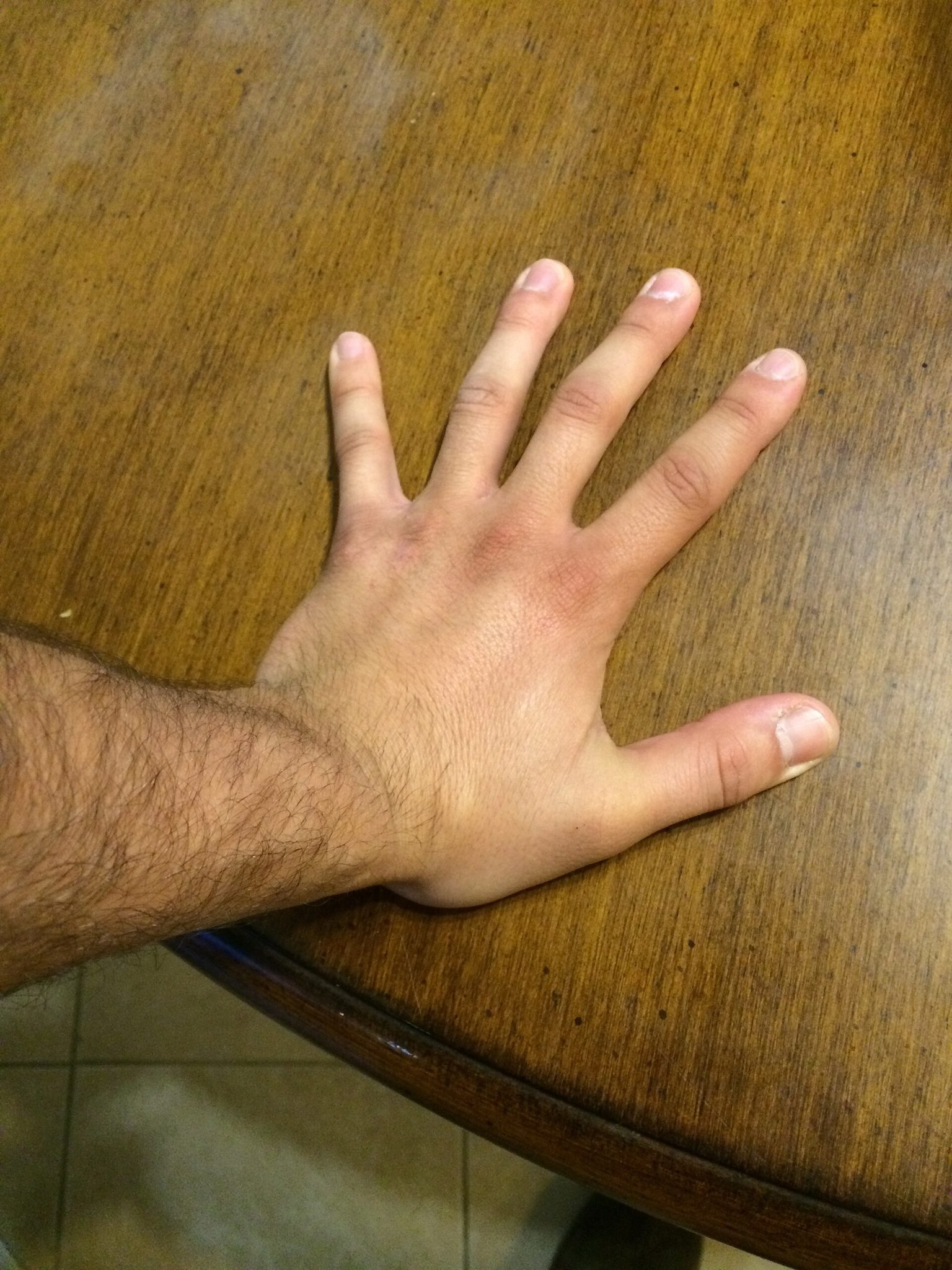
Photo: Trubio1286 / Wikimedia Commons, CC BY-SA 3.0

Between two clients: 1–2 minutes
Within the 15 minutes for resetting the room, set aside 1–2 minutes for your hands: wash them in warm water, shake them out loosely, slowly open and close your hands 10 times, clasp your hands behind your back and gently open your chest for 15 seconds, drink a few sips of water, and sit down if you can. Ask yourself one question: are my hands more numb or painful than at the start of the shift? If so, tell the shift supervisor so that you can switch to a lighter service for the next client.
End of the shift: 8–10 minutes
Stretch the forearm flexors and extensors for about 30 seconds on each side; stretch the thumb gently (do not force it); stand in a doorway with your forearms on the frame and step forward to stretch your chest for 30 seconds; stretch the hamstrings and calves for 30 seconds on each side; at home, lie hugging your knees and gently rotate your back for about 1 minute. Stretch slowly, breathe steadily, do not bounce. If you feel a sharp pain, stop that stretch.
Sensible shift planning and scheduling
- Alternate heavy and light services: after a deep-pressure body treatment, if possible, take a facial, a hair wash or a foot treatment next. Discuss this with the manager when the schedule is drawn up, especially on busy days.
- Keep enough time between two clients for resetting the room and resting your hands; do not accept back-to-back clients without a break.
- Eat proper meals and drink water regularly: muscles that lack fluid and energy tire faster.
- Build up your workload gradually when you are new to the job: in the first month your hands are not yet conditioned, so do not take on too many deep-pressure body treatments in a single day.
- Footwear: flat, cushioned, non-slip soles that hold the foot securely; no thin flip-flops and no high heels. Stretchy clothing that does not restrict the shoulders.
- Outside working hours: exercises that strengthen the back, abdominal and hand muscles help you cope with the load. Ask a qualified professional (a fitness trainer, a rehabilitation specialist) if you want to train systematically.
Photo: Jlgay38 / Wikimedia Commons, CC BY 4.0

Signs that you need to see a doctor
Tired muscles after a busy day that recover after a night's rest are normal. The signs below are not normal; tell the manager, reduce the work you do with your hands and see a doctor (a musculoskeletal, orthopaedic or rehabilitation specialist):
- Numbness or tingling in the thumb, index finger and middle finger, especially at night or early in the morning, relieved only by shaking the hand.
- Weak hands: frequently dropping things, difficulty doing up buttons or twisting bottle caps.
- Pain in the wrist or at the base of the thumb lasting more than 1–2 weeks despite reducing your workload, or pain that is gradually getting worse.
- Swelling or heat in a joint, or a finger that catches or "clicks" when bending and straightening.
- Pain spreading from the neck down the arm, or lower-back pain spreading down the leg with numbness or weakness.
- Pain that wakes you up, or pain even when resting.
Do not take painkillers on your own to push through to the end of the shift, and do not buy medication yourself or ask someone to inject the painful area. Medication masks the pain but does not correct your posture, and you may cause more serious damage. Only use medication, splints or physiotherapy when prescribed by a doctor. Seeing a doctor early usually means a shorter time off work.
Common mistakes
| Mistake | Why it is dangerous or wrong | The right way |
|---|---|---|
| Not adjusting the couch, using the setting of the person on the previous shift | You have to bend over or lift your shoulders to compensate, causing back and shoulder pain | Stand upright with arms hanging to compare against the couch surface before every client |
| Standing with feet together, back bent, pushing with your arms | Force comes from the shoulders and wrists; you tire quickly and the pressure is uneven | Lunge or horse stance, push from the back leg, shift your weight |
| Pressing deeply with a hyperextended thumb | Concentrates force on a small joint, causing tendon inflammation and pain at the base of the thumb | Thumb in line and supported; use the heel of the hand or forearm for large areas |
| Bending the wrist back when pressing with the heel of the hand | Compresses the wrist, causing pain and numb fingertips | Keep the wrist almost straight, place the other hand on top to share the load |
| Reaching far instead of stepping with the movement | Strains the shoulders and twists the back | Step with the movement, toes pointing the same way as your hands |
| Skipping the warm-up because "the client is waiting" | Cold tendons and muscles tolerate load poorly with the first client | Warm up for 5–7 minutes before your first client arrives |
| Taking painkillers to keep working when your hands are numb | Masks the signs of injury and makes it worse | Tell the manager, reduce the work you do with your hands, see a doctor |
Pass criteria for this lesson
The instructor observes you during a 15-minute sample massage and assesses you with questions. You pass when you:
- Set the couch height correctly for the type of movement within 1 minute, and state where the couch surface should come to on your hand for the 3 levels of pressure.
- During a 15-minute sample back massage, maintain the correct lunge for long strokes and the horse stance for cross-body kneading; the instructor corrects your posture no more than 2 times.
- Increase pressure on request by leaning in and switching to the forearm or the heel of the hand, without bending the wrist or hyperextending the thumb.
- Perform all 5 warm-up exercises before the shift within 5–7 minutes and all 5 end-of-shift stretches, holding each for the correct time (15–30 seconds).
- Name at least 5 signs that you need to see a doctor and state correctly what to do when you have them.
- After a 60-minute practice session, self-assess pain in the wrists, thumbs and lower back as no pain or only mild tiredness.
Frequently asked questions
I'm short, and the spa couch is at its lowest setting but still too high. What should I do?
Ask the manager for a sturdy, non-slip platform that is wide enough to step on. In the meantime, use the lunge with your back leg further behind so that the force travels diagonally, and choose movements that use the heel of the hand and forearm instead of trying to force pressure with your fingers.
Is it a good idea to wear a wrist support or splint while working?
Supports and splints do not correct poor posture. If your wrist already hurts enough that you want to wear a splint, that is a sign you should see a doctor; which type of splint to use and when to wear it is for a doctor or rehabilitation specialist to prescribe.
What do I do if a client wants very firm pressure and I'm not strong enough?
Deep pressure comes from body weight and the angle at which you lean, not from arm muscle. Lower the couch, use your forearm, lean in further, and work more slowly. If that is still not enough, explain clearly to the client the safe pressure level for a relaxing service; do not strain or press with your elbow on areas you have not been trained to work.
Should I do extra exercise outside working hours?
Yes. Walking, swimming, and exercises that strengthen the back and abdominal muscles and grip strength help you cope with the load. If you already have pain or numbness, see a doctor before exercising.
Further reading
The two stances, bow and horse, in the context of a complete body massage are covered in the article 60-minute relaxing body massage: posture, hand pressure and the standard spa sequence. The marking scheme for posture in the practical exam is in Spa safety and service skills check.