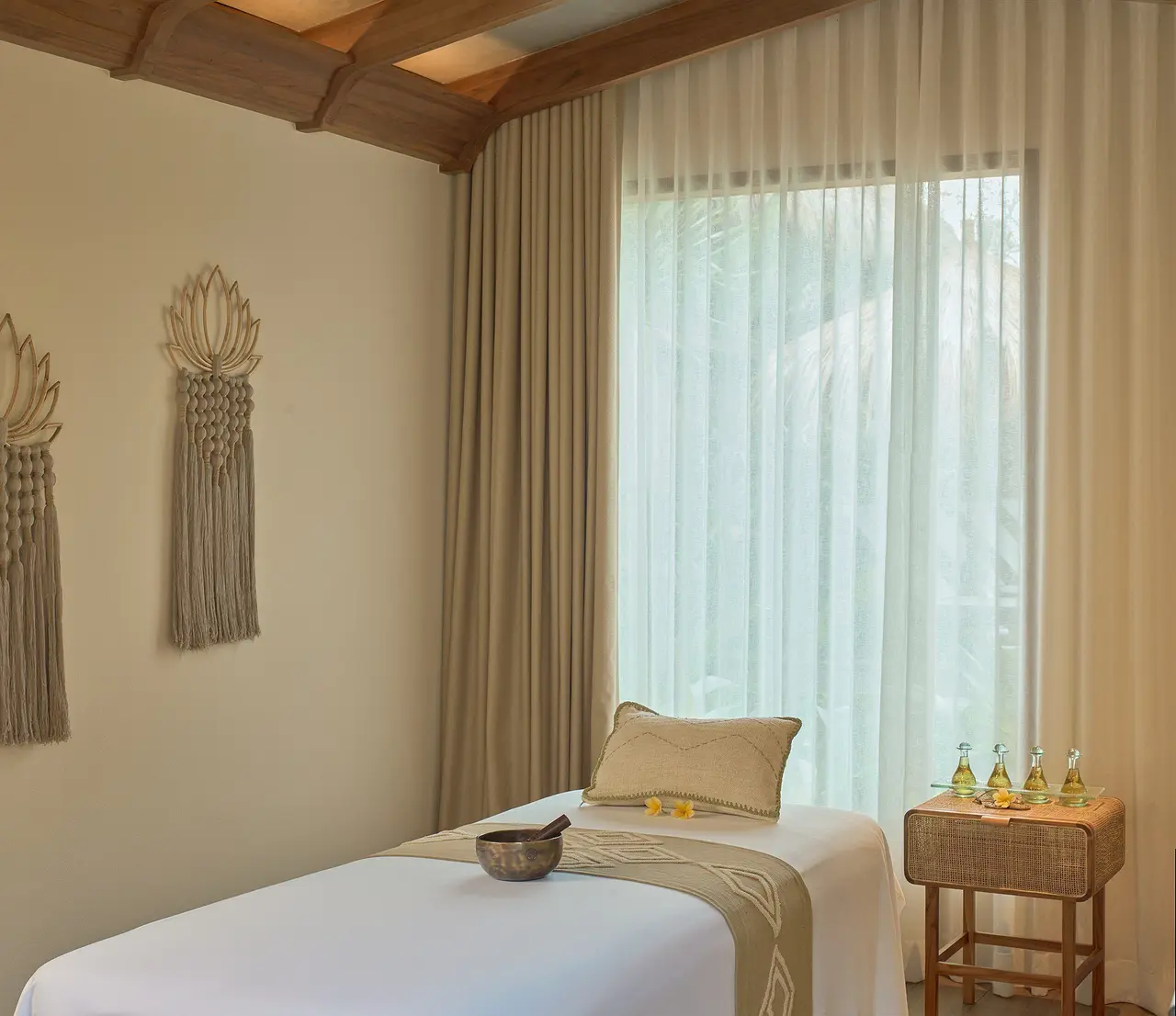
In many Vietnamese spas, a new client judges the service within the first 3 minutes, before the therapist's hands have even touched them. A room chilled to 20°C because the air conditioning was left on from the previous shift, a bed sheet that is still creased, a heavy smell of agarwood incense, a therapist standing in the room while the client is awkwardly taking off their top: any single one of these details is enough to make the client tense up for the whole session. In contrast, a comfortably warm room, soft lighting, a smooth bed, a towel that covers fully and a therapist who knows when to step outside and when to ask will help the client relax even before the massage begins.
This lesson is the "foundation" skill of every body treatment. You do not yet need to be good at hand movements; you need to do things correctly and the same way every time: prepare the room, set up the bed, drape with towels, welcome and see off the client, keep boundaries and turn the room around on time.
By the end of this lesson, you will be able to:
- Check and adjust the four elements of the treatment room: temperature, lighting, sound and smell, at least 10 minutes before the appointment.
- Set up the bed and trolley using a 12-point checklist, so you never have to leave the room to fetch items during the treatment.
- Drape with towels correctly: uncover only the area being worked on, tuck the towel edges securely, and turn the client over without exposing the body.
- Welcome the client, give changing instructions, ask permission before touching and see the client off using professional language.
- Recognise and maintain professional boundaries, and know how to stop the session and report to the manager when a client behaves inappropriately.
- Clean and reset the room between two clients in 10–15 minutes in the correct order.
The treatment room is part of the treatment
Clients come to the spa to rest. To relax, the client's nervous system has to "trust" that they are safe: not cold, not being watched, not being disturbed, with no strange smells or noises. That is why experienced therapists treat the room as a working tool, just like the bottle of oil or the towel. You prepare it deliberately, not just "switch on the light and the air conditioning and that's it".
Remember also that massage at a spa is a health care and relaxation service. Businesses offering massage services belong to the group of business lines subject to security and order conditions under Decree 96/2016/ND-CP (security and order conditions for certain businesses, including massage services), as amended by Decree 56/2023/ND-CP. A professionally prepared room, correct draping and clear boundaries are how you and the spa demonstrate this in every session, not just on the licence.
Four environmental elements to adjust
| Element | Target level | Quick check | Adjusting to the client |
|---|---|---|---|
| Temperature | About 25–27°C for body massage, with no air-conditioning draught blowing straight down onto the bed | Look at the room thermometer; hold your hand above the bed surface to feel for a cold draught | Older, slim clients and clients coming out of a sauna usually need it warmer; clients who feel hot can have it 1–2°C lower |
| Lighting | Soft, indirect, with no bulb shining straight into the client's face when lying on their back | Lie on the bed yourself and look up at the ceiling once when you start working at a spa | Turn it brighter when the client enters the room, changes and leaves, to avoid trips and falls |
| Sound | Instrumental music, quieter than a normal speaking voice; a soft voice can still be heard clearly | Stand at the head of the bed and ask a colleague quietly, "Can you hear me clearly?" | If the client wants complete silence, switch the music off; the therapist's phone is always on silent and kept outside the room |
| Smell | Clean, neutral or very lightly scented; no smell of stale oil, sweat or heavy incense smoke | Walk from the corridor into the room and breathe normally; a smell that "hits your nose" is too strong | Ask the client before diffusing essential oils; switch off for clients who are pregnant, asthmatic, allergic or who dislike the scent |
The figure of 25–27°C is the common level at which a client lying covered only by a towel does not feel cold. Each spa may set a different rule, and more important than the number is that you ask the client in the first minute: "Is the room temperature comfortable for you, sir?". A client lying face down for a long time will gradually feel colder as the body relaxes, so a warm towel or a light blanket should be ready on the trolley.
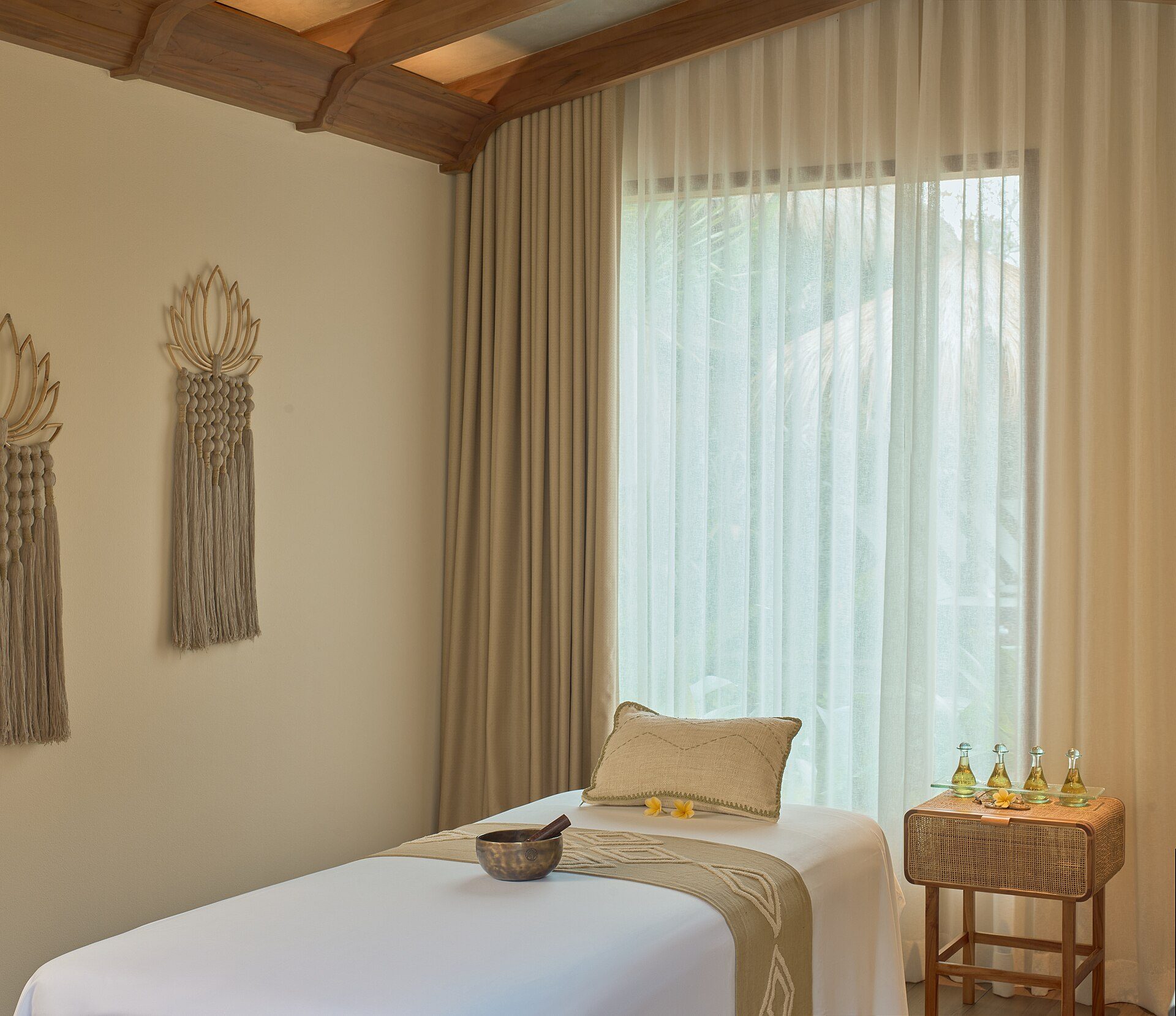
Photo: Paradisus Bali / Wikimedia Commons, CC BY-SA 4.0

Setting up the bed and trolley with a checklist
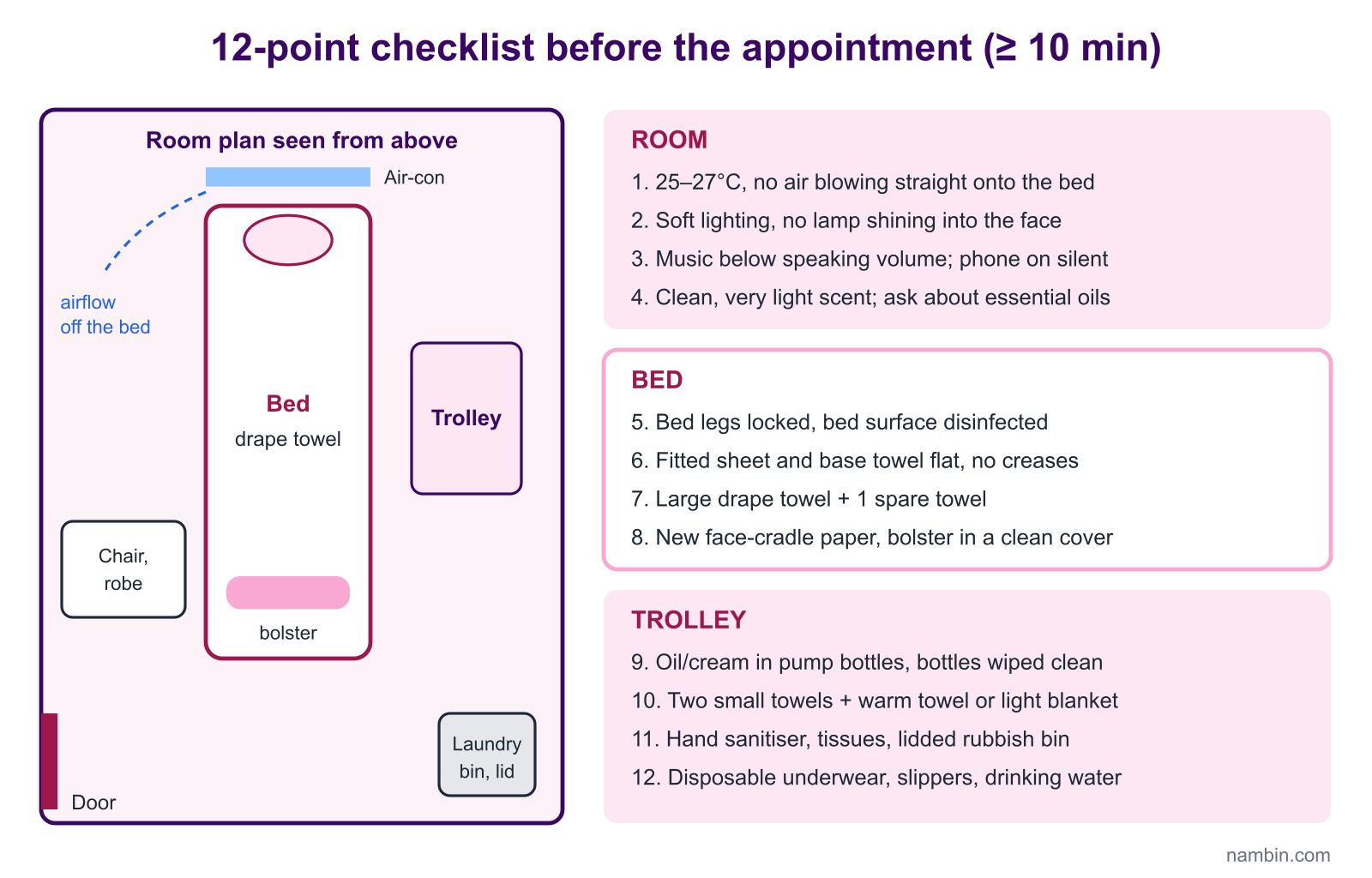
The massage bed (treatment bed) has a face hole or face cradle so the client can lie face down without turning the neck. The trolley is a shelf unit on wheels placed beside the bed, holding everything you use during the session. The principle for both is: clean, complete, in the right place. Once the session has started, you must not leave the room to fetch more items, because the client is left alone and the flow is broken.
Order for setting up the bed
- Check the bed: the legs are locked firmly and do not wobble when you lean your hands on it; the bed surface was wiped with disinfectant at the last clean and is dry.
- Adjust the height to suit the person working (detailed adjustment is covered in the lesson on therapist posture). Remember your own height setting so you can adjust quickly when sharing a bed with a colleague.
- Heated pad (if the spa has one): place it under the sheet, never directly under the client's body; switch it on in advance following the manufacturer's instructions, keep it on a low setting and switch it off when the client feels hot.
- Fitted bed cover: smooth, pulled taut, with no creases in the chest and abdomen area where the client will lie.
- Under-towel or top sheet: laid with straight edges, with one corner folded diagonally at the foot end so the client can slip in easily.
- Large draping towel: long enough to cover from the shoulders to the ankles of a person about 1.75 m tall; keep a second towel ready for tall clients or clients who feel cold.
- Face cradle: covered with fresh paper or a clean towel for each client; check that the angle adjustment joint is locked.
- Bolster: a long bolster under the ankles when the client is face down, moved under the knees when the client is face up; covered with a clean case.
Trolley checklist
The trolley is divided into levels: the top level holds items for immediate use, the middle level holds spares, and the bottom tray holds paper and a small lidded rubbish bag. Dirty items (used towels) are never kept on the same trolley as clean items; the spa must have a separate lidded laundry basket in the corner of the room or out in the corridor.
- Massage oil or cream in a pump bottle, with the outside of the bottle wiped clean; a small tray or bowl if mixing is needed.
- Two small towels: one for wiping the therapist's hands, one for wiping excess oil off the client at the end.
- A spare warm towel or light blanket; hand sanitiser; tissues.
- Disposable underwear, a clean robe and slippers for the client (placed on a chair or a hook in the room).
- A water jug and clean cup for the client to drink after the session.
Draping technique
Draping is the English term for using towels or sheets to cover the client's body throughout the session. It has three purposes: to maintain privacy, to keep the client warm, and to make clear the boundary of the area being touched. The client is uncovered only in the exact area you are working on; when you finish an area, cover it again before uncovering the next one.
Five unchanging principles
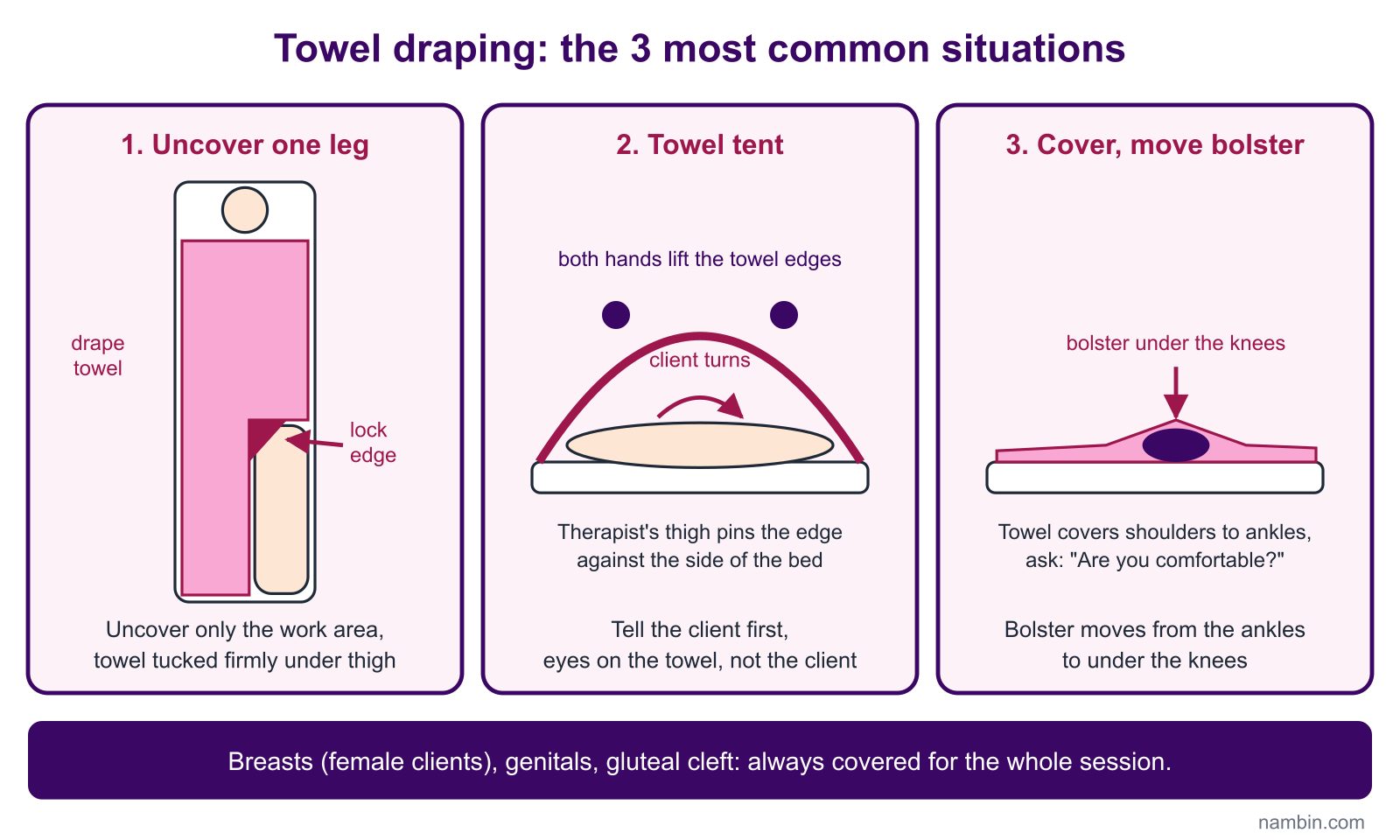
- Uncover only one area: the back, one leg, one arm. Never uncover the back and both legs at the same time.
- Intimate areas are always covered: the breasts on women, the genital area and the gluteal cleft are never uncovered in relaxation massage at a spa, even if the client says "it's fine".
- Secure the towel edge: when uncovering a leg, fold the excess towel and tuck it firmly under the client's inner thigh and hip (known as "locking the towel"), so the towel does not slip while you work.
- Hands do not glide under the towel beyond the agreed area: the stroke stops at the edge of the towel.
- A clean towel for every client: a towel that falls on the floor is a dirty towel; replace it immediately with a spare.
Turning the client over without exposure
This is the step new therapists find most awkward. The common method in spas is the "towel tent": you stand on one side of the bed, use both hands to hold the far and near edges of the towel, and lift the towel just high enough for the client to turn underneath, with your eyes looking away or at the towel, not at the client's body. Press your thigh against the edge of the bed to hold the towel on your side so it does not slip off.
- Announce it first: "Now I'd like to invite you to turn over onto your back. I'll hold the towel; just turn slowly."
- Remove the bolster from under the ankles and place it on the trolley.
- Lift the towel into a "tent" and guide the client to turn towards you (so the client does not roll towards the far edge of the bed).
- Lower the towel, check that it covers fully from shoulders to feet, and straighten it evenly.
- Place the bolster under the client's knees and ask: "Are you comfortable lying like that?".
Draping for clients with particular wishes
Some clients want to keep their own underwear on, some want to keep their top on, some are shy about exposing the abdomen or upper arms. You respect all of them: adjust the working area and strokes to the client's wishes and note it on the record card for next time. Do not persuade the client to remove more clothing "for a more satisfying treatment", and do not comment on the client's body, weight or skin.
Welcoming the client, changing instructions and seeing the client off
The health consultation and client record card steps have their own lesson. Here you focus on the "human" side of welcoming and seeing off: words, distance, and when to enter and leave the room.
The 9-step procedure
- Welcome at the reception desk or waiting area: greet, introduce yourself by name, confirm the service and duration: "I'm Lan, and today I'll be doing your 60-minute body treatment."
- Lead the client to the room: walk half a step ahead, point the way with an open hand, mention any door step or slippery floor.
- Introduce the room in 30 seconds: where to put belongings, the robe, the disposable underwear and the nearest toilet.
- Give changing instructions in specific words: "Please change, put on this disposable underwear, then lie face down on the bed and pull the towel over yourself for me. I'll step outside and knock on the door in about 3 minutes."
- Leave the room and close the door: the therapist does not stay in the room while the client changes, even with a regular client or a client of the same sex.
- Knock and wait for an answer: "Are you ready?". Enter only when the client agrees. If there is no answer, wait a little longer and knock again.
- Ask permission and agree before touching: repeat the areas you will work on, ask about areas the client does not want touched, and tell the client they can ask you to stop or change the pressure at any time.
- End the session: tell the client you have finished, guide them to sit up slowly, and say clearly that you will step outside so they can change: "Take your time; I'll wait outside and get you some water."
- See the client off: offer water, ask how they feel, mention the next appointment if there is one, lead the client to the desk, thank them and say goodbye.
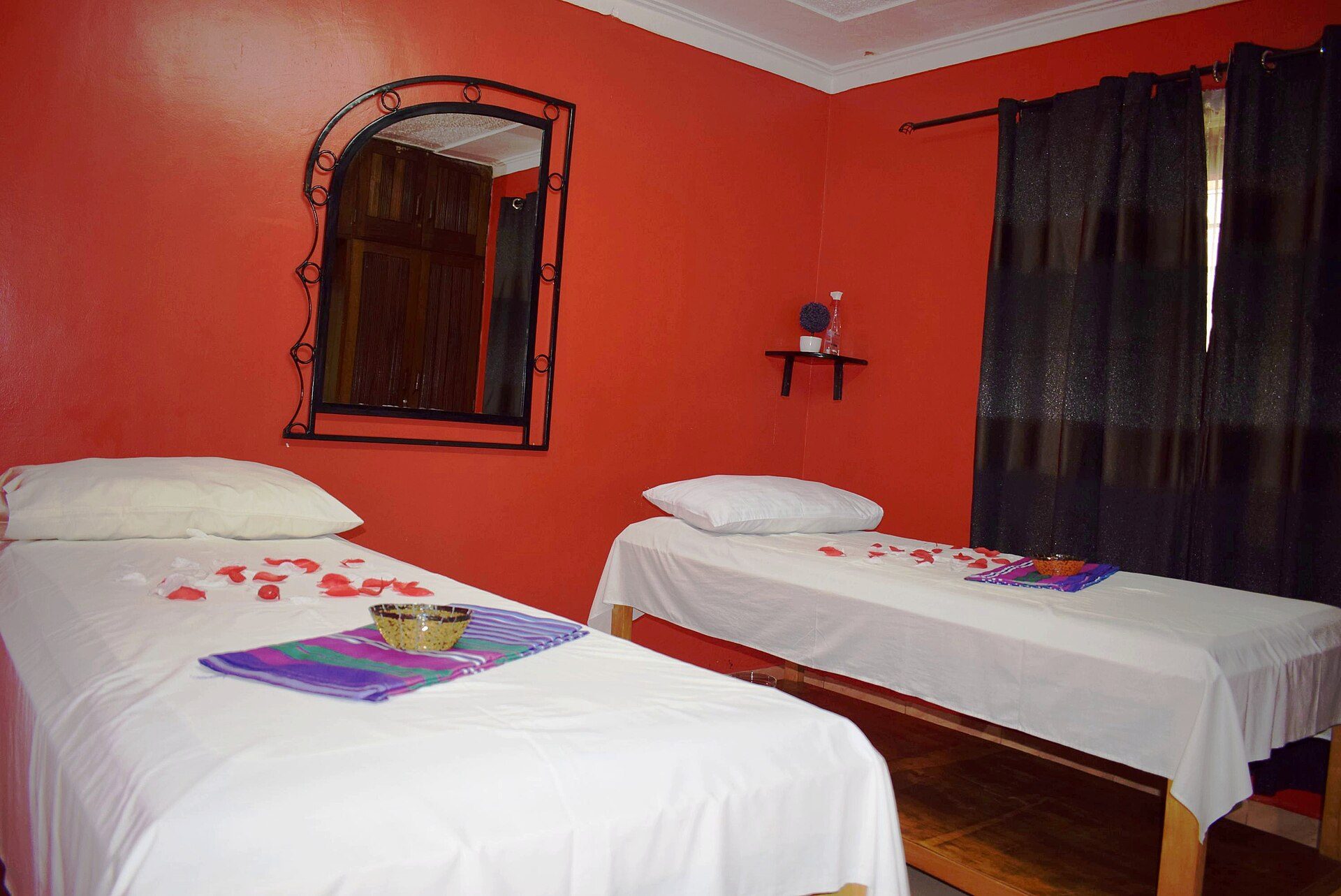
Photo: Alvinategyeka / Wikimedia Commons, CC BY-SA 4.0

Asking permission before touching and professional boundaries
Consent in the spa profession means that the client knows in advance what you will do and in which area, and has the right to refuse or stop at any time. Consent is not asked just once at the start; you ask again whenever you move to a more sensitive area such as the abdomen, the thighs, the gluteal area (always worked through the towel) or the upper chest above the collarbones.
Sample phrases
- Before starting: "Today I'll work on your back, shoulders, neck, arms and legs. Is there any area you'd prefer me not to touch?"
- Before a sensitive area: "May I work gently on your abdomen through the towel? If you'd rather not, I'll skip it."
- When the client refuses: "Of course, I'll skip this area." Do not ask why, do not persuade.
Boundaries the therapist must keep
- Do not make personal comments about the client's appearance, weight, skin or tattoos.
- Do not ask for or give personal phone numbers or private social media; book appointments through reception.
- Do not tell long personal stories, and do not ask about the client's family or income.
- Do not accept invitations to go out, eat or drink privately with a client.
- Do not perform services outside the spa's menu, or work at a client's home unless assigned by the spa.
When a client says or does something inappropriate (requesting a sexual service, deliberately uncovering themselves, touching the therapist): stop immediately, say clearly in a calm voice, "The spa's services do not include this; I am going to stop the session," leave the room and report to the manager. You are not at fault for stopping. A professional spa always protects the therapist in this situation.
Turning the room around between two clients in 10–15 minutes
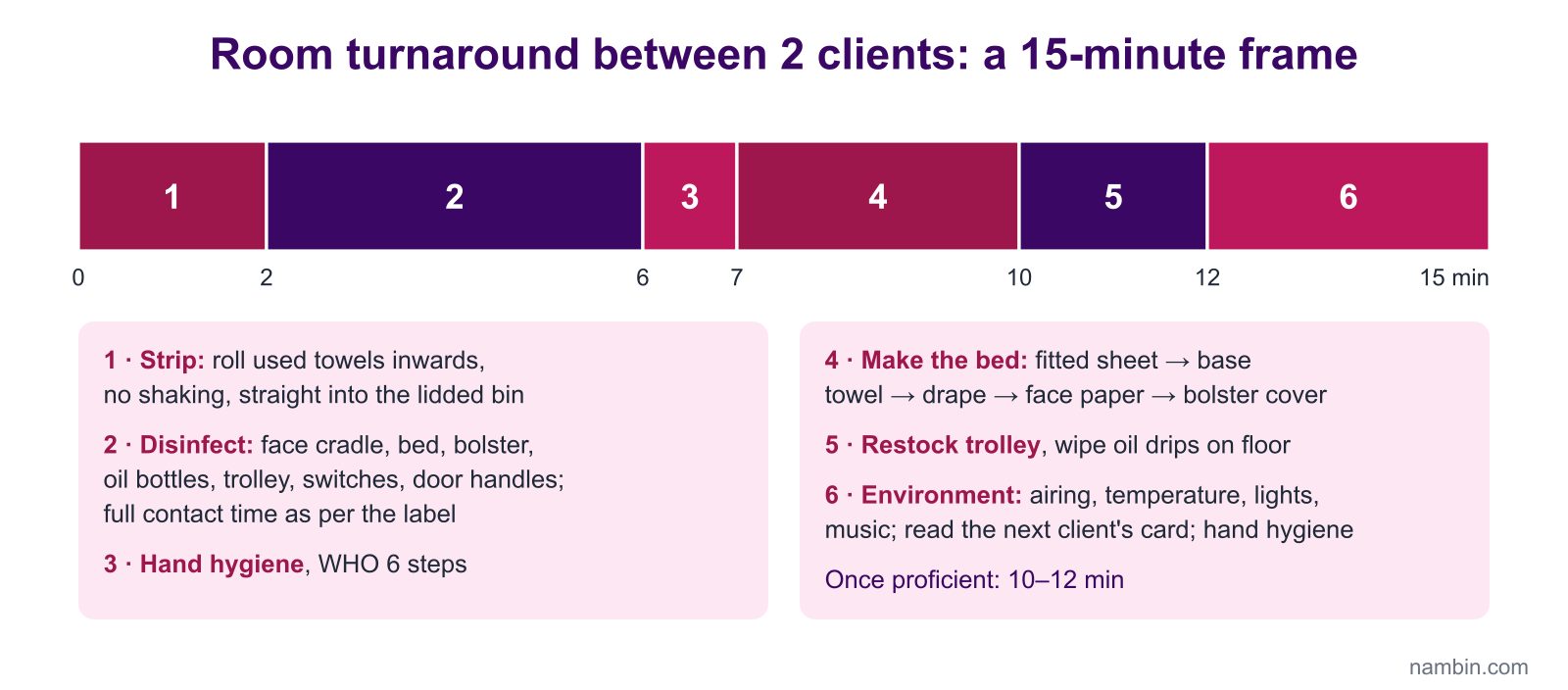
Spa appointments are usually booked close together. If you clean slowly, the next client has to wait; if you clean carelessly, the next client lies on a bed that still carries the previous person's oil smell and hair. The secret is to work in a fixed order: dirty items out first, wipe from clean to dirty and from top to bottom, and only then bring clean items in. Details of chemicals, concentrations and contact times are in the lesson on disinfecting equipment; here is the practical time frame.
- Minutes 0–2: turn the lights up, put on gloves if the spa requires it. Roll the sheets and towels from the outside in (dirty side rolled into the middle), do not shake them, and put them straight into the lidded laundry basket. Throw the face paper into the bin.
- Minutes 2–6: disinfect the surfaces touched by the client and the therapist's hands: face cradle, bed surface, bolster cover, oil bottle, trolley handle, light switch, door handle. Use the solution supplied by the spa and allow the full contact time stated on the manufacturer's label.
- Minutes 6–7: remove gloves and wash your hands using the WHO 6 steps.
- Minutes 7–10: remake the bed with the fitted cover, under-towel, draping towel, new face paper and a clean bolster cover.
- Minutes 10–12: restock the trolley: oil, small towels, disposable underwear, cups. Check the floor around the bed: no hair, no drops of oil (oil on a tiled floor very easily causes slips and falls).
- Minutes 12–15: ventilate or switch on the extractor fan for a few minutes if the room smells, readjust the temperature, dim the lights, choose the music. Quickly read the next client's record card. Wash your hands one last time.
If a busy shift leaves no time, ask reception to push the appointment back a few minutes; do not skip the disinfection step.
Photo: Matt @ PEK from Taipei, Taiwan / Wikimedia Commons, CC BY-SA 2.0

Common mistakes of trainee therapists
| Mistake | Why it is wrong or dangerous | Correct practice |
|---|---|---|
| Staying in the room and turning your back while the client changes | The client loses their sense of privacy, it is easily misunderstood and damages the spa's reputation | Always step outside, close the door, knock and wait for the client to answer before entering |
| Uncovering the back and both legs to be "quick" | The client gets cold, the body is exposed, and the boundary of the working area is lost | Uncover one area at a time, cover it again when finished, then uncover the next |
| Not securing the towel edge when working on the legs | The towel slips when stroking up the thigh, exposing intimate areas | Fold the excess towel and tuck it firmly under the inner thigh and hip before working |
| Leaving the air conditioning at 20°C blowing straight onto the bed | The client's muscles contract, it is hard to relax, and some clients catch a chill | Set about 25–27°C, change the airflow direction, keep a spare warm towel |
| Burning incense or diffusing strong essential oils without asking | The client may get a headache, breathing difficulty or an allergy; unsuitable for pregnant clients | Ask first, use only a very light scent, switch off if the client does not want it |
| Shaking dirty towels in the room | Spreads hair, skin flakes and microorganisms into the air and onto clean surfaces | Roll the dirty side inwards and put straight into the lidded basket |
| Leaving the room mid-session to fetch oil or towels | Breaks the flow, leaves the client alone, causes delays | Check the trolley checklist before the appointment |
| Complimenting or criticising the client's body to "make conversation" | Crosses professional boundaries; the client feels scrutinised | Ask only about sensations: pressure, temperature, painful areas |
Case study: a female client on her first spa visit, very shy
A 45-year-old female client books a 60-minute body massage for the first time, a gift from her daughter. On entering the room, she asks quietly, "Do I have to take everything off?" and stands with her arms folded.
- Reassure with clear information: "No, not at all. You can wear this disposable underwear, or keep your own underwear on. You will be covered by a towel throughout the session, and I only uncover the exact area I'm working on."
- Give the client a choice: ask whether she would like to keep her top on for the first part of the session; she chooses to take it off but wants the back done first to get used to it.
- Step outside for 3 minutes and knock; the client answers "not ready yet", so you wait another 2 minutes and knock again.
- First minute: ask about the temperature; the client feels a little cold, so you raise it by 1°C and add a light towel over the legs.
- Before turning her over: explain the towel tent; the client turns without being exposed, then says, "Now I feel reassured."
- Abdomen: you ask, the client declines, so you skip it and spend extra time on the arms and shoulders.
- Record card: the client likes a warm room, no abdominal work, wants the back done first, was quite shy on the first visit so needs an explanation before each step.
Expected outcome: the client lies still and breathes evenly from about minute 10, and at the end asks to book the next appointment. That is the result of preparation and draping, not of hand movements.
Pass criteria for this lesson
The instructor assesses you on a real bed with a classmate, timed. You pass when you:
- Complete the 12-point checklist (room, bed, trolley) in no more than 8 minutes without missing any point; can state the target temperature of 25–27°C and how to check for an air-conditioning draught.
- Set up the bed in the correct 8 steps in order, with the sheet smooth and free of creases in the torso area when the instructor checks by hand.
- Drape a classmate through one full round: uncover the back, each leg, turn over, each arm; 0 exposures of intimate areas, 0 towel slips, and the towel edge secured on each leg.
- Turn the client over using the towel tent in no more than 60 seconds, announcing it verbally first and moving the bolster to the correct position.
- Role-play welcoming – changing instructions – seeing off in all 9 steps, using the correct phrase for asking permission before touching and the phrase for handling a client who declines an area.
- State at least 4 professional boundaries and role-play correctly how to stop the session when a client behaves inappropriately.
- Clean and fully reset the room in no more than 15 minutes, in the correct order of 6 stages, with hand hygiene twice and without shaking dirty towels.
Frequently asked questions
Can a male client be treated by a female therapist, and vice versa?
It depends on each spa's policy. Many spas ask clients whether they prefer a male or female therapist at the time of booking. Whether the therapist and client are the same or different sexes, the rules on draping, stepping out while the client changes and asking permission before touching are the same. The therapist also has the right to report to the manager if they do not feel safe treating a particular client.
What do I do if the client says, "No need to cover me with a towel, it's too hot"?
Lower the room temperature and switch to a thinner towel, but still cover the intimate areas and the areas not yet worked on. Draping is a professional spa standard, not an option. Say gently: "I'll lower the room temperature and change to a thinner towel for you; according to the spa's rules, I still need to keep the towel on."
Is 10 minutes of room cleaning enough to disinfect properly?
Yes, if the solution the spa uses has a short contact time according to the label and you follow the order. If the label states a contact time longer than the time you have, tell the manager: the product needs to be changed or appointments spaced further apart; do not shorten the contact time.
How do I wake a client who has fallen asleep after the session?
Place your hand lightly on their shoulder through the towel, call the client's name softly and raise the lights slowly. Do not shake them hard and do not switch on bright lights suddenly. Give the client a few minutes to sit up, then step outside so they can change.
Further reading
See how to fit room preparation into a complete working shift in Delivering a complete spa treatment, and details of chemicals and the cleaning order for room turnaround in Spa equipment disinfection procedure.