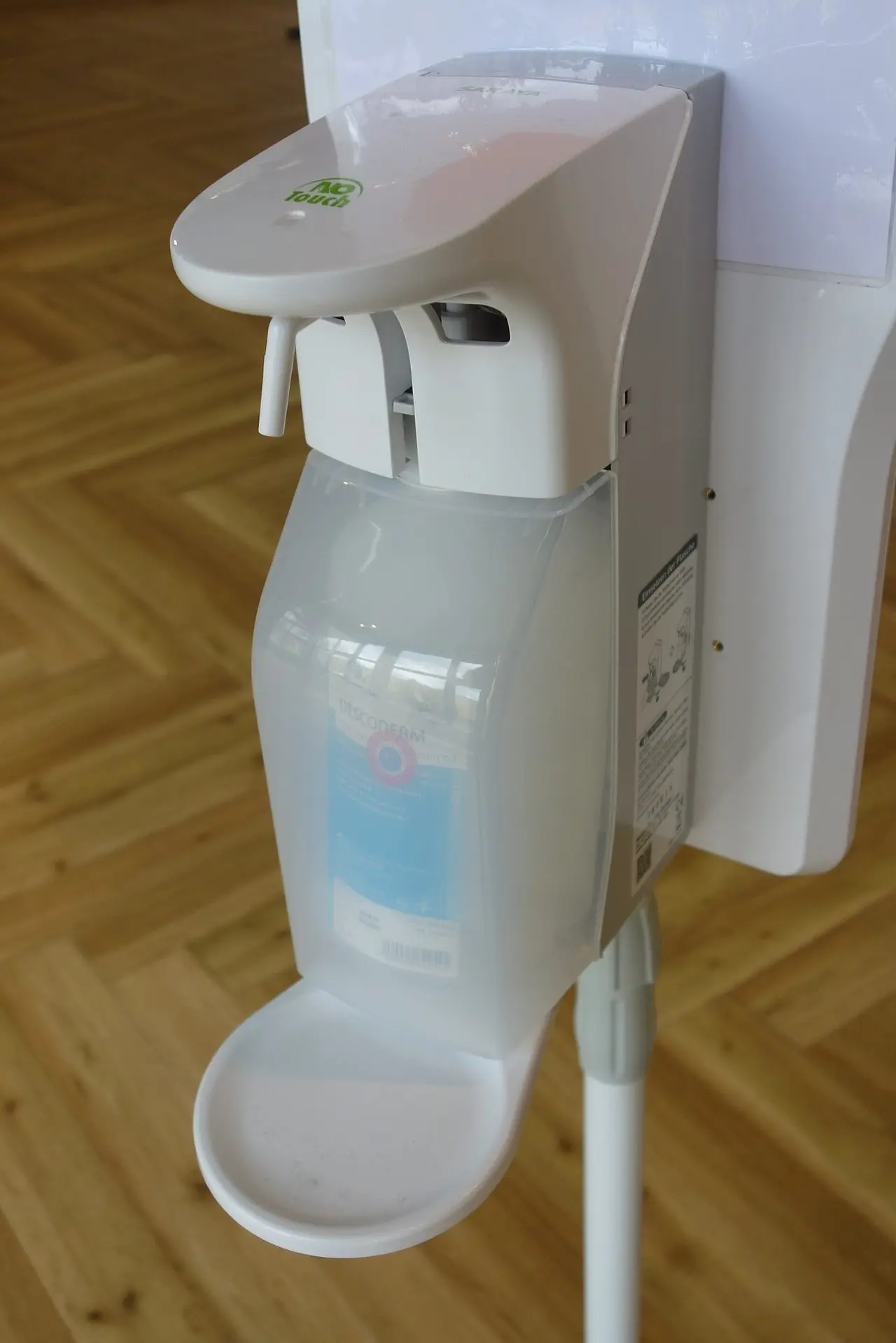
On a busy day, one room in a spa may receive six or seven clients in a row, with only fifteen minutes between them. That is exactly when trainee therapists tend to "cut corners": wiping the couch with a dry towel, soaking bowls for two minutes instead of the full time, skipping hand hygiene because "I washed them a moment ago". A case of fungal skin infection, an outbreak of inflamed spots after a facial, or a needlestick injury all start from those minutes of cutting corners. This lesson goes deep into the reasons behind each step, so that you know which steps must never be skipped and can make the right decision yourself when you meet a new tool or situation.
By the end of this lesson, you will be able to:
- Name all 5 moments for hand hygiene defined by the World Health Organization (WHO) and apply each moment to a real facial or body massage.
- Rub your hands through all 6 steps for the right length of time: 20–30 seconds with alcohol-based hand rub, 40–60 seconds with soap and water.
- Distinguish cleaning, disinfection and sterilisation, and place any item in the room into the correct processing group.
- Wash, dry and store towels and linen correctly, including items heavily soaked with massage oil.
- Explain what an autoclave can do, and what a UV cabinet can and cannot do.
- Sort waste in the treatment room and act correctly after a needle or sharp object pierces your hand.
How does cross-infection travel in a spa?
To block it, you must know its route. Micro-organisms (bacteria, fungi, viruses) need three things to make a client ill: a source (the previous client, the therapist, stagnant water in a tub), a route of transmission (hands, towels, equipment, a jar of cream) and a portal of entry on the client (freshly exfoliated skin, pores just opened by steam, tiny scratches after waxing, the eyes and mucous membranes). Infection control means breaking these links in the chain, as many as possible.
The route of transmission is where the therapist has the most control. WHO regards staff hands as the most important route of transmission in healthcare settings, and the same is true in the spa: your hand touches the client's face, then the steamer knob, a jar of cream, your phone, then the client's face again. Next come reusable items (towels, sheets, bowls, brushes, stones) and shared products (a cream jar dipped into with fingers, an oil bottle held with oily hands).
Infections commonly seen when control is poor
- Bacterial skin infections: folliculitis, impetigo, inflamed acne becoming worse after a facial.
- Fungal skin and foot infections: spread through damp towels, foot-soaking tubs and shared slippers.
- Cold sores (herpes labialis): spread when you touch a blistered area and then touch another client.
- Blood-borne infections (hepatitis B, hepatitis C, HIV): the risk is low in a non-invasive spa, but not zero when needles or blades are present.
On professional scope: under the Law on Medical Examination and Treatment No. 15/2023/QH15, injections, deep microneedling and extraction involving medical intervention belong to licensed medical facilities. A Level 1 therapist provides non-invasive care, so most of the tools you handle belong to the "contact with intact skin" group; your job is to process them consistently, without missing a step.
WHO hand hygiene: the 5 moments
WHO sets out "5 moments for hand hygiene" for healthcare workers. A spa is not a hospital, but the logic is exactly the same: clean your hands before your hands could carry germs to the client, and after your hands may have picked up germs from the client or the client's surroundings. Below are the 5 moments, translated into treatment-room examples.
- Before touching the client. Before placing your hand on the client's shoulder to greet them, before the first movement of the treatment, before shaking hands. Purpose: to protect the client from germs you bring from the reception area, your phone or the previous client.
- Before a clean task. Before opening a pack of sterilised instruments, taking cream out of a jar into a bowl, or touching freshly exfoliated skin or the eye area. Purpose: not to introduce germs into a "portal of entry" that is open.
- After risk of exposure to body fluids. After touching a burst inflamed spot, fluid, blood (even a single spot) or nasal mucus, and after removing gloves. Purpose: to protect yourself and the next client.
- After touching the client. At the end of the treatment, after helping the client sit up, after shaking hands to say goodbye.
- After touching the client's surroundings. After removing sheets, collecting used towels or wiping down the couch, even if you did not touch the client. This is the moment most often forgotten.
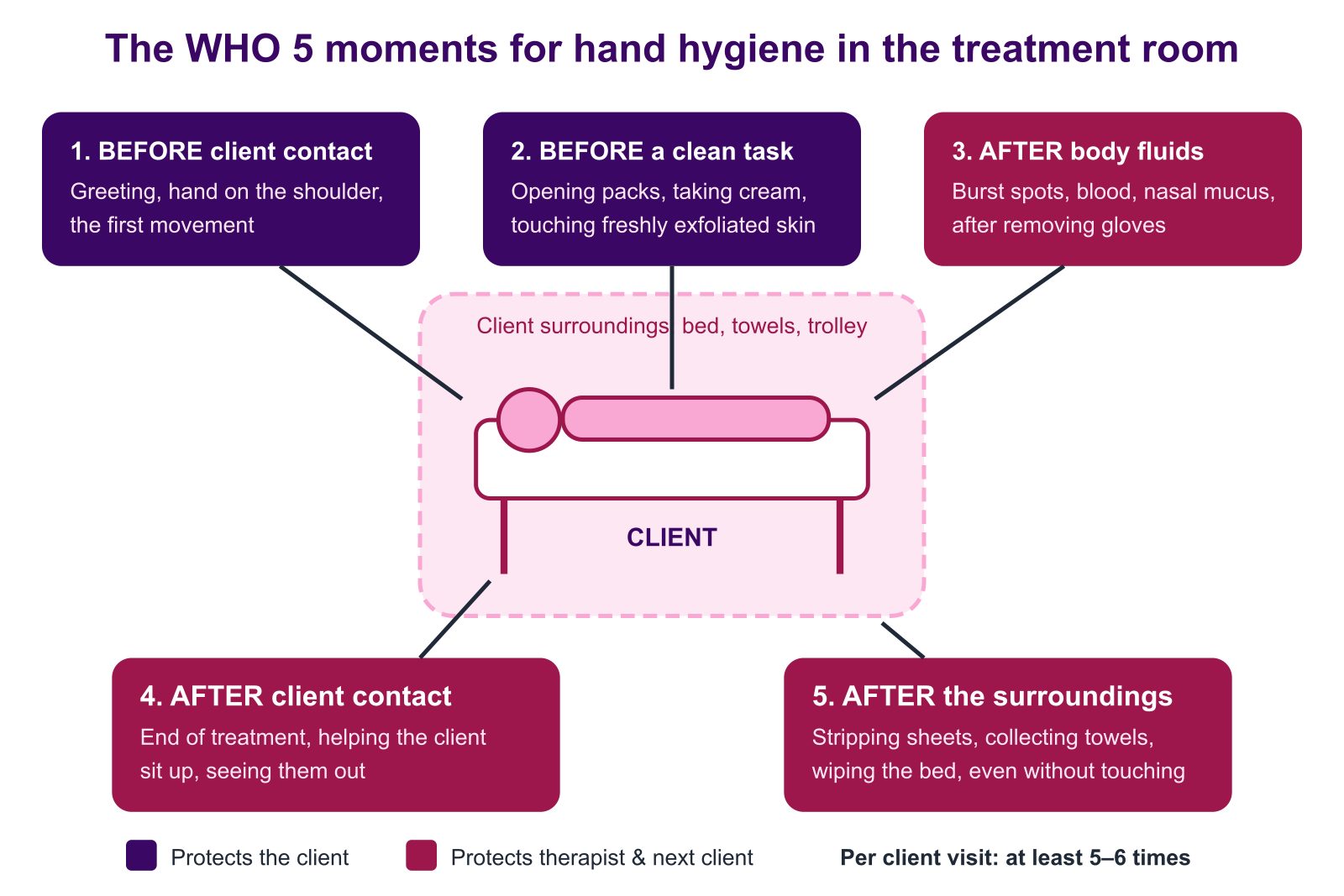
Applied to a facial: before touching the client (1); before opening instruments or taking out products (2); if an inflamed spot bursts, remove gloves and clean your hands (3), then (2) again; seeing the client off (4); collecting towels and removing sheets (5). At least 5–6 times per client.
The 6 hand-rubbing steps, and choosing alcohol rub or soap
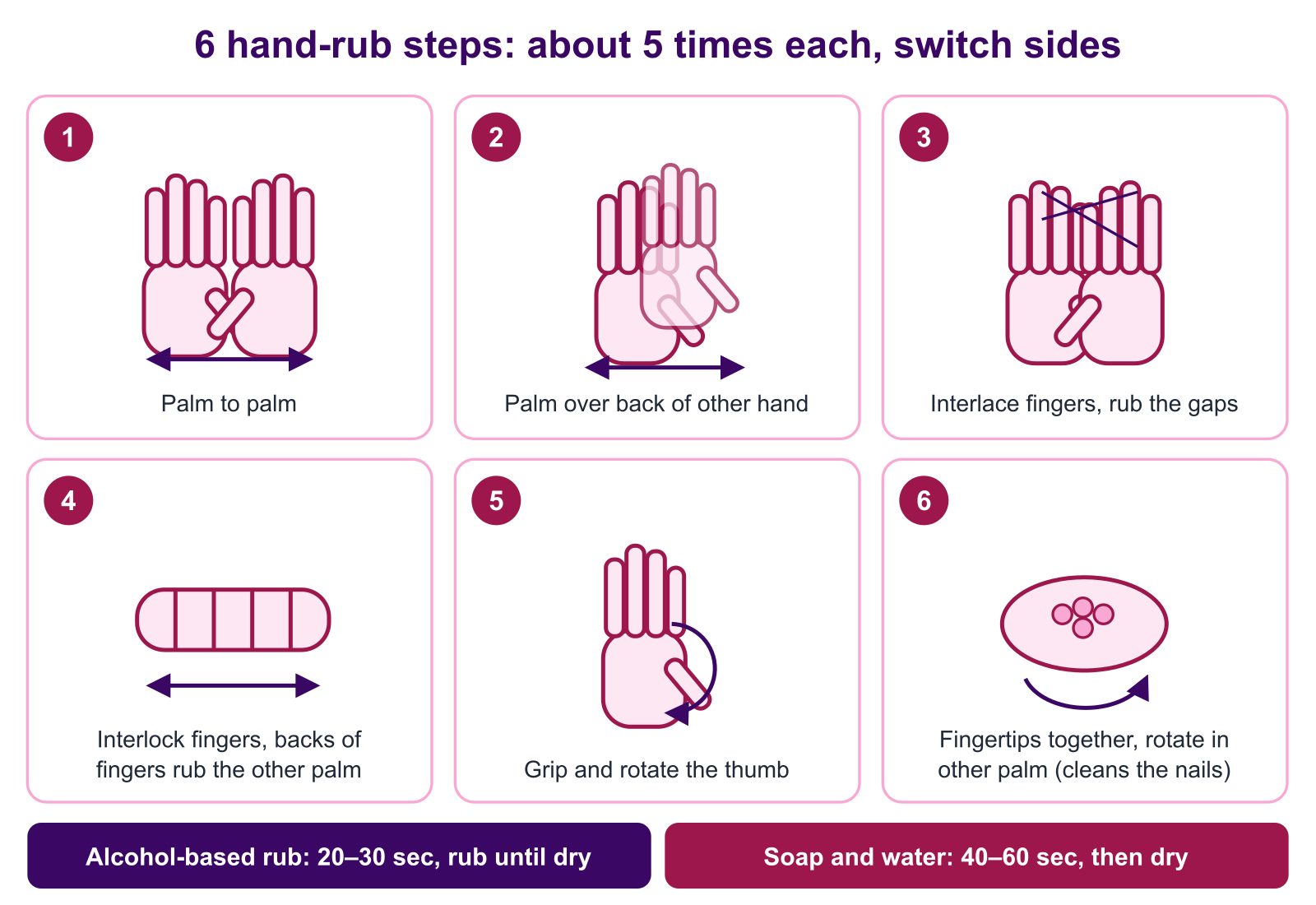
Whether you use alcohol-based hand rub or soap, the rubbing action is the same: 6 steps, each repeated about 5 times, covering both hands.
- Rub palm to palm.
- Right palm over the back of the left hand with fingers interlaced, and vice versa.
- Palm to palm with fingers interlaced, rubbing firmly between the fingers.
- Interlock the fingers: backs of the fingers of one hand against the palm of the other; swap sides.
- Clasp the thumb of one hand in the palm of the other and rotate; swap sides.
- Bunch the fingertips together and rotate them in the palm of the other hand to clean fingertips and nails; swap sides.
When to use alcohol rub, and when you must wash with soap
| Situation | Choose | Time | Notes |
|---|---|---|---|
| Hands not visibly dirty, between tasks with the same client | Alcohol-based hand rub (usually 60–80%) | 20–30 seconds, rub until dry | Take a full palmful of rub; do not wipe on a towel while your hands are still wet with alcohol |
| Hands with massage oil, cream or clay mask on them | Soap and water | 40–60 seconds for the whole procedure | Alcohol does not penetrate a layer of oil; it must be washed off |
| Hands soiled with blood or body fluid, after using the toilet | Soap and water | 40–60 seconds | Wash immediately; do not wait until the task is finished |
| After removing gloves | Alcohol rub if hands are clean; soap if the glove tore or hands are soiled | As above | Gloves can have tiny invisible holes |
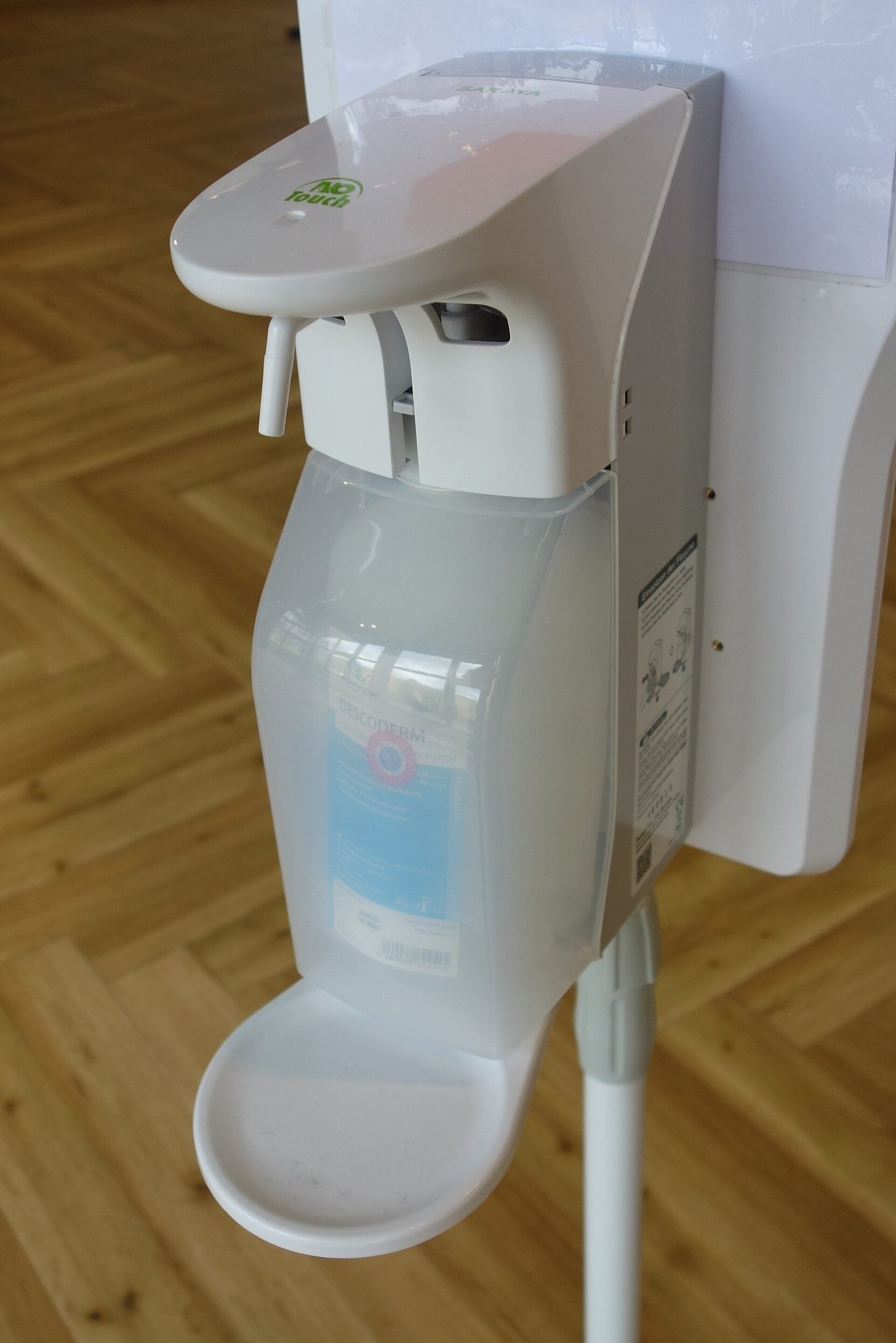
Photo: Enter / Wikimedia Commons, CC BY 4.0

Washing with soap correctly: wet your hands, take enough soap, rub through the 6 steps, rinse under running water, dry with a single-use paper towel and use that same towel to turn off the tap. Wet hands transfer germs more easily than dry hands, so drying is not an optional extra; do not use a hand towel that hangs in shared use all day.
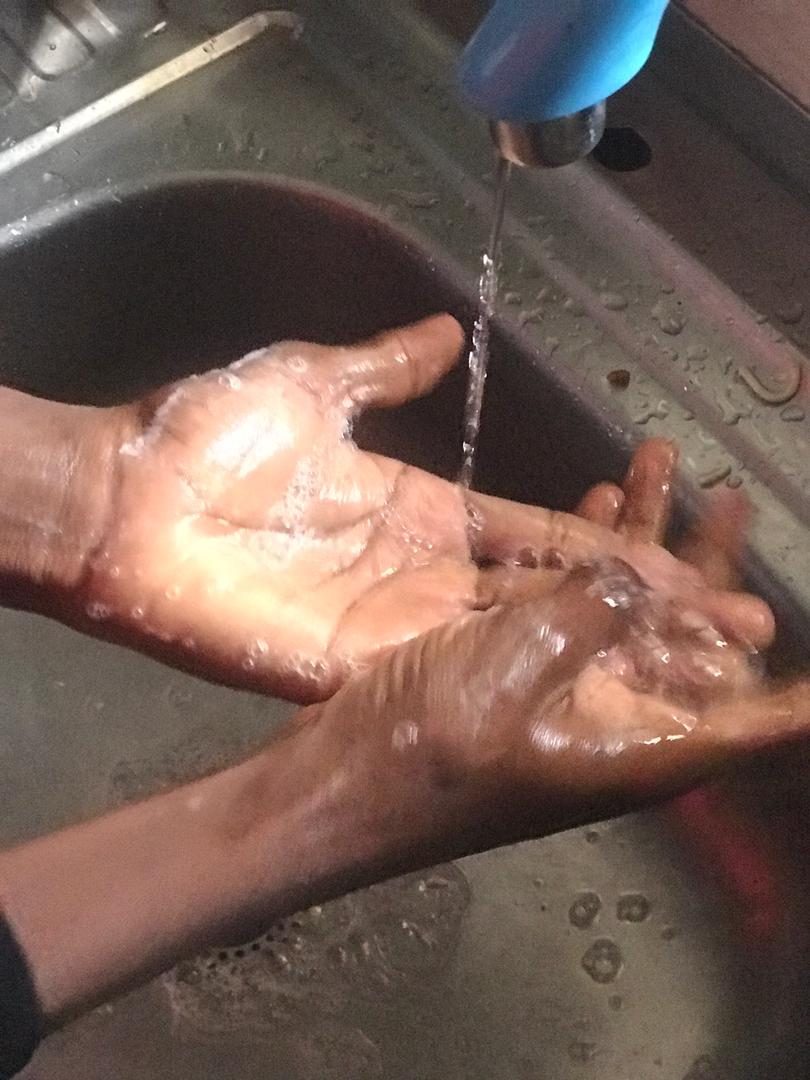
Photo: Justmee3001 / Wikimedia Commons, CC BY-SA 4.0

Conditions for hand hygiene to work: nails cut short, no gel polish, no artificial nails; no rings, bracelets or watches while working; moisturise your hands at the end of the shift so the skin does not crack; cover any scratch on your hand with a waterproof dressing and wear gloves.
Cleaning, disinfection, sterilisation: what is the difference?
These three words are often used interchangeably. In the profession they are three different levels, and each level only works when the previous level has been completed.
- Cleaning means removing visible dirt: oil, cream, skin flakes, hair and dust, using water, detergent and scrubbing. Cleaning by itself removes most micro-organisms, and it is a mandatory condition for the two levels that follow.
- Disinfection means using chemicals (or heat) to kill most disease-causing micro-organisms on a surface that is already clean. It does not kill everything, especially bacterial spores. Two figures decide how effective it is: the concentration and the contact time stated on the label.
- Sterilisation means killing all micro-organisms including spores, usually with high-pressure steam in an autoclave. It is used for reusable metal instruments that may come into contact with blood or broken skin.
Why contact time matters more than you think
Disinfectants do not kill germs the moment they touch them. The surface must stay continuously wet for a period of time, which may be 30 seconds for some products and several minutes or longer for others, depending on the product and the type of micro-organism; the exact figure is on the manufacturer's label. Spraying and then immediately wiping dry is almost useless. 70% alcohol dries very quickly on door handles and machine knobs, so you sometimes need to wipe a second time to achieve the full contact time. 70% alcohol kills germs better than 90% or stronger, because the water helps the alcohol penetrate the bacterial cell and makes it evaporate more slowly.
Chemical safety: dilute exactly according to the label using a measuring cup, write the date and time of mixing, and discard solutions past their use-by time; never mix bleach ("Javel" water, which contains chlorine) with acidic or ammonia-based cleaners, because this produces toxic gas; wear gloves and work in a ventilated area; never store chemicals in drinking-water bottles; surface chemicals must never be applied to a client's skin.
Processing equipment by group
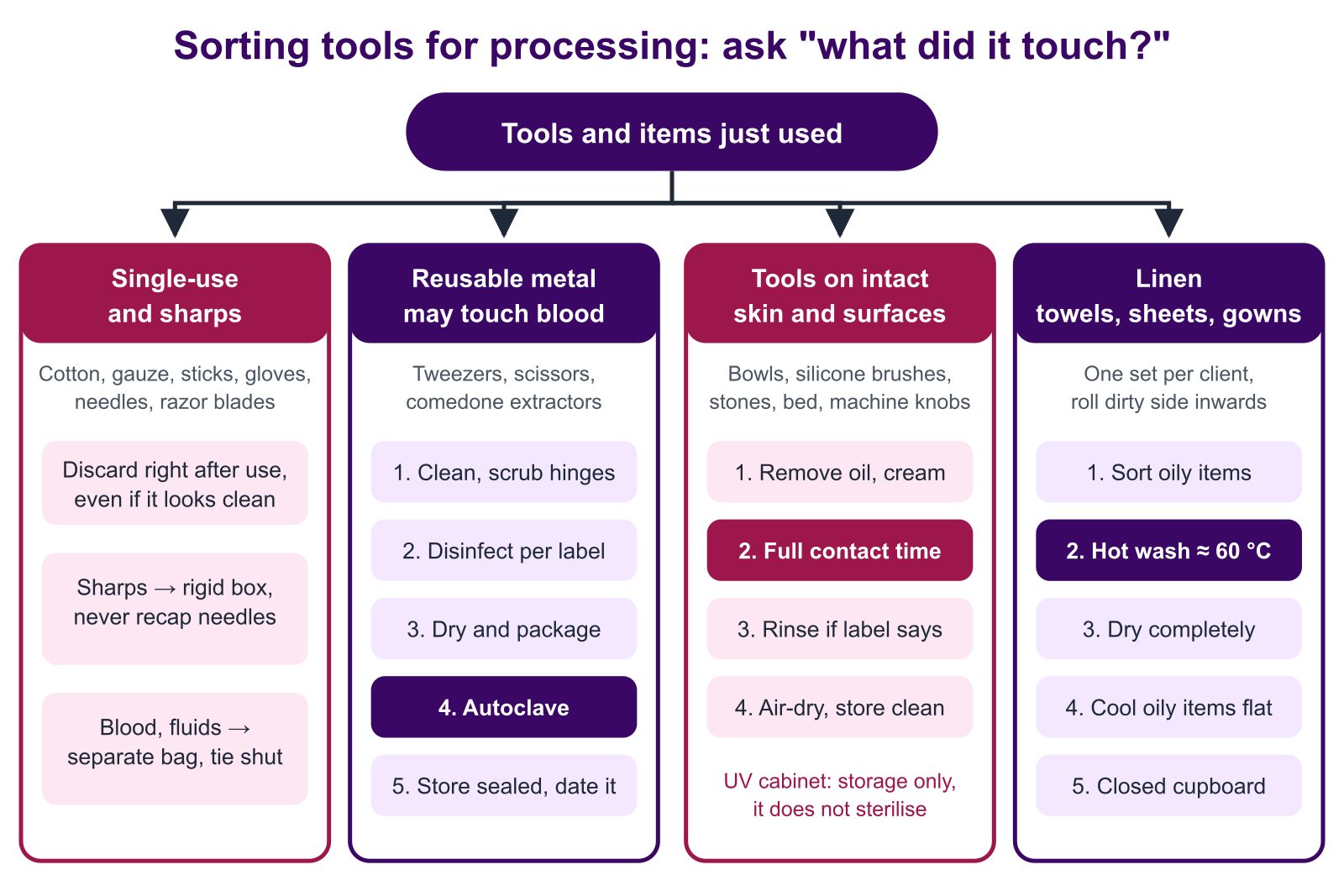
Instead of memorising how to process each item, ask one question: what does this item touch? Medicine uses a similar classification (usually called the Spaulding classification): instruments that penetrate the skin or touch blood are the highest-risk group, those touching mucous membranes or broken skin are medium risk, and those touching intact skin are low risk. In the spa, we divide items into three practical groups as follows.
Group 1: Single-use items
Cotton wool, gauze, wooden spatulas for cream, disposable cleansing sponges, face-hole paper covers, gloves, razor blades, needles. The only rule: use once, then discard, even if it still looks clean, and even if you would reuse it on the same client at their next visit. Packaging that is torn, damp or past its expiry date is also discarded. Sharps go straight into a sharps container within arm's reach; never recap a needle with two hands, never bend it, and never carry a needle across the room.
Group 2: Reusable metal instruments
Tweezers, scissors, comedone extractors (used in spas permitted to carry out non-invasive cleansing of blemishes according to the establishment's rules). The mandatory sequence: clean (scrub joints and crevices thoroughly under running water, wearing heavy-duty gloves) → disinfect according to the label → dry → pack and date → sterilise in the autoclave if the instrument touches damaged skin or blood → store sealed, opening the pack only in front of the client. Open the joints of scissors and tweezers when soaking and autoclaving so that the chemical and steam reach the inner surfaces.
Group 3: Items touching intact skin, and surfaces
Bowls, spoons, silicone brushes, massage stones, steamer heads, the treatment bed, bolsters, the face cradle, the trolley, door handles. The sequence: clean → disinfect for the full contact time → rinse if the label requires → leave to dry. Bristle brushes and wooden tools are hard to disinfect because they absorb water and have crevices; many spas switch to silicone brushes and smooth basalt stones that are easier to process. The leather or faux-leather surface of the couch must be intact; tears and cracks cannot be disinfected and must be repaired or replaced.
The autoclave, and the limits of the UV cabinet
An autoclave uses saturated steam under pressure, with common cycles at 121 °C or 134 °C for the time specified by the manufacturer. It only gives a correct result when: the instruments have been cleaned and dried, packed in purpose-made pouches, not overloaded, run through the full cycle including drying, and there is indicator tape or a colour-change strip on the pouch to prove the pack has been through the autoclave. A pouch that is wet or torn after autoclaving is no longer considered sterile. Trainee therapists only operate the autoclave after being shown how, and record every load in the log book.
The UV cabinet (ultraviolet lamp cabinet) is often wrongly called a "steriliser". UV light only acts on surfaces it shines on directly; the underside of instruments, joints and crevices, overlapping areas, and layers of oil or dust are all "shadows" the rays cannot reach, and the lamp weakens with hours of use even while it still lights up. For this reason a UV cabinet does not replace an autoclave or disinfectant soaking; it is only a place to store instruments that have already been processed. Never look at a UV lamp while it is switched on.
Towels and linen: wash hot, dry completely, store separately
Towels, sheets and robes touch the client the most and stay damp the longest. One client, one set. Collect used items by rolling the dirty side inwards, holding them away from your body, and placing them straight into a lidded basket; never shake out towels in the room.
- Sort before washing: separate items soiled with blood or body fluid (wash separately, wear gloves when handling), items heavily soaked with oil, and ordinary items.
- Wash hot: choose a hot-water cycle of about 60 °C or above if the fabric and machine allow. If you can only wash in warm water, add a suitable laundry detergent or laundry disinfectant according to the label. Oily items need a degreasing detergent and may need washing twice.
- Tumble-dry or air-dry completely: a towel folded away while slightly damp will smell and go mouldy overnight.
- Let oily items cool after drying: towels with residual massage oil that are tumble-dried hot and then piled up can catch fire spontaneously, because the oil oxidises and generates heat. Take them out as soon as the machine stops, spread them out to cool, and never leave them overnight in the dryer drum.
- Store in the clean area: a cupboard with doors, away from the dirty-laundry basket; never put clean towels on a trolley next to the bin.
Photo: Ата / Wikimedia Commons, CC0

Towels that are yellowed, stiff, or smell of rancid oil even though freshly washed have oil built up in the fibres: tell the manager so they can be taken out of use.
Waste and sharps
The treatment room produces three types of waste, and each needs its own place in the room, positioned near the door (the dirty area):
- General waste: paper, packaging, cotton wool without blood or body fluid. A pedal bin with a lid and a liner bag.
- Waste contaminated with blood or body fluid: gauze, cotton wool and gloves with blood or pus on them. Place in a separate bag, tie it closed, and dispose of it according to the instructions of the local waste-collection contractor the spa has an agreement with.
- Sharps: needles, blades, broken glass ampoules. Only place them in a rigid, puncture-proof container with a lid; when it is about three-quarters full, close the lid permanently and replace the container; never press down with your hand to compact it.
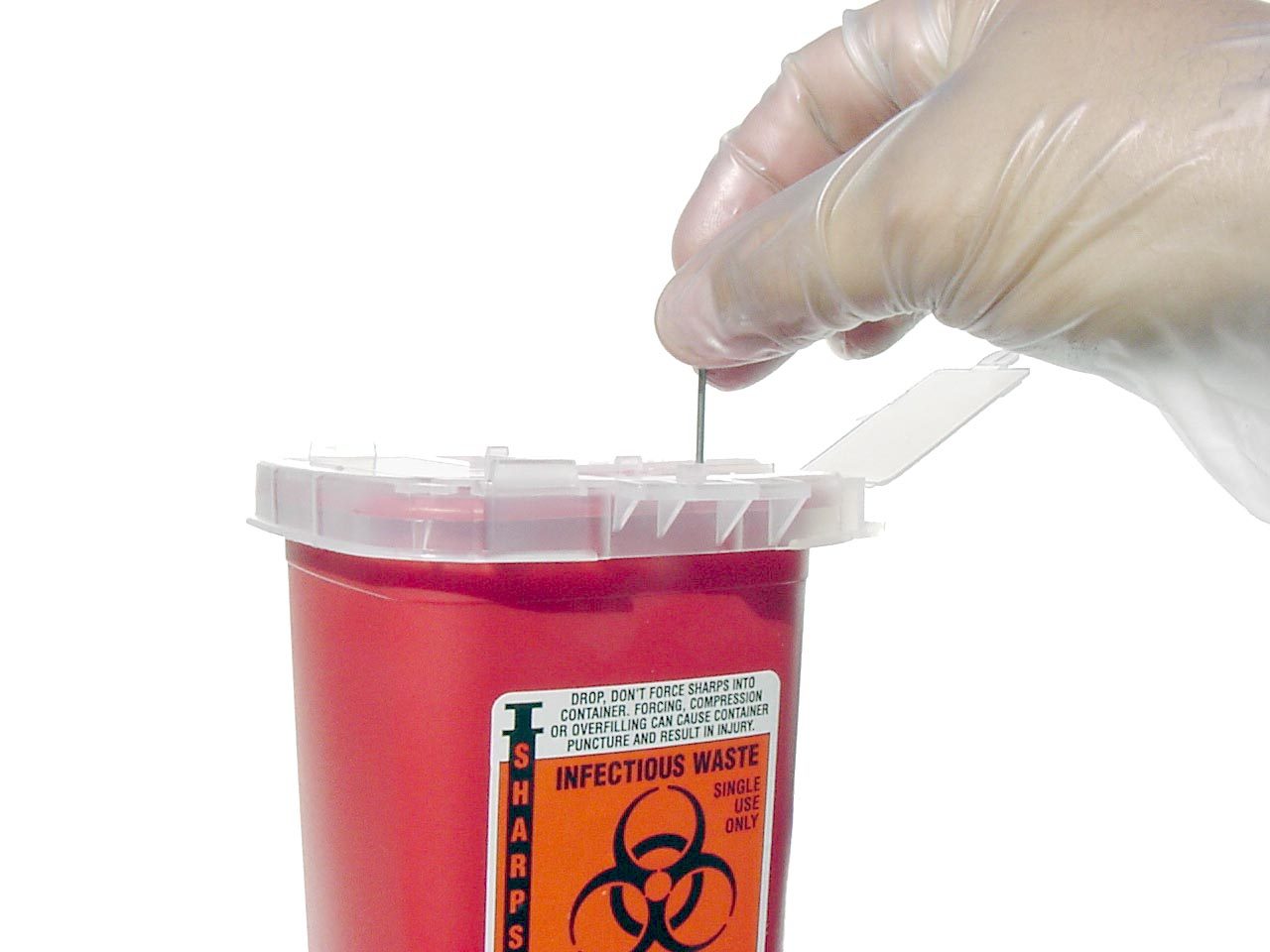
Photo: Photographed by William Rafti of the William Rafti Institute. / Wikimedia Commons, CC BY 2.5

If a needle or sharp object pierces your hand
- Let the wound bleed freely; do not squeeze hard, and do not suck the wound.
- Wash immediately under running water with soap; do not use strong chemicals on the wound.
- Tell the manager immediately, recording which instrument it was, which client it had been used on, and the time it happened.
- Go to a medical facility as soon as possible, ideally within the first few hours, so that a doctor can assess the risk and decide whether testing or preventive treatment is needed.
Therapists should ask a doctor about hepatitis B vaccination if they are not already immune; it is an extra layer of protection, not a substitute for handling sharps correctly.
Preventing cross-infection between two clients
The five principles below combine everything above into a habit for every client; the instructor observes exactly these points when assessing you.
- One client, one set: towels, sheets, paper covers, gloves, cotton wool and the processed instrument set are all fresh for each client; the spa must have enough sets in rotation so that nobody is forced to shorten soaking or autoclaving times.
- Take products out with a clean spatula: decant the amount you need into a bowl before you start; discard any leftover, never pour it back into the jar; never dip fingers or a spatula that has touched skin into the jar.
- Gloved hands also need discipline: gloves that have touched the client must not handle your phone, open cupboards or adjust the music. If you need to do something else, remove the gloves and clean your hands.
- Wipe from clean to dirty, from top to bottom: machine knobs, lamp, trolley, face cradle, couch, couch legs, and the floor last; use colour-coded cloths for each area.
- Screen first rather than deal with it afterwards: if a client has blisters around the lips, skin suspected of fungal infection, impetigo, open wounds, or red, discharging eyes, avoid that area or postpone the service, tell the manager and advise the client to see a doctor. A therapist who has a cold or flu, blisters on the hands or diarrhoea also reports it and takes leave or switches duties.
Common mistakes
| Mistake | Why it is dangerous or wrong | The right way |
|---|---|---|
| Spraying the couch with disinfectant and wiping it dry immediately | Not enough contact time; the germs are not yet dead | Keep the surface wet for the time on the label; wipe a second time if it dries early |
| Using alcohol rub on hands that still have massage oil on them | Alcohol does not penetrate the oil layer | Wash with soap and water for 40–60 seconds |
| Putting instruments still covered in cream into the UV cabinet and calling them "sterilised" | UV does not pass through dirt or into joints; a UV cabinet does not sterilise | Clean → disinfect or autoclave; the UV cabinet is only for storage |
| Mixing the solution twice as strong "to be sure" | No cleaner, corrodes instruments and irritates the skin of your hands | Dilute exactly according to the label using a measuring cup |
| Wearing the same gloves from one client to the next, just wiping them with alcohol | The gloves become a route of transmission | Change gloves for every client, clean your hands after removing them |
| Recapping a needle before disposing of it | The action that causes the most needlestick injuries | Drop it straight into a sharps container within arm's reach |
| Taking cream out of the jar with your finger | Introduces germs into the whole jar, spreading to every following client | Use a clean spatula and decant into a bowl before you start |
Pass criteria for this lesson
The instructor observes you during one sample client session and one room clean-down. You pass when you:
- Name all 5/5 WHO moments for hand hygiene and identify the correct moment in 4 situations given by the instructor.
- Perform all 6/6 hand-rubbing steps, with alcohol rub for 20–30 seconds and soap for 40–60 seconds (timed by the instructor).
- During a sample facial, clean your hands at least 5 times at the correct moments, and touch no other objects while wearing gloves.
- Correctly place 10/10 items given by the instructor into their processing group (single-use, reusable metal, items and surfaces touching intact skin, linen).
- Read the label of a disinfectant and correctly state the dilution ratio, contact time and shelf life after mixing; dilute it correctly using a measuring cup.
- Explain within 1 minute why a UV cabinet is not sterilisation and what conditions an autoclave requires.
- State the 4 steps to take after a needlestick injury and the clean-to-dirty order for wiping down the room.
Frequently asked questions
Washing my hands so much makes them crack; should I just use alcohol rub for everything?
Alcohol-based hand rubs containing emollients usually dry the skin less than repeated washing with soap, so using alcohol rub when your hands are not dirty is sensible; when your hands have oil, cream or body fluid on them, you still wash with soap. Apply hand cream during breaks and at the end of the shift. If your hands crack and bleed, tell the manager and see a dermatologist.
How should reusable hot massage stones be processed?
Stones touch intact skin, so they belong to the clean-then-disinfect group: wash off the oil with warm water and soap, disinfect according to the label, dry and store covered. The water heater for the stones does not replace the oil-washing step.
What if a client with a blister on the lip wants a facial?
Blisters around the lips may be herpes, which spreads very easily via hands and equipment. It is best to postpone facial services until it has healed and advise the client to see a doctor; explain gently that this is to protect the client's skin, without guessing at the illness.
Is it safer to wear gloves for the whole shift?
No. Gloves worn for a long time become damp inside and tear easily, and a gloved hand touches just as many things as a bare one. Only wear them when there is a risk of contact with body fluid, blood or chemicals, or when you have a scratch on your hand; change them for every client, and clean your hands before putting them on and after taking them off.
Further reading
The 6-step instrument processing routine and the 15-minute room clean-down schedule between two clients are in the article Hygiene and disinfection procedures for spa equipment and treatment rooms. A self-check question set on hygiene is in Spa safety and service skills check.