
At Level 2, a client books a 90-minute body massage and reception writes your name next to it: from the moment the client walks into the room until they finish their cup of ginger tea, everything is your responsibility. In many Vietnamese spas, clients rarely complain because "your hands are weak"; far more often it is "you spent too long on my back and rushed my legs", "turning over felt awkward" or "the sticky oil got all over my hair". This lesson helps you deliver a complete Swedish massage session as a senior therapist.
You learned posture, the five groups of movements, anatomy, towel draping and contraindications at Level 1; this lesson puts them together into a complete routine and goes deeper into the points where therapists tend to stumble.
By the end of this lesson, you will be able to:
- Draw up a time plan for 60-minute and 90-minute sessions by body area, and readjust that plan within 1 minute when the client wants to focus on one area while keeping the total time correct.
- Turn the client from prone (face down) to supine (face up) using the "towel wall" technique in about 1–2 minutes, without exposing intimate areas and without the client losing balance.
- Choose a suitable carrier oil, estimate the amount of oil needed for each area and for the whole session, and warm the oil correctly.
- Adjust pressure on a 1–5 scale based on what the client says and on body signals, and know when to stop working an area.
- Handle three common situations mid-session: the client falls asleep, feels cold or feels pain; and close the session with appropriate aftercare advice, without over-promising.
What Swedish massage is and how it differs from an ordinary "oil rub"
Swedish massage is the classic Western body massage, performed with oil or cream directly on the skin, area by area under towel draping, combining the five groups of movements you have already learned: effleurage (stroking), petrissage (kneading), friction (deep rubbing), tapotement (percussion) and vibration. Many Vietnamese spas call it "aromatherapy oil body massage", to distinguish it from Thai massage (no oil, lots of stretching).
A genuine Swedish session rests on three principles:
- Go from superficial to deep, then back to superficial. Each area opens with effleurage to spread the oil, then moves on to kneading and friction, and closes with gradually lighter effleurage. The whole session works the same way: the beginning and end are lighter than the middle.
- Stroke towards the heart on the limbs. From ankle up to thigh, from wrist up to shoulder; the return stroke glides lightly.
- Continuous and rhythmic. Your hands never leave the client abruptly; movements are slow and even, like the breathing of someone at rest.
Swedish massage in a spa is a relaxation and wellbeing service, not a medical treatment. You may say "it helps relax the muscles, feels pleasant, and you may sleep better after the session"; you must not say "it cures back pain", "it breaks down fat" or "it detoxifies".

Photo: Paradisus Bali / Wikimedia Commons, CC BY-SA 4.0

Time allocation for 60-minute and 90-minute sessions
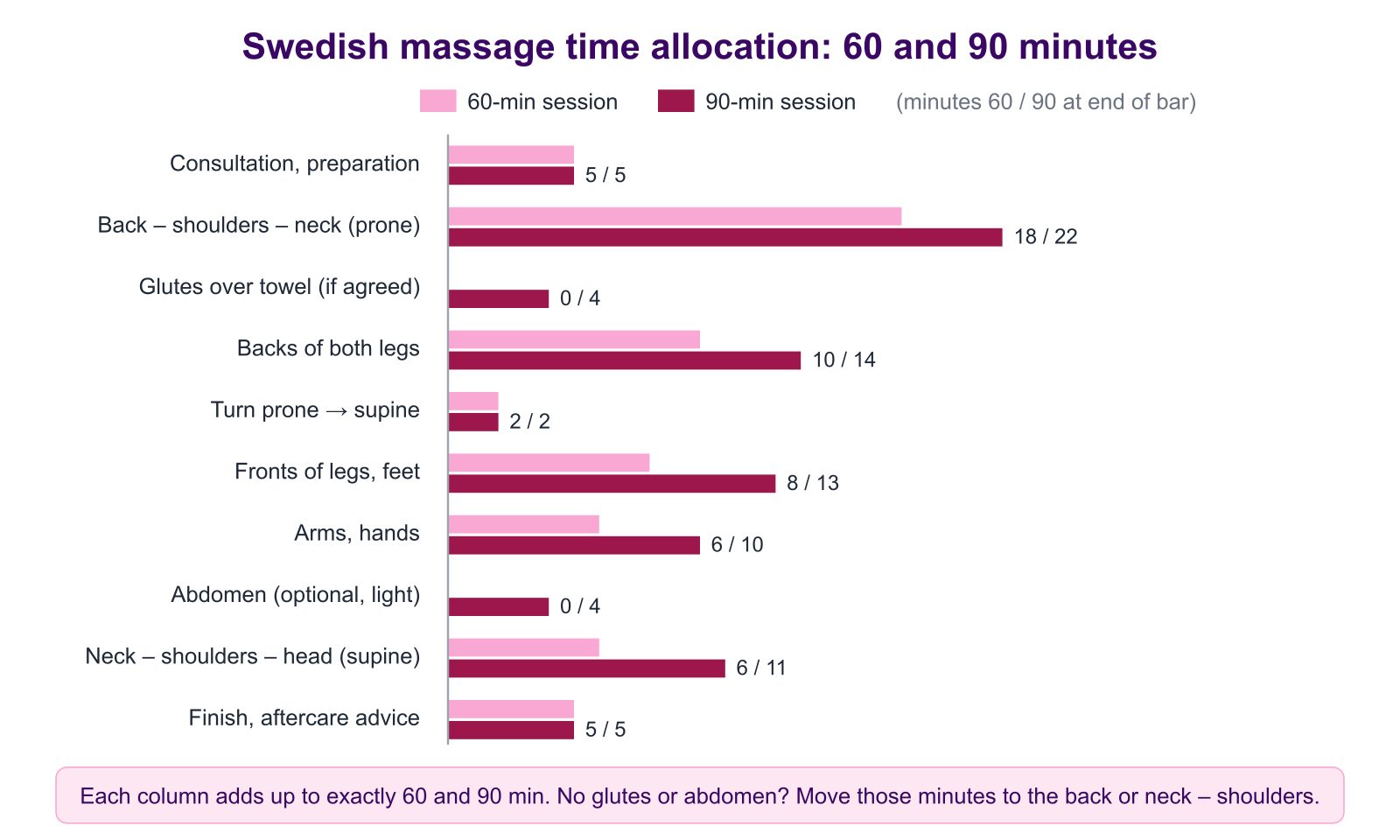
You already know the basic 60-minute plan. At Level 2 the plan is more detailed: turning time is counted separately, the arms are separated from the neck and shoulders, and you know where a 90-minute session is "richer". Time is counted from when the client enters the room until they leave the bed; consultation at the front desk and changing clothes are not included.
| Area / stage | 60 minutes | 90 minutes | Senior therapist's notes |
|---|---|---|---|
| Quick in-room consultation, preparation | 5 | 5 | Confirm the area to focus on, the preferred pressure and the oil the client has chosen |
| Back – shoulders – nape (prone) | 18 | 22 | The area where clients carry the most tension; the 90-minute session adds time for the shoulder blades and the muscles along the spine |
| Hips, gluteal muscles over the towel | 0 | 4 | Only if the client agreed at the start; work over the towel or with the towel edge neatly folded |
| Backs of both legs | 10 | 14 | Divide evenly between sides; avoid the back of the knee |
| Turning from prone to supine | 2 | 2 | Counted in the timing so it does not "eat into" the final part |
| Fronts of legs, feet | 8 | 13 | The 90-minute session works the feet and ankles thoroughly |
| Both arms, hands | 6 | 10 | The hands are an area many office-worker clients love |
| Abdomen (optional) | 0 | 4 | Only with the client's consent, light pressure, clockwise |
| Neck – shoulders – head (supine) | 6 | 11 | Lighter pressure than the back; the 90-minute session adds a scalp massage |
| Closing, aftercare advice | 5 | 5 | Never cut this part, even when running late |
| Total | 60 | 90 |
Three rules for adjusting the plan
- Take time from other areas, never from the beginning or the end. If the client wants 5 extra minutes on the back: take 2 minutes from the backs of the legs and 3 minutes from the fronts of the legs. Do not drop the 5 minutes of consultation or the 5 minutes of closing.
- No area drops below "one full pass". Each limb gets at least a few passes of opening effleurage – kneading – closing effleurage, about 2–3 minutes per leg; otherwise the client will feel that area was "skipped".
- If the client arrives late, shorten evenly; do not run over into the next client's slot. Tell the client straight away: "We have 45 minutes left, so I'll prioritise your back, shoulders and legs, is that all right?", and write the actual time on the client record card.
To know whether you are on time, choose 3 "checkpoints" instead of looking at the clock constantly. For a 90-minute session: at around minute 31 you should be working on the hips or starting the backs of the legs (5 + 22 + 4 = 31); at around minute 47 you should be turning the client (31 + 14 = 45, plus 2 minutes of turning); at around minute 74 you should be starting the neck – shoulders – head (47 + 13 + 10 + 4 = 74). Being more than 3 minutes off at a checkpoint is the signal to adjust the next area.
Massage oil: choosing a carrier oil, quantity and warming
Common carrier oils in spas
A carrier oil is a vegetable oil used as the main lubricant, either on its own or as the base for blending essential oils (next lesson). Each type has its own slip, absorption and risks:
| Carrier oil | How it behaves in use | Notes |
|---|---|---|
| Sweet almond oil | Medium slip, absorbs slowly, suits long strokes; many spas use it as their main oil | Ask about nut allergies before use |
| Jojoba oil | Actually a liquid wax, not greasy, slow to go rancid, suits oily skin and clients who dislike greasiness | Expensive, usually blended with other oils |
| Fractionated coconut oil | Thin, does not solidify in the cold, almost odourless, easier to wash out | Different from ordinary coconut oil, which solidifies when the weather is cool |
| Grapeseed oil, sunflower oil | Light, absorbs quickly, affordable | Because it absorbs quickly, you need to top up more often |
| Massage cream or balm | Grips the hands, makes deep friction easy, runs less | Less slip, not suitable for fast long strokes |
Oils used in a spa must be products of clear origin. Products applied to the skin for care are cosmetics and must have a cosmetic product notification under Circular 06/2011/TT-BYT on cosmetics management; therapists must not buy unlabelled oil from the market to use on clients, nor "mix in" extra ingredients on the spot in the treatment room.
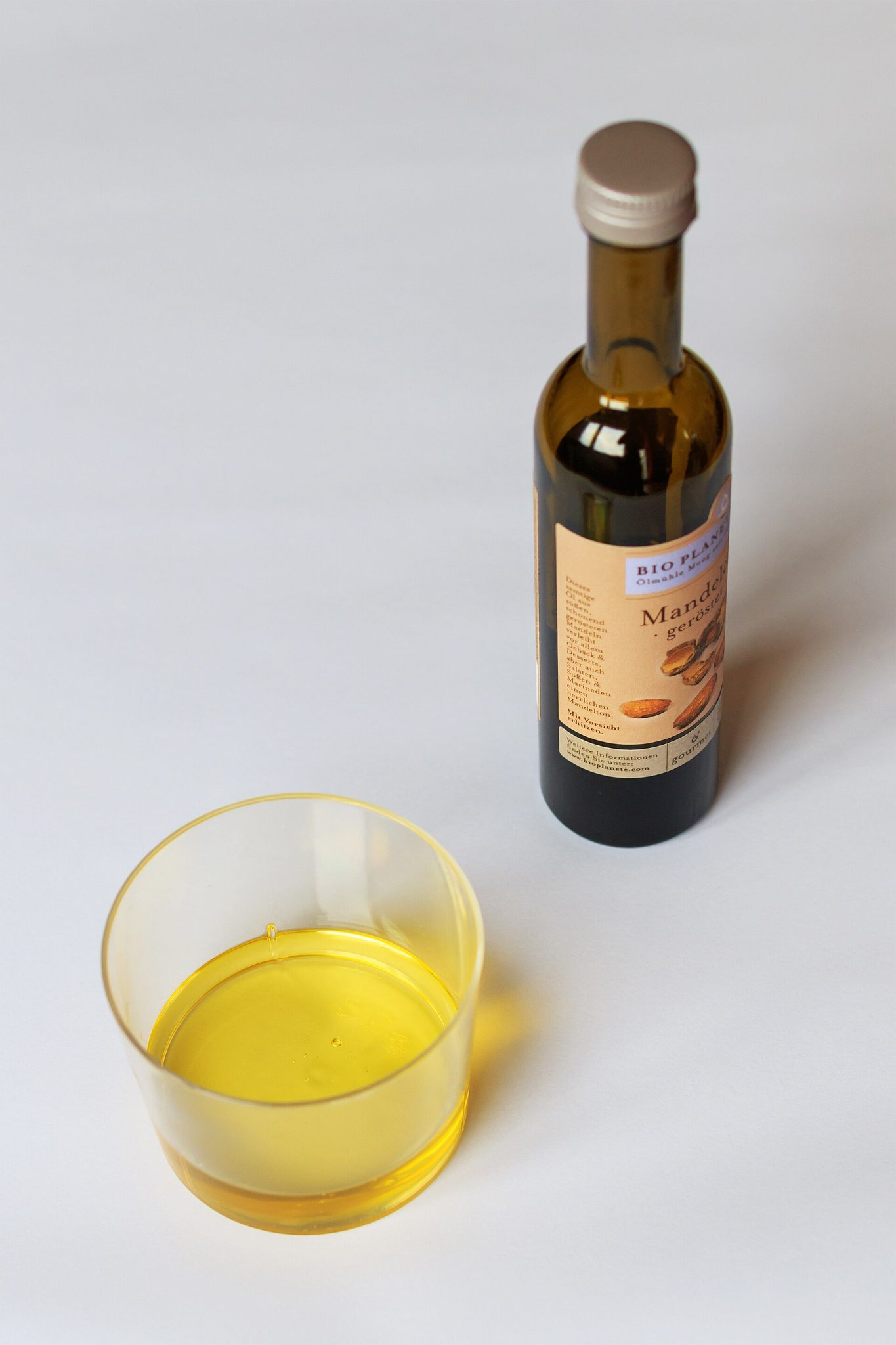
Photo: A.Savin / Wikimedia Commons, CC BY-SA 3.0

How much oil is enough
For an average adult with normal skin, a 60-minute session usually uses about 15–25 ml of oil; a 90-minute session uses correspondingly more. Dry skin, a lot of body hair or a tall, large client needs more; oily skin or a petite client needs less. How to check by hand:
- Enough oil: your hands glide smoothly with a little "grip" so you can move the tissue; the skin has a light sheen, without running streaks.
- Too little oil: the skin is dragged along with your hands, hairs are pulled and the client feels a burning sensation. Add a small amount; do not pour a whole handful.
- Too much oil: your hands slip, you cannot create deep pressure, oil runs onto the sheets and into the hair. Wipe off the excess with a warm towel and continue.
The order is always: pump the oil into your own palm, rub your hands together to warm it, and only then place your hands on the client. Never drip oil directly onto the client's back. Start each new area with about 1 pump and add gradually.
Warming oil safely
Cold oil placed on the back makes the client tense up and lose relaxation in the very first minute. Common ways to warm oil: stand the bottle in a cup of warm water, or use a purpose-made oil warmer following the manufacturer's instructions. Do not heat oil in a microwave, because it heats unevenly and creates very hot spots. Before use, put a little on the inside of your own wrist: the oil should be warm, close to skin temperature, not hot.
Turning the client safely from prone to supine
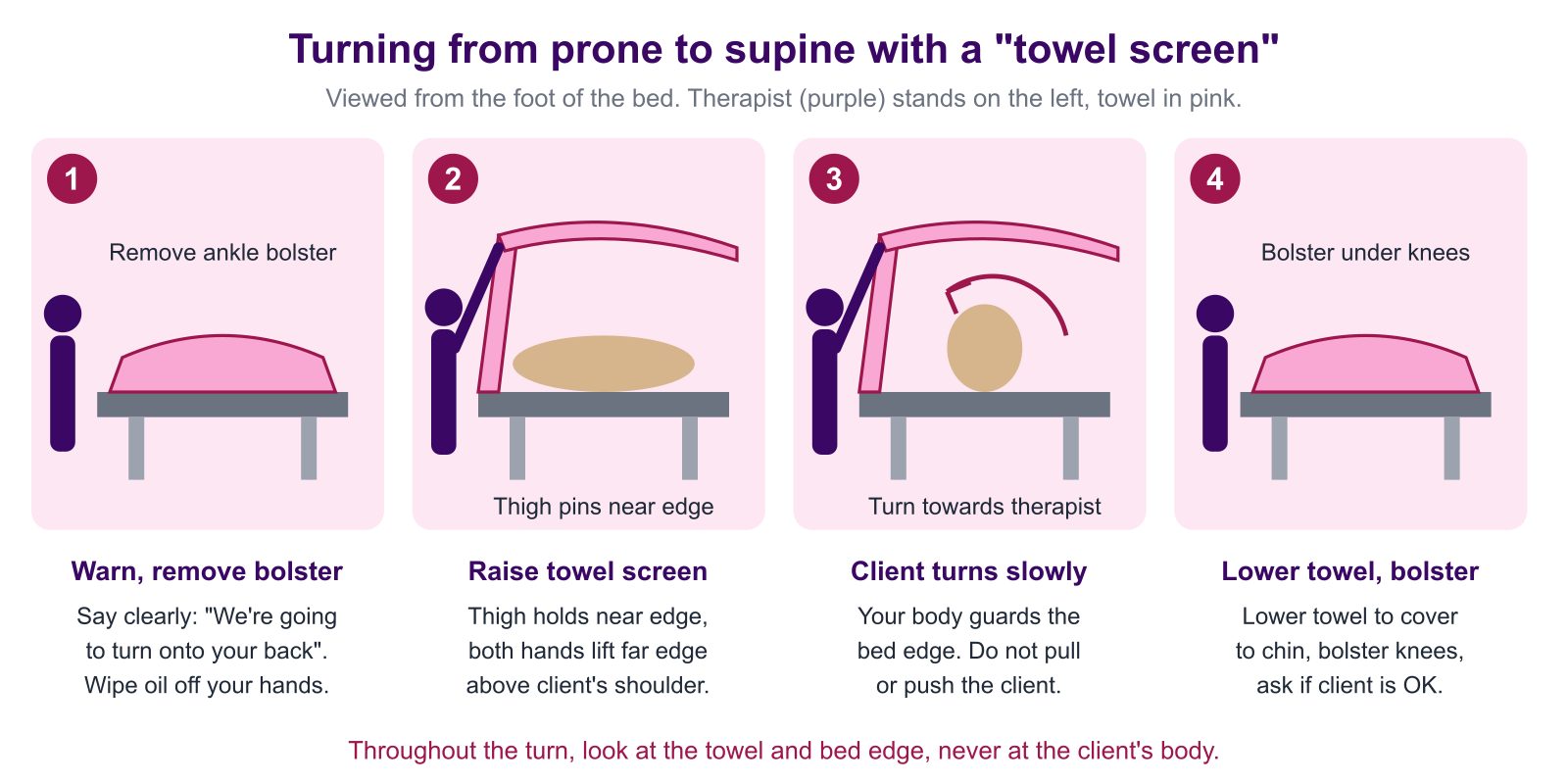
Turning is the moment when the client feels most self-conscious and is most likely to slip and fall: their body is relaxed, there is still oil on the skin, and the bed is narrow. Use one fixed technique for every client: the "towel wall", meaning you raise the draping towel to form a screen between the client and you while the client turns over by themselves.
Steps for turning the client
- Tell the client in advance. "Your back is done now; let's get ready to lie on your back. Take your time, I'll hold the towel for you."
- Wipe your hands, remove the bolster. Wipe the oil off your hands so the towel does not slip. Remove the ankle bolster and put it within reach. If the bed has a face hole, tell the client to lift their head out of the face hole as they turn.
- Raise the towel wall. Stand level with the client's hip. Use your thigh to press the near edge of the towel against the side of the bed. With both hands, hold the far edge of the towel and lift it straight up, higher than the client's shoulder, to form a wall.
- Guide the client to turn towards you. "Please turn towards me." Turning towards the therapist means your body blocks the edge of the bed, so the client cannot roll off. Do not pull their arm or push their hip.
- Lower the towel and adjust. Once the client is lying stably on their back, lower the towel slowly, covering them completely from neck to feet. Place a bolster under the knees to reduce strain on the lower back. Change the face towel if the old one is damp, and free any trapped hair.
- Check again. "Are you comfortable lying like this? Are you cold?" Then rest your hand on the shoulder or foot over the towel for a few seconds before continuing.
Special cases
- Older clients, clients with back pain, overweight clients: turn in stages: bend the knees, roll onto the side, then lie on the back. Do not rush them, and do not try to support them on your own; in the next session you can work in the side-lying position.
- Clients who feel dizzy when changing position: stop in the side-lying position, wait until the client is stable and check on them; if the dizziness persists or comes with nausea or chest pain, inform the shift leader and follow the first-aid procedure you have learned.
Respect for the client: While turning the client, keep your eyes on the towel and the edge of the bed, not on the client's body. Never comment on the client's body. The towel only uncovers the area being worked on; the chest and intimate areas stay fully covered throughout the session. Massage in a spa is a wellbeing service; if a client says or does anything inappropriate, you stop the session, leave the room and report it to the manager.
Adjusting pressure to the client's feedback
A senior therapist does not wait for the client to complain of pain before reducing pressure: you ask proactively, observe, and share a common language with the client about pressure.
The 1–5 pressure scale
Introduce this scale during the consultation: "I grade my pressure from 1 to 5: 1 is very light, like stroking, 3 is medium, and 5 is the strongest that still feels comfortable for you. Whenever you need to, just tell me a number." First-time clients start at 3.
- When to ask about pressure: around minute 2–3 of the first area, each time you move to a major new area, and when you switch to a tool for deep pressure such as the forearm.
- Correct pressure: the client breathes evenly, the muscles soften under your hands, and they might say "tight, but it feels good".
- Too much pressure: the client holds their breath, tenses their muscles, curls their toes, lifts their head, or says "yes, it's fine" in a strained voice. Reduce by one level immediately; do not wait until the end of the movement.
Increasing pressure correctly
If the client wants it stronger: increase pressure using your body weight and the contact surface, not by straining your thumbs. Move from the palm to the heel of the hand, then to the forearm on large muscle areas (back, thighs), and go more slowly. Never increase pressure over bone (the spine, shoulder blades, shins), the back of the knee, the front of the neck, or the lower back area below the ribs.
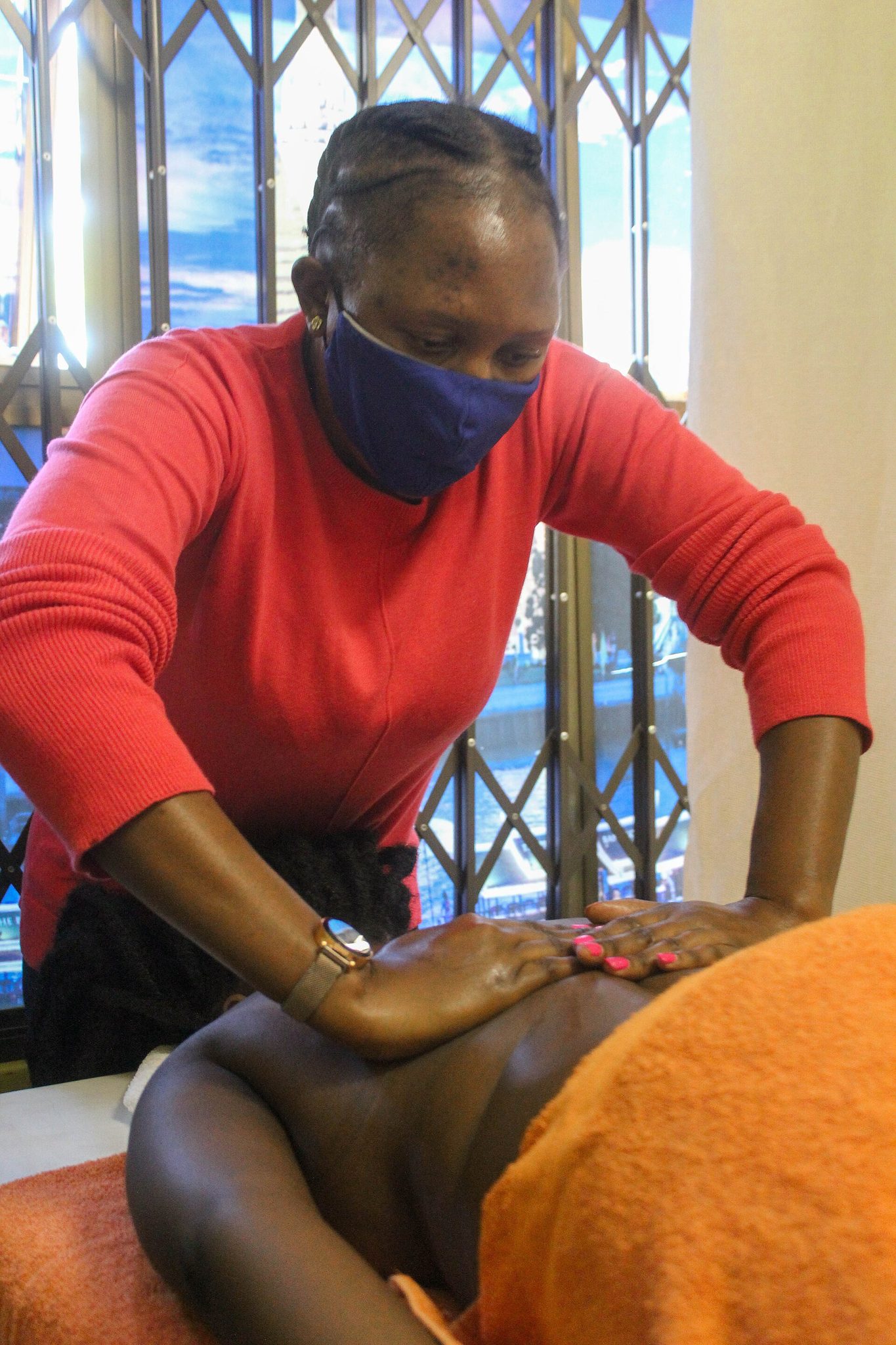
Photo: Kolobetsoo / Wikimedia Commons, CC BY-SA 4.0

Detailed routine for a 90-minute session
The 60-minute session follows the same sequence, leaving out the hips, abdomen and scalp and shortening each area according to the allocation table.
- In-room consultation (5 minutes). Review the client record card, ask how the client is feeling today, introduce the pressure scale, ask about areas they do not want touched, confirm whether to include the hips and abdomen, and let the client choose the oil.
- Initial contact. The client lies prone, fully covered with the towel. Place both hands on the back over the towel and hold for a few breaths.
- Back – shoulders – nape (22 minutes). Fold the towel down to waist level. Effleurage to spread the oil, knead the trapezius, apply friction on both sides of the spine, work around the borders of the shoulder blades, apply sustained pressure on tight spots, light cupping on the shoulders (never percuss over the kidney area), closing effleurage, then re-cover with the towel.
- Hips over the towel (4 minutes, if the client agrees). Work over the towel with the heel of the hand, using sustained pressure and gentle circling on the gluteal muscles. Do not uncover the buttocks.
- Backs of the legs (14 minutes, 7 per side). Uncover one leg and tuck the towel edge neatly. Effleurage, knead the calf and hamstrings, apply friction with the heel of the hand, and avoid the back of the knee.
- Turning (2 minutes). Using the towel wall technique described above.
- Fronts of the legs and feet (13 minutes). Avoid pressing on the kneecap and shin. Work the feet thoroughly: friction on the soles, gentle ankle rotations, gentle traction on each toe.
- Both arms (10 minutes). Effleurage from wrist to shoulder, knead, apply friction on the palms; tuck the client's arm back under the towel as soon as you finish.
- Abdomen (4 minutes, if the client agrees). Fold a second towel to cover the chest and uncover only the abdomen. Very light pressure, circular effleurage clockwise around the navel. Do not work the abdomen if the client has just eaten a heavy meal, is menstruating and feels uncomfortable, or is pregnant.
- Neck – shoulders – head (11 minutes). Stand at the head of the bed, glide gently along both sides of the neck to the hairline, gently knead the nape, and massage the scalp (ask first, since it gets oil in the hair). Never twist or crack the neck.
- Closing (5 minutes). Rest your hands still for a few seconds, tell the client the session is finished, and let them lie for about 1 more minute.
What to do when the client falls asleep, feels cold or feels pain
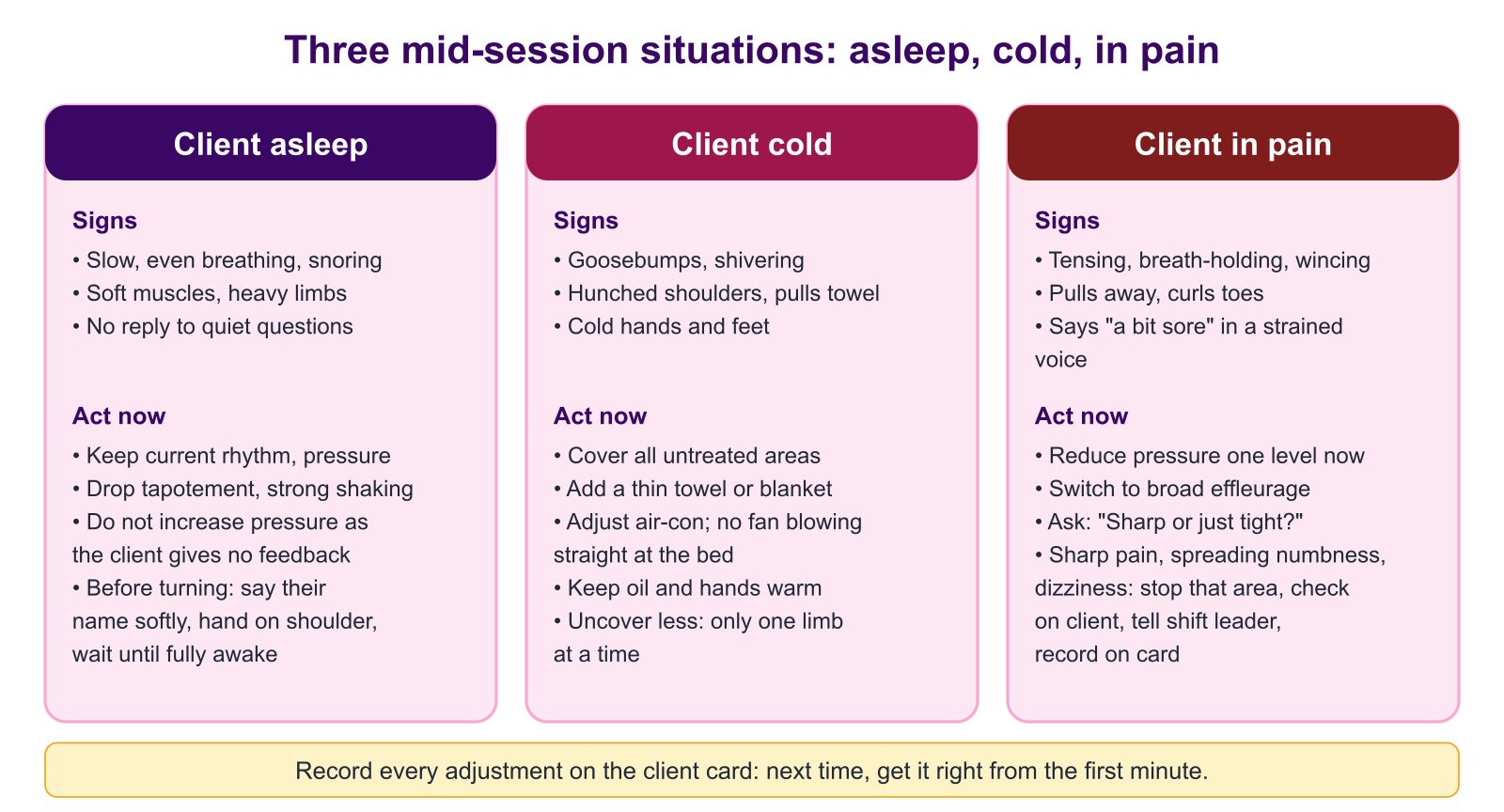
The client falls asleep
A client falling asleep means the session is going well. Keep the same rhythm and drop percussion and strong vibration. A common mistake: because the client is not giving feedback, the therapist gradually increases pressure; keep the pressure at the level the client confirmed earlier. Before turning, wake the client gently with a quiet voice and one hand on the shoulder; never shake them.
The client feels cold
Lying still in an air-conditioned room with oil on the skin, clients lose heat faster than you think. What to do: keep areas not yet worked fully covered, add a thin towel or light blanket, adjust the air conditioning and make sure the airflow does not blow straight at the bed. Uncover only one limb at a time.
The client feels pain
Distinguish "pleasant tightness" from "sharp, stabbing pain". Ask a specific question: "Does this spot feel tight or sharp?". If it is tight, keep the pressure and go slowly; if it is sharp, reduce the pressure immediately and switch to broad palm effleurage. Stop working that area and inform the shift leader if the client feels sharp pain radiating along an arm or leg, numbness or tingling, dizziness or nausea, or if you notice an area that is unusually swollen, hot or red. Calf cramp mid-session: stop massaging that area, gently flex the top of the foot towards the shin to stretch the calf, hold until the muscle softens, then effleurage lightly.
Closing the session and aftercare advice
Helping the client sit up
Standing up suddenly after lying down for a long time can easily cause light-headedness. Guide the client to roll onto one side, bend their knees and push themselves up with their arms, sit on the edge of the bed for about 1 minute, and only then stand. Wipe the oil off the soles of their feet and hand them their slippers before they stand, to prevent slipping.
Aftercare advice
- Drink warm water or the tea the spa offers, and rest for a few minutes before leaving.
- The client may take a warm shower after a few hours to remove the oil; avoid a very cold shower straight after the session.
- Slight soreness in areas worked with strong pressure may occur for 1–2 days; if the pain increases, bruising spreads, or there is swelling and heat, contact the spa and see a doctor.
- Suggest habits that suit the client (stretching every hour when working at a computer); do not suggest medication, and do not say "massage helps you detox".
Recording on the client card
Record straight after the session: the oil used, pressure by area, areas of tension, any incidents, adjustments to the time plan, and suggestions for next time.
Common mistakes of therapists new to Level 2
| Mistake | Why it is dangerous or wrong | The correct way |
|---|---|---|
| Spending too long on the back, then rushing the legs and arms to finish on time | The client feels the session was "uneven" and complains that areas were skipped | Set 3 time checkpoints; if you are more than 3 minutes off, adjust the next area |
| Pulling the client's arm or pushing their hip when turning | The client loses balance, falls off the bed or feels inappropriately touched | Raise a towel wall and let the client turn towards the therapist by themselves |
| Pouring oil directly onto the client's back | The oil is cold, the client is startled, and oil runs onto the sheets and into the hair | Pump the oil into your hands, warm it, add a little at a time |
| Increasing pressure after the client has fallen asleep | The client cannot give feedback, bruises easily and is sore the next day | Keep the pressure level the client confirmed before falling asleep |
| Cutting the closing part when running late | The client stands up suddenly and may feel light-headed, and loses the feeling of being cared for | Shorten the middle areas and always keep the full 5 minutes for closing |
Pass criteria for this lesson
You pass this lesson when you can do the following in front of your instructor, on a fellow student or a model client:
- Write out the time plan of a 90-minute session for 10 stages, adding up to exactly 90 minutes, in no more than 3 minutes; readjust the plan when the client wants 5 extra minutes on the back without touching the consultation and closing.
- Perform a complete 90-minute session, deviating by no more than 3 minutes at each of the 3 checkpoints (around minutes 31, 47 and 74).
- Turn the client with the towel wall, completing all 6/6 steps in no more than 2 minutes, with the chest or intimate areas never exposed at any moment.
- Name at least 4 carrier oils correctly, each with one characteristic and one note; state the estimated amount of oil for a 60-minute session correctly (about 15–25 ml for an average adult).
- Ask about pressure on the 1–5 scale at least 4 times during the session (start of the back, backs of the legs, fronts of the legs, neck – shoulders) and record the pressure level for each area on the client card.
- Handle 3/3 situations set by the instructor correctly (client asleep, client cold, client in sharp pain) and state correctly when you must stop and inform the shift leader.
- Guide the client to sit up by rolling onto their side, and give at least 4 pieces of aftercare advice without any statement promising a therapeutic effect.
Frequently asked questions
What if the client books 90 minutes but only wants their back and shoulders done?
That is fine, but explain that working one area for too long with strong pressure can easily cause soreness. Suggest: back – shoulders – nape for about 40 minutes using a variety of techniques, with a few minutes of light effleurage as rest in between, then the arms and the neck – head in the supine position. Record the client's request clearly on the client card.
Should I use essential oils for every client to make the massage feel more "luxurious"?
No. Essential oils are an option, not the default. For clients who are pregnant, have asthma or epilepsy, have sensitive skin or dislike scents, an unscented carrier oil is the safe choice. The next lesson in this module teaches how to dilute essential oils and which groups of clients must avoid them.
How should I handle a male client who asks a female therapist to work the inner thighs or open the towel wider?
Decline politely and clearly: "I'm sorry, according to the spa's procedure I don't work on this area." Continue with the areas in the routine. If the client keeps asking or behaves inappropriately, stop the session, leave the room and report it to the manager. The spa has a duty to protect its staff, and establishments offering massage services must comply with the security and order conditions in Decree 96/2016/ND-CP (security and order conditions for certain businesses, including massage services), as amended by Decree 56/2023/ND-CP.
Further reading
Revise the basic 60-minute plan and the five foundation movements in the lesson Relaxing 60-minute body massage, and learn how to fit a body massage into a complete treatment in the lesson Delivering a complete spa treatment.