
At Level 1 you became comfortable with the health questionnaire: hand it to the client, read it back, and place the client into one of three levels – "proceed as normal, proceed with adjustments, postpone". As a senior therapist, your name goes on the service record, you explain the risks before waxing or a treatment programme, and you answer when the client asks, "Where does the spa keep my information?" Many complaints come not from poor technique but from one over-promise, a consent form signed in a hurry, or a photo of a record sent to the wrong group chat.
By the end of this lesson, you will be able to:
- Lead a 10–15 minute consultation in 5 stages, using open questions, reflecting back and summarising, and finishing with a recommendation that sets realistic expectations.
- Create and update a client record covering health information, allergies, medicines, recent procedures and service history, written so that a colleague on the next shift can understand it.
- Explain and obtain a service consent form in the true sense: the client understands the content, the risks, the alternatives and her right to stop at any time, and only then signs.
- Manage records according to the personal data protection principles in Decree 13/2023/ND-CP on personal data protection: consent, correct purpose, minimisation, security, defined retention period.
- Handle a client who conceals an illness or a medicine without arguing, while still protecting both the client and yourself.
From "filling in the form" to "professional consultation"
The foundation article on consultation covered the 7-part health questionnaire and the 5–10 minute consultation. For a senior therapist the consultation is longer, around 10–15 minutes with a new client or at the start of a multi-session treatment programme, because you have to do three extra things that trainees are not yet given:
- Recommend a service instead of just performing the package the client booked. Recommending means you take responsibility for whether it is suitable.
- Set expectations with clear limits: how far the results go, how long they take, what the spa cannot do.
- Obtain consent with an explanation, and keep records to prove it if a dispute arises later.
The scope does not change when you move up a level
Becoming a senior therapist does not mean you may diagnose: do not name diseases, do not advise stopping or changing medicines. The spa only provides non-invasive care. Filler and botox injections, mesotherapy, therapeutic laser and IPL, deep microneedling and extraction involving medical intervention fall within the scope of licensed medical facilities under the Law on Medical Examination and Treatment No. 15/2023/QH15. When a client asks for these services, the correct answer is: "This service needs a doctor to perform it in a medical facility; our spa does not do it."
The structure of a 10–15 minute consultation
Rambling questions tire the client; going straight into selling a package puts her on guard. Divide the consultation into 5 stages, each with one main task and one "closing" question.
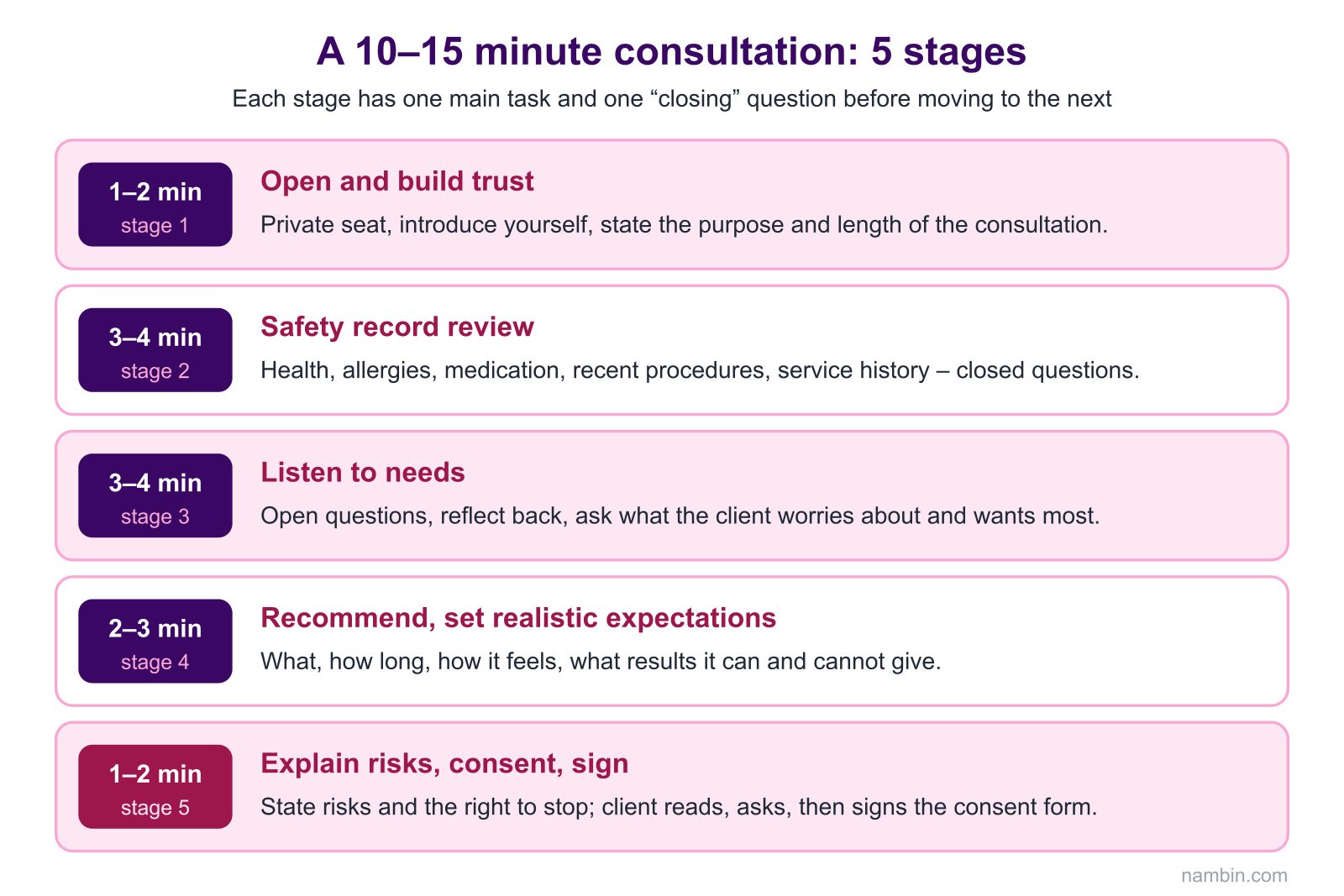
- Opening, building trust (1–2 minutes). Invite the client to sit in a private corner, at eye level. Introduce your name and role: "I'm Hang, the senior therapist in charge of your treatment programme." State the purpose clearly: "Let's take about fifteen minutes so I understand your skin and your health first, and then we'll choose how to work." Closing question: "Are you in a hurry at all?"
- Safety record review (3–4 minutes). Read the form the client has just filled in, and ask again about every box that is ticked or left blank. This stage uses closed questions, because you need a clear yes or no. Closing question: "Apart from what you've just told me, are you applying or taking any other medicines, including anything bought at a pharmacy?"
- Listening to needs (3–4 minutes). Switch to open questions. Let the client talk while you take notes. The closing question is the summary: "Let me sum up to check I've understood correctly…"
- Recommendation and expectation setting (2–3 minutes). State the service you recommend, why, how many sessions, the interval between sessions and the price. State the realistic result and its limits. Closing question: "Does this recommendation suit you, or would you like to change anything?"
- Explaining risks and consent (1–2 minutes). Describe the possible reactions, what the client must report immediately and her right to stop. Give her the consent form to read herself, answer questions, then sign. Closing question: "Is there anything else you'd like to ask before signing?"
A regular client returning for the next session only needs a shortened stage 2 (updates on health, medicines, new procedures) and a question about her reaction after the previous session, about 2–3 minutes. When switching to a service with different risks, repeat stages 4 and 5.
Open questions, listening and setting realistic expectations
Open questions are for understanding, closed questions are for confirming
Open questions ("how", "when", "what") invite the client to describe things in her own words. Closed questions (yes/no) are used to pin down safety information. The common mistake is to use them the wrong way round: closed questions in the needs stage make the client just nod, and open questions in the safety stage ("How's your health?") get the answer "Fine, thanks."
| Purpose | Question to ask | Question to avoid |
|---|---|---|
| Understanding wishes | "What would you most like to change about your skin right now?" | "You want whiter skin, right?" |
| Understanding habits | "What do you usually do for your skin in the evening, and which products do you use?" | "Do you wash your face?" |
| Understanding past experience | "Where did you last have this service, and how was your skin afterwards?" | "Was it OK last time?" |
| Confirming medicines | "Are you applying any acne medicine or a cream with retinol or tretinoin?" | "Are you using anything special?" |
| Confirming pregnancy | "Are you currently pregnant, or is there any chance you might be pregnant?" | "You haven't got a baby on the way, have you?" |
Active listening
Active listening has three moves: reflecting back (repeating a few of the client's key words: "You said your skin often stings when the season changes…"), naming the feeling ("From what you're saying, you were quite worried last time because your skin was red for several days"), and summarising at the end of the stage. Do not interrupt, do not scroll on your phone, and do not jump to conclusions like "So your skin is sensitive, then."
Setting realistic expectations
Wrong expectations are the biggest source of complaints. Clients often come to the spa with images from the internet: "one session and the hair is gone", "three sessions and my skin is shades whiter". Your job is to state four things clearly, in this order:
- What the service can do: "Waxing keeps the area hair-free for a few weeks; the hair will grow back."
- How long and how many sessions: "Usually you repeat it every 3–6 weeks, depending on how fast your hair grows."
- Normal sensations and reactions: "Slight redness and little bumps around the follicles for a few hours are normal."
- What the service cannot do: "The spa does not do permanent hair removal and does not treat melasma; those need a doctor."
Do not use promising words such as "for good", "permanent", "guaranteed to clear", "ten years younger". Such phrases are both untrue and may breach advertising rules under the Advertising Law 2012 when they appear on leaflets or a fanpage. Replace them with "support", "care", "helps the skin feel more comfortable", and always state the limits.
Photo: 阿道 / Wikimedia Commons, CC BY-SA 4.0

The client record: what to record and how
The health questionnaire is a sheet of paper the client fills in on one day. The client record is a living set of information, updated over many sessions, that follows the client for as long as she uses the spa's services. A record that is adequate at Level 2 has five blocks.
| Information block | Required content | Why it is needed |
|---|---|---|
| Identification, contact | Full name, year of birth, phone number, emergency contact | To call the right person in an incident; no ID card number is needed if the service does not require it |
| Health | Pregnancy, breastfeeding, blood pressure, heart conditions, diabetes, epilepsy, varicose veins, skin conditions, blood clotting disorders | Decides whether to proceed, adjust or postpone |
| Allergies | Cosmetic ingredients, essential oils, rosin (found in many waxes), latex, adhesive tape; past reactions | To choose suitable products and gloves |
| Medicines and recent procedures | Names of topical and oral medicines (especially retinoids, isotretinoin, antibiotics, anticoagulants, corticosteroids); peels, laser, injections in recent months | Many medicines make the skin thin, prone to lifting and bruising |
| Service history | Date, service, therapist, products, parameters (area, type of wax, time), reaction, aftercare advice, signature | So the next shift continues correctly, and to trace events in an incident |
How to write so others can read it
- Be specific, with numbers and dates: "Uses tretinoin cream in the evening, stopped from 01/11" is better than "uses a topical medicine".
- Separate the client's words from the therapist's observations: Client says: "just a bit dry". Therapist observes: "fine flaking on both cheeks, slight redness at the sides of the nose".
- Also record what you did not do and why: "No exfoliation because client is using a retinoid." This is evidence that you considered safety.
- No remarks on body or personality ("client is fat", "difficult"); no erasing: if you make a mistake, strike through it with one line, rewrite, initial and date it.
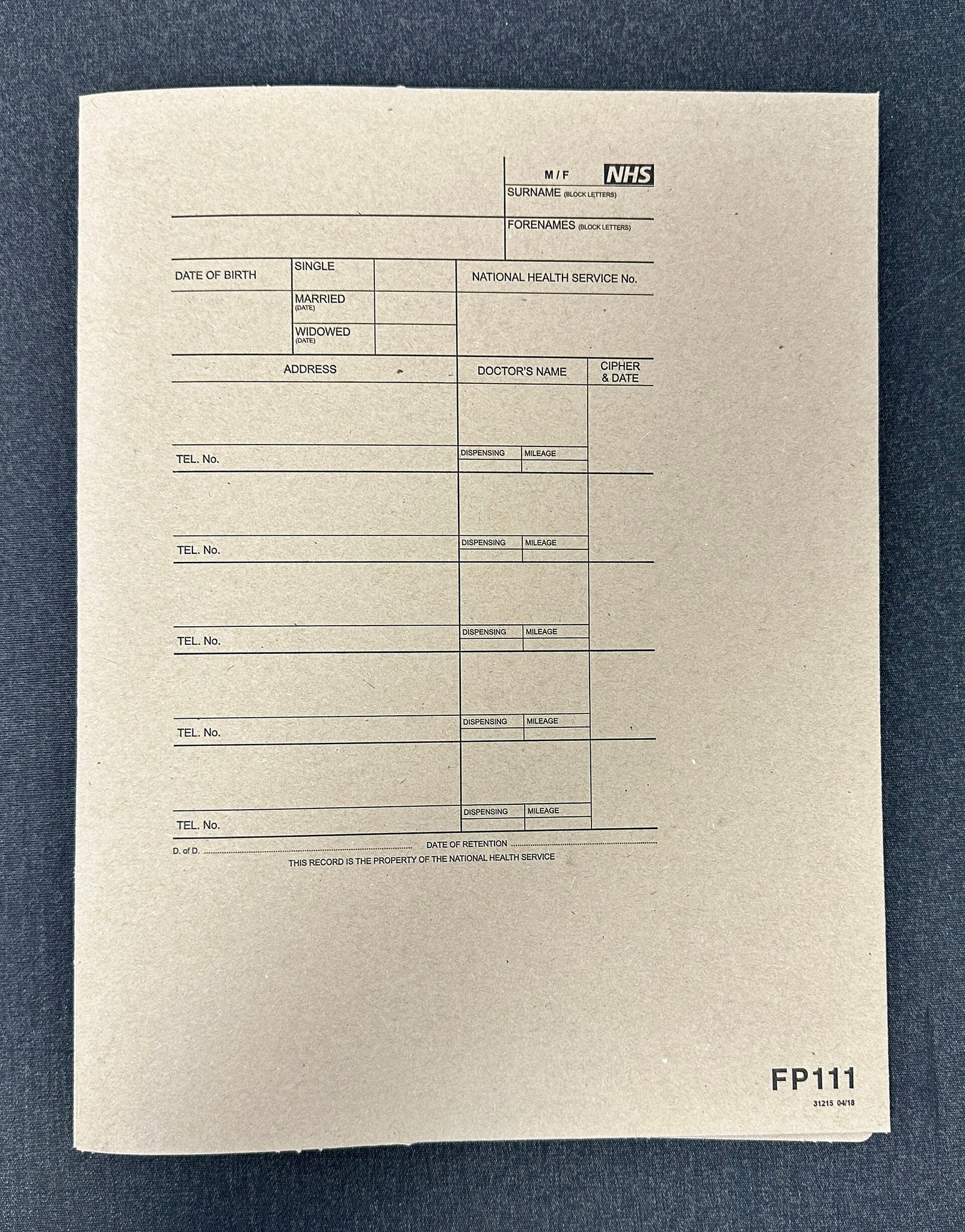
Photo: Whispyhistory / Wikimedia Commons, CC0

The service consent form: consent after explanation
The client's signature only has real value when she understands what she is agreeing to. In medicine this principle is called "informed consent". A spa is not a medical facility, but it applies the same spirit to services that carry risk, such as waxing, light chemical exfoliation according to the label, multi-session treatment programmes and services touching intimate areas. True consent has four conditions:
- The content has been explained: what will be done, on which area, for how long, with which products.
- The risks and alternatives have been stated: common reactions, rare but serious reactions, and other options (a lighter service, or no service).
- It is voluntary: not pressured by "today only" promotions, not signed once already lying on the treatment bed, not signed on someone else's behalf.
- The client knows her right to stop: she can stop at any step and withdraw consent for later sessions.

Photo: NIAID / Wikimedia Commons, CC BY 2.0

Sample service consent form
Each spa drafts its own forms for its services, and they should be approved by the manager. The table below is a reference framework for a waxing service; change the content of each row for other services.
| Item | Content on the form | What the therapist explains verbally |
|---|---|---|
| 1. Service | Hot wax on both underarms, about 20 minutes | The steps, the short sharp sting when the wax is removed |
| 2. Information declared | Client confirms she has correctly declared her health, allergies and medicines in the record dated … | Repeat the main points the client declared |
| 3. Common reactions | Redness, bumps around the follicles, stinging for a few hours up to 1–2 days | That this is normal, and how to care for it at home |
| 4. Uncommon risks | Heat burns, skin lifting, bruising, folliculitis, wax allergy | When she must report immediately, how the spa handles it |
| 5. Alternatives | Shaving, depilatory cream, or no service; laser hair removal belongs in medical facilities | State honestly the pros and cons, without disparaging |
| 6. Client's rights | To ask questions, to stop at any time, to withdraw consent for the next session | "If it hurts too much, just raise your hand and I'll stop straight away" |
| 7. Personal data | Purpose of collection, who may see it, retention period, how to request correction or deletion | Briefly, in line with the spa's policy |
| 8. Confirmation | Client signs, writes her full name, date and time; the explaining therapist signs and writes her name | Give the client a copy, or let her photograph it if she wishes |
No form "exempts" the spa from liability when the therapist uses incorrect technique. The form proves the client was informed; it does not replace doing the work correctly. Obtain consent again when changing the service, the area or a product with different risks, or when the client declares new health information or a new medicine. For intimate areas, always ask and receive verbal consent immediately before touching, even if the client signed at the start.
Protecting the client's personal data
Spa records contain exactly the kind of information the law considers sensitive: health conditions, medicines being taken, sometimes even before-and-after photos of the skin. Decree 13/2023/ND-CP on personal data protection classifies information about health conditions as sensitive personal data and sets out general principles for processing data. This lesson does not go into individual articles; drafting the procedures is the job of the spa owner together with someone with legal expertise. The therapist must understand the general spirit below.
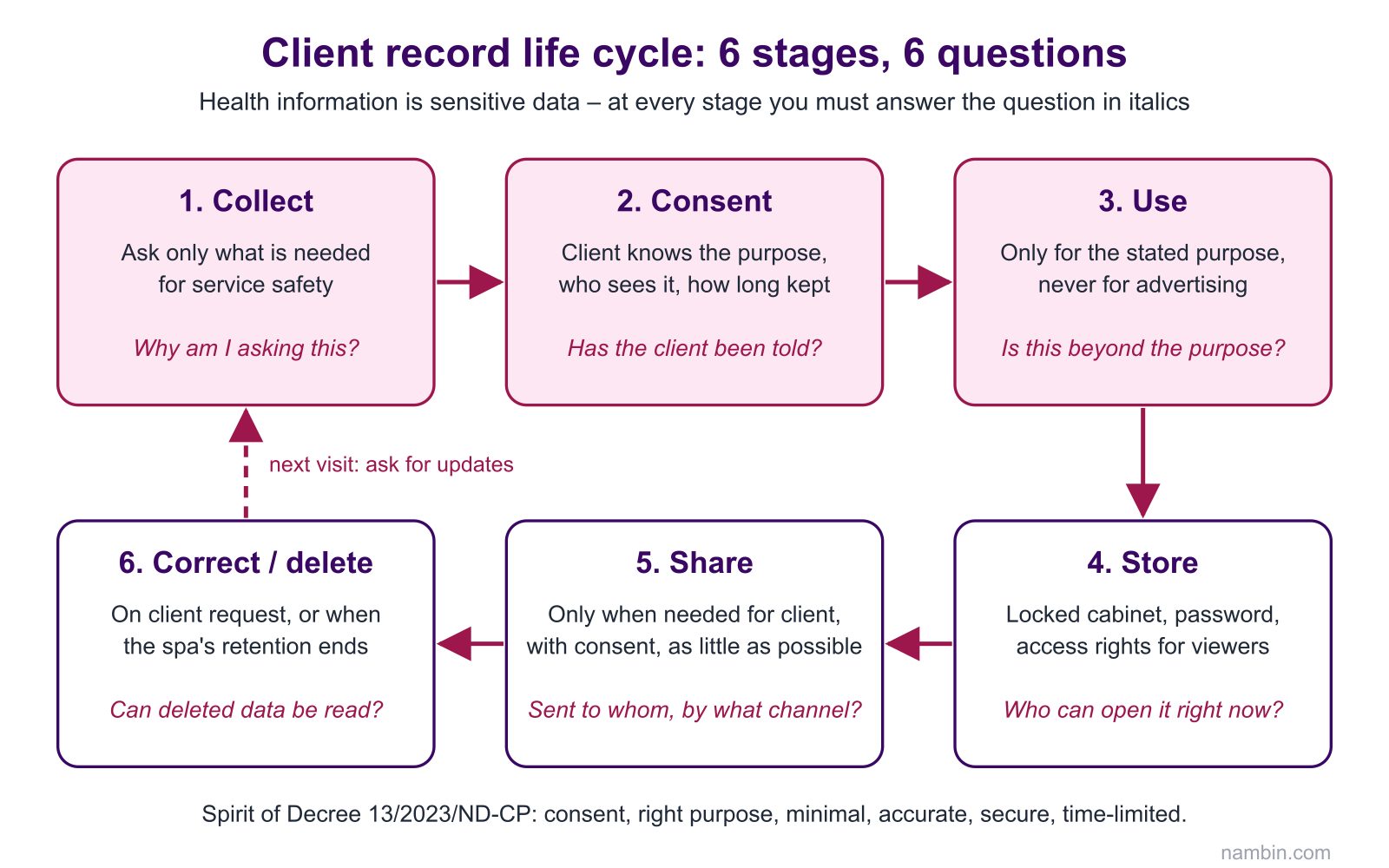
Six principles therapists apply every day
- Client consent: the client is told what information the spa collects and why, and gives clear consent. Silence is not consent.
- Correct purpose: health information collected to perform services safely is used only for that. Do not use the phone number in the record to send promotional messages unless the client has agreed to receive them.
- Minimisation: ask only what the service needs. A leg wax does not need her income or ID card number.
- Accurate and up to date: correct the record immediately when the client reports a change; note the date of the update.
- Security: paper records in a locked cabinet; software with an individual password for each person, no shared accounts; do not leave the screen open when you leave the desk.
- A defined retention period and respect for the client's rights: the spa sets how long records are kept; the client has the right to ask what the spa holds about her, to request correction, to withdraw consent or to request deletion in accordance with the regulations. A therapist who receives such a request passes it to the manager, and does not make promises or delete anything herself.
Photo: San Diego Air & Space Museum Archives / Wikimedia Commons, Public domain

Things you must never do
- Photograph a form or a client's skin and send it to a staff group on Zalo or Messenger. If you need to ask the shift leader, ask in person, without the client's name or face.
- Post before-and-after photos without separate written consent. Consent to a service does not include consent to publish photos.
- Discuss a client's illness in the staff room or at the desk; take records home or store them on a personal phone.
- Throw old forms in the bin instead of destroying them in a paper shredder according to the spa's procedure.
If you accidentally send a photo of a form to a group chat: tell the manager immediately during the shift, and record what happened, when, and who may have seen it. Do not quietly delete the message and treat it as finished.
When a client conceals an illness or a medicine
Clients conceal information usually because they are afraid of being refused the package they bought, are embarrassed to talk about health, or do not think acne medicine "has anything to do with waxing". Your attitude decides whether the client tells the truth when you ask the second time.
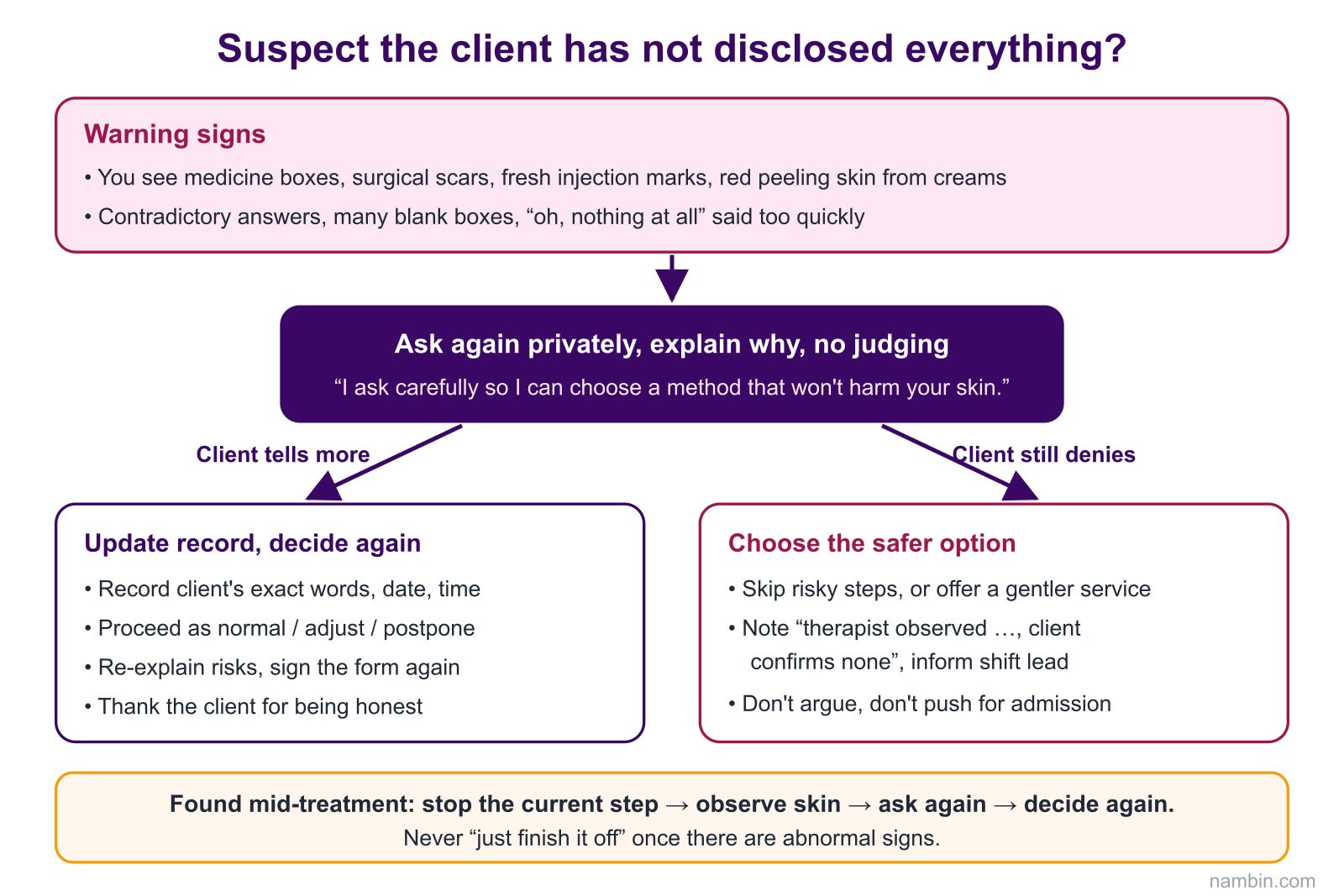
The 5-step procedure
- Recognise the signs: red, flaking skin typical of a topical medicine, fresh injection marks or surgical scars, a medicine box in her bag, contradictory answers, many boxes left blank.
- Ask again privately, giving the reason: "The skin on your cheeks is flaking a little, so I'm asking carefully to choose a method that won't make it sting more. Have you been applying any acne cream or anti-ageing cream recently?" Ask specifically, not vaguely, and not in an interrogating tone.
- If the client tells you more: thank her, record exactly what she said with the date and time, decide again using the three levels, explain the risks again and obtain consent again.
- If the client still denies it but the signs are clear: do not argue and do not push her to admit it. Choose a safer option (drop the risky step or switch to a lighter service), and explain it using your observation: "Your skin looks a little thin today, so I suggest we don't wax the face for now." Record: "Therapist observed …; client confirms she is not using any medicine; switched to …". Inform the shift leader.
- If you discover it during the service: stop the current step, observe the skin, ask again, then decide whether to continue. Never "just finish it off" when the skin already shows abnormal signs such as lifting, weeping or spreading redness.
Safety: If the client shows serious signs such as difficulty breathing, swollen lips or eyes, a rapidly spreading rash, chest pain or fainting: stop immediately, call emergency services on 115 and inform the manager. Do not give the client any medicine yourself. Record the incident once the client has been safely cared for.
Common mistakes made by senior therapists
| Mistake | Why it is dangerous or wrong | The right way |
|---|---|---|
| Handing over the consent form once the client is already lying on the treatment bed | The client does not read carefully and signs out of embarrassment; the consent is no longer voluntary | Sign at stage 5 of the consultation, while the client is still seated and still has a real choice |
| Saying "just sign it, it's only a formality" | Destroys the meaning of the form; the client feels deceived if there is an incident | Explain that the form is so she knows the risks and her right to stop |
| Promising "one treatment programme and it's gone" | Wrong expectations lead to complaints; may breach advertising rules | State what it can do, how long it takes, what it cannot do |
| Photographing a form and sending it to a group chat to ask the shift leader | Exposes health data, which is sensitive data | Ask in person or via an internal channel, without the client's name or face |
| Writing a vague record such as "skin OK" | The next shift does not know what was done; events cannot be traced | Record the service, area, products, reaction, and what was not done and why |
Pass criteria for this lesson
You pass this lesson when you can do the following in front of the trainer:
- Lead a role-play consultation with a new client in 10–15 minutes, covering all 5/5 stages in the correct order, with at least 3 open questions in stage 3 and a summary the "client" confirms as correct.
- State all 4 expectation-setting points (what it can do, how long, normal reactions, what it cannot do) for a service chosen by the trainer, without using any promising words.
- Write a client record with all 5 information blocks; the trainer can read it and carry out the next session without asking you a single question.
- Explain the 8-item consent form in no more than 3 minutes, stating correctly the 4 conditions of true consent and the client's right to stop.
- State correctly at least 5/6 personal data protection principles and 3 things you must never do with records.
- Correctly handle 2 role-play situations of a client concealing a medicine (one client who opens up, one who denies it), with records written for both.
Frequently asked questions
What if the client does not want to sign the consent form but still wants the service?
Ask what worries her about the form and explain each item again. Many clients are only uneasy about the personal data section; explaining who sees it and how long it is kept usually resolves this. If the client still refuses, follow the spa's policy; for services with risk such as waxing, the service is normally not performed without consent. Inform the shift leader; do not decide on your own.
Do regular clients need to sign again at every session?
Not necessarily; it depends on the spa's policy. But at every session you must ask for updates on health, medicines and new procedures, and record the date. When changing the service or area, or when there is new health information, obtain consent again.
A client asks the spa to delete all her information. What does the therapist do?
Acknowledge the request, thank the client and pass it to the manager immediately; the spa decides according to the personal data regulations. The therapist does not delete anything herself and does not promise "I'll delete it right away".
Further reading
Review the 7-part health questionnaire and the three decision levels in Spa client consultation and the health questionnaire: asking the right questions to work safely, then see how consultation fits into a whole service in Delivering a complete 90-minute spa treatment: from welcoming the client to the record.