The "scrub – wrap – steam" package is a best-selling body package in many Vietnamese spas, especially at the end of the year and before the wedding season. It is also the package with the most incidents: a client whose whole back is red and burning after a salt scrub straight after waxing, a client who feels faint in the steam room after a drinking session, a client who slips on the way from the shower to the treatment bed. Most incidents are not caused by weak hands-on technique, but by the therapist skipping a screening question or leaving the room at exactly the moment the client needs them.
At Level 1 you learned skin structure, general contraindications, infection control and first aid. This lesson does not teach those again; it goes straight into three services involving heat, water and friction, where the senior therapist must decide alone whether to "treat, adapt or not treat".
By the end of this lesson, you will be able to:
- Choose the exfoliating grain (salt, sugar, coffee) according to skin type and body area; state the areas and cases that must never be exfoliated.
- Perform a full-body exfoliation in about 20–25 minutes with light pressure, under towel draping, without missing any area and without scratching the skin.
- Perform a mud or seaweed body wrap in 7 steps, wrapping at the correct looseness, checking on the client every 5 minutes, and unwrapping promptly at any sign of a problem.
- Guide clients through the steam room and sauna with the common temperatures, times, number of rounds and amounts of water to drink; screen out people who should not use heat treatments.
- Check wet-area safety (heat, water, slippery floors, electricity) at the start of the shift and handle a client who feels faint or collapses in the heat room.
Three services, three different effects on the body
Before learning the techniques, you need to understand what each service "does" to the body, because that is how you work out who should have it and who should not.
- Body exfoliation (body scrub) is a mechanical action: the grains rub away the layer of dead keratinised cells at the surface. The skin becomes smoother, but its protective barrier is thinner for a few days.
- A body wrap means covering the body with a product (mud, seaweed, cream) and then wrapping it tightly to hold in moisture and warmth. The wrap retains heat and creates a feeling of being bound: a risk for people with weak hearts, people prone to panic, and people with unstable blood pressure.
- Heat treatments (steam and sauna) are a whole-body heat effect: blood vessels in the skin dilate, the heart beats faster, and the body sweats to cool down and loses water. Healthy people find it pleasant; for people with heart disease or blood pressure problems, pregnant women, or people who have just drunk alcohol, this heat load can cause light-headedness and fainting.
All three are care and relaxation services. You may say "smoother skin, pleasant, relaxing"; you must not say "detox", "fat melting", "weight loss" or "gets rid of stretch marks".
Body exfoliation: choosing the grain by skin type and area
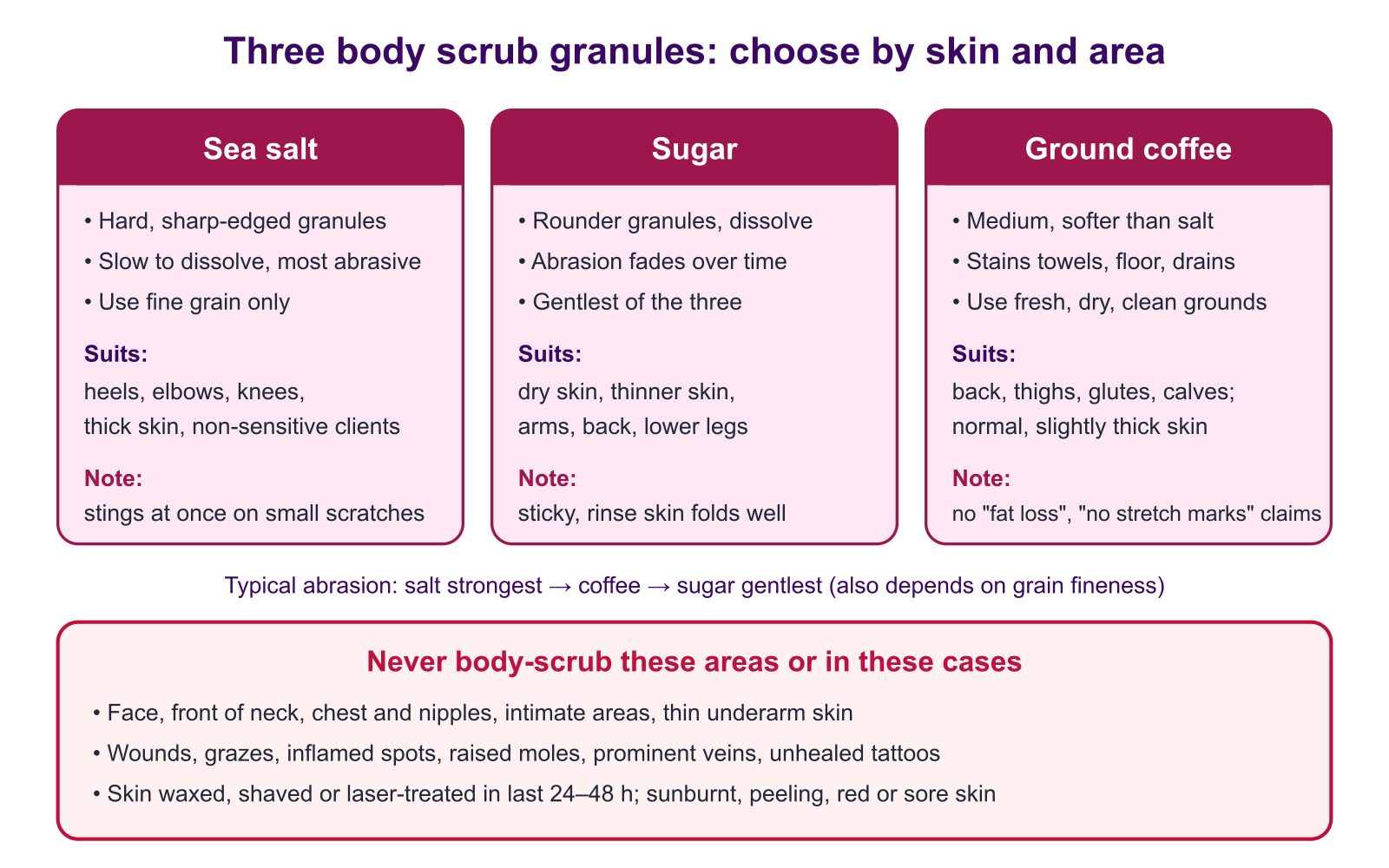
Spas in Vietnam commonly use three groups of grain: salt, sugar and ground coffee, mixed with carrier oil, cream or honey. The table below gives a quick comparison; the diagram after it helps you remember by body area.
| Grain type | Characteristics | Suits | Points to note |
|---|---|---|---|
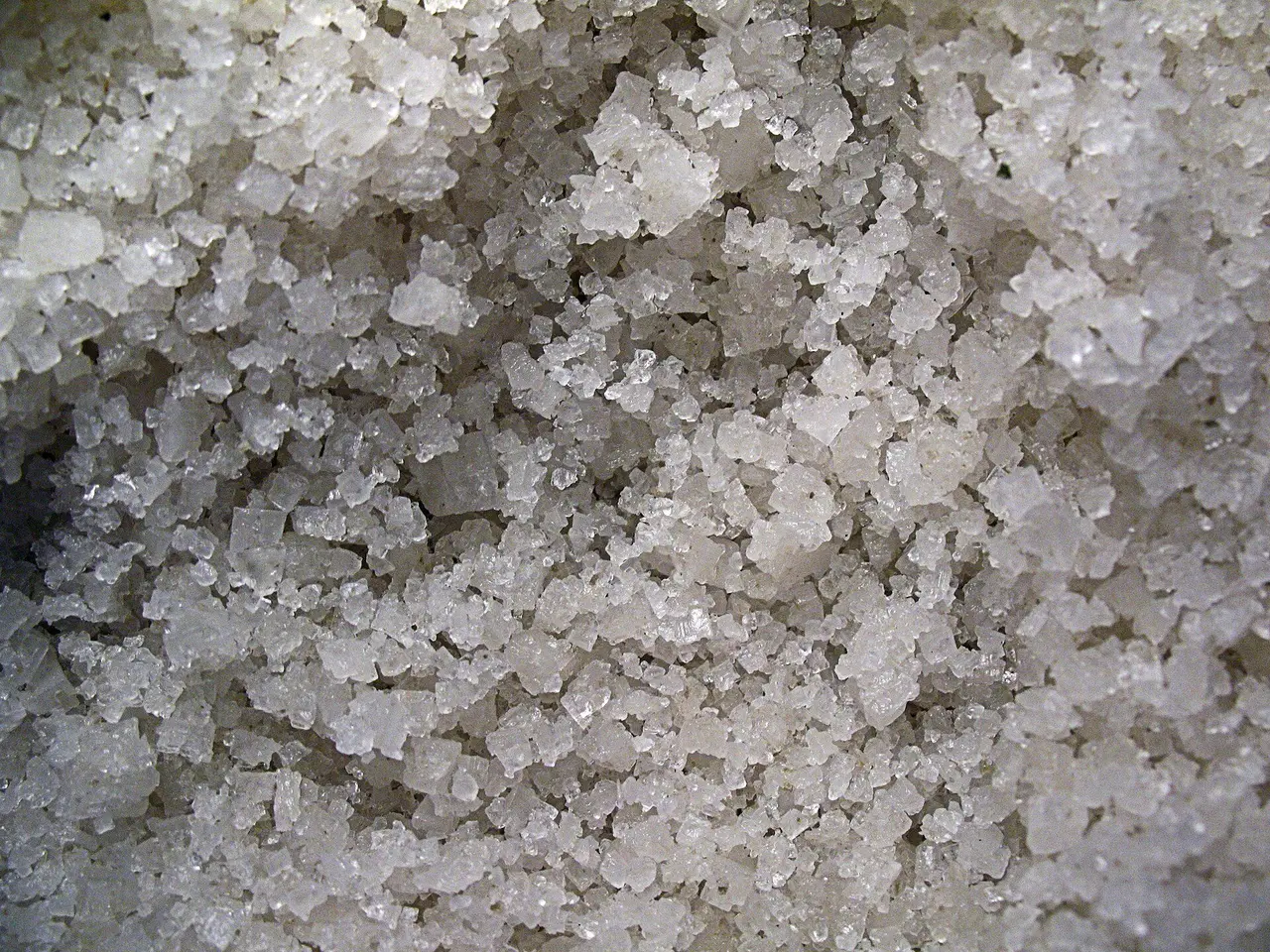
| Sea salt, pink salt | Hard, angular grains that dissolve slowly; the most abrasive | Heels, elbows, knees; thick skin, clients who are not sensitive | Only use fine grains; stings immediately on even small scratches; do not use after waxing or shaving |
| Sugar (granulated sugar, brown sugar) | Rounder grains that gradually dissolve in water and the warmth of the skin; abrasiveness decreases over time | Dry skin, thinner skin, arms, back, lower legs; clients having their first scrub | Sticky, so skin folds must be rinsed clean; store sealed, away from ants and damp mould |
| Ground coffee | Medium grains, softer than salt; pleasant aroma | Back, thighs, buttocks, calves; normal skin, slightly thick skin | Stains towels, sheets and floor grout; use fresh, dry, clean grounds; do not promise "fat melting" or "no more stretch marks" |
Grain size matters more than grain type. Salt with grains as large as peppercorns rubbed on the back scratches very easily; finely ground salt mixed with plenty of oil can be gentler than coarse granulated sugar. A tip for checking: take a pinch of the mixture and rub it 5–6 times in circles on your own inner forearm. If your skin turns red or burns, the mixture is too coarse or too dry; add more oil or cream, or change the grain.
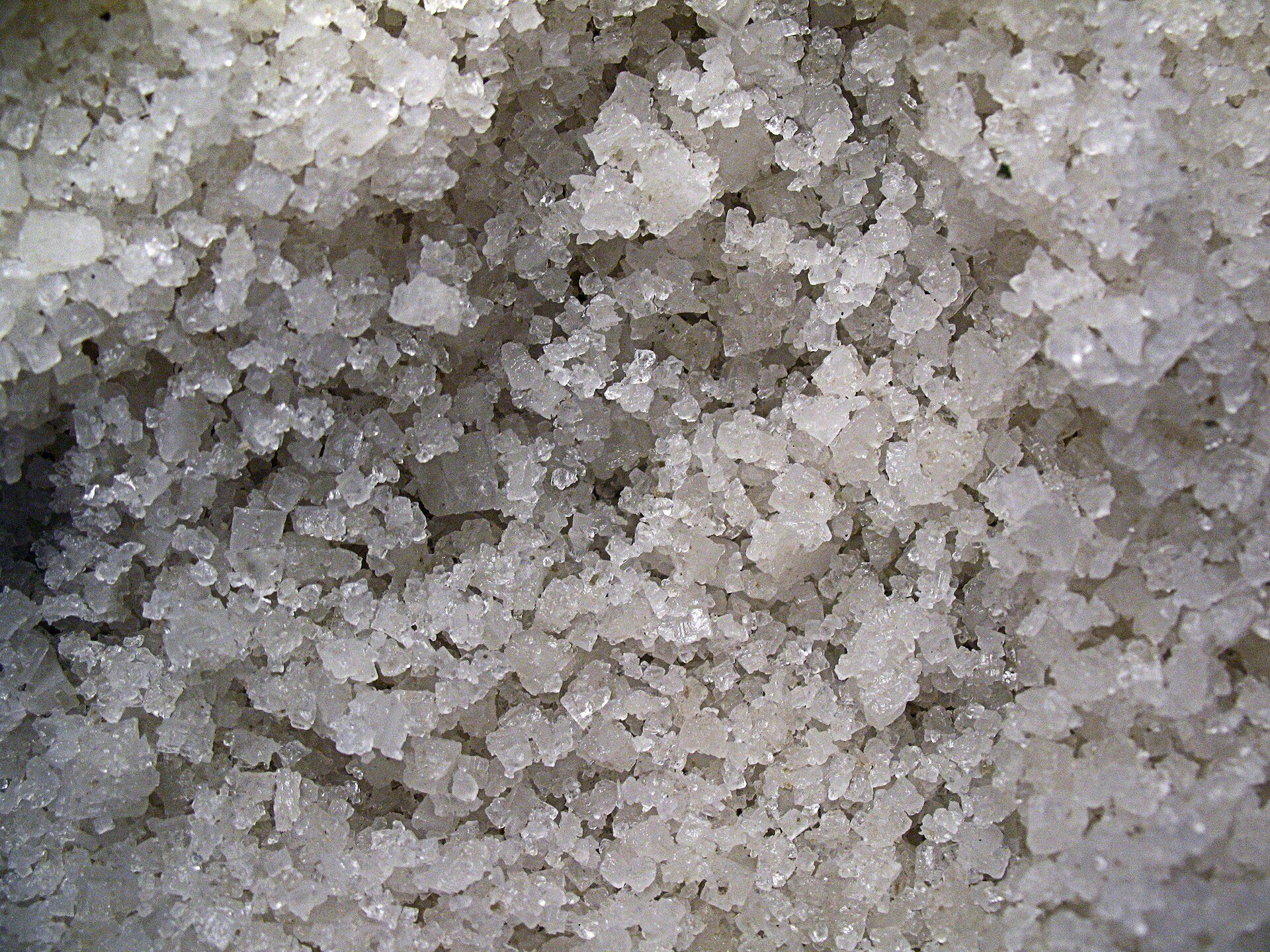
Photo: Richard Huber / Wikimedia Commons, CC BY-SA 3.0

Home-made mixtures (salt or coffee with coconut oil) must follow a fixed spa recipe, be made in small batches sufficient for the day, and be kept in a clean lidded jar labelled with the date made. Essential oils must not exceed the 1–3% you have learned; do not add lemon or vinegar "for whitening". For ready-made products, follow the manufacturer's instructions.
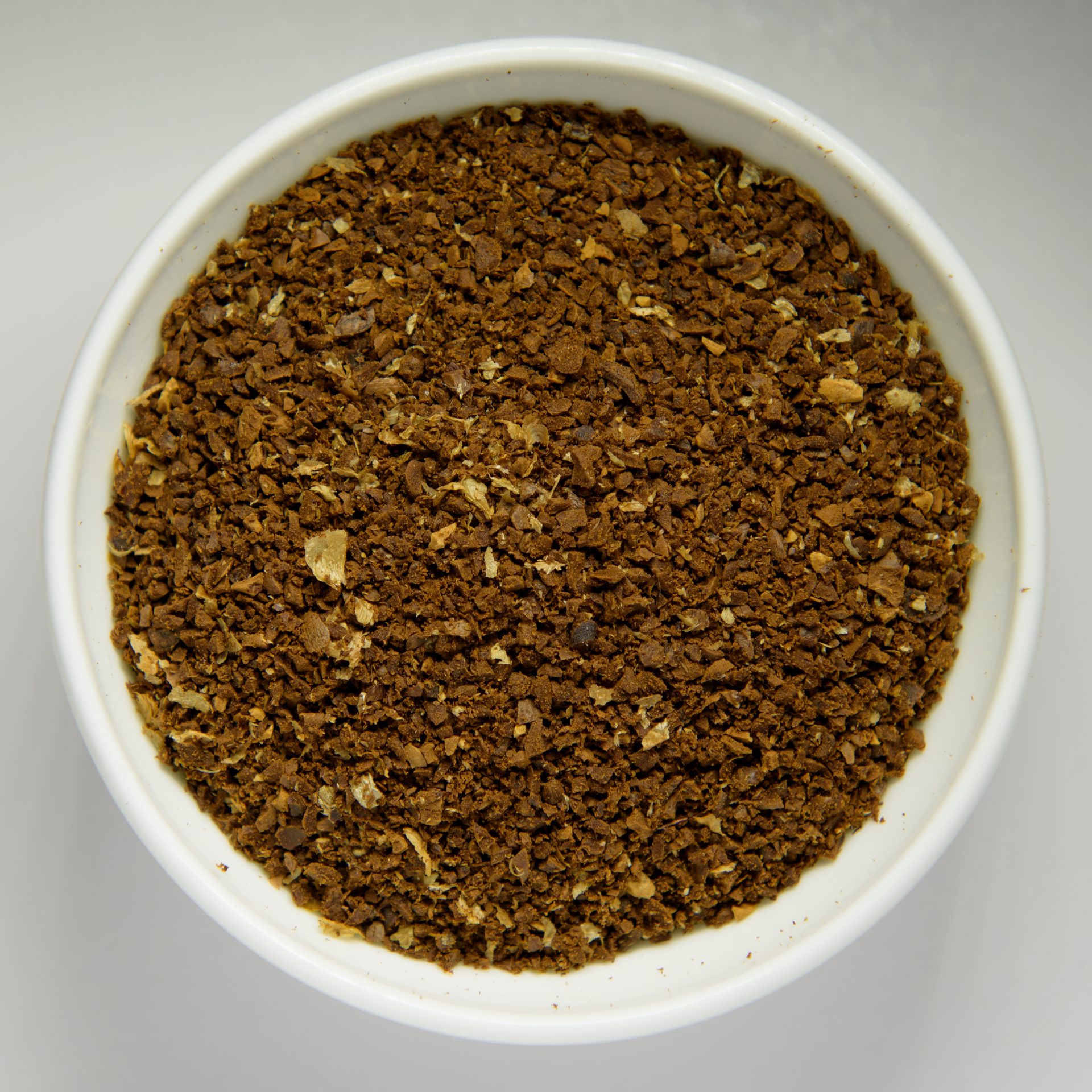
Photo: Alorin / Wikimedia Commons, CC BY 4.0

Areas to avoid and cases where exfoliation is not performed
This is something a senior therapist must know as well as the names of regular clients:
- Areas not exfoliated in a body scrub: the face (the face uses its own, much gentler products), the front of the neck, the breasts and nipples, the intimate areas, the armpits (thin skin, often recently shaved).
- Avoid areas with: wounds, scratches, inflamed spots, raised moles, warts, twisting visible veins on the lower legs, new tattoos that have not healed, new scars that are still pink.
- Do not exfoliate the whole area: skin that has been waxed, shaved or had hair removal within about 24–48 hours (the pores are still open and a layer of skin has already been removed); sunburnt skin, or skin that is red, burning or peeling; skin with active eczema or psoriasis flare-ups, fungal skin infections or scabies.
- Ask carefully before exfoliating: clients applying retinoids or acne medication on the back or chest; clients who have just had a body peel; clients taking anticoagulants (they bruise easily). In these cases, reduce pressure, switch to a gentle product, or leave out the scrub.
The client wants waxing and a scrub on the same day? Do not combine them: exfoliate the body a few days before the waxing appointment, or postpone the scrub to at least 24–48 hours after waxing.
Full-body exfoliation routine
The usual time for a full-body exfoliation is about 20–25 minutes, not including showering. The client lies on a bed covered with a waterproof sheet and towels; only the area being worked on is uncovered.
- 2-minute screening. Read the existing health questionnaire; ask three more questions: "In the last few days, have you had any waxing, shaving or hair removal anywhere? Have you had any sunburn? Are you applying any medication to your skin?". Take a quick look at the back and legs as the client lies down.
- Test the product. For new clients or new products, apply a little of the mixture to the client's inner forearm and wait while you prepare. If the client has had a reaction to cosmetics before, a patch test is needed before the session, following the Level 1 procedure exactly.
- Moisten the skin. Wipe the skin with a warm damp towel or have the client take a quick rinse shower. Never exfoliate dry skin, because the grains will scratch it directly.
- Exfoliate area by area, prone: backs of the legs (from the ankles upwards), back and shoulders. Use about 1–2 tablespoons per large area, rub in small circles with light to medium pressure, 3–5 circles per spot, then move on. Heels and elbows can be worked longer; the back of the knee and lower legs with visible veins are only glided over lightly or skipped.
- Turn the client using the towel wall technique you have learned, reminding the client to hold on because the oily skin is slippery.
- Exfoliate supine: fronts of the legs, feet, arms, abdomen (very light pressure, clockwise). Do not exfoliate the chest, front of the neck or intimate areas.
- Cleansing: wipe each area with a warm damp towel, or take the client to rinse off in a warm shower. When the client moves from the bed to the shower, non-slip slippers must already be placed right next to the foot of the bed.
- Moisturise with cream or body oil, then record on the client card: product, pressure, areas skipped and why, skin reaction.
Frequency you can advise the client: for normal skin, a body scrub about once every 1–2 weeks is enough; for dry or sensitive skin, less often. Exfoliating more often does not make the skin "whiter faster"; it only weakens the skin.
Body wraps: mud, seaweed and wrapping technique
A body wrap usually follows straight after the scrub. The three common groups of products:
- Mineral mud and clay: thick, absorbs oil, feels cool and then gradually warm when wrapped. Suits normal skin and oily skin on the back. Do not leave mud to dry hard for too long on dry skin.
- Seaweed (algae): as a powder mixed with water or as a gel; soft and hydrating. Ask carefully whether the client is allergic to seafood or iodine; if the client has had such an allergy, do not use it.
- Warming creams and nourishing oils: the lightest option, suits dry skin and first-time clients.
Wrap products containing warming agents (chilli, ginger) or cooling agents (menthol) are only used exactly as labelled, are not chosen for sensitive skin, new clients or clients who have just had a strong scrub, and you do not promise "fat burning".
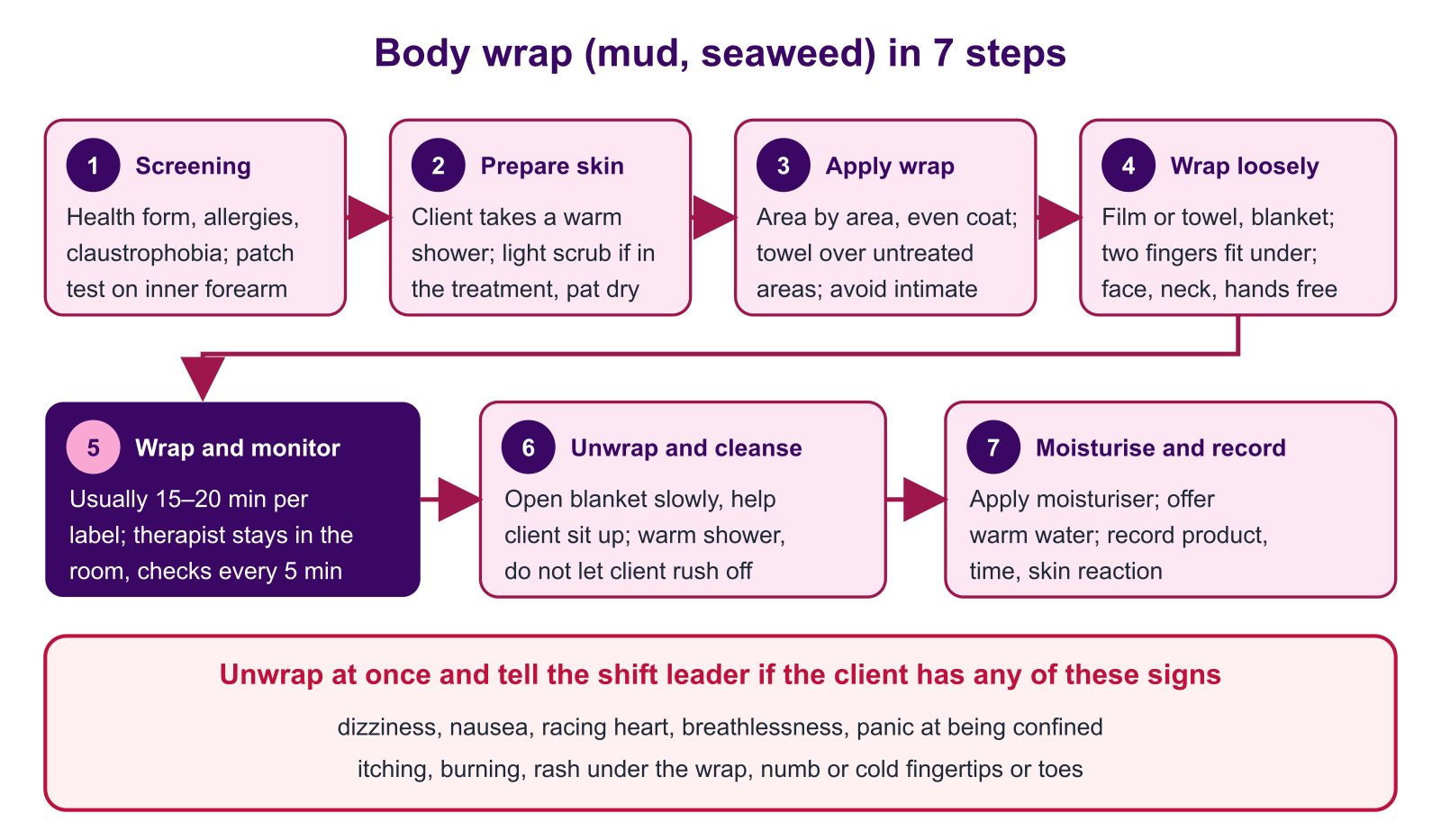
Safe wrapping technique
- Lay out on the bed in order from the bottom up: waterproof sheet, thin blanket, wrapping film or large towel. The client lies down in the middle once the back of the body has been coated, or the back is coated while the client is sitting, depending on the product.
- Apply the wrap layer evenly, just thick enough to hide the skin colour, area by area; cover areas not yet worked with towels. Do not apply to the intimate areas, the chest or the face.
- Wrap one side at a time: fold the edge of the film or towel over from one side, then the other, overlapping. The correct tightness: 2 fingers should fit between the wrap and the client's body. Any tighter restricts breathing and blood flow back from the legs.
- Leave the face, neck and hands uncovered (or wrap the hands separately and loosely). Place bolsters under the knees and head for comfort.
- Cover with a thin blanket on the outside. Do not use an electric blanket or a heat lamp shining close to the body while the client is wrapped.
Wrapping time is usually about 15–20 minutes, according to the product label. During this time the therapist stays in the room: you can massage the scalp or hands, or simply sit nearby. About every 5 minutes, ask the client a short question: "Is the warmth comfortable? Any difficulty breathing or itching anywhere?". For clients who are claustrophobic or prone to panic, wrap more loosely, leave both arms out, shorten the time, or switch to an unwrapped treatment.
Unwrap immediately if the client feels dizzy or nauseous, has a racing heart or difficulty breathing, panics at being bound, has itching, burning or a rash under the wrap, or numbness or coldness in the fingertips or toes. Unwrap from the top down, raise the client's head slightly, let them lie and rest, give them sips of cool water and inform the shift leader. If the client has difficulty breathing, a rapidly spreading rash, or swollen lips or eyes: follow the allergy first-aid procedure you have learned and call emergency number 115.
When unwrapping is finished, help the client sit up slowly and sit on the edge of the bed for about 1 minute before standing, because lying warm for a long time easily causes a drop in blood pressure when standing up suddenly. Warm shower, apply moisturiser, offer the client water.
Steam room and sauna: the common figures
The two types of heat treatment differ in humidity. A steam room has a lower temperature but humidity close to saturation, so it feels very hot and can make breathing difficult for people not used to it. A sauna (usually wood-lined, with a stone stove) is much hotter but the air is dry.
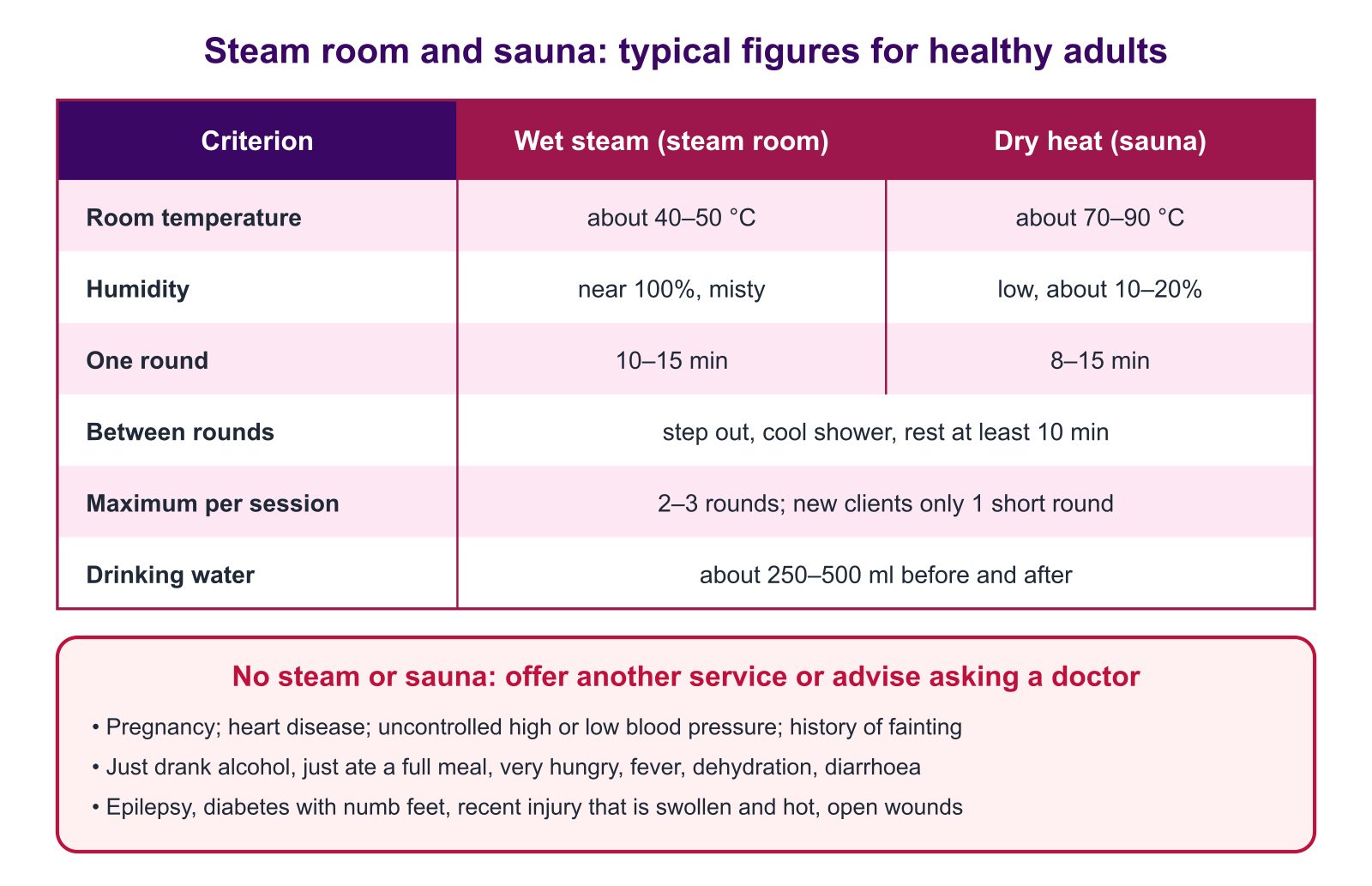
Summary of the figures: steam room about 40–50 °C, 10–15 minutes per round; sauna about 70–90 °C, 8–15 minutes per round. Rest at least 10 minutes between rounds, with a maximum of 2–3 rounds per session; first-time clients have only 1 short round of about 5–8 minutes. Drink about 250–500 ml of water before and after, in sips.
The golden rule: the figures above are maximums, not targets. If the client feels uncomfortable, they come out immediately, even if they have only been in for 2 minutes. There is no such thing as "push on a bit longer to sweat it out". Sitting on the lower bench in the sauna is cooler than the upper bench.
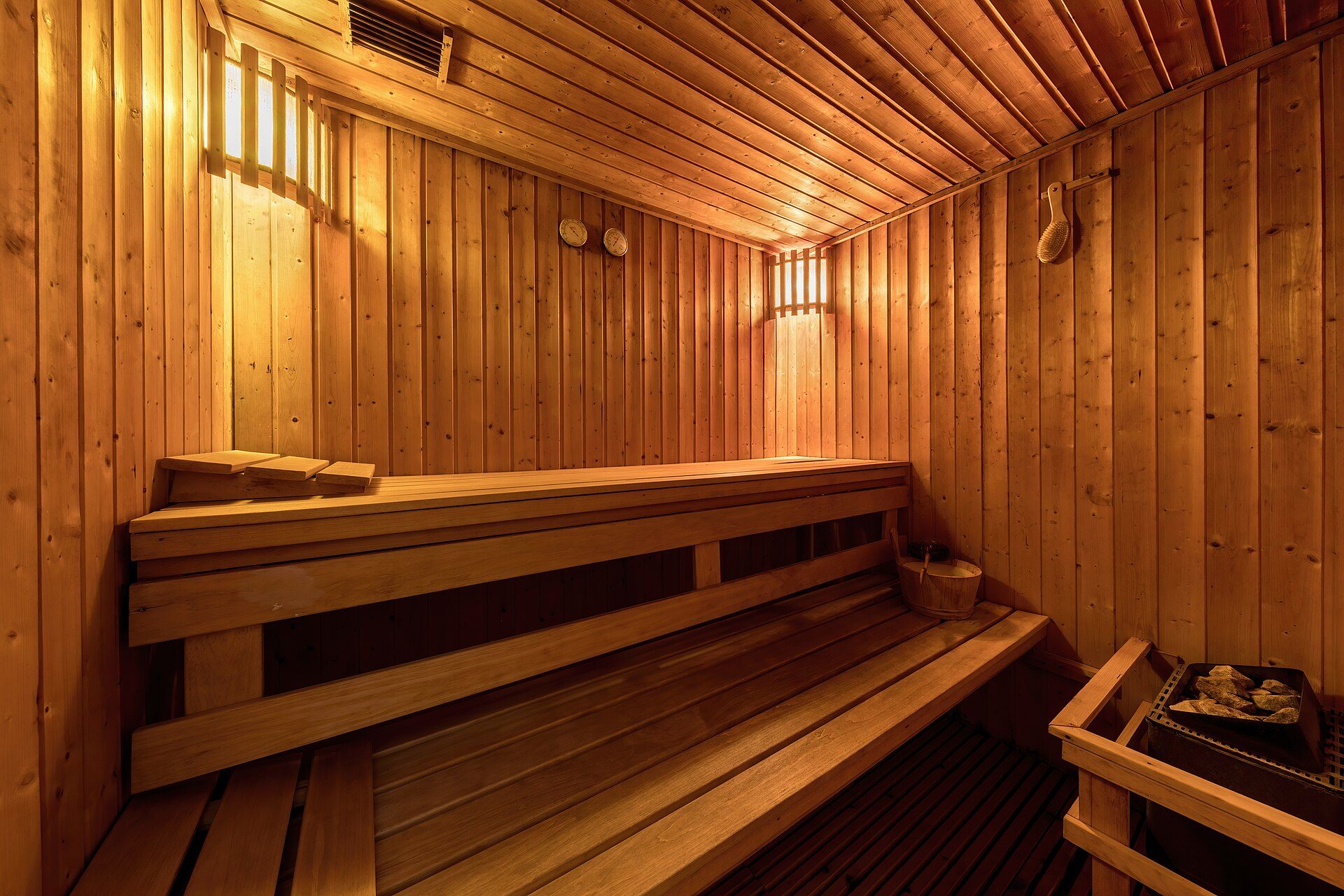
Photo: Basile Morin / Wikimedia Commons, CC BY-SA 4.0

Who must not use the steam room or sauna
The senior therapist asks these questions again immediately before the client enters the heat room, even if a health questionnaire is already on file, because conditions such as "just had a drink" or "haven't eaten anything" change from day to day:
- Pregnancy (especially the first 3 months) – a large rise in body temperature is not good for the baby.
- Heart disease (angina, previous heart attack, arrhythmia, a stent), uncontrolled high or low blood pressure, people who often faint or feel light-headed when standing up.
- Having just drunk alcohol or beer – alcohol dilates the blood vessels and causes dehydration, and combined with heat it easily leads to a drop in blood pressure, fainting or arrhythmia. Say it tactfully: "Let's just do a gentle massage today, and save the steam for another day".
- Having just eaten a large meal (less than about 1 hour ago), or being very hungry and weak; fever, diarrhoea, dehydration.
- Epilepsy; diabetes with numbness in the feet (poor heat perception, burns easily); a recent injury that is swollen and hot; open wounds.
- People taking medication that affects the heart or blood pressure, or sedatives: invite the client to ask their treating doctor first, and choose a different service today.
Wet-area safety: heat, water, slippery floors, electricity
The heat rooms, showers and body-wrap area are "wet areas". Here, water, heat and electricity are very close to each other. The start-of-shift check is the job of the senior therapist on duty, not only of the maintenance technician.
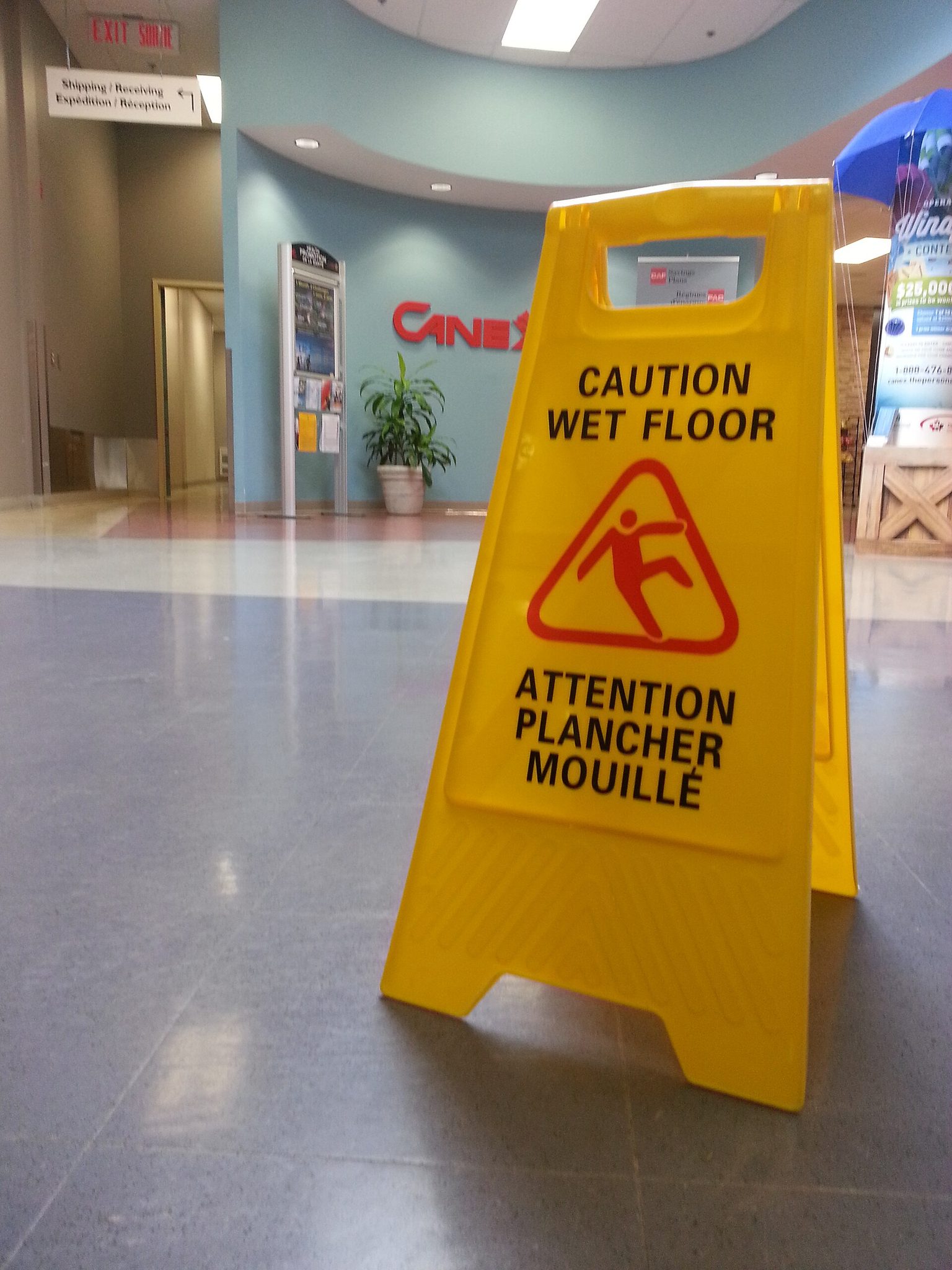
Photo: Dvermeirre / Wikimedia Commons, CC0

| Risk group | Start-of-shift check | During service |
|---|---|---|
| Heat | The heat-room thermometer is working correctly; the sauna stove has a guard rail; the hot and cold shower mixes correctly (test with the back of the hand, warm water about 37–40 °C) | Do not let clients splash water on the stones themselves if the spa does not allow it; remind clients not to touch the stove; set a timer for each client |
| Water, hygiene | Floor drains are clear with no standing water; the heat rooms are cleaned and disinfected on schedule; a clean seat towel for each client | One seat towel per client in the sauna; wipe up water on walkways as soon as you see it |
| Slippery floors | Non-slip mats at the shower and heat-room doors; secure grab rails; enough rubber-soled slippers in all sizes | Oil, mud or sugar dropped on the floor must be wiped up immediately; support clients getting on and off the bed and the sauna benches |
| Electricity | Sockets, heaters and steam generators are placed away from splashing water and have covers; the residual current device (often called an anti-shock breaker, ELCB/RCD) is tested with its test button on schedule; no electrical cables run across wet floors | Never plug in or unplug with wet hands; if you feel a tingle when touching equipment: switch off the breaker, do not let anyone use it again, and report it to the technician |
In addition: heat-room doors must open from the inside and must not be locked; there must be a call button or a glass panel to look in through; and a clock hung outside so the therapist can track each client's time.
Monitoring clients and handling a client who feels faint or collapses
Clients can sit in the heat room on their own, but the senior therapist is still responsible for monitoring them. The usual approach:
- Write the time of entry on the board or in the logbook; agree with the client: "In 5 minutes I'll knock on the door to check on you".
- About every 5 minutes, look through the glass panel or knock and ask. For first-time clients, older clients or clients just recovering from illness: check more often.
- When the time is up, invite the client out; remind them to cool down gradually in the shower and not to jump straight into ice-cold water if they are not used to it; sit and rest, drink water.
Signs that the client must be brought out immediately: a flushed or very pale face, cold sweats, slow speech, drowsiness or confusion, complaints of dizziness, nausea or headache, a pounding heart, cramps.
What to do:
- Take the client out of the heat room to a cool, airy place; walk with them, supporting them on both sides; do not let them walk unaided.
- Lay the client down with the legs raised about 20–30 cm above the heart; loosen the towel and cover the body to preserve modesty.
- Cool the forehead, neck and armpits with a cool damp towel; give sips of cool water if the client is conscious and able to swallow.
- Inform the shift leader; monitor continuously. If the client has fainted and does not come round, is breathing abnormally, has chest pain, is having a seizure, or remains drowsy and confused: call 115 immediately and follow the first-aid procedure you have learned (place them in the recovery position if they are breathing but unconscious, start chest compressions if they are not breathing).
- Record it in the incident log: time of entry, time in the heat room, signs, actions taken.
Putting together a safe "scrub – wrap – steam" package
The usual order: short heat session (or warm shower) → scrub → wrap → shower → moisturise. Three general rules:
- Do not stack heat: after 2 sauna rounds, do not add another 20 minutes of hot wrapping.
- Do not stack friction: after a grain scrub, wrap with a gentle product, with no acids or warming agents.
- Water before, during and after; advise the client to avoid alcohol for the rest of the day.
Aftercare advice: do not rub the skin hard, do not wax or exfoliate again for a few days, moisturise, use sun protection, and contact the spa if redness and burning persist.
Common mistakes
| Mistake | Why it is dangerous or wrong | The correct way |
|---|---|---|
| A salt scrub for a client who had their legs waxed yesterday | A layer of skin has just been removed and the pores are open; salt causes burning, rashes and possibly folliculitis | Ask about waxing and shaving; postpone the scrub to at least 24–48 hours later, or leave out the scrub for that area |
| Scrubbing hard "to get all the dirt off" | Invisible abrasions, redness and burning the next day; darker skin is prone to dark marks | Light to medium pressure, small circles, enough oil; test on your own arm first |
| Wrapping tightly and leaving the room during the wrap | The client has difficulty breathing, panics or their blood pressure drops without anyone knowing | Wrap with room for 2 fingers; stay in the room and check on the client every 5 minutes |
| Letting a client use the steam room after a drinking party because they beg | Alcohol plus heat easily causes fainting and heart rhythm disturbances | Decline tactfully, suggest another service; record it on the client card |
| Saying "steam for 30 minutes to sweat it out and detox" | Too long in the heat causes dehydration and faintness; "detox" is a false advertising claim | One round lasts a maximum of about 15 minutes; say "relaxing, pleasant" |
| Leaving mud, oil or sugar on the floor | Slips and falls on walkways, especially when clients are barefoot | Wipe it up immediately, put out a wet floor sign, have non-slip mats and slippers |
| Plugging a heater in near the shower, unplugging with wet hands | Risk of electric shock in a humid environment | Equipment away from water, protected by a residual current device; dry your hands before touching anything electrical |
Pass criteria for this lesson
- State correctly in front of the instructor the 3 types of scrub grain and the areas that suit each; name at least 5 areas or cases that must not be exfoliated, including "24–48 hours after waxing or shaving" and "sunburnt skin".
- Perform a full-body exfoliation on a model in 20–25 minutes, with all 8 steps, without exposing sensitive areas, and with the model showing no redness or burning after 15 minutes.
- Wrap a body wrap at the correct looseness (room for exactly 2 fingers), leaving the face and neck uncovered; ask the model at least 3 times during a 15-minute wrap.
- State correctly the common temperatures (steam room about 40–50 °C, sauna about 70–90 °C), the time per round, the maximum number of rounds and the amount of water to drink.
- Name at least 6 cases where heat treatments must not be used, including pregnancy, heart disease, uncontrolled blood pressure and having just drunk alcohol.
- Complete the start-of-shift wet-area checklist covering all 4 groups (heat, water, slippery floors, electricity) in 10 minutes.
- Rehearse handling a client who feels faint in the heat room with all 5 steps, including raising the legs and deciding when to call 115.
Frequently asked questions
Can a client with oily skin and lots of spots on the back have a body scrub?
Do not rub grains over spots that are inflamed, red or contain pus; friction spreads the spots and leaves dark marks. The skin around them can be cleansed gently. If the client has many back spots that persist, advise them to see a dermatologist; the spa only supports cleansing and does not treat acne.
Do steam rooms and saunas help with weight loss?
No. The weight lost after a heat session is water lost through sweat, and it comes straight back when you drink. Spas must not advertise heat treatments for weight loss or detox. You can say that heat treatments help the client relax, warm up and feel good.
Should clients jump straight into a cold plunge pool after the heat room?
Some spas have a cold plunge pool. A sudden change in temperature makes the heart rate and blood pressure change quickly, so it is only for healthy people who are used to it; people with heart disease or blood pressure problems must not use it. New clients should cool down gradually in the shower, starting from the feet upwards.
Can leftover home-made coffee scrub be kept until tomorrow?
It is not advisable. A mixture with oil and opened organic grains kept in a humid room easily goes mouldy and rancid. Make enough for the day; any portion already taken out into a bowl for a client is discarded and never poured back into the jar.