"Skin peel" is a hot keyword in Vietnamese spas. Clients watch videos online, see someone's skin shed a layer and come out bright and smooth, and immediately ask the spa, "Peel me like that." Some spas sell packages called "biological skin replacement peel" or "express renewal peel" while the therapist does not know which acid is in the bottle, at what concentration, or how long to leave it before rinsing. The usual consequences are burning, blistering and patchy darkening that lasts for months, especially in Vietnamese skin, which is prone to post-inflammatory hyperpigmentation. A correctly performed peel is a good care tool; an incorrect peel is a chemical accident on the client's face.
This lesson teaches you the part of the work the spa is permitted to do: superficial peels using cosmetic products, following the correct procedure and the manufacturer's instructions. You already know skin structure and the facial cleansing procedure from Level 1, so here we focus on acids, depth, contraindications and the skill of reading the skin during the peel.
By the end of this lesson, you will be able to:
- Distinguish superficial, medium and deep peels, and state clearly which the spa may perform and which belong to the doctor.
- Compare the four acids commonly used in spas (glycolic, lactic, mandelic, salicylic) and choose the right one for each skin type.
- Explain why concentration, pH, contact time and number of layers all determine the strength of a peel.
- Screen for all contraindications, carry out a patch test, then perform the 8-step superficial peel procedure with timing.
- Recognise the signs that mean you must stop immediately and handle them correctly, then give the client post-peel care and sun protection advice.
What a peel is, and the spa – doctor boundary
A chemical peel means applying an acid solution to the skin to loosen the bonds between corneocytes so that the old cell layer sheds faster. The new skin revealed is smoother and more even in tone, and pores are clearer. The degree of effect depends on how deep the acid goes.
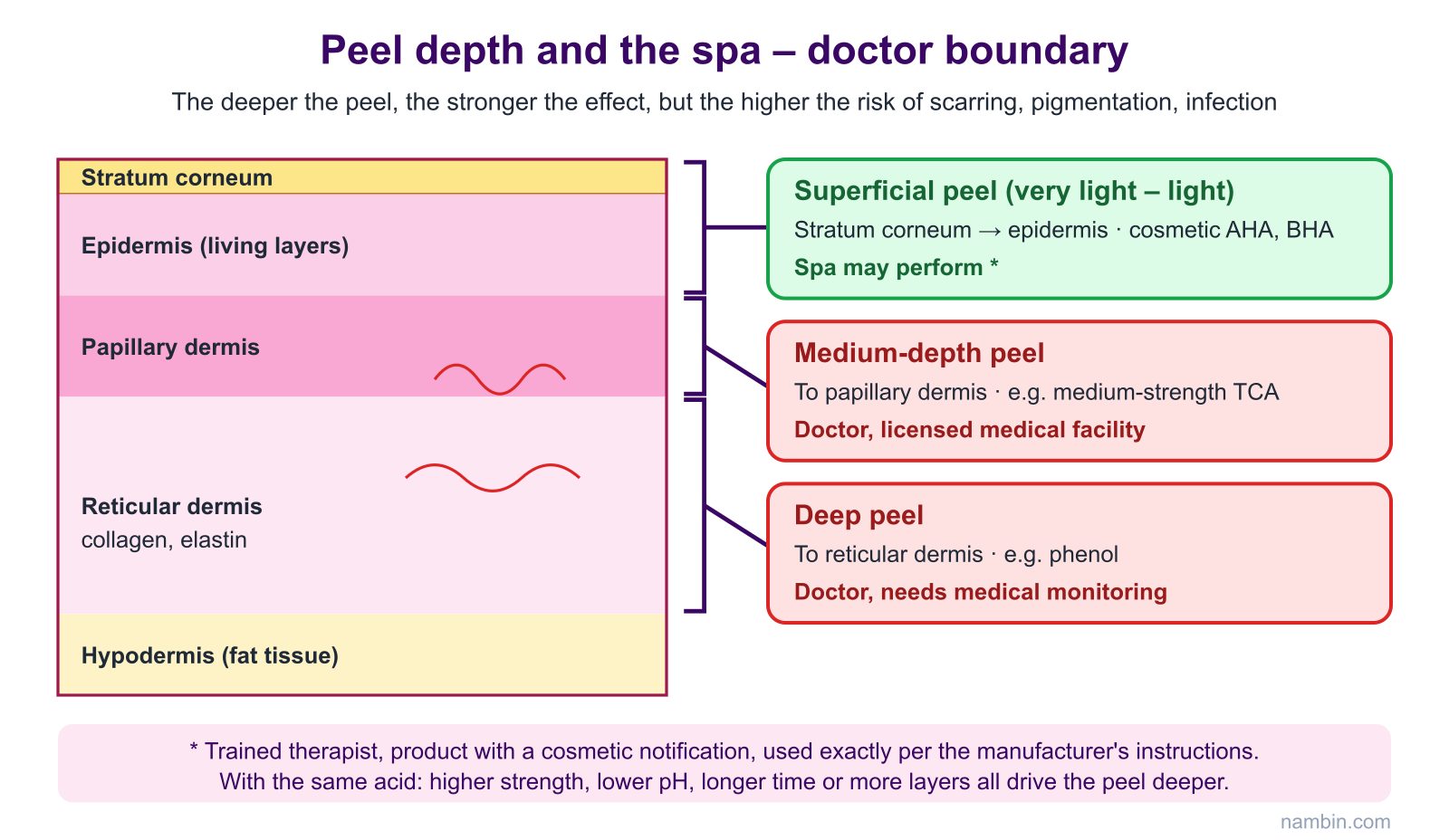
- Superficial peel (very superficial to superficial): acts on the stratum corneum and epidermis. Uses cosmetic AHA and BHA products. The skin may be slightly red with fine flaking for a few days. This is the level the spa may perform, provided the therapist has been trained, the product has a cosmetic product notification under Circular 06/2011/TT-BYT on cosmetics management, and the manufacturer's instructions are followed.
- Medium peel: reaches the papillary dermis, for example TCA (trichloroacetic acid) at medium concentration, or a combination of agents. The skin peels in sheets and is red and swollen for several days; complications need to be monitored.
- Deep peel: reaches the reticular dermis, for example phenol. It can affect the heart and kidneys and requires medical monitoring.
Medium and deep peels are procedures that intervene in the dermis and fall within the scope of licensed practitioners and licensed medical facilities under the Law on Medical Examination and Treatment No. 15/2023/QH15. The spa does not perform them, does not "add a bit extra to make it stronger", and does not buy TCA or phenol to use. When a client asks for a peel to treat acne scars or deep melasma, you say: "That level needs a dermatologist to assess it and do it in a medical facility. Our spa only does superficial peels to care for the skin surface."
Do not over-promise
Superficial peels help the skin look brighter and smoother, clear the pores and gradually fade superficial marks when the full treatment programme is completed with good sun protection. Superficial peels do not "cure melasma for good", do not "erase acne scars" and do not "give you completely new skin". Advertising like that is both untrue and may breach the Advertising Law 2012.
Four acids commonly used in spas
You will meet these four acids in almost every superficial peel product. The first three are AHAs (alpha hydroxy acids), which are water-soluble. Salicylic acid is a BHA (beta hydroxy acid), which is oil-soluble. Different molecule sizes mean different penetration speeds: the smaller the molecule, the faster it penetrates and the more likely it is to sting.
| Acid | Group, characteristics | Suits | Notes |
|---|---|---|---|
| Glycolic (from sugar cane) | AHA, smallest molecule, penetrates fast, strong effect | Thick, dull skin; oily skin that is not sensitive | Stings easily, can penetrate deeply and unevenly; darker skin needs caution |
| Lactic (from milk) | AHA, larger molecule, gentler, with a moisturising effect | Dry skin, skin having its first peel | Can still irritate weak skin; always test first |
| Mandelic (from bitter almonds) | AHA, large molecule, penetrates slowly and evenly | Sensitive skin, skin prone to marks, mild acne | Slower effect; needs the full number of sessions in the programme |
| Salicylic | BHA, oil-soluble, gets into pores, has a calming effect on inflammation | Oily skin, skin with comedones, congested pores | Do not use on people allergic to aspirin (salicylates); crystallises white on the skin |
Photo: ECTran71 / Wikimedia Commons, CC BY-SA 4.0

Many products combine two or three acids together with soothing ingredients. You do not need to memorise formulas; you need to read the label to know the main acid, the form (gel, solution), whether it needs neutralising, the contact time and the interval between sessions. Products without a Vietnamese label, of unknown origin or without a notification are not used.
Concentration, pH and the factors that make a peel stronger
Many therapists look only at the percentage on the bottle. In reality, the strength of a peel comes from several factors added together, and you must watch them all.
- Concentration (%): the amount of acid in the product. The higher the concentration, the stronger the effect. But two products with the same percentage can differ greatly in strength because their pH is different.
- pH: the scale of acidity from 0 to 14, where 7 is neutral. The lower the pH, the more acidic the solution and the more "free" acid there is to act on the skin. The pH scale is logarithmic: a drop of 1 pH unit means the acidity increases about 10 times. So a low-pH product can be much stronger than a product with the same concentration but a higher pH. Manufacturers usually state both values; when the label does not give the pH, ask the supplier.
- Contact time: AHAs keep working until they are neutralised or rinsed off. Leaving them on too long is the most common way a superficial peel becomes far too deep.
- Number of layers and pressure of application: applying several layers or rubbing hard with gauze both push the acid deeper.
- The skin's condition that day: skin that has just been exfoliated, waxed or shaved, is using a retinoid, is sunburnt or has grazes absorbs acid quickly and unevenly.
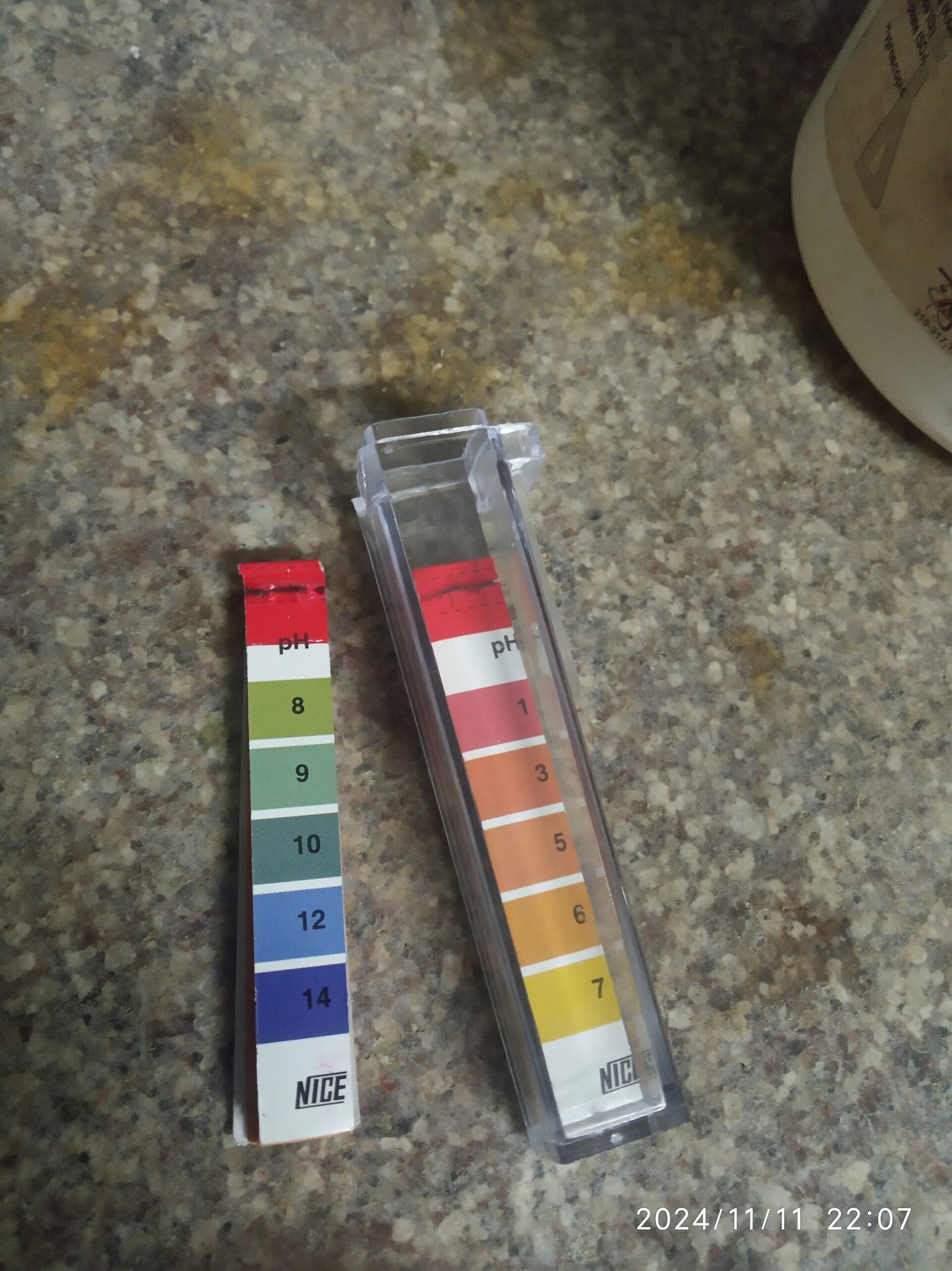
Photo: SAHAYA RAJAN S / Wikimedia Commons, CC0

The lesson to take away: with the same acid, a high concentration, a low pH, a long contact time or several layers all push the peel deeper. Do not extend the time or add layers yourself because "the client's skin can take it". This lesson deliberately does not give general concentration or time figures for all products, because every product is designed differently. The only correct figure is the one in the instructions of the manufacturer of the product in your hand.
Contraindication screening and skin preparation
Screening is the most important part of a peel session, and it happens before the bottle is opened. Ask using the health questionnaire, ask again verbally and record the answers clearly.
Do not peel (contraindications)
- Pregnant or breastfeeding. The spa chooses safety: postpone the peel and switch to gentle care.
- Taking isotretinoin, or stopped less than 6 months ago. Thin skin, slow healing, prone to scarring.
- Active cold sores (herpes labialis) (blisters, ulcers, burning on the lips). A peel can make herpes spread. Clients with frequent recurrences should ask a doctor's advice before a peel.
- Damaged skin: open wounds, grazes, sunburn, flaring atopic dermatitis or eczema, severe widespread inflamed acne.
- Recent procedures: laser, microneedling, a peel elsewhere, recent facial waxing or shaving. The waiting period follows the manufacturer's instructions and the advice of the doctor who carried out the procedure.
- Aspirin (salicylate) allergy: do not use salicylic peels.
- Previous allergy to acids or to ingredients in the product, or a reaction to the patch test.
Caution
- Darker skin, skin prone to post-inflammatory marks: much Vietnamese skin falls into this group. Choose slow-penetrating acids such as mandelic or lactic, start at the product's lightest level, test carefully and insist on strict sun protection.
- Using topical retinoids or home exfoliating products: these usually have to be stopped for a few days before the peel; the exact period follows the manufacturer's instructions.
- Sensitive skin, dilated capillaries, rosacea: consider not peeling, or use only the gentlest product after testing.
- Clients going to the beach or spending a lot of time in the sun in the coming week: reschedule.
Patch test
Before the first peel session, or when changing products, do a patch test: apply a small amount of product to a hidden area such as behind the ear or under the angle of the jaw, leave it for the shortest time in the instructions, then neutralise or rinse. Ask the client to observe and report back after 24–48 hours. Prolonged redness, itching, a rash, swelling or blistering means you do not peel with that product. Record the test date, the product and the result on the form.
Finally, explain to the client what will happen: stinging, warmth, flushing, possibly fine flaking for a few days, and what she must report immediately. Only start once the client understands and has signed the consent form.
The 8-step superficial peel procedure
Prepare the trolley before the client lies down: peel product, neutralising solution (if the product requires one) or a bowl of clean cool water, gauze, cotton, a fan brush or gauze for application, a protective balm (wax-based, petroleum jelly) for sensitive areas, a cooling fan, a timer, a gentle moisturiser and sunscreen. Everything within reach, because from application until neutralisation you must not leave the client.
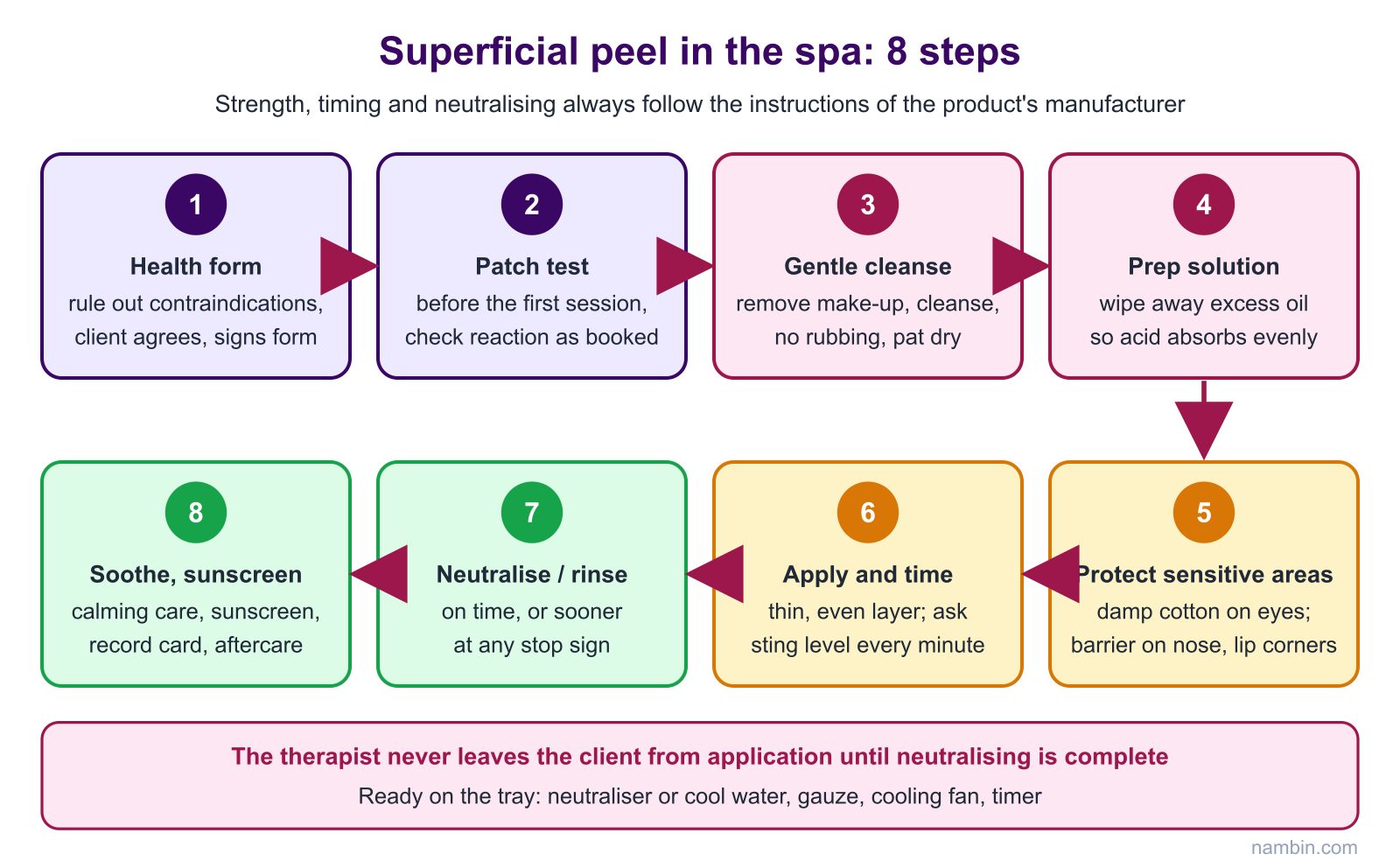
- Health questionnaire and consent. Re-check contraindications on the day itself, even for regular clients: any new medicines, any sunburn, any cold sores. The client signs the consent form.
- Confirm the patch test. Check the recorded test result. If there was no test, or the test caused a reaction, do not peel today.
- Gentle cleansing. Remove make-up and cleanse with a gentle cleanser. No exfoliation, no steaming and no extraction before the peel in the same session, because broken skin absorbs acid unevenly. Dry the skin completely.
- Prep solution. If the product has a prep (pre-peel) solution, wipe it on evenly to remove excess oil so the acid penetrates evenly. Let the skin dry.
- Protect sensitive areas. Place damp cotton pads over the eyes. Apply a thin layer of protective balm to the sides of the nose, nasolabial folds, corners of the mouth, corners of the eyes and any small grazes. These are thin-skinned areas where acid easily pools and causes a lot of stinging.
- Apply and time. Start the timer as soon as you begin applying. Apply a thin, even layer in a fixed order, usually starting with thicker skin (forehead, cheeks) and then thinner areas, avoiding the eyes and lips. Do not rub. Ask the client about the stinging level every minute, watch the skin continuously, and use the fan if needed.
- Neutralise or rinse. When the time in the instructions is reached, or earlier if there are signs to monitor or stop, neutralise with the manufacturer's solution or rinse repeatedly with clean cool water, exactly as the product specifies. Salicylic peels usually crystallise white on the skin; wipe them off as instructed.
- Calm, protect from the sun, record. Apply a mask or gentle moisturiser, then broad-spectrum sunscreen. Record on the form: product, batch number, contact time, number of layers, the highest stinging level the client reported, the skin's reaction and the advice you gave.
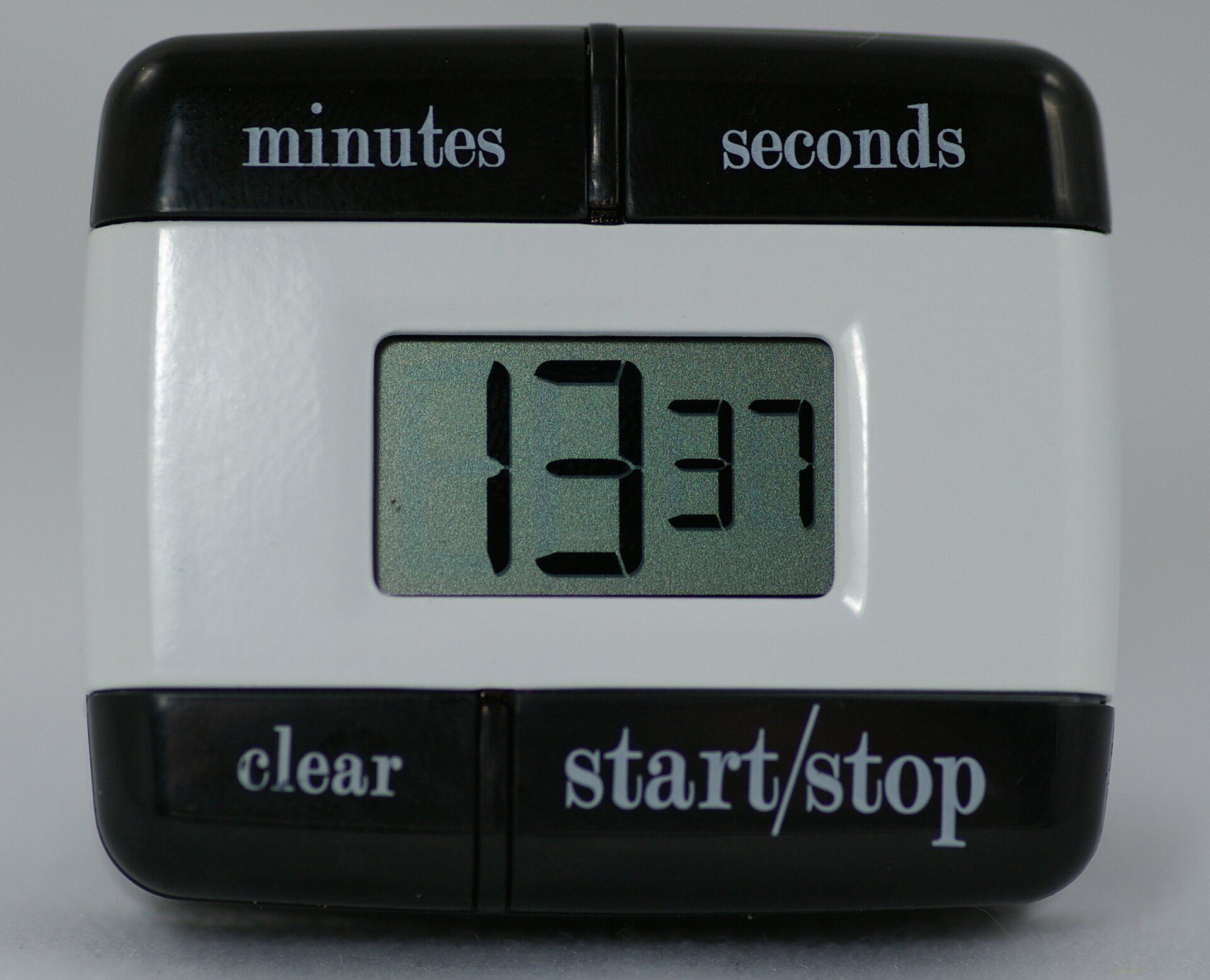
Photo: Hustvedt / Wikimedia Commons, CC BY-SA 3.0

Why you never leave the client
The skin's reaction can change within a few tens of seconds. If you step out to fetch a towel or take a phone call, the client may already be burning badly with no one there to neutralise in time. Firm rule: from application until neutralisation is complete, the therapist stands beside the client, hands ready.
Reading the skin during the peel: signs to stop immediately
Use a 0–10 stinging scale for the client to describe what she feels, and ask every minute: "From 0 to 10, how much is it stinging?" Combine this with what you see on the skin to decide whether to continue, monitor closely or stop immediately.
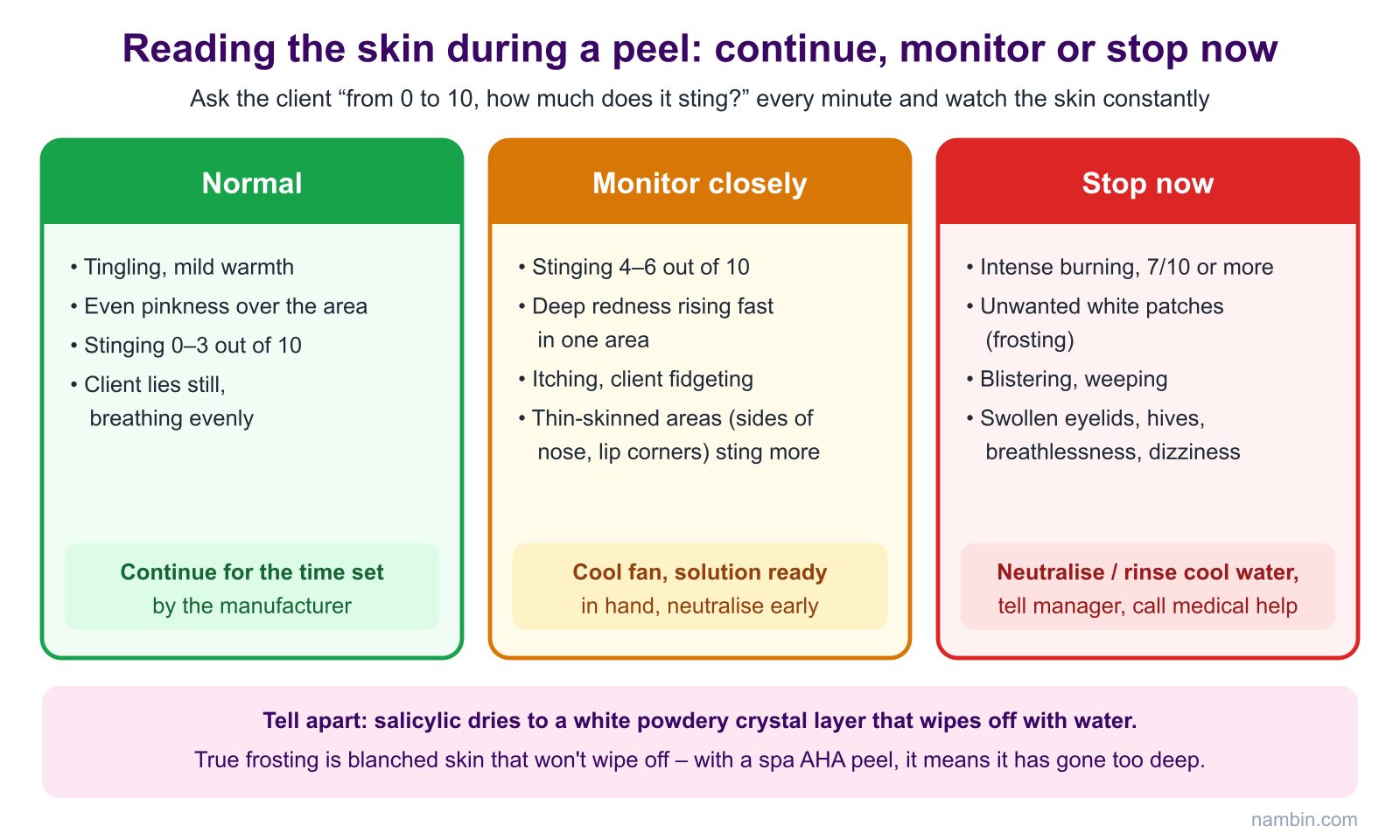
- Normal: stinging, mild warmth, an even pink flush over the whole area; the client reports stinging around 0–3 out of 10, lies still and breathes evenly. Continue to the manufacturer's time.
- Monitor closely: stinging 4–6 out of 10, one area quickly turning deep red, the client itching or fidgeting, the sides of the nose or corners of the mouth stinging much more than elsewhere. Use the fan, hold the neutraliser ready and be prepared to finish early.
- Stop immediately: severe stinging of 7 out of 10 or more, unwanted white patches (frosting), blistering, weeping, swollen eyelids, hives, difficulty breathing, dizziness.
True frosting and salicylic crystals
Frosting is the skin turning pale white because skin proteins have been coagulated by the acid. In a medium peel performed by a doctor, frosting may be an intended sign. With an AHA peel in the spa, frosting means the acid has gone too deep, and you must stop immediately. Distinguish this from a salicylic peel: salicylic acid dries into a white, powder-like crystal layer on the skin surface (often called "pseudo-frost"), which wipes off with water. True frosting does not wipe off.
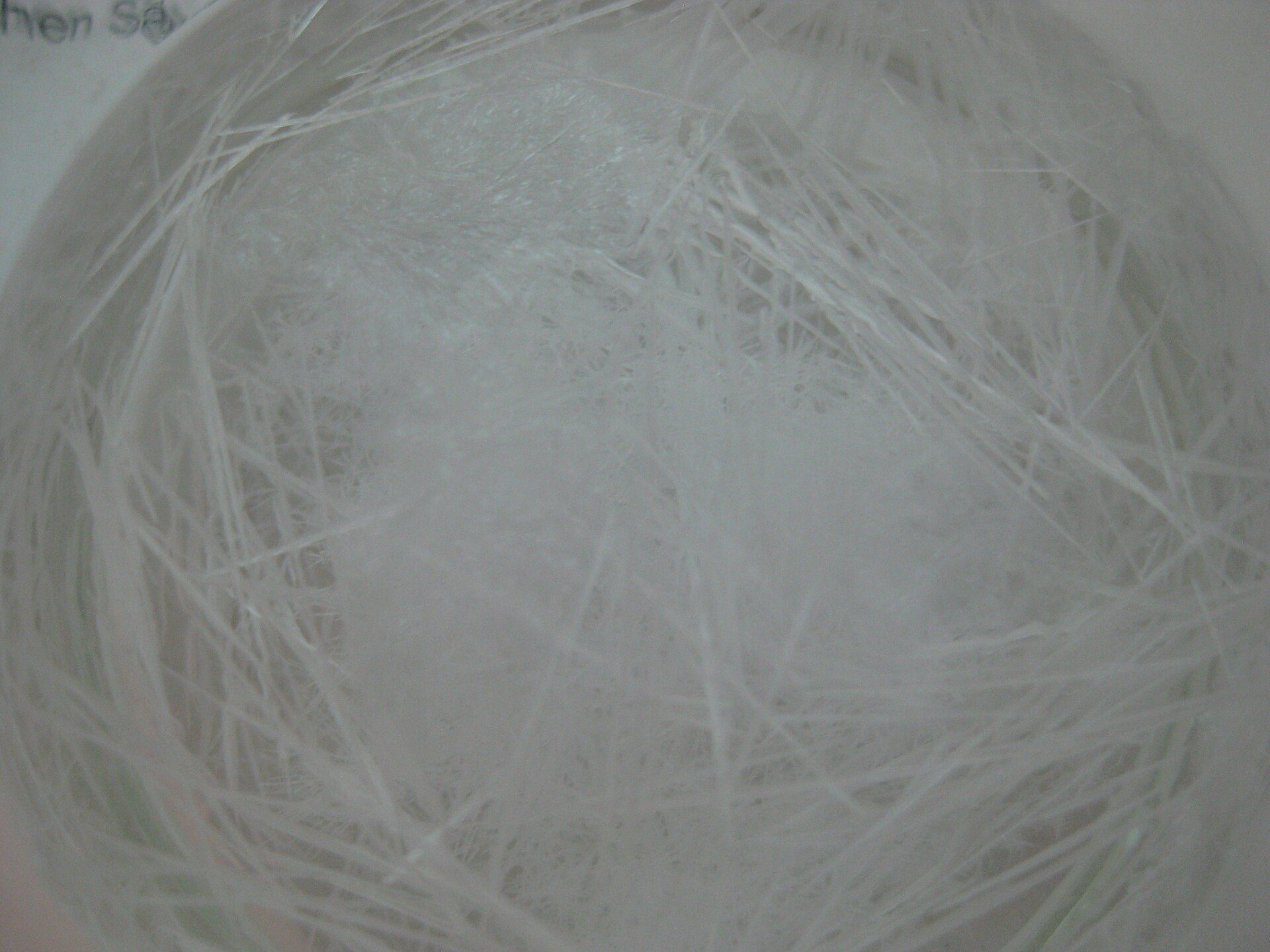
Photo: Studihermit / Wikimedia Commons, Public domain

What to do when you must stop
- Say calmly: "I'm going to rinse the product off for you right now."
- Neutralise or rinse repeatedly with clean cool water according to the product instructions, and apply cool gauze. Do not apply any other unfamiliar product.
- Inform the shift manager. If there is eyelid swelling, hives, difficulty breathing or dizziness, this may be a systemic allergic reaction: call emergency services on 115 and follow the spa's first-aid procedure.
- Blistering, weeping: do not burst the blisters, cover with clean gauze and advise the client to see a dermatologist the same day.
- Write an incident report: time, product, batch number, contact time, signs, actions taken. Call the client the next day to check on her.
Post-peel care and sun protection
After a superficial peel the skin may be slightly red for a few hours, feel tight and dry, and flake finely for a few days, depending on the product and the skin. The following advice should be printed on a sheet and given to the client:
- Daily sun protection with a broad-spectrum sunscreen, reapplied during long periods outdoors; wear a wide-brimmed hat and a face mask. Skin after a peel is more sensitive to UV and darkens easily if exposed to the sun without protection.
- Wash gently with a mild cleanser and cool or lukewarm water; pat dry.
- Moisturise well with a gentle, fragrance-free cream.
- Do not peel off or pick at flakes. Let them fall away naturally; removing them early easily leaves marks.
- Temporarily stop exfoliants, retinoids and other acid products for the number of days given in the manufacturer's instructions.
- In the first 24–48 hours: avoid steaming, sauna, swimming, heavy exercise that causes a lot of sweating and heavy make-up.
- Report back to the spa or see a doctor if the redness and stinging increase, or there is blistering, weeping, swelling or blisters on the lips.
The interval between peel sessions and the number of sessions in a treatment programme follow the manufacturer's instructions, usually a few weeks apart. Only step up at the next session (more time, a stronger product) if the skin recovered well after the previous session, the client has no marks, and you remain within the limits the manufacturer allows.
Common mistakes when peeling
| Mistake | Why it is dangerous/wrong | The right way |
|---|---|---|
| Not reading the instructions, estimating the time from experience | Every product has a different concentration, pH and time; leaving it on too long causes burns | Read the label before every new product, time it with a timer |
| Skipping the patch test | Allergies cannot be detected before the whole face is covered | Test before the first session and when changing products, record the result |
| Peeling straight after exfoliation, extraction or waxing | Broken skin, acid penetrates deeply and unevenly, stinging, patchy marks | Only gentle cleansing in a peel session; other services in a different session |
| Not protecting the sides of the nose, corners of the mouth and eyes | Acid pools in thin skin folds, causing local stinging, redness and heavy peeling | Damp cotton over the eyes, protective balm on the nasal folds and mouth corners |
| Applying several layers "for faster results" | Pushes the peel from superficial to far too deep | The correct number of layers per the instructions, increasing gradually over sessions |
| Leaving the client while the acid is on the skin | Signs to stop are not spotted in time | Stand beside the client from application until neutralisation is complete |
| Peeling a client taking isotretinoin or with active cold sores | Slow healing, scarring, herpes spreading | Re-screen at every session; postpone and refer to a doctor when there is a contraindication |
| Using a strong acid on darker skin at the very first session | Prone to post-inflammatory hyperpigmentation, marks that fade slowly | Choose a slow-penetrating acid, a light level, test carefully, strict sun protection |
| Mixing your own acids, buying TCA or phenol to use | Beyond the spa's scope, risk of deep burns and scarring, against the law | Use only finished products with a cosmetic notification, at superficial peel level |
Pass criteria for this lesson
You pass this lesson when you can do the following in front of the trainer:
- Draw or point out on a diagram the three peel levels – superficial, medium, deep – and state correctly which level the spa may perform, in no more than 2 minutes.
- State correctly the group, characteristics and suitable skin type for 4/4 acids: glycolic, lactic, mandelic, salicylic.
- List at least 5 factors that make a peel stronger (concentration, pH, time, number of layers, skin condition) and explain why a drop of 1 pH unit means about 10 times more acidity.
- Screen a role-play client and correctly identify 100% of the planted contraindications (pregnancy, isotretinoin, cold sores…).
- Carry out all 8/8 steps of the procedure in the correct order on a model or mannequin, timing exactly to the product label, never leaving the client, and asking the stinging level at least once a minute.
- Correctly classify 3 situations described by the trainer into the three levels – normal, monitor closely, stop immediately – and state the correct steps for stopping.
- Give the client the full post-peel advice and complete the form fully: product, batch number, time, number of layers, reaction.
Frequently asked questions
If the skin does not peel afterwards, did the peel not work?
No. A superficial peel often produces only very fine flaking that is hard to see, or no peeling at all. Results come from completing the full treatment programme, good care and sun protection, not from the skin coming off in sheets. Do not extend the time or add layers just so the client "can see it peeling".
Can darker skin be peeled?
Yes, but with more caution. Darker skin is prone to post-inflammatory hyperpigmentation, so choose slow-penetrating acids such as mandelic or lactic, start at the lightest level, do a patch test, and require the client to use strict sun protection. If marks appear after a session, stop the treatment programme and advise the client to see a dermatologist.
Should we peel in summer?
Superficial peels are possible if the client can protect fully from the sun and has no plans for a lot of sun exposure. Clients about to go to the beach or who work outdoors a lot should reschedule. In every season, sun protection after a peel is compulsory.
Can a client who occasionally gets cold sores have a peel?
When a cold sore is active, absolutely no peel. For clients with frequent recurrences, a peel can trigger an outbreak, so advise the client to ask a doctor's advice before the peel session and record it clearly on the form. Without a doctor's advice, choose a gentle care service instead.