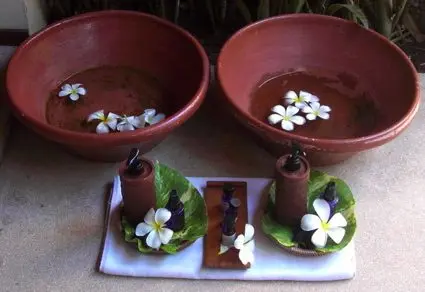
Foot massage is a best-selling service in a great many spas and "foot massage" shops in Vietnam: clients who have walked all day, tourists, office workers dropping in after work. The client sits in a reclining chair, soaks their feet in a herbal foot bath, and then has the soles pressed and rubbed for 45–60 minutes. It sounds simple, but this service involves many difficult situations: foot-bath water that is too hot for a diabetic client, touching athlete's foot between the toes, a client asking "this spot hurts, does that mean you can tell something is wrong with my liver?". A senior therapist must handle both the hands-on skill and the words.
By the end of this lesson, you will be able to:
- Prepare a foot bath at the right temperature (about 38–40°C, measured with a thermometer) and for the right length of time, choose suitable herbs and know when not to use them.
- Look and ask in order to screen the feet before soaking, and place the client in one of four levels: full treatment, treatment avoiding areas, light treatment with conditions, no treatment.
- Perform a complete 45-minute and 60-minute foot massage routine within the time plan.
- Use the foot reflexology map to choose areas and a relaxation sequence, describe reflexology accurately, and never diagnose illness from the feet.
- Apply pressure at a safe level on the 1–5 scale, and know the areas that must not be pressed deeply.
Foot massage and reflexology: describing them correctly
In Vietnamese spas, "foot massage", "foot acupressure" and "foot reflexology" are often used interchangeably. In this lesson:
- Foot massage: massaging the feet and lower legs with oil or cream, using the effleurage, kneading and friction movements you have learned, for relaxation.
- Foot reflexology: a school of thought holding that areas on the foot "correspond to" parts of the body, using the thumb to press according to a map. In the spa, you use this map as a framework for choosing areas and the order of work.
What the therapist needs to state plainly, to themselves and to the client: reflexology is a relaxation therapy. Many people find it pleasant, their legs feel lighter and they sleep better; but there is currently not enough scientific evidence that pressing the feet can treat diseases of the liver, kidneys, stomach or any other organ. Therefore:
- Never diagnose illness from the feet. A spot that hurts when pressed is usually due to thick calluses, tight muscles in the sole, tight shoes or long hours standing, not a "sign of a weak liver or weak kidneys".
- Never promise treatment. Do not say "foot acupressure cures stomach pain", "cleanses the kidneys", "detoxes the liver" or "cures insomnia". Say "it helps the legs feel lighter and more relaxed, and many people find it easier to sleep".
- Never advise a client to stop taking medication or to replace a medical examination with foot acupressure.
The Advertising Law 2012 and the Law on Medical Examination and Treatment No. 15/2023/QH15 are the legal reasons why the spa does not advertise or advise on foot massage as a medical treatment. Speaking accurately also protects your reputation: clients trust you more when you are honest.
Sample answer when the client asks: "This map is just a convention I follow so I work in order and help you relax. The spot that hurts is usually due to calluses and tight muscles from walking a lot. If you are having stomach symptoms, it's best to see a doctor."
Foot bath: temperature, herbs, time
The foot bath softens and cleans the skin and warms the feet before the massage, and it is a part clients really enjoy. But it is also the step of the service that most easily causes burns.
Temperature
- Foot-bath water at about 38–40°C: clearly warm, not hot. Measure it with a water thermometer; do not guess by hand.
- Put the cool water in first and add hot water afterwards, stir well and then measure. Never pour boiling water into the bowl while the client's feet are in it.
- Test with the therapist's inner forearm, then invite the client to dip their toes in first and ask: "Is the water warm enough for you?".
- Diabetic clients, clients with numb feet, older clients with reduced sensation: the therapist measures the water with a thermometer and keeps it at the lower end of warm, and does not ask the client whether the water is hot enough, because the client may not feel it accurately. For many clients at this level, the feet should only be wiped with a warm towel, not soaked (see the screening section).
- If the client insists "make it hotter", explain that water that is too hot dries the skin, burns easily and can cause dizziness.
Time
A soak of about 10–15 minutes is enough. Soaking for longer does not clean any better; it makes the skin wrinkled and dry, and clients with low blood pressure may feel faint when standing up. Add warm water mid-soak if the water cools, and measure again.
Herbs
Vietnamese spas often use herbal foot-bath sachets (ginger, lemongrass, mugwort, pomelo leaves, coarse salt) or ready-made foot-soak salts. A few points:
- Only use labelled herbal sachets and soak salts of clear origin supplied by the spa; follow the dosage on the label.
- Ginger, salt and pungent "hot" herbs sting on cracked or scratched skin and on athlete's foot. If the client has a small scratch: leave out the herbs and use clean warm water.
- Do not add neat essential oil to the bowl: essential oil floats on the surface and touches the skin in concentrated form. If you use it, follow the previous lesson: blend it into an emulsifier or carrier oil according to the manufacturer's instructions.
- Do not say the foot-bath water "changes colour because of detox". The water changes colour because of the herb pigments, dirt and the reaction of the salt.
Foot-bath hygiene
The foot bath easily spreads fungus and bacteria if hygiene is careless. Use disposable bowl liners if the spa has them. After every client: empty the water, wash the bowl with soap to remove residue, disinfect with the solution the spa uses for surfaces at the correct concentration and contact time according to the manufacturer's label, then rinse and dry. For bowls with whirlpool jets or spray nozzles, clean the pipework according to the manufacturer's instructions, because residue inside the pipes is hard to see.
Photo: User: (WT-shared) Johnycanal at wts wikivoyage / Wikimedia Commons, CC BY-SA 4.0

Checking the feet before treatment
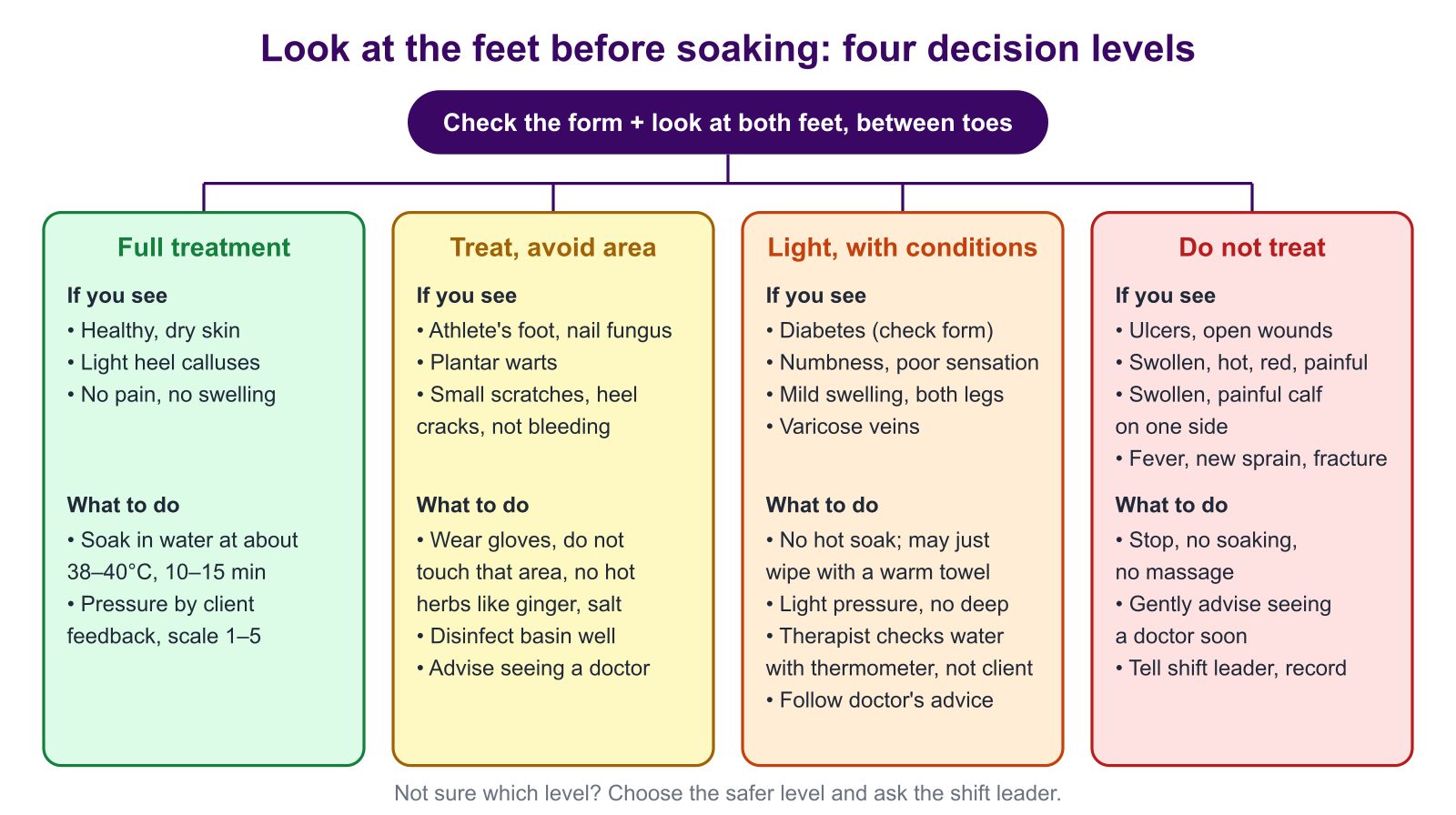
Before the client puts their feet into the bowl, go through the questionnaire and look at both feet, between the toes, the nails and the heels. This takes less than 1 minute. A natural way to open: "Let me take a quick look at your feet so I can choose the right foot bath and pressure for you." Wear gloves if you see anything unusual on the skin.
The four decision levels:
- Full treatment: healthy, dry skin, light calluses on the heels, no pain, no swelling. Soak at 38–40°C for 10–15 minutes, pressure according to feedback.
- Treatment avoiding areas: athlete's foot between the toes, nail fungus, plantar warts, small scratches, cracked heels that are not bleeding. Wear gloves, do not touch that area, leave out pungent herbs, disinfect the bowl thoroughly, and advise the client to see a dermatologist for treatment.
- Light treatment with conditions: diabetes, numbness or reduced sensation, mild swelling of both feet, varicose veins. No hot soak, possibly just a warm towel wipe; light pressure, no deep pressing, no work over visible veins; follow the advice of the client's doctor.
- No treatment: ulcers, open wounds, areas that are swollen, hot, red and painful, a swollen and painful calf on one side, fever, a recent sprain or suspected fracture. No soaking and no massage; speak gently and advise the client to see a doctor soon, inform the shift leader and record it on the client card.
The diabetic foot: why extra care is needed
People with long-standing diabetes may have reduced sensation in the feet and poor blood supply. They can be scalded by foot-bath water without feeling the heat, scratched without feeling pain, and small foot wounds heal very slowly and become infected easily. With these clients:
- Ask directly but politely on the questionnaire: "Are you being treated for diabetes? Do your feet ever feel numb or tingly?"
- If there are ulcers, dark discoloured spots, areas of changed skin colour, or the feet are unusually cold: no treatment; advise a medical examination.
- If there are no wounds: only a warm towel wipe or a short warm soak measured with a thermometer; light pressure, mainly effleurage; do not cut dead skin, do not scrub hard with a pumice stone, do not use sharp tools.
- Dry carefully between the toes after soaking.
- Look at the feet again after the session and remind the client to check their feet every day.
The 45-minute and 60-minute foot massage routine
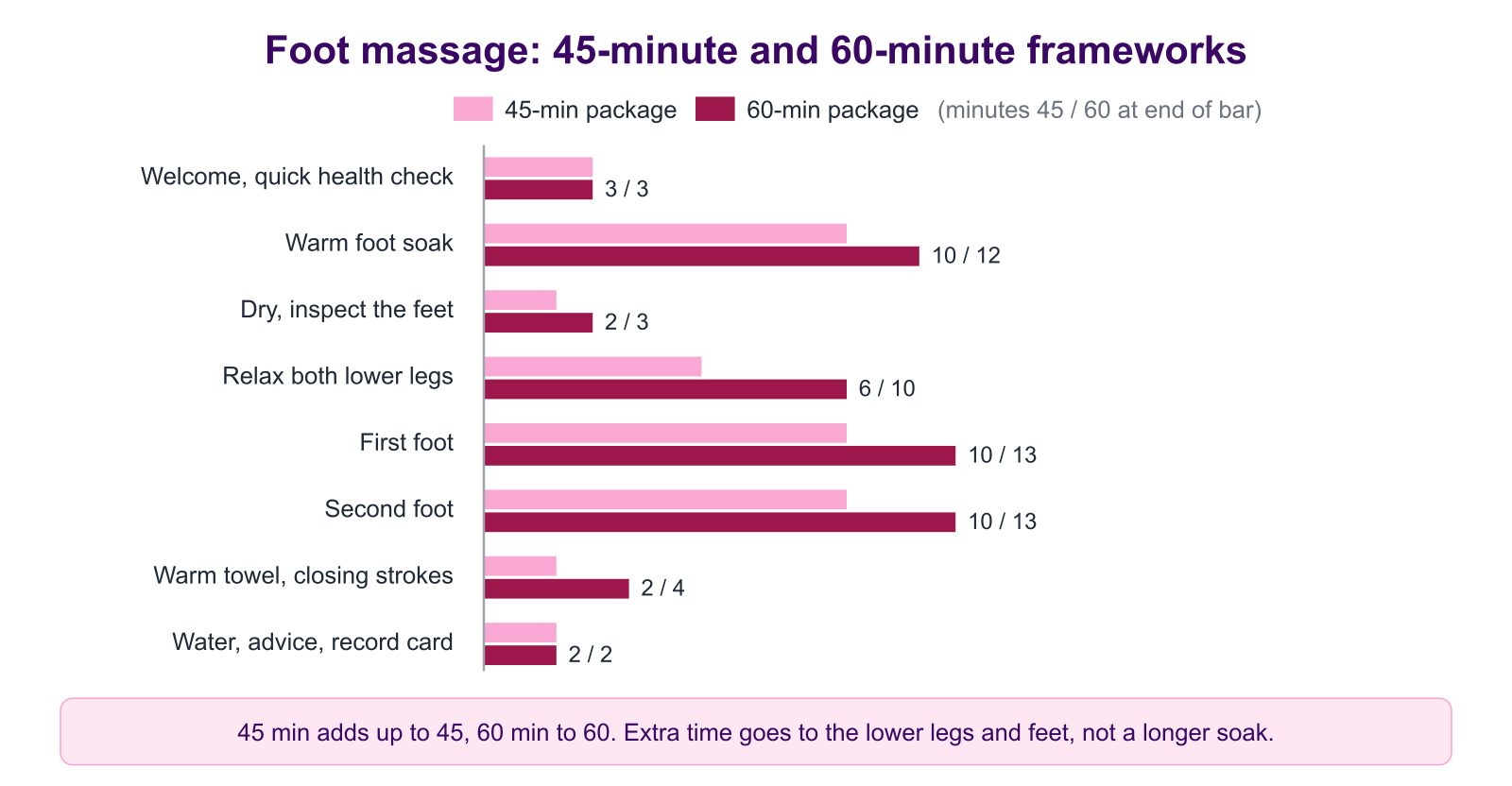
The client sits in a reclining chair or lies supine on the bed, with a bolster under the backs of the knees so the knees are slightly bent and a towel over the thighs. Position the chair so the client's feet are at about the height of your hips when you sit on a low stool; keep your back straight and use your body weight rather than straining your thumbs.
| Stage | 45-minute package | 60-minute package | Main tasks |
|---|---|---|---|
| Greeting, quick health check, looking at the feet | 3 | 3 | Go through the questionnaire, four-level screening, introduce the pressure scale |
| Foot bath | 10 | 12 | Water at 38–40°C measured with a thermometer; a light neck and shoulder massage can be given during the soak |
| Drying, re-checking the feet | 2 | 3 | Dry carefully between the toes, look at the skin again |
| Relaxing both lower legs | 6 | 10 | Effleurage and kneading of the calves, avoiding the shins and visible veins |
| First foot | 10 | 13 | Following the reflexology map sequence |
| Second foot | 10 | 13 | As for the first foot |
| Warm towel, closing effleurage | 2 | 4 | Wrap in a warm towel, long strokes from the toes up to the knee |
| Offering a drink, aftercare advice, recording | 2 | 2 | Guide the client to stand up, record the pressure and the areas to avoid |
| Total | 45 | 60 |
The 60-minute package puts the extra time into the lower legs and feet; it does not lengthen the soak. If the client wants extra neck and shoulder work, use the time while the feet are soaking; do not cut into the foot work.
The sequence on one foot
- Opening the foot: take a small amount of cream or oil, effleurage over the top and the sole of the foot, apply gentle traction to the ankle, and rotate the ankle slowly a few times in each direction within the range that is comfortable for the client.
- Warming the sole: apply friction with the heel of the hand from the heel to the base of the toes, and gently twist the foot like wringing a towel (hands moving in opposite directions, medium pressure).
- Toes: stroke each toe from the base to the tip, rotate gently, and never jerk to make the joints click.
- The ball of the foot below the base of the toes: thumb walking: bend the thumb joint slightly, move forward in small steps, pressing and releasing at each step.
- The arch of the foot: thumb-walk in horizontal lines from the inner edge to the outer edge, the upper arch and then the lower arch.
- Heel: the skin of the heel is thick; you can use the bent knuckle of the index finger to press, with medium pressure, without digging deep.
- Inner edge of the foot: thumb-walk along the inner edge from the heel to the big toe, more lightly because this area is thin.
- Top of the foot and around the ankle bones: stroke lightly with the fingertips between the metatarsal bones and around the ankle bones, with light pressure.
- Closing the foot: long strokes from the toes up to the ankle, hold the foot between both hands for a few breaths, wrap it in a warm towel and then move to the other foot.
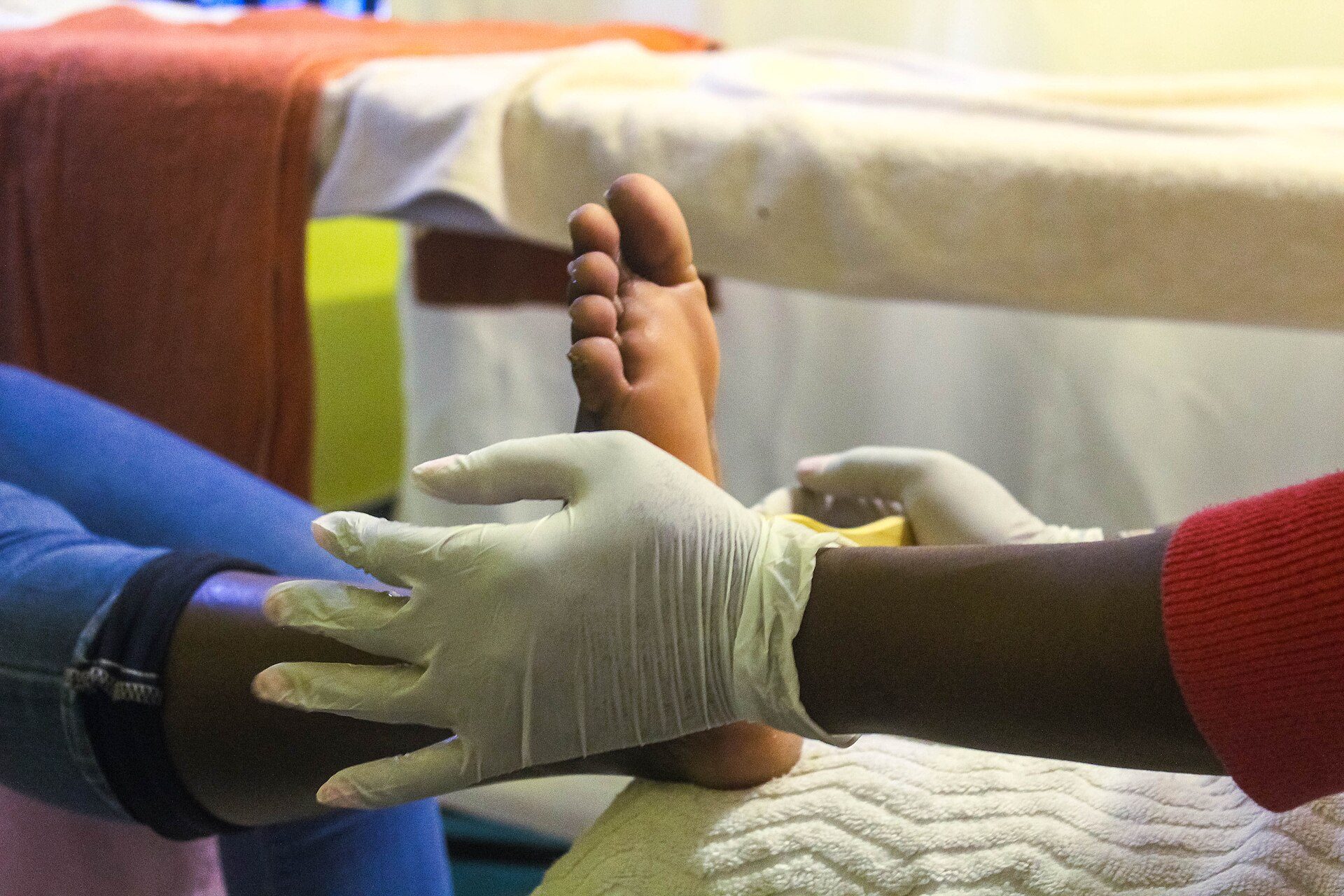
Photo: Kolobetsoo / Wikimedia Commons, CC BY-SA 4.0

How to use the foot reflexology map correctly
The reflexology map divides the sole into zones by convention, roughly: the toes correspond to the head and face; the ball of the foot below the base of the toes corresponds to the chest area; the arch corresponds to the abdominal area; the heel corresponds to the pelvic area; the inner edge corresponds to the spine. Each school draws it slightly differently; some maps are very detailed, others simplified.
For a spa therapist, the map has three practical uses:
- A sequence framework: working systematically from the toes to the heel or vice versa, without missing any area, and treating both feet the same.
- A language for talking with the client: if the client likes "the toe area" or "the heel area", you know where to do extra work.
- Creating an experience: many clients enjoy hearing "by convention this is the head area; I'll work it thoroughly to help you relax". You may say this, as long as you do not turn it into a diagnosis.
You must not use the map to: tell a client they have an illness, guess which organ is weak, advise the client to use acupressure instead of medication, or upsell treatments with scare tactics ("your foot hurts at the kidney point, you need 10 sessions").
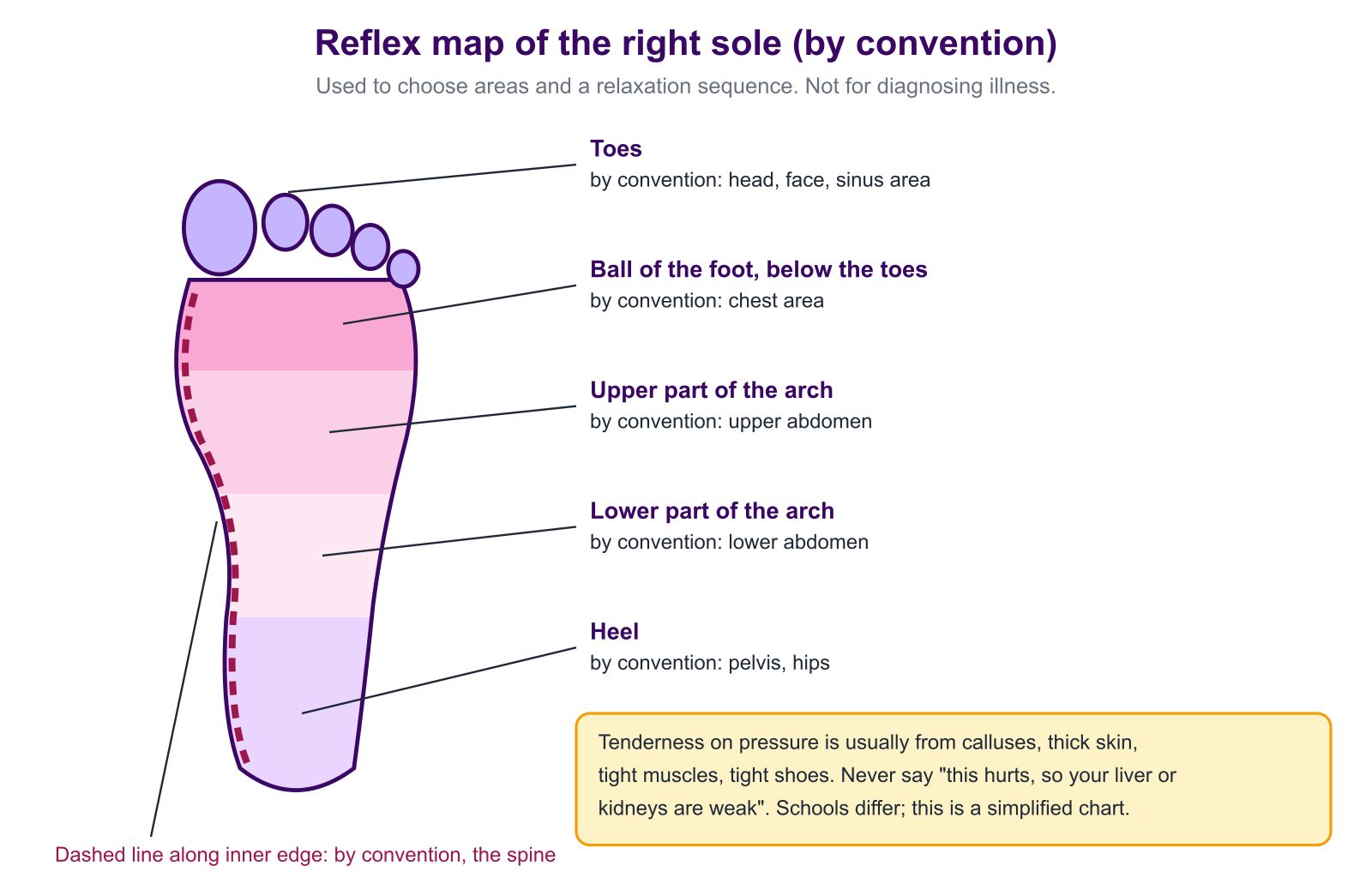
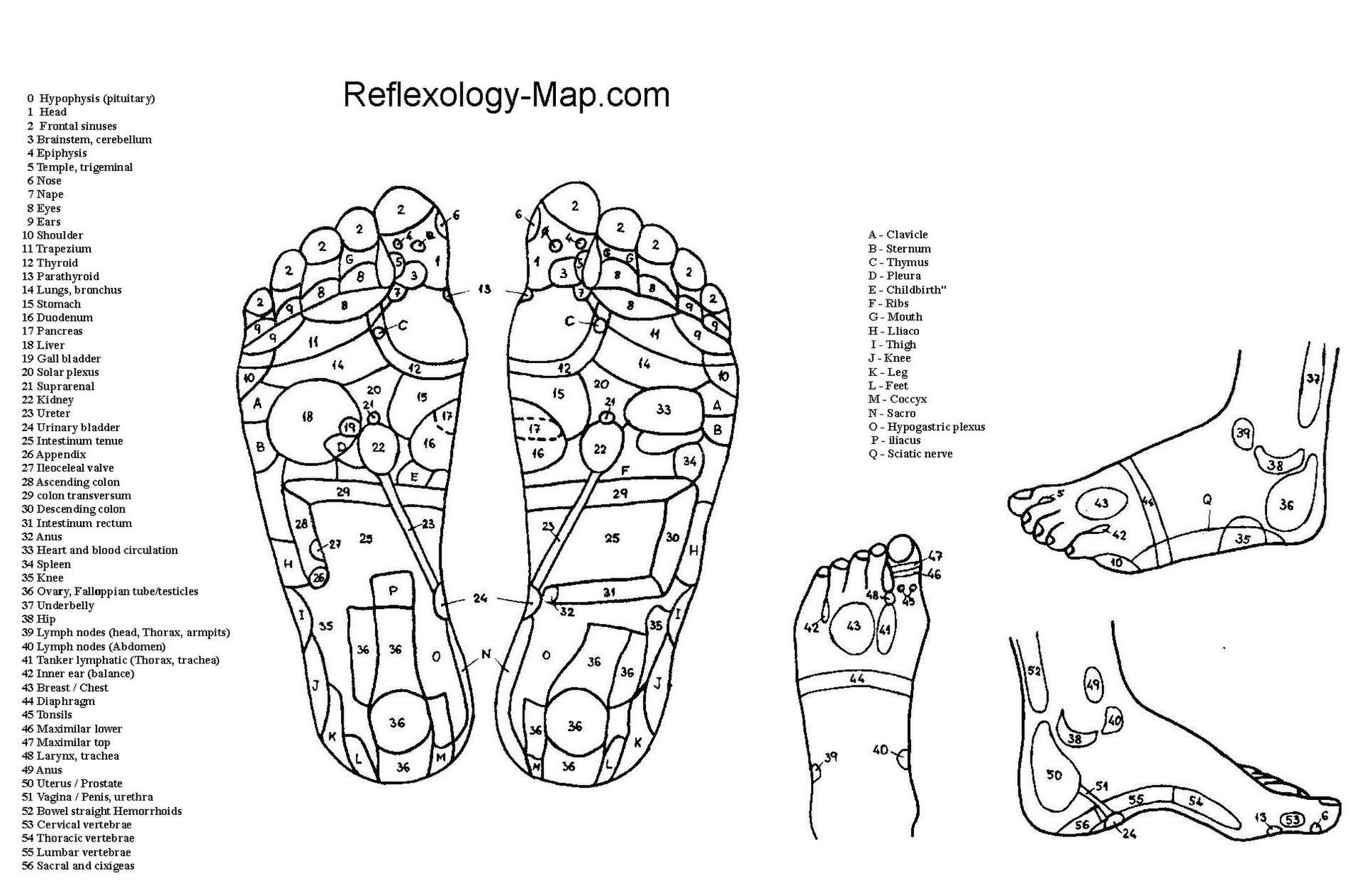
Photo: Anguxxx / Wikimedia Commons, CC0

Safe pressure and areas to avoid
Use the 1–5 pressure scale from the body massage lesson again. First-time clients start at level 2–3. Many clients are used to the idea that "foot acupressure has to hurt to feel good"; you still keep to the principle: correct pressure means the client is still breathing evenly, the foot does not pull away and the toes do not curl.
- Increase pressure through angle and body weight: lean forward, keep your wrist straight, and press with the thumb at close to a right angle to the skin. Never press with the tip of your fingernail.
- Press and release: hold each pressure point for a few seconds and then release; do not hold one point too long, and do not grind until it bruises.
- Wooden acupressure tools: if the spa uses them, only on the heel and ball of the foot where the skin is thick, with no more pressure than the fingers, and disinfect them after every client. Do not use them on the top of the foot or the ankle bones.
Areas not to press deeply: the top of the foot (thin skin, many tendons and blood vessels), around the ankle bones, the inner edge of the foot near the inner ankle bone, the back of the knee, the front of the shin, and visible veins on the lower leg. With pregnant clients, many spas avoid deep pressure around the ankle bones and heel; work lightly, mainly with effleurage, and only when the client has her doctor's approval and the therapist has learned the dedicated procedure.
Stop and check again if the client: pulls their foot away, holds their breath, says "the numbness is spreading up", feels a sharp, needle-like pain, the foot turns cold or blue, or they feel dizzy. Cramp in the foot or calf: stop, gently pull the toes towards the shin to stretch the calf, and hold until the muscle softens.
Closing the session and aftercare advice
- Wipe excess oil off the soles before the client stands, hand them their slippers and support them if needed. Dry the floor around the chair.
- Offer warm water. Advise the client: the feet may feel slightly sore the next day if strong pressure was used; if there is swelling, spreading bruising or increasing pain, contact the spa and see a doctor.
- Clients with athlete's foot or cracked heels: advise them to keep their feet dry and see a dermatologist; do not sell "antifungal" creams unless they are products that are permitted to be sold.
- Diabetic clients: remind them to look at their feet every day and not to soak their feet in hot water at home.
- Record on the client card: screening level, water temperature, herbs used, pressure by area, areas to avoid.
Common mistakes
| Mistake | Why it is dangerous or wrong | The correct way |
|---|---|---|
| Mixing the foot-bath water by feel, without a thermometer | The therapist's palm is used to heat, so the water easily goes above 40°C and clients with reduced sensation get scalded | Measure with a thermometer, keep it at about 38–40°C, and also test with the forearm |
| Asking a diabetic client "is the water hot enough?" | The client may not perceive the temperature accurately | The therapist measures it, keeps it at the lower end of warm, or only uses a warm towel wipe |
| Not looking at the feet before soaking | Missing ulcers or fungus, making wounds worse and spreading infection to other clients | Four-level screening in about 1 minute before soaking |
| Putting ginger and salt in the bowl for a client with cracked heels | Stinging, burning, and the cracks become inflamed easily | Leave out pungent herbs and use clean warm water |
| Saying "this spot hurts because your liver is weak" | An unfounded diagnosis that worries the client and may breach the rules on advertising and on medical examination and treatment | Explain that the pain comes from calluses and tight muscles; if there are symptoms, advise a medical examination |
| Pressing with the fingernail tip or straining the thumb | Pain and bruising for the client; thumb joint pain for the therapist | Thumb-walk with the pad of the thumb and increase pressure through body weight |
| Just emptying and rinsing the bowl before using it for the next client | Spreads fungus and bacteria between clients | Wash with soap, disinfect for the correct contact time according to the label, dry, or use a liner |
Pass criteria for this lesson
You pass this lesson when you can do the following in front of your instructor:
- Prepare a foot bath measuring 38–40°C on the thermometer in no more than 3 minutes, and keep the soak time to 10–15 minutes.
- Place 4/4 situations set by the instructor (for example athlete's foot, diabetes with numbness, an ulcer, healthy feet) into the correct screening level and state how to proceed at each level.
- Perform a complete 45-minute or 60-minute package, deviating from the time plan by no more than 3 minutes, with all 9/9 sequence steps on each foot.
- Point out the 5 main zones on the reflexology map correctly, and answer the question "this spot hurts, what illness is it?" with a reply that neither diagnoses nor promises treatment.
- Ask about pressure on the 1–5 scale at least 3 times during the session, and correctly name at least 4 areas that must not be pressed deeply.
- Clean the foot bath with all the steps: empty the water, wash with soap, disinfect for the correct contact time according to the label, dry.
Frequently asked questions
What do I say when a client insists "foot acupressure cures illness, I read it online"?
Do not argue and do not criticise the client. Say: "Many people find foot acupressure helps them relax and sleep better. As for illness, I can't diagnose or treat it, so please follow your doctor's advice." Then carry on doing the relaxation part really well.
Can I treat a client with nail fungus?
Usually yes, at the "treatment avoiding areas" level: wear gloves, do not touch the affected nails and toe spaces, do not share tools, leave out pungent herbs and disinfect the bowl thoroughly. Advise the client to see a dermatologist. If the fungus has spread widely or is weeping, do not treat.
Should I use a foot massage machine instead of my hands to save energy?
A machine is a different service and cannot replace the manual routine. If the spa has a machine, use it only according to the manufacturer's instructions, screen clients as usual, and do not use the heat setting for diabetic clients with reduced sensation.
What if a pregnant client wants a foot massage?
Only perform it if the spa has a pregnancy massage procedure, the therapist has had dedicated training and the client has her doctor's approval. Warm foot-bath water, no strong herbs, no essential oils, light pressure, avoiding deep pressure around the ankle bones and heel, with the client sitting comfortably in a semi-reclined position.