Many Vietnamese spas sell "herbal essential oil massage" or "volcanic hot stone massage" packages at a higher price than an ordinary massage. Clients pay extra for the pleasant scent and the feeling of deep warmth. But these are also two services with their own risks that a plain carrier-oil massage does not have: too many drops of essential oil can cause burning and rashes; lemon or bergamot applied before going out in the sun can darken and blister the skin; stones that are too hot, or left resting in one spot, can burn the client before they have time to say anything. At Level 2 you blend the oil yourself, heat the stones yourself and decide for yourself whether or not to perform the treatment for the client.
By the end of this lesson, you will be able to:
- Distinguish carrier oils from essential oils, and explain why essential oils are never applied neat (undiluted) to a client's skin.
- Calculate the number of drops of essential oil for 10, 30 and 50 ml of carrier oil at 1%, 2% and 3% without looking at a table, to within 1 drop.
- Recognise phototoxic essential oils and groups of clients who must not use essential oils, and store essential oils correctly.
- Prepare the stone heater, keep the water within the working temperature range, and check the stone temperature four times before a stone touches the client.
- Screen clients before a hot stone treatment, and clean and disinfect the stones after every client.
Carrier oils and essential oils: two completely different things
In the previous lesson you chose a carrier oil for the massage: sweet almond oil, grapeseed oil, jojoba oil, fractionated coconut oil. A carrier oil is a fatty vegetable oil, used in large quantities as the lubricant that lets your hands move over the skin. It can be applied neat.
Essential oils are different. They are the volatile aromatic compounds distilled or pressed from flowers, leaves, peel or roots of plants. A 10 ml bottle of lavender essential oil is the concentrate of a great many plants. Because they are so concentrated, essential oils are:
- Never applied neat to the client's skin. Always dilute them in a carrier oil at a set ratio. Applying them neat easily causes irritation and burning, and in the long term can make the client allergic to that very essential oil.
- Not oils in the lubricating sense. Essential oils evaporate and do not make your hands slip. You cannot "massage with essential oil"; you massage with a carrier oil to which a little essential oil has been added.
- Never swallowed, never put into the eyes or nose. Keep them out of the reach of young children.
Pre-blended massage oils that the spa buys are cosmetics and must have a cosmetic product notification under Circular 06/2011/TT-BYT on cosmetics management. When the spa blends on site, therapists only use essential oils and carrier oils with clear labels, within their expiry date and supplied by the spa; never bring in unlabelled "home-made" bottles from outside.
What to say to clients: essential oils help create a pleasant scent and a feeling of relaxation. Do not say "lavender cures insomnia", "cajeput treats colds", "essential oils burn fat" or "detox through the skin".
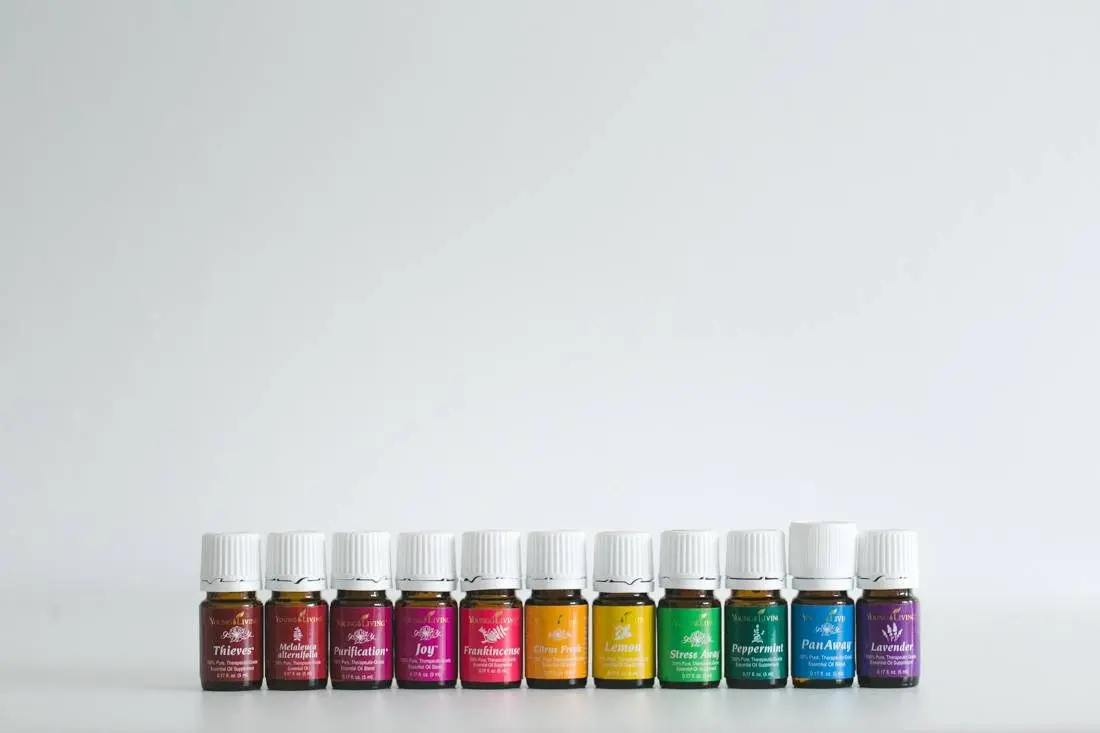
Photo: Vanilla and lace / Wikimedia Commons, CC BY 2.0

Essential oil dilution at 1%, 2% and 3%
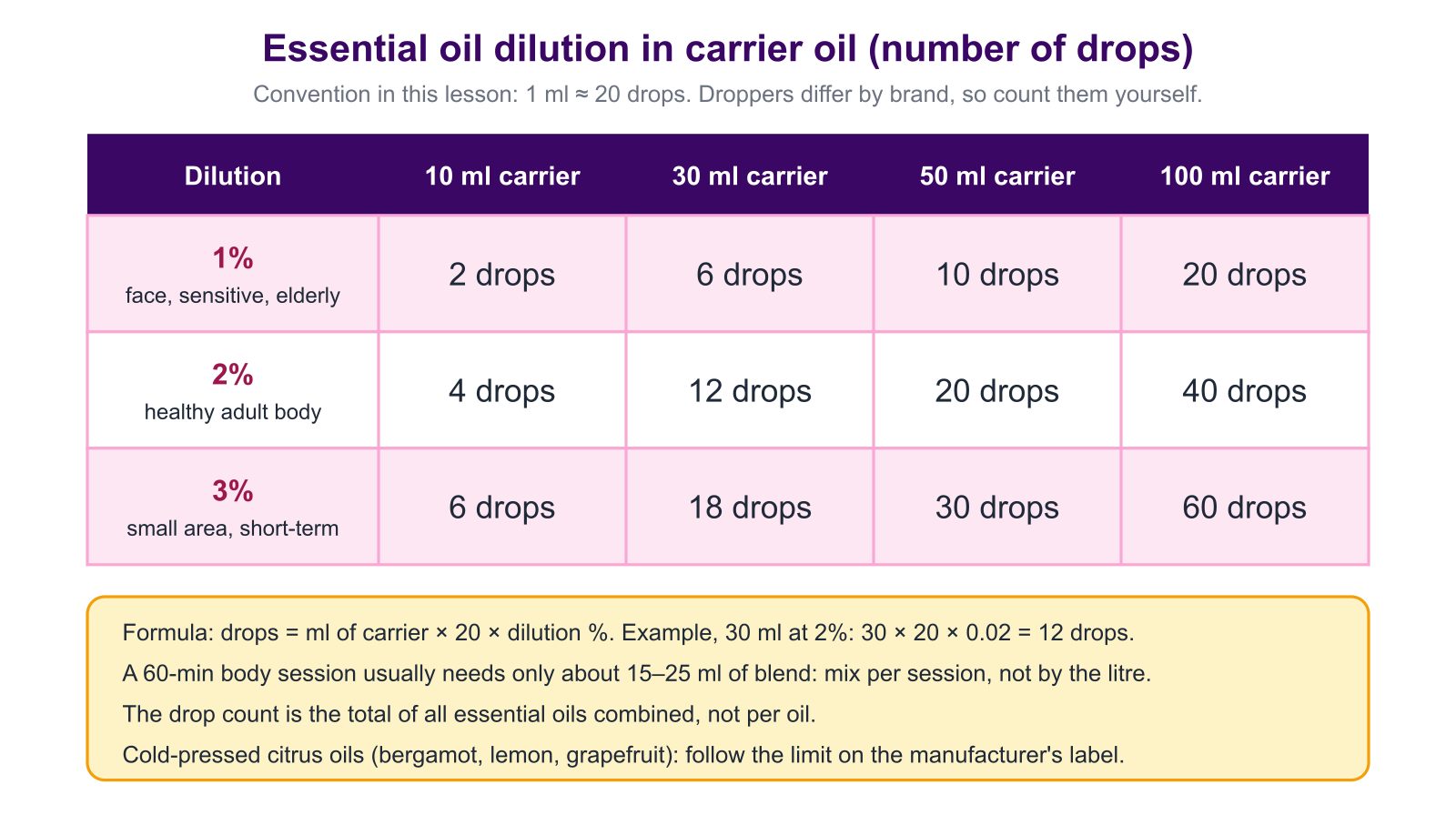
The dilution ratio is the percentage of essential oil in the total blend. For body massage on healthy adults, the common safe range is 1–3%. In the spa, 2% is the default level for the body; 1% for sensitive skin, older clients and the face; 3% only for small areas and short-term use (for example the shoulders and nape), never for the whole body.
Converting ml to drops
In this lesson we use the convention 1 ml ≈ 20 drops. This is an estimate; dropper caps differ from brand to brand, and thick or thin essential oils give larger or smaller drops. The first time you use a new bottle, count the drops in 1 ml yourself using a small measuring cylinder or a needle-free syringe used for measuring.
Formula: number of drops = ml of carrier oil × 20 × percentage.
- 10 ml at 2%: 10 × 20 × 0.02 = 4 drops.
- 30 ml at 1%: 30 × 20 × 0.01 = 6 drops.
- 50 ml at 3%: 50 × 20 × 0.03 = 30 drops.
| Ratio | Used for | 10 ml carrier oil | 30 ml carrier oil | 50 ml carrier oil |
|---|---|---|---|---|
| 1% | Face, sensitive skin, older clients, clients using essential oils for the first time | 2 drops | 6 drops | 10 drops |
| 2% | Body of healthy adults, the default level | 4 drops | 12 drops | 20 drops |
| 3% | Small areas, short-term use (shoulders and nape, upper back) | 6 drops | 18 drops | 30 drops |
Three common mix-ups:
- The total number of drops is for all essential oils combined. If you blend 30 ml at 2% with lavender and sweet orange, the total is 12 drops, for example 7 drops of lavender + 5 drops of sweet orange, not 12 + 12.
- Blend per session. A 60-minute body session uses about 15–25 ml of blend. Blend enough for the day in a clean bowl or small bottle with a label (name, ratio, date blended). Do not pre-blend a whole litre and keep it for a long time.
- More is not better. An overpowering scent gives the client a headache or nausea, and the therapist breathes it in all day. If the client says "make it smell stronger", explain gently and keep the ratio.
Blending oil for one client
- Wash your hands and sanitise the blending area. Prepare a clean, dry glass bowl or small bottle.
- Check the health questionnaire: whether the client belongs to a group that must not use essential oils, and whether they have scent allergies or nut allergies (relevant to almond oil).
- Let the client smell 2–3 scents from the bottle caps (not held right under the nose) and choose. If the client does not like any of them, use an unscented carrier oil.
- Measure the carrier oil with a graduated cup, for example 20 ml.
- Calculate the drops: 20 ml at 2% is 20 × 20 × 0.02 = 8 drops. Add one drop at a time, counting aloud or keeping a tally.
- Close, shake or stir well. Record the essential oil names and the ratio on the client record card.
- For first-time clients, apply a little to the inner forearm during the consultation; if it burns or turns red, switch to an unscented carrier oil.
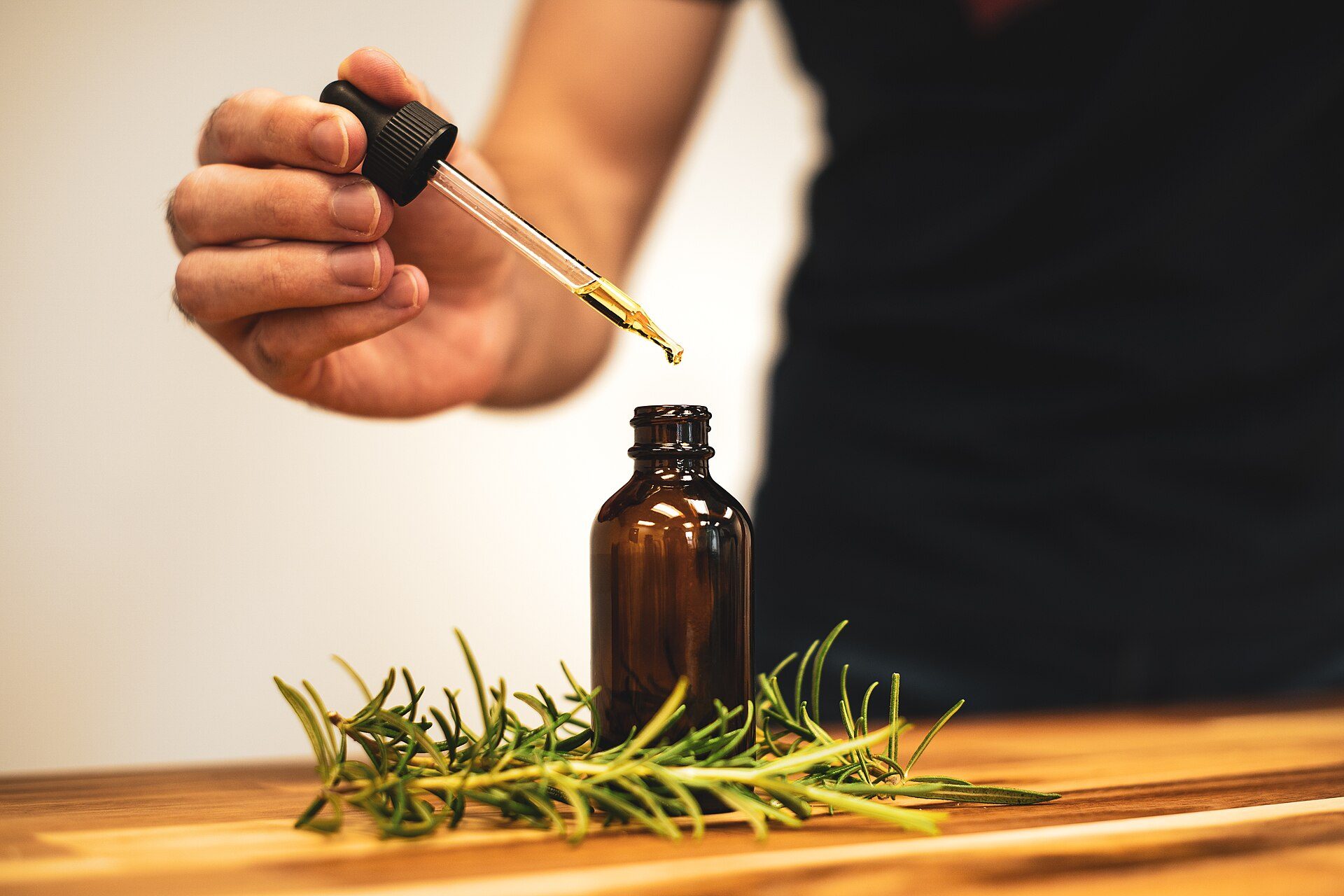
Photo: formulatehealth / Wikimedia Commons, CC BY 2.0

Phototoxic essential oils, clients who must avoid them, and storage
Phototoxic essential oils (the citrus family)
Some essential oils, especially cold-pressed citrus peel oils such as bergamot, lemon, lime and grapefruit, contain compounds that make the skin sensitive to sunlight (phototoxicity). Applied to the skin before going out in the sun or sunbathing, they can cause redness and burning, blistering, and dark marks that are slow to fade. In Vietnam the sun is strong all year round, and clients often ride a motorbike home straight after a treatment, so this risk is very real.
- For daytime sessions where the client will go out into the sun: do not use cold-pressed citrus oils on exposed skin (arms, neck, legs).
- If the spa uses citrus oils with the phototoxic compounds removed (labelled "FCF" or "bergaptene-free") or distilled citrus oils, follow the limits on the manufacturer's label.
- Sweet orange is generally considered less phototoxic than lemon and bergamot, but when in doubt, treat it as phototoxic.
- Advise clients who have had citrus essential oils: cover the skin and avoid direct sun for about 12 hours.
Clients who must not use essential oils
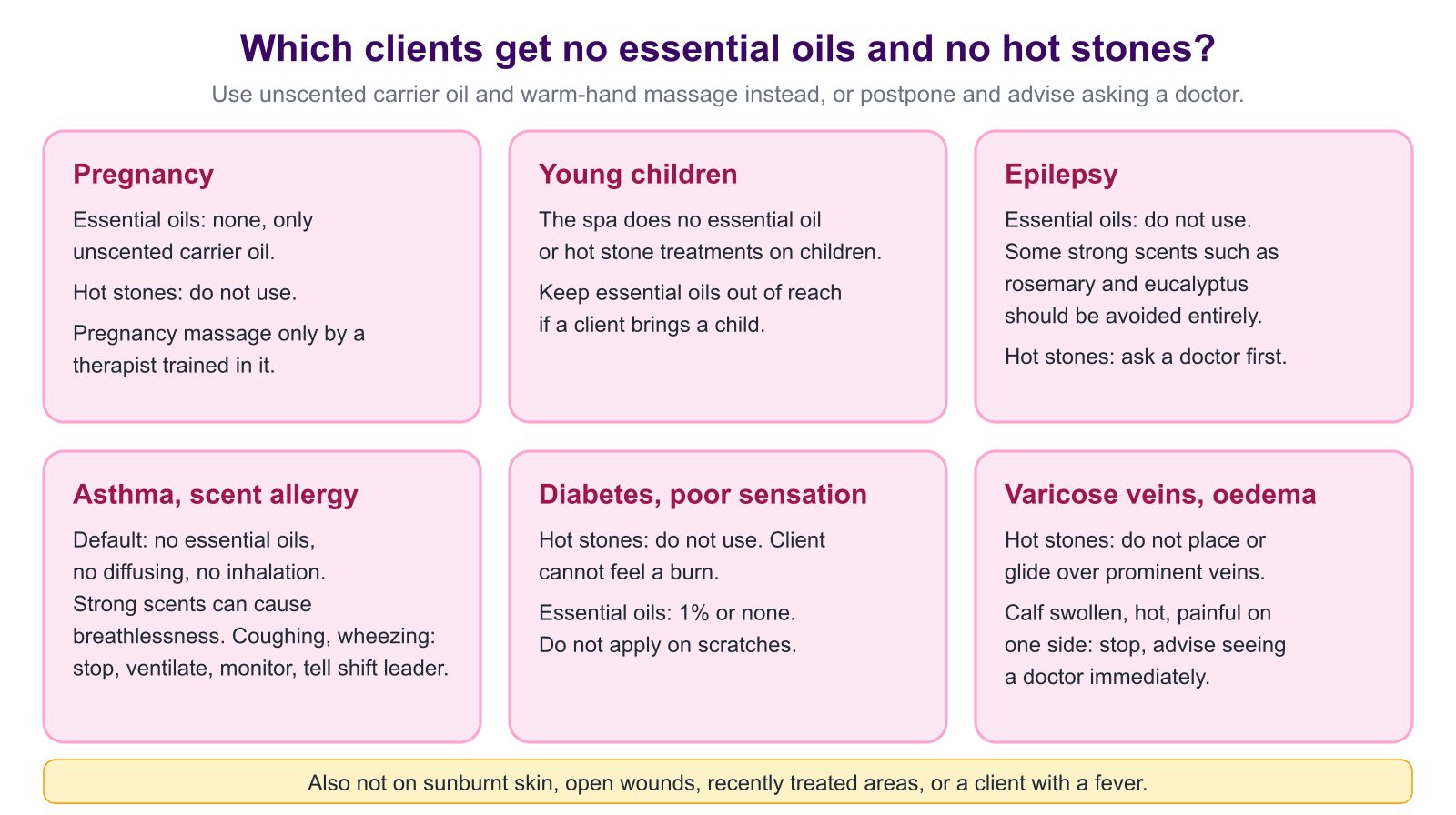
Spa default: the groups below receive an unscented carrier oil, with no essential oil blended in and no essential oil diffused in the room.
- Pregnant women: many essential oils lack sufficient safety data for pregnancy. The spa does not decide on its own; if the client wants to use them, advise her to ask her obstetrician. Pregnancy massage is also only performed by therapists who have learned the dedicated procedure.
- Young children: the spa does not perform essential oil treatments on children. If a client brings a child along, store essential oil bottles out of reach and do not diffuse oils in the waiting area.
- People with epilepsy: some strong-smelling essential oils such as rosemary and eucalyptus should be avoided completely. Do not experiment with clients.
- People with asthma, scent allergies or allergic rhinitis: strong scents can cause breathing difficulty. If the client coughs or wheezes mid-session: stop, open the door for ventilation, help the client sit up, monitor them and inform the shift leader; if the client has an asthma inhaler, let them use it themselves.
- Also do not use essential oils on sunburnt skin, open wounds, areas that have just had a procedure, or on clients who have a fever or are being treated for a skin disease.
Storing essential oils
- Dark glass bottles, closed tightly immediately after use, kept in a cool place away from sunlight and away from the stone heater and towel warmer.
- Write the opening date on the bottle. Citrus essential oils kept for a long time oxidise easily, change scent and are more likely to cause irritation; use them within the manufacturer's expiry date.
- Discard bottles that smell odd, have turned cloudy or thick, or are past their expiry date. Never pour leftover essential oil from the bowl back into the original bottle.
- Essential oils are flammable: keep them away from candles, flames and hot sockets.
- If essential oil gets into a client's eye: do not rinse with oil; have the client rinse with plenty of clean water and inform the shift leader; if burning or blurred vision persists, advise them to see a doctor.
Hot stone massage: stones, heater and working temperature
Hot stone massage uses smooth heated stones that are placed on and glided over the body, combined with hand massage. The warmth of the stones helps the client relax and helps the therapist's hands work into large muscle areas more gently. Hot stones do not "drive out cold" or "unblock the meridians"; they give a pleasant feeling of warmth.
Types of stone
The most commonly used stone is basalt, a black or dark grey volcanic rock that holds heat well and releases it slowly. The stones are polished smooth, with no sharp edges and no cracks. A body stone set usually includes:
- Large, flat stones: placed along both sides of the spine (on a towel) and in the palms.
- Medium stones: held in the palm to glide over the back, thighs and calves.
- Small stones: placed between the toes, glided over the hands and feet.
Check every stone before the shift: remove any that are cracked, chipped or have sharp edges. Cracked stones can break when hot, and cracks trap dirt that is hard to clean.
The stone heater
A stone heater is a water bath with a thermostat. The stones are immersed in water, and the water keeps the heat even. A few points the therapist must watch:
- Place the heater on a stable table, away from walkways, with the cable tidy and not stretched across where people walk. Do not place it right next to the client's bed.
- Fill with enough water to cover the stones, up to the manufacturer's mark. Line the bottom of the bath with a towel if the heater's instructions allow, so the stones do not touch the hot base.
- Switch the heater on early enough before the session for the water to stabilise, following the manufacturer's instructions.
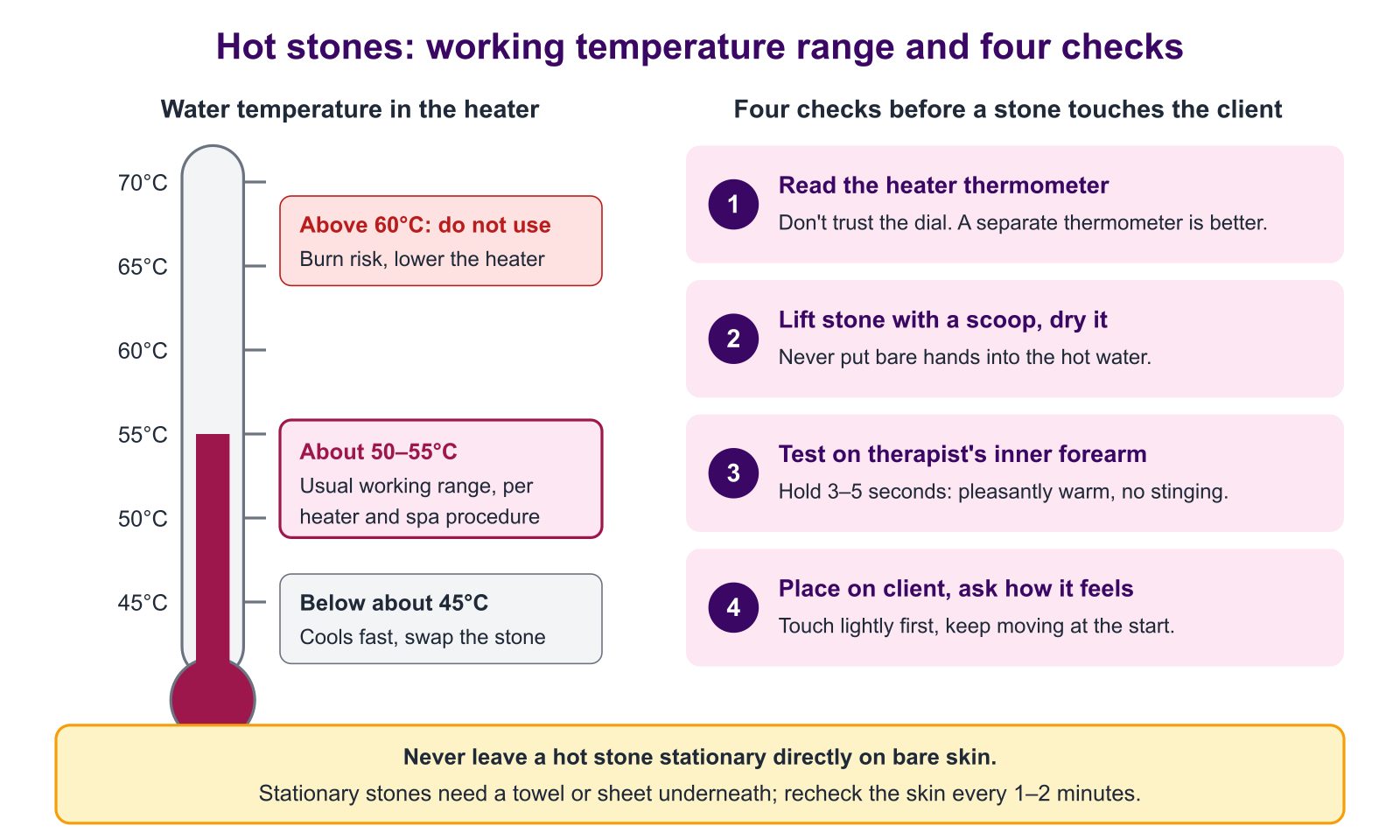
- Do not trust the dial. Read the temperature with a thermometer; a separate thermometer for measuring the water is better than the heater's indicator light.
- Never put your bare hand into the water. Lift stones out with a slotted spoon or tongs.
Working temperature
The common water temperature range for body hot stone massage is about 50–55°C, depending on the heater and the spa's procedure. Above about 60°C is too hot to work with and the burn risk is high; below about 45°C the stones cool quickly, lose their warmth, and you have to change stones more often. Water temperature is not the temperature the client feels: a stone just lifted out is at its hottest, and after being dried and glided for a few seconds it gradually becomes gentler.
Four checks before a stone touches the client:
- Read the thermometer for the water in the heater; it must be within the working range.
- Lift the stone out with the spoon and dry it with a towel. Hot water left on the stone burns more easily than the stone itself.
- Test it on the therapist's inner forearm, holding for about 3–5 seconds. It must feel pleasantly warm, not burning. The therapist's palm is used to heat and is therefore not used for testing.
- Place it on the client and ask: "How does this warmth feel for you?". Glide first, keep moving continuously at the start, and only let a stone rest still once the client confirms it is comfortable and there is a towel underneath.
Safe hot stone massage routine
Below is the outline of a 75–90-minute body hot stone session combining hands and stones. The stones are a tool and the hands remain the main instrument: you still work through the areas following the Swedish massage sequence from the previous lesson.
- Before the client arrives. Check the stones, switch the heater on and measure the water. Prepare towels to place under the stones, dry towels to wipe the stones, a spoon, a tray for used stones, and carrier oil.
- Screen the client. Go over the questionnaire again: diabetes, numbness in the hands or feet, varicose veins, blood pressure, heart conditions, pregnancy, recent sun exposure or sunburn, wounds on the skin. If the client belongs to a group that cannot have the treatment, switch to a warm-hands massage.
- Explain to the client. "The stones will be warm; if it feels too hot, tell me and I'll lift them off straight away." Agree on the phrase for "too hot".
- Hand massage to spread the oil on the back first, warming the tissue for 3–5 minutes. The oil helps the stones glide smoothly.
- Gliding with stones: hold the stone in your palm, flat side down, and glide along the muscles, never over the spine. Every time you change to a new stone, repeat the forearm check.
- Resting stones (if used): only place them on a towel or sheet, never directly on bare skin; check the skin underneath every 1–2 minutes by lifting the stone, looking and asking the client. Do not place stones under the back of a supine client who lies on top of them, because body weight pressing onto the stone increases the burn risk.
- Monitor throughout the session: light, even redness that fades quickly is normal; deep red patches, burning, blanched white spots or blisters are signs of a burn.
- Closing: remove all stones from the client and count them again. Wipe off excess oil, cover with the towel, and advise the client to drink water and sit up slowly.
If the client is burned: stop immediately, lift the stones off, cool the burn under cool running water (do not use ice, toothpaste or grease), cover with a clean gauze dressing, inform the shift leader and record the incident. For blistered or large burns, or burns on the face, advise the client to see a doctor.
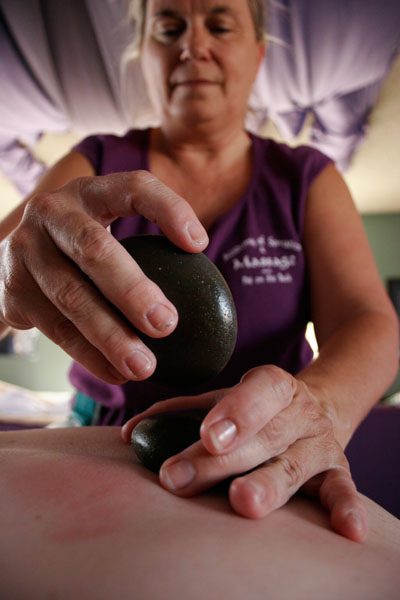
Photo: borediq / Wikimedia Commons, CC BY 2.0

Contraindications specific to hot stones
In addition to the general massage contraindications you have learned, hot stones have an extra group that must be excluded because of the heat:
- Diabetes with reduced sensation, numbness in the hands or feet (peripheral neuropathy): the client cannot feel heat and can be burned without knowing. Do not perform hot stone treatment.
- Varicose veins: do not place or glide stones over areas with visible veins. If a calf is swollen, hot and painful on one side, stop the massage and advise the client to see a doctor immediately.
- Pregnancy: do not perform hot stone treatment.
- Uncontrolled high blood pressure, heart disease: heat can make the client tired or dizzy; a doctor's opinion is needed.
- Sunburnt skin, wounds, dermatitis, recent hair removal or strong exfoliation: do not place stones on that area.
- Fever, taking blood-thinning medication or medication that reduces sensation: postpone and ask a doctor.
If you are not sure whether the client can have the treatment, choose the safe option: a hand massage with warm oil still gives a feeling of relaxation, and the client will come back because they see how careful you are.
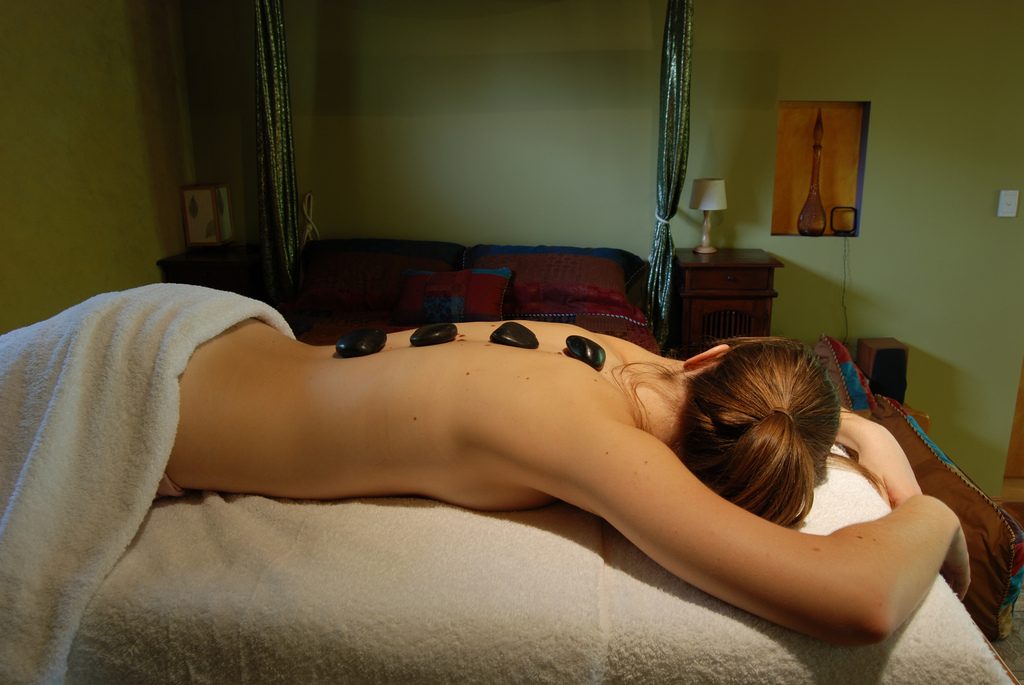
Photo: Daniela / Wikimedia Commons, CC BY 2.0

Cleaning and storing stones after every client
The stones touch skin with the client's oil and sweat, so they must be cleaned and disinfected before use on the next person, just like the reusable tools you learned about at Level 1.
- Put used stones into a separate tray; never drop them back into the heater.
- Wash the stones under the tap with soap or instrument detergent, scrubbing with a soft brush until all the oil is gone. Remaining oil prevents the disinfectant from contacting the surface.
- Rinse thoroughly, then disinfect with the solution the spa uses for non-invasive tools, at the correct concentration and contact time according to the manufacturer's label. Wiping with 70% alcohol is a method many spas use for smooth surfaces, after the oil has been washed off.
- Wipe dry and leave to dry completely on a clean towel. Stones stored away while still damp easily develop an odour.
- At the end of the day: switch off, unplug, let the heater cool, empty the water, then wash and dry the bath according to the manufacturer's instructions. Never leave water in the heater overnight.
- Occasionally apply a very thin layer of carrier oil to keep the stones' colour, according to spa rules; check regularly for cracks.
Common mistakes
| Mistake | Why it is dangerous or wrong | The correct way |
|---|---|---|
| Dripping essential oil directly onto the client's back | Neat essential oil causes burning and irritation and can make the client allergic in the long term | Always dilute in carrier oil at 1–3% before applying |
| Adding 12 drops of each oil for 30 ml | Two oils make 24 drops, double the 2% ratio | The total of all essential oils is 12 drops for 30 ml at 2% |
| Using lemon or bergamot oil at midday for a client who will ride a motorbike home | Phototoxic; exposed skin in the sun easily turns red, burns and darkens | Choose another essential oil, or one with the phototoxic compounds removed according to the label |
| Diffusing essential oil in the room for a client with asthma | Strong scents can cause breathing difficulty | Check the questionnaire first, do not diffuse, use unscented oil |
| Only looking at the heater dial | The thermostat may be inaccurate and the water hotter than the setting | Read with a thermometer and test the stone on the therapist's forearm |
| Resting stones on bare skin, or letting the client lie on top of the stones | Heat concentrates in one spot and burns before the client can react | Resting stones always have a towel underneath; lift and check the skin every 1–2 minutes |
| Performing hot stones on a diabetic client with numb feet | The client cannot feel heat and is easily burned | No hot stones; light hand massage, with a doctor's opinion |
| Dropping used stones back into the heater | Contaminates the water and other stones; oil makes the water cloudy | Separate tray, wash with soap, disinfect, dry |
Pass criteria for this lesson
You pass this lesson when you can do the following in front of your instructor:
- Calculate the number of drops correctly for 3/3 random problems (for example 20 ml at 2%, 30 ml at 1%, 50 ml at 3%) within 2 minutes, using the convention that 1 ml is about 20 drops, to within 1 drop.
- Blend a 20 ml bowl of 2% oil (8 drops in total) from two essential oils, label it correctly and record it on the client card.
- Name at least 3 phototoxic essential oils correctly and give the client the sun-avoidance advice.
- State correctly all 4/4 client groups who by default do not use essential oils (pregnancy, young children, epilepsy, asthma or scent allergy) and the alternative.
- Prepare the heater, read the water thermometer within about 50–55°C, and perform all 4/4 heat checks before a stone touches the model.
- Place resting stones on a towel and lift to check the skin at least every 2 minutes throughout the stone placement.
- State at least 4 hot stone contraindications correctly, and clean, disinfect and dry a stone set following the first 4 steps of the hygiene procedure.
Frequently asked questions
What if a client brings their own essential oil and wants the therapist to use it?
The spa only uses clearly labelled products managed by the spa. Politely decline unlabelled bottles of unknown origin. If the bottle is fully labelled and spa rules allow it, still dilute it at the correct ratio, test it on the client's forearm first and note on the client card that the client brought it.
Should I use 5% for a client with long-standing shoulder pain so it "absorbs better"?
No. Relaxation massage in a spa stays within 1–3%. Higher ratios increase the risk of irritation without making the massage "cure" shoulder pain. If the pain is long-standing, advise the client to see a doctor; the spa supports relaxation.
Is it a problem if hot stones leave the client's skin red after the session?
Light, even redness that fades within a few tens of minutes is a normal reaction to warmth. Deep red patches in the shape of a stone, prolonged burning, blisters or blanched white skin indicate a burn: give first aid by cooling with cool water, cover with gauze, inform the shift leader, record the incident and advise the client to see a doctor if there are blisters.
Can the spa heat stones in a rice cooker or an electric kettle?
No. These appliances do not hold a stable temperature; they boil easily and make the stones too hot or cause them to crack. Only use a purpose-made stone heater with a thermostat, together with a thermometer for checking.