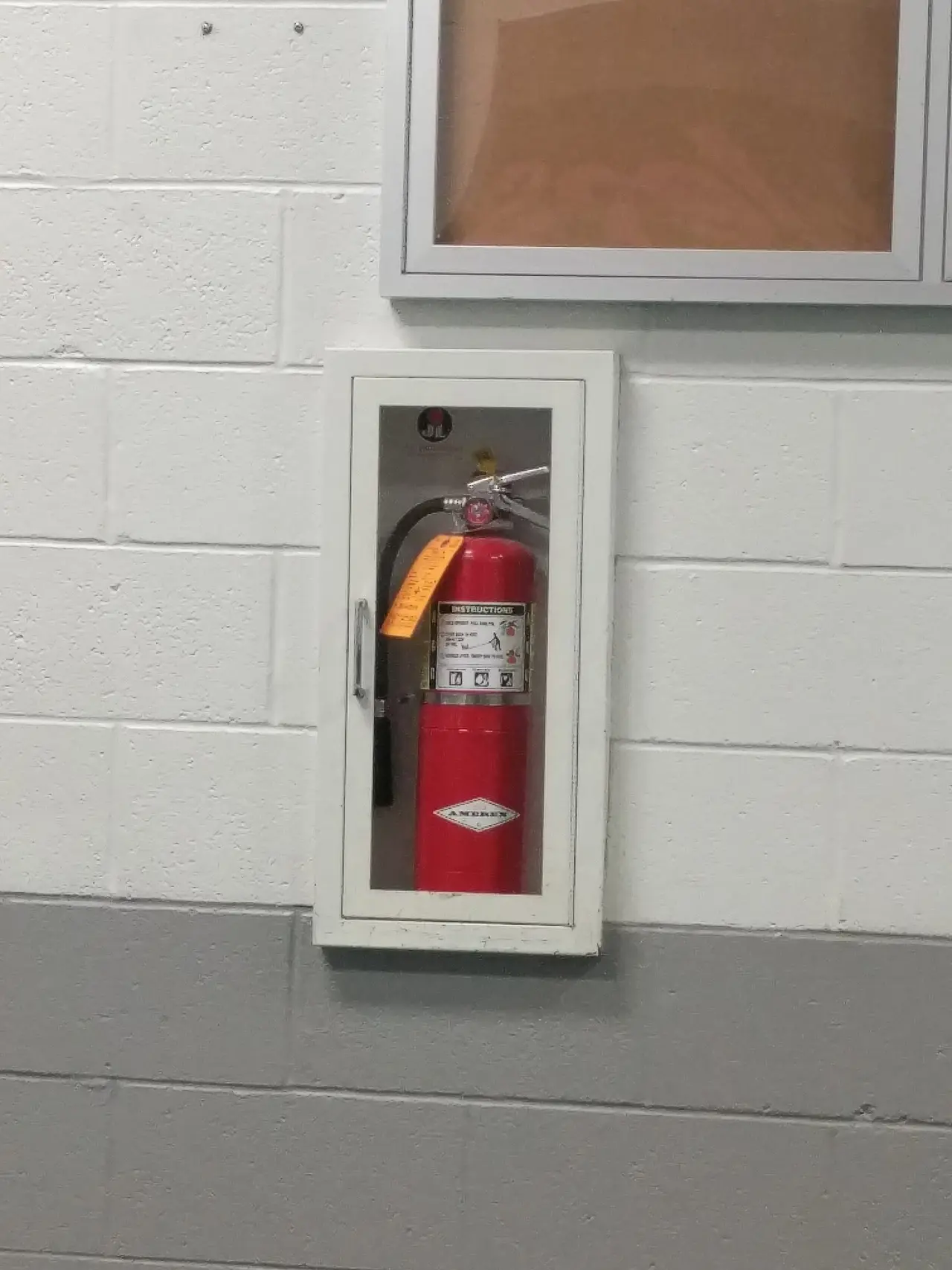
Thao had been a head therapist for eight years when she rented a three-storey house on a wide alley to open her own spa. She renovated the rooms, bought treatment beds, printed a shop sign and posted an opening announcement. Two weeks later an inspection team called in: the spa offered body massage but had no certificate of meeting security and order conditions; the fire extinguisher was kept in the storeroom; and the sign advertised "laser melasma treatment" although the spa held no medical examination and treatment licence. She had to stop the massage service, take the sign down and rewrite her advertising, while the rent kept running.
Skilled practitioners often think "the paperwork can wait". The right order is the opposite: choose the business model, register, meet the conditions, and only then open. This lesson gives the manager or owner of a small spa the legal picture at the level of principles, so you know whom to ask, what to prepare, and how not to push your spa into forbidden territory.
Important note: regulations on business registration, security and order, fire prevention and fighting, and tax change fairly often, and practice can differ from one locality to another. This lesson teaches principles; it does not replace the legal texts. Before submitting any application, always check the current version on the official government portal and ask the business registration office, the police and the tax office where the spa is located directly.
By the end of this lesson, you will be able to:
- Compare a household business and a company against 6 criteria and choose the model that fits the size of your spa.
- Identify the business lines you need to register and recognise which services must not be registered at a spa.
- Explain why a spa offering massage must meet security and order conditions, and prepare questions for your meeting with the local police.
- Carry out a basic fire-safety self-check: extinguishers, escape routes, electrics, flammable materials.
- Draw a clear line between a spa and a medical examination and treatment facility in your service menu and advertising.
- Understand the principles of tax, employment, cosmetics and advertising, and use a pre-opening checklist.
The legal roadmap: what comes first, what comes next
Opening a spa is a chain of steps that depend on one another. Without a business registration certificate you cannot apply for the certificate of meeting security and order conditions; until the premises are fitted out you cannot self-check fire safety. Getting the order wrong costs time and rent.
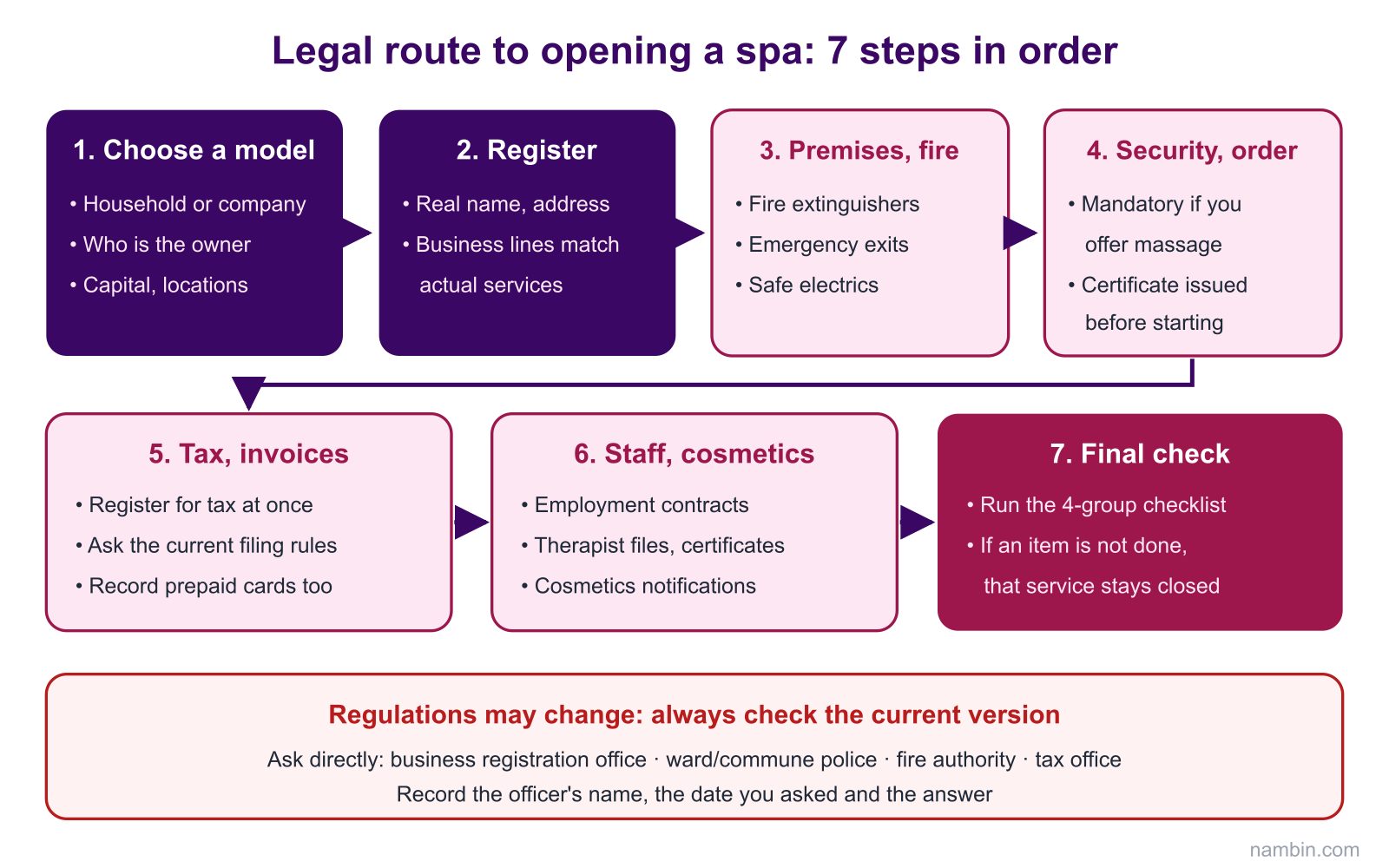
- Choose the model: household business or company, who is the registered owner, how much capital.
- Register the business: name, address and business lines that match the services you actually provide.
- Premises and fire safety: a clear lease, safe electrics, escape routes, firefighting equipment.
- Security and order: hold the certificate before providing any massage service.
- Tax and invoices: register for tax, file returns and issue invoices under current rules.
- Staff and products: employment contracts, therapists' professional records, cosmetics with a product notification.
- Final check: run the checklist at the end of this lesson, and only then open the doors and advertise.
Household business or company?
A household business is registered by one individual or by members of a household. It suits a small spa at a single location where the owner works hands-on. A company (usually a limited liability company, LLC) is a separate legal entity. It suits a spa that plans to open branches, has several investors, or needs to work with corporate clients.
| Criterion | Household business | Company (LLC) |
|---|---|---|
| Who is registered | One individual or the representative of a household | The company is a legal entity with a legal representative |
| Liability for debts and compensation | The owner is liable with all of his or her personal assets | Usually limited to the capital contributed |
| Number of locations | Suited to one location | Easier to open branches and additional business locations |
| Books and accounting | Simpler | Must organise accounting and reporting under the rules for companies |
| Capital contribution | Hard to divide ownership clearly | Clear, according to each party's share of capital |
| Working with partners | Suited to walk-in clients | Easier to work with hotels, companies and large suppliers |
Rule of thumb: for a spa with a few treatment beds at one location, managed by the owner, a household business is usually enough and keeps things simple. If two or more people are putting in capital, if you plan to open a branch within one to two years, or if you want to separate family assets from business risk, consider setting up a company from the start.
About the registered owner: this is the person legally responsible, including for security and order. Do not ask a relative to "lend their name" if they know nothing about the spa; when something goes wrong, they are the one who has to deal with the authorities.
Where to submit the application
A household business registers with the business registration office at the level responsible for the area where the spa is located; a company registers with the provincial business registration office and can apply online via the National Business Registration Portal. Local government has recently been reorganised, so the names of offices and where applications are received may differ from older guides online. The safest approach: ask the one-stop service desk of the ward or commune People's Committee where the spa is located about where to submit and which forms are currently in use.
Registering business lines: register what you actually do
Business lines must match the services you really provide. If you leave one out, that service is treated as unregistered; if you list lines a spa is not allowed to carry out, you will have trouble at inspection. Lines are chosen from the Vietnam Standard Industrial Classification. The table below shows the groups commonly used; look up the exact codes in the current list when you apply, because the code system may be updated.
| Actual service | Business line usually registered | Notes |
|---|---|---|
| Body massage, foot massage, steam bath | Steam bath, massage and similar health-enhancing services (except sports) | Involves massage, so security and order conditions must be met |
| Non-invasive facial care, hair washing, waxing, nail care | Hairdressing, hair washing and non-medical beauty care services | Ask the registration office how to word the detailed line |
| Selling cosmetics and essential oils to clients | Retail sale of cosmetics and toiletries | Products with clear origin and a product notification |
| Filler and botox injections, meso, laser treatment, surgery | Not to be registered at a spa | These are medical examination and treatment and need a separate licence |
Tip: when you meet the officer receiving your application, describe your services in plain words ("manual body massage, skincare using cosmetics, no needles, no treatment devices") so they can guide you to the right business lines.
Security and order conditions for massage services
Massage services are a business line subject to security and order conditions under Decree 96/2016/ND-CP (security and order conditions for certain businesses, including massage services), as amended and supplemented by Decree 56/2023/ND-CP. Put simply: before offering massage, the spa must hold a Certificate of Meeting Security and Order Conditions issued by the competent police authority, and while operating it must keep to the responsibilities it has committed to.
What the police usually look at
The list of documents and forms may change with each amendment and with local guidance, so ask the ward or commune police where the spa is located directly. In principle, the application and the inspection usually cover:
- Legal status of the premises: a business registration that includes massage, with an address matching the actual place of operation.
- The person responsible for security and order: identity and background record of the head of the business; this person must not fall into any of the categories barred by regulation.
- Fire safety: the premises meet fire prevention and fighting requirements appropriate to their size.
- Room layout: treatment rooms are transparent and easy to inspect; the next lesson shows how to design doors and corridors in this spirit.
- Staff management: staff list, background records, contracts, diplomas or vocational certificates.
Responsibilities after the certificate is issued
- Operate only at the address and in the business lines stated on the certificate.
- Inform the police when the head of the business, the address, the scale or the business lines change, following the guidance of the issuing office.
- Do not let anyone with an unknown background work at the spa; keep staff records.
- Do not allow prostitution, drugs or gambling on the premises; report any signs to the police.
Questions to take to the local police: "My spa offers body massage and foot massage, X treatment beds, at address Y. Which documents do I need to prepare under the current regulations? Where do I submit them, and can I apply online? How long until I get the result? How do I notify you if I change the manager or add rooms?" Write down the answers, the officer's name and the date you asked.
Fire prevention and fighting: the principles
Spas burn more easily than many people think: cotton towels, curtains, mattresses, decorative wood, essential oils, alcohol, and many electrical appliances running at once (stone heaters, steamers, towel cabinets, water heaters). Clients are lying down, wrapped in towels, sometimes in the steam room, so they get out slowly. That is why fire safety must be planned from the moment you fit out the premises, not when you are waiting for an inspection.
The specific requirements (whether a design approval is needed, how many extinguishers, which type, whether an automatic fire alarm is required) depend on floor area, number of storeys and type of building, and are set out in the current law on fire prevention and fighting and its implementing documents. Do not guess: ask the fire prevention and fighting unit of the local police, or hire a qualified consultant. Below are the minimum measures every small spa should take.
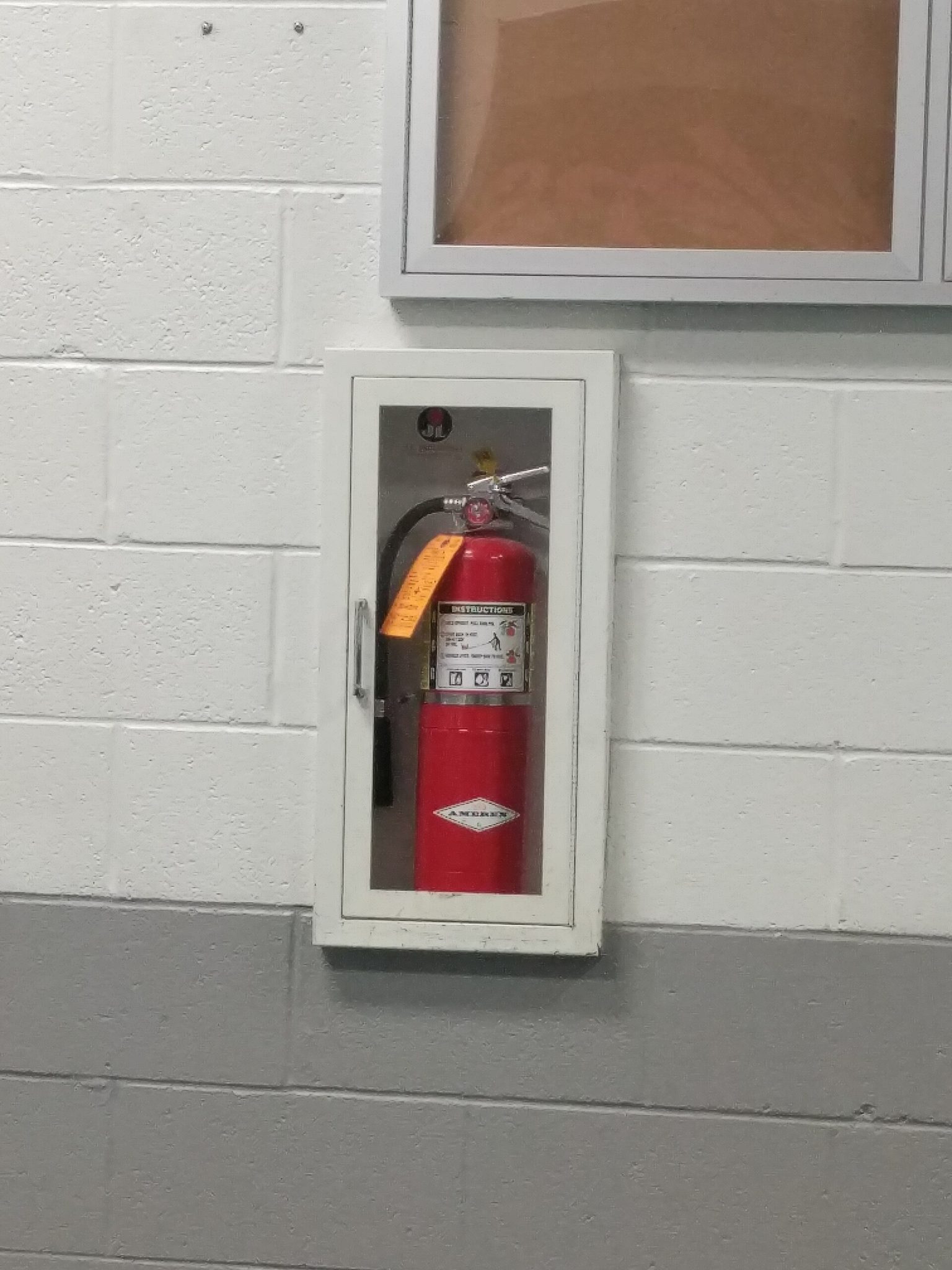
Photo: Mibrahim74 / Wikimedia Commons, CC BY 3.0

- Fire extinguishers: the right number and the right type according to guidance; mounted in the corridor, near the door, within easy reach. Check the pressure gauge and service date as instructed by the manufacturer. Every member of staff should practise pulling the pin, aiming the nozzle and squeezing the handle at least once.
- Escape routes: always clear; no towels or boxes stacked on the stairs. Doors can be opened quickly from the inside and are never locked during working hours. Emergency lighting and exit signs are visible during a power cut.
- Electrics: wiring done by a skilled electrician; circuit breakers and suitable residual-current devices; never plug several high-power appliances into one extension lead; use covered sockets in wet areas.
- Chemicals and materials: store alcohol, essential oils and candles away from heat sources; never leave candles burning in an empty room; let freshly heated towels cool before stacking them in thick piles.
- Narrow multi-storey tube houses: if there is only one staircase, ask the fire authority carefully about a second escape route or an alternative solution before signing the lease.
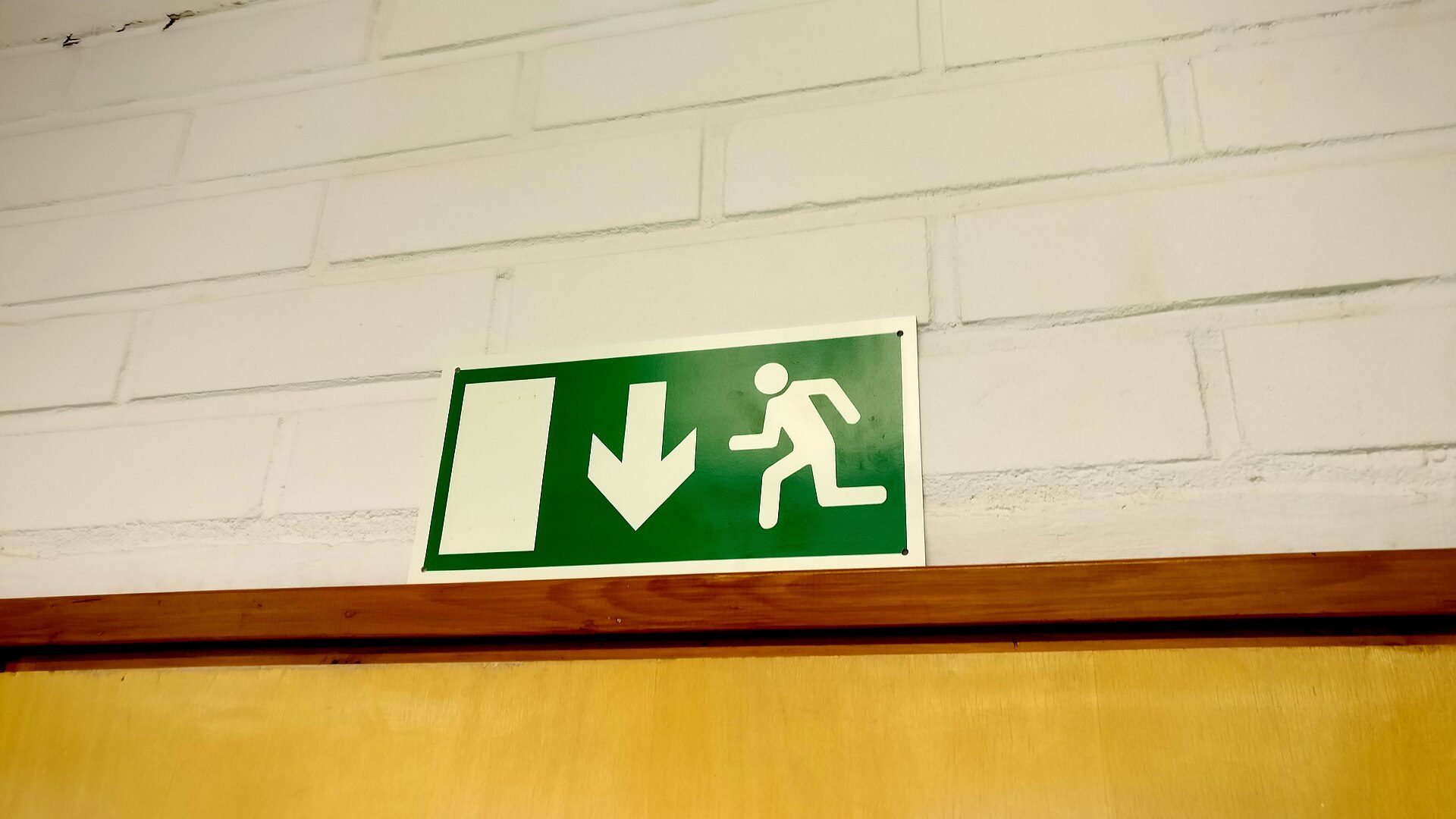
Photo: Santeri Viinamäki / Wikimedia Commons, CC BY-SA 4.0

Everyone on the shift must know the evacuation plan: who checks each room, who brings towels and robes for clients, where the assembly point is, and who calls 114 (the fire emergency number). Run a five-minute drill every time a new member of staff joins.
The medical boundary: a spa is not a clinic
At Level 3 you studied invasive aesthetics and light-based devices in detail. As a spa owner, you are responsible for the whole service menu, signage and advertising. Under the Law on Medical Examination and Treatment No. 15/2023/QH15, procedures that intervene in the body, such as injections (filler, botox, meso), surgery, therapeutic laser or IPL, deep microneedling, and extraction involving medical intervention, must be carried out by a licensed medical examination and treatment facility and by practitioners holding a practising licence. A spa must not add these services to its price list on its own initiative.
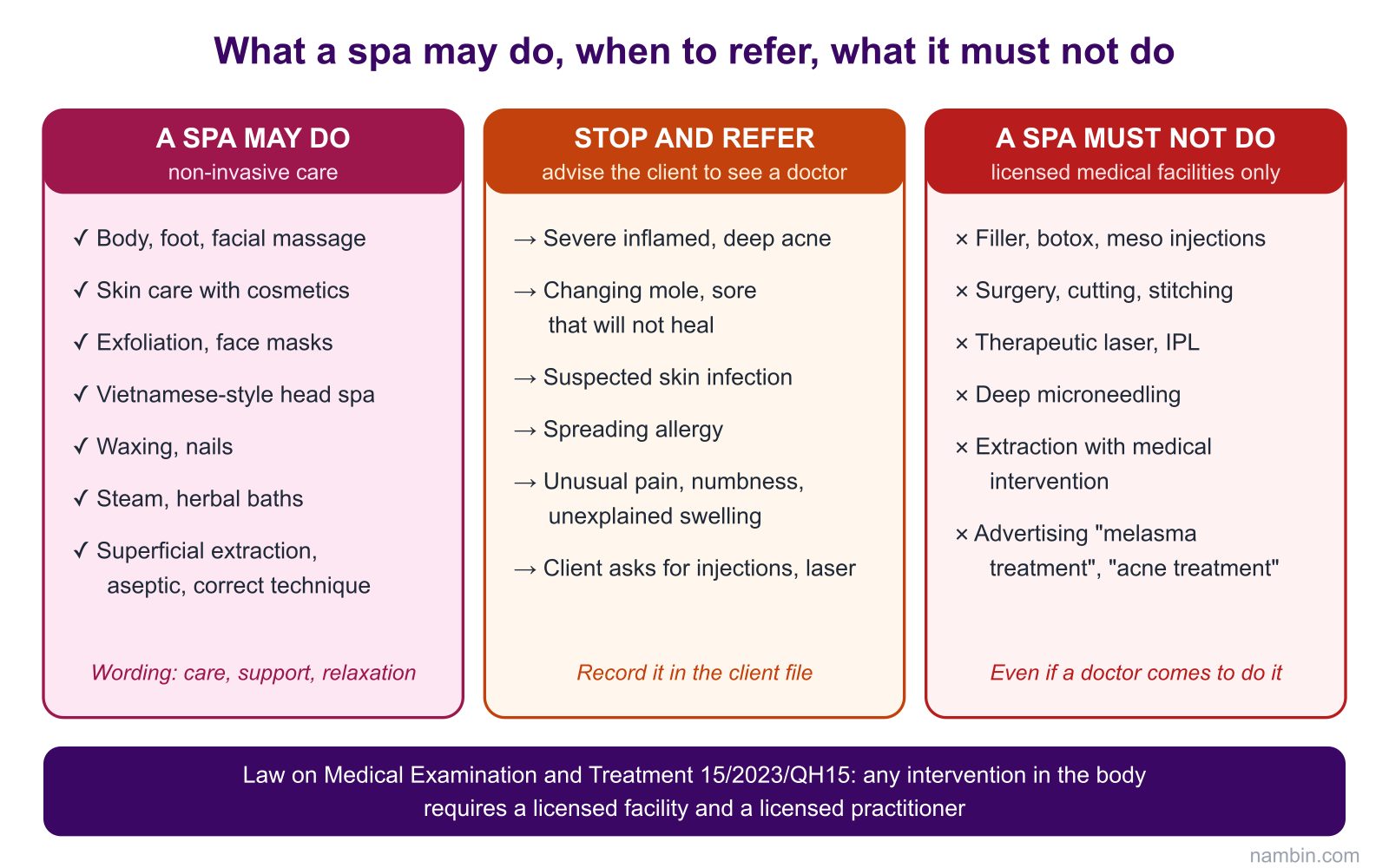
Three traps spa owners often fall into
- "A doctor comes in to do extra work at weekends": even if the person injecting is a doctor, injecting at premises without a medical examination and treatment licence is still unlawful. The practitioner's qualifications cannot replace the facility's licence.
- Giving services medical-sounding names: "melasma treatment", "acne treatment", "laser rejuvenation" on signs and social media pages. Even if all that happens in the room is a face mask, advertising like this is still wrong and can easily be treated as advertising unlicensed medical services. Use words such as "care", "support" and "relaxation".
- Buying the device first and asking later: laser machines, treatment-strength IPL and microneedling devices are sold easily, but a spa may not use them for treatment. Ask clearly where a device may be used and for what purpose before you buy it.
If you want to offer medical aesthetic services, there are two correct routes: refer clients transparently to a licensed clinic, or invest in becoming a properly licensed medical examination and treatment facility with a professionally responsible person who holds a practising licence.
Tax, employment, cosmetics and advertising
Tax: the principles
If you run a business, you have tax obligations. Household businesses and companies file differently, and the policy for household businesses is moving towards self-declaration based on actual revenue, using e-invoices or invoices generated from cash registers instead of the old presumptive (fixed-amount) system. Tax rates, revenue thresholds and filing deadlines may change from year to year. Therefore:
- Register for tax at the same time as you register the business; ask the tax office responsible for your area how to file and issue invoices for your model.
- Record all revenue from day one, including money from prepaid treatment programme cards; track the remaining sessions on each card separately.
- Keep the supporting documents for purchases of cosmetics and equipment, rent, electricity and water.
- If you cannot do it yourself, hire an accounting service from the start; it is far cheaper than penalties for late filing.
Employment
Sign written employment contracts with therapists and receptionists covering duties, working hours, salary, commission and probation. Pay compulsory insurance contributions under current regulations. Keep staff records (identity documents, diplomas or vocational certificates, contracts); these records are also part of your security and order responsibilities.
Cosmetics
Under Circular 06/2011/TT-BYT on cosmetics management, cosmetics on the market must have a cosmetic product notification that has been given an acknowledgement number by the competent authority. Keep a file for each product: invoice, supplier, copy of the product notification, expiry date. Do not mix and bottle your own unregulated mixed creams ('kem tron') to sell to clients; do not use hand-carried goods of unknown origin.
Advertising
Signs, leaflets and social media posts must comply with the Advertising Law 2012: describe only the services you are allowed to provide, make no promises of treatment results, use no misleading "before and after" photos, and never use a client's photo without consent. You studied consultation ethics at Level 3; at Level 4, you are the person who gives final approval to content before it is published.
Photo: Matt @ PEK from Taipei, Taiwan / Wikimedia Commons, CC BY-SA 2.0

Pre-opening checklist
Run the checklist about two weeks before opening day so that you still have time to fix things. Each item has a person in charge and a completion date; any item not yet done means the related service does not open.
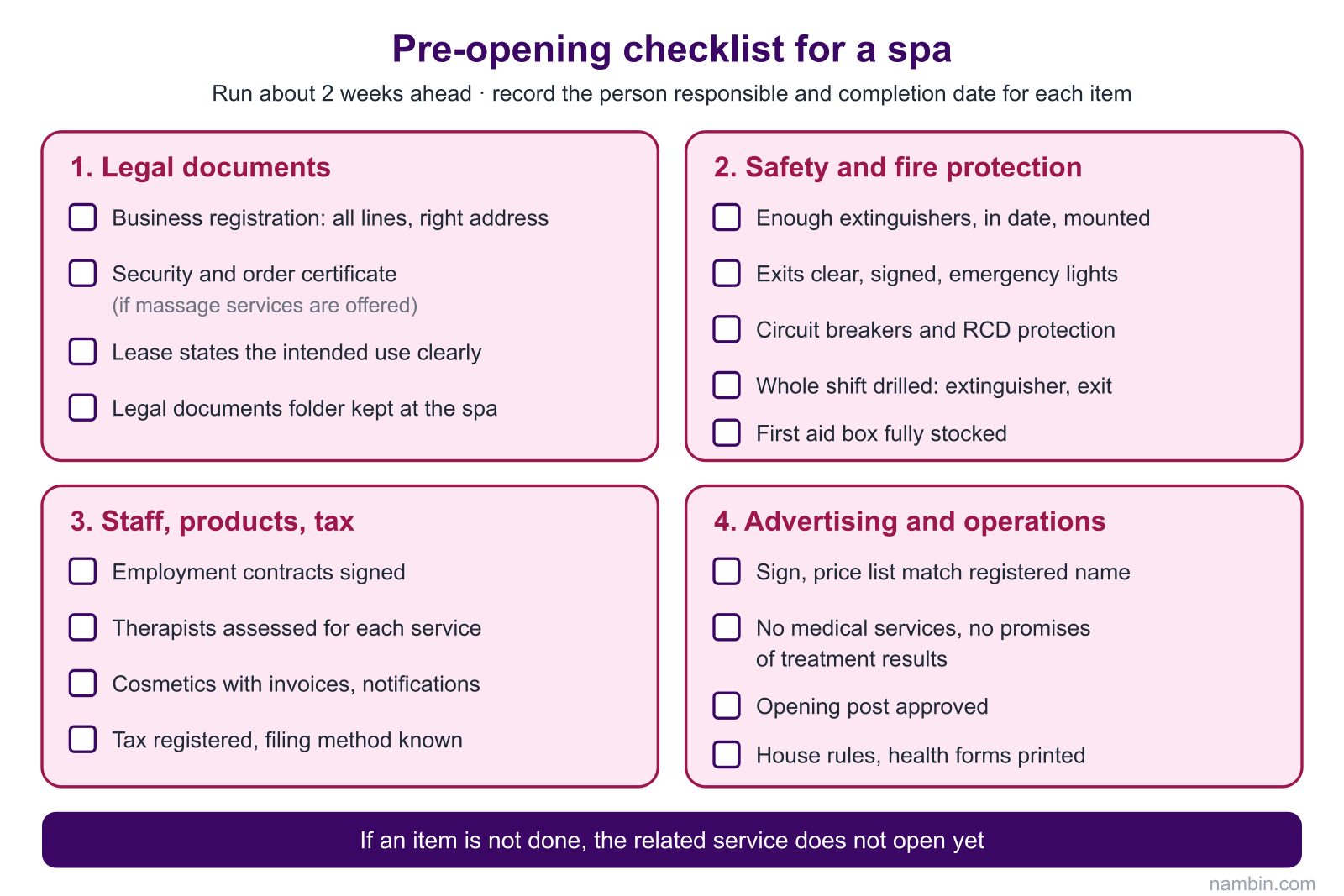
| Group | Items to check |
|---|---|
| Documents | Business registration with all business lines and the correct address; security and order certificate if massage is offered; lease stating the purpose clearly |
| Safety, fire prevention | Enough extinguishers, in date, mounted in the right places; escape routes clear, with signs and emergency lighting; electrics with protective devices; the whole shift has practised; first-aid kit complete |
| Staff, products, tax | Contracts signed; therapists have passed assessment for each service; cosmetics with invoices and product notifications; registered for tax and know how to file |
| Advertising, operations | Sign and price list use the registered names, with no medical services; opening post approved; house rules, health questionnaires and incident report forms printed and ready |
Keep a legal documents folder at the spa (copies) and a digital version: business registration, security and order certificate, fire safety file, lease, staff list, cosmetics records. When an inspection team arrives, the shift manager can open it and have everything to hand.
Common mistakes
| Mistake | Why it is dangerous or wrong | The right way |
|---|---|---|
| Opening first and doing the paperwork later | Operating a conditional business line before meeting the conditions; suspension, lost clients, wasted rent | Follow the 7-step roadmap; open only the services that are fully licensed |
| Signing a long lease before asking about fire safety and security and order | The premises may not be able to meet the requirements; alterations may be very costly or impossible | Ask the authorities and view the premises with a qualified person before signing |
| Registering in a relative's name when they are not involved | The registered person carries the legal responsibility without knowing how the business runs | The person who actually manages registers, or the registered person is fully informed and properly delegated |
| Writing "melasma treatment, laser, injections" on the sign | Advertising and providing unlicensed medical examination and treatment under Law 15/2023/QH15 | List only non-invasive services; refer transparently to a licensed clinic |
| Keeping the extinguisher in the storeroom so it "looks nicer" | In a fire nobody can reach it in time | Mount it in the corridor near the door; staff know how to use it |
| Locking the back door, piling towels on the stairs | Blocks the escape route in a fire | Escape routes always clear and openable from the inside during working hours |
| Trusting old guides on the internet | Regulations, office names and forms may have changed | Check the current legal texts, ask directly and note the date you asked |
Pass criteria for this lesson
You pass this lesson when you can do the following in front of your supervisor:
- State the 7 legal steps in the correct order in no more than 2 minutes, and point out at least 2 pairs of steps that depend on each other.
- Compare a household business and a company on all 6/6 criteria, and choose a model with reasons for 2 sample scenarios.
- Given a sample price list of 10 services, classify all 10/10 correctly: allowed; must be removed or referred to a licensed facility; must be renamed.
- Role-play a meeting with the local police: ask at least 5 necessary questions and record the answers with the date and the name of the person who answered.
- Inspect real premises, or photos of them, for fire safety: find at least 4 points to fix concerning extinguishers, escape routes, electrics and flammable materials.
- Complete the checklist for a hypothetical spa, with a person in charge and a date for each item, in no more than 20 minutes.
Frequently asked questions
If the spa only does facials and hair washing, with no body massage, does it need a security and order certificate?
The condition is tied to massage services, but many facial and hair-washing services include face, neck and shoulder massage. When something counts as a "massage service" is for the police to advise on. Do not decide for yourself: describe your services accurately, ask the local police and write down the answer.
I work from home with a few regular clients. Do I need to register?
Regularly charging for services is doing business. Massage services are subject to security and order conditions, so do not assume you are exempt. Ask the business registration office where you live. Working from home also adds a fire risk for the whole family.
I want to work with a dermatologist. How do I do it properly?
The spa refers clients to a licensed clinic; clients are examined and treated there. The spa does not organise injections or therapeutic laser on its premises, even if a doctor is present. The referral arrangement should be transparent to clients.
Information online is contradictory. Which source should I trust?
Trust the original legal text on the official government portal and the direct answer from the office that receives applications where the spa is located.
Further reading
Review the path from therapist to manager in the lesson Spa vocational certificates and career path: from therapist to opening a small spa, and the contraindications in the lesson Skin structure and the contraindications every spa therapist must know by heart.