Thu worked as a therapist and then as a spa manager for nearly ten years, saved a little capital and decided to open a 3-bed spa in a wide alley near the market. Her opening month was busy; she sold 20 prepaid treatment packages and her account grew by 70 million VND. She ordered another machine and bought more cosmetics. By month five, package clients were still coming regularly, but the account was almost empty: those sessions had been paid for long ago, and now there were only costs. She was not losing money because her work was poor, but because she had no financial plan: she did not know how many client visits she needed each month to break even, and she had spent the clients' prepayments as if they were profit.
This lesson teaches you to draw up a financial plan for a small spa using addition, subtraction, multiplication and division on a spreadsheet. You do not need to be an accountant; you need to know how to ask the right questions and check the numbers yourself.
By the end of this lesson, you will be able to:
- Draw up a start-up capital table for a small spa, including a reserve fund of 3–6 months of fixed costs.
- Separate fixed costs from variable costs and calculate the contribution margin per client visit.
- Calculate the break-even point in visits, in revenue and in bed capacity; calculate the number of visits needed to reach a target profit.
- Distinguish cash received from revenue earned; manage prepaid package money as a service liability.
- Prepare a one-page monthly report and recognise the signs that you need to cut back or stop.
All figures in this lesson are illustrative assumptions for a 3-bed spa in a residential area of a large city. Actual rents, wages and service prices vary widely by area; replace them with your own figures.
Start-up capital: count it all before signing the lease
Start-up capital is all the money you must spend before welcoming your first client, plus the money to survive the first months before you have enough clients. Newcomers often forget the second part.
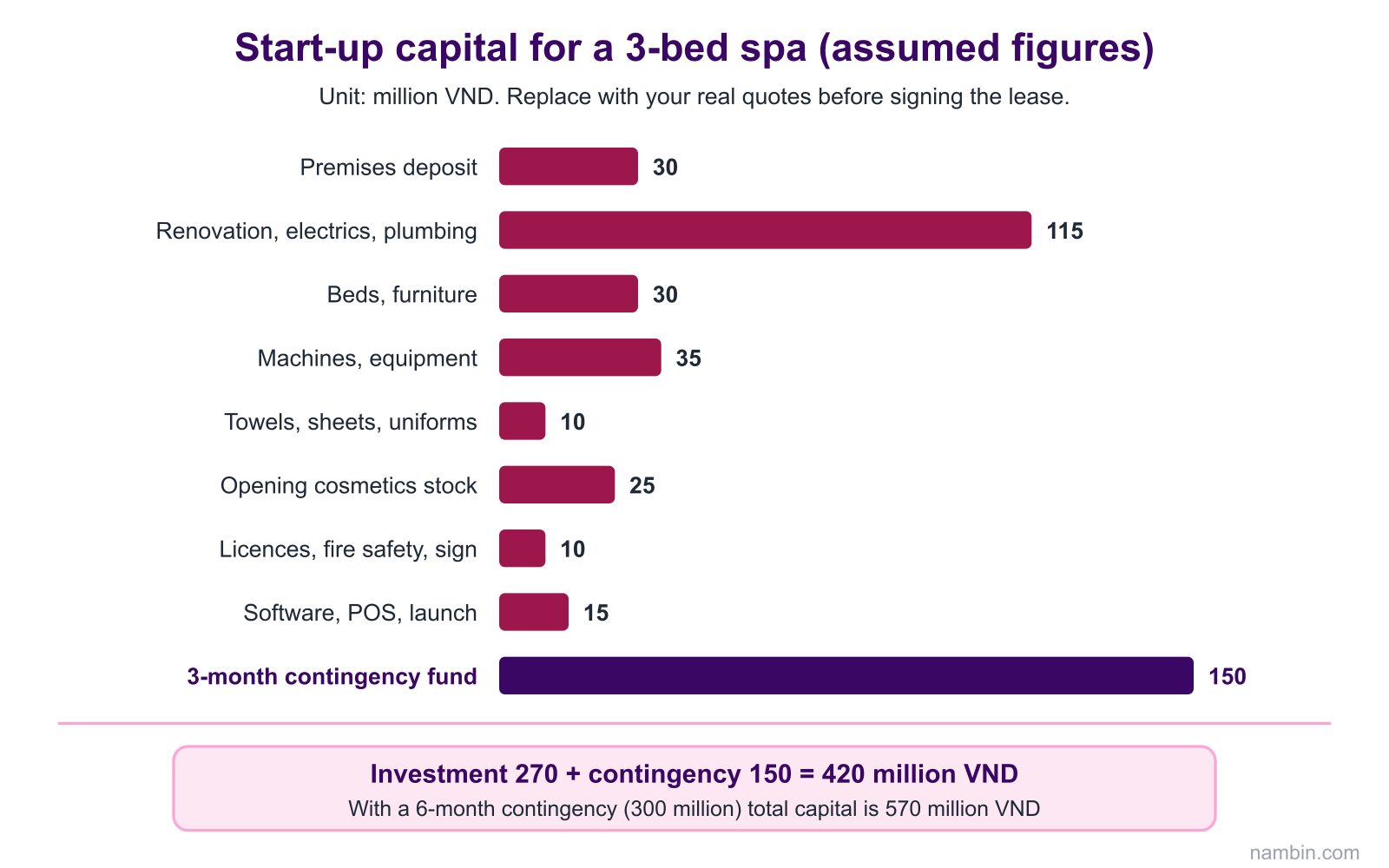
| Item | Assumed (million VND) | Notes |
|---|---|---|
| Premises deposit | 30 | 2-month deposit × 15 million; monthly rent counts as a fixed cost |
| Renovation, electrics and plumbing, soundproofing, shower room | 115 | The item most likely to exceed the budget; get quotes from 2–3 contractors |
| Treatment beds, trolleys, towel cabinets, stools, reception desk | 30 | 3 beds and basic furniture |
| Machines and equipment | 35 | Facial steamer, towel warmer cabinet, washer-dryer, disinfection equipment |
| Towels, sheets, robes, uniforms | 10 | Enough to rotate while washing |
| Opening stock of cosmetics, essential oils and supplies | 25 | Buy only products with a cosmetic product notification (Circular 06/2011/TT-BYT on cosmetics management) |
| Business registration, security and order conditions, fire safety, signage | 10 | Ask the local authorities about the actual procedures and costs |
| Booking software, POS machine, opening event | 15 | Do not pour it all into opening advertising |
| Total investment | 270 | |
| Reserve fund of 3 months of cash fixed costs | 150 | 3 × 50 million; 6 months would be 300 million |
| Total capital needed | 420 | Up to 570 million with a 6-month reserve |
Check the addition: 30 + 115 + 30 + 35 + 10 + 25 + 10 + 15 = 270. Adding the reserve of 150 gives 420.
Why a reserve fund of 3–6 months
A new spa rarely has enough clients from the first month, but rent and basic salaries still have to be paid on time. The reserve fund must not be used to buy machines or stock; it only covers shortfalls in fixed costs. If you are not bringing an existing base of regular clients with you, keep close to 6 months.
Borrowed capital and own capital
If you borrow, add the monthly loan repayments to your fixed costs. Do not take out informal high-interest loans, and do not use credit cards to pay the rent. A simple safety line: invest only an amount that, if lost completely, would still let your family live normally.
Fixed costs and variable costs
These two types of cost behave differently, so they must be separated before calculating break-even.
- Fixed costs: must be paid whether the month has 10 or 300 client visits. Rent, basic salaries, baseline electricity and water, internet, software, depreciation.
- Variable costs: rise with each client visit. Therapist commission per session, cosmetics and supplies used for that visit, towel laundry, electricity and water per visit, card payment fees.
Assumed monthly fixed costs
| Fixed item | Million VND/month |
|---|---|
| Rent | 15 |
| Basic salaries: owner 10, two therapists 5 + 5, receptionist 6 | 26 |
| Baseline electricity, water, internet | 4 |
| Software, fixed advertising | 3 |
| Other costs (cleaning, minor repairs) | 2 |
| Total cash fixed costs | 50 |
| Depreciation: (renovation 115 + beds 30 + machines 35) ÷ 36 months | 5 |
| Total fixed costs (F) | 55 |
Two common mistakes. First, the owner must pay a salary to themselves; otherwise you think you are making a profit when in fact you are simply working unpaid. Second, depreciation is a way of spreading the cost of renovation and equipment over the months: 180 million ÷ 36 months = 5 million. Depreciation is not cash spent each month, but if you ignore it, in three years' time the beds and machines will break and you will have no money to replace them.
Variable costs and contribution margin per visit
In the Level 4 lesson on cost per bed-minute, you learned how to calculate the cost of each service. This lesson does not recalculate it; we use an average figure for the whole menu. Assume the average price of one visit (after promotions) is 400 thousand VND:
- Therapist commission at 15% of the price: 60 thousand.
- Cosmetics, essential oils, single-use supplies: 40 thousand.
- Towel laundry, electricity and water per visit: 15 thousand.
- Card and e-wallet payment fees (average): 5 thousand.
Variable cost per visit (v) = 60 + 40 + 15 + 5 = 120 thousand. Contribution margin per visit = price − v = 400 − 120 = 280 thousand, a contribution margin ratio of 280 ÷ 400 = 70%. The contribution margin is the amount each client visit "contributes" towards paying the fixed costs; only once those are fully covered is the remainder profit.
Break-even point: how many client visits you need each month
The break-even point is the level of activity at which total contribution margin exactly equals fixed costs: no profit, no loss.
Formula: Break-even visits = Fixed costs ÷ Contribution margin per visit. Break-even revenue = Fixed costs ÷ Contribution margin ratio.
Step-by-step calculation with assumed figures
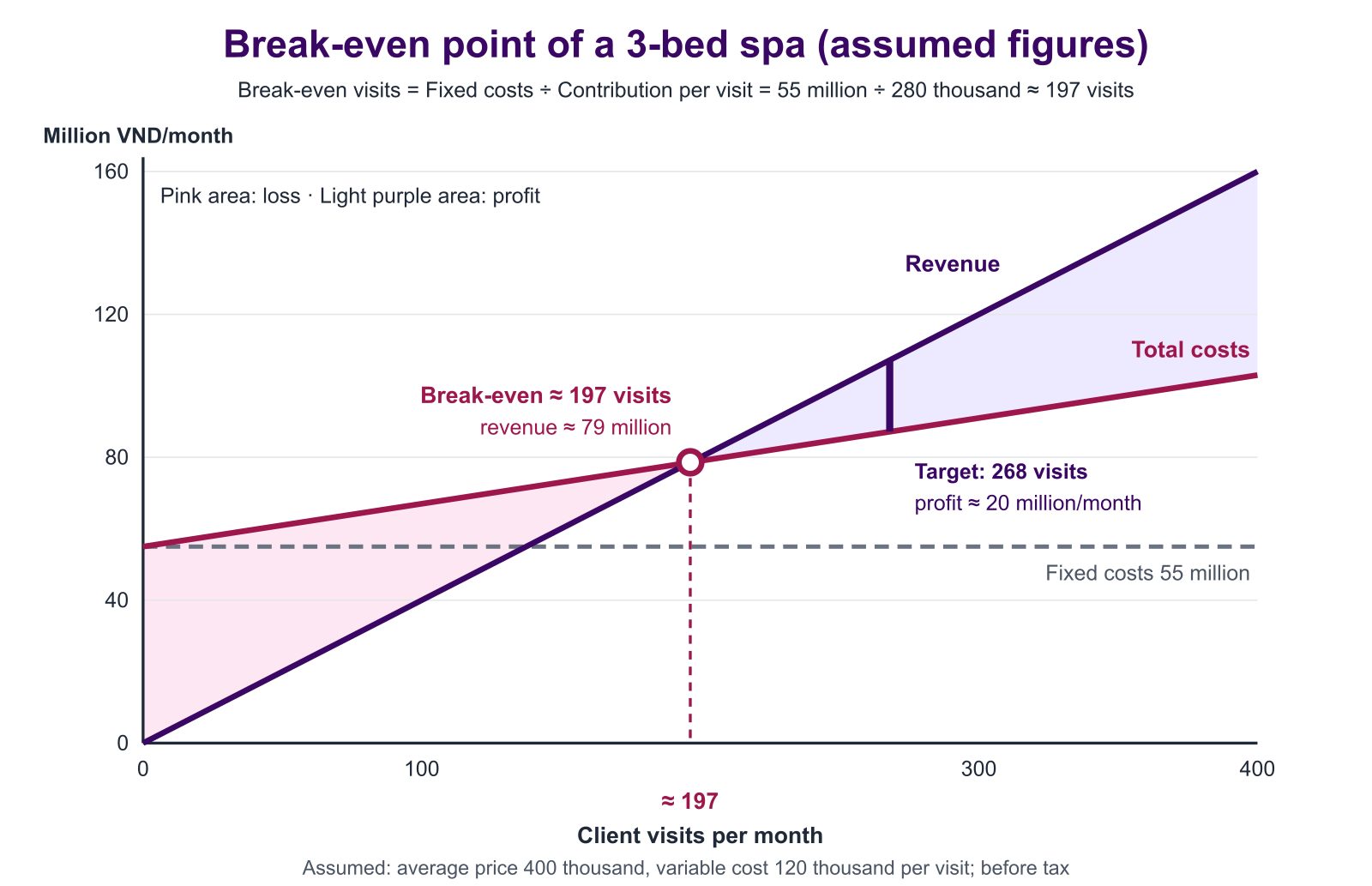
- Break-even visits = 55,000,000 ÷ 280,000 = 196.4 → round up to 197 visits/month. Always round up, because at 196 visits you are still making a loss.
- Break-even revenue = 55 million ÷ 70% ≈ 78.6 million VND/month. Cross-check: 197 × 400 thousand = 78.8 million, which matches (the difference is due to rounding).
- Per day, open 26 days/month: 197 ÷ 26 ≈ 7.6, that is about 8 visits/day.
- Target profit of 20 million/month: (55 + 20) million ÷ 280 thousand = 267.9 → 268 visits/month, about 10.3 visits/day.
Reading the result: what moves the break-even point
- Rent rises by 5 million: F = 60 million → 60,000 ÷ 280 = 214.3 → 215 visits. Each extra million in fixed costs needs about 3.6 more visits.
- Average price cut to 350 thousand (deep promotion) while v stays roughly the same at about 112 thousand (commission falls with price): contribution margin drops to 238 thousand → 55,000 ÷ 238 = 231.1 → 232 visits. A 12.5% price cut raises the number of visits needed by about 18%.
- Commission at 20% instead of 15%: v = 140 thousand, contribution margin 260 thousand → 55,000 ÷ 260 = 211.5 → 212 visits.
The lesson: discounting is the most expensive way to "win clients". Recalculate the break-even point before every promotion.
Bed capacity: is break-even achievable?
A break-even figure only means something when compared with your maximum capacity to serve.
- By bed: open 10 hours/day = 600 minutes. Each visit is 60 minutes of service + 15 minutes to clean up and change towels = 75 minutes. Each bed: 600 ÷ 75 = 8 visits/day; 3 beds = 24 visits/day; × 26 days = 624 visits/month.
- By people: two therapists and the owner all doing hands-on work, each safely doing about 5 visits/day (to protect their stamina and quality) → 15 visits/day × 26 = 390 visits/month. The real limit is people, not beds.
- Break-even capacity = 197 ÷ 624 ≈ 32% of bed capacity, or 197 ÷ 390 ≈ 51% of staff capacity.
- Target capacity = 268 ÷ 624 ≈ 43% of bed capacity, or 268 ÷ 390 ≈ 69% of staff capacity.
Conclusion: the target is achievable but without much margin, because clients tend to bunch up in the late afternoon, evening and at weekends. If your plan needs more than about 80% of staff capacity just to break even, it is too tight: one therapist off sick and you make a loss.
Photo: Smallbones / Wikimedia Commons, CC0

Cash flow: profitable on paper, yet you can still run out of money
Profit is revenue earned minus costs. Cash flow is the real money going into and out of the account. The two differ for three reasons: money received in advance (packages), money paid in advance (bulk stock purchases, rent paid 3 months at a time), and non-cash costs (depreciation).
Example: a first month without enough clients
In month 1, the spa has 120 single visits. Contribution margin = 120 × 280 thousand = 33.6 million. Cash fixed costs are 50 million. The cash shortfall is 50 − 33.6 = 16.4 million, taken from the reserve fund: 150 − 16.4 = 133.6 million remaining. Including depreciation, the accounting loss is 55 − 33.6 = 21.4 million. If the first three months are all like this, the fund still has about 150 − 3 × 16.4 = 100.8 million — still safe. This is exactly why you need a reserve fund.
Drawing up a 12-month cash flow
On the spreadsheet, each column is a month, and the rows are: opening balance; money received (single visits, packages, products); fixed cash costs; variable cash costs; one-off spending (repairs, replacing machines, loan repayments); closing balance. Assume visits rise gradually (for example 120, 150, 180, 200…) rather than hitting the target straight away. Look at the month with the lowest balance: if it is negative, you need more capital or lower costs before opening.
Payback period
Once you reach 268 visits, a profit of 20 million plus depreciation of 5 million added back (not cash spent) gives a monthly cash surplus of about 25 million. Recovering the 270 million investment takes about 270 ÷ 25 ≈ 11 months from the point the target is reached. Add the early months without enough clients and in reality it usually takes much longer. This example does not include tax.
The prepaid package trap: money received in advance is not profit
Prepaid treatment packages are a good tool for retaining clients if they are sold to match genuine needs, as you learned at Level 3. Financially, they are a double-edged sword: the money comes in immediately, but the obligation to deliver stretches over many months.
Example: a month of package sales
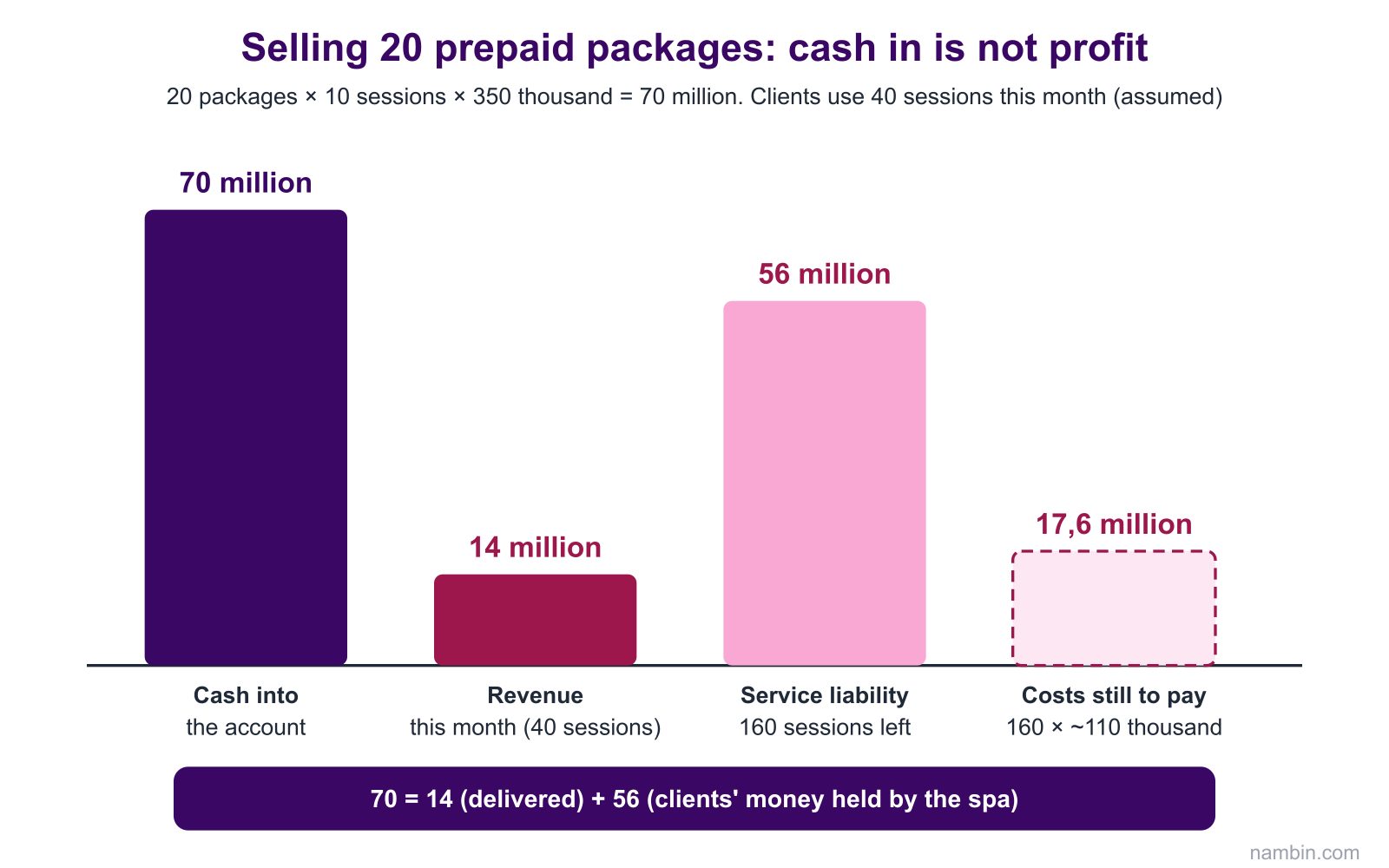
- In month 3, the spa sells 20 packages, each of 10 sessions priced at 3.5 million (350 thousand/session): cash in 70 million.
- During the month, package clients use 40 sessions: revenue earned = 40 × 350 thousand = 14 million.
- That leaves 200 − 40 = 160 sessions not yet delivered: service liability = 160 × 350 thousand = 56 million. This is clients' money held by the spa, not your money.
- The variable cost of delivering those 160 sessions (about 110 thousand/session, because commission is calculated on the package price): 160 × 110 thousand = 17.6 million, which will have to be spent over the coming months with no new income attached.
Rules for managing package money
- Track the number of package sessions still owed and their value separately, updated daily in the software or log.
- Set aside at least enough money to cover the cost of delivering the sessions still owed (17.6 million in the example above, about 31% of the 56 million); setting aside more is safer. Do not use package money to buy machines, renovate or pay off old debts.
- Selling large packages leaves the following months "cash-hungry": regular clients have already paid and come only to use their sessions. Build this into your cash flow.
- A spa that has to use money from new packages to pay this month's wages and rent is entering a dangerous spiral; once it can no longer sell new packages, the spa collapses and clients lose their money.
Separate accounts and a one-page monthly report
Separate personal and business accounts
- Open an account used only for the spa: all client payments go into it, and all spa costs are paid from it.
- The owner takes money for themselves as a fixed monthly salary, transferred to a personal account. No ad hoc withdrawals.
- Do not let therapists receive transfers into their personal accounts. Every payment received has an invoice or receipt.
- Keep invoices and expense records month by month; this is what the accountant and the tax authority need.
Photo: Maksym Kozlenko / Wikimedia Commons, CC BY-SA 4.0

A sample monthly report
At the start of each month, spend about an hour preparing the report for the previous month. The example below is a hypothetical June.
| Line | June (assumed) | Compared with plan |
|---|---|---|
| Visits served (single + package) | 230 | Above break-even of 197, below target of 268 |
| Bed capacity / staff capacity | 37% / 59% | 230 ÷ 624; 230 ÷ 390 |
| Revenue earned | 92 million | 230 × 400 thousand |
| Variable costs | 27.6 million | 230 × 120 thousand |
| Fixed costs (including depreciation) | 55 million | As planned |
| Profit before tax | 9.4 million | 92 − 27.6 − 55 |
| Package service liability at month end | From the package log | Compared with the money set aside |
| Reserve fund remaining | Number of months of fixed costs | Not below 3 months |
The example uses an average price of 400 thousand for every visit to keep the calculation simple; a real report separates single visits and package visits.

Photo: John Carlin / Wikimedia Commons, CC0

Tax: the principles
Whether a spa operates as a household business or a company, it has tax obligations, and the rules on filing, calculation and invoices may change over time. The examples in this lesson do not include tax; when drawing up a real plan, add a tax line at the rate your accountant or the tax authority managing you confirms for your case. Do not rely on word of mouth or posts online.
The procedure for drawing up a financial plan before opening a spa
- List the investment using the sample table, and get real quotes for renovation and equipment.
- Set out the monthly cash fixed costs, including the owner's salary; add depreciation.
- Calculate the average variable cost per visit (using your cost-per-bed-minute results) to get the contribution margin.
- Calculate the break-even visits, break-even revenue and the visits needed for the target profit; round up.
- Compare with bed capacity and staff capacity; if break-even needs more than about 80% of staff capacity, reconsider the premises, staffing or prices.
- Draw up a 12-month cash flow with gradually rising visits; find the month with the lowest balance.
- Set a reserve fund of 3–6 months of cash fixed costs; add it to the total capital.
- Write down a stop point in advance: for example "if after 6 months visits are still below 150 and the reserve fund is below 2 months, I will stop or scale down".
- Ask an accountant to review the tax and paperwork before signing the lease.
Signs that you need to cut back or stop
Stopping at the right time is not failure; it keeps you and your clients from losing more.
Cut back immediately
- Two months in a row below break-even with no increase in visits.
- The reserve fund is below 3 months of fixed costs.
- Cosmetics stock is growing and products are close to expiry.
How to cut back: reduce opening hours in quiet periods, stop advertising that brings no clients, renegotiate the rent, stop selling large packages, buy no more equipment.
Consider stopping or scaling down
- You have reached the stop point you wrote down in advance.
- The reserve fund is below 2 months and there is no source to top it up.
- You have to use new package money to pay fixed costs, or the package service liability is larger than the money you have.
- You have to take informal high-interest loans or borrow from relatives to pay wages and rent.
- The owner has been unable to pay themselves a salary for three months in a row.
Stopping responsibly: stop selling packages as soon as you decide, notify clients with remaining sessions early, deliver all remaining sessions or refund the unused part according to the policy you committed to, and pay staff in full.
Common mistakes
| Mistake | Why it is wrong or dangerous | The right way |
|---|---|---|
| Putting all the capital into renovation and machines | No money left to survive the first months with few clients | Set aside a reserve fund of 3–6 months of fixed costs first |
| Not counting the owner's salary | You think you are making a profit when the owner is actually working unpaid | The owner's salary is a fixed cost |
| Treating prepaid package money as profit | You spend clients' money and later lack the money to deliver | Track the service liability; set aside the delivery costs |
| Rounding break-even visits down | You still make a loss at that number of visits | Always round up |
| Comparing break-even only with the number of beds | The real limit is usually the number of therapists | Compare with both bed capacity and staff capacity |
| Deep discounts to attract clients | Contribution margin falls and the visits needed rise sharply | Recalculate break-even before every promotion |
| Using a shared personal account | No idea whether the spa is making a profit or a loss; tax is difficult | A separate account for the spa; the owner takes a fixed salary |
Pass criteria for this lesson
You pass this lesson when you can do the following in front of your instructor:
- Draw up a start-up capital table for a hypothetical spa within 20 minutes, with all 8 groups of items and a reserve fund of 3–6 months, with correct addition.
- Correctly classify at least 9/10 expense items given by the instructor as fixed or variable.
- Correctly calculate the contribution margin, break-even visits (rounded up), break-even revenue and the visits needed for a target profit with a new set of figures, with a rounding error of no more than 1 visit.
- Calculate maximum bed capacity and staff capacity, and state what percentage of each break-even represents.
- For a package-sales scenario, correctly separate cash received, revenue earned, the service liability and the remaining delivery costs.
- Prepare a one-page monthly report from given figures within 15 minutes and identify at least 2 signs that cut-backs are needed, if any.
Frequently asked questions
Does a small spa need to hire an accountant?
At the very least, use an accounting service to help with tax and paperwork. The one-page monthly report, however, the owner should prepare personally, so as to understand their own spa.
Where does the average price per visit come from?
Before opening, estimate it from the menu and the expected mix of services, minus promotions. Once open, divide revenue earned by the number of visits in the month. Update it every month.
Should we sell prepaid packages when we have just opened?
Yes, if the packages are small, match genuine needs, have a reasonable expiry period and you track the service liability. Do not sell packages to raise money for opening costs.
Is 36-month depreciation a mandatory rule?
No. It is an assumption for planning, estimated from realistic useful life. Ask your accountant about the depreciation method for tax filing.
Further reading
Review the career steps before opening your own spa in the lesson Spa vocational certificates and career path: from therapist to opening a small spa, and the lesson Delivering a complete 90-minute spa treatment: from welcoming the client to the client record to estimate the real length of a visit when calculating bed capacity.