Hanh has run a skin-care spa for a year; clients come steadily but not in large numbers. A freelance marketer offered her an advertising package: "Melasma cleared for good in 5 sessions, 100% guaranteed, money back if it doesn't work", with two before-and-after photos taken from the internet, the "after" photo already smoothed. He also suggested buying 200 five-star reviews and inviting someone with a large following to livestream an introduction to a "skin-regenerating cream that works like medicine". The advert ran for two weeks and the phone really did ring a lot. Then one client completed all 5 sessions, still had melasma, demanded a refund and posted accusing the spa of fraud, with screenshots of the advert. Another client recognised that the "after" photo came from a spa in a different city. Hanh lost her reputation much faster than she had gained the clients.
At Level 3 you learned to take consented before-and-after photos to track a treatment programme, and to sell services ethically from the therapist's point of view. This lesson takes the owner's point of view: you are the person responsible for all advertising content carrying the spa's name, whether it was written by you, by your staff, by an outside agency, or spoken by a celebrity on a livestream.
By the end of this lesson, you will be able to:
- State the main groups of advertising prohibitions under the Advertising Law 2012 at the level of principles, and apply them to spa advertising.
- Tell the difference between wording that advertises cosmetics and care services and wording that advertises them like medicines or medical services, and correct it.
- Set up a 5-step content approval procedure before any post, photo or video is published.
- Use before-and-after photos in advertising correctly: separate consent, identical photo conditions, no editing, with a note on results.
- Manage genuine reviews: do not buy them, do not delete bad reviews, and respond responsibly.
- Work with KOLs and livestreamers under an agreement that keeps control of the content.
Why even a small spa must be careful with advertising
An advert is the spa's public promise to people who do not yet know it. Clients have never met you and never lain on your treatment bed; they have only words and pictures to decide on. That is why the law sets specific requirements for advertising, and consumers have the right to accurate and complete information under the Law on Protection of Consumer Rights 2023.
For a spa, misleading advertising causes two kinds of harm:
- Harm to clients: a client who believes "cleared for good" may skip seeing a dermatologist, delay treatment for a skin condition that genuinely needs a doctor, or have a service that does not suit them.
- Harm to the spa: disappointed clients demand refunds and post complaints; screenshots of old adverts become evidence against you. The authorities can inspect, fine and order content to be removed.
Advertising is not just a signboard: social media posts, short videos, bulk messages, leaflets, livestreams and posts by celebrities who are paid by the spa or given free services are all subject to the same principle of honesty.
Photo: Tyler A. McNeil / Wikimedia Commons, CC BY-SA 4.0

The main prohibitions under the Advertising Law 2012, applied to spas
The Advertising Law 2012 and its implementing and amending regulations contain a list of prohibited acts and specific conditions for certain types of product. This lesson does not cite article numbers or penalty levels; you need to understand the spirit so you can check your own content, and ask a lawyer or the authorities when a case is difficult. For spas, there are five groups to remember.
1. Untrue or misleading
You must not make untrue statements about the quality, uses, origin or price of products and services. "Misleading" is broader than "lying": a statement can be true word for word yet, taken as a whole, make the client understand something wrong. For example "only 99,000 VND", when that is the price of the first session, later sessions cost 600,000 VND and a package must be bought; "Korean expert" when it is a therapist who did a short course there; "latest technology machine" when the machine has been in use for 5 years.
2. Absolute claims without evidence
Words such as "best", "only", "number 1" and "the very best" are restricted: they may be used only when there is lawful supporting documentation as required. A small spa almost never has such evidence, so do not use them. Likewise, "100% guaranteed", "absolutely effective" and "absolutely safe" are promises that cannot be true for everyone, because every person's skin and body is different.
3. Comparisons that disparage other spas
You must not make direct comparisons that disparage the products or services of other organisations or individuals, and you must not badmouth competitors. "The spa over there uses fake products, come here and have it redone properly" may be untrue and also damages someone else's reputation. Talk about what you can do, not about what others do wrong.
4. Cosmetics advertised as medicines
Cosmetics are products that come into contact with the surface of the skin to clean, perfume, change the appearance, protect, or keep the skin in good condition. Under Circular 06/2011/TT-BYT on cosmetics management, cosmetics must have a cosmetic product notification before being put on the market, and advertising content must match the features and uses notified. Cosmetics must not be advertised as having the effect of a medicine: no "treats acne", "treats melasma", "cures dermatitis", "regenerates cells" or "anti-inflammatory like an antibiotic". Correct wording is "helps cleanse and reduce shine", "helps skin look more even in tone", "moisturises".
5. Advertising medical services the spa is not allowed to provide
Spas provide only non-invasive care. Filler, botox and mesotherapy injections, surgery, therapeutic laser or IPL and deep microneedling fall within the scope of licensed medical facilities under the Law on Medical Examination and Treatment No. 15/2023/QH15 (you learned this boundary at Level 3). Advertising medical services is subject to specific conditions and is reserved for licensed facilities. If a spa posts "skin-booster injections" or "laser treatment for acne scars", it is both advertising outside its scope and publicly declaring that it is doing something it is not permitted to do. Even the words "treatment" (in the medical sense), "treatment protocol" or "doctor" on a spa's page make clients think it is a medical facility.
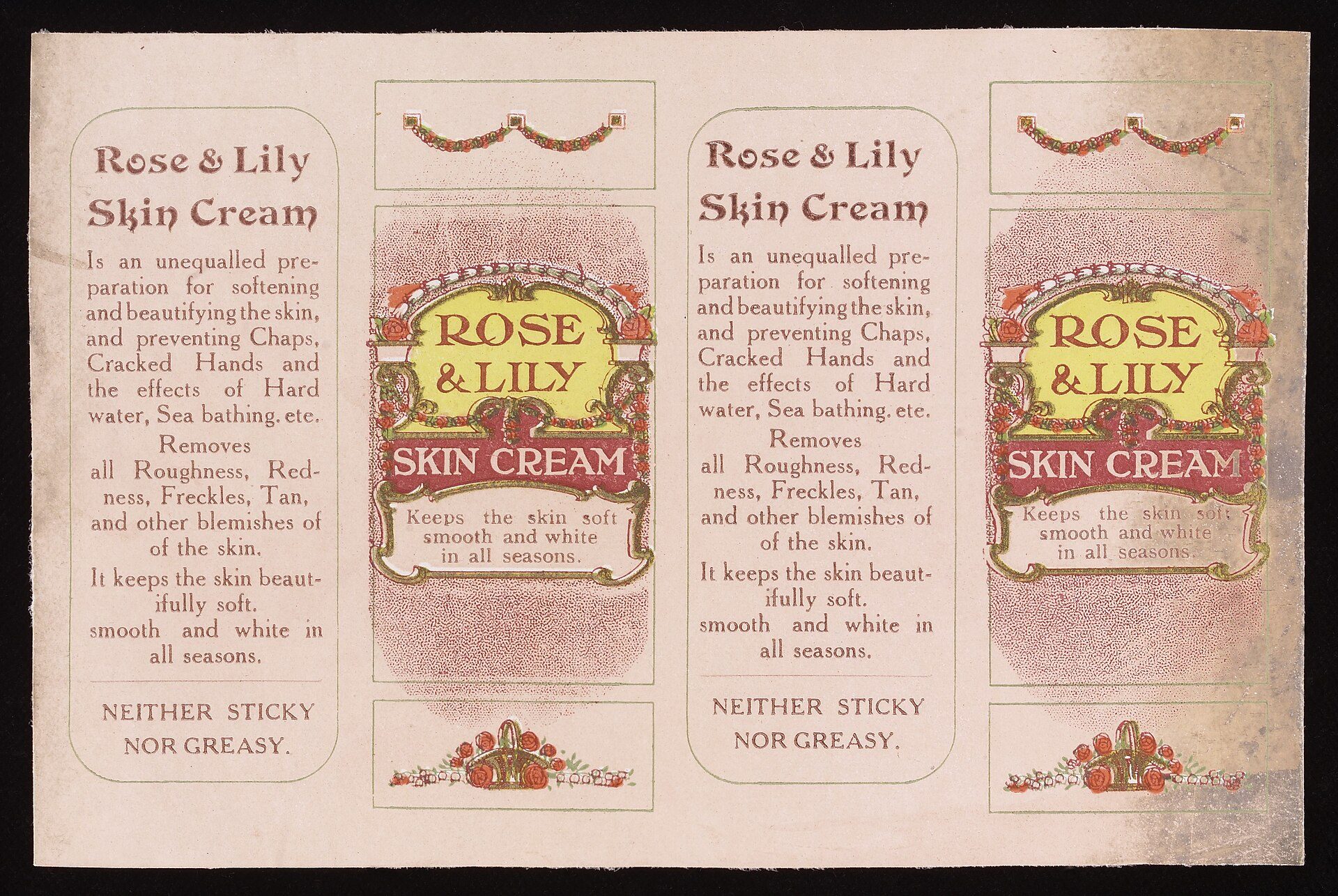
Photo: https://wellcomeimages.org/indexplus/obf_images/51/a0/7f557c9f4c0d48b3f51f8d8b0061.jpg Gallery: https://wellcomeimages.org/indexplus/image/L0034278.html Wellcome Collection gallery (2018-04-02): https / Wikimedia Commons, CC BY 4.0

Correcting advertising wording: wrong → right
The quickest way for your team to understand is to show them pairs of statements. Print this table and stick it on the desk of whoever writes your content. Correct wording can still be attractive: say clearly what the client gets, how it is done, who does it and how safe it is.
| Wrong wording | Why it is wrong | Right wording |
|---|---|---|
| "Melasma cleared for good in 5 sessions" | Promises a treatment result; melasma is a skin condition that needs a doctor's assessment and often recurs | "A care programme for dull, uneven skin, combined with advice on sun protection at home. Melasma needs assessment by a dermatologist; the spa provides supportive care" |
| "100% guaranteed acne-free, or your money back" | An absolute promise that cannot be true for everyone; "acne-free" is a treatment promise | "Skin cleansing, aseptic extraction and home-care advice. For widespread, swollen or painful inflamed acne, the spa advises clients to see a doctor" |
| "Skin-regenerating cream, a specialist treatment for dermatitis like medicine" | A cosmetic advertised as a medicine, beyond its notified uses | "A moisturiser that helps skin feel softer and less dry and tight" (matching the uses on the notification) |
| "The number 1 spa in the city" | An absolute claim without lawful evidence | "A 6-bed spa, therapists with vocational certificates, open since 2024" |
| "Lose 5 kg after one treatment programme" | Promises a body result; body care does not produce weight loss like that | "60-minute relaxing body massage that helps muscles release and you feel more comfortable" |
| "Skin-booster injections and stem-cell microneedling at the spa" | Invasive services that the spa may neither provide nor advertise | Remove entirely. Advertise only the non-invasive services the spa actually provides |
| "Unlike spa X, which uses dodgy products" | A disparaging comparison, possibly untrue | "Every cosmetic used at the spa has a product notification; just ask and we will show you" |
| "Only 99k" (first-session price, later sessions 600k, package compulsory) | Misleading about price | "First trial session 99,000 VND; single-session price 600,000 VND; no obligation to buy a package" |
| "Absolutely safe, no side effects" | No service is risk-free; hides the risks | "Consultation and contraindication check before treatment; slight redness may occur and fades within a few hours" |
The right wording replaces promises of results with a description of what is actually done and its limits (when a doctor is needed, results vary from person to person). Clients who come because of this wording are less likely to be disappointed.
A 5-step content approval procedure
Whoever writes it, every post must be approved by a responsible person, usually the owner or the manager. Each post takes 5–10 minutes.
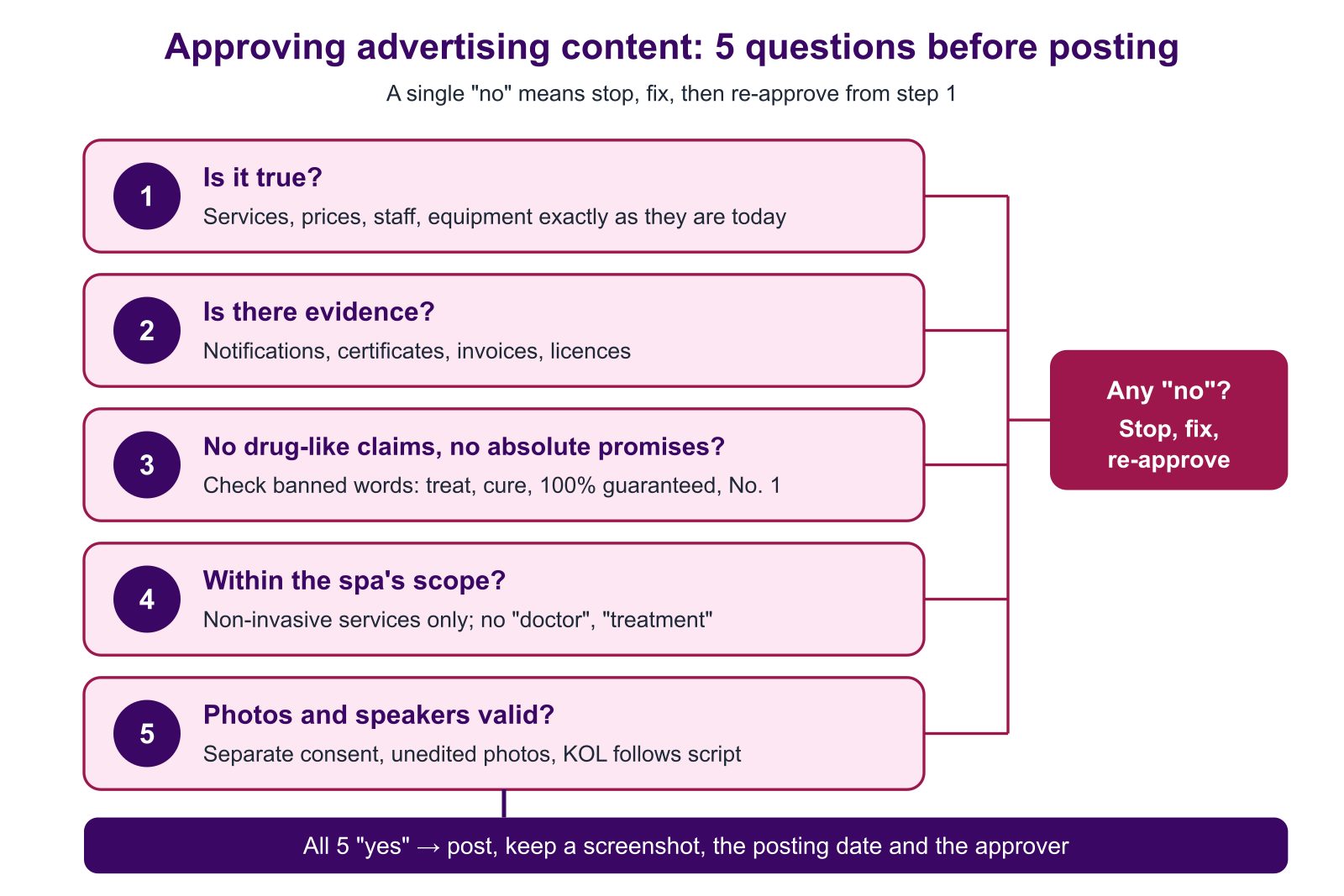
- Is it true? All information on services, prices, times, staff and equipment must match what actually exists at the spa today. Promotional prices state their conditions and deadline clearly.
- Is there evidence? Every claim must be backed by a document: the cosmetic product notification, the therapist's certificate, the invoice for the machine, the spa's licence. No document means the claim is removed.
- Not worded like a medicine, no absolute promises? Scan for banned words: "treats", "specialist treatment", "cleared for good", "cures", "100% guaranteed", "permanent", "best", "number 1", "absolute". Replace them with "supports", "cares for", "helps", "relaxes".
- Within the spa's scope? The services presented must be non-invasive services the spa is actually permitted to provide. No "doctor", "clinic", "treatment" in the medical sense or "treatment protocol" if the spa is not a medical facility.
- Are the photos and spokespeople valid? Photos have a clear source, client photos have a consent form for advertising use, before-and-after photos meet the standard in the next section; any celebrity sticks to the approved script.
After posting, keep a copy of the content (screenshot, posting date, approver) in a shared folder. When a complaint comes in months later, you know exactly what the spa said. When you find an old post with incorrect wording, remove or correct it immediately; do not wait for someone to complain.
Before-and-after photos in advertising
Before-and-after photos are a skin-care spa's most powerful advertising tool, and therefore the easiest to get wrong. At Level 3 you took photos to track a treatment programme in the client record. Putting those photos into an advert is a different purpose and needs extra conditions.
1. Separate consent for advertising
Photos of a client's face and body are personal data; Decree 13/2023/ND-CP on personal data protection requires them to be processed only for the purpose the client has consented to. A client who agreed to photos for tracking a treatment programme has not agreed to have them posted online. You need a separate consent form that states clearly:
- Which photos (numbered, with the client's signature or confirmation on a small print or a list of photos).
- Where they will be used (the spa's social media page, website, leaflets, signs at the spa) and for how long.
- Whether the face, tattoos, moles or other identifying details will be covered.
- The client has the right to withdraw consent; on withdrawal, the spa removes the photos from the channels it controls within the time stated on the form.
- No strings attached: a client who refuses is served as usual; do not trade photos for discounts in a way that makes it hard for the client to say no.
2. Identical photo conditions, no editing
Before and after photos only mean something when the difference comes from the treatment programme, not from the lighting or software. An "after" photo that is brighter, closer, with make-up or a smoothing filter is a deceptive photo, even if the client is real.
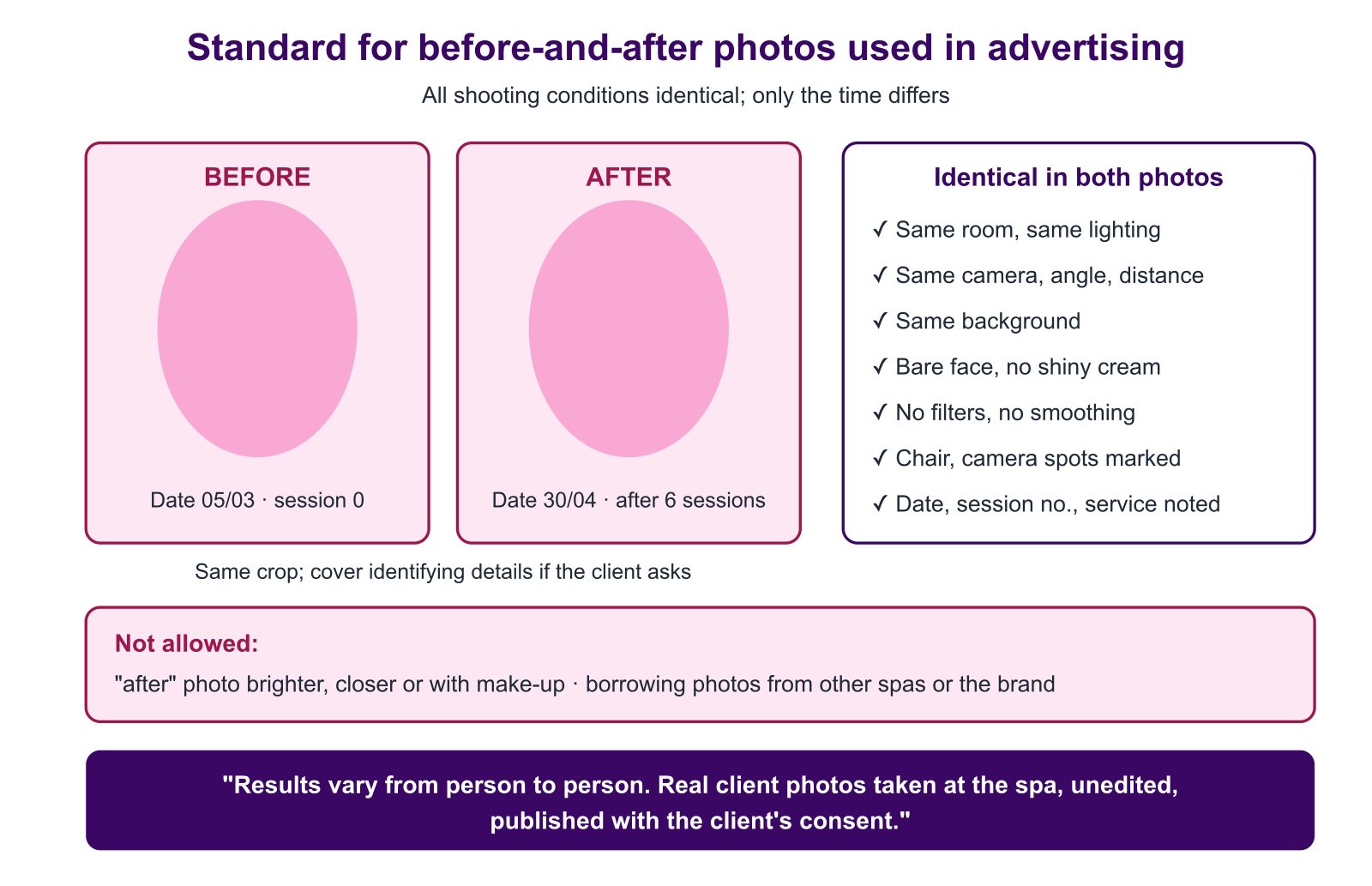
- Same light source (same room, same lamps, ceiling light off if it was off the first time), same background, same camera, same distance and angle. Mark the camera and chair positions on the floor so they can be placed in exactly the same spot next time.
- The client's face is bare in both photos: no make-up, no freshly applied shiny cream.
- No editing: no smoothing, no changing skin colour, no removing marks, no filters. You may crop and cover identifying details according to the client's consent, but crop both photos the same way.
- Note the date taken, the number of sessions completed, the services carried out, and whether the client used any products at home (if known).
- Always include the line: "Results vary from person to person. Genuine client of the spa, photos unedited, published with the client's consent."
3. Do not borrow photos, and do not pick the single best case to imply "everyone gets this"
Do not use photos from other spas, from the internet or from cosmetic brands as if they were your spa's results. A brand's photos may be used when clearly labelled as the manufacturer's illustrations and when you have the right to use them, but do not call them "our spa's clients". If you post only the best case out of ten clients, do not add wording that makes viewers think everyone achieves the same.
Genuine reviews: do not buy, do not delete, respond responsibly
New clients read reviews on maps and social media before they call. Bought reviews, reviews written by staff under multiple accounts, or reviews exchanged for gifts without disclosure all give clients a false impression of the real quality, which makes them misleading. Platforms also detect fake reviews and may remove them or lower the page's ranking.
Doing it right
- Ask every client for a review, not just the happy ones: after the session, reception sends the link once. Do not invite only selected regulars.
- Do not pay or give gifts in exchange for 5 stars. If there is a gift scheme for reviewers, give it to everyone who writes a review regardless of the star rating, and say so clearly.
- Do not let staff or relatives write reviews pretending to be clients.
- Do not delete or report bad reviews just because they are bad. Report to the platform only when a review contains abusive language, exposes personal information or is clearly not from a client.
- Reply to bad reviews within 24–48 hours: thank the client, apologise for the experience and invite them to get in touch privately to resolve it. Do not argue, and do not reveal the client's health information or treatment details in a public reply.
KOLs, livestreamers and freelance promoters
A KOL (key opinion leader, an influencer) or a livestream seller talks about your spa in front of thousands of people. What they say is advertising for the spa. In the spirit of the Advertising Law and its amending and implementing regulations, the person who directly presents a product or service is also responsible for what they say, must research the information before presenting it, and must not misstate its uses. If the spa hires them, the spa is also responsible. "The KOL said it on their own, the spa didn't know" will not protect you.
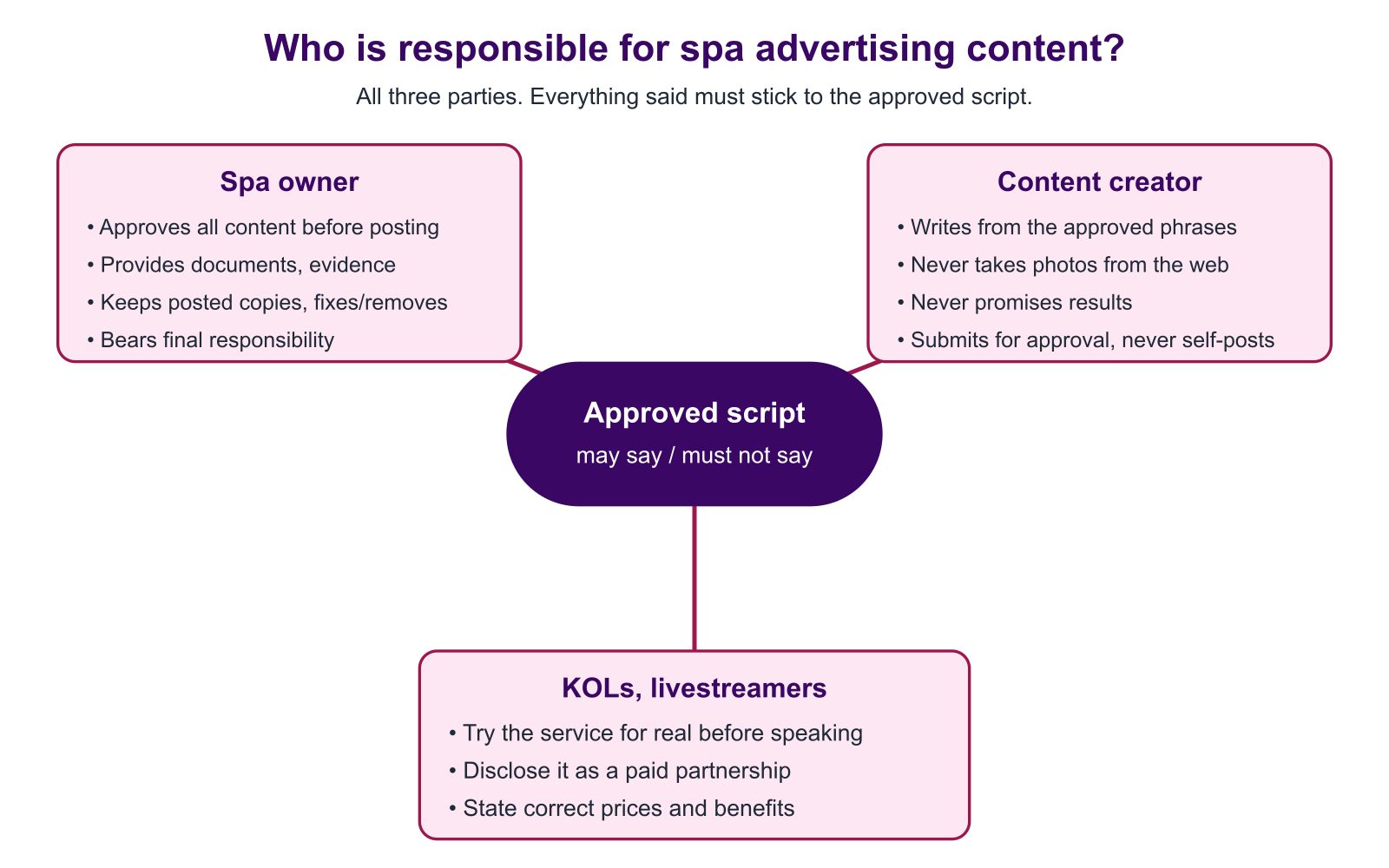
Minimum terms of an agreement with a KOL
- A genuine experience before speaking: the KOL has the service at the spa and goes through the consultation and health questionnaire like any other client.
- A script with a list of what may and may not be said, with the wrong → right wording table above attached.
- Clearly disclose the paid partnership in the post, video or livestream; no pretending to be a client who just happened to drop in.
- The spa approves the edited video before it is posted; for livestreams, someone from the spa monitors and prompts immediately if the KOL says something wrong, and reviews the recording afterwards.
- Correction and removal clause: if incorrect wording is found, the KOL corrects or removes it within the time stated in the agreement.
- Prices and offers the KOL reads out on air must match the prices reception applies when clients arrive.
The same applies to online promoters and outsourced content creators: their content must be approved. Do not sell skin treatment packages via livestream before a consultation and contraindication check; sell only trial vouchers or consultation vouchers.
Photo: 円周率3パーセント / Wikimedia Commons, CC BY-SA 4.0

Common mistakes in spa advertising
| Mistake | Why it is dangerous or wrong | The right way |
|---|---|---|
| Using "cleared for good", "100% guaranteed" | Promises treatment and absolute results; clients are disappointed, complain, and the spa may be penalised | Describe what is actually done and its limits; "results vary from person to person" |
| Advertising a moisturiser as "a specialist treatment like medicine" | A cosmetic advertised beyond its notified uses | Check the product notification and state only the actual uses |
| Posting injection or therapeutic laser services | Outside the spa's scope; publicly declares doing something not permitted | Advertise only non-invasive services; refer clients who need more to a medical facility |
| Smoothed or brighter "after" photos, photos taken from the internet | Deceives viewers; using other people's photos also infringes rights | Genuine client photos, identical conditions, no editing, separate consent |
| Posting client photos based only on consent for tracking photos | Uses personal data for a purpose not consented to | A separate consent form for advertising, stating channels, duration and the right to withdraw |
| Buying reviews, staff writing reviews | Misleading about quality; platforms may remove them | Ask every client for a review; never pay for stars |
| Letting a KOL say whatever they like on a livestream | The spa is still responsible for the KOL's incorrect statements | Approved script, a spa staff member monitoring, a correction and removal clause |
| Not keeping copies of published adverts | You do not know what you promised when a complaint arrives | Keep screenshots, posting dates and the approver's name |
Pass criteria for this lesson
You pass this lesson when you can do the following in front of your instructor:
- Correctly state the 5 groups to avoid in spa advertising (untrue or misleading, absolute claims, disparaging comparisons, cosmetics as medicines, medical services outside the spa's scope) within 3 minutes.
- Given 10 sample advertising statements, correctly identify at least 9/10 of the wrong ones and rewrite a correct version of each within 20 minutes.
- Approve a sample post using all 5 steps, stating clearly which step fails and what to correct.
- Write a consent form for advertising use of photos covering all 5 items: which photos, which channels, duration, covering identifying details, the right to withdraw.
- Check a pair of before-and-after photos and identify all the photo conditions that are not identical (lighting, angle, distance, background, make-up, filters).
- Write a public reply to a 1-star review within 5 minutes: no arguing, no health information revealed, with an invitation to resolve it privately.
- List the 6 minimum terms of an agreement with a KOL.
Frequently asked questions
Can we say "effective", or must we avoid it completely?
You may talk about genuine care effects, such as "skin is cleansed and feels softer after the session" or "relaxing, eases muscle tension". You may not claim treatment effects ("melasma gone", "acne gone", "cures back pain") or promise certain results for everyone. When in doubt, ask: is this something only a doctor should say? If so, remove it.
A cosmetics brand has printed leaflets with the words "specialist treatment". Can the spa hand them out?
Better not. If the content is wrong, the spa that hands it out is also advertising wrongly. Check the leaflet against the product notification; do not use any leaflet with claims that go beyond the notified uses, and tell the distributor.
A client who agreed to have her photos posted now wants them removed. What should the spa do?
Remove the photos from all channels the spa controls within the time stated on the form, confirm to the client once they have been removed, and record it in the file. Do not pressure the client to keep the photos, and do not demand back any discount that was given. If the photos were printed on leaflets that have been handed out, stop distributing the remaining copies.
Further reading
Review how to explain the limits of a service clearly to clients in the lesson Spa client consultation and the health questionnaire: asking the right questions to work safely, and see the safety check steps in the lesson Spa safety and service skills test.