
At the end of the year, a spa owner cleared out the cosmetics cabinet and counted 11 half-used bottles of serum, three of them expired since June, and two unopened boxes of expired sheet masks. Meanwhile the massage oil "just ran out" every week and the supplier had to be called for urgent deliveries. Money sat dead in the cabinet, money flowed out without anyone knowing where it went, and, more importantly, at times therapists had used expired products on clients. Stock management is not an accounting chore; for a spa it is a matter of client safety and of survival for the profit margin.
By the end of this lesson, you will be able to:
- Choose suppliers on the criteria of origin, invoices, cosmetic product notifications and delivery terms.
- Receive goods, enter them into stock, fill in stock cards and label opening dates correctly.
- Shelve and issue stock by FEFO, and store products under the conditions stated on the label.
- Use the standard usage per service to calculate expected consumption, the reorder point and the wastage rate.
- Carry out regular stocktakes, deal with expired and spoiled goods, and set up loss-prevention measures.
The life cycle of a cosmetic bottle in a spa
From the moment it is chosen and bought to the moment the bottle is empty or discarded, every product passes through seven stages. Wherever a stage is slack, money and risk leak out.
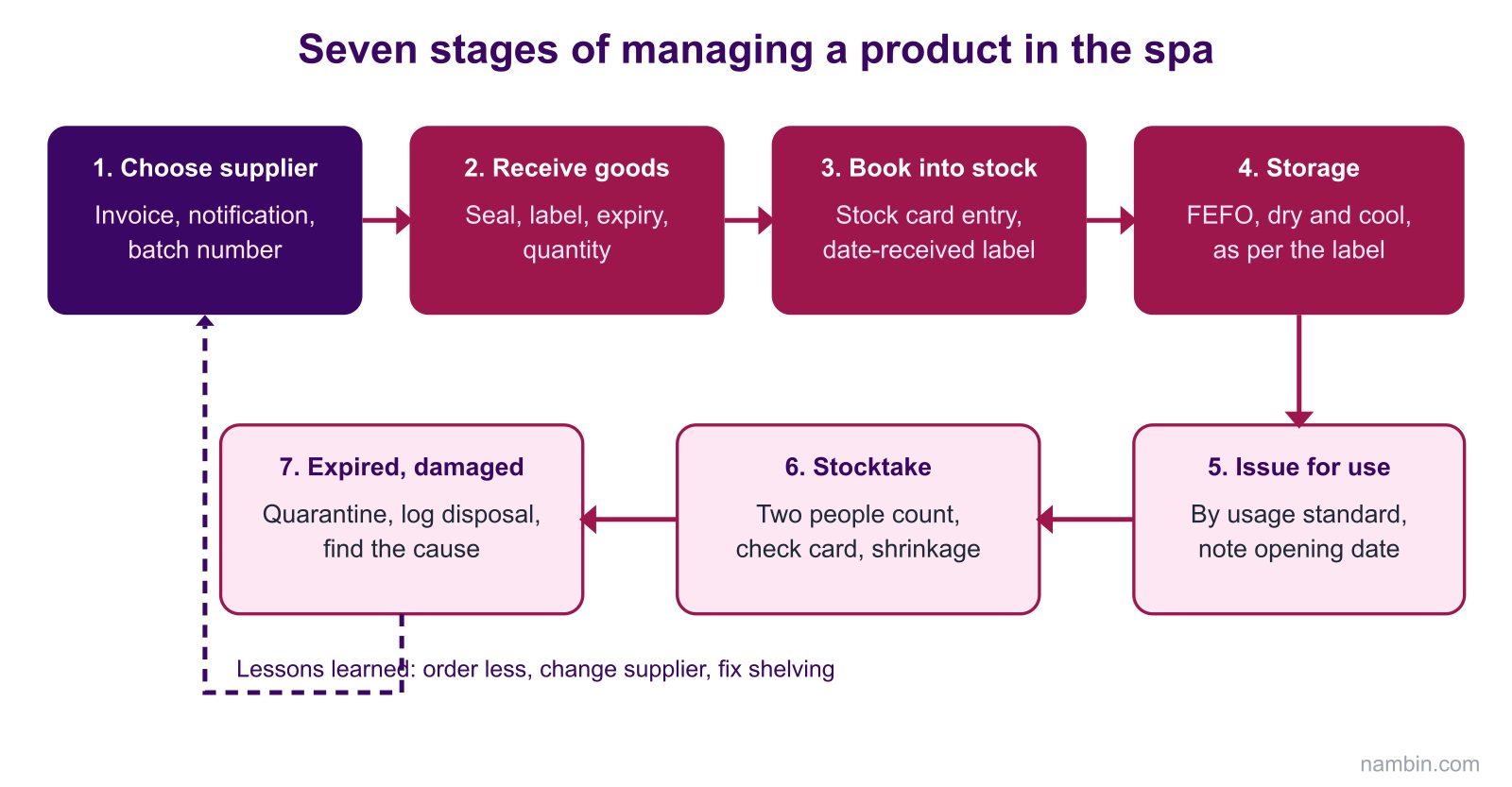
You learned to read labels, INCI ingredient lists, the PAO symbol and product notifications at Level 2. This lesson does not teach label reading again but applies it to management: who checks, where it is recorded, and when.
Choosing suppliers and checking origin
A price 20% cheaper is not worth it if what you get in return are goods of unknown origin without an invoice. When a client has a reaction, the first question will be "where did this product come from?"
| Criterion | What to check | Warning signs |
|---|---|---|
| Clear legal entity | Company name, tax code, address, contact person | Only a social media account, no invoices issued |
| Cosmetic product notification | A copy of the product notification, or its acknowledgement number, for each product | "Hand-carried goods, no notification needed" |
| Product label | Label with all mandatory information, a Vietnamese supplementary label on imported goods, a batch number and expiry date | Label peeled off or covered over, no batch number |
| Shelf life at delivery | Long enough for the spa's rate of use (the spa sets its own minimum, for example at least 12 months remaining) | "Near-expiry" goods at unusually low prices |
| Documents | Invoice and delivery note stating product name, quantity and batch number | Only a bank transfer message |
| After-sales support | Exchange of faulty goods, instructions for use, product safety information | No returns accepted, no documentation provided |
Under Circular 06/2011/TT-BYT on cosmetics management, cosmetics must be notified to the regulatory authority before being placed on the market, and the organisation placing the product on the market is responsible for it. In principle the spa is not the notifying party, but it is where the product is used on clients' skin, so it must choose notified products and keep the evidence. Each product has a page in the "Product records" folder: a copy of the product notification (or its acknowledgement number), the invoice from the first purchase, and the manufacturer's instructions.
Do not use too many suppliers, but do not depend entirely on one either. A small spa usually does well with 2–4 main suppliers and a list of back-up suppliers for its most important items (massage oil, paper towels, gloves).
Receiving goods and entering stock
- Check against the order: correct name, volume and quantity on the invoice and delivery note.
- Check the packaging: seals intact, no dents, no leaks, no discolouration visible through clear bottles.
- Check the label: batch number, expiry date, Vietnamese supplementary label; shelf life meets the spa's requirement.
- Goods that need refrigeration (if the manufacturer requires it): check that they are still cool on delivery and put them away immediately.
- Goods that fail the check: refuse them, or accept them and set them aside labelled "awaiting return", noting this clearly on the delivery note.
- Fill in the stock card the same day: date, invoice number, batch number, expiry date, quantity received, new balance.
- Label the date received on the box or on each product, then shelve it by FEFO.

Photo: Shixart1985 / Wikimedia Commons, CC BY 2.0

The stock card: one sheet per product
A stock card is a sheet recording every receipt and issue of one product and the balance after each movement. A stock card is correct when, if you go to the shelf and count, the actual number matches the balance on the card. A small spa can use paper cards clipped to the end of the shelf, or one spreadsheet page per product.
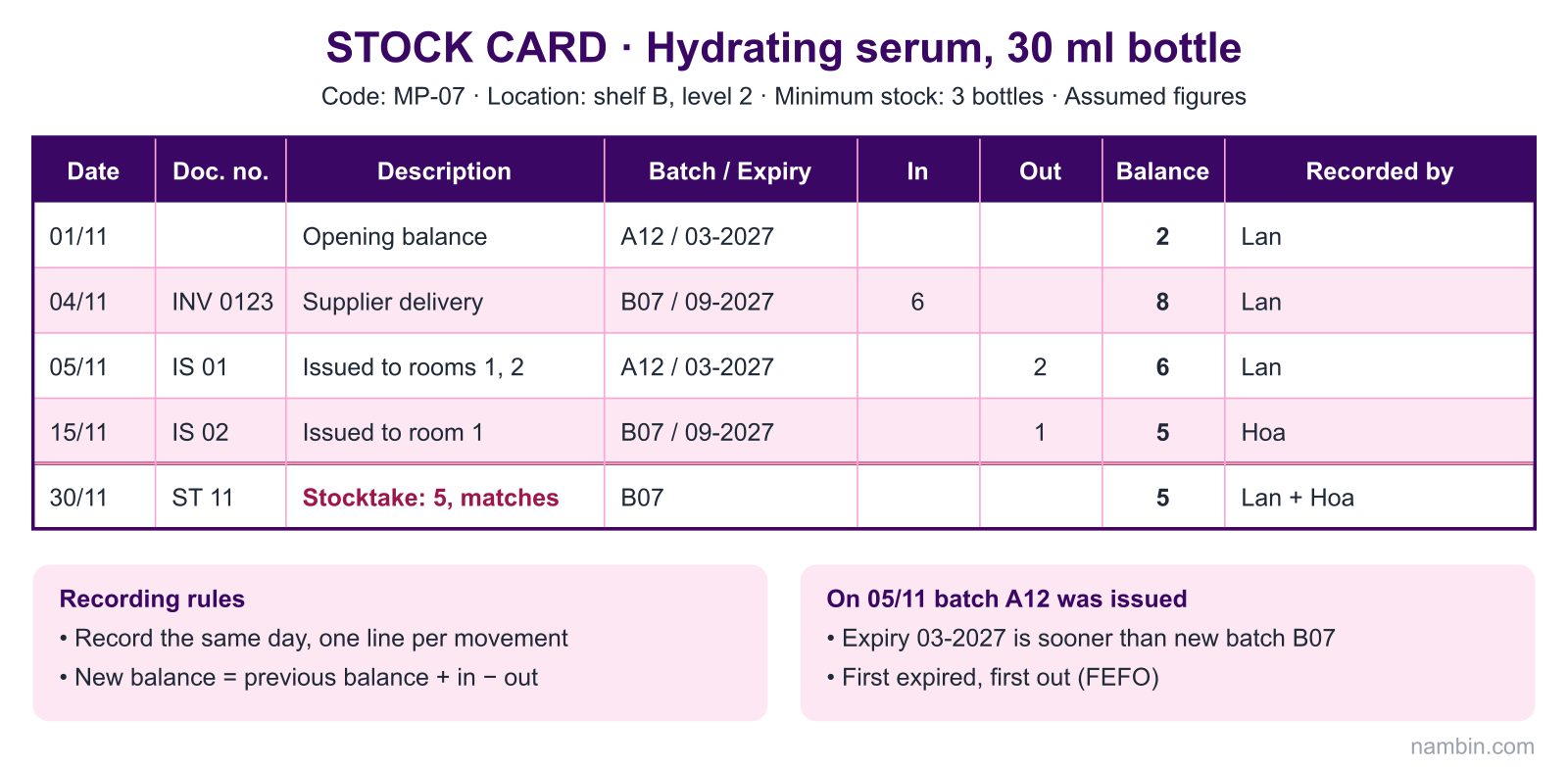
| Date | Document | Description | Batch / Expiry | In | Out | Balance |
|---|---|---|---|---|---|---|
| 01/11 | Opening balance for the month | A12 / 03-2027 | 2 | |||
| 04/11 | INV 0123 | Received from supplier | B07 / 09-2027 | 6 | 8 | |
| 05/11 | ISS 01 | Issued to rooms 1 and 2 (batch A12) | A12 / 03-2027 | 2 | 6 | |
| 15/11 | ISS 02 | Issued to room 1 (batch B07) | B07 / 09-2027 | 1 | 5 | |
| 30/11 | ST 11 | Stocktake: actual count 5, matches | B07 | 5 |
Note 05/11 (5 November): batch A12 expires in 03-2027, sooner than the newly received batch B07, so it is issued first. That is FEFO.
Opening dates, FEFO and storage conditions
Recording the opening date
Every bottle or jar must be labelled when it is opened: "Opened: day/month – Use by: day/month – Opened by". The "use by" date is the earlier of two dates: the opening date plus the PAO period on the label, and the expiry date printed on the packaging.
- Example 1: opened on 05/11/2026, PAO 6 months, printed expiry 31/12/2027. Use by 05/05/2027.
- Example 2: opened on 05/11/2026, PAO 12 months, printed expiry 31/03/2027. Use by 31/03/2027, because the printed expiry comes first.
Products the spa blends or decants itself (massage oil blended with essential oils, oil decanted from a large container into small pump bottles) must also be labelled: name, original batch number, blending or decanting date, and use-by date according to the manufacturer's instructions or the spa's internal rules. Use clean, dry bottles, and never pour leftovers back into the original container.
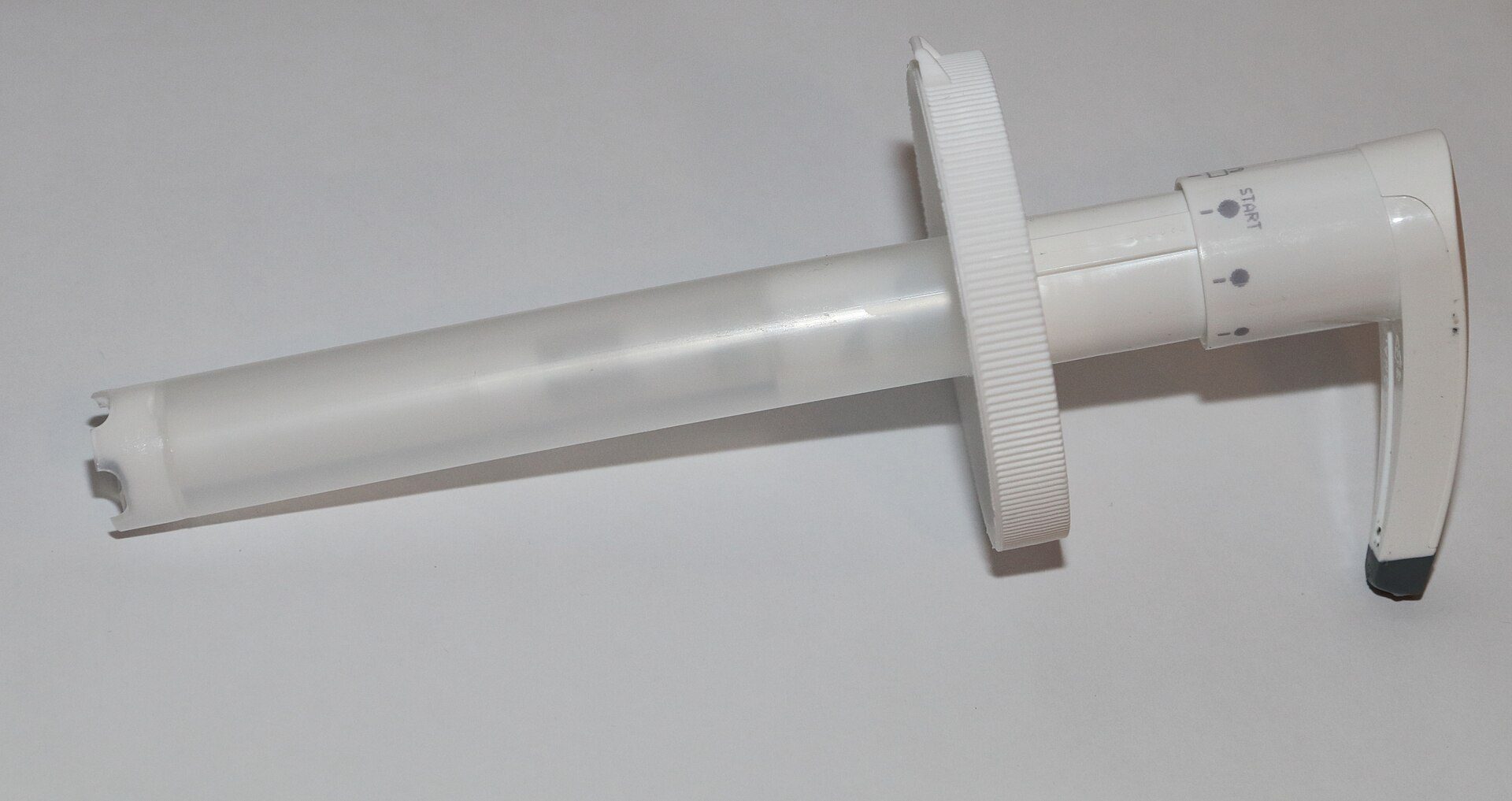
Photo: MKFI / Wikimedia Commons, Public domain

FEFO: first expired, first out
FEFO (First Expired, First Out) means the product with the nearest expiry date is used first. It differs from FIFO (First In, First Out): sometimes a batch received later actually expires sooner, for example when a supplier delivers its own old stock. For cosmetics, FEFO is safer.
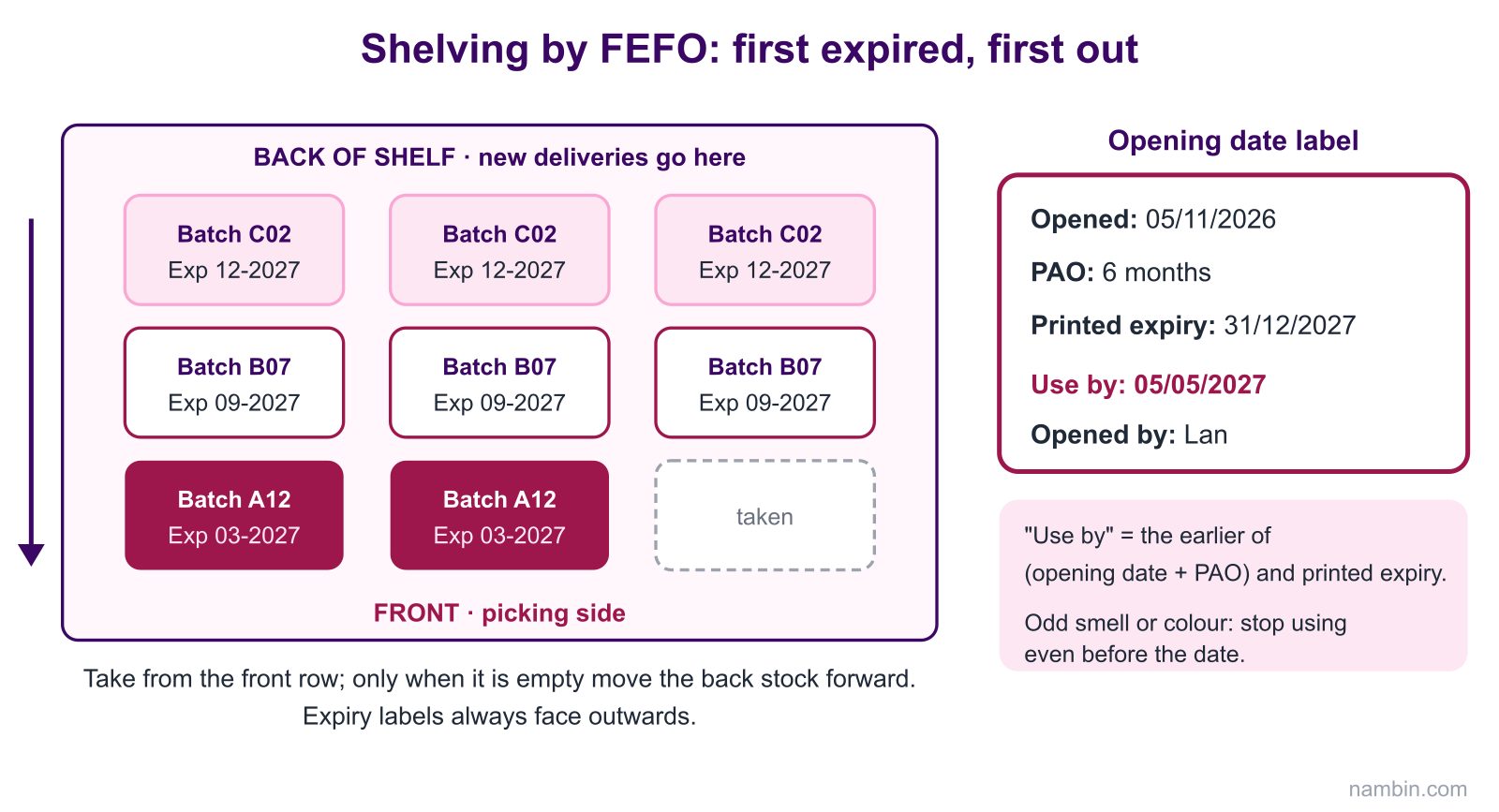
- Place the stock with the nearest expiry at the front, at hand height; put newly received stock at the back.
- Expiry labels face outwards; or use coloured dots by quarter of expiry so you can see at a glance.
- Each room keeps only one bottle in use of each product; a new bottle is taken from the store only when it is finished.
- At the start of each month, list the products expiring in the next 60–90 days so they are used first, or stop reordering them.
Storage conditions
| Product group | Storage | Avoid |
|---|---|---|
| Cosmetics (cleansers, creams, serums, masks) | A dry, cool place out of sunlight; at the temperature stated on the label | Next to the towel steamer or steamer, at a sunny window, in a hot car |
| Products the manufacturer says must be refrigerated | A dedicated product fridge with a thermometer, temperature recorded daily | Storing them together with staff food and drinks |
| Massage oils, essential oils | Dark bottles, tightly closed, in a cool place | Leaving them open or near a heat source |
| Cleaning and disinfection chemicals | A separate low cabinet or shelf, labelled, away from cosmetics and client areas | Decanting into drinking-water bottles, storing on the cosmetics shelf |
| Clean towels, disposables | A closed cabinet or covered shelf, off the floor, dry | Near dirty towel baskets, against damp walls |
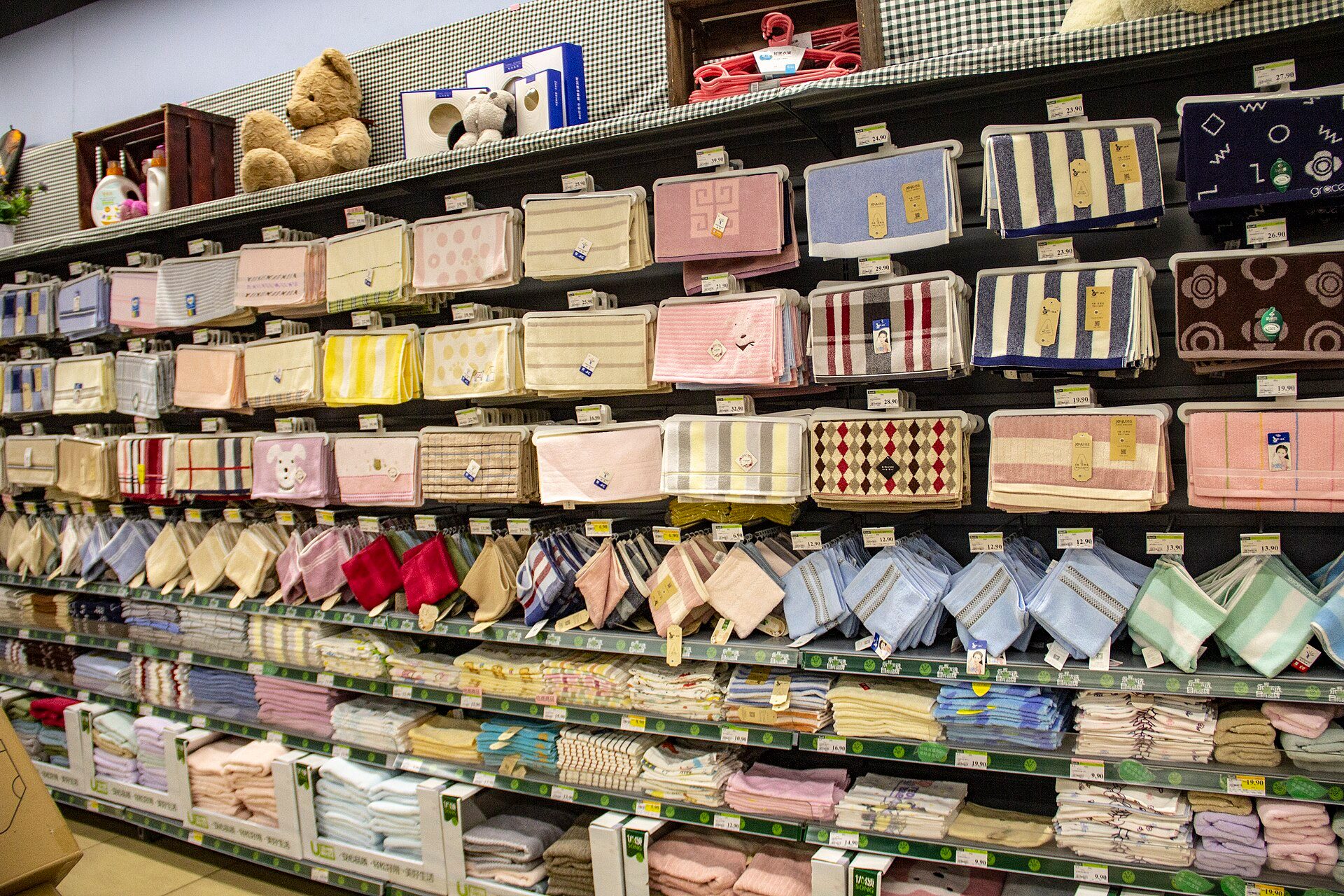
Photo: 維基小霸王 / Wikimedia Commons, CC BY-SA 4.0

Standard usage, reorder point and wastage
In the pricing lesson you set a standard usage (standard dose) for each service. In stock management, the standard usage answers two questions: when to reorder and whether anything is going missing.
Calculating expected consumption and wastage
Hypothetical example: in November the spa performs 300 sixty-minute body massages, with a standard oil usage of 30 ml per massage.
- Expected consumption: 300 × 30 = 9,000 ml, i.e. 9 litres.
- Actual consumption from the stock card: opening stock 4 litres + received 10 litres − closing stock 3.5 litres = 10.5 litres.
- Difference: 10.5 − 9 = 1.5 litres. Wastage rate against standard usage: 1.5 ÷ 9 ≈ 16.7%.
The spa sets its own acceptable threshold, for example wastage below 10%. If it is exceeded, look for the cause: therapists using too much, spilt oil, leaking bottles, a standard usage that is no longer right, or stock being taken out of the spa. Talk to the team before drawing conclusions; sometimes it is the standard usage that needs correcting.
Reorder point
The reorder point is the stock level at which you place an order immediately so that the goods arrive before you run out.
Reorder point = average daily usage × delivery lead time in days + safety stock.
Hypothetical example: about 300 ml of oil is used each day (10 massages × 30 ml), the supplier delivers after 4 days, and safety stock is equal to 3 days' usage.
- Usage while waiting for delivery: 300 × 4 = 1,200 ml.
- Safety stock: 300 × 3 = 900 ml.
- Reorder point: 1,200 + 900 = 2,100 ml. With 1-litre bottles, reorder when 3 unopened bottles remain (rounded up for safety).
The quantity ordered each time should not exceed what the spa will use before expiry. Buying in bulk for a discount and then having to discard expired stock is a loss. For expensive serums and ampoules with a short PAO, order small quantities more often.
Regular stocktaking
Stocktaking means counting what is actually there and comparing it with the stock card. Without stocktaking, the stock card is just numbers on paper.
| Type of stocktake | Suggested frequency | Items covered |
|---|---|---|
| Spot check | Weekly | High-value products (serums, ampoules, premium masks), retail products sold to clients |
| Full stocktake | End of every month | All cosmetics, oils, disposables, chemicals, towels |
| Unscheduled stocktake | When the storekeeper changes, when loss is suspected, after an incident | The product groups concerned |
- Close the books: stop receipts and issues while counting, or count outside working hours.
- Two people count together: one counts, one records; the storekeeper never checks alone.
- Count unopened bottles by batch; record opened bottles by level remaining (full, about half, nearly empty), or weigh them if they are large containers.
- Check expiry dates, opening dates and packaging condition at the same time; set aside goods that are due to expire or suspected of being spoiled.
- Compare with the stock card; record differences in a stocktake report signed by both people.
- Find the cause of any difference, adjust the stock card with the reason noted, and report to the spa owner.
Dealing with expired and spoiled goods, and preventing loss
Expired or suspected spoiled goods
Signs of suspected spoilage: change of colour or smell, separation, lumps, mould, swollen bottles, unusual residue on the pump. When any of these signs appears, or the "use by" date has passed:
- Stop using it immediately and quarantine it in a box labelled "DO NOT USE – AWAITING DISPOSAL".
- Record it in the disposal log: name, batch number, quantity, reason, value, person who found it.
- Goods within date but faulty: take photos and contact the supplier for an exchange as agreed. If it has already been used on a client and the client has reacted, follow the incident procedure learned at Level 3 and keep the product as evidence.
- Dispose of it according to the manufacturer's instructions and local waste collection rules; never pour large quantities of chemicals or cosmetics down the drain.
- Find the cause: over-ordering, wrong FEFO shelving, incorrect storage? Adjust order quantities or the way shelves are arranged.
Do not "use it up", do not sell it off cheaply to clients, and do not use it on staff as practice models. Expired products can irritate the skin and be microbially contaminated.
Preventing loss
- Store access control: one person holds the key and fills in the stock card each shift; anyone else taking stock must go through this person or fill in an issue slip.
- Issue by room and by shift: each room has one bottle in use of each product; a new bottle is given only in exchange for the empty one.
- Compare standard usage with the number of services every month, as in the example above.
- Separate retail stock from stock used in services: two stock cards, two locations; testers recorded separately.
- Cameras, if used, only in the store and at the desk; never in treatment rooms or changing rooms.
- When the storekeeper changes, carry out a handover stocktake signed by both parties.
Monthly stock management routine
- Day 1: set the opening balance for the month from last month's stocktake report; list products expiring in the next 60–90 days.
- Daily: receive goods using the 7 steps, fill in stock cards, label the opening date when a new bottle is opened; check the fridge temperature if there is one.
- When stock reaches the reorder point: order immediately and record the order date.
- Weekly: spot-check high-value products and retail stock.
- End of month: full stocktake, calculate actual consumption against standard usage, and record the wastage rate for each main product.
- Short team meeting: which products exceed the wastage threshold, which are about to expire, which supplier needs changing; update standard usage if needed.
Common mistakes in managing cosmetics and stock
| Mistake | Why it is wrong or dangerous | The right way |
|---|---|---|
| Buying goods without invoices or a clear product notification | Origin cannot be traced when a client has a reaction; legal risk | Choose suppliers who issue invoices; keep a copy of the product notification in the product records |
| Not recording the opening date | You cannot tell whether a bottle is still usable; products are easily used past their PAO | Label "Opened – Use by – Opened by" as soon as it is opened |
| Putting new stock at the front | Older stock is pushed to the back and expires unused | FEFO: nearest expiry at the front, new stock at the back |
| Keeping cosmetics next to the towel steamer or steamer | Heat spoils products and makes them separate | Store in a dry, cool place as stated on the label |
| Decanting chemicals into drinking-water bottles | Risk of someone drinking or using it by mistake | Dedicated, fully labelled bottles on a separate shelf |
| Buying in bulk to get a discount | Stock expires before it is used up; money tied up in the store | Order by reorder point and actual rate of use |
| Storekeeper doing the stocktake alone | Discrepancies go undetected; easy for mutual suspicion to arise | Two people count together and both sign the report |
| "Using up" expired products | Irritation and infection for clients | Quarantine, record in the disposal log, dispose of properly |
Pass criteria for this lesson
You pass this lesson when you can do the following in front of your supervisor:
- Check a sample delivery using the 7 receiving steps and find at least 3/4 of the planted errors (missing batch number, short shelf life, broken seal, wrong quantity) in 10 minutes.
- Write the correct "use by" date for 5/5 opening scenarios with different PAO periods and printed expiry dates.
- Arrange a shelf of 10 products by FEFO without a single item in the wrong position.
- Fill in a stock card for a sequence of 6 receipts and issues and calculate the correct balance after each row.
- Correctly calculate the reorder point and wastage rate from hypothetical figures given by the supervisor, with a rounding error of no more than 1%.
- Carry out a stocktake of one shelf together with another person and draw up a discrepancy report with two signatures in 20 minutes.
Frequently asked questions
Does a small spa need stock management software?
It is not essential. With fewer than 50 items, paper stock cards or one spreadsheet page per product are enough, as long as dates are recorded correctly and stocktakes are regular. Software is useful when you have several branches or a lot of retail stock.
A supplier says the product is "spa professional use only, no notification needed". Is that true?
In principle, under Circular 06/2011/TT-BYT, cosmetics placed on the market must be notified, whether they are sold to spas or to consumers. Ask for the product notification acknowledgement number; if there is none, do not buy. When you need to be sure, look it up on the official information channel of the cosmetics regulatory authority.
What if an opened bottle has not reached its "use by" date but smells strange?
Stop using it. The "use by" date is the maximum limit when stored correctly, not a guarantee. Signs of spoilage always override the date on the label.
Further reading
Review how to store and clean the tools used alongside cosmetics in the lesson Cleaning and disinfection procedures for spa tools and treatment rooms, and see the path from therapist to spa owner in the lesson Spa vocational certificates and career path: from therapist to opening a small spa.